Are there records where the same source is cut with multiple EQ curves on one disc?
Are there records where you can hear the difference between recording curves with your own ears?
Question answered on this page: More precisely: are there documented examples where the same source material (other than test tones) is cut with multiple different EQ curves on a single record, so that the curve differences themselves can be verified by ear?
For records around the RIAA transition, there are documented cases of the same title being cut twice (once with a pre-RIAA curve, once with RIAA) — for example, the Esoteric Sound Re-Equalizer III manual explains how to tell apart pre-RIAA pressings and re-cut RIAA pressings of the same catalog number using dead-wax matrix numbers, label variants, stickers, and similar markers.
That said, the curve used during cutting can usually only be inferred after the fact, and "comparing the same recording across different curves" tends to slip into subjective listening territory. But if a producer has deliberately cut one record with several different curves on it, then the difference between curves can be confirmed directly by ear.
To the author's knowledge, the only widely known example that satisfies this condition is the Folkways "Sounds of Frequency" series (FPX-100 / FX-6100, 1954). This record, made in 1954 — exactly the year the RIAA curve was being formalized — is an exceptionally rare artifact from a transitional period when multiple curves coexisted.
1. What are FPX-100 and FX-6100?
"Sounds of Frequency" is a test LP released by the Folkways label in 1954. The recording, cutting, and liner-notes writing were all done by Peter Bartók (1924-2020) himself. Peter is the son of Béla Bartók (1881-1945), one of the great composers of the 20th century.
Two catalog numbers are confirmed: FPX-100 (first pressing, packaged as a boxed LP, 11 tracks on Side B) and FX-6100 (second pressing, in a standard LP jacket, 10 tracks on Side B). For details about the records themselves and Peter Bartók's biography, see Pt.17 §17.5.7.
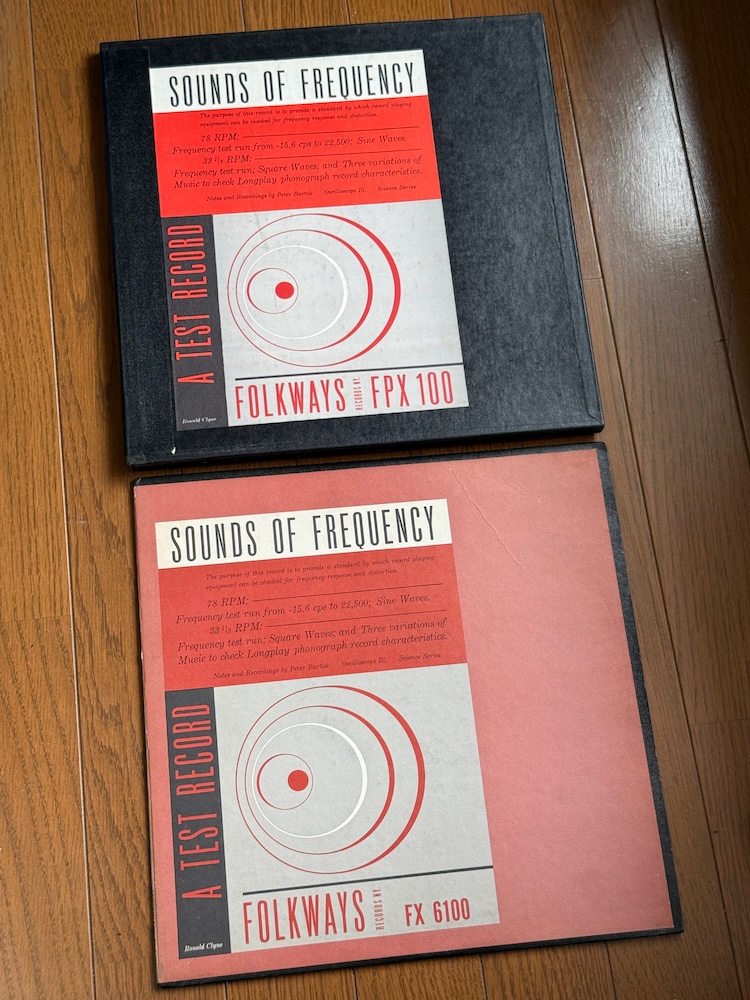
The focus of this page is the last three tracks of Side B. On FPX-100 they are Band 9 / Band 10 / Band 11, and on FX-6100 they are Band 8 / Band 9 / Band 10. They contain the same performance of "Mikrokosmos Suite" Piece No. 8 (Sixth Dance in Bulgarian Rhythm) arranged by Bartók-Serly, cut with three different recording curves:
- Band 9 (Band 8 on FX): 500 cps turn-over, no preemphasis (Band 10 without HF preemphasis)
- Band 10 (Band 9 on FX): 500 cps turn-over, preemphasis starting from 2,000 cps (equivalent to the 1954 RIAA curve)
- Band 11 (Band 10 on FX): 630 cps turn-over, preemphasis starting from 1,600 cps (the so-called "Bartók curve")
Note that the liner notes describe these characteristics in rounded frequency values (cps) rather than the precise time-constant notation that became standard later (75 µs = 2,122 Hz, 100 µs = 1,591 Hz).
2. Peter Bartók's own explanation in the liner notes
The Side B notes of FPX-100 / FX-6100 close with the following statement, written by Peter Bartók himself:
"From bands 9, 10 and 11 it should be evident that the loudest is Band 11, thus the advantage of the long-playing characteristics are proven. (The choice of recording characteristics is made with the purpose of finding one that will make it possible to record with the highest volume without overcutting at low frequencies and without creating excessive distortion at high frequencies.)
No sample of a completely 'flat' characteristics was included inasmuch as this would have been rather soft and only bass notes would have been heard."
— Liner notes of Sounds of Frequency (Folkways FPX-100 / FX-6100, 1954), end of Side B notes, written by Peter Bartók
In short, Bartók himself positions Band 11 (630 cps turn-over / 100 µs preemphasis) as the best choice for long-playing characteristics, and explains the choice in cutting-optimization terms: avoiding low-frequency overcutting, suppressing high-frequency distortion, and maximizing recording volume.
A noteworthy detail: Bartók explicitly labels Band 10 as "(RIAA curve)". In 1954 — the very year the RIAA standard was formalized — Bartók was already treating the 630 cps proposal and RIAA as two parallel options, and on top of that promoted 630 cps on the grounds of "the advantage of long-playing characteristics."
629 vs. 630: variant notation by Bartók himself
The turn-over frequency of the so-called "Bartók curve" appears in two forms — 629 cps and 630 cps. This is not a rounding error in the sources; it is documented that Bartók himself used both values:
- 630 cps: 1954 Folkways FPX-100 liner notes, Band 11 description (quoted in this section)
- 629 cps: The back of the BR-918 (1954) jacket on the Bartók label, which Bartók himself founded, states
"Recording characteristics: turn-over frequency — 629 cps. preemphasis 16 db, at 10 kc."See Pt.17 §17.5.7 for details.
Numerically, 629 cps ≒ 253 µs and 630 cps ≒ 253 µs — the same curve up to rounding error. This page respects the historical fact that Bartók himself used both notations and uses both as appropriate to context.
Consistency with the later interview
In a later audioXpress interview, Bartók discusses only the RIAA curve (500 Hz / 75 µs): "the turnover would become 500 cycles [Hz], and the high-frequency pre-emphasis begins at [2,122] cycles [Hz], that was the RIAA curve." He does not mention 630 cps.
This is not a contradiction — the interview describes mastering practice after the industry had converged on RIAA, so the period referenced is different. The 1954 FPX-100 was made in the very year RIAA was formalized, when the 630 cps proposal and RIAA still coexisted as parallel options. Bartók's preference for 630 cps as discussed on this page should be understood as a record of that 1954 transitional moment.
100 µs preemphasis was considered "excessive" in NAB/NARTB discussions
The phrase "without creating excessive distortion at high frequencies" at the end of the quote is a curious statement when set against the contemporaneous industry context. In the NAB/NARTB Recording and Reproducing Standards Committee (RRSC) discussions, 100 µs-class high-frequency preemphasis (16 dB at 10 kHz) was repeatedly flagged as a concern — for cutter-head overload and tracing distortion — and the RIAA curve approved in 1954 ultimately settled on the gentler 75 µs (≈ 13.6 dB at 10 kHz). Bartók's adoption of 100 µs in the same year, with the claim that it produces no excessive high-frequency distortion, runs against the industry's mainstream judgment.
That said, it is worth considering how much high-frequency content the recording technology of 1954 was actually capturing in the first place. Measuring the long-term average spectrum (LTAS, an averaged frequency spectrum over an extended time window) of Band 10 on this record (cut at RIAA, used here as a proxy for the source material), the high-frequency components are recorded at substantially lower levels than the midrange: relative to 1 kHz, 10 kHz sits at −29 dB and 15 kHz at −43 dB.
Measuring Decca LXT 2529 (recorded 1948, van Beinum / Concertgebouw Orchestra, Bartók's Concerto for Orchestra) with the same method gives a high-frequency distribution that matches Band 10 above 1 kHz to within 2 dB. By contrast, Mercury Living Presence SR-90179 (recorded 1958, Doráti / Philharmonia Hungarica Orchestra, Bartók's Two Romanian Dances Sz.43) retains roughly 8 dB more high-frequency energy at 10 kHz and 18 dB more at 15 kHz — showing that, even within the same composer's orchestral repertoire, the 1958 wide-band recording captures considerably more high frequencies than recordings from 1948-1954.
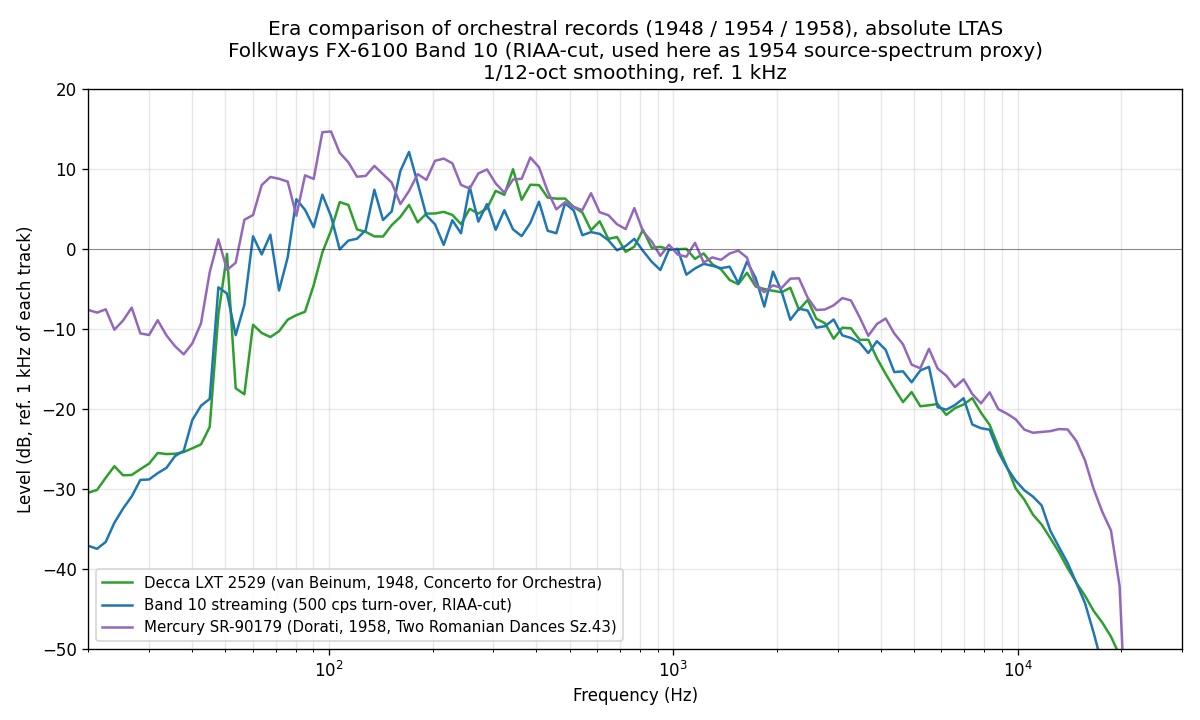
In other words, given the recording technology and source material of 1954, even with 100 µs preemphasis the cutter-input headroom at high frequencies was likely substantial, and any resulting distortion may have been practically inaudible (speculation). Conversely, with a wide-band recording like the 1958 Mercury, the same 100 µs preemphasis would significantly erode that headroom. The mid-1950s was a transitional period in which both recording technology and cutting technology were advancing rapidly. The industry's convergence on 75 µs in 1954 — which may not have been strictly necessary if one looked only at the source material then available — can also be read as a forward-looking move that anticipated continued improvements in the recording chain.
Bartók himself did not specify the bass shelf
For the so-called "Bartók curve," the turn-over (= the lower roll-off corner of the midrange, 629 / 630 cps) and the high-frequency preemphasis (16 dB at 10 kHz, ≈ 100 µs time constant) are explicitly stated. However, the "bass shelf" — the low-frequency point where the curve flattens out (in RIAA terms, the 3,180 µs ultra-low-frequency corner) — is not explicitly stated by Bartók himself:
- The Side B notes of the FPX-100 / FX-6100 liner notes quoted in §2: only turn-over and high-frequency preemphasis
- The back of the BR-918 jacket on the Bartók label: only
"turn-over frequency — 629 cps. preemphasis 16 db, at 10 kc." - The later audioXpress interview: only the RIAA curve is mentioned; the low end of the Bartók curve is not discussed
Consequently, the complete definition of the "Bartók curve" was not documented as of 1954, and one cannot determine — from Bartók's own statements alone — where the bass shelf should sit when the record is played back today.
Later research suggests an answer in two stages. First, regarding the original pressings on the Bartók label that Bartók himself founded, the Audacity Team's "Playback equalization for 78 rpm shellacs and early 33⅓ LPs" classifies BRS 301-307 / 309 / 906-920 as 630C-16 (= turn-over 630 cps / "C" bass shelf / 16 dB at 10 kHz). The "C" denotes the same 1,590 µs bass shelf as the Columbia LP curve.
The source material for "Mikrokosmos Suite" Piece No. 8 on FPX-100 / FX-6100 originally comes from Bartók Records BRS 303 (recorded 1950), which falls precisely in the 301-307 group. So the original BRS 303 pressing on the Bartók label is presumed to have been cut as 630C-16.
By contrast, for the Band 11 re-cut on FPX-100 / FX-6100, the §3 LP-transcription LTAS measurements give a different clue. If Band 11's bass shelf were "C" (1,590 µs), then when played back through standard RIAA equalization, the level near 50 Hz would be predicted to come out a few dB higher than Band 10 (= RIAA, "R" = 3,180 µs) — because the C curve flattens at 100 Hz, so below that frequency the RIAA playback over-compensates. In the actual §3 LP-transcription measurements, however, Band 11 sits about −3 dB below Band 10 at 50 Hz, which is roughly explained by the turn-over difference between 500 cps and 630 cps alone (theoretical −2 dB at 50 Hz). If Band 11 had a C shelf, the deviation would be expected in the opposite direction — higher than Band 10 at 50 Hz, exceeding what the turn-over difference predicts — but the measurement does not show that.
The natural reading of the LTAS analysis, then, is that when Peter Bartók re-cut the material as FPX-100 / FX-6100, he aligned the bass shelf with RIAA as well, cutting at the equivalent of "630R-16" (= 630B-16) — a reasonable choice given that FPX-100 was a test record intended for playback through a standard RIAA-correcting reproducer.
The §3 LP-transcription measurements also show that the difference between Band 10 and Band 9 (both with 500 cps turn-over) is essentially zero at 50 Hz, suggesting that Band 9's bass shelf is shared with Band 10. Reading Band 9's liner-note description ("500 cps turn-over, no preemphasis", i.e. Band 10 with the high-frequency preemphasis removed) at face value, it is natural to conclude that Band 9's bass shelf is also the same "R" or "B" (3,180 µs) as Band 10.
3. What measurement reveals: LTAS of the digital release and the LP transcription
While the original FPX-100 / FX-6100 pressings are scarce, Smithsonian Folkways has digitized and released the source material as "Science Series: Sounds of Frequency". Listening to the digital release alone is enough to experience the differences among the three curves to a fair degree, but quantitative measurement reveals an interesting observation that does not quite match what one would naively predict from the three curves described in the liner notes.
Digital release LTAS: Band 11 closely resembles Band 10
The author purchased the FLAC version (44.1 kHz / 16 bit) directly from Smithsonian Folkways and computed the LTAS of Band 9 / 10 / 11 (Track 23 / 24 / 25 on the FX-6100 digital release) with 1/12-octave smoothing. Differences relative to Band 9 are as follows (selected frequencies, dB):
| Frequency (Hz) | Band 10 − Band 9 | Band 11 − Band 9 | (Band 11 − Band 10) |
|---|---|---|---|
| 50 | −1.21 | −1.40 | −0.19 |
| 100 | −1.12 | −1.11 | +0.01 |
| 500 | −0.77 | −0.83 | −0.06 |
| 2,000 | +2.16 | +2.27 | +0.11 |
| 5,000 | +8.14 | +8.69 | +0.55 |
| 10,000 | +13.56 | +14.00 | +0.44 |
| 15,000 | +10.50 | +10.93 | +0.43 |
Band 10 − Band 9 at +13.56 dB @ 10 kHz closely matches the theoretical RIAA 75 µs preemphasis value of +13.6 dB, consistent with the §1 / §2 description that Band 9 is Band 10 with the high-frequency preemphasis removed.
For Band 11, however, the picture is different. If "the Bartók curve" (100 µs preemphasis, 16 dB at 10 kHz) had been applied as documented, Band 11 − Band 9 would be expected to come out around +16 dB at 10 kHz, i.e. about +2.4 dB higher than Band 10. The measurement gives Band 11 − Band 10 ≈ +0.44 dB @ 10 kHz, almost no difference. On the digital release, Band 11's curve is essentially indistinguishable from Band 10 — that is, from RIAA.
This does not match the liner-note description. Looking at the digital release alone, the effect of the Bartók curve is barely observable. Why?
Verification via LP transcription
To probe this question, the author made an LP transcription of an original FPX-100 pressing through the following chain and compared the result against the digital release:
- Turntable: Michell Engineering Orbe SE
- Tonearm: SME Series IV
- Cartridge: Hana MH (MC, stereo, Microline stylus)
- Phono preamp: Musical Surroundings SuperNova II (RIAA equalization)
- Preamp: Benchmark LA4
- A/D converter: KORG DS-DAC-10R
- Recording app: KORG AudioGate 4 (24 bit / 96 kHz / stereo)
Since a stereo cartridge is being used to play a mono record, L and R were summed ((L+R)/2) to cancel vertical-axis noise (eccentricity, light scratches, and similar artifacts).
The figure below places the digital release and the LP transcription side by side.
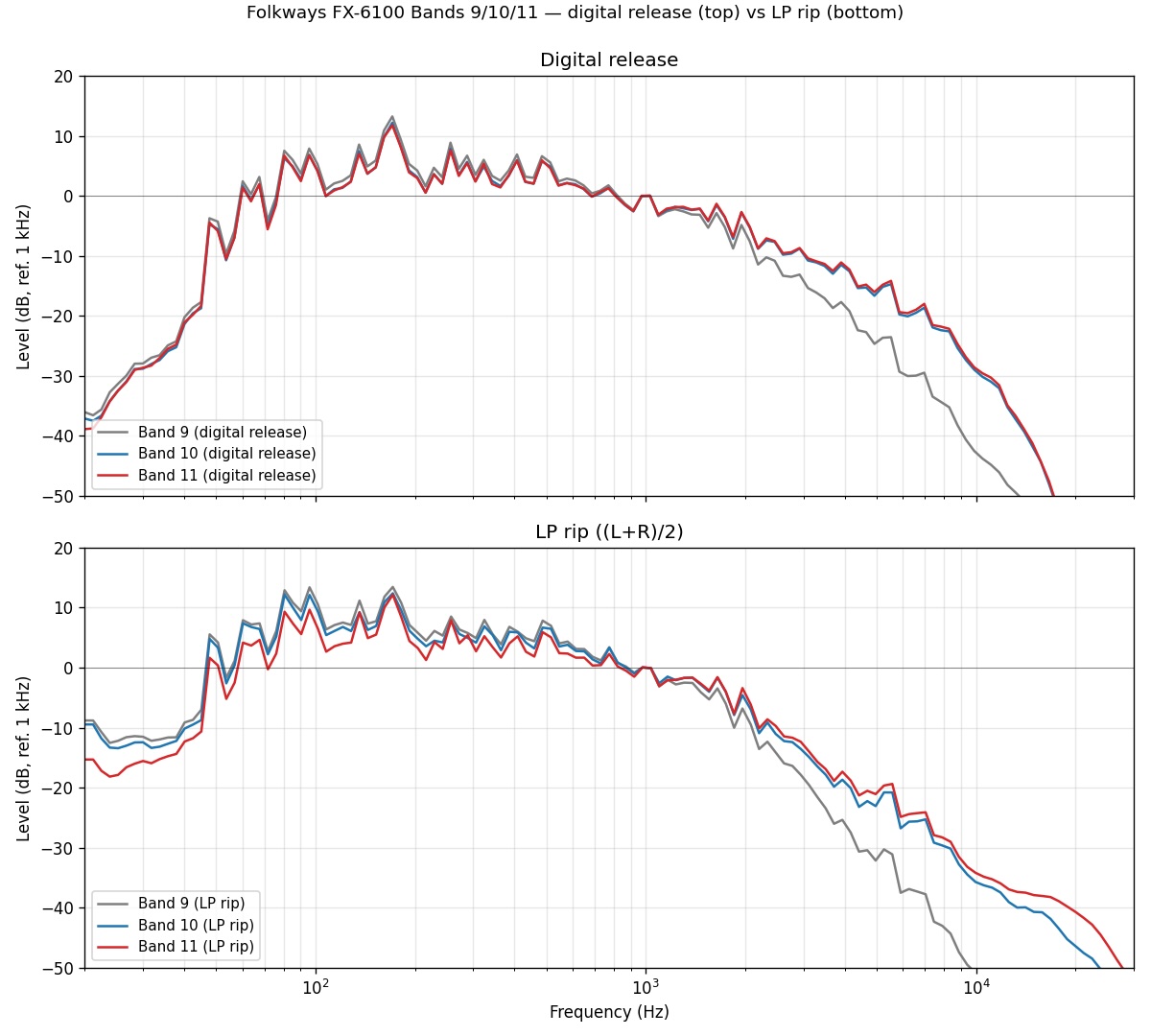
LP-transcription difference values (relative to Band 9, dB):
| Frequency (Hz) | Band 10 − Band 9 | Band 11 − Band 9 | (Band 11 − Band 10) |
|---|---|---|---|
| 50 | −0.84 | −3.84 | −3.00 |
| 100 | −1.20 | −3.95 | −2.75 |
| 500 | −0.87 | −1.92 | −1.05 |
| 2,000 | +2.32 | +3.37 | +1.05 |
| 5,000 | +9.13 | +11.01 | +1.88 |
| 10,000 | +15.16 | +16.68 | +1.52 |
| 15,000 | +13.62 | +16.41 | +2.79 |
The LP transcription tells a different story:
- Band 10 − Band 9 behaves essentially the same as on the digital release (+15.16 dB at 10 kHz here, +13.56 dB on the digital release; both consistent with RIAA 75 µs preemphasis)
- Band 11 − Band 10 shows a clear high-frequency difference of +1.5 to +2.8 dB (close to the theoretical +2 dB). At the bass end, Band 11 sits −2 to −3 dB below Band 10, consistent with the turn-over difference 500 → 630 cps (theoretical −2 dB at 50 Hz)
- In other words, the LP carries the difference between Band 11 (Bartók curve, 630 cps + 100 µs) and Band 10 (RIAA curve, 500 cps + 75 µs) faithfully — both at the high-frequency end and at the bass end
Sorting out the observations: the author's inference
Putting the observations together:
- Physical fact: The LP transcription preserves the EQ difference between Band 11 and Band 10 (Bartók 100 µs preemphasis + 630 cps turn-over) as theoretically expected
- Absence of LP-transcription artifacts: The author's listening test does not pick up surface noise, scratch noise, or eccentric wow/flutter on the digital release — none of the artifacts characteristic of an LP transcription
- Asymmetry hard to motivate by editing: If the digital release had been deliberately edited so that Band 10 and Band 11 were aligned, it is hard to see why Band 9 would be left as a separate, preemphasis-removed track — the asymmetry has no obvious editorial motivation
From these three points, the author considers the most plausible reading to be that the digital release is a direct transfer from the cutting master, and that the difference between Band 10 and Band 11 only arises at the moment of LP cutting, when the EQ is physically switched on the cutting amplifier. The detailed hypothesis about the production process is laid out in §5.
As an additional supporting fact, FPX-100 / FX-6100 were cut by Peter Bartók himself: the dead wax on both records carries the combined "P + B" stamp known as Peter Bartók's cutting signature.
That said, this remains the author's inference based on observation. Definitive confirmation would require primary sources (production notes from Folkways, a statement from Peter Bartók, or similar).
4. How to listen
Where to obtain the album:
- Smithsonian Folkways direct sales: FLAC or MP3 download available at folkways.si.edu/science-series-sounds-of-frequency/nature/album/smithsonian
- Apple Music: streaming on the album "Science Series: Sounds of Frequency" (Smithsonian Folkways)
Tracks of interest: The digital release follows the FX-6100 structure (10 tracks on Side B), with Track 23 / 24 / 25 corresponding to FPX-100 Band 9 / 10 / 11 (FX-6100 Band 8 / 9 / 10). The same Bartók-Serly arrangement of "Mikrokosmos Suite" Piece No. 8 (Sixth Dance in Bulgarian Rhythm) is recorded back-to-back with three different curves.
What to listen for:
The first cue when comparing the three tracks by ear is, as Bartók himself anticipates in the liner notes, loudness and tonal balance. Played back through standard modern RIAA equalization, the three tracks sound as follows:
- Track 23 (FPX-100 Band 9 / FX-6100 Band 8, 500 cps turn-over / no HF preemphasis): With no high-frequency preemphasis, the high end is more subdued and the overall level is somewhat softer than the other two
- Track 24 (FPX-100 Band 10 / FX-6100 Band 9, ≈ RIAA): Cut at the RIAA curve, so it sounds the closest to a flat balance when played back through modern RIAA equalization
- Track 25 (FPX-100 Band 11 / FX-6100 Band 10, the Bartók curve): With 100 µs (= from 1,600 cps) high-frequency preemphasis, it should sound the brightest and loudest of the three, following Bartók's own statement quoted in §2 that "the loudest is Band 11" (although, as shown in §3, on the digital release Track 24 and Track 25 sound at roughly the same level and tonal balance)
Listening through the three tracks back-to-back, you can directly experience how dramatically the same performance shifts in loudness and tonal balance. As an "EQ curve difference confirmable by ear", this is hard to substitute for.
That said, identifying the curve of an unknown record by ear alone is a separate question from what this page covers. Hearing is highly sensitive to changes in loudness and tonal balance, but it is not a reliable means of identifying a specific curve with 100 % accuracy. The most honest way to read this page is in the order objective documentation in the liner notes first, then differences confirmable by ear.
5. How were the three curves made? (the author's hypothesis)
From the observations in §3 and the established fact that Peter Bartók himself cut FPX-100 / FX-6100, the author proposes the following hypothesis ("Hypothesis A" hereafter):
Bands 9, 10, and 11 share a single source on the master tape, and Peter Bartók produced the three different bands by physically switching the turn-over and high-frequency preemphasis on the cutting amplifier during LP cutting.
The Peter Bartók cutting workshop as background
Peter Bartók (1924-2020) was the son of composer Béla Bartók and ran his own Bartók Records label (founded 1947), through which he handled the recording and cutting of his father's works. The source material for "Mikrokosmos Suite" Piece No. 8 on FPX-100 / FX-6100 originates from Bartók Records BRS 303 (recorded 1950). From his Bartók-label years onward, cutting the same material with different EQs was a routine part of Peter Bartók's everyday workshop practice. Producing an educational test record like FPX-100 / FX-6100 would have been entirely natural in his hands.
The complete EQ structure of FPX-100 Side B
The complete Side B structure of FPX-100, based on the liner notes:
| Band | Content | EQ during cutting |
|---|---|---|
| 1 | 100 cps square wave | 500 cps turn-over, no preemphasis |
| 2 | 1,000 cps square wave | (not stated, presumed same as Band 1) |
| 3 | 16 kHz + 60 cps amplitude modulation | 630 cps turn-over, preemphasis from 1,600 cps |
| 4 | 8 kHz + 60 cps amplitude modulation | same as above |
| 5–8 | various test tones | 630 cps, preemphasis from 1,600 cps |
| 9 | Mikrokosmos Suite | 500 cps turn-over, no preemphasis |
| 10 | same | 500 cps turn-over, preemphasis from 2,000 cps (= RIAA 75 µs) |
| 11 | same | 630 cps turn-over, preemphasis from 1,600 cps (= 100 µs) |
Square-wave tests (Band 1-2) and steady-state checks (Band 3-8) use different EQ lines depending on purpose. This is corroborating evidence that "cutting the same material with different EQs" was routine in Peter Bartók's workshop. Splitting Mikrokosmos Suite into three EQ versions across Band 9 / 10 / 11 was, by extension, not a special operation.
The second pressing FX-6100 is restructured into a 10-track Side B layout: Band 1-2 (square waves, no preemphasis) and Band 3-4 (the same square-wave material cut with preemphasis from 2,000 cps, i.e. the RIAA preemphasis) form an opening pair, followed by Band 5-6 (16 kHz / 8 kHz sine waves with 60 cps AM), Band 7 (multi-frequency check tones), and Band 8-10 (Mikrokosmos Suite × three EQs). The original FPX-100 Band 3-4 (sine waves with AM, Bartók EQ) is dropped here, and a square-wave RIAA-preemphasis pair takes its place.
The "cut the same material with multiple EQs" pattern is thus made explicit in FX-6100 in both the square-wave tests (Band 1-2 vs Band 3-4) and the Mikrokosmos Suite (Band 8-10). The end of the Side B notes on the FX-6100 jacket reads "Recorded by Peter Bartok", documenting once again that this pressing too is from Peter Bartók's cutting work.
Comparison with an alternative (Hypothesis B)
A plausible alternative production process would be to pre-apply the differential EQ for each of the three tracks on the master tape, while cutting all of them through a single fixed EQ ("Hypothesis B" hereafter). If Hypothesis B were correct, the EQ differences for the three tracks would be preserved through tape → cutting → digitization, so the digital release would also show the EQ difference between Band 10 and Band 11. Since the measurement shows that difference essentially vanishing on the digital release, Hypothesis B does not fit the §3 LTAS observations.
By contrast, Hypothesis A is consistent with all three observations from §3 (EQ differences inscribed on the LP / no LP-transcription artifacts on the digital release / asymmetry hard to motivate by editing).
Confirmation by primary sources is left for future work
To repeat: the hypothesis presented on this page is the author's inference based on observation and logical consistency. Confirmation through primary sources (Folkways production notes, statements by Peter Bartók himself, etc.) is left for future work. If any reader has related information, please contact the author.
Revision History
- April 30, 2026: Initial publication