Why did phono EQ curves converge on the RIAA standard? A 100-year history from primary sources
The History of Phono EQ Curves
Your phono equalizer plays records according to a standard called "RIAA." But do you know why it's called "RIAA," or whether other standards ever existed?
Follow the thread, and it leads all the way back to the dawn of electrical recording in the 1920s. How did EQ curves — once different for every label and every era — converge into a single standard? That history is not as distant from today's record playback as you might think.
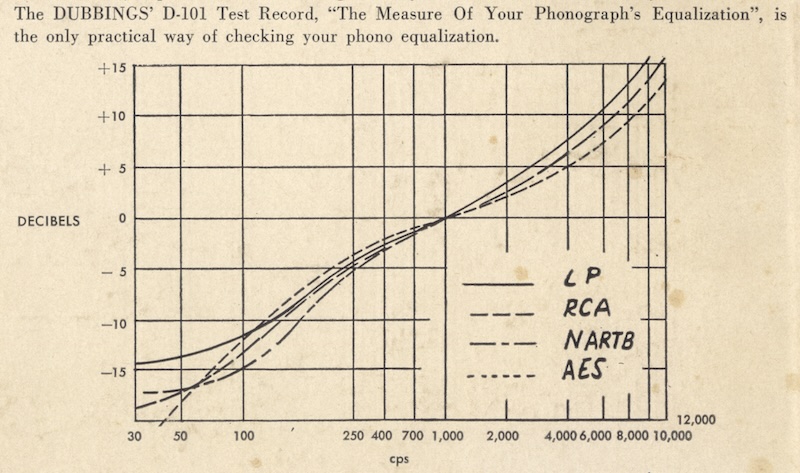
from my own collection
What kind of reader are you?
I want the big picture first (approx. 15–20 min)
What is an EQ curve, why was it needed, and how was it standardized? A century of history, condensed into three standalone parts.
→ Read the history in brief (In a Nutshell)
I'm looking for a specific answer (3–8 min per topic)
"What is the RIAA curve?" "How should I play pre-RIAA records?" Common questions answered one page at a time.
I want all the details
The complete record of over two years of research. Written from primary sources — Bell Labs technical documents, patents, AES papers, and more — across 25 installments plus a prologue.
→ Overview and reading guide for "Things I learned on Phono EQ curves"
Recent updates
- September 10, 2026
- ✏️ Are U.S. stereo LPs recorded with RIAA, or with per-label EQ curves? — Added Evidence 6, "the industry standard and direct statements by the parties involved" (RIAA Bulletin E3; Bachman, Bauer, and Goldmark, 1962), and renumbered the former Evidence 6 and 7 as 7 and 8. Corrected Evidence 5 against the primary source (Roys 1977): Roys's position (member of the RIAA Engineering Committee, chairman of EIA Committee R 7); the September 5, 1957 demonstration was private, with the public demonstration at the AES convention on October 11; Bachman called for the vote at the EIA meeting of January 21, 1958, not at the RIAA Board on March 25. Added the Board meeting of February 7 and the compatible disc demonstration of March 17 to the chronology
- September 3, 2026
- ✏️ How generative AI is used in producing this site — what AI handles, and what it does not — Added Claude Fable 5.1 to the model timeline
- July 25, 2026
- ✏️ How generative AI is used in producing this site — what AI handles, and what it does not — Added Claude Opus 5 (released July 25, 2026) to the model timeline and closed the date ranges for models no longer in use. Updated the cross-review trio to Claude Fable 5, Claude Opus 5, and Codex/GPT-5.6 Sol. Added the practice of deciding model switches by measurement to the quality control list
- July 2, 2026
- ✏️ How generative AI is used in producing this site — what AI handles, and what it does not — Reflected Claude Fable 5's reinstatement (available again July 1, 2026) and its resumed use in this site's production in the model timeline. Noted the adoption of Claude Sonnet 5 (released June 30, 2026) into the default cross-review lineup
- June 30, 2026
- ✏️ How generative AI is used in producing this site — what AI handles, and what it does not — Updated the model timeline. Expanded the cross-review description to cover Japanese and English drafting/review in addition to design judgments, reflecting the three-model independent drafting and cross-review workflow. Added AI tell detection/correction skills to the quality control list
- ✏️ Reading guide for the blog series 'Things I Learned on Phono EQ Curves' (25 parts plus a prologue) — Added Liner Notes II (II-a / II-b / II-c) and Liner Notes III
- June 14, 2026
- 🔔 Newly published: Can EQ curve differences be measured objectively?
- June 2, 2026
- ✏️ Rudy Van Gelder's cutting equipment and EQ curves — what the equipment records and his own testimony tell us — Added the full term ("long-term average spectrum") at the first mention of "LTAS".
- ✏️ What cutting curve did Rudy Van Gelder use before installing his Gotham (1953 to early 1955)? — Added the full term ("long-term average spectrum") at the first mention of "LTAS". Rewrote the "Current confidence and remaining means of verification" bullet list to separate pre-Gotham and Gotham-era points and to give context to the "AES at Hackensack" mention. Replaced the example for the earliest deadwax-traceable RVG cut from PRLP-142 to PRLP-180, and added the criteria used to identify RVG cuts on Prestige 10-inch LPs.
- ✏️ Where is Rudy Van Gelder's "sound" actually made? — Recording- and mastering-stage sound shaping — Added the full term ("long-term average spectrum") at the first mention of "LTAS".
About this content
This section (this page, In a Nutshell, the FAQ, and Research Notes) was built on the content of the blog series, with Claude Code (Anthropic) used as an aid for structuring and drafting. Codex (OpenAI) is also used alongside Claude Code, as a sub-agent for close reading of primary sources. Responsibility for factual accuracy and final editorial judgment rests with the author.
→ How is generative AI used in producing this site?
The blog series (Pt.0–Pt.25) on the parent site was researched and written by the author over more than two years, drawing on primary sources — circuit diagrams, technical documents, academic papers, industry journals, patents, and more — examined by hand.
Wherever possible, "established facts" and "the author's interpretation or conjecture" are explicitly distinguished throughout the text.
Start with a popular FAQ
- What is the RIAA curve?
- Can you hear a difference when you change the EQ curve?
- How should I play pre-RIAA records?
- EQ curve vs. mastering — which determines the sound?
- Are all U.S. stereo LPs on the RIAA curve?
Revision History
- April 17, 2026: Minor revision to the summary
- April 17, 2026: Updated the "About this content" section (explicitly mention Codex as a companion tool; detailed model names consolidated into how-generative-ai-is-used)
- April 10, 2026: Added a "Recent updates" section that aggregates revision history from child pages
- April 9, 2026: Minor wording fix
- April 8, 2026: Initial publication