What sources did I use for this research? — an overview of primary sources over two years
What sources did I use for this research?
What this page answers: What kinds of sources did I use to investigate the history of phono EQ curves? Where should you start reading?
Sources encountered over two years of research
I spent over two years investigating the history of phono EQ curves, documenting the results in a 25-part article series. The sources I consulted ranged widely: technical books, histories, academic papers, back issues of trade magazines, interview transcripts with key figures, patent documents, circuit diagrams and equipment manuals, product catalogs, and online articles.
The final installment of the series (Pt.25, section 25.14) contains a curated list of the most useful sources. Here, I introduce the full landscape across ten categories.
1. Technical reference books
Specialized books on acoustics, analog electronics, and disc recording and reproduction technology. These span roughly a century of accumulated knowledge, from early 1920s literature to editions published in the 2020s.
Highlight: Oliver Read, The Recording and Reproduction of Sound (2nd edition, 1952) is a comprehensive guide to recording and playback technology written just before the LP and EQ curves were standardized — a true witness to its era.
Another essential resource, particularly for the European side, is Peter Copeland, Manual of Analogue Sound Restoration Techniques (British Library, 2008). Copeland, a former BBC engineer and conservation manager at the British Library Sound Archive, systematically compiled the technical knowledge required for disc record restoration. Chapter 6 in particular documents European disc recording characteristics — including the Blumlein system, the BBC's recording characteristics across different eras, Decca ffrr, CCIR, and DIN — with measured data, making it an indispensable resource for the history of European EQ curves. Note, however, that the manuscript was published posthumously — Copeland passed away in 2006 — and some content contains chronological errors or statements that subsequent research has corrected. Even so, its value as a systematic record of European recording characteristics remains undiminished.
2. Histories and chronologies
Books that trace the history of the record industry, the evolution of technology, the relationships between key figures, and the power dynamics of the business. These are essential for understanding not just how things were done, but why.
Highlight: Oliver Read & Walter L. Welch, From Tin Foil to Stereo (1959) is the classic history of recording technology, tracing the arc from Edison's tinfoil phonograph to the stereo LP.
3. Interviews and autobiographies
First-hand accounts from the people who were there: LP developers, cutting engineers, and recording technicians. Fortunately, several oral history interviews with engineers of the era have been preserved, offering insights that published literature alone cannot provide.
Highlight: The oral history of Columbia Records president Edward Wallerstein (1969, 1976) is an invaluable first-person account of the decision-making behind the LP's development. Read alongside Peter Goldmark's autobiography Maverick Inventor (1973), the same events come into three-dimensional relief from different perspectives.
4. Academic papers and trade magazine articles
This is the category I referenced most heavily. From early papers on electrical recording in the 1920s to articles tracing the technical path toward RIAA standardization, arranging these chronologically reveals the evolution of recording and playback technology in real time.
The journals span Bell System Technical Journal, Journal of the Acoustical Society of America, Audio Engineering (later Audio magazine), RCA Review, and the Journal of the Audio Engineering Society (JAES), among others. Audio Engineering magazine was a distinctive publication that served simultaneously as a general-interest monthly and as an academic journal.
Highlight: J.P. Maxfield & H.C. Harrison, "Methods of High Quality Recording and Reproducing of Music and Speech Based on Telephone Research" (Bell System Technical Journal, 1926) is the landmark paper describing the design principles of Western Electric's electrical recording system. It is no exaggeration to say that the history of EQ curves begins here.
Also, Gary A. Galo, "Disc Recording Equalization Demystified" (ARSC Journal, Vol. 27:2, 1996) systematically covers the technical background of disc recording equalization, making it an ideal starting point for modern research on phono EQ curves.
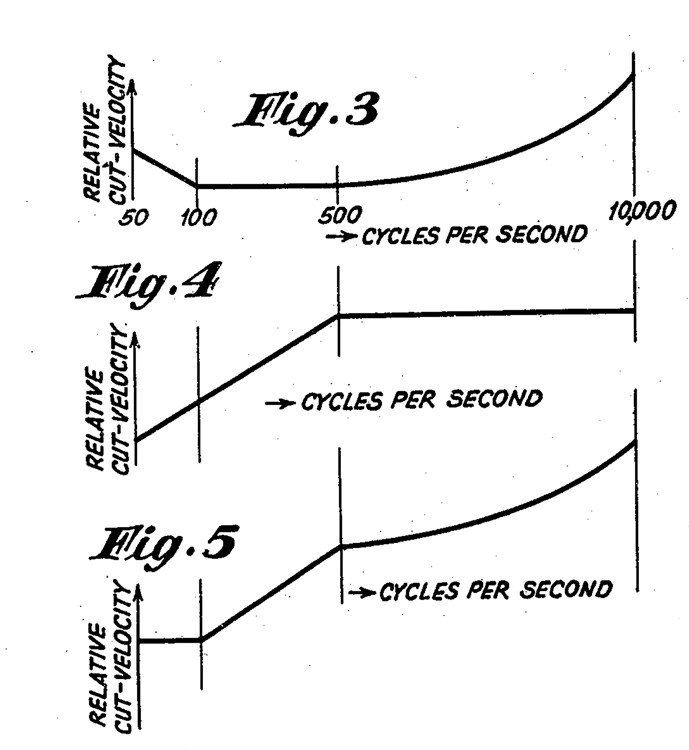
5. Patent documents
Patent documents are an often-overlooked but extremely valuable resource for understanding the development of disc recording and reproduction technology. Patent specifications describe the principles of the technology, differentiate from prior art, and detail the reasoning behind design decisions — sometimes in greater depth than published papers.
Pt.25 focuses primarily on patents filed up to the late 1940s, just before the LP era, but these documents reveal that the fundamental designs for recording heads and equalizer circuits were already well established by that time.
6. Online articles
I also learned a great deal from online articles by others who have explored the same subject. The PsPatial Audio (Stereo Lab) website offers systematic content on the history of recording characteristics, and Michael Fremer's articles on AnalogPlanet ("Decca/London Records Myths Exploded!", "Phono Equalization B.S. Continues!") were valuable for addressing common misconceptions about EQ curves.
The personal website "Analog Record Playback" by the handle yosh has also been a long-term reference. Continuously updated since 2001 (now in its third decade), it explores areas that overlap with this project in depth: meticulous tracing of patent history, careful organization of IEC 98 revision history, and independent measurement data. I became familiar with the site before starting this project and have learned much from the work of this predecessor in the field.
7. Trade magazine back issues
For understanding the industry's developments as they happened, back issues of trade magazines are the most direct source. The publications I referenced most frequently include Audio Engineering (later Audio magazine), Wireless World, Broadcasting (later Broadcasting & Cable), Electronics, RCA Broadcast News, RCA Review, and the NAB Engineering Handbook.
From these pages, I was able to trace the industry debates leading up to EQ curve standardization, specification changes in recording equipment, announcements of new technologies, and their reception — the kind of "events in progress" that rarely make it into books or papers. Reports from the NAB standards committee and the development of the AES Standard Playback Curve, for instance, are documented primarily in trade magazine articles that serve as primary sources in their own right.
Highlight: R.C. Moyer, "Standard Disc Recording Characteristic" (RCA Engineer, Vol. 3, No. 2, Oct.–Nov. 1957) charts the evolution of RCA's disc recording characteristics in five stages and documents that "at least eight different recognized characteristics" were "being used or to be considered during the early 1950's." It is a valuable insider account that describes the development of New Orthophonic (identical to RIAA) as a compromise between the interests of record companies and phonograph manufacturers.
8. Circuit diagrams, manuals, and service documentation
Circuit diagrams, instruction manuals, and service manuals for recording and playback equipment are decisive resources for understanding what characteristics were actually used in recording and reproduction.
From the circuit diagrams of cutting amplifiers and phono equalizers, it is possible to determine the equalization topology (LCR, CR, or negative feedback) and the designed turnover and rolloff values. Instruction manuals for consumer amplifiers, with their labeled EQ positions and corresponding curves, serve as evidence of which curves were recognized in the market at the time.
These materials are too voluminous to include in the Pt.25 reference list, but individual pieces of equipment are discussed in detail throughout the series.
9. Product catalogs
Tracing product catalogs for recording equipment and consumer audio gear by era and by manufacturer reveals the spread of technology and shifts in the market in concrete terms.
For example, comparing consumer amplifier catalogs from the late 1950s year by year shows how models with multiple EQ curve selector positions gradually disappeared, replaced by RIAA-only units. The Allied Radio catalogs were particularly useful for tracking this transition (see Pt.22).
Similarly, catalogs from cutting equipment manufacturers confirm that recording equipment designed after the RIAA standard was established was built with RIAA as a given.
10. Japanese-language resources
Most of the sources listed above are in English. For readers who can read Japanese, the following resource provides an excellent starting point for grasping the full picture.
Recommended: Takeaki Anazawa, "Systematic Report on Analog Disk Record Technology and the Status of Existing Materials" (National Museum of Nature and Science Technical Systematization Survey Report, Vol. 21, March 2014). This official technical history report published by the National Museum of Nature and Science covers the entire span of analog disk record technology — from Edison's mechanical recording through LP, stereo, manufacturing processes, standards, and surviving artifacts — in a single volume. It is the definitive Japanese-language overview of the field.
See the full list
What I have introduced here is only a small selection from each category. The full curated list is published in the final installment of the series:
→ Pt.25, section 25.14 — Notable References
Revision History
- June 1, 2026: Added "Analog Record Playback" by yosh to the Online articles section
- May 17, 2026: Added figure (patent document Fig.3+4+5 showing the Orthacoustic recording equalizer response)
- April 11, 2026: Added Copeland (2008) to technical references and Moyer (1957) to trade magazines
- April 11, 2026: Added Japanese-language resources section
- April 9, 2026: Initial publication