Are LCR and RC phono equalizers fundamentally different?
Are LCR and RC Phono Equalizers Fundamentally Different?
The question this page answers: Phono equalizers are referred to with terms like "LCR type" and "RC type." Is this a difference in the time constants themselves, or only in the details of the physical implementation that realizes the same target curve? This page sorts out the essence of the difference, and defers the deeper question of "what happens when you cascade them" to a sister FAQ.
A note up front
This page does not set out to settle which curve to play records back with. This FAQ assumes the same RIAA curve as defined by the three time constants 75 / 318 / 3180 μs. The difference is not in "the time constants themselves" but in "the physical-implementation circuit topology that realizes those time constants."
To preview the discussion:
- Mathematically, first-order elements with the same time constant (an L/R parallel and a C/R parallel) are completely equivalent
- Differences emerge when an implementation involves a second-order section, or when first-order implementations have different stage configurations (i.e., different ways of integrating into an active circuit)
- However, looking only at the frequency response (amplitude), regardless of the categorical name, the target curves are designed to follow the standard
This is a separate topic from "whether you can hear it", and it is also independent of the curve-disagreement debate.
1. As first-order systems, LR and RC are equivalent
Here, "first-order system" refers to a simple circuit described by a single time constant τ (no resonance point). A "second-order system" is one that includes resonance, such as an LC tank.
If the time constant τ is the same, an L/R parallel and a C/R parallel give the same first-order transfer function. Their amplitude and phase responses match completely from 20 Hz to 20 kHz. The same holds for L+R series and C+R series.
Therefore, as long as an EQ curve is described as a combination of three time constants (poles and zeros), it defines the same curve in the standards document whether you write it in LCR language or in RC language. This point is detailed on a separate page, When did the standards documents change their wording for the time constants from LCR to all-RC?.
In other words, the LCR-vs-RC dichotomy does not determine the mathematical content of the standard. Differences emerge in the details of physical implementation, away from the standard itself.
2. Cases where implementations diverge
There are two broad categories.
2.1 When a second-order LCR appears
If an implementation includes inductors and contains a second-order section such as a parallel LC tank, resonance points appear that cannot be reproduced by a sum of first-order sections. The Orthacoustic Compensator for the RCA Victor cutting chain, documented in the 1940 RCA Master Reference Book SECTION II (an internal RCA Victor document), contained two parallel LC tank stages and exhibited a second-order response with resonance points around 407 Hz and 8.16 kHz.
When a record cut by such an implementation is played back through a first-order RC phono preamp, residuals remain in both amplitude and phase around the resonance points. This is not a question of LCR vs RC notation in the time-constant definition, but a question of whether the implementation is second-order or first-order.
Note that "Orthacoustic" originally refers to the target frequency-response curve itself, and within the same RCA group of the era, multiple physical circuits realizing it coexisted (the broadcast-station product MI-4916 Orthacoustic Recording Filter and the implementation in the Lynn/Hathaway patent US2286494 are separate lineages). When this FAQ writes "second-order LCR", it refers strictly to the RCA Victor cutting-chain implementation documented on p.79 of the Master Reference Book.
Whether 1950s consumer microgroove LP cutting chains directly inherited this second-order implementation is currently undetermined.
2.2 When the same first-order RC has a different stage configuration
The other case is when the cutting and playback sides are both first-order RC, but they differ in how they are integrated into the active circuit. Historically, at least the following two circuit-topology categories have been used in playback-side phono preamps:
- NF type (active-feedback type): the RC equalizing network is placed inside the negative-feedback loop of a tube (or transistor) amplifier. The Marantz 7C (1958) and Luxman CL35/III (1974) belong here
- CR type (passive-interstage type): the RC equalizing network is inserted between stages. The preamp circuits in the RCA Receiving Tube Manual series (e.g., p.412 of RC-20 (1960)) belong here. RCA consistently recommended this topology in its own official publications across the 22 years from 1953 (Moyer's "Evolution of a Recording Curve" in Audio Engineering magazine) to 1975 (the Receiving Tube Manual series final edition RC-30)
You may wonder why a cascade of first-order RIAA implementations on both ends produces any residual at all. The reason is that each implementation, on top of the RIAA core defined by the three time constants (3180 / 318 / 75 µs), carries circuit-specific additional poles and zeros (originating from finite component performance, interstage interactions, and the like). These additional elements differ from one implementation to another, so cascading the cutting and playback sides does not cancel them completely, and they appear as band-edge residuals.
For details on what differences appear in band-edge amplitude and phase depending on the combination, see the sister FAQ Can a Playback EQ Perfectly Cancel a Cutting EQ?.
3. Looking only at the frequency response, the target curve is the same
The previous sections established the theoretical possibility of residuals due to implementation differences. But when you look at actual implementations only by frequency response (amplitude), each is designed to follow the standard RIAA target curve, and all settle into a range you could roughly call "the same."
The figure below overlays the 1955 RCA Victor LCR-type cutting EQ (rising, red solid) and the 1958 Marantz 7C NF-type playback EQ (falling, blue solid) on a single plot. For comparison, the ideal RIAA preemphasis (cutting side, faint red dashed) and the ideal RIAA deemphasis (playback side, faint blue dashed) are drawn behind them.
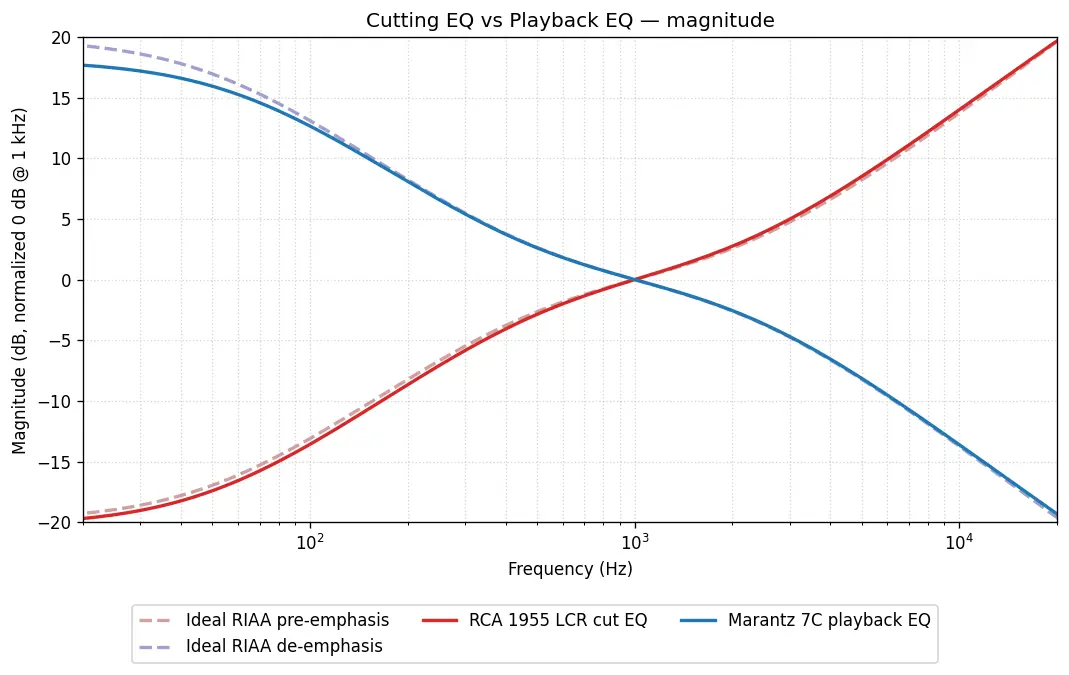
Whether LCR-type or RC/NF-type, both are designed to the same three time constants (75 / 318 / 3180 μs), and representative implementations end up roughly along the standard RIAA target curve.
In other words, the categorical distinction "LCR or RC" does not change the target curve of the standard.
That said, when you look more deeply at "what happens when you cascade the cutting and playback EQs", interesting phenomena appear in the phase response as well as the frequency response. A comparison of various cutting and playback EQs and what the simulation reveals are summarized in the sister FAQ:
- Can a Playback EQ Perfectly Cancel a Cutting EQ?: cascade residuals between cutting and playback EQs, the theory and practice of perfect cancellation, and the essence of the ±2 dB tolerance
Closing
LCR-type and RC-type are different physical implementations approximating the same target curve (RIAA). Looked at by frequency response alone, representative implementations roughly follow the target curve.
When you take the implementation details (presence of second-order sections, differences in stage configuration) into account, you start needing to consider the phase residuals upon cascading and the question of whether a perfectly canceling playback EQ exists. Those are the topics of the sister FAQ Can a Playback EQ Perfectly Cancel a Cutting EQ?.
Revision History
- May 13, 2026: Initial publication