When did the standards documents change their wording for the time constants from LCR to all-RC?
When did the standards documents change their wording from LCR to all-RC?
Question answered on this page: If you read the original text of the 1953 NARTB and 1954 AES (TSA-1-1954) standards, the bass shelf is defined as a "parallel L/R network." But from the 1964 NAB onward — and certainly in the 1978 RIAA Revised — the same time constants are written using only "RC" (capacitance and resistance), and the L/R wording is gone. When did this rewriting happen, and what does it mean?
A note up front
This page is not about which curve to use for playback. The three time constants 75 / 318 / 3,180 μs are identical from the 1953 NARTB standard through the present-day RIAA Revised. What is at issue here is only the language in which the standards documents express those same time constants.
To preview the conclusion: a curve defined as the sum of three first-order terms is mathematically the same curve whether you write it in LCR language or all-RC language (a perfect first-order equivalence — same magnitude response, same phase response). The rewrite did not change the computed curve. What it did affect is an "implicit suggestion" carried by the 1953 wording, which Section 5 takes up.
1. Timeline of the standards documents
| Year | Standard | Definition form | Plot ceiling |
|---|---|---|---|
| 1942 | NAB Recording and Reproducing Standards | Graph only (no time-constant text) | 10 kHz |
| 1945 | NAB Engineering Handbook 3rd ed. §21.1 | Reprint of the 1942 standard, graph only | 10 kHz |
| 1949 | NAB revision | Disc curve unchanged from 1942, graph only | 10 kHz |
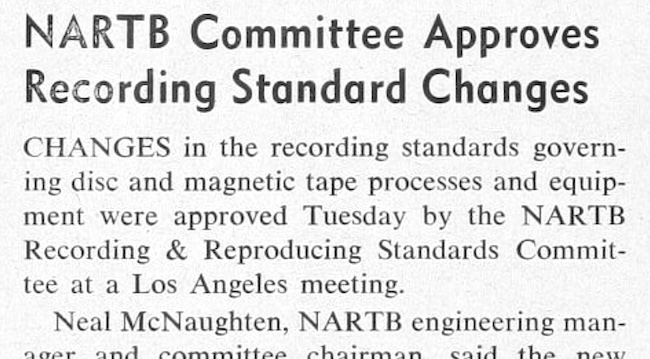
| 1953 | NARTB revision | LCR time constants (L/R parallel + RC series + RC parallel) | 15 kHz |
| 1953/12 | AES "The Proposed AES Disk Standard" (draft, published in JAES) | LCR time constants (RC parallel + RC series + L/R parallel) | 15 kHz |
| 1954/01 | RIAA Bulletin E1 (original) | Not in hand. Graph-only is also possible | Unknown (15 kHz likely) |
| 1954/06 | AES TSA-1-1954 (formally approved) | (same characteristic as the proposed draft) | 15 kHz |
| 1955/05 | B.S. 1928:1955 revision (UK) | Standard text not in hand. In a 1956 Wireless World commentary, fine groove is 75 / 318 / 3,180 μs (RIAA-equivalent) with all three networks described in RC | Unknown |
| 1964 | NAB revision | RC time constants only (no L/R) | 15 kHz |
| 1978 | RIAA Bulletin E1 Revised | RC time constants only | 20 kHz |
Through 1942–1949, the NAB family stayed in a "graph-only" paradigm with no written time constants. Time-constant text first appears in the 1953 NARTB revision and in the AES draft published in JAES in December 1953 (formally approved as TSA-1-1954 in June 1954). Between then and the 1964 NAB / 1978 RIAA, the definitional language was rewritten from LCR to all-RC.
The British Standard 1928:1955, revised in May 1955, adopted 75 / 318 / 3,180 μs for fine groove — the same values as RIAA — but the standard text itself is not in hand. In Wireless World, November 1956, J. D. Smith's commentary on the standard described all three networks in RC (including the 3,180 μs bass shelf), followed in the January 1957 Letters column by an exchange with W. H. Livy of E.M.I. Studios (Abbey Road) who corrected Smith's formulae. This suggests British engineering teaching may already have been using all-RC notation by 1956, although this reflects Smith's commentary rather than the wording of B.S. 1928:1955 itself, which would still need verification from the standard text.
2. The 1953 NARTB / 1954 AES LCR definition (direct quotes)
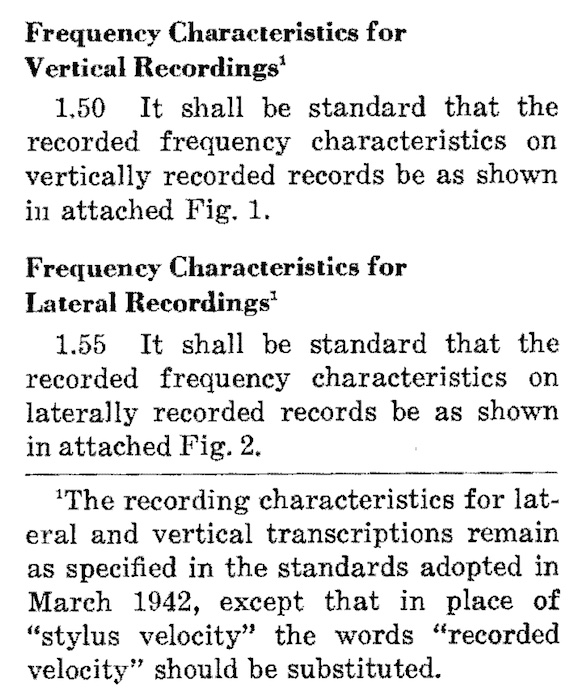
The footnote to the 1953 NARTB standard, §1.55 "Frequency Characteristics for Lateral Recordings," defined the lateral recording curve as follows:
"This curve is defined as the algebraic sum of the ordinates of three individual curves which conform to the admittances of the following three networks expressed in db: a) A parallel L/R network having a time constant of 3180 microseconds. b) A series RC network having a time constant of 318 microseconds. c) A parallel RC network having a time constant of 75 microseconds."
— NARTB Recording and Reproducing Standards, 1953, §1.55 footnote
"The Proposed AES Disk Standard" was published in the Journal of the Audio Engineering Society in December 1953 as a draft (formally approved the following June 1954 as TSA-1-1954, with the same characteristic). It also defined the same three time constants — though in the order RC parallel / RC series / L/R parallel:
"The characteristic curve is defined as the algebraic sum of the ordinates of three individual curves which conform to the impedances of the following networks expressed in decibels (db). Curve I. A parallel combination of a resistor and capacitor having a time constant of 75 µsec. […] Curve II. A series combination of a resistor and capacitor having a time constant of 318 µsec. […] Curve III. A parallel combination of a resistor and inductor having a time constant of 3180 µsec. […]"
— "The Proposed AES Disk Standard," Journal of the Audio Engineering Society, December 1953, §1.2
In both, the bass shelf at 3,180 μs is defined as a parallel network of an inductor and a resistor. The text "L/R" — inductor and resistor — appears in the standard documents themselves. That was the state of the wording in 1953.
3. The 1964 NAB and 1978 RIAA Revised RC definitions (direct quotes)
The 1964 NAB standard defines the reproducing characteristic for the same three time constants as follows:
"Reproducing characteristic — with constant velocity of the reproducing stylus tip the curve of voltage output of the reproducing system versus frequency shall be that which results from the combination of three curves as follows: — one falling with increasing frequency in conformity with the impedance of a parallel combination of a capacitance and a resistance having a time constant of t₁ (75 µsec) — one falling with increasing frequency in conformity with the impedance of a series combination of a capacitance and a resistance having a time constant of t₂ (318 µsec) — one rising with increasing frequency in conformity with the admittance of a series combination of a capacitance and a resistance having a constant of t₃ (3180 µsec)"
— 1964 NAB Audio Recording and Reproducing Standards for Disc Recording and Reproducing, Section III
The November 6, 1978 revised RIAA Bulletin E1, "Statement of Recording Characteristics," likewise uses RC-only definitions:
"With constant voltage applied to that point in the recording chain where the normal signal has the frequency characteristic that it is desired subsequently to reproduce, the curve of recorded velocity versus frequency shall be that which results from the combination of the following three curves: — one rising with frequency in conformity with the admittance of a parallel combination of a capacitance and a resistance having a time-constant of t₁, — one rising with frequency in conformity with the admittance of a series combination of a capacitance and a resistance having a time-constant of t₂, — one falling with rise of frequency in conformity with the impedance of a series combination of a capacitance and a resistance having a time-constant of t₃."
— RIAA Bulletin No. E 1 (Revised: November 6, 1978), "Statement of Recording Characteristics"
All three terms in both documents describe "capacitance and resistance" networks. The "L/R" (inductor and resistor) wording present in the 1953 NARTB and 1954 AES is gone entirely. Additionally, the 1978 Revised version extends the upper frequency ceiling from 15 kHz to 20 kHz, while the 1964 NAB still stopped at 15 kHz.
4. The original 1954 RIAA Bulletin E1 is not in hand
The original 1954 RIAA Bulletin No. E1 (the version on which the 1978 Revised is based, approved by the RIAA Technical Committee on 29 January 1954) is not in our hands. We have not been able to find a copy through AES or ARSC member resources, and as of July 2026 no public report from another researcher confirms holding one.
It therefore cannot be confirmed directly whether the 1954 original used the LCR definition, the RC definition, or — as in the 1942 NAB — only a graph with no written time constants.
The circumstantial evidence from adjacent sources:
- The 1953 NARTB and the 1954 AES (TSA-1-1954) both defined the curve in LCR (see Section 2).
- The 1942 / 1945 / 1949 NAB family stayed in the "graph-only" paradigm with no time-constant text.
- Around 1969, the Westrex RA-1703 cutting-amplifier manual, Appendix C, cites the RIAA curve using the same LCR definition as the 1953 NARTB, lists dB values only up to 15 kHz, and explicitly notes "20 kHz: No Figure Given."
- Shin Nakagawa, a Sony engineer who designed the equalizer of the TA-1120F preamplifier at the time, recalls that as of 1969 only an "approximate table" of the RIAA characteristic was available in the industry.
- McKnight, a central figure in AES standards work, writes in a 1982 retrospective (J. Audio Eng. Soc. 30(4), p.244, April 1982) that AES TSA-1-1954 and the RIAA characteristic of the same year shared the same characteristic, and that the original RIAA document "carries neither an identifying number nor date, but was later identified as 'Bulletin No. E1,' with appropriate revision dates." Since AES TSA-1-1954 is documented to plot only to 15 kHz, the reasonable inference is that the 1954 RIAA document did the same.
- The Japan Standards Association's JIS S 8502 (the disc-record standard itself, formulated October 1956) originally specified the recording frequency range as 30 to 15,000 Hz. The 1973 revision that extended this range to 20 to 20,000 Hz officially recorded the change as: "the recording characteristics were previously specified in the range of 30 to 15,000 Hz, but with the improvement of record quality, the range was specified as 20 to 20,000 Hz" (Standardization Journal No. 114, Japan Standards Association, July 1973). For the 17 years from 1956 to 1973, the Japanese disc-record standard (including stereo from the 1962 revision onward) operated with a 15 kHz upper limit, strongly reinforcing the inference that the contemporaneous RIAA 1954 was also capped at 15 kHz. The contemporaneous test-record standard JIS C 5507 (formulated December 1958, mono LPs, RIAA-conforming) likewise specified its frequency range as 30 Hz to 15 kHz, as physically realized in the Victor Japan TRS-1001 test record (mid-1960s) that conforms to this standard.
These together make it relatively likely that the 1954 original was LCR-defined and capped at 15 kHz. But this is the accumulation of circumstantial evidence, not a direct sighting, and it remains provisional until the original itself is found.
Tracking down the original is an ongoing project objective.
5. Did the rewrite mean anything?
In short, the rewrite is a mathematically lossless change of wording.
If τ is held fixed, an L/R parallel with τ = L/R and an RC parallel with τ = RC give exactly the same first-order transfer function (matching magnitude and phase response). Both the 1953 NARTB / AES and the 1964 NAB / 1978 RIAA describe each of the three terms as a first-order network, so the algebraic-sum equivalence holds across them as well. As a result:
- The computed curve is identical between the 1953–1954 LCR definition and the post-1964 RC definition.
- The numerical time constants (75 / 318 / 3,180 μs) are preserved through the rewrite.
- The combined frequency response — both magnitude and phase — is identical.
Does that mean nothing changed? Not quite. What the document conveys to the reader as an "implicit suggestion" did change.
The 1953 L/R wording carried the implication that the implementation involved an inductor. Cutting equipment of the period did indeed include circuits using inductors, and the "L/R" wording quietly aligned the standard with that reality on the floor.
The 1964 rewrite removed that hint. Reading the standard alone, you can no longer tell whether the implementation includes an inductor. Mathematically the curve is unchanged, but in the sense that the document no longer suggests anything about implementation, information has been compressed out.
6. Read further
- The effect on residual phase when the recording side is LCR and the playback side is RC is the topic of the sister FAQ Can a Playback EQ Perfectly Cancel a Cutting EQ?.
- The graph-only paradigm of the 1942 NAB standard is detailed in The first-ever recording standard — the 1942 NAB.
- Whether differences in EQ curves are audibly distinguishable is a separate question: Can you hear a difference when you change the EQ curve?
Closing
The wording in the standards documents was LCR at the time of the 1953 NARTB and the 1954 AES (TSA-1-1954, drafted in December 1953 JAES). From the 1964 NAB onward it was rewritten as RC. The numerical time constants stayed put; what disappeared was the implicit hint about implementation that the document used to carry.
When exactly that rewrite happened, and what language the original 1954 RIAA Bulletin E1 used — or whether it was graph-only like 1942 NAB — currently has no settled answer. Locating the 1954 RIAA original, somewhere between 1953 and 1964, is the key to fixing the boundary line of this transition.
Revision History
- May 27, 2026: Added JIS S 8502 (1956 disc-record standard, extended in the 1973 revision from 30-15,000 Hz to 20-20,000 Hz) along with the related JIS C 5507 (1958 test-record standard) and Victor Japan TRS-1001 (mid-1960s) to the circumstantial evidence for the 15 kHz upper limit of the 1954 RIAA Bulletin E1.
- May 16, 2026: Added figures (the 1949 NAB standard's notes page and the Broadcasting Telecasting article reporting the 1953 NARTB revision)
- May 13, 2026: Tidied up the Read further section, replacing placeholder references with sister FAQ links.
- April 30, 2026: Tidied up the Read further section.
- April 29, 2026: Initial publication