Columbia and RCA Victor shared information through NAB, Sapphire, and AES — so why incompatible formats?
Why did Columbia and RCA Victor release separate formats if their engineers were cooperating?
Question answered on this page: Columbia and RCA Victor recording engineers routinely shared technical information through the NAB Recording Subcommittee and the Sapphire Group. So why did the Columbia LP and the RCA 45 arrive in 1948–1949 as mutually incompatible formats?
The short answer
The format war was not a technical problem but a managerial one.
- At the engineering layer, engineers from Columbia, RCA Victor, NBC, CBS, Decca and others met regularly — through the 1941 NAB Recording Subcommittee, the New York and Hollywood Sapphire Groups, and the Audio Engineering Society (founded 1948) — to standardize groove geometry, stylus dimensions, and terminology.
- At the corporate layer, Columbia developed the LP under Peter Goldmark's leadership from 1939 onward in strict secrecy, and in April 1948 offered a private licensing demonstration to RCA's top management. RCA, meanwhile, already had its 45 rpm fine-groove system — record plus dedicated changer — sitting on the shelf ready for launch. Both companies operated under complete secrecy around physical format and business planning.
This two-layer structure — cooperation at the engineering level, rivalry at the management level — is the real shape of the 1948–1949 format war. The fact that the Columbia LP curve's actual implementation values would remain unresolved for more than half a century lies on the same continuum of secrecy.
The engineering cooperation pipeline — information sharing from 1941 onward
Venues where engineers from rival labels shared technical information predated the format war by many years.
- 1941: The NAB (National Association of Broadcasters) Recording Subcommittee documented physical disc standards and frequency characteristics for broadcast use. Columbia's Vincent Liebler, NBC's G.E. Stewart and others participated.
- Early 1940s onward: The New York Sapphire Group, which began as an informal wartime-rationing dinner club and grew into a regular forum for technical exchange.
- February 1946: The Hollywood Sapphire Group was founded. Within two years it had fifty members, a Recording Standards Committee, and three subcommittees.
- 1948: The Audio Engineering Society (AES) was established, inheriting the Sapphire Group networks directly.
In other words, by 1948, Columbia and RCA Victor engineers were sharing dinners in the same rooms and debating stylus dimensions and terminology with their supposed rivals.
→ What was the Sapphire Group?
Three layers of secrecy — what was shared and what was sealed
Treating late-1940s record industry "secrecy" as a monolith misreads the period's dynamics. In practice, secrecy operated on three distinct layers.
- Public knowledge: NAB documents, AES papers, graphs, terminology and stylus dimensions published in technical journals. Engineers shared this layer freely.
- Corporate confidential: Hot stylus cutting techniques, the circuit implementation values of the LP, distribution plans, product launch timing. This was guarded as trade secret.
- Committee-internal working discussions: Technical points raised in NAB, AES, and later RIAA subcommittees — not yet published but known among participating companies.
The problem with the Columbia LP is that its complete picture — physical format plus implementation details plus sales strategy — was kept at Layer 2, out of reach even of its own engineers. Even William Bachman, directly involved in the LP project, was under strict internal orders not to speak about it to anyone.
→ What is a hot stylus? (a parallel case of knowledge shared only among engineers)
Wallerstein's testimony — the April 1948 secret CBS boardroom demo
Edward Wallerstein, then president of Columbia Records, contributed a "Creating the LP" memoir to High Fidelity in 1976. His own words capture how thoroughly the LP's secrecy had been enforced.
"We had been given strict instructions to tell no one about it, not even our wives."
— Edward Wallerstein, "Creating the LP Record," High Fidelity, April 1976
When the LP had reached a point where it could be demonstrated in a boardroom, Columbia decided to offer RCA a license. In April 1948, CBS president Frank Stanton invited RCA president David Sarnoff and a group of RCA engineers to the CBS boardroom and ran a side-by-side comparison of the LP against a 78 rpm disc on two turntables. According to Wallerstein's recollection, Sarnoff could not hide his agitation.
"Wallerstein's memory was that Sarnoff looked down his side of the table at his RCA engineers, pulled the cigar from his mouth and said, 'You sonsabitches got caught with your pants down again!'"
— Gary Marmorstein, The Label: The Story of Columbia Records, Thunder's Mouth Press, 2007, p.164
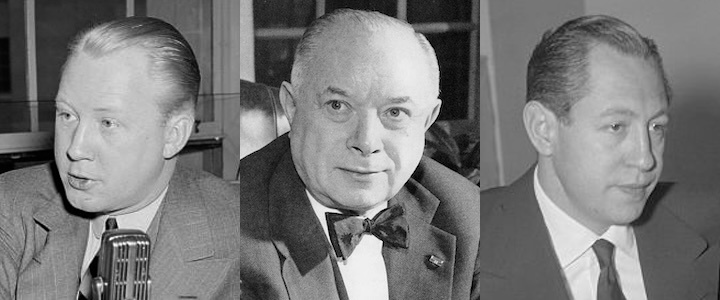
CBS disclosed the physical format and overall design of the LP to RCA's top management at that moment. Columbia itself had made a strategic decision to lift the lid of secrecy. On a layer separate from the engineers' routine exchanges, a managerial disclosure took place. Even so, RCA declined the offer.
Why unification failed — RCA already had its own system "on the shelf"
Why did Columbia's April 1948 licensing offer fail?
William S. Bachman gave his account in a 1977 JAES memoir.
"At this time RCA had a fine-groove record of its own and a record changer for it all designed and ready 'on the shelf.'"
— William S. Bachman, "The LP and the Single," JAES, Vol. 25, 1977
RCA had already completed its 45 rpm system. In other words, from RCA's point of view, what CBS was offering was something RCA did not need. Bachman also explains why Columbia nevertheless made the offer.
"The eventual success of the LP would require that the repertoires of all companies be available to the public."
— William S. Bachman, "The LP and the Single," JAES, Vol. 25, 1977
Columbia's goal was to absorb the entire industry's classical-music catalog onto the LP. RCA, in contrast, chose to pursue the exclusive success of its own 45 rpm format. The two companies' managerial judgments simply did not intersect.
Wallerstein looked back at the failure from another angle. He named CBS chairman William Paley directly, and suggested that Goldmark — who had led the licensing negotiations — had planted "bad advice" in Paley's ear. While the engineers were sharing information, managerial decisions were being warped by personal ambition and misguided counsel. That was the dynamic of the period.
→ The Battle of the Speeds (for the 1949-and-after chronology)
The reality of EQ secrecy — graphs published, implementation values sealed for 60 years
The managerial-layer secrecy was, in a sense, resolved by the 1948 breakdown and the 1949 dual-format launches. But a second form of secrecy went on operating for much longer: the implementation details of the EQ curves themselves.
On the Columbia LP's EQ curve, Peter Goldmark's team published a paper at the IRE (Institute of Radio Engineers) in 1949. But the paper was structured as follows.
"The recording characteristic employed is shown in Fig. 3."
— Goldmark, Snepvangers, Bachman, "The Columbia Long-Playing Microgroove Recording System," Proceedings of the IRE, August 1949
Figure 3 showed a frequency-response graph. But no time constants, no turnover frequencies, no circuit values are given. Gary A. Galo put it this way in his 2009 ARSC Journal paper.
"Snepvangers, Bachmann and Goldmark failed to accompany the graph in Figure 2 with any data on the time constants or turnover frequencies used to produce it."
— Gary A. Galo, "Columbia LP Equalization Curve," ARSC Journal, Vol. 40, No. 1, Spring 2009
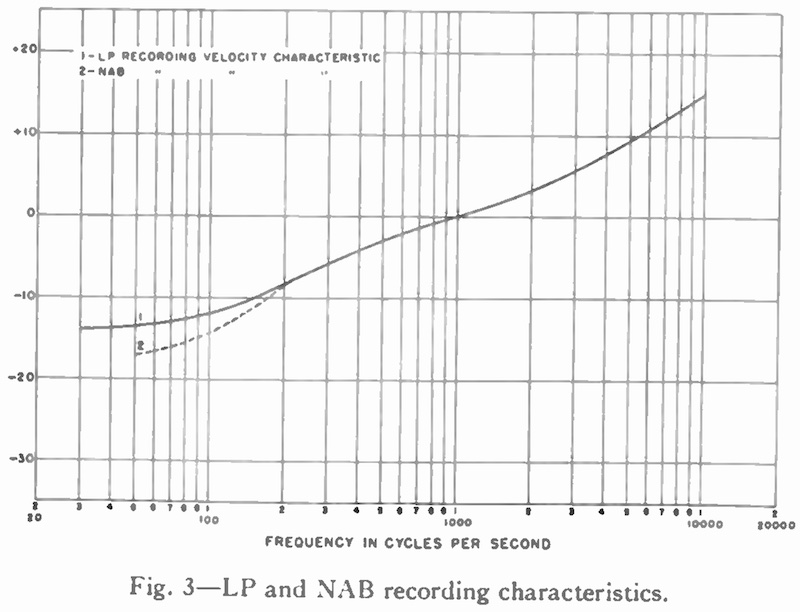
As a result, the Columbia LP curve's implementation values remained contested for sixty years, with competing proposals from KAB, Tremaine, Copeland, Langford-Smith, McIntosh and Powell/Rek-O-Kut.
In 2009, Galo took Snepvangers's original graph, measured it with a dial caliper, and simulated it in CircuitMaker 2000 to confirm that the values John Eargle had proposed — F1 = 100 Hz (1590 μS), F2 = 500 Hz (318 μS), F3 = 1590 Hz (100 μS) — were correct to within 0.3 dB. One of the EQ-curve secrets was finally cracked in full sixty years after the Columbia LP's announcement.
→ What was the Columbia LP curve?
Interestingly, this "graph only, no values" pattern was not unique to the Columbia LP. RCA Victor also published a technical description of the 45 rpm system by H.I. Reiskind in the June 1949 issue of RCA Review — "A Record Changer and Record Complementary Design" — and the Old Orthophonic curve shown there is likewise presented only as a frequency-response plot, with no time constants or circuit values attached. As of 1949, both Columbia and RCA Victor published their recording curves as figures while keeping the implementation values in-house.
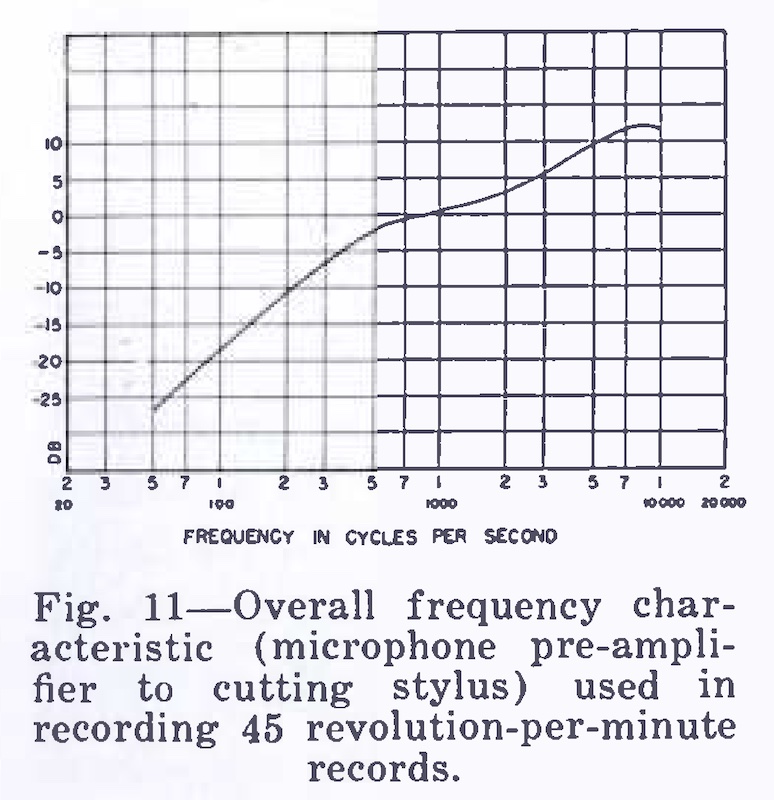
What deserves attention here is that multiple independent sources all fall silent on the same single point. Wallerstein's managerial memoir, Bachman's engineering memoir, Goldmark et al.'s 1949 technical paper, Reiskind's 1949 RCA-side paper — these sources, written from different positions and in different decades, each tell the story of the LP's and the 45's creation from their own angle, yet none of them step into the implementation details of the EQ curves. This shared silence shows that EQ secrecy operated on a separate layer from physical-format secrecy, and that this layer remained in force for much longer, on both sides.
The RCA Victor side of that silence broke in July 1953. In that month's Audio Engineering, R.C. Moyer of the RCA Victor Division contributed a piece titled "Evolution of a Recording Curve," which he framed as "a presentation of the official specifications for the 'New Orthophonic' curve currently used for RCA Victor records," and which disclosed a relative-velocity table running from 30 Hz to 15 kHz (Table 1) together with triode and pentode equalizer circuits with actual component values (Fig. 9).
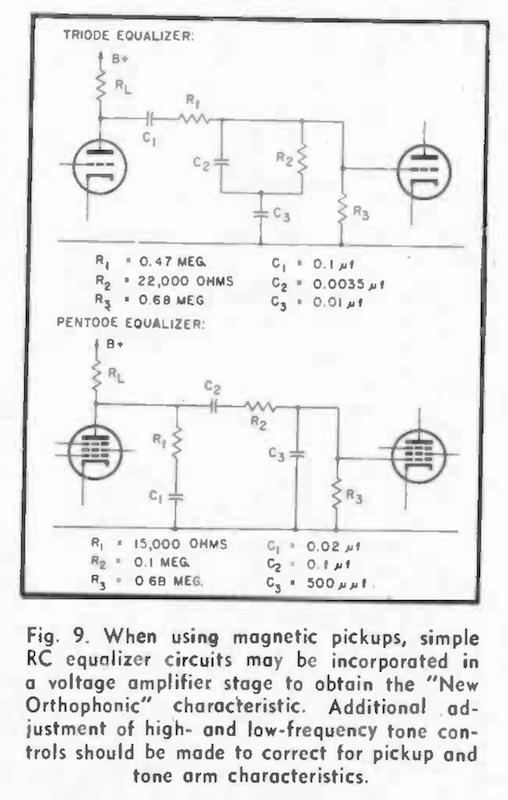
The article appeared immediately after NARTB's approval of the new standard (June 1953) and before RIAA's official publication (1954). At the very moment the momentum for standardization had solidified, RCA moved the implementation details of its own curve into the public record. This stands in sharp contrast to the Columbia LP curve's implementation values, which remained a matter of competing hypotheses for sixty years. The asymmetry suggests that EQ secrecy was tied not to engineering culture as such but to commercial calculation. When corporate rivalry gave way to standardization, engineers were permitted to publish the implementation details.
The following is the author's speculation. Why did Columbia not publish the implementation details of the Columbia LP curve around the same time RCA disclosed its own in July 1953? The industry context suggests a possible reason. June 1953 brought NARTB approval of a new standard; 1954 followed with the revised AES interim and with the RIAA recording/playback standard. Consumer curves in the United States were rapidly converging toward unification. In this current, there was no practical reason for Columbia to bother publishing the implementation details of what was about to become an obsolete curve. Viewed this way, the Columbia LP curve's sixty-year "contested" state was less an act of active sealing than the natural result of a company's motive for disclosure simply fading with time.
Resolution — from the 1951 AES to the 1954 RIAA
From 1951 onward, the format war converged through engineer-layer cooperation.
- 1951: The AES Equalization Committee began work on a common industry curve.
- June 1953: NARTB issued a new standard. In substance, its characteristics were equivalent to today's RIAA curve.
- 1954: The RIAA formally issued the "RIAA curve," effectively ratifying NARTB's work.
What deserves attention is that the 1951–1954 convergence was driven by the very same engineers who had been meeting through NAB, the Sapphire Groups and the AES since the 1940s. Columbia and RCA, divided at the managerial layer, were reunified through the engineer-layer circuit.
→ When was the RIAA curve established?
→ Why did RIAA become the standard?
Revision History
- April 15, 2026: Initial publication