The first-ever recording standard — the 1942 NAB and its revisions (1949, 1953 NARTB, 1964)
The first-ever recording standard — the 1942 NAB
Question answered on this page: How was the 1942 NAB standard — the world's first recording and reproducing standard — established? How did its subsequent revisions lead to the RIAA curve?
In short
On March 19-20, 1942, the NAB (National Association of Broadcasters) Board of Directors formally adopted the first-ever recording and reproducing standard. Officially titled "NAB Recording and Reproducing Standards," it targeted broadcast transcription discs (16-inch, 33⅓ rpm) and covered sixteen items ranging from physical disc dimensions to recording frequency characteristics.
The standard went through the following revisions:
| Year | Standard | Key changes |
|---|---|---|
| 1942 | NAB Recording and Reproducing Standards | First-ever recording standard. Covered both lateral and vertical |
| 1949 | NAB standard revised | Magnetic tape standard added. Disc recording curves unchanged |
| 1953 | NARTB standard revised | Complete revision. High-frequency pre-emphasis changed from 100 μs to 75 μs |
| 1954 | RIAA Standard Recording and Reproducing Characteristics | Same time constants as NARTB. Established as the record industry's unified standard |
| 1964 | NAB standard revised | Vertical-cut removed. Nearly identical to the RIAA standard |
→ When was the RIAA curve established? — the 1953–1954 standardization push
Why was standardization needed?
In the late 1930s, broadcast transcription discs were manufactured by multiple companies, each using its own recording characteristics. Vertical-cut discs had effectively converged on a single recording and reproducing characteristic, but with lateral-cut discs, broadcasters had to apply different equalization for each disc — an inefficient and confusing situation.
The turning point came in 1939, when RCA/NBC announced the Orthacoustic curve. It combined high-frequency pre-emphasis with a bass shelf to improve the signal-to-noise ratio and dramatically raise the quality of transcription discs. However, the prospect of an RCA proprietary curve becoming the de facto standard was not welcome to competing companies.
Against this backdrop, NAB stepped in to establish a standard that would represent the entire industry. The June 1941 NAB Reports already described the state of the field in vivid terms:
"broadcast stations use as high as ten different equalizer settings for reproducing various transcriptions"
— NAB Reports, Vol.9 No.23, June 13, 1941, pp.522-523
Committee structure and the standardization process
On May 23, 1941, the NAB convention resolved to formulate recording and reproducing standards, and the Recording and Reproducing Standards Committee (RRSC), chaired by NAB Director of Engineering Lynne C. Smeby, was formally organized at its first meeting, held in Detroit on June 26. There, its mission was defined as follows:
"The task of the committee is to formulate 'Recording and Reproducing Standards' that will tend to bring about uniform quality of reproduction of transcriptions with a minimum number of equipment adjustments on the reproducing system."
— NAB Reports, Vol.9 No.28, July 18, 1941, p.669
An Executive Committee meeting followed in New York on August 20, and by the end of August membership had reached 58, representing "practically all the leaders in the field."
From August 1941 onward, the Executive Committee worked with the following line-up:
- R.M. Morris (NBC) — Executive Committee Chairman
- H.A. Chinn (CBS)
- C. Lauda, Jr. (World Broadcasting System)
- E.T. Mottram (Bell Telephone Laboratories)
- I.P. Rodman (Columbia Recording)
- L.C. Smeby (NAB) — Committee Chairman, Director of Engineering
Beyond the Executive Committee, the broader membership drew on RCA, Columbia, Bell Labs, Presto Recording, Audio Devices, and even Harvard professor Frederick V. Hunt — a broad cross-section of everyone involved in recording and reproduction.
October 23, 1941 — the New York main-committee adoption
The decisive milestone in the committee's work was the main-committee meeting held in New York on October 23, 1941. On the basis of the Executive Committee's report, fifteen standards were adopted.
"After much discussion of the Executive Committee's report, 15 standards were adopted including two on the highly controversial subject of Recording Frequency Characteristics. Separate characteristics were adopted for vertical and lateral transcriptions."
— NAB Reports, Vol.9 No.43, October 31, 1941, p.47
Of the fifteen items adopted that day, the two that would cast the longest shadow were the ones on recording frequency characteristics — which NAB Reports describes plainly as a "highly controversial subject." That very contentiousness is one reason the standard was written not as an abstract ideal curve but in the more forgiving form of a graph with tolerances, capable of accommodating the differences among competing implementations.
The meeting also organized four subcommittees to carry the remaining items forward:
- SC-I (I.P. Rodman / Columbia) — Groove Contour
- SC-II (R.M. Morris / NBC) — Distortion, S/N, Maximum Recorded Level
- SC-III (H.A. Chinn / CBS) — Direction, Record Life, Glossary, Concentricity
- SC-IV (S.J. Begun / Brush) — Reproducing Systems
"Some controversy occured toward the formulation of sixteen items, but overall the process went very peacefully and democratically."
— Smeby, "Recording and Reproducing Standards," Proc. IRE, August 1942
On March 19-20, 1942, the standards were formally adopted by the NAB Board of Directors.
→ The full story from committee launch to approval is covered in blog post Pt.8
What the 1942 NAB standard covered
The standard comprised sixteen items covering both physical specifications and recording characteristics.
Physical specifications (items 1–12, 15–16): Outer disc diameter, center hole diameter, groove spacing, turntable speeds (33⅓ and 78.26 rpm), wow factor, record warp, minimum label information, and more.
Recording frequency characteristics (items 13–14): The most important items.
- Item 13: Frequency Characteristic for Vertical Recording — derived from the Bell Labs/Western Electric curve
- Item 14: Frequency Characteristic for Lateral Recording — derived from the RCA/NBC Orthacoustic curve
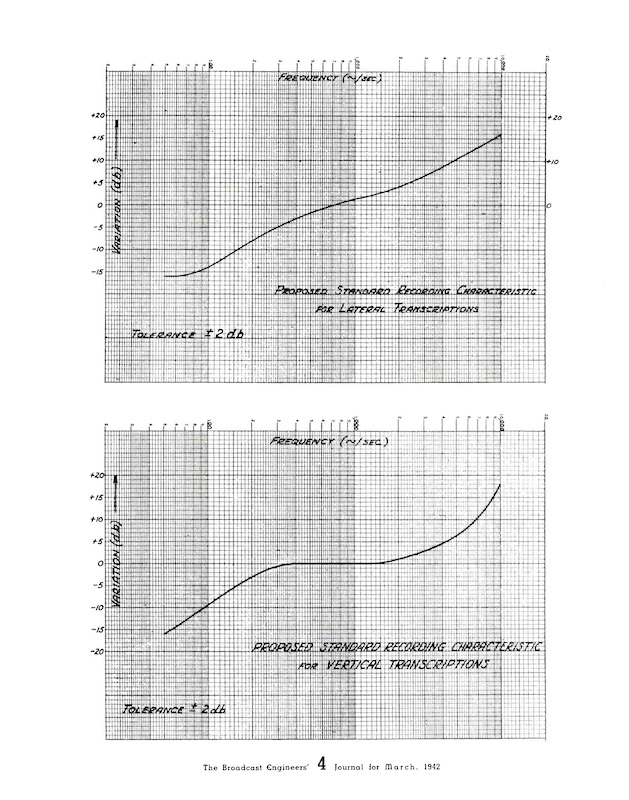
Recording frequency characteristics for vertical (lower curve) and lateral (upper curve) transcriptions, published in a trade-journal article on the 1942 NAB standard prior to its formal adoption by the NAB.
Both curves are marked “Tolerance ±2 db”.
The high-frequency pre-emphasis time constant for lateral-cut discs was specified as 100 μs (+16 dB at 10 kHz). This value would become a point of contention for years to come.
Notably, the standard specified frequency response curves (graphs) rather than circuit parameters or time constants. This was intentional: studios used diverse circuit designs, and the standard was kept flexible enough not to mandate any particular circuit topology. The standard text assigned a tolerance of ±2 dB to the curve (Smeby's paper, captions to Fig. 1 and Fig. 2), so any circuit topology that fell within that band counted as compliant. Smeby himself opened his explanatory paper by candidly noting how widely industry practice varied:
"some stations use as many as 10 equalizing networks"
"Quite a number of different characteristics have been used by the various manufacturers of transcriptions, recording equipment, and reproducing equipment."
— Smeby, "Recording and Reproducing Standards," Proc. IRE, August 1942, p.355
In other words, the 1942 NAB standard was a transitional document. Rather than abstractly defining a single ideal curve, it prioritized converging the proliferating existing implementations onto one shared graph.
The "transitional" character shows in the closing phase of the drafting process as well. In late February 1942, at a wartime engineering conference held at Ohio State University, CBS's H.A. Chinn reported on the RRSC's progress:
"A preliminary release of the 16 standards adopted so far was made at the conference."
"However, it had been decided by the committee that as many of the items as possible would be standardized in the next two months, and then the job would be deferred for the duration of the war."
— NAB Reports, Vol.10 No.10, March 6, 1942, p.135
Fifteen items on October 23, 1941; sixteen by March 6, 1942 — a single addition. The standard that reached the NAB Board of Directors on March 19-20, 1942 can be read as a pragmatic convergence on what was achievable before the wartime deferral set in. There was no time to pursue a perfect definition.
The 100 μs pre-emphasis debate
The 1942 NAB curve's high-frequency pre-emphasis drew criticism almost from the start. Serious discussion began after the war, in 1947.
At the 1947 NAB Recording Standards Meeting, several experts raised concerns about 100 μs.
Theodore W. Lindenberg (Fairchild Camera and Instrument) opened the debate:
"I have had the feeling for some time that the high frequency uplift is a little bit overdone. In our present day assembly the greatest thing to my mind is the heavy level of transcriptions. I think that we should consider a decrease in the high frequency pre-emphasis."
— NAB Reports, September 29, 1947, Vol.15, No.39
R.A. Miller (Bell Telephone Laboratories) concurred:
"today Bell Laboratories, as an apparatus designed of equalizers, was being requested continuously to put as many as 24 to 27 restoring networks in their equalizers, and that, therefore, there must be considerable agreement with the present curve and that they generally feel that the rise at the high end is too much for good wide band reproduction."
— ibid.
A.E. Barrett (BBC) noted that the NAB pre-emphasis was too extreme even for BBC equipment:
"the NAB pre-emphasis characteristic was more extreme than the BBC could use with its present equipment, for the tendency to overload on lighter frequencies was too great."
— NAB Recording Standards Meeting, Audio Engineering, October 1947
In response, Executive Committee Chairman R.M. Morris (NBC) struck a cautious note:
"while many believed that the high frequency pre-emphasis had been too high, the adherence to the NAB standards for electrical transcriptions had been good"
— ibid.
The meeting concluded that any revision should be carried out carefully, with due consideration for the impact on existing recording libraries. As a result, 100 μs remained unchanged in 1947.
→ Detailed minutes of the 1947 meeting are covered in blog post Pt.10
The 1949 revision — tape took priority
The April 1949 NAB revision was approved through a two-layer process. The executive committee inside the RRSC (chaired by Robert M. Morris / ABC) adopted the draft first; the full RRSC committee gave final approval on the afternoon of Saturday, April 9, 1949; and the NAB Board of Directors formally adopted it on April 14–15, 1949. Two days before the full-committee meeting, on April 7, the RRSC held an open meeting at which three papers were presented: Morris (overview), S.J. Begun (magnetic tape), and Reynolds Marchant (tape physical properties).
In the trade press, however, the board's adoption was reported in a single line:
"Accepted new recording standards."
— Broadcasting Telecasting, April 18, 1949, p.21
No concrete figures (track counts, tape speeds, reel dimensions, disc specifications, tolerances) appeared in the magazine. Procedurally, the full RRSC had already fixed the details in advance, and the board meeting read as an approval rather than a deliberative session. To follow the details of the standard, one has to turn to NAB's own publications (NAB Reports and the NAB Engineering Handbook, 4th Edition).
And in this revision, the disc recording curves were carried over unchanged from 1942.
There were two reasons.
First, formulating a magnetic tape standard was the top priority. After the war, magnetic tape recording was spreading rapidly among broadcasters, and the committee's work was focused on tape. A trade-press summary shortly before the convention (late March 1949) characterized the nature of the revision as follows:
"reaffirmed a majority of the old standards and have recommended many new standards, principally those covering magnetic recordings"
— Broadcasting Telecasting, March 28, 1949, p.29
Disc-related items fell on the "reaffirmed" side; the center of the revision was new magnetic-tape standards. The committee also took up an 8-inch 33⅓ rpm composite-groove record (a fine-groove broadcast-station format designed to accommodate a range of common stylus sizes), but this was approved only as a subject for study, not as a formal standard:
"The committee voted in favor of studying standards for an 8-inch 33⅓ rpm record with composite groove using most common sizes of needles."
— Broadcasting Telecasting, April 18, 1949, p.81
Second, the Columbia LP complicated matters. Columbia introduced the LP in June 1948, and its recording characteristics were very similar to the 1942 NAB curve. A major change to the disc curve could have created compatibility problems with the newly launched format.
Thus, the 100 μs issue raised in 1947 was once again deferred.
The 1949 revision also drew little ongoing coverage in Broadcasting Telecasting. RRSC follow-up reporting fell silent from May onward (Broadcasting Telecasting, May–June 1949 issues). The second half of 1949 was dominated instead by NAB's own internal restructuring: at the Portsmouth board meeting in July 1949, the engineering department was downgraded (Broadcasting Telecasting, July 18, 1949, pp. 4, 23), and at the November board meeting the existing 19 standing committees were consolidated into 10, with the RRSC name disappearing from the magazine's pages (Broadcasting Telecasting, November 21, 1949, pp. 41, 42). Even the year-end review articles make no mention of the 1949 revision (Broadcasting Telecasting, December 19 and 26, 1949 issues).
Behind this silence in the trade press was a turnover of the RRSC chair himself. The engineering department that was downgraded in July had been led by Royal V. Howard, who concurrently chaired the RRSC; his formal resignation was reported on July 25, 1949 (Broadcasting Telecasting, July 25, 1949, p.26), and on August 1 Neal McNaughten took over as director of engineering (Broadcasting Telecasting, August 1, 1949, p.30). McNaughten served as vice-chair of the RRSC and had just completed the NAB Engineering Handbook, 4th Edition. The senior RRSC personnel responsible for disseminating, explaining, and implementing the revised standards had turned over only three to four months after adoption.
Measured by trade-press attention, the 1949 revision was not a major event — the main battleground was the initial formulation of magnetic-tape standards, and the disc-curve revision was positioned as a reaffirmation of the existing standard. This "quiet revision" is exactly what set up the complete rewrite just four years later, in the 1953 NARTB revision.
Why the shift from graph to time-constant definition?
The 1953 NARTB revision was the first to formally define the recording and reproducing characteristics in terms of time constants (3,180 μs / 318 μs / 75 μs). This shift is sometimes assumed to reflect "improved measurement technology that finally made strict time-constant definitions feasible." But the contemporary primary sources point to a different reason.
As noted above, the reason the 1942 standard took the form of a graph with tolerances in the first place was that recording frequency characteristics were contentious enough at the October 23 main-committee meeting to be called a "highly controversial subject" — a situation that called for a description flexible enough to accommodate implementation-dependent differences. The 1953 move to time constants may be read not so much as a sign that this flexibility was no longer needed, but as a response to a different kind of problem: graphs alone were awkward to work with for design and specification.
In July 1953, Moyer (RCA Victor) wrote in Audio Engineering:
"The obvious difficulty with a curve alone is that the true crossover frequency and pre-emphasis are usually obscured, making the design of suitable equalizers possible only by the cut and try method."
— Moyer, "Evolution of a Recording Curve," Audio Engineering, Vol.37 No.7, July 1953, p.22
Moyer goes on to argue that impedance / admittance expressions (descriptions in terms of circuit parameters, including time constants) are "an ideal method of expressing or defining a recording or reproducing characteristic." The notable point is that the motivation was not improved measurement accuracy, but clearer specification and easier equalizer design.
In fact, time-constant thinking already existed in the industry well before 1953. The minutes of the 1947 NAB Recording Standards Meeting already discussed pre-emphasis values of 35–40 μs, 50 μs, 75 μs, and 100 μs in microsecond units. The shift, then, was not enabled by some new ability to "think in time constants" — it was driven by the practical inconvenience of a graph-only definition for designers and for sharing specifications.
H.E. Roys (RCA Victor) later looked back on the formation of the 1954 RIAA standard and described its characteristic as the result of a careful comparison of the many curves in use at the time:
"The characteristic selected was one adopted by the NAB as a revision of their earlier standard. It was the outcome of a careful study made by the NAB Engineering Committee of the many recording characteristics then in use."
— Roys, "The RIAA Engineering Committee," JAES, 1968, p.18
The 1953–1954 convergence, then, was less about new measurement technology than about translating a tangle of existing curves into a shared, definable format.
1953 NARTB — finally 75 μs
In June 1953, NAB — by then officially renamed NARTB (National Association of Radio and Television Broadcasters) — undertook a comprehensive revision of the recording and reproducing standards.
Two months before the revision, in the April 1953 issue of Radio & Television News, working audio engineer Charles P. Boegli wrote about the difficulties of phono equalizer design:
"The need for some sort of standardization is becoming ever more pressing..."
— Boegli, "New Developments in Phono Equalizers," Radio & Television News, April 1953, p.103
Reliance on secondary sources, manufacturers refusing to answer inquiries, paper-capacitor tolerances reaching as wide as +40% / −20% (Boegli's report) — the climate just before the revision was one of growing demand for standardization from people working at the bench.
The most significant change was that the high-frequency pre-emphasis time constant was lowered from 100 μs to 75 μs. The rise at 10 kHz dropped from +16 dB to +13.7 dB. The frequency response range was also extended from 10 kHz to 15 kHz.
The 75 μs value was identical to the high-frequency time constant of RCA Victor's New Orthophonic curve, which had been in use since around 1952. In December 1953, the AES (Audio Engineering Society) tentatively approved a standard playback curve with the same time constants, and in January 1954, the RIAA approved recording and reproducing characteristics with the same time constants. Three standardization bodies converged within just six months — because their memberships overlapped and they were coordinating their efforts.
The 1953 NARTB standards book formally defined the reproducing characteristic as a combination of three time constants — 3,180 μs / 318 μs / 75 μs (Supplement No.2 to NAB (NARTB) Engineering Handbook [Fourth edition, 1949]: NARTB Recording and Reproducing Standards, June 1953, Section III). These are exactly the same time constants the RIAA would approve in January 1954, and the primary source confirms that NARTB adopted them six months ahead of RIAA.
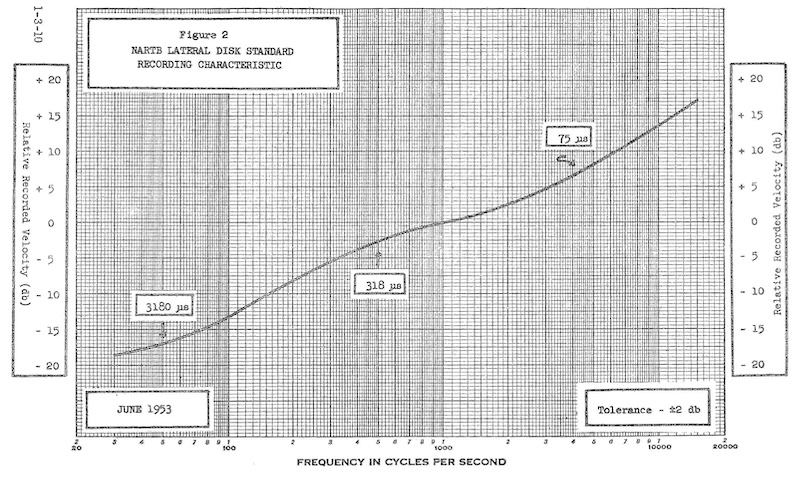
The lateral-cut transcription recording curve as printed in the 1953 NARTB standards document.
This graph too is marked “Tolerance ±2 dB”.
H.E. Roys (RCA Victor) was particularly central to this coordination, serving on standardization committees for NAB/NARTB, AES, RIAA, EIA, and ASA (the predecessor of ANSI).
→ The detailed timeline of 1953–1954 standardization is covered in When was the RIAA curve established?
→ Why the RIAA curve stuck as the industry standard is covered in Why did RIAA become the standard?
1964 NAB — vertical removed
In February 1964, NAB revised the recording and reproducing standards once more. Two significant changes were made.
First, vertical-cut discs were removed from the standard. Since 1942, the standard had included recording characteristics for both lateral and vertical. By 1964, vertical-cut transcription discs had long since disappeared.
Second, the lateral characteristic was redefined as a "reproducing" rather than a "recording" characteristic. The 1942 standard had specified the curve from the recording side; the 1964 revision reframed it from the reproducing side. This reflected a shift in the standard's function.
The 1964 NAB disc standard was nearly identical to the 1954 RIAA standard. The 1964 edition defined the reproducing characteristic as follows:
"Reproducing characteristic — with constant velocity of the reproducing stylus tip the curve of voltage output of the reproducing system versus frequency shall be that which results from the combination of three curves [...]"
— NAB Audio Recording and Reproducing Standards for Disc Recording and Reproducing, NAB Engineering Department, February 1, 1964, Section III, p.6
The three curves are specified as a combination of time constants t₁ = 75 μs, t₂ = 318 μs, t₃ = 3,180 μs, exactly matching the 1954 RIAA recording and reproducing characteristics.
→ How vertical-cut discs figured in standardization history is covered in Why did lateral-cut become the standard?
Historical significance of the NAB standard
The NAB standard holds a uniquely important place in the history of sound recording.
The world's first recording and reproducing standard. Before NAB, no comprehensive standard covering recording frequency characteristics existed. Each company recorded with its own curve, and playback equipment had to be adjusted disc by disc.
A precedent for democratic process. The deliberations of a 58-member committee set the template for subsequent standardization by NARTB, AES, and RIAA. Building consensus across the entire industry took time, but the result was a durable standard that everyone could accept.
The lesson of the 100 μs debate. Six years elapsed between the recognition of the problem in 1947 and its resolution in 1953 — a record of the industry struggling between caution toward existing libraries and the pursuit of technical correctness.
Revision History
- April 18, 2026: Expanded the 1949 revision section in four layers based on close reading of Broadcasting Telecasting (1948–1949): the two-layer approval flow (RRSC executive committee → full committee on April 9, 1949 → NAB Board of Directors on April 14–15, 1949) with the April 7 open meeting; primary-source backing for the disc-curve carry-over (March 28, 1949 "reaffirmed a majority" quote; April 18, 1949 composite-groove study quote); the trade-press silence in the second half of 1949 (May–June follow-up gap, July Portsmouth engineering-department downgrade, November consolidation of standing committees, absence from year-end reviews); and the Howard → McNaughten engineering-director turnover three to four months after adoption
- April 13, 2026: Inserted the recording frequency-characteristic chart from the 1942 NAB standard paper (Chinn 1942, Broadcast Engineers' Journal) and the lateral-cut recording chart from the 1953 NARTB standards document. Both visually show that the graph definitions carried a ±2 dB tolerance band
- April 13, 2026: Noted that the 1942 graph definition carried a ±2 dB tolerance, citing the Fig. 1 / Fig. 2 captions of Smeby's paper
- April 13, 2026: Reflected the following from the contents of NAB Reports 1941-1942. Precised the 1941 RRSC timeline (May 23 → June 13 → June 26 → August 20 → October 23), added four direct NAB Reports quotes (task definition, "ten different equalizer settings," "highly controversial subject," wartime deferral), introduced a new subsection on the October 23 main-committee adoption, and connected the graph→time-constant section to the 1942 rationale. Minor wording fixes elsewhere
- April 13, 2026: Strengthened the rationale for the graph→time-constant shift with Moyer 1953 and Roys 1968. Added a direct Smeby quote on why the 1942 standard used graph form. Added Boegli (April 1953) on conditions just before the NARTB revision
- April 12, 2026: Added the 1953 NARTB standards book and the 1964 NAB standards book as primary-source citations
- April 10, 2026: Initial publication