(In a Nutshell Part 3) What does this history mean for playing records today? — Post-RIAA transition, stereo LPs, and the open questions that remain
← Part 2 | In a Nutshell top | Part 3
What does this history mean for playing records today?
In 1954, the RIAA standard was finally established. But the adoption of a standard and the industry's complete transition to it are two different things. And the question of when that transition was truly complete remains a matter of debate even today.
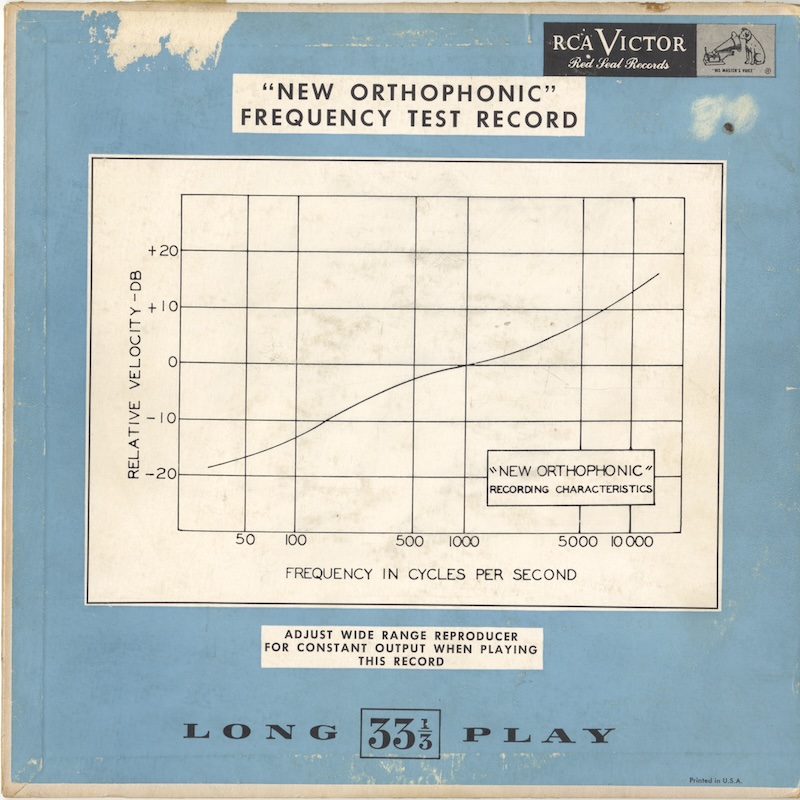
from my own collection
1. The RIAA transition period: 1954–1958
After the RIAA standard was formally adopted on January 29, 1954, US labels did not all switch to the new standard at once. There were two main reasons why the transition was not immediate.
The problem of existing inventory: Discs pressed from stampers cut before RIAA adoption naturally retained their original curves. Pre-RIAA pressings continued to circulate until stocks were exhausted and new masters were cut.
The cost of equipment replacement: Disc recording equalizers had fixed characteristics—unlike playback equalizers, they could not simply be switched over. For major labels with mastering facilities across the country, updating all equipment uniformly required significant cost and time. Beyond merely replacing the equalizer, the process demanded repeated test cuttings, measurements, and adjustments to ensure stable recording characteristics.
The pace of transition varied with financial resources
RCA Victor had been using its New Orthophonic recording characteristic since around 1952, and since this was identical to RIAA, the company was effectively already compliant. For Columbia and labels or studios using the NAB curve, however, the treble pre-emphasis and bass shelf characteristics differed, requiring equipment changes. Smaller independent studios may have continued using older equipment, and the timing of their transitions likely varied from studio to studio (see Pt.19 / Pt.20).
2. The arrival of stereo LPs (1958) — the effective completion of the RIAA transition
In 1958, stereo LPs using the Westrex 45/45 system went on general sale in the United States.
The stereo cutting equipment (such as the Westrex 3C/3D stereo cutterhead) was designed on the assumption of the RIAA recording characteristic. To produce stereo LPs, studios had to adopt this new cutting equipment, which meant their entire recording chain was updated to an RIAA-based system.
In other words, in the US, the arrival of stereo LPs in 1958 effectively completed the transition to RIAA-based recording and playback.
The transition on the playback side
The evolution of consumer amplifiers corroborates this timeline.
Before 1957, many monaural amplifiers offered switchable EQ curve positions— Columbia LP, AES, Orthophonic, and others. After 1958, however, stereo amplifiers supporting only RIAA rapidly became the norm. By around 1965, models retaining non-RIAA positions were limited to a handful of high-end units such as McIntosh, Marantz, and Harman-Kardon (see Pt.22).
3. The questions history left behind
That is the broad arc of EQ curve history. But certain parts of this history remain unresolved.
Established facts
- After the RIAA standard was adopted in 1954, major US labels progressively transitioned to RIAA
- Stereo LP cutting equipment introduced in 1958 was designed with RIAA as its basis
- US stereo LPs were recorded using the RIAA curve
Unresolved areas
- For certain pre-RIAA monaural recordings (particularly those from independent labels around 1954), the curve actually used is often unknown because no technical documentation survives
- The recording chains of the era contained numerous variables beyond the curve's three parameters (turnover, pre-emphasis, bass shelf)—including microphone characteristics, low-pass filters, and differences in equalizer circuit topology (LCR / CR / NF) (see Pt.23 / Pt.24)
Where opinions diverge
Debates about EQ curves tend to split along the following lines:
- "What curve was actually used for the recording" and "what curve sounds best on playback" are separate questions — conflating the two is one reason the discussion becomes so tangled
- For some recordings from the monaural transition period of 1954–1958, the exact recording curve is genuinely unknown. However, "unknown" and "non-RIAA" are not synonymous
- For the US stereo LP era (1958 onward), the design of the recording equipment itself makes it extremely unlikely that any curve other than RIAA was used. Testimony from engineers who worked in the studios of that era corroborates this point (see Pt.20)
Closing: listening with an understanding of history
What this hundred-year history teaches us is that recordings from before the mid-1950s in particular involved a level of complexity that cannot be fully captured by choosing values for three parameters—turnover, treble pre-emphasis, and bass shelf.
The parameters selectable on a modern variable phono equalizer are approximations; no setting comes with a guarantee that it is "correct." But knowing the history behind these parameters should change the way you approach record playback.
We hope this history serves readers as a starting point for thinking about how records are played.
For specific questions, please also see the FAQ pages.
For those who wish to go deeper, we invite you to read the full 25-part series that the author spent over two years researching.
→ Overview and reading guide for "Things I learned on Phono EQ curves"
For further reading (blog series)
- Pt.19 — Disc recording equalizer models after RIAA adoption; how difficult it would have been to record in non-RIAA
- Pt.20 — When each label switched to RIAA; a review of EQ curve list resources
- Pt.21 — The diversity of test records; a survey of frequency test discs
- Pt.22 — The evolution of consumer amplifier EQ support, as seen in Allied Radio catalogs
- Pt.23 — Deviations from the ideal RIAA reproducing characteristic; LCR vs. RC equalization
- Pt.24 — The complete signal path in the recording chain and its many variables
- Pt.25 — Series summary
Revision History
- April 8, 2026: Initial publication