What a 46-issue close reading of 'Dialing Your Disks' (1950s High Fidelity) reveals
What was "Dialing Your Disks"? What can it tell us, and what can't it?
Question answered on this page: What was "Dialing Your Disks", the recurring column in High Fidelity magazine throughout the 1950s? How was it useful to record collectors at the time, and what can — and cannot — we learn from it today as a historical primary source?
The short answer
"Dialing Your Disks" (hereafter DYD) was a column that ran in every issue of the U.S. music magazine High Fidelity from January/February 1953 through April 1957 (with a single one-off revival in October 1957). It was a table that told record collectors how to set their phono equalizer in order to play back records from each label correctly.
As a minor trivia note: from the February 1957 issue onward, the title was changed to "Dialing Your Discs" — the spelling shift from "Disks" to "Discs" is itself a curious detail.
The column listed playback compensation recommendations, not the actual curves used by each label during recording (cutting). This distinction is the most important premise when we cite DYD today as a historical primary source.
Over the four-and-a-half years of the column's run, the editor made a total of 12 revisions, and in the closing issue (April 1957, "A Farewell To Obfuscation") declared that the U.S. record industry had finally converged on the RIAA curve.
A brief history of Dialing Your Disks
When the column first appeared in the January/February 1953 issue (Vol.2 No.4), the editor wrote:
"Many amplifiers now incorporate 'equalizing' controls, to compensate for the various recording characteristics used by different record companies in cutting their disks. However, the record companies have been slow to indicate what these characteristics are..."
— "Dialing Your Disks", High Fidelity, Vol.2 No.4, Jan/Feb 1953, p.64
The editor wrote to every LP-producing label listed in the Schwann record catalog asking "what playback compensation characteristic do your records require?" and published the responses received from 17 companies in the inaugural issue.
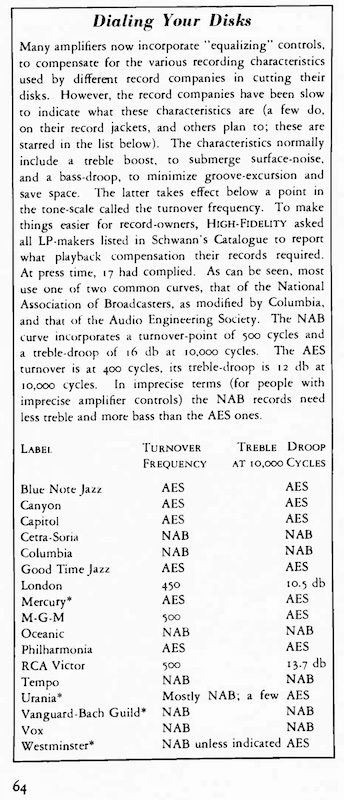
The data from these earliest three issues (January/February, March/April, and May/June 1953) is already compiled in Pt.17 §17.6 of the blog series. This FAQ covers different angles of insight that emerge from a close reading of all 46 issues, including the remaining 43.
A note: DYD only covered playback recommendations for LPs (33⅓ rpm); 78 rpm and 45 rpm records were out of scope. Every issue's header stated explicitly: "All LP discs are recorded with treble boost and bass cut...". Even labels that had existed since the 78 rpm era (such as Prestige and New Jazz, discussed below) appear in DYD only with their LP-era playback recommendations.
The 12-stage evolution of the editor's methodology
DYD was not simply "the same table repeated every month": the editor revised the page structure and editorial approach 12 times over the four-and-a-half year run. Lining these revisions up reveals the U.S. record industry's convergence on the RIAA curve, traced from the editor's decision-making side as well.
| Issue | Editorial revision |
|---|---|
| Jan/Feb 1953 | First issue. 17 labels listed under the framing "playback compensation" |
| Mar/Apr 1953 | Wording changed to "recording characteristics". The editor described the geometry of each curve overlaid on graph paper |
| May/Jun 1953 – May 1954 | Simple list format stabilized; label count expanded (to about 30) |
| March 1954 | First appearance of "RIAA" in DYD (the editor mistakenly wrote "Record Industry Association of America" — the correct name is Recording Industry...) |
| June 1954 | New format (turnover × rolloff dot grid). RIAA and NARTB grouped in the same turnover column |
| September 1954 | Asterisk legend made explicit: "★ = labels whose new masters from sometime in 1954 onward are recorded to RIAA" |
| October 1955 | Major format change to a "NEW / OLD" two-column format. For each label, "until when the old recommendation applies" and "from when the new recommendation (= RIAA) applies" was indicated by date or record number |
| June 1956 | Editor declared a 16-label group as "all records produced under these labels are recorded with the industry-standard RIAA curve" in the header (at this point each label still had its own row; consolidation into a single row came in August 1956) |
| July 1956 | Paper reprint card mail-order sales began at 25¢ each (intended to be kept beside the phono control unit) |
| August 1956 | Format changed to a split table: "industry-standard RIAA group" (just label names listed in a single row) separated from "other curves still being tracked" |
| February 1957 | Title spelling changed: "Dialing Your Disks" → "Dialing Your Discs" |
| April 1957 | Closing issue, "A Farewell To Obfuscation" |
The October 1957 revival was the single instance of the "occasional update" the editor had promised in the closing issue.
Looking at these 12 stages of evolution, we can see DYD's role transforming constructively from "a guide for setting playback for current new releases" (1953-1955) to "a guide for correctly playing back back-catalog records" (1955-1957). The OLD column introduced in October 1955 was a resource so that readers who owned a label's older releases could play them back correctly.
What DYD tells us
A close reading of DYD reveals the following about the U.S. record industry of the time.
1. The editor's grasp of the industry's convergence timing
In the June 1956 issue, the editor declared:
"All records produced under the following labels are recorded with the industry-standard RIAA curve [500R turnover; 13.7 rolloff]: Angel; Atlantic; Bethlehem; Classic Editions; Clef; EMS; Epic; McIntosh; MGM; Montilla; New Jazz; Norgran; Prestige; Romany; Savoy; Walden. Labels that have used other recording curves are listed below."
— "Dialing Your Disks", High Fidelity, June 1956, p.48
This list grew to 17 by the October 1957 issue (Composers Recordings was added) — at a rate of about one label per year — showing that the final phase of the industry's convergence was steadily moving forward.
2. The R / C suffix indicates a difference in bass shelf
In EQ curve notation, the alphabetical suffix following a turnover frequency uses the initial letter of a contemporary recording standard (R = RIAA, C = Columbia, B = NAB), and technically denotes a difference in bass shelf (low-frequency time constant).
| Suffix | Origin | Bass shelf time constant | Treble time constant |
|---|---|---|---|
| R | RIAA / RCA New Orthophonic | 3,180 μs (50 Hz) | 75 μs |
| B | 1942/1949 NAB | 3,180 μs (50 Hz) — same as R | 100 μs |
| C | Columbia LP | 1,590 μs (100 Hz) | 100 μs |
R and B share the same bass shelf time constant; the difference is solely in the treble time constant (R = 75 μs vs B = 100 μs). C, on the other hand, has a different bass shelf from R/B (50 Hz vs 100 Hz).
That said, across all 46 issues of DYD, only R and C ever appear as suffixes — B is never used even once. In the explanation of suffixes that appears in the header from the October 1955 issue onward, the 500-series turnovers are divided into the following three positions:
| Position | Corresponding phono preamp switch labels |
|---|---|
| 500R | RIAA / ORTHOphonic / NARTB |
| 500C | LP / COL / COL LP / Mod NAB / LON / FFRR |
| 500 (no suffix) | NAB |
NAB is given its own baseline position as "500 (no suffix)" — it is not lumped into 500C or 500R. The editor's note at the top of the header reads "Equalizer control panel markings correspond to the following values"; these designations list the actual labels printed on the front-panel switches of contemporary consumer phono preamps (i.e., what readers should set their amplifier to).
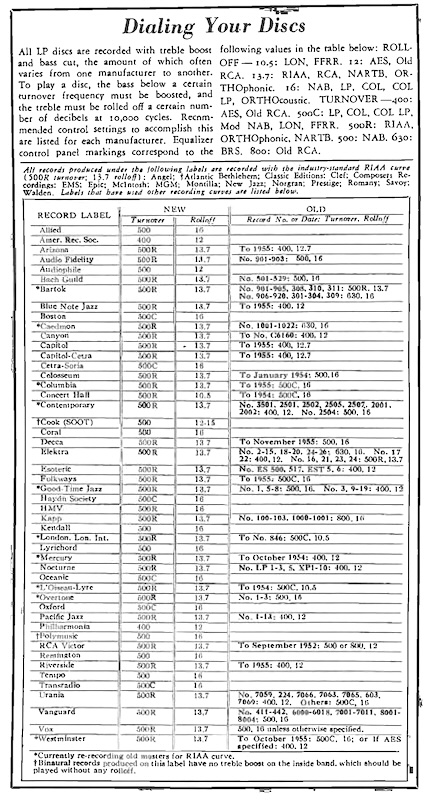
This is speculation, but: the NAB curve had been the broadcast industry's standard since the 1942 NAB specification, and in the earliest LP era (from 1948), there were also instances of cutting with the NAB curve, which differed from the Columbia LP curve only in bass shelf. So at the time, "500 turnover" likely carried an implicit sense of meaning NAB — a sense shared across the industry. From there, RIAA-derived curves were marked with R and Columbia LP-derived curves with C as a way to distinguish them, which would have been sufficient — there was no need to add B to NAB itself. That seems to have been the editor's working sense of things.
For details, see Curve notation (how to read "500C-16").
3. Active re-cutting programs in progress
In the March and October 1957 issues, the editor added the following note for ten labels marked with an asterisk (★) — Bartók, Caedmon, Columbia, Contemporary, Good-Time Jazz, London, Mercury, L'Oiseau-Lyre, Overtone, Westminster:
"*Currently re-recording old masters for RIAA curve."
— "Dialing Your Disks", High Fidelity, March 1957, p.86
This shows that, as of early 1957, several major and mid-tier labels were actively re-cutting their old masters to RIAA.
What DYD cannot tell us
DYD on its own cannot establish the actual recording (cutting) curve switch dates of individual labels. This point was already made in Pt.17 §17.6 of the blog series; this FAQ goes further by examining two cases — Capitol and Prestige.
The Capitol 400N-12.7 case
The DYD listing for Capitol:
For 16 issues from October 1955 through October 1957, the Capitol row appeared as follows:
| Column | Value |
|---|---|
| NEW Turnover / Rolloff | 500R / 13.7 (= RIAA) |
| OLD | To 1955: 400, 12.7 |
In other words, the playback recommendation was: "for Capitol records before 1955, play back with a 400 turnover and 12.7 dB rolloff." Capitol-Cetra and Arizona were given the same "To 1955: 400, 12.7" recommendation.
When Capitol actually switched its recording curve:
Capitol's actual switch to the New Orthophonic (= RIAA-equivalent) cutting curve can be confirmed from the booklet of their own sampler, Capitol SAL-9020 "Full Dimensional Sound", as having begun around autumn 1953 (see Pt.17 §17.5.3 and Pt.20 §20.1.1).
What's more, High Fidelity magazine itself corroborates this. In the March 1954 issue — published the month after the RIAA standard was officially approved — the article "After Five Years: Uniform Equalization" (p.50) states:
"Capitol, echoing Mr. LeBel's assurance that the new curve differed only slightly from the old AES, which they had been using since the inception of their 'FDS' (Full Dimensional Sound) series, shifted to the new curve in the middle of last summer (without advising HIGH FIDELITY, to permit a change in the Dialing Your Disks listing of various companies' equalization-settings.)"
— "After Five Years: Uniform Equalization", High Fidelity, March 1954, p.50 (see Pt.20 §20.1.3)
In other words, High Fidelity itself, in a separate March 1954 article, publicly acknowledged that "Capitol's recording-curve switch had not been communicated to the magazine's own DYD column". The High Fidelity article states explicitly that Capitol had already completed its switch to the new curve by mid-summer 1953 (around July–August 1953; in reality, this was more likely when the transition began), but the DYD column continued to publish the old recommendation until it finally demoted Capitol to the OLD column in October 1955 with "To 1955: 400, 12.7."
That is, there was a gap of more than two years between the start of the recording-characteristic switch (mid-summer 1953) and the DYD playback recommendation switch (October 1955).
An open question:
A puzzle remains. The same March 1954 article had already informed the editorial team of the start of Capitol's switch (mid-summer 1953) — yet DYD did not demote Capitol to the OLD column until October 1955, about two years later. Why? And further: when DYD finally did demote Capitol, why did it set the OLD-column boundary as "To 1955" rather than "To 1953" (the actual switch year) or "To 1954"? This is a two-tiered question. We currently have no definitive answer from primary sources. Possible hypotheses include:
- (a) Capitol's mastering studios across the U.S. may have completed the switch on different timelines, with some 400N-12.7 new releases continuing to circulate into 1955;
- (b) The DYD editor may have erred on the side of safety for readers' on-hand records (i.e., judged that older-curve records still in circulation needed the old recommendation) and delayed the OLD-column demotion;
— but neither hypothesis is directly supported by contemporary documents in our hands. We leave this as an open research question.
What does it mean when a resource lists "Capitol = 400N-12.7"?
The figure 400N-12.7 was consistently published as the recommended playback setting for pre-1955 Capitol records across the major contemporary playback-recommendation sources (DYD, the 1954 Heathkit Pre-amplifier WA-P2 manual, the 1956 McIntosh Audio Compensator C-8 manual). Later compendia such as Powell's 1989 ARSC Journal article and modern web resources like midimagic and the Audacity wiki appear to be derivatives of these primary sources.
In other words, the data point "Capitol = 400N-12.7" is:
- ✓ Corroborated by multiple contemporary primary sources as a playback recommendation
- ✗ NOT a primary source for what curve Capitol actually cut with
- ✗ Capitol's actual recording had begun switching to New Orthophonic (= RIAA-equivalent) by autumn 1953 at the latest (an established fact)
This gap shows the necessity of recognizing that playback recommendation and recording curve are two different kinds of evidence when citing trade-press historical sources like DYD. "Capitol = 400N-12.7" is sometimes cited in modern non-RIAA discourse as "evidence that Capitol used a non-RIAA curve in recording" — but returning to the original source (DYD), it is no more than "the recommended playback setting for pre-1955 Capitol records."
The RIAA-uniform group declaration and the limits of the 10-inch LP era
Even for the 16 labels declared as recording with "the industry-standard RIAA curve" by the editor in the June 1956 issue (cited above), it would be incorrect to apply DYD's wording retrospectively to all of those labels' previous releases.
For example, New Jazz / Prestige had been releasing 10-inch LPs since 1951, when neither New Orthophonic (1952) nor RIAA (1954) yet existed. Those early 10-inch records were of course cut with different curves.
Tracing the playback-curve markings on the back covers of Prestige's 10-inch LPs (from back-cover images on Discogs) reveals the following progression:
| Catalog number | Release period | Back-cover marking |
|---|---|---|
| PRLP-198 and earlier | through early 1955 | No playback-curve mention |
| PRLP-199 | 1955 | "Users of wide-range equipment should set their controls for the NARTB curve for best results." |
| PRLP-200 | 1955 | "Users of wide range equipment should adjust their controls to the RIAA curve for the best results." |
| PRLP-207 | 1955 | RIAA (same wording as PRLP-200) |
| PRLP-208 | 1955 | RIAA (same as above) |
| PRLP-209 | 1955 | RIAA (same as above) |
| PRLP-210 | 1955 | RIAA (same as above) |
(PRLP-201–206 are omitted from this list because they were either unreleased or reissues of older New Jazz 1100-series titles.)
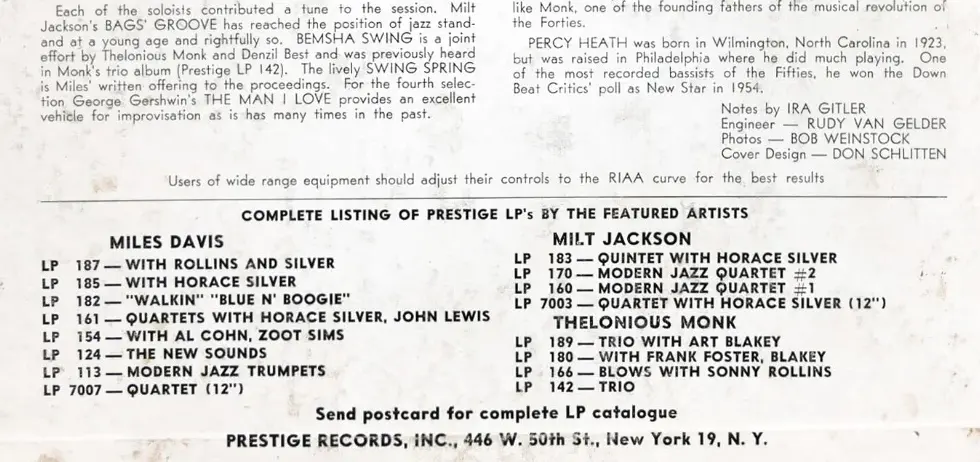
For Prestige, the switch can be confirmed: NARTB at PRLP-199, then RIAA from PRLP-200 and PRLP-207 onward — consistent with the introduction of the Gotham PFB-150WA cutting amplifier at the Rudy Van Gelder studio in early 1955 (see Pt.19 §19.2.2 Gotham PFB-150WA Recording Amplifier). Earlier Prestige / New Jazz 10-inch LPs were therefore likely cut with a different curve.
This shows that the RIAA-uniform group list that first appeared in the June 1956 issue is a declaration of "labels currently cutting new releases to RIAA" — it does not mean that all LPs those labels previously released were cut to RIAA.
March/April 1953: The editor's precise account of curve geometry
The most technically interesting passage in DYD is the editor's commentary in the March/April 1953 issue. Overlaying each label's reported playback recommendation curves on graph paper, the editor wrote:
"If the recording characteristics reported to us are plotted on graph paper, they are found to be close together in the region from 200 to 2,000 cycles. Below 200 cycles, the curves differ. London and Columbia parallel one another closely, each drooping about 12.5 db at 50 cycles. The RCA Victor 'Orthophonic' and the NAB curves also run parallel to a droop of about 16 db at 50 cycles. The AES curve is shaped a little differently, and drops 18 db at 50 cycles."
"At the high end, all the curves follow about the same shape, but incorporate varying amounts of treble pre-emphasis. NAB and Columbia reach 16 db at 10,000 cycles. At this frequency, the Orthophonic curve is up 13.7 db; AES is up 12 db; and London is up 10.5 db."
— "Dialing Your Disks", High Fidelity, Mar/Apr 1953, p.60
This passage is a primary-source account showing that contemporary trade-press editors recognized that "the differences between curves matter at the two extremes (below 200 Hz in the bass and above 2,000 Hz in the treble), and the curves converge in the 200–2,000 Hz mid-range." Specific numerical values at 50 Hz and 10 kHz are also given for each curve, letting us see how period record collectors "grasped curve differences as numbers."
April 1957: "A Farewell To Obfuscation"
In the April 1957 issue, the editor declared the end of the column.
"After many years of confusion confounded, the record industry has finally adopted a standard playback equalization curve that seems acceptable to everybody. The RIAA playback curve is being used by all but a few small companies, and the days when every manufacturer had his own unique recording curve are at last a matter of history. The 'Dialing Your Discs' table that appeared regularly in this recordings section served its purpose when record equalization was changing as fast as the international situation, but now that things have pretty well settled down we're going to discontinue the monthly DYD chart. As changes occur, we'll update readers with an occasional DYD table in HIGH FIDELITY. Meanwhile, anyone who wants two copies of the current 'Dialing Your Discs' card to keep near the phono control unit can obtain them by sending 25¢ to Dialing Your Discs, HIGH FIDELITY, The Publishing House, Great Barrington, Mass."
— "A Farewell To Obfuscation", High Fidelity, April 1957, p.84
A close reading shows, however, that even in the March 1957 issue (p.86) — just before the closing issue — about 20 labels still had non-RIAA recommendations in the lower half of the table (Boston, Cetra-Soria, Cook, Haydn Society, HMV, Lyrichord, Oceanic, Oxford, Philharmonia, Polymusic, Remington, Tempo, Transradio, etc.). The Farewell phrase "all but a few small companies" reflected a judgment focused on major and mid-tier labels; smaller labels were still operating with their own old curves.
The October 1957 revival was the only instance of the "occasional update" the closing issue had promised.
Methodological lessons: anatomy of a source chain
From the DYD case, here are general cautions for citing 1950s trade-press sources as historical evidence.
1. "Playback recommendation" and "recording curve" are different kinds of evidence
DYD was created to guide readers on "how to set their phono equalizer." It published values that each label declared to the editor as "play this curve to play our records correctly," or values the editor judged. It does not directly show each label's actual recording curve.
2. Even when multiple contemporary primary sources agree, they are still not evidence of recording curve
When DYD, the Heathkit manual, and the McIntosh manual all listed the same recommendation — as in "Capitol = 400N-12.7" — these are all playback recommendation sources. Multiple agreeing sources support "what was a shared understanding of playback recommendations at the time," but not "what recording curve was actually in use historically."
3. Secondary and tertiary sources do not necessarily preserve the original source's intent
Modern web resources (midimagic, the Audacity wiki) and academic compendia (Powell's 1989 ARSC Journal article) compile and inherit these primary sources, but the framing "this is a playback recommendation" can get pruned away due to space constraints, leaving "Capitol = 400N-12.7" to circulate as a bare data point. When subsequent interpretation reads this as "Capitol cut at 400N-12.7," the claim has drifted far from the original source's meaning.
4. DYD's per-label data may itself contain errors that later research has corrected
For example, in the case of MGM, later compendia such as midimagic state that "MGM LPs prior to 1952 were cut to NAB (500B-16), with a small fraction using a unique MGM curve (500N-12)" — which conflicts with the contemporary DYD MGM row (500 turnover / AES 12 dB rolloff). The information that contemporary trade-press editors collected from labels and the facts later researchers established by cross-referencing multiple sources do not necessarily agree. Treating any single DYD data point as "the one correct answer for that label" should be avoided; cross-referencing with modern research and multiple primary sources is necessary.
The actual recording-curve switch dates need to be confirmed from different kinds of primary sources: labels' own sampler records, internal documents, engineer testimony, trade-press interviews, and so on. For details, see When did each label switch to the RIAA curve?.
Revision History
- May 17, 2026: Added figure (close-up of Prestige PRLP-200 back cover with the RIAA curve marking)
- April 28, 2026: Initial publication