When did major U.S. labels move to the RIAA curve — a list based on verifiable documents
When did each label switch to the RIAA curve?
Question answered on this page: When did the major U.S. labels complete the transition to RIAA recording characteristics?
Background: the transition did not happen overnight
The RIAA standard was established in January 1954, but labels did not all switch the next day. There were two main reasons the transition took time.
- Existing inventory: Pressings from stampers cut with the old curves remained in stock and continued to circulate in the market.
- Cost of equipment updates: Cutting equalizers had fixed characteristics, and updating equipment at all facilities was costly and time-consuming. Measurement and fine-tuning through test cutting was also necessary.
Also, RCA Victor and Capitol had been using recording characteristics identical to RIAA before the standard was established, so they required no "transition" at all.
Transition timeline for major labels
The following list is based on information verified from primary sources (trade journal articles, engineer testimonies, internal documents, etc.).
| Label | Transition period | Basis |
|---|---|---|
| RCA Victor | From around 1952 (no transition needed) | New Orthophonic recording characteristics = identical to RIAA. Adopted around 1952 |
| Capitol | From around fall 1953 (adopted identical characteristics before RIAA was established) | Switched from old AES curve to New Orthophonic = RIAA. Estimated to have been completed during 1954 |
| Columbia | Less than half transitioned as of August 1954. Estimated completion in early 1955, late 1955 at the latest | Billboard, August 1954: "All facilities still six months away from completing transition." Bachman internal documents (c. 1955–1956) also support this timeline |
| Mercury | Around 1954 | Chief engineer C. Robert Fine announced intention to adopt RIAA (Radio & Television News, July 1954). The earliest LPs (cut at Reeves Sound Studios around 1949) are estimated to have used NAB or Columbia LP curves, shifting to AES around 1951–1952 |
| London (UK Decca) | Early 1954 | A&R director Remy van Wyck Farkas: "We have been using RIAA for several months" (High Fidelity, June 1954) |
| U.S. Decca | Around 1955 (relatively late) | Transitioned from NAB curve. Some sources suggest NAB was used until around November 1955 |
| MGM | Around late 1954 (details unknown) | Pre-transition curve likely 500N-12 (Old Orthophonic turnover/bass shelf + AES HF rolloff), though accounts vary. Most sources suggest the transition was completed in late 1954 |
| Westminster | Same as Columbia | Sent tapes to Columbia for cutting and pressing. Transition followed Columbia's timeline. However, some were sent to RCA Victor for cutting and pressing. These would have been cut using Old Orthophonic or New Orthophonic, yet the jacket indicates playback with the AES curve |
| Blue Note (Rudy Van Gelder mastering) | From early 1955 | Cut at the Rudy Van Gelder studio (Hackensack / Englewood Cliffs). Van Gelder introduced RIAA recording equipment (Gotham PFB-150WA) in early 1955 and stated his own use of RIAA in an article he contributed in October 1955 (→ What equipment did Rudy Van Gelder cut with?) |
| Prestige (Rudy Van Gelder mastering) | From early 1955 | Cut at the same Rudy Van Gelder studio as Blue Note. From PRLP-200 onward, the back covers explicitly indicate the RIAA curve (→ Dialing Your Disks) |
| Contemporary, Good Time Jazz, etc. (Capitol-commissioned) | From around fall 1953 | Used Capitol's cutting facilities, so their transition followed Capitol's |
Beyond these, the Rudy Van Gelder studio handled mastering for many other jazz labels, including Savoy, Pacific Jazz, and Debut (see Richard Capeless's RVG Discography for details).
There were also many other independent labels that used Columbia or RCA Victor cutting facilities; their transitions follow those of the major they were commissioned to. Urania, for instance, outsourced cutting to both Columbia and RCA Victor depending on the disc: Columbia-cut pressings (matrix XTV...) were cut with the Columbia LP curve, while RCA Victor-cut pressings (matrix E1KP, E2KP, etc.) used Old or New Orthophonic depending on the period (→ Pt.17).
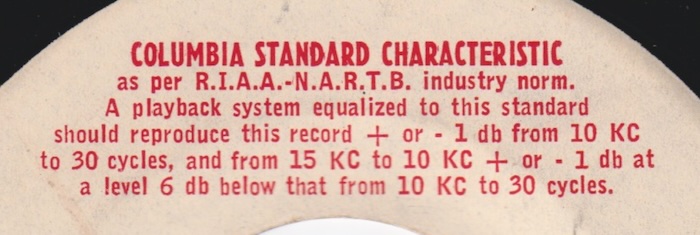
1958: effectively complete with stereo LPs
When the stereo LP was introduced in 1958, cutting equipment was designed with RIAA as the standard, leaving no room for any curve other than RIAA in stereo LP production.
→ Are all U.S. stereo LPs on the RIAA curve?
Supplement: corroboration from test records
Professional frequency-response test records also support the RIAA transition.
Before the RIAA standard was established, test records existed that were cut with various curves, including NAB, ffrr, and Columbia LP curves.
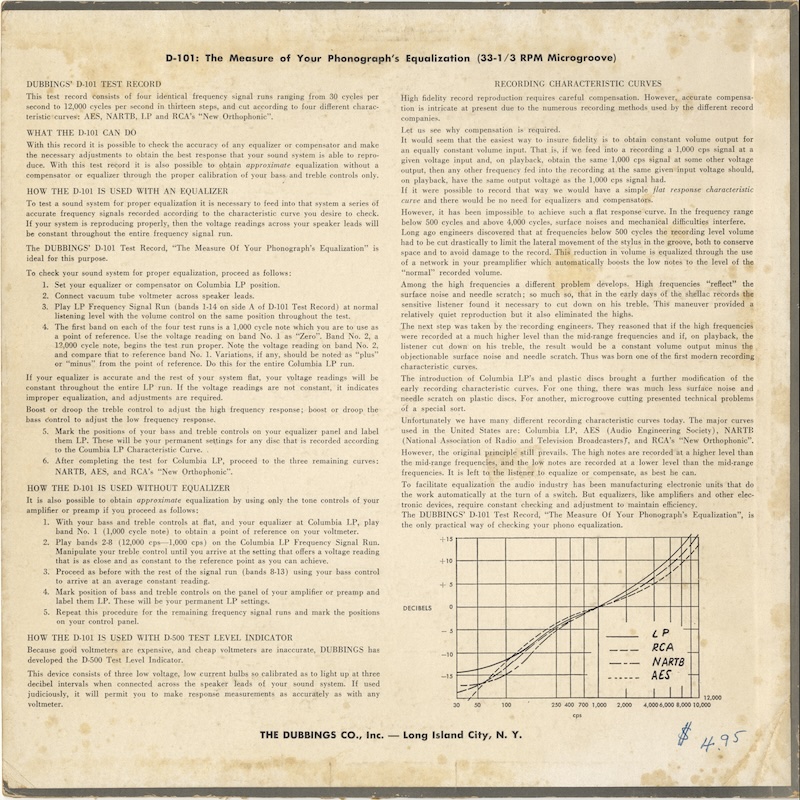
However, by the time the stereo LP was introduced, only test records cut with the RIAA curve (or RIAA with the high-frequency pre-emphasis removed) have been identified.
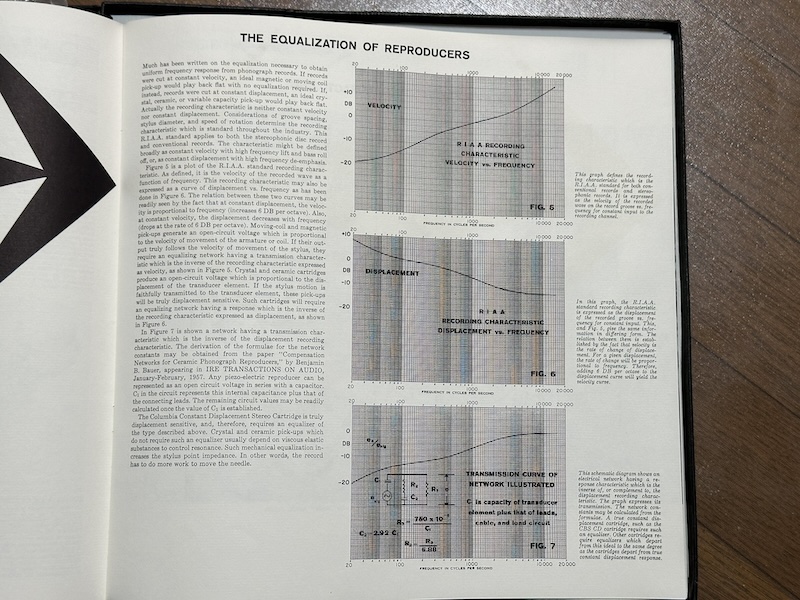
For details → Pt.21
(→ Is there a reliable EQ curve reference? — overview of documentation including test records)
Supplement: how to read this table
This table is based on primary sources the author has been able to verify. It does not cover all labels and all pressings.
In particular, some smaller independent studios may have continued to use old equipment due to lack of funds. Records of such cases were often not kept, and the exact transition dates are unknown.
Also, some independent labels in the monaural era outsourced to multiple mastering and pressing plants simultaneously. Some cut their own masters and outsourced only pressing; others sent tapes and outsourced both cutting and pressing. These varied arrangements make the full picture even harder to reconstruct. As a result, even records with the same label and catalog number may have been cut with different curves depending on the pressing.
For details → Pt.20
Revision History
- May 17, 2026: Merged the "Independent studios" table into the main label table (added Blue Note, Prestige, Contemporary / Good Time Jazz as label rows so readers can find labels in a single list)
- April 14, 2026: Added figures
- April 8, 2026: Initial publication