What is the RIAA curve? — the analog record EQ standard established in 1954
What is the RIAA curve?
Questions answered on this page: What is the RIAA curve? When and why was it created?
In short
The RIAA curve is the standard equalization characteristic used for the recording and playback of analog records. It was established in 1954 by the Recording Industry Association of America (RIAA). Virtually all records manufactured today are recorded using this curve.
For more on phono equalization itself → What is phono equalization?
Three time constants
The RIAA curve is defined by three time constants. A time constant is a value used to describe the characteristics of a filter circuit and can be converted into a frequency.
| Time constant | Corresponding frequency | Function |
|---|---|---|
| 3,180 μs | 50.05 Hz | Bass shelf — Emphasizes low frequencies during recording and suppresses them during playback to reduce the effects of rumble noise and disc warping |
| 318 μs | 500.5 Hz | Turnover — At this frequency, the amplitude of the low-frequency range is suppressed |
| 75 μs | 2,122 Hz | High-frequency pre-emphasis — Emphasizes higher frequencies during recording and restores them during playback to reduce noise |
During playback, the inverse response (amplifying the low frequencies suppressed during recording and attenuating the emphasized high frequencies) is applied. The device that correctly applies this inverse response is called a "phono equalizer."
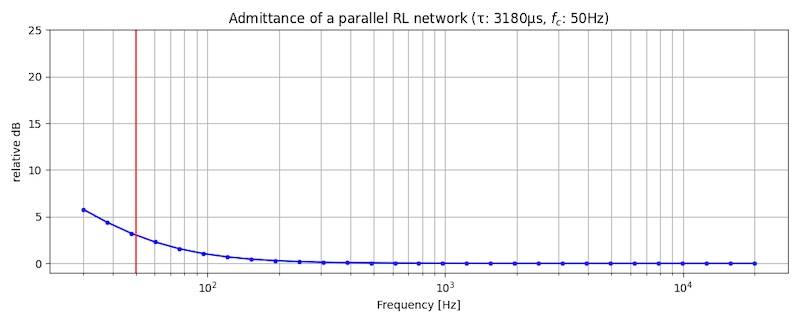
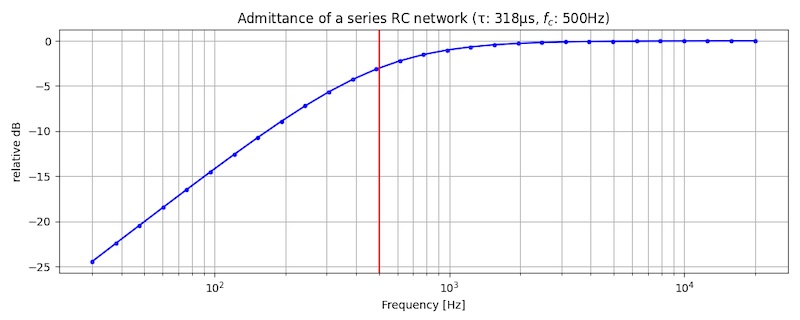
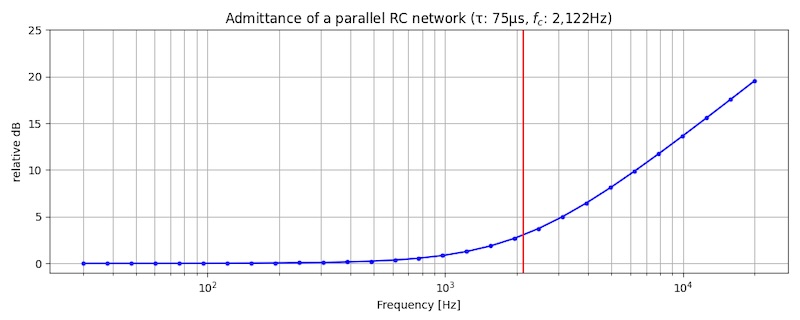
When and by whom was this decided?
Starting in early 1953, the RIAA's Recording and Reproducing Standards Committee —comprising chief engineers from the five major US labels (Columbia, RCA Victor, Decca, Capitol, and Mercury)— spent approximately one year conducting research and discussions.
On January 29, 1954, the RIAA Standard Recording and Reproducing Characteristic was officially approved. The standard document circulated formally in June of that year.
Around the same time, the broadcasters' association NARTB (June 1953) and the Audio Engineering Society (AES; provisional approval December 1953, final approval June 1954) also adopted the same time constants, resulting in all three organizations reaching the same conclusion.
→ Why was a unified standard needed, and how was it achieved?
Are all current records RIAA?
When stereo LPs were introduced in 1958, the cutting equipment was designed with the RIAA curve in mind. Since then, stereo LPs from major US labels have been recorded using the RIAA curve.
However, records produced before the RIAA standard was established (prior to 1954) and mono records from the transitional period between 1954 and 1958 include some that were recorded using different curves.
→ How should pre-RIAA records be played?
→ Are all US stereo LPs recorded with the RIAA curve?
Revision History
- April 17, 2026: Minor revision of the summary
- April 14, 2026: Added figures
- April 12, 2026: Added note on RIAA standard document circulation date (June 1954)
- April 8, 2026: Initial publication