Are U.S. stereo LPs recorded with RIAA, or with per-label EQ curves?
Are all U.S. stereo LPs recorded with RIAA curves?
Question answered on this page: Were all U.S. major-label stereo LPs recorded with RIAA curves after 1958? Or were different EQ curves used by different labels?
Introduction: two different acts
Before getting into the subject, there is an important distinction to make.
- Switching curves and comparing sounds to find your preference — this is one of the pleasures of record playback. Listening with the sound you prefer is a personal choice.
- Identifying that "this record was recorded with XX curve" — this is a separate act that requires historical and technical verification.
This page deals with the latter: which curve was in fact used for recording.
Answer: U.S. stereo LPs were recorded with RIAA curves
Stereo LPs by major U.S. labels since 1958 have been recorded with RIAA curves.
This is confirmed by multiple independent lines of evidence.
Evidence 1: design of stereo cutting equipment
When stereo LPs were introduced to the U.S. public in 1958, the entire recording system used for cutting in the United States (the stereo cutter head and recording amplifier combination) was designed with RIAA recording characteristics as the standard.
To produce stereo LPs, it was necessary to install this new cutting equipment. In other words, the entire recording system was updated to an RIAA-based design at the point when stereo LPs were produced.
This is also confirmed by technical papers written by the equipment developers themselves. Regarding the Westrex 3A stereo recording system, which played a central role in the 1958 stereo disc standardization, its developers C.C. Davis and J.G. Frayne wrote the following in The Westrex Stereodisk System (IRE paper, 1958):
"the input network of the recording amplifier provides the RIAA reproducing equalization."
The same paper further states explicitly that, in commercial cutting practice, the RIAA recording pre-emphasis characteristic is added to this:
"This characteristic is modified in commercial practice by inserting the RIAA or equivalent recording pre-equalization characteristic."
In other words, the Westrex 3A was designed from the outset with RIAA in mind, and was not designed to accommodate other EQ curves.
To cut a stereo disc with a curve other than RIAA would have required special measures to deliberately circumvent the equipment design, and no record of such measures has been found.
(→ See Pt.19)
Primary source: C.C. Davis and J.G. Frayne, "The Westrex Stereodisk System," Proceedings of the IRE, Vol. 46, No. 10, pp. 1686–1693, October 1958.
Evidence 2: cutting engineers' testimonies
Several cutting engineers have testified that RIAA curves were used in their own facilities.
- A mastering engineer at Capitol testified: "Capitol's mastering used RIAA curves. That's all."
- A cutting engineer at Decca (UK) (1957–1972) testified: "There is no such thing as the FFSS curve. FFSS is a marketing term; Decca used RIAA."
- A mastering engineer at Columbia reported, after inquiring with senior engineers, that "the switch to RIAA was completed for all releases by 1955."
- Another veteran mastering engineer at Columbia testified: "Absolutely, positively, no Columbia curve was used in the stereo era."
(→ See Pt.20)
Evidence 3: Columbia's internal documents
An internal document prepared by William Bachman, Columbia's Director of Electronics and Research, has been discovered. This document contains the following:
- A graph showing the similarity between the Columbia curve and the RIAA curve
- A note that manufacturing variation was greater than the difference between the two curves
- A statement that "the RIAA curve is ideal for reproduction of Columbia LPs, and a gradual transition to RIAA should be implemented"
The document is undated, but has been identified as having been filed between the 1955 and 1956 memos.
Also, an article in the August 28, 1954 issue of Billboard reported that at that time less than half of Columbia's mastering equipment had been converted to RIAA, and that it would take another six months to complete the transition of all equipment.
Meanwhile, the CSL (Columbia Standard Level) test disc, distributed by Columbia to radio stations beginning in February 1955, bears the label inscription: "Columbia Standard Characteristic: as per R.I.A.A - N.A.R.T.B. industry norm."
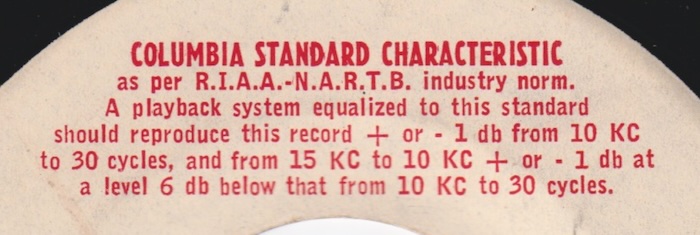
These indicate that Columbia's transition to RIAA was completed in the first half of 1955, or at the latest in the second half of 1955.
Evidence 4: Rudy Van Gelder's equipment records
Rudy Van Gelder's studio, which handled recording and cutting for jazz labels such as Blue Note, Prestige, and Impulse!, introduced RIAA recording equipment (Gotham PFB-150WA) in early 1955.
Van Gelder himself stated his use of RIAA characteristics in an article he contributed in October 1955.
Blue Note and Prestige records differ only in label artwork; cutting was all done in the same Van Gelder studio, using the same equipment.
(→ See Pt.19)
(→ Rudy Van Gelder's cutting equipment and EQ curves)
Evidence 5: the 1957–1958 stereo disc standardization process
The selection of the stereo disc standard was not a unilateral decision by any single company or country. It was a consensus-building process in which engineers from the U.S. and Europe held repeated meetings throughout 1957 and 1958. H.E. Roys of RCA, a member of the RIAA Engineering Committee and chairman of EIA Committee R 7 (Phonograph Combinations), documented this process in detail in his retrospective paper The Coming of Stereo (JAES, 1977).
The main milestones were as follows:
- September 5, 1957 — Westrex gave a private demonstration of its 45/45 system. RCA engineers heard it and ordered a cutter on the spot
- October 11, 1957 — The Westrex system was demonstrated publicly at the AES convention in New York, before an audience of about 500
- November 28, 1957 — A European meeting in Zurich, where European engineers also agreed to support the 45/45 method
- December 17–18, 1957 — The RIAA Engineering Committee met in Indianapolis and discussed adopting the 45/45 method
- January 21, 1958 — A joint EIA (Electronic Industries Association) meeting attended by 60 people from 44 companies. William Bachman of Columbia called for a vote of approval on the RIAA committee's recommendation that 45/45 be adopted as the standard, and approval was given
- February 7, 1958 — The RIAA Board neither opposed nor approved the proposal, and deferred its decision
- March 17, 1958 — Columbia demonstrated to RCA a "compatible" stereo disc (a method that restricted vertical modulation so that monaural pickups could play it). RCA judged its quality inferior to both the LP and the full stereo record
- March 25, 1958 — The RIAA Board officially approved the 45/45 stereo disc standard. Roys describes this as a decision in favor of the "full" stereo record rather than the compatible record
- March 27, 1958 — The EIA gave its final approval. Bachman reported the RIAA Board's approval to the meeting
Three bodies were involved in approval: the RIAA Engineering Committee, which made the recommendation; the EIA meetings, which endorsed it; and the RIAA Board of Directors, which gave formal approval. Bachman called for the vote at the EIA meeting of January 21. Neither Roys's paper nor RIAA Bulletin E3 (quoted in Evidence 6 below) records who moved the approval at the RIAA Board on March 25.
Of particular note are the words attributed to Arthur Haddy of Decca (UK) at one of these meetings:
"Roys, it does not matter which system we choose, we must have one and only one system."
That William Bachman of Columbia was the one who called for the vote at the EIA meeting of January 21, 1958, and that he had attended the Indianapolis meeting of December 1957 as Columbia's representative, is also indirect evidence that Columbia itself had completed its transition from the Columbia LP curve to RIAA before entering the stereo era (→ Evidence 3).
The points at issue in this standardization process were the modulation method and compatibility with existing monaural equipment. There was no discussion of adopting a separate EQ curve for stereo. The 1958 paper describing the Columbia/CBS compatible disc, "The Compatible Stereophonic Record," likewise deals only with groove geometry, vertical amplitude, wear, and stylus size, and says nothing about the recording EQ curve (Audio, May 1958, pp. 26, 28, 66–67).
Primary source: H.E. Roys, "The Coming of Stereo," Journal of the Audio Engineering Society, Vol. 25, No. 10/11, pp. 824–827, October/November 1977.
Evidence 6: the industry standard and direct statements by the parties involved
The minutes of the meetings contain no discussion of a different curve. On its own, that is weak evidence; an absence does not settle the recording characteristic. So what did the standards body itself write about it?
RIAA issued the Board's decision of March 25, 1958 as Bulletin E3, "Standards for Stereophonic Disc Records." After the clauses adopting the 45/45 system, it states (the full text was reprinted in High Fidelity, October 1958):
"The Board also approved for stereophonic disc records the same Recording and Reproducing characteristics and the same Dimensional standards as have previously been adopted for 45-rpm and 33⅓-rpm records as outlined in the RIAA Bulletins E1 and E2."
Bulletin E1 is the RIAA recording and reproducing curve itself (→ When was the RIAA curve established?). In the same resolution that adopted the 45/45 system, the standards body defined the EQ of stereo records as the existing RIAA curve.
Roys, in Evidence 5, was an RCA engineer. What did the Columbia/CBS side write? William S. Bachman of Columbia Records and Benjamin B. Bauer and Peter C. Goldmark of CBS Laboratories, in a 1962 paper surveying the history of disc recording, wrote the following after describing the adoption of the 45/45 system:
"Stereophonic records are recorded with the RIAA characteristics. Significantly, the stereophonic record standards were adopted prior to the commercial introduction of the system."
The standards body defined it in March 1958, and by 1962 the parties involved were writing it down as settled fact. In the four years between, there is no trace, on either the RIAA side or the Columbia/CBS side, of a different recording characteristic being adopted for stereo records.
Primary sources: "Bulletin E3," Recording Industry Association of America, 1958 (reprinted in full in High Fidelity, October 1958, "Noted with Interest," pp. 9–10); W.S. Bachman, B.B. Bauer, and P.C. Goldmark, "Disk Recording and Reproduction," Proceedings of the IRE, Vol. 50, No. 5, pp. 738–744, May 1962.
Evidence 7: professional stereo-era playback equipment was also designed around RIAA
Evidence 1 through 6 above all concern the recording side (cutting equipment, engineers, internal documents, the standardization process, the standards document). What about the playback side?
The Fairchild 605, released in 1960, is a professional stereo phono equalizer amplifier designed for broadcast stations, studios, and mastering rooms. Its designer, Erling P. Skov, described its EQ positions in Equalized Stereo Preamplifier for Professional Use (JAES, 1960) as follows:
"RIAA is the standard equalization for stereo records, 3,180, 318, and 75 μsec; flat is RIAA minus the treble attenuation; and roll-off is RIAA with an additional 40-μsec roll-off."
In other words, the three EQ positions provided by the Fairchild 605 were:
- RIAA — the standard
- Flat — RIAA minus the treble attenuation (a derivative defined relative to RIAA)
- Roll-off — RIAA with an additional roll-off (also a derivative defined relative to RIAA)
All three are configurations organized around RIAA as the reference. There are no positions for older EQ curves such as Columbia LP, AES, NAB, or ffrr.
In 1960, a designer of professional equipment stated outright that "RIAA is the standard equalization for stereo records," and built the EQ structure of his product around RIAA. This indicates that the stereo-era playback environment was also operated with RIAA as the common reference.
Primary source: Erling P. Skov, "Equalized Stereo Preamplifier for Professional Use," Journal of the Audio Engineering Society, Vol. 8, No. 4, pp. 250–253, October 1960.
Evidence 8: consumer stereo amplifiers also treated stereo LPs as RIAA by default
Evidence 7 looked at professional playback equipment (the Fairchild 605). Consumer stereo amplifiers for the home market show the same trend.
The year after stereo LPs were introduced to the public in 1958, Bell Sound Division (Thompson Ramo Wooldridge Inc., Columbus, Ohio) released the Bell 3030 stereo amplifier (1959). Its Installation & Operation Manual describes the EUR / RIAA / LP positions of the Function Selector Switch as follows:
"RIAA, (Recording Industry Association of America) is the present industry standard, and all current LP, 45, and Stereo discs conform."
And at the end of the same description, on how the EUR / LP positions operate:
"The RIAA, curve is on both left and right channels for stereo or monaural discs. EUR and LP curves are only on the left channel for monaural discs."
(The comma in "The RIAA, curve" appears as in the original manual.)
The manufacturer itself made "play stereo records in the RIAA position" a premise of both design and instructions. The older positions, such as EUR and LP, operate on only the left channel and exist as a secondary feature for users playing back older monaural records — they were not designed for stereo records.
Here is the key point: if stereo records had required older curves, then matching equalization would have to be present on both channels. In the Bell 3030, the older positions are physically implemented only on the left channel. This asymmetric design itself shows the manufacturer's design premise: "stereo records use RIAA."
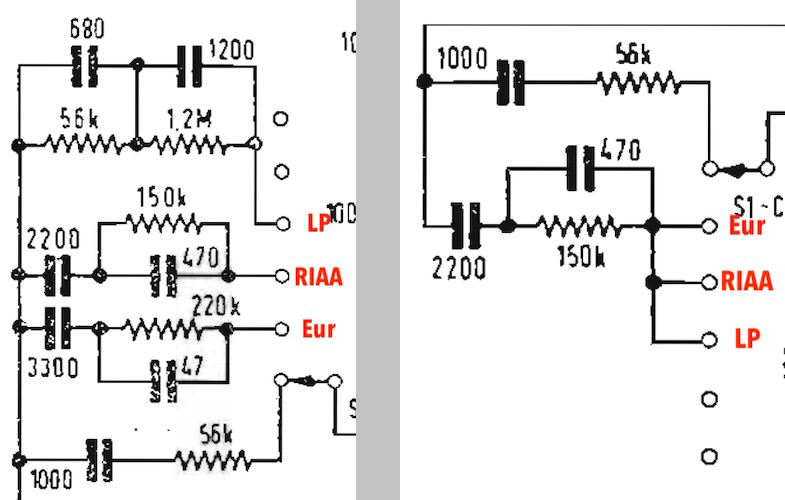
This single-channel implementation is also confirmed at other manufacturers. The 1959 catalog lists KNIGHT 720 "Bantam," Fisher X-101, and Fisher 400-C, all of which apply non-RIAA positions only to the left channel. Quad 22 (1960) uses the same design. There are exceptions — high-end units such as McIntosh C-20 (1959), Harman-Kardon Citation I (1960) / Citation "A" (1962) that operate the older positions on both channels — but the manuals of those manufacturers also specify the RIAA position for stereo records.
By the mid-1960s, the convergence becomes still more explicit. In Audio Magazine's "Annual Product Preview" of August 1964, of the 76 stereo amplifiers with built-in phono inputs that were listed, only 6 models supported curves other than RIAA (Harman-Kardon Citation "A", Marantz Model 7, McIntosh C-22 / C-24 / MA-230, Quad 22). The remaining 70 models — about 92% of the total — shipped with RIAA only. On the consumer playback side as well, the stereo-era standard converged to RIAA.
(→ See Pt.22)
Primary source: Bell Model 3030 2-Channel Stereo Amplifier Installation & Operation Manual, Bell Sound Division, Thompson Ramo Wooldridge Inc., Columbus, Ohio, 1959; Audio Magazine, August 1964, "Annual Product Preview" issue.
The recording side (Evidence 1–6) and the playback side (professional in Evidence 7, consumer in Evidence 8) of the stereo era can be confirmed, from multiple independent primary sources — equipment design, internal documents, the standardization process, the standards document, owner's manuals, and quantitative market data — to have been designed and operated with RIAA as the common reference.
So why does the "non-RIAA curve" theory exist?
On the other hand, there is also a claim in circulation that "most U.S. stereo LPs are recorded with non-RIAA curves." The following summarizes the typical arguments offered for this claim.
1. Judgments based on aural comparison
When you switch curves on a variable-EQ phono equalizer, the sound changes. And sometimes one setting sounds "better" than another.
However, changing the EQ curve is a change in frequency response and phase response. It is physically natural for the sound to change, and "the sound changed" does not mean "the recording curve has been identified."
(→ Can you hear a difference when you change the EQ curve?)
2. "Recommended curve" lists by label
Several tables on the Internet assign the "correct EQ curve" to each label. However, comparing these tables reveals cases where different curves are recommended for the same label.
For example, one table recommends "AES" for a given label, another recommends "NAB," and yet another recommends "Columbia."
If these tables were based on objective measurements, the recommendations for the same label should match. The fact that they disagree suggests that these tables reflect subjective choices based on aural preferences.
3. Confusion between "recommended playback settings" and "recording curves"
The "recommended settings by label" lists that appeared in 1950s magazine articles were guides to recommended settings on the playback side (in effect, "it is easier to listen with these settings"). They were not records of the curves used at the time of recording. There are cases where these two have been confused.
4. The implicit assumption that "label = curve"
Label-specific curve lists rest on the premise that once you know the label, you know the curve. However, a record's EQ curve is determined during the cutting process — specifically, by the recording system (cutter head and recording amplifier combination) used for cutting.
Not every label owned its own cutting facilities. Outsourcing cutting and pressing was common, and the actual production process cannot be captured by a simple "label = curve" correspondence.
- Blue Note and Prestige records were both cut at Rudy Van Gelder's studio, using the same equipment, by the same engineer (different labels sharing the same studio, equipment, and engineer)
- Contemporary and Good Time Jazz initially outsourced cutting and pressing to the Charles Eckart Company, but later their in-house engineer Roy DuNann took over cutting himself, with only pressing outsourced to the Capitol LA plant or the RCA Victor Hollywood plant (the same label changing its cutting arrangements over time)
- Mercury Living Presence had its records cut at Fine Sound Studios or Fine Recording, while pressing was outsourced to the RCA Victor Indianapolis plant or Richmond Record Pressings plant (cutting and pressing performed at separate facilities)
If "each label had its own curve," then Van Gelder would have had to change his equipment settings every time he switched between Blue Note and Prestige sessions.
On the other hand, major labels like RCA Victor and Columbia, which operated cutting facilities across the country, had established internal practices to maintain near-uniform quality regardless of which facility performed the cutting. While results were not always identical — cutting engineers differed in skill and taste — at the very least, the EQ curve standard was unified within the company. And that standard was RIAA (→ Evidence 3).
Furthermore, stereo-era disc recording equalizers had fixed characteristics, aside from a calibration position (treble pre-emphasis only OFF), and changing the curve was not straightforward. Even if a change were possible, it would require test cutting and measurement each time to verify that the change was correctly applied. No record of such work being performed every time the label changed is known to the author (at least, the author has been unable to confirm any).
What determines the EQ curve is not the label name but the equipment used for cutting. And stereo-era cutting equipment was designed with RIAA as the standard (→ Evidence 1).
That said, when listening to stereo-era U.S. LPs side by side, real differences in sound between labels and recording sites are often audible. These differences come not from EQ curves but from the recording chain upstream of cutting — microphone choice and placement, program EQ, mixing, tape-machine characteristics, the engineer's sound-shaping decisions, and processing at the mastering stage. These elements lay outside the scope of RIAA standardization, and they are where each engineer, studio, and label leaves their own fingerprint.
(→ What factors besides the EQ curve affect the sound of a record?, Which determines the sound, the EQ curve or the mastering?)
Supplement: what this page does not claim
This page does not negate the following points.
- It is historical fact that multiple EQ curves existed during the pre-RIAA period (before 1954). Before RIAA was established, each label used its own curve (→ The History of Phono EQ Curves: In a Nutshell)
- During the monaural LP transition period (1954–1958), some records may have remained on non-RIAA curves. The timing of transition varied, especially among independent studios (→ When did each label switch to RIAA?)
- It is physically natural that changing the EQ curve changes the sound.
- Listening with the sound you prefer is a personal choice.
Summary
That U.S. stereo LPs (1958 onward) were recorded with RIAA curves can be confirmed by multiple independent lines of evidence: the design of the cutting equipment, engineer testimonies, internal company documents, equipment records, the industry-wide standardization process, direct statements by the standards body and the parties involved, and the design of playback equipment.
As for the claim that they were recorded with non-RIAA curves, the author has not so far been able to confirm any presentation of grounds drawing on primary sources (recording equipment specifications, cutting engineers' testimonies, or label technical documents). Aural comparison appears to be the principal basis offered.
Switching curves and comparing sounds is one of the pleasures of record playback, but "what sound do you prefer" and "what curve was used in the recording" are two different questions. We hope this page helps in making that distinction.
Revision History
- September 10, 2026: Added Evidence 6, "the industry standard and direct statements by the parties involved" (RIAA Bulletin E3; Bachman, Bauer, and Goldmark, 1962), and renumbered the former Evidence 6 and 7 as 7 and 8. Corrected Evidence 5 against the primary source (Roys 1977): Roys's position (member of the RIAA Engineering Committee, chairman of EIA Committee R 7); the September 5, 1957 demonstration was private, with the public demonstration at the AES convention on October 11; Bachman called for the vote at the EIA meeting of January 21, 1958, not at the RIAA Board on March 25. Added the Board meeting of February 7 and the compatible disc demonstration of March 17 to the chronology
- May 17, 2026: At the end of the "So why does the 'non-RIAA curve' theory exist?" section, added a note that audible differences come from the recording chain upstream of cutting (microphones, program EQ, mixing, tape, engineer's decisions, mastering) rather than from EQ curves, with links to related FAQs. Added partial bolding to the concluding sentence
- May 16, 2026: Added Evidence 7 (design and owner's manuals of consumer stereo amplifiers, with tabulation from the August 1964 issue of Audio Magazine). Added the CSL test disc label to Evidence 3 and the Bell 3030 schematic to Evidence 7. Added AES E-Library links to Evidences 5 and 6
- April 17, 2026: Minor revision of the summary
- April 10, 2026: Added primary sources (Westrex 1958 quotation in Evidence 1, new Evidence 5 on the standardization process and Evidence 6 on playback equipment), with tone adjustments
- April 9, 2026: Added section on the "label = curve" assumption
- April 8, 2026: Initial publication