Rudy Van Gelder's cutting equipment and EQ curves — what the equipment records and his own testimony tell us
What equipment did Rudy Van Gelder use for cutting?
Question answered on this page: What equipment did Rudy Van Gelder, the engineer who cut records for Blue Note and Prestige, use, and what EQ curve did he cut with? And how do his equipment and EQ curve choices relate to the debate over EQ curves?
An engineer who controlled everything from recording to cutting
Rudy Van Gelder (1924–2016) was the engineer behind decades of recordings and lacquer cutting (mastering) for jazz labels including Blue Note, Prestige, and Impulse!
Van Gelder handled everything from recording to cutting himself. Most labels farmed out recording and cutting to different studios and different engineers, but Van Gelder controlled the entire chain (from microphone selection to lacquer cutting) under one roof.
Originally a practicing optometrist, Van Gelder began recording discs at home in the mid-1930s, around age twelve (Skea 2002, p.55), and by the 1940s was taking on direct-to-disc recording work on 78 rpm acetates (RVG Legacy). Around 1950, he transitioned to tape recording (Ampex 300), and in 1953 he acquired a Fairchild 523 cutting lathe to begin mastering in-house. The move into self-contained cutting led him to secure Blue Note Records and Vox Records as clients.
Producer Bob Porter noted that Van Gelder could "put more level on an LP than anyone else" in the business.
The evolution of his cutting equipment
Before Grampian / Gotham (1953 – early 1955)
For the period from when Van Gelder acquired the Fairchild 523 cutting lathe in 1953 to the installation of the Gotham PFB-150WA (March 1955), no primary source directly indicating the cutting curve Van Gelder used has been identified to date. Before Van Gelder, Blue Note was cut at WOR Studios, whose chief engineer was a member of the AES standards committee, which suggests the AES curve as a possibility (→ Pt.17). For the pre-Gotham era (1953-1954) at Van Gelder's Hackensack studio after he took over Blue Note's cutting from WOR Studios, however, the Vox pressings confirmed as RVG cuts from the same period carry "NAB" on the back jacket as a clue, but whether that directly indicates the actual cutting curve is a separate question. Multiple possibilities remain for the pre-Gotham RVG cutting curve.
The detailed argument (Vox / Prestige / Blue Note matrix and jacket markings, the ambiguity of the "NARTB" marking, a staged confidence assessment, and means of long-term average spectrum (LTAS, an averaged frequency spectrum over an extended time window) verification) is organized on a separate page.
→ What cutting curve did Rudy Van Gelder use before installing his Gotham (1953 to early 1955)?
Grampian / Gotham system onward (early 1955–): the switch to RIAA
Van Gelder then turned his attention to improving his cutterhead and cutting amplifier.
He adopted the BBC-standard Grampian B1/AGU cutterhead, but found the companion Grampian RA4 cutting amplifier underpowered. He asked Rein Narma, an engineer at Gotham Audio in Manhattan, to develop a more powerful cutting amplifier. The result was the Gotham PFB-150WA, a 150-watt cutting amplifier with built-in RIAA recording equalization (RVG Legacy).
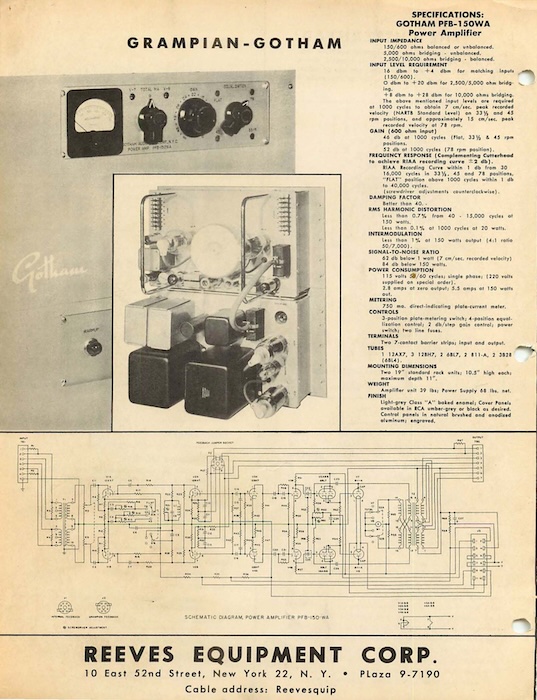
A frequency measurement graph of this system dated March 11, 1955 (measured by Jay McKnight, verified by Rein Narma) is available on the RVG Estate website.
That same year, Van Gelder invested in a Scully 601 cutting lathe ($8,500, roughly $80,000 in today's dollars). In 1962, he acquired a second unit, enabling simultaneous dual-master cutting.
The stereo era: Fairchild → Westrex (late 1950s–)
With the arrival of stereo, Van Gelder adopted the Fairchild 642 stereo cutterhead, co-designed by Rein Narma, the same engineer he had worked with since the Gotham days. Although the competing Westrex system became the industry standard, Van Gelder continued using the Fairchild for several years.
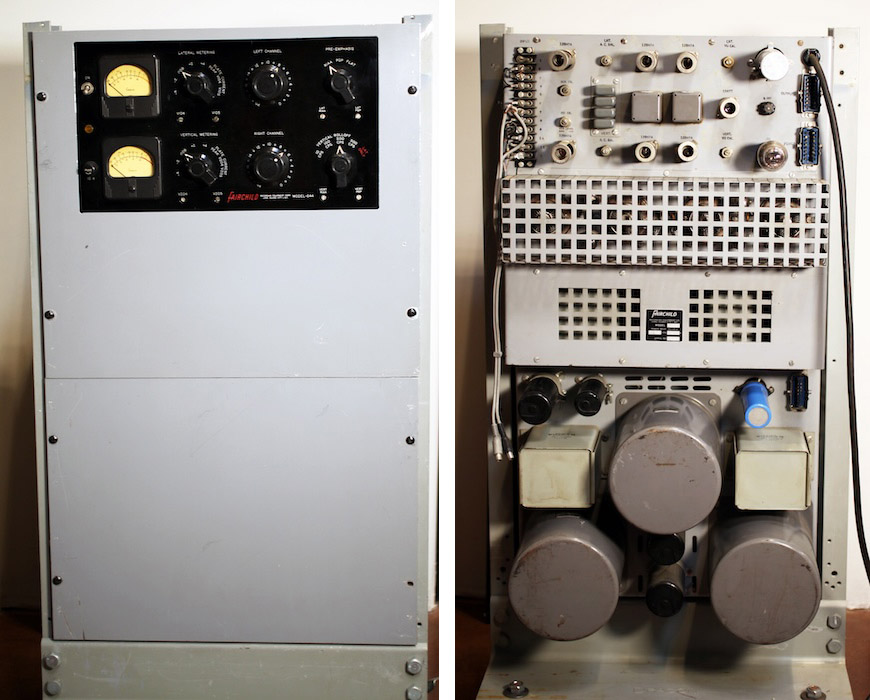
Around 1965, he finally transitioned to the Westrex 3D II cutterhead. This system remained in use for decades (RVG Legacy).
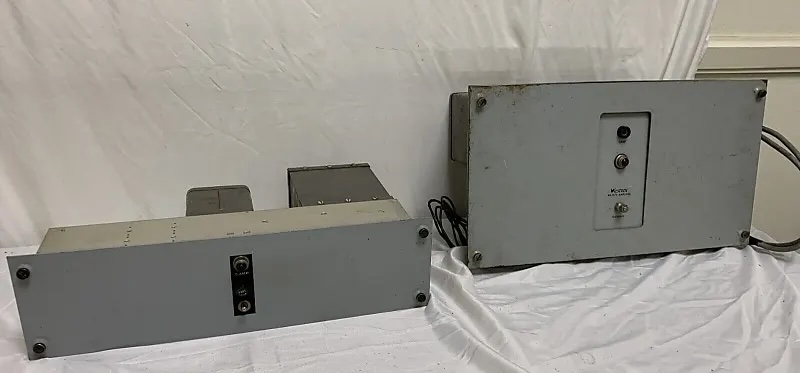
Both the Fairchild 641 system (which included the 642 cutterhead) and the Westrex system were designed around the RIAA recording characteristic (→ Pt.19).
Van Gelder's own testimony
In a contributed article titled "How Quality Of Old Discs Is Brought Up In Standard," published in Down Beat on October 19, 1955, Van Gelder described the process of remastering older recordings. Regarding cutting, he stated:
"Incidentally, these remastered recordings should be played back with the same reproduction curve as any new records. In my case, I use the standard RIAA curve."
— Rudy Van Gelder, "How Quality Of Old Discs Is Brought Up In Standard," Down Beat, October 19, 1955, p.20
The equipment records and his own testimony are consistent. The Gotham PFB-150WA introduced in early 1955 (RIAA recording EQ built in), the Fairchild 641 from the late 1950s (RIAA recording EQ), and the Westrex system from 1965 (RIAA recording EQ) were all designed around the RIAA characteristic.
For details → Pt.20
Connection to the EQ curve debate
Van Gelder's cutting equipment and his own testimony both point to the use of the RIAA characteristic.
These records and testimony together show that Van Gelder was cutting with the RIAA curve from early 1955 onward.
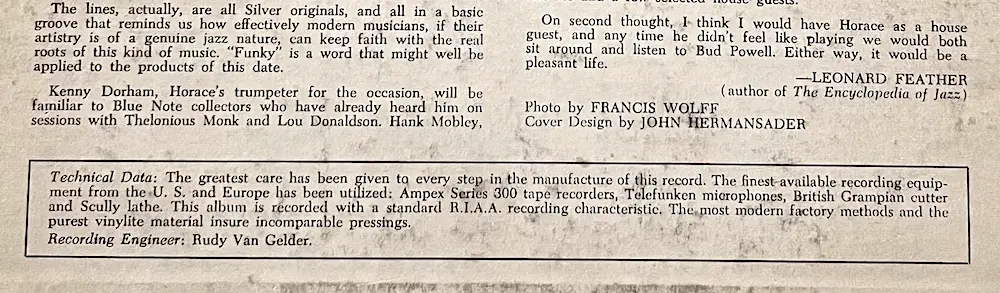
Blue Note and Prestige records bear different label artwork, but the cutting was all done at the same Van Gelder studio, using the same equipment.
→ Are all U.S. stereo LPs on the RIAA curve?
"Reissues sound different" is not about the cutting EQ
You sometimes hear the argument: "If the original LP and a modern reissue of the same recording sound different, doesn't that mean the original was cut with a different curve?" But the difference between the original LP and a reissue can be explained as a difference in the mastering stage, independent of the cutting EQ.
Van Gelder himself, in a November 1995 Audio Magazine interview, put it this way:
"Reissuing is nothing but post-production."
— Van Gelder, interview by James Rozzi, Audio Magazine, November 1995
The mastering done at reissue time is a separate process from the cutting EQ.
The perceptual difference of "the original sounds different from the reissue" can be explained by mastering-stage sound shaping (centering, compression, and low-end reduction newly added at the RVG Edition CD 1999 stage), rather than by a difference in the cutting EQ curve. A 3-way LTAS comparison of the 1958 Somethin' Else recording demonstrates this.
→ Where is the RVG sound made? Recording- and mastering-stage sound shaping (the recording- and mastering-stage sound shaping organized through quotations and primary sources)
→ Somethin' Else 3-way LTAS — measuring the processing newly added at the RVG Edition stage (a case study measuring three CDs of the 1958 Somethin' Else recording)
Further reading
- What cutting curve did Rudy Van Gelder use before installing his Gotham (1953 to early 1955)? — A companion to this FAQ. Evidence from Vox / Prestige / Blue Note jacket markings on the pre-Gotham RVG cutting curve, with a staged confidence assessment
- RVG Legacy — A comprehensive site on Van Gelder's equipment and recordings, built by Richard Capeless from primary sources with the cooperation of the Van Gelder Estate. Includes previously unpublished photographs and technical documents
- Pt.18 — The Grampian B1/AGU cutterhead and the Gotham PFB-150WA
- Pt.19 — The Gotham PFB-150WA, Fairchild 641, and Westrex 3D II in detail
- Pt.20 — Van Gelder's 1955 Down Beat article
Acknowledgments
This FAQ belongs to a four-part set on RVG cutting and mastering. Richard Capeless of RVG Legacy provided advice and review comments that shaped the revision and split. My thanks for the help.
Revision History
- June 2, 2026: Added the full term ("long-term average spectrum") at the first mention of "LTAS".
- June 1, 2026: Split the related FAQ "Where is the RVG sound made?" into two pages: "Where is the RVG sound made? Recording- and mastering-stage sound shaping" and "Somethin' Else 3-way LTAS — measuring the processing newly added at the RVG Edition stage". The pointer at the end of the "Connection to the EQ curve debate" section in this FAQ has been updated to point to both. Rewrote the "Before Grampian / Gotham (1953 to early 1955)" section to be more neutral, splitting the detailed discussion off into a new FAQ "What cutting curve did Rudy Van Gelder use before installing his Gotham (1953 to early 1955)?"
- May 17, 2026: Added figure (close-up of Blue Note BLP-5058 back cover with explicit RIAA marking, one of the earliest Blue Note LPs to do so)
- May 11, 2026: Separated "The 'RVG sound' is not about the EQ curve," "Measuring the 1958 Somethin' Else," and "The cutting EQ curve and sound shaping are separate matters" into a new FAQ Where is the RVG sound made? A 3-way LTAS of Somethin' Else. This FAQ now ends at the "Connection to the EQ curve debate" section with a pointer to the new FAQ
- May 11, 2026: Expanded the LTAS comparison of the 1958 Somethin' Else recording to a 3-disc comparison (Capitol/Blue Note 1987 McMaster / RVG Edition 1999 / Analogue Productions 2009) and expanded the figures to 5. Confirmed via the 3-disc comparison that the centering processing was newly added at the RVG Edition CD 1999 stage. Organized Steve Hoffman's interpretation of LP cutting master stage sound shaping and tabulated its correspondence with the 3-way LTAS. Added quotes from Van Gelder's own 2012 JazzWax interview (interviewer Marc Myers): the joint work with Alfred Lion, control of the entire recording chain, and his own description of the lacquer master process
- May 6, 2026: Expanded the "RVG sound is not about the EQ curve" section into a two-stage structure (session recording stage / mastering stage). Added Hackensack studio acoustics, the Telefunken U47 close-miking strategy, Billy Taylor's piano-recording testimony from Skea 2002, and the construction of the Englewood Cliffs dedicated studio in 1959 (designed by David Henken) with its contrast to Hackensack (RVG Legacy) to the session recording stage. Added quotes from Van Gelder's own testimony (1995 Audio Magazine interview by James Rozzi; 2005 All About Jazz article by Chris M. Slawecki). Added an LTAS comparison (author's analysis) of the 1958 Somethin' Else recording as a table and figures
- April 14, 2026: Added figures
- April 8, 2026: Initial publication