What cutting curve did Rudy Van Gelder use before installing his Gotham (1953 to early 1955)?
What cutting curve did Rudy Van Gelder use before installing his Gotham (1953 to early 1955)?
Question answered on this page: What cutting curve did Rudy Van Gelder use before he installed the Gotham PFB-150WA cutting amplifier (1953 to early 1955)? What can, and what can't, the matrix numbers and jacket markings of Vox, Prestige, and Blue Note pressings tell us?
Where this page sits
This page is a companion to the sister FAQ What equipment did Rudy Van Gelder use for cutting? and treats one specific question: which curve Van Gelder used for cutting before he installed his Gotham PFB-150WA in March 1955 (i.e., from 1953 through early 1955). For the post-March 1955 RIAA confirmation, established by equipment records, Van Gelder's own testimony, and the jacket notation on Prestige PRLP-199, see the sister FAQ.
No primary source directly indicating Van Gelder's cutting curve during this period has been identified to date. To organize the available evidence, two periods need to be considered separately: the WOR Studios era, when Blue Note's records were cut before Van Gelder took over the work, and the Hackensack era (from 1953), when Van Gelder began cutting in his own studio.
WOR Studios era (before Van Gelder)
Before Van Gelder took over Blue Note's work, Blue Note's cutting was done at WOR Studios. The chief engineer at WOR Studios was also a member of the AES standards committee (→ Pt.17). This lineage suggests that the WOR Studios era Blue Note may have been cut with the AES curve. However, there is no direct confirmation from a primary source, and verification is limited. Comparing the pre-RIAA 10-inch LP and the RIAA 12-inch LP of the same recording is unreliable: the latter is likely to have substantial sound shaping added by Van Gelder, which limits how far the comparison can go.
Hackensack era (Van Gelder, from 1953)
For the period from 1953 onward, when Van Gelder began cutting at his Hackensack home studio, no primary source has been found showing which curve his own setup used either. Below, we look at what the jacket markings of the Vox and Prestige pressings cut at Van Gelder's studio during the same period (1953 to early 1955) can, and cannot, tell us.
Evidence from Vox jackets
Three Vox pressings (PL 8140 / VX 500 / PL 8710) are confirmed Van Gelder pre-Gotham (1953-1954) cuts, identified by the matrix and the "RVG" stamp in the deadwax. All three jackets have NAB marked as the playback recommendation. Across the Vox catalog, the jacket marking switches from NAB to RIAA during 1954; the boundary appears in the Billboard issue of December 18, 1954, which carried side-by-side reviews of PL 8910 (NAB jacket) and PL 8960 / PL 9050 (RIAA jackets) on the same page. The full matrix survey of the Vox catalog is being compiled separately.
The "NAB" marking here can be read as referring to the 1942/1949 NAB curve. The earliest jacket-NAB Vox pressing reviewed in Billboard during this author's Vox survey was PL 8030, first noted in the May 9, 1953 issue's "Reviews of the Current Classical Releases" (PL 8030 itself was cut at Columbia, XTV matrix, and is not a Van Gelder cut). This review date predates the June 19, 1953 approval of the 1953 NARTB revised curve (equivalent to the New Orthophonic curve and to the later RIAA). There is therefore no chronological possibility that Vox's "NAB" naming originally referred to the 1953 NARTB revised curve. The Dialing Your Disks series, first installment (January/February 1953 issue), also lists Vox's own label-questionnaire response as NAB turnover plus NAB rolloff. Vox kept the "NAB" jacket marking consistently until switching to RIAA in November/December 1954, and reading the Vox jacket "NAB" marking as 1942/1949 NAB throughout is the consistent interpretation.
That said, the jacket "NAB" markings cannot be taken to mean that "Van Gelder actually cut with the 1949 NAB curve". Jacket markings are playback recommendations, not direct records of the actual cutting curve. This is the same framework as detailed in the Dialing Your Disks FAQ, and the Vox catalog itself illustrates it: the majority of 1953-1954 Vox pressings were actually cut at Columbia (XTV matrix), and although they were cut with the Columbia LP curve, the jackets still say "NAB." This is because the Columbia LP curve and 1942/1949 NAB are nearly identical except for the bass shelf, and in the labels' and listeners' understanding of the time, Columbia LP ≒ NAB was the accepted view (since Vox was using another company's facility, printing "Columbia LP" on the jacket would have been difficult for trademark reasons).
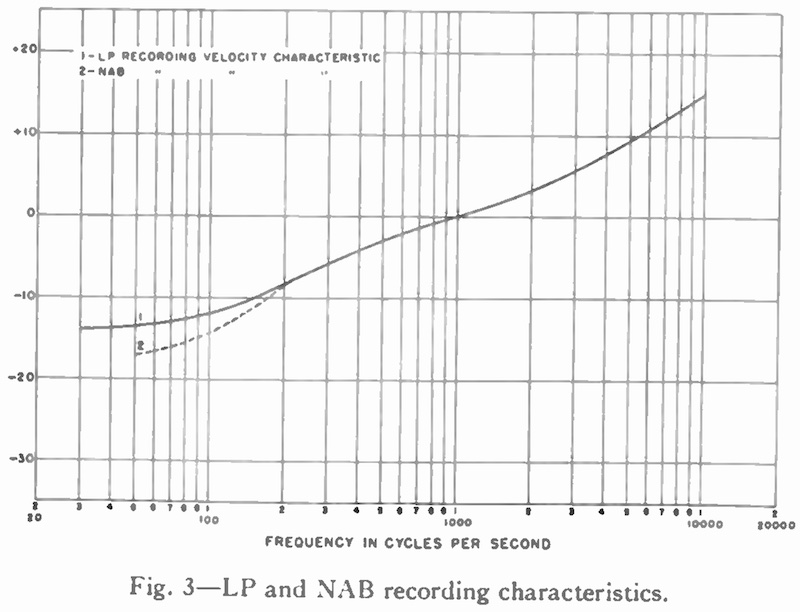
Overall, the jacket markings allow only the inference that "Van Gelder may have intended to cut with 1949 NAB in the pre-Gotham era." Given Vox's own "NAB" stamping on its Columbia-cut commission pressings, the jacket markings cannot be a basis for stating the actual cutting curve definitively.
The Prestige case and the ambiguity of "NARTB" — an anchor for dating the Gotham install
For Prestige pressings cut at Van Gelder's studio, PRLP-198 and earlier also include many pre-Gotham RVG cuts with "RVG" stamps in the deadwax, but the jackets carry no playback-curve marking, so the actual cutting curve cannot be inferred from the jacket. The earliest example the author has been able to trace via deadwax is PRLP-180 (Hackensack recording; the corresponding 12-inch reissue is PRLP-7053). The criteria used here to identify RVG cuts on Prestige 10-inch LPs are: "RVG" clearly written in the Matrix / Runout field on Discogs entries; "RVG" visible by eye on label-area scans found online (zoomed in); and as corroboration, recording sessions confirmed to have taken place in Hackensack, NJ. Starting with PRLP-199 (Jimmy Raney 1955, Hackensack recording on February 18 and March 8, 1955, with "RVG" stamp in the deadwax and Plastylite earmark, reviewed in the June 29, 1955 issue of Down Beat, "Down Beat Jazz Reviews," p.15), a playback-curve marking appears on the jacket for the first time, written as "NARTB." From PRLP-200 onward (and especially PRLP-207 onward), the marking is unified as "RIAA" (for the full Prestige listing, see the Prestige table in the Dialing Your Disks FAQ).
The "NARTB" marking here requires care. "NARTB" is an organization name (the National Association of Radio and Television Broadcasters, the renamed NAB), but the industry of the time used the same name to refer to multiple distinct curves. The 1942/1949 NAB curve (HF pre-emphasis 100 μs, turnover 318 μs, bass shelf 3,180 μs) and the 1953 NARTB revised curve (HF pre-emphasis 75 μs, turnover 318 μs, bass shelf 3,180 μs, approved June 19, 1953, equivalent to RCA New Orthophonic and 1954 RIAA) were both approved by the same organization, but the curves themselves are different.
For Prestige PRLP-199, however, the chronology fixes which curve the marking refers to. The pressing was recorded in February-March 1955 and manufactured in spring to early summer 1955, more than a year after the RIAA standard was finalized in January 1954. With a jacket marked "NARTB" at this timing, it cannot chronologically be 1942/1949 NAB; it can only refer to the 1953 NARTB revised curve (≒ 1954 RIAA). The shift to the "RIAA" marking from PRLP-200 onward presumably reflects the desire to avoid confusion with 1942/1949 NAB.
From the catalog numbers and the Hackensack recording dates, the most consistent reading is that the Gotham PFB-150WA was first introduced at the time of cutting PRLP-199 and the disc was cut with RIAA, while PRLP-198 and earlier RVG-cut Prestige 10-inch LPs are pre-Gotham cuts (the actual curve cannot be inferred from the jacket). This also matches the date of the Gotham PFB-150WA's frequency response measurement: March 11, 1955 (measured by Jay McKnight, confirmed by Rein Narma; published on the RVG Estate site).
The Blue Note case: jacket silence and the puzzle of the conventional wisdom
The Blue Note case is one step more complicated. As with Prestige, Blue Note's pre-RIAA (pre-Gotham) era pressings, unlike Vox, carry no playback-curve markings on the jacket or the label. So Van Gelder's pre-RIAA cutting curve cannot be read from these jackets. The conventional wisdom "Blue Note = AES" originates in Blue Note's response in the first installment (January/February 1953 issue) of the contemporary trade publication Dialing Your Disks series, but that response is likely to reflect the WOR Studios era curve from before Van Gelder took over. If RVG cut Blue Note records with a curve other than AES (e.g., NAB) after he took over (from 1953 onward), the change might not have been reflected in the trade press's tables. For the Blue Note pre-RIAA period, then, both possibilities (that RVG cut with NAB, and that RVG cut with AES) currently remain open.
There is a tension here. From 1953 onward, Van Gelder was cutting both Vox (jackets marked "NAB" = consistently readable as 1942/1949 NAB) and Blue Note in the same Hackensack room during the same period, in parallel. If Blue Note really were cut with AES, then Van Gelder would have been running NAB (for Vox) and AES (for Blue Note) in parallel in the same studio, which is hard to imagine unless he had multiple mastering rigs. From the standpoint of cutting-floor practice, the more natural reading is that Blue Note's pre-RIAA cuts were also done with the same NAB.
That said, no primary source from the Blue Note side has been found that confirms this reading. One possible verification method would be to compare a pre-RIAA 10-inch LP and a RIAA 12-inch LP of the same Blue Note recording (e.g., a pre-Gotham / Gotham pair such as Miles Davis BLP 5040 and BLP 1502). The latter, however, was re-cut by Van Gelder himself in later years, and substantial sound shaping is likely to have been added at that mastering stage, so the comparison is confounded as a pure curve comparison. Reaching a definitive conclusion would require long-term average spectrum (LTAS, an averaged frequency spectrum over an extended time window) analysis or systematic multi-disc comparisons separately.
Current confidence and remaining means of verification
Van Gelder's pre-Gotham (1953 to early 1955) cutting curve can be evaluated in stages as follows.
- A — Confirmed (jacket-level and equipment-level evidence):
- The three Vox pre-Gotham RVG cuts (PL 8140 / VX 500 / PL 8710) all carry "NAB" on the jacket.
- Vox's "NAB" refers to the 1942/1949 NAB curve (confirmed by chronological argument).
- From March 1955 onward (after the Gotham PFB-150WA was installed), the cut was RIAA (confirmed by equipment records, Van Gelder's own testimony, and the "NARTB" jacket marking on Prestige PRLP-199).
- B — Inferred (not directly measured):
- The three Vox pre-Gotham RVG cuts were most plausibly cut with the 1942/1949 NAB curve. The basis is jacket-marking consistency and the NAB mainstream practice of the time, not direct measurement via LTAS analysis or transfer.
- Blue Note's Hackensack-era pre-RIAA cuts were most plausibly NAB as well, given the implementation-side reading that running Vox (NAB) and Blue Note (AES) in parallel in the same room during the same period would have been impractical. With no primary source supporting either curve choice, however, the AES possibility for Blue Note remains open.
- The popular view that "Van Gelder cut with AES at Hackensack" — based on Blue Note's response to the 1953 Dialing Your Disks survey, which more likely reflects the WOR Studios era curve before Van Gelder took over — is not directly supported by any primary source identified to date.
- C — Unresolved (resolution would shift the conclusion):
- LTAS measurement of pre-Gotham RVG cuts. LTAS of a single disc is not decisive on its own; comparison with reference pressings of known curves is required. Candidates include an A/B comparison of Vox VX 500 (pre-Gotham RVG cut, NAB jacket) and VX 25200 (1956 12-inch RIAA reissue, with RVG cutting at the Gotham era confirmed), or a comparison with same-era Columbia classical LPs (since the Columbia LP curve and 1942/1949 NAB differ only in the bass shelf, this is a well-targeted reference)
- LTAS comparisons of pre-Gotham 10-inch LPs and Gotham-era 12-inch RIAA reissues of the same Blue Note and Prestige recordings (Richard Capeless's RVG Discography can be used for RVG cut identification on both labels). For Blue Note, candidates include Miles Davis BLP 5040 and BLP 1502 (recorded March 6, 1954 in Hackensack), and Lou Donaldson BLP 5055 and BLP 1537 (recorded August 22, 1954 in Hackensack); all RVG cuts. For Prestige, candidates are Hackensack-recording pairs released as PRLP-198 or earlier and later reissued on 12-inch LP. Examples include Sonny Rollins & Thelonious Monk PRLP 190 and PRLP-7075 (recorded September 22 and October 25, 1954 in Hackensack); all RVG cuts.
No primary source directly indicating Van Gelder's pre-Gotham cutting curve has been found at present. At the level of jacket-marking inference, Vox is most plausibly 1942/1949 NAB, and Blue Note is more plausibly NAB but with AES still possible. Definitive resolution will require LTAS analysis and other direct measurement going forward.
Related pages
- → What equipment did Rudy Van Gelder use for cutting? — Sister FAQ to this page; the cutting equipment lineage and the post-1955 RIAA confirmation
- → Dialing Your Disks — The 1950s trade-press playback-curve recommendation tables referenced in this article's discussion of Vox / Prestige jacket markings
Acknowledgments
This FAQ belongs to a four-part set on RVG cutting and mastering. Richard Capeless of RVG Legacy provided advice and review comments that shaped the revision and split. My thanks for the help.
Revision History
- June 2, 2026: Added the full term ("long-term average spectrum") at the first mention of "LTAS". Rewrote the "Current confidence and remaining means of verification" bullet list to separate pre-Gotham and Gotham-era points and to give context to the "AES at Hackensack" mention. Replaced the example for the earliest deadwax-traceable RVG cut from PRLP-142 to PRLP-180, and added the criteria used to identify RVG cuts on Prestige 10-inch LPs.
- June 1, 2026: Initial publication (split off from the sister FAQ "What equipment did Rudy Van Gelder use for cutting?", separating the pre-Gotham cutting-curve discussion)