(In a Nutshell Part 2) How did unification finally happen? — From the postwar era to the birth of the RIAA curve (1942–1954)
← Part 1 | In a Nutshell top | Part 3 →
How did unification finally happen?
In Part 1, we saw how the first standard for broadcast use (NAB) was born in 1942. But for consumer records, another twelve years would pass. During that time, the proliferation of curves actually got worse. How, then, did unification ultimately come about?
1. Wartime origins of cooperation
When the 1942 NAB standard was established, the United States was in the midst of World War II. Under wartime conditions, shellac—a key raw material for records, sourced primarily from Southeast Asia—was in short supply. Vacuum tubes and aluminum were also subject to priority allocation for military use.
Ironically, this crisis became the catalyst that broke down industry barriers.
Engineers from competing labels began holding regular meetings to share surplus stocks of lacquer discs and vacuum tubes. These gatherings, known as the "Sapphire Group," initially focused on business-level cooperation but gradually evolved into forums for technical discussion.
Until then, each company's recording technology had been closely guarded trade secrets. Through the Sapphire Group's activities, however, technical information began to be published and shared, fostering momentum toward standardization. This network of personal connections would later become the foundation for the establishment of AES (Audio Engineering Society) and the development of the RIAA standard (see Pt.16).
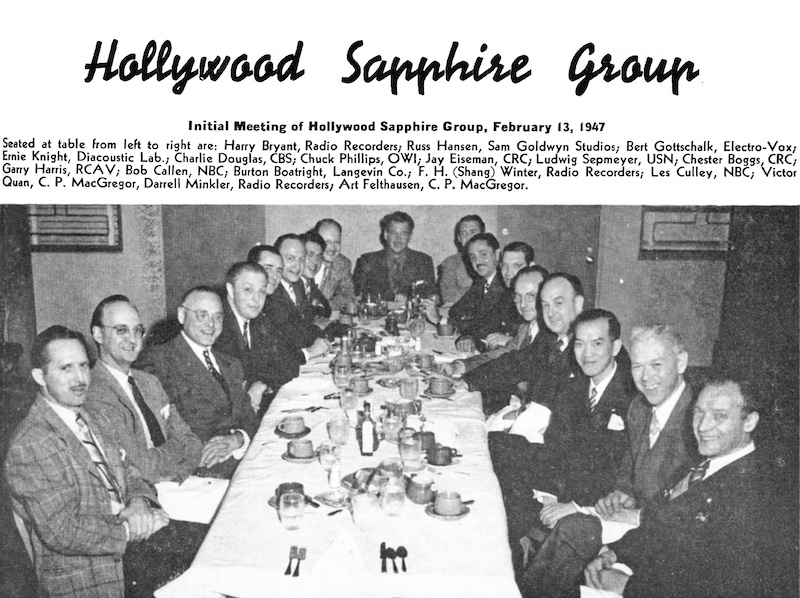
Photo of the first meeting of the Hollywood Sapphire Group, held at Brittingham's restaurant in Hollywood on February 13, 1946 (the caption's date of 1947 is incorrect)
2. The LP and the 45 — the "Battle of the Speeds" and the proliferation of curves
Two new formats appear
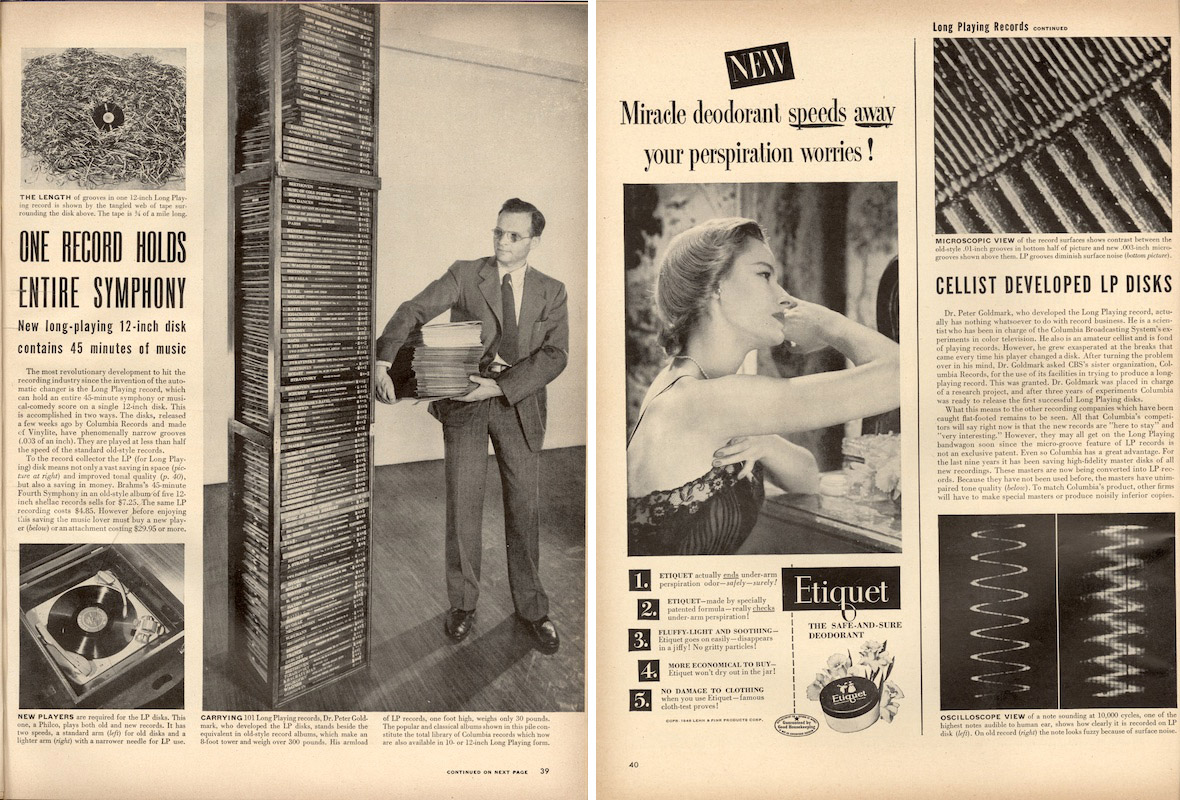
On June 18, 1948, Columbia introduced the 33⅓ rpm LP (Long Playing) record. Unlike the conventional shellac 78 rpm disc, the Vinylite microgroove disc was dramatically quieter and could hold over twenty minutes per side on a 12-inch disc (see Pt.11).
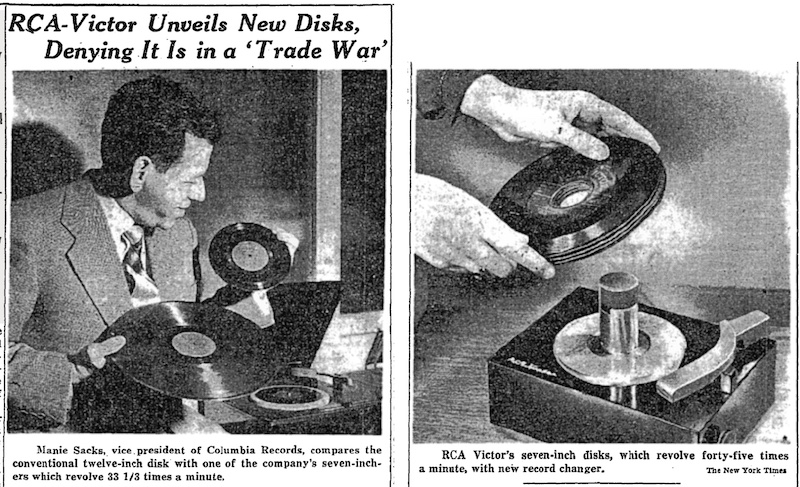
Six months later, on January 10, 1949, RCA Victor announced the 7-inch 45 rpm disc. The ensuing "Battle of the Speeds" drew in every US label, but by around 1950 the market had settled into a division: albums on LP, singles on 45 (see Pt.13 / Pt.14).
The arrival of magnetic tape
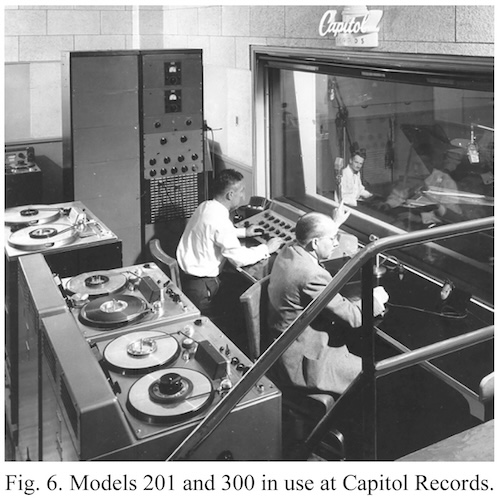
At almost the same time, in 1948, the Ampex 200A tape recorder appeared, fundamentally transforming the studio workflow. In place of direct-to-disc cutting (recording directly onto lacquer), the practice of recording to tape, then editing and cutting spread rapidly. Along with this shift, the use of equalizers and other tools for "sound shaping" during the recording-to-cutting process became commonplace.
The proliferation of curves
Amid these technological upheavals, EQ curves for microgroove discs proliferated. The major curves in use in the United States in the early 1950s can be grouped into roughly five families:
- Columbia LP / NAB curve (500C-16 / 500B-16) — The curve used by Columbia, developer of the LP, and the NAB curve, which differed only in the bass shelf time constant. The two were considered nearly identical; independent studios are known to have repurposed NAB recording equalizers for cutting consumer discs.
- RCA Victor Orthophonic / New Orthophonic curve (500N-12 / 500R-13.7) — Used by RCA Victor. The Old Orthophonic lacked a bass shelf, but in 1952 the company transitioned to New Orthophonic, which added one. New Orthophonic is identical in characteristic to RIAA.
- AES playback curve (400N-12) — Proposed by the Audio Engineering Society (AES) in 1951 as a compromise designed for compatibility with several existing curves.
- Bartók curve (630C-16) — Used by independent studio engineer Peter Bartók.
- Decca ffrr curve (500C-10.5) — Used by UK Decca (corresponding to the London label in the US).
(For an explanation of the notation "500C-16," see → Glossary)
The recording equalizers used by major labels were proprietary, fixed-characteristic designs, and their specifications were treated as trade secrets. Many independent studios, meanwhile, are believed to have repurposed NAB recording equalizers designed for broadcast use. In either case, listeners and amplifier designers were left to guess which curve applied to which record (see Pt.17).
3. The conditions that made unification possible
So why did unification finally happen? As the mirror image of the "reasons it didn't happen" we saw in Part 1, several conditions had fallen into place by the early 1950s.
The technology had reached a stage where it could be "fixed"
The feedback cutterhead was put into practical use. Some achieved a flat characteristic in the cutterhead itself; others relied on correction circuits within the associated recording system — but in either case, EQ curve implementation became independent of the cutterhead's physical properties and could be freely controlled by electronic circuits. The constraint we saw in Part 1—"the curve was inseparable from the physics of the machine"—was finally resolved (see Pt.18).
In addition, the advent of the hot stylus (heated cutting stylus) made it possible to cut high frequencies with precision even on the inner grooves of a 33⅓ rpm disc. This enabled a reduction of treble pre-emphasis from the excessive level of NAB (100 μs) to 75 μs, also reducing high-frequency distortion (see Pt.12).
"Faithful reproduction" became a selling point
From the early 1950s, the consumer component audio market grew rapidly, ushering in the "hi-fi boom." As more listeners began to value sound quality, accurate record playback became a market demand.
The proliferation of curves was a serious problem for listeners and equipment manufacturers alike. Manufacturers were forced to build phono equalizers that could switch between multiple EQ curves, and listeners were left wondering "which setting is correct for this record?" Demand for a unified standard had emerged also from the market itself.
The people and the forums were in place
The network of personal connections that grew from the Sapphire Group and extended into AES provided the forums for standardization discussions. Technology that had once been proprietary was gradually being published, creating common ground for deliberation.
4. Three standards, one curve (1953–1954)
Under these conditions, within little more than a year, three organizations—broadcasters (NARTB), the engineering society (AES), and the record industry (RIAA)—each adopted standards with essentially the same characteristic.
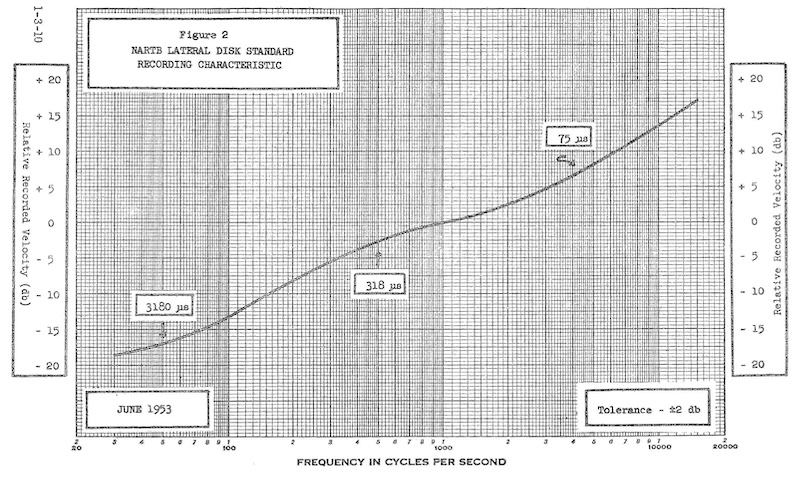
June 1953: The NARTB standard
NARTB (the successor organization to NAB) revised its standard for transcription discs. RCA Victor's New Orthophonic recording characteristic was adopted. For the first time in the NAB/NARTB lineage, three time constants (75 μs, 318 μs, 3,180 μs) were rigorously defined.
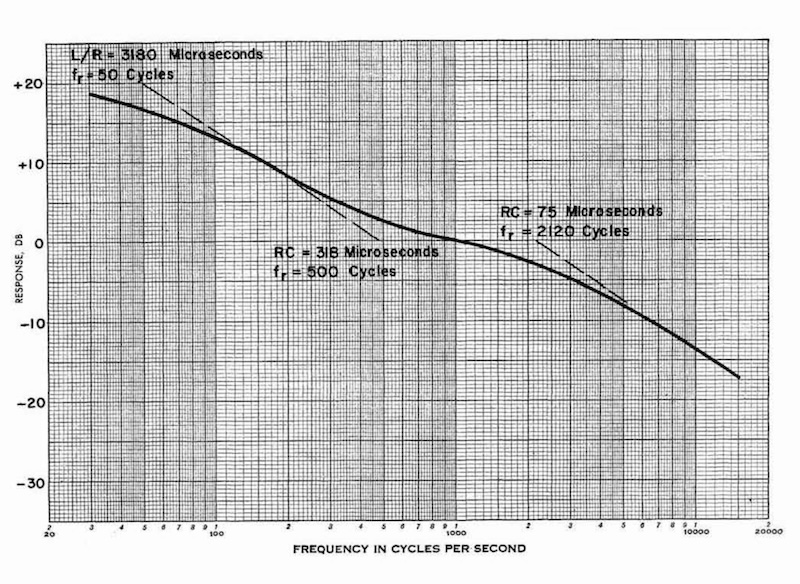
June 1954: The new AES playback curve
AES revised its 1951 playback curve. Provisionally approved in December 1953 and finalized in June 1954, the new curve adopted the same three time constants as the 1953 NARTB standard, adding a bass shelf (3,180 μs).
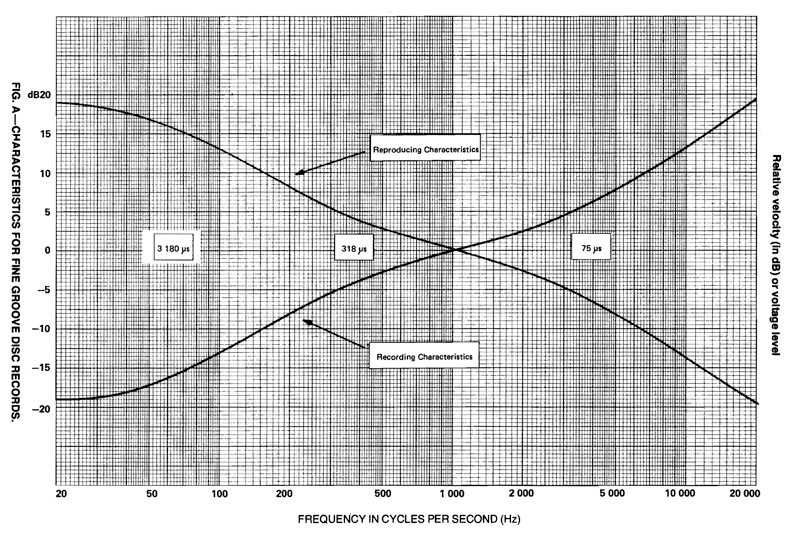
January 1954: The RIAA standard
The RIAA's engineering committee, comprising the chief engineers of the five major US labels, spent a year conducting research and deliberation. The result was the RIAA Standard Recording and Reproducing Characteristic—again, the same three time constants: 75 μs, 318 μs, and 3,180 μs.
The three standards are essentially the same curve. Broadcasters (NARTB), the engineering society (AES), and the record industry (RIAA) each arrived, independently yet almost simultaneously, at the same conclusion.
Summary: how unification finally happened
From the birth of electrical recording (1925) to the RIAA standard (1954)—roughly thirty years. What changed during that time can be summarized as follows:
| Barriers seen in Part 1 | What changed by the early 1950s |
|---|---|
| Curves were determined by the physics of the machine | Feedback cutterheads enabled electronic control |
| Technology was evolving too rapidly to fix | Hot stylus and other advances brought technology to maturity |
| Recording technology was proprietary; there was no common forum | Sapphire Group → AES → RIAA committee |
| Faithful reproduction was not a selling point | The hi-fi boom made sound quality a market value |
| Only broadcasters had the impetus to standardize | Listeners, manufacturers, and labels all needed it |
But the adoption of the RIAA standard did not mean that every record became RIAA overnight. The transition took time—and parts of that process remain unclear to this day.
On to Part 3: What does this history mean for playing records today? →
For further reading (blog series)
- Pt.9 — Wartime stagnation; what 1940s technical articles and equipment reveal
- Pt.10 — The 1949 NAB standard revision: discussion and adoption
- Pt.11 — Columbia's LP announcement (1948) and the history of its development
- Pt.12 — Hot stylus technology; the technical background of the LP
- Pt.13 — RCA Victor's 45 rpm disc and the Battle of the Speeds
- Pt.14 — How other labels responded in 1949; the end of the Battle of the Speeds
- Pt.15 — The birth and popularization of the "high fidelity" concept
- Pt.16 — The founding of AES; the Sapphire Group; the AES playback curve
- Pt.17 — Recording practices at independent studios; the proliferation of curves in detail; consumer amplifier EQ support
- Pt.18 — Feedback cutterheads; the adoption of NARTB / AES / RIAA standards
Revision History
- April 8, 2026: Initial publication