
Contents / 目次
- Revisiting “Force”: “Sweet Mao” and 1976
- はじめに:21年前には考えていなかったこと / Introduction: What I Was Not Thinking About 21 Years Ago
- “Sweet Mao” は何を音にしているのか / What Does “Sweet Mao” Put into Sound?
- “La Marche” は長征なのか、それとも行進なのか / Is “La Marche” the Long March, or Simply a March?
- 1976年という空気の中でこのLPを聴く / Listening to This LP in the Atmosphere of 1976
- おわりに / Conclusion
- 補遺・調査メモ / Appendices and Research Notes
- 補遺1:Max Roach 本人の発言について / Appendix 1: On Max Roach’s Own Statements
- 補遺2:“La Marche” と “The Long March” の関係 / Appendix 2: The Relationship between “La Marche” and “The Long March”
- 補遺3:Acklyn R. Lynch のライナーノーツについて / Appendix 3: On Acklyn R. Lynch’s Liner Notes
- 補遺4:Baraka / CAP / RCL と 1976年の黒人国際主義 / Appendix 4: Baraka / CAP / RCL and Black Internationalism in 1976
- 参考資料・関連リンク / References and Related Links
- 旧記事 / Earlier Post
- 本文中で触れた一次資料・同時代資料 / Primary and Contemporary Sources Mentioned in the Main Text
- 補遺2関連:アーカイブ・作曲資料 / Appendix 2: Archival and Compositional Materials
- 補遺3関連:Acklyn R. Lynch とその周辺 / Appendix 3: Acklyn R. Lynch and Related Materials
- 補遺4関連:Baraka / CAP / RCL と黒人国際主義 / Appendix 4: Baraka / CAP / RCL and Black Internationalism
Revisiting “Force”: “Sweet Mao” and 1976
21年前には純粋に「強烈な音楽」として聴いていたこのLP、いま改めて聴き直すと、 その背後に、1976年という時代の空気や、アメリカの黒人急進派を取り巻く国際的な文脈が、色濃く刻まれていたことに気づかされます。
Revisiting this LP, which 21 years ago I heard simply as “overwhelming music”, I now find myself struck by how deeply it is marked by the atmosphere of 1976 and by the international context surrounding the Black radical milieu in the United States.
Max Roach と Archie Shepp による “Sweet Mao” は、 文化大革命や毛沢東個人を讃えたり細目の賛否を論じる作品というよりも、 1976年時点における 黒人国際主義 (Black Internationalism) という文脈で 毛沢東が担っていた象徴性を音にした作品として読むと見通しがよいように思われる。
“Sweet Mao” by Max Roach and Archie Shepp seems more fruitfully heard not as a work praising the Cultural Revolution or Mao himself, nor as one debating its details one by one, but as a musical rendering of what Mao symbolized within the context of Black Internationalism in 1976.
![[UNI 28.976 Front Cover]](/img/UNI28.976_F.jpg)
Force: Sweet Mao – Suid Afrika 76 / Max Roach & Archie Shepp
(Uniteledis [F] UNI 28.976)
はじめに:21年前には考えていなかったこと /
Introduction: What I Was Not Thinking About 21 Years Ago
21年前、Max Roach と Archie Shepp の 2 枚組 LP『Force: Sweet Mao – Suid Afrika 76』を入手したとき、 私はこのアルバムを、まず何よりも純粋に「強烈な音楽」として聴いていました。 2005年に書いた当時の記事でも、 私はこの盤を「思想(?)を抜きにして演奏そのものを楽しむのが吉でしょう」と書き、 Max Roach のドラミングの美しさと、Roach / Shepp の美しく同時に爆発的な対話そのものに強く惹かれていました。
21 years ago, when I acquired Max Roach and Archie Shepp’s double LP “Force: Sweet Mao – Suid Afrika 76”, I listened to it, above all else, simply as overwhelming music. In the article I wrote back in 2005, I described it as a record best enjoyed for the performance itself, “with the ideology (?) set aside”, and I was deeply drawn to the beauty of Max Roach’s drumming and to the dialogue between Roach and Shepp, at once beautiful and explosive.
Force / Max Roach & Archie Shepp
その聴き方自体は間違っていなかったと思います。 けれども最近になってふと、 「Max Roach と Archie Shepp は、文化大革命について、どのように考えていたんだろうか?」 「なぜ文化大革命と反アパルトヘイト闘争がテーマに選ばれたんだろうか?」 と、この盤のことが改めて気になりだしたのです。
I still think that way of listening to it was not wrong. But recently I found myself wondering anew: “what did Max Roach and Archie Shepp actually think about the Cultural Revolution?”, and “why were the Cultural Revolution and the anti-apartheid struggle chosen as the themes here?”
その背景を少しずつ調べていくうちに、当時の自分にはまったく見えていなかった時代の空気が、このレコードには濃く封じ込められていることに気づきました。
As I gradually looked into that background, I came to realize that this record had preserved, with great density, a historical atmosphere that I had not perceived at all at the time.
“Sweet Mao” は何を音にしているのか /
What Does “Sweet Mao” Put into Sound?
このアルバムは 1976 年の作品で、A面からC面までが Max Roach 作曲の三部組曲 “Sweet Mao”、 そして D面が同じく Roach 作曲の “Suid Afrika 76” という構成になっています。
This album, released in 1976, consists of the three-part suite “Sweet Mao”, composed by Max Roach and occupying sides A through C, and “Suid Afrika 76”, also composed by Roach, on side D.
三部構成の組曲の各楽章はそれぞれ、 “La Préparation”(準備)、“La Marche”(行進)、“Le Commencement”(始まり)、 と名付けられており、 タイトルを見ても、そしてカバーアートを見ても、これは単なる抽象的なフリー・ジャズ作品ではなく、 なんらかの歴史的・政治的イメージを帯びた作品である、と主張しているかのようです。
The three movements of the suite are titled “La Préparation” (Preparation), “La Marche” (March), and “Le Commencement” (Beginning). Even from the titles alone — and from the cover art as well — the work seems to present itself not as a merely abstract piece of free jazz, but as one invested with some sort of historical and political imagery.
世界史や中国史は門外漢なので、あくまで私個人の印象ですが、この作品は、文化大革命の細目を論じる「政治解説」という性質を帯びたものではなく、 むしろ 革命を時間の中で進んでいく過程として捉えた音楽であると想像されます。
I am no specialist in world history or Chinese history, so this is only my personal impression, but the work does not strike me as a kind of “political commentary” on the details of the Cultural Revolution. Rather, it seems to imagine revolution as a process unfolding through time.
また、特に気になるのは、第三部のタイトルです。 “Préparation” と “Marche” のあとに来るのが、“Fin” や “Victoire” ではなく “Commencement” である。 つまりこの組曲は、「準備」し、「行進」し、その先にようやく「始まり」が来る、という流れということになります。
What especially catches my attention is the title of the third movement. What comes after “Préparation” and “Marche” is not “Fin” or “Victoire,” but “Commencement.” In other words, the suite suggests a sequence in which one prepares, marches, and only then arrives at a beginning.
これは革命を、勝利の瞬間で完結する物語ではなく、長い準備と運動を経て新しい歴史が始まる過程として捉えた構成の組曲、と考えることができそうです。 そして、“Sweet Mao” は毛沢東個人の肖像画というより、中国革命や文化大革命という歴史過程を凝縮して音にしたものとして捉えた方が自然な気がします。
This makes it possible to hear the suite as a structure reflecting a view of revolution not as a story completed in the moment of victory, but as a process in which a new history begins only after long preparation and movement. In that sense, “Sweet Mao” seems more naturally understood not as a portrait of Mao the individual, but as an abstraction of historical processes such as the Chinese Revolution and the Cultural Revolution.
“La Marche” は長征なのか、それとも行進なのか /
Is “La Marche” the Long March, or Simply a March?
この読みをさらに面白くするのが、第2楽章 “La Marche” です。
What makes this reading even more interesting is the second movement, “La Marche”.
この曲は、3年後の1979年にスイスのヴィリザウ・ジャズ・フェスティバルで26分超の “The Long March” として再演されています。 なお、米国議会図書館の Max Roach Papers の目録には “Sweet Mao” と並んで “The Long March” のリードシートも記載されています(詳しくは 補遺2)。
Three years later, in 1979, this piece was performed again at the Willisau Jazz Festival in Switzerland as the twenty-six-minute-plus “The Long March”. The finding aid of the Max Roach Papers at the Library of Congress also lists lead sheets for “The Long March” alongside “Sweet Mao” (see Appendix 2 for details).
これは “La Marche” の拡大・再提示という意味での “Long March” でもあるのでしょうが、 同時に、中国革命における「長征」(1934〜1936)のイメージを重ねた可能性もあります。
This may suggest “Long March” in the sense of an expanded or re-presented version of “La Marche,” but it may also imply an overlapping image of the “Long March” (1934–1936) of the Chinese Revolution.
しかし、アルバム “Force” の録音・リリースが1976年であることを考えると、文化大革命(1966〜1976)における 紅衛兵(文化大革命期の若者動員組織) による行進や大衆動員のイメージを反映させたのかもしれません。
Yet given that Force was recorded and released in 1976, it may instead reflect the imagery of marches and mass mobilization by the Red Guards – the youth mobilization organizations of the Cultural Revolution (1966–1976).
しかし、ここで話はそれだけでは終わりません。 Max Roach にとって “March” という語は、もともと中国革命・文化大革命だけの語彙ではありませんでした。
But that is not the end of the story. For Max Roach, the word “March” did not belong solely to the Chinese Revolution or the Cultural Revolution.
1960年リリースのアルバム “We Insist! Freedom Now Suite” のライナーノーツ冒頭には、公民権運動活動家 A. Philip Randolph による “Masses of Negroes are marching onto the stage of history and demanding their freedom now!” (「黒人の大群が歴史の舞台へと行進し、まさに今自由を要求しているのだ!」) という言葉がありました。
At the very beginning of the liner notes to the 1960 album “We Insist! Freedom Now Suite” appears A. Philip Randolph’s statement: “Masses of Negroes are marching onto the stage of history and demanding their freedom now!”
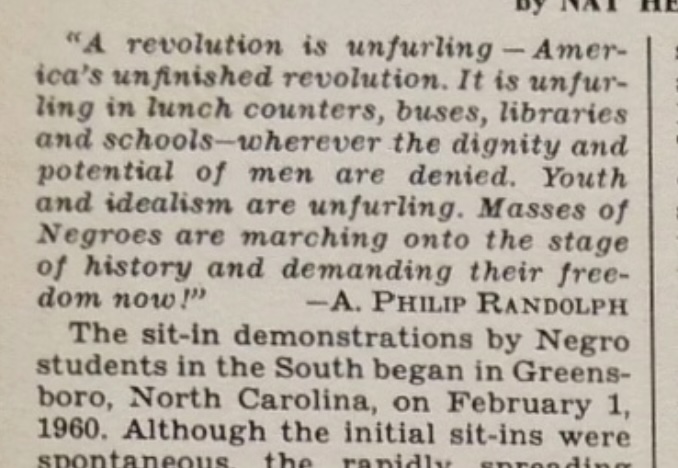
さらに Randolph は 1963年のワシントン大行進におけるスピーチで、 “The March on Washington is not the climax of our struggle, but a new beginning…” (「ワシントン大行進は闘争の頂点ではなく、新しい始まりだ」) と語っています。
Randolph also said, in his speech at the 1963 March on Washington, “The March on Washington is not the climax of our struggle, but a new beginning…”.
これらを “La Marche” と “Le Commencement” の並びに重ねると、文化大革命(あるいは中国革命の長征)だけでなく、 アメリカ黒人解放運動・公民権運動における “March” もまた響いているのではないか、と思わずにはいられません。
Set against the pairing of “La Marche” and “Le Commencement,” these statements make it difficult not to hear, alongside the Cultural Revolution — or the Long March of the Chinese Revolution — the resonance of “March” in the African American freedom struggle and the civil rights movement.
もちろん、Roach 自身がそこまで意識していたと断言はできません。 しかし、黒人解放運動を「歴史の舞台へ行進する集団」として音楽で表現してきた人が、 毛沢東を題材にした組曲の中心楽章を “La Marche” と呼ぶとき、 そこに公民権運動の “March” がまったく鳴っていない、というのは、むしろ考えにくい気がするのです。
Of course, I cannot assert that Roach consciously intended all of this. Yet when a musician who had long represented Black freedom as a collective march onto the stage of history names the central movement of a suite about Mao “La Marche,” it feels difficult to believe that none of the civil rights movement’s “March” is sounding there at all.
1976年という空気の中でこのLPを聴く /
Listening to This LP in the Atmosphere of 1976
この盤のオリジナルLPに掲載された Acklyn R. Lynch のライナーノーツも、 そうした読みを強く後押ししています。
The original LP liner notes by Acklyn R. Lynch also strongly reinforce such a reading.
そこでは、毛沢東の死(ライナーノーツが書かれたのは、毛沢東が逝去した1976年9月9日の翌日)と南アフリカの反政府暴動であるソウェト蜂起(1976年6月〜)、 この両者が同じ歴史運動の中に置かれ、Roach と Shepp は「自由」「正義」「人間の尊厳」への揺るぎないコミットメントを持つ存在として描かれています。
There, Mao’s death — written about literally the day after his passing on September 9, 1976 — and the Soweto uprising in South Africa beginning in June 1976 are placed within the same historical movement, and Roach and Shepp are portrayed as figures committed unwaveringly to “freedom,” “justice,” and “human dignity.”
これは単なる販促コピーというより、かなり明確に政治的な文体で書かれています。Lynch の既知の論文や文章断片を見ても、黒人解放、国際主義、文化労働者(文化の担い手)、人間の尊厳といった語彙の束が今回のライナーとかなり近く、その意味でこの文章は、1970年代黒人国際主義の文体で書かれた短い政治的エッセイとして読む方が自然に思われます(詳しくは 補遺3)。
This is less a piece of mere promotional copy than prose written in a distinctly political idiom. Even Lynch’s known essays and fragments show a cluster of concerns — Black liberation, internationalism, cultural workers (or bearers of culture), and human dignity — remarkably close to the language of this liner note. In that sense, it seems more natural to read the text as a short political essay written in the idiom of Black Internationalism in the 1970s (see Appendix 3 for details).
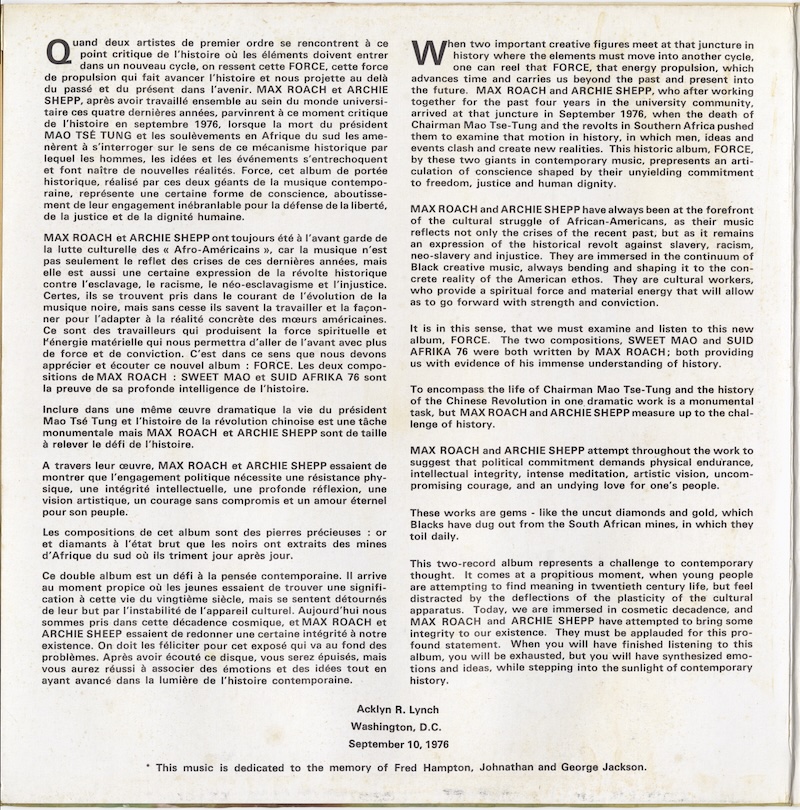
Liner Notes for the “Force” LP by Acklyn R. Lynch, written in a distinctly political idiom. Scanned from my own copy.
Acklyn R. Lynch による、明確に政治的な文体で書かれた LP “Force” ライナーノーツ。筆者所有盤よりスキャン。
ここで見えてくるのは、1976年という年の特殊な空気です。 1960〜70年代当時のアメリカ黒人急進派の一部にとって、毛沢東は単なる「中華人民共和国の指導者」ではなく、 第三世界革命、反帝国主義、そして文化闘争の象徴でもありました(詳しくは 補遺4)。
What comes into view here is the peculiar atmosphere of the year 1976. For some in the Black radical milieu of the United States in the 1960s and 1970s, Mao was not merely “the leader of the People’s Republic of China,” but also a symbol of Third World revolution, anti-imperialism, and cultural struggle (see Appendix 4 for details).
そう考えると、“Sweet Mao” は Max Roach 個人の中国趣味というわけではなく、 1976 年の黒人国際主義の空気の中では十分にあり得た題材だった、と見た方がよさそうです。
Seen in that light, “Sweet Mao” appears less as Max Roach’s private fascination with China than as a subject that could very naturally emerge within the atmosphere of Black Internationalism in 1976.
もっとも、1976年は、黒人急進派における毛沢東主義への共鳴がなお強く残っていた時期であると同時に、 その象徴性を支えていた現実の政治状況が揺らぎ始めていた時期でもありました。 一方で、“Mao” はなお強い革命的象徴であり続けていましたが、 他方では毛沢東の死と文化大革命の収束によって、大きな転換点を迎えようとしていました。 だからこそ、このアルバムは面白いのだと思います。 『Force』は、毛沢東がまだ黒人国際主義にとって強い革命的象徴として鳴っていた、 ほぼ最後の瞬間を記録したレコードなのかもしれません。
At the same time, 1976 was a moment when sympathy for Maoism remained strong among Black radicals even as the actual political conditions supporting that symbolism had begun to shift. On the one hand, “Mao” still functioned as a powerful revolutionary symbol; on the other, Mao’s death and the winding down of the Cultural Revolution were bringing about a major turning point. That, I think, is precisely what makes this album so compelling. “Force” may be a record capturing one of the very last moments when Mao still resonated as a strong revolutionary symbol within Black Internationalism.
おわりに /
Conclusion
2005年当時の私は、この作品を「音」として、つまり Max Roach のドラミングの美しさ、その歌うような打楽器の扱い、 そして Shepp との緊張感あふれる対話を堪能する作品として聴いていました。 政治的背景を抜きにしても、いや、知らなくとも、十分に圧倒的な音源です。
Back in 2005, I listened to this work as sound — that is, as a record through which to savor the beauty of Max Roach’s drumming, his almost singing use of percussion, and the tense dialogue with Shepp. Even without its political background — or rather, even without knowing that background — it remains an overwhelming recording.
けれども今回あらためて調べてみて、私はこの盤を、Roach=Shepp の異色のデュオ作品としてではなく、 1976 年という時代の「気圧」まで刻み込んだ作品としてじっくりと聴き直したくなりました。 昔の自分には音しか聴こえていなかった(聴いていなかった)わけですが、 今は少しだけ、時代のざわめきも聴こえてくるかもしれない、そんな気がしています。
But after looking into it again now, I find myself wanting to hear this record not merely as an unusual Roach=Shepp duo album, but as a work inscribed with the very atmospheric pressure of 1976. Where my younger self heard only sound — or only listened to sound — I now feel that I may be able to hear, if only slightly, the unrest of the age as well.
…やっぱり聴こえてこないかも知れませんが(笑)
…then again, perhaps I still won’t hear it after all 🤣
なお、今回は自分なりに資料をたどって調べてみましたが、中国史やアメリカ公民権運動史の専門家ではありません。事実関係や言い回しに不正確な点があれば、どうぞ遠慮なくご指摘ください。
This article is based on my own attempt to trace the available sources, but I am not a specialist in Chinese history or in the history of the American civil rights movement. If there are any factual inaccuracies or imprecise formulations, please feel free to let me know.
補遺・調査メモ /
Appendices and Research Notes
補遺1:Max Roach 本人の発言について /
Appendix 1: On Max Roach’s Own Statements
今回確認できた範囲では、Max Roach 自身が文化大革命の個々の政策や出来事を細かく論評した一次インタビューは見つけられませんでした。 したがって、「Roach は文化大革命を全面支持していた」と強く断定することはできません。
So far as I have been able to determine, I have not found any primary interview in which Max Roach comments in detail on individual policies or events of the Cultural Revolution. For that reason, I cannot strongly assert that “Roach fully supported the Cultural Revolution”.
ただし一方で、Roach が “Sweet Mao” を毛沢東の死を受けた追悼的・敬意ある文脈で構想していたことを示す周辺資料はいくつか確認できました。 たとえば、William & Mary 大学の American Studies に提出された修士論文(2015)には、Max Roach による次の発言が引用されています。
On the other hand, however, I have found several contextual sources suggesting that Roach conceived “Sweet Mao” in a commemorative and respectful framework following Mao’s death. For example, a 2015 master’s thesis submitted to American Studies at William & Mary quotes the following statement by Max Roach.
Mao Tse-tung had died, so the Left all over Europe wanted to pay tribute… Archie and I did it as a duo. I wrote ‘Sweet Mao’, in three parts. About that time there had also been a slaughter of students in South Africa, so I wrote another piece, ‘Soweto‘76’.
毛沢東が亡くなり、ヨーロッパ中の左派が追悼の意を表したがっていた……。 Archie と私はデュオでそれを行った。私は ‘Sweet Mao’ を三部構成で書いた。 ちょうどその頃、南アフリカでは学生虐殺事件が起きていたので、私はもう1曲 ‘Soweto ’76’ という曲を書いた。
Members, Don't Git Weary: Max Roach, Treme and the Sound of Resistance. Brian Edward Jones, The College of William and Mary, May 2015もちろん、ここで参照しているのは Roach 本人の一次インタビューそのものではなく、修士論文中に引用された発言です。 それでも、少なくともこの資料に依拠する限り、文化大革命の細目への賛否はなお不明であるとしても、 Roach が毛沢東を否定的に扱っていたとは考えにくいように思われます。
Of course, what is cited here is not a primary interview with Roach himself, but a statement quoted within a master’s thesis. Even so, on the basis of this source at least, although his judgment on the details of the Cultural Revolution remains unclear, it still seems difficult to think that Roach treated Mao negatively.
補遺2:“La Marche” と “The Long March” の関係 /
Appendix 2: The Relationship between “La Marche” and “The Long March”
本文では “La Marche” を、中国革命における「長征」あるいは文化大革命における紅衛兵の行進・大衆動員と、 黒人解放運動における “March” の二重写しとして読みました。 特に3年後、1979年の演奏 “The Long March” は、冒頭の Max Roach のドラムソロのパターンや、 それに続く Archie Shepp のサックスのメロディラインを共有しており、 “La Marche” を「長征」と結びつけて読む可能性を補強する材料にはなっているように思われます。
In the main text I read “La Marche” as a double image: on the one hand, the Long March of the Chinese Revolution (or the marches and mass mobilizations of the Red Guards during the Cultural Revolution) and, on the other, “March” in the Black freedom movement. In particular, the 1979 performance “The Long March,” three years later, shares both the opening pattern of Max Roach’s drum solo and the melodic line of Archie Shepp’s saxophone that follows, which seems to strengthen the possibility of reading “La Marche” in relation to the Long March.
実証面で重要なのは、米国議会図書館に “Max Roach Papers” というアーカイブ資料群があることです。 その目録には、 “Box 27, Folder 20 – Sweet Mao / by Max Roach / Lead Sheets” と “Box 13, Folder 9 – The Long March / by Max Roach / Lead Sheets” という記載があり、 少なくとも “Sweet Mao” と “The Long March” が、作曲資料のレベルでは別個のリードシートとして存在していたことが確認できます。
What is important from an evidentiary standpoint is that the Library of Congress holds an archival collection called the Max Roach Papers. Its finding aid includes the entries “Box 27, Folder 20 – Sweet Mao / by Max Roach / Lead Sheets” and “Box 13, Folder 9 – The Long March / by Max Roach / Lead Sheets”, confirming at least that “Sweet Mao” and “The Long March” existed as separate lead sheets at the level of compositional materials.
ただし、オンライン上からは譜面そのものの内容を閲覧できないため、 作成年代や両者の具体的な音楽的関係については、現時点では未確認であることを申し添えておきます。
That said, because the contents of the scores themselves cannot be viewed online, the date of composition and the precise musical relationship between the two remain unconfirmed at present.
補遺3:Acklyn R. Lynch のライナーノーツについて /
Appendix 3: On Acklyn R. Lynch’s Liner Notes
Acklyn R. Lynch によるオリジナルLPのライナーノーツは、本文で見た通り、 単なる作品紹介文というより、かなり明確に政治的な文体で書かれています。 そのことを考える上で参考になるのが、Lynch 自身の既知の論文や文章です。
As discussed in the main text, the original LP liner notes by Acklyn R. Lynch are written in a distinctly political idiom rather than merely functioning as a piece of descriptive copy. What helps in thinking about this are Lynch’s own known essays and writings.
たとえば、1976年の論文 “Paul Robeson: His Dreams Know No Frontiers” では、Lynch は Paul Robeson(歌手・俳優・公民権運動家)を “perhaps the most important American cultural and political figure in the twentieth century” (“20世紀アメリカにおいて、おそらく最も重要な文化的・政治的人物”) とまで書いています。 ここからも、彼が文化と政治を強く結びつけて考えていたことがうかがえます。
For example, in his 1976 essay “Paul Robeson: His Dreams Know No Frontiers”, Lynch describes Paul Robeson (a singer, actor, and civil rights activist) as “perhaps the most important American cultural and political figure in the twentieth century”. This alone suggests how strongly Lynch tended to think culture and politics together.
さらに、この論文を参照した修士論文では、 Lynch が Robeson の重要性を、黒人と労働者の権利を植民地解放闘争へ結びつけたこと、 そして芸術と政治を結びつけて歴史的な先例を作ったこと、 という二点に見ていたと整理されています。 これは、今回のライナーに見える「黒人解放」「国際主義」「文化実践」といった関心とかなり近いように思われます。
Moreover, a master’s thesis that refers back to Lynch’s essay summarizes Lynch’s view of Robeson’s significance in two ways: first, that Robeson connected the rights of Black people and workers to anti-colonial liberation struggles; and second, that he linked art and politics in a way that created a historical precedent. This seems quite close to the concerns visible in the Force liner notes: Black liberation, internationalism, and cultural practice.
また、Attica をめぐる再掲文 でも、Lynch は “The men at Attica were prepared to die for the democratic principles … experienced in their revolt” (“アッティカの人々は、自らの蜂起の中で経験し体現した民主主義の原理のためなら、死をも辞さない覚悟だった”) という強い言い回しで、蜂起を倫理的・政治的な出来事として書いています。 ここでも、自由や民主主義、蜂起、闘争といった語彙が前面に出ており、 “Force” のライナーに見られる語り口と地続きのものと考えられます。
Likewise, in a republished text on Attica, Lynch writes of the uprising in strongly ethical and political terms: “The men at Attica were prepared to die for the democratic principles … experienced in their revolt”. Here too, vocabulary such as freedom, democracy, revolt, and struggle comes to the fore, and it seems continuous with the tone of the Force liner notes.
Lynch は、単にこのLPのライナーを書いただけの人ではありませんでした。 UMBC の Africana Studies の沿革ページ には、Acklyn R. Lynch が長年にわたり同分野に関わった人物として記されています。 少なくとも彼は、Africana / African American Studies の文脈の中で思考し、書いていた人物と見てよさそうです。
Lynch was not merely someone who happened to write the liner note for this LP. The history page of Africana Studies at UMBC lists Acklyn R. Lynch as someone long involved in the field. At the very least, he appears to have been a figure thinking and writing within the context of Africana and African American Studies.
そう考えると、ライナーの中に現れる 「自由」「正義」「人間の尊厳」「揺るぎないコミットメント」「文化労働者(文化の担い手)」 といった表現は、たまたまそうなったというより、 Lynch の既存の問題意識(芸術と政治の結合、黒人解放の国際主義的理解)の延長として読む方が自然です。 その意味で、このライナーは「なんとなく左っぽい宣伝文」ではなく、 1970年代の黒人国際主義の文体で書かれた短い政治的エッセイと考えることができます。
Seen in that light, the expressions that appear in the liner notes — “freedom,” “justice,” “human dignity,” “unyielding commitment,” and “cultural workers” — seem less accidental than part of Lynch’s existing set of concerns: the connection between art and politics and an internationalist understanding of Black liberation. In that sense, this liner note can be understood not as vaguely left-leaning promotional prose, but as a short political essay written in the idiom of Black Internationalism in the 1970s.
補遺4:Baraka / CAP / RCL と 1976年の黒人国際主義 /
Appendix 4: Baraka / CAP / RCL and Black Internationalism in 1976
本文では、1976年当時のアメリカ黒人急進派の一部にとって、毛沢東が第三世界革命、反帝国主義、文化闘争の象徴でもあった、と簡単に触れました。 その背景を具体的に考える上で重要なのが、詩人・批評家・活動家として知られる Amiri Baraka と、 彼が率いた Congress of Afrikan People(CAP、ここでは仮に「アフリカ系人民会議」とする)、 そしてその後継組織である Revolutionary Communist League(RCL、革命的共産主義者同盟)の動きです。
In the main text I briefly noted that, for part of the Black radical milieu in the United States in 1976, Mao functioned as a symbol of Third World revolution, anti-imperialism, and cultural struggle. To think more concretely about that background, it is important to consider the movements of Amiri Baraka — known as a poet, critic, and activist — along with the Congress of Afrikan People (CAP), which he led, and its successor organization, the Revolutionary Communist League (RCL).
CAP は 1970年に結成された組織ですが、1970年代半ばになると、 黒人民族主義的な立場から、より明確なマルクス主義・レーニン主義・毛沢東思想への接近を強めていきました。 そして 1976年には組織名を Revolutionary Communist League へ改め、 自らをより明確な共産主義運動の一部として位置づけるようになります。
CAP was founded in 1970, but by the mid-1970s it had moved from a Black nationalist orientation toward a more explicit embrace of Marxism-Leninism and Mao Zedong Thought. In 1976 it changed its name to the Revolutionary Communist League and came to position itself more clearly as part of a communist movement.
Robin D. G. Kelley と Betsy Esch は、この時期の Mao 受容について、 中国革命を単に遠い異国の出来事としてではなく、 アメリカ国内の黒人解放闘争と響き合う「第三世界の革命的想像力」として理解すべきだと論じています。 その文脈で見ると、Baraka や CAP / RCL の動きは、 文化大革命の言語やイメージを、アメリカの都市部における黒人解放運動の文脈へ移し替えようとした試みのひとつとして捉えることができます。
Robin D. G. Kelley and Betsy Esch argue that Mao was received in this period not simply as a figure from a distant foreign revolution, but as part of a “Third World revolutionary imagination” resonating with Black liberation struggles within the United States. Seen in this context, the activities of Baraka and CAP/RCL can be understood as one attempt to translate the language and imagery of the Cultural Revolution into the context of Black liberation struggles in urban America.
もちろん、Max Roach が Baraka や CAP / RCL と同じ政治組織に属していたわけではありません。 しかし、1976年のアメリカにおいて “Mao” という名前が、 黒人急進派の文化圏の中で、反帝国主義・国際主義・革命的文化実践の象徴として響きうる状況があったことは、 こうした周辺史からもかなり具体的に見えてきます。 本文で述べた “Sweet Mao” の背景には、このような同時代の政治文化もあったと考えてよさそうです。
Of course, Max Roach did not belong to the same political organizations as Baraka or CAP/RCL. Even so, the surrounding history makes quite concrete the fact that in the United States of 1976 the name “Mao” could resonate, within the cultural world of Black radicals, as a symbol of anti-imperialism, internationalism, and revolutionary cultural practice. It seems reasonable to think that the background of “Sweet Mao” included precisely this kind of contemporary political culture.
ただし、こうした Mao の象徴性は1976年に至っても一枚岩だったわけではなく、 中国外交や世界情勢をめぐって、黒人急進派内部にも緊張や揺らぎが生じていました。
That said, even by 1976 such Mao symbolism was no longer entirely monolithic. Tensions and instabilities had begun to emerge within Black radical circles as a result of Chinese foreign policy and broader world events.
参考資料・関連リンク /
References and Related Links
旧記事 / Earlier Post
-
Matsubayashi, Kohji. Force / Max Roach & Archie Shepp. microgroove.jp, 2005.
今回の記事の出発点になった旧記事
An earlier post (by me) that served as the starting point for the present article.
本文中で触れた一次資料・同時代資料 /
Primary and Contemporary Sources Mentioned in the Main Text
-
Randolph, A. Philip. “March on Washington” speech. 1963. PDF transcript.
本文で触れた “The March on Washington is not the climax of our struggle, but a new beginning …” を確認できる transcript
A transcript in which the passage cited in the main text—“The March on Washington is not the climax of our struggle, but a new beginning …”—can be confirmed.
-
Jones, Brian Edward. Members, Don’t Git Weary: Max Roach, Treme and the Sound of Resistance. Master’s thesis, William & Mary, 2015.
補遺1で触れた、Roach の “Sweet Mao” に関する発言が引用されている修士論文
A master’s thesis cited in Appendix 1 that quotes a statement by Roach concerning “Sweet Mao.”
補遺2関連:アーカイブ・作曲資料 /
Appendix 2: Archival and Compositional Materials
-
Max Roach Papers. Library of Congress.
補遺2で参照した、米国議会図書館所蔵の Max Roach アーカイブ資料群
The Max Roach archival collection at the Library of Congress, cited in Appendix 2.
-
“Box 27, Folder 20: Sweet Mao / by Max Roach / Lead Sheets.” In Max Roach Papers, Library of Congress.
“Sweet Mao” のリードシート目録
Catalog entry for the lead sheets of “Sweet Mao.”
-
“Box 13, Folder 9: The Long March / by Max Roach / Lead Sheets.” In Max Roach Papers, Library of Congress.
“The Long March” のリードシート目録
Catalog entry for the lead sheets of “The Long March.”
補遺3関連:Acklyn R. Lynch とその周辺 /
Appendix 3: Acklyn R. Lynch and Related Materials
-
Lynch, Acklyn R. “Paul Robeson: His Dreams Know No Frontiers.” The Journal of Negro Education 45, no. 1 (1976): 7–21.
補遺3で参照した、Lynch の論文
A known essay by Lynch, discussed in Appendix 3.
-
Giovannetti, Hannah. Voice of the Movement: Examining Paul Robeson’s Revolutionary Intellectualism. Master’s thesis, California State University, Sacramento, 2021.
補遺3で触れた、Lynch 論文を後年参照した修士論文
A later study, mentioned in Appendix 3, that refers back to Lynch’s essay.
-
“ESSAY: Attica Then and Now! Acklyn R. Lynch, 1971.” Black Agenda Report.
補遺3で参照した、Attica をめぐる再掲文
A republished text on Attica, cited in Appendix 3.
補遺4関連:Baraka / CAP / RCL と黒人国際主義 /
Appendix 4: Baraka / CAP / RCL and Black Internationalism
-
Kelley, Robin D. G., and Betsy Esch. “Black Like Mao: Red China and Black Revolution.” Souls 1, no. 4 (1999): 6–41.
本文および補遺4で参照した、毛沢東受容と黒人国際主義を理解する上で重要な論考
An important essay, cited in the main text and Appendix 4, for understanding Mao reception and Black internationalism.
-
Revolutionary Communist League (M-L-M). Encyclopedia of Anti-Revisionism On-Line.
CAP から RCL への流れを確認するための基礎資料
A basic source for tracing the transition from CAP to RCL.
-
Frazier, Robeson Taj P. “Baraka, Brother Mao and the Year of ’74.” Souls 8, no. 3 (2006): 142–159. DOI: 10.1080/10999940600882947.
Amiri Baraka と毛沢東主義の接点をたどる補助資料
A supplementary source for tracing the points of contact between Amiri Baraka and Maoism.
-
Clavin, Peter. “The Sound Approach: The Changing Same of Amiri Baraka’s Black Internationalism.” Souls 22, nos. 2–4 (2020): 239–259. DOI: 10.1080/10999949.2021.2003621.
Baraka の黒人国際主義を文化実践との関係から考える補助資料
A supplementary source for considering Baraka’s Black internationalism in relation to cultural practice.