2026/06/26

Preservation and Storage of Sound Recordings (1959) — A First Reading

レコードの敵は素材ごとに違った — 1959年の議会図書館レポートを読む

数年前、フォノEQカーブや録音再生機材、レコード製造工程などを調査しているときに見つけ、念のため手元に保管していたPDFがあります。先日、ふとこれを精読してみようと思い立ち、読んでみると、レコード保存における劣化要因について詳細に調査研究されたレポートで、われわれコレクターにとっても非常に参考になるものでした。

A few years ago, while researching phono EQ curves, recording and playback equipment, and record manufacturing processes, I came across a PDF and saved a copy just in case. Recently I decided to sit down and read it properly. It turned out to be a detailed study of the factors behind storage deterioration of sound recordings, and very much worth the time for anyone who collects records.

以下、1950年代末に編纂された、74ページにも及ぶこの濃厚なレポートで述べられている注目点を概説してみようと思います。

Below is an overview of the main points from this dense, 74-page report compiled in the late 1950s.

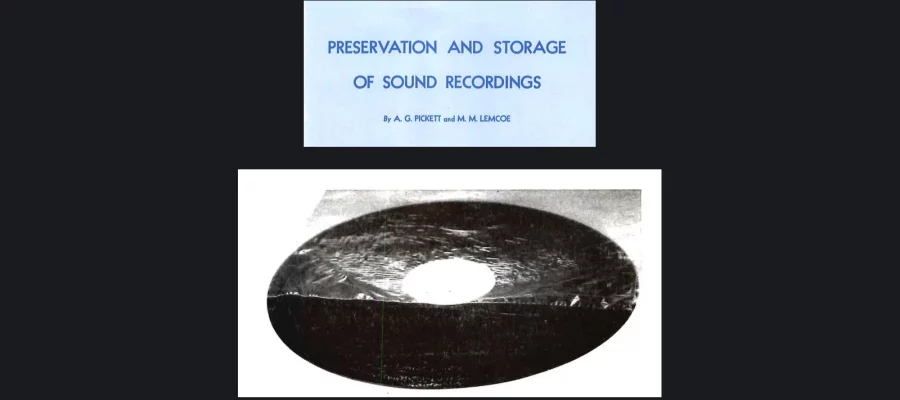
Cover page of Preservation and Storage of Sound Recordings by A. G. Pickett and M. M. Lemcoe, Library of Congress, 1959

A. G. Pickett and M. M. Lemcoe, Preservation and Storage of Sound Recordings, Library of Congress, 1959.

Continue reading
2026/06/14

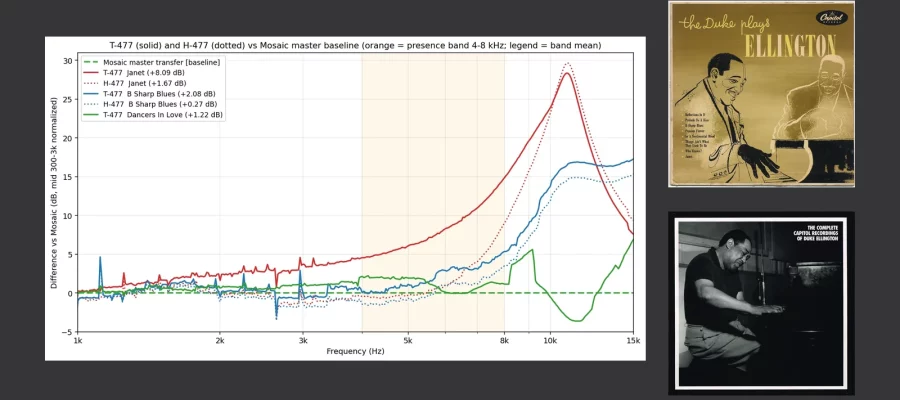
Phono EQ Curves Liner Notes II-c — Capitol H-477 The Duke Plays Ellington (1953) and T-477

Phono EQ Curves Liner Notes IIII-a / II-b / II-c の 3 部作で、 20年前のブログ記事で主観的に書いた問いに、 客観的な計測の道具の力を借りて再度向き合います。本稿はその第3部 Liner Notes II-c として、 Liner Notes II-a + Liner Notes II-b の延長で、 そこで扱ったセッションの半年あまり前(1953年4月)に録音された Capitol H-477 “The Duke Plays Ellington” と、 数年後の 12インチ再発 T-477 に同じ手法を適用します。

Phono EQ Curves Liner Notes II is a three-part work (II-a / II-b / II-c) revisiting a question I wrote about subjectively in a blog post twenty years ago, this time with objective measurement. This third part, Liner Notes II-c, extends Liner Notes II-a and Liner Notes II-b, applying the same methods to Capitol H-477 “The Duke Plays Ellington“, recorded in April 1953, some seven months before the sessions covered there, and to its 12-inch reissue T-477 released a few years later.

Continue reading
2026/06/14

Phono EQ Curves Liner Notes II-b — H-488 Reissue and Remaster Lineage (1955-1998)

Phono EQ Curves Liner Notes IIII-a / II-b / II-c の 3 部作で、 20年前のブログ記事で主観的に書いた問いに、 客観的な計測の道具の力を借りて再度向き合います。本稿はその第1部 Liner Notes II-a に続く第2部 Liner Notes II-b で、 同じ Capitol H-488 “Songs For Young Lovers” セッションマスターから派生した再発・リマスター系を LTAS で横並びに読み解きます。

Phono EQ Curves Liner Notes II is a three-part work (II-a / II-b / II-c) revisiting a question I wrote about subjectively in a blog post twenty years ago, this time with objective measurement. This second part, Liner Notes II-b, continues from Liner Notes II-a and reads the reissue and remaster lineage branching from the same Capitol H-488 “Songs For Young Lovers” session master, side by side, on LTAS.

Continue reading
2026/06/14

Phono EQ Curves Liner Notes II-a — Capitol H-488 Songs For Young Lovers (1954)

Phono EQ Curves に関する筆者の学習過程を、これまで Pt.0Pt.25 として連載してきました。本シリーズ Phono EQ Curves Liner Notes は、その続編ではなく、別の角度からのアプローチです。 LP のジャケット裏に書かれた解説(ライナーノーツ)のように、本編とは別の物語を、別の温度感で記録するためのシリーズです。

For the past few years, I have been documenting my own learning around phono EQ curves in the long-running series Pt.0Pt.25. This new series, Phono EQ Curves Liner Notes, is not a continuation of that body of work but rather a different approach altogether. Like the liner notes printed on the back of an LP jacket (separate from the music itself, written in a different register), these pieces are meant to record stories and findings that sit alongside, rather than inside, the main series.

第1弾 Liner Notes I では、Nicholas Bergh さんから提供いただいた RCA Victor 社内エンジニアリングノート 1955年4月18日付ページの発見報告を扱いました。第2弾 Liner Notes II は II-a / II-b / II-c の 3 部作で、 20年前のブログ記事で主観的に書いた問いに、 客観的な計測の道具の力を借りて再度向き合います。本稿はその第1部 Liner Notes II-a として、 Capitol H-488 “Songs For Young Lovers” (Frank Sinatra) を題材に、 1953〜1954年の Capitol 録音 EQ カーブを LTAS(長期平均スペクトル)解析で読み解く試みです。

The first installment, Liner Notes I, reported on the discovery of a page from an internal RCA Victor engineering notebook dated April 18, 1955, courtesy of Nicholas Bergh. The second installment, Liner Notes II, is a three-part work (II-a / II-b / II-c) revisiting a question I wrote about subjectively in a blog post twenty years ago, this time with objective measurement. This is the first part, Liner Notes II-a, taking Capitol H-488 “Songs For Young Lovers” (Frank Sinatra) as its subject, reading the 1953-1954 Capitol recording EQ curves through LTAS (Long-Term Average Spectrum) analysis.

Continue reading
2026/05/13

Phono EQ Curves Liner Notes I — RCA Engineering Notebook 1955-04-18

Phono EQ Curves に関する筆者の学習過程を、これまで Pt.0Pt.25 として連載してきました。本シリーズ Phono EQ Curves Liner Notes は、その続編ではなく、別の角度からのアプローチです。LP のジャケット裏に書かれた解説 (ライナーノーツ) のように、本編とは別の物語を、別の温度感で記録するためのシリーズです。

For the past few years, I have been documenting my own learning around phono EQ curves in the long-running series Pt.0Pt.25. This new series, Phono EQ Curves Liner Notes, is not a continuation of that body of work but rather a different approach altogether. Like the liner notes printed on the back of an LP jacket (separate from the music itself, written in a different register), these pieces are meant to record stories and findings that sit alongside, rather than inside, the main series.

第 1 弾 Liner Notes I は、Nicholas Bergh さんのご厚意で提供を受けた、RCA Victor 社内エンジニアリングノートの 1955年4月18日付のページについての発見報告です。

The first installment, Liner Notes I, is a report on a discovery: a single page from an internal RCA Victor engineering notebook dated April 18, 1955, generously shared with me by Nicholas Bergh.

RCA New Orthophonic Equalizer Old Type & New Type from 4-18-55

source: RCA Victor Engineering Book, Notebook No.1, page 6, dated 4-18-55
photo courtesy of Nicholas Bergh
RCA Victor 社内エンジニアリングノート 1, p.6 (1955-04-18)。Nicholas Bergh さん提供

Continue reading
2026/04/14

「フォノEQカーブの歴史」を再構築しました

RCA Victor 45rpm record sleeve, 12-5-49

New Orthophonic Frequency Test Record (RCA Victor 12-5-49, 1952 or 1953)
from my own collection

2年以上にわたって連載してきた Things I learned on Phono EQ curves, Pt.0Pt.25 の内容を、固定ページセクション フォノEQカーブの歴史 として再構築しました。連載は時系列で調査順に書かれているため、「結論だけ知りたい」「特定の論点だけ確認したい」という読者には辿りにくい面がありました。そこで、読者の問いを起点に整理し直しています。

I have restructured the contents of my two-year-plus blog series Things I learned on Phono EQ curves, Pt.0 through Pt.25 into a dedicated section: History of Phono EQ Curves. The original series was written chronologically in my research order, which made it hard for readers who just wanted a conclusion or wanted to check a specific point. The new section is reorganized starting from the reader’s questions, not from my research timeline.

Continue reading
2026/03/19

『Force』を今あらためて聴く — “Sweet Mao” と1976年

Revisiting “Force”: “Sweet Mao” and 1976

21年前には純粋に「強烈な音楽」として聴いていたこのLP、いま改めて聴き直すと、 その背後に、1976年という時代の空気や、アメリカの黒人急進派を取り巻く国際的な文脈が、色濃く刻まれていたことに気づかされます。

Revisiting this LP, which 21 years ago I heard simply as “overwhelming music”, I now find myself struck by how deeply it is marked by the atmosphere of 1976 and by the international context surrounding the Black radical milieu in the United States.

要点 (TL;DR)

Max Roach と Archie Shepp による “Sweet Mao” は、 文化大革命や毛沢東個人を讃えたり細目の賛否を論じる作品というよりも、 1976年時点における 黒人国際主義 (Black Internationalism) という文脈で 毛沢東が担っていた象徴性を音にした作品として読むと見通しがよいように思われる。

“Sweet Mao” by Max Roach and Archie Shepp seems more fruitfully heard not as a work praising the Cultural Revolution or Mao himself, nor as one debating its details one by one, but as a musical rendering of what Mao symbolized within the context of Black Internationalism in 1976.

[UNI 28.976 Front Cover]

Force: Sweet Mao – Suid Afrika 76 / Max Roach & Archie Shepp
(Uniteledis [F] UNI 28.976)
Continue reading
2025/06/26

Schiit Mimir Balanced Mesh™ DAC

Introduction

つい先日、音楽好きな知人のお宅を訪問する機会がありました。主に LP(特に 1940〜50 年代のジャズやソウル/R&Bのオリジナル盤)や 45 回転シングル盤、78 回転盤(こちらもジャズやソウル/R&Bがメイン)を愛聴されていて、CD は積極的には聴かず、PC オーディオやストリーミングにもまったく興味がない、という方です。

The other day I had a chance to visit a friend who’s a hardcore music lover. His daily spins are mostly LPs – original jazz, soul and R&B pressings mainly from the ’40s to ’50s – plus 45 rpm singles and even 78 rpms of the same genres. CDs rarely make it onto his system, and PC-based audio or streaming? Zero interest.

Billie Holiday、Johnny Hodges、Willie Smith、Aretha Franklin、Helen Merrill、Dinah Washington、Solomon Burke などを特に愛好されており、自慢のオリジナル盤 LP や SP 盤をいろいろ聴かせていただきました。

He’s especially fond of artists like Billie Holiday, Johnny Hodges, Willie Smith, Aretha Franklin, Helen Merrill, Dinah Washington, and Solomon Burke, and he treated me to a parade of prized and treasured LPs and 78 rpm records of original pressings.

Some of his collection – Jazz, Soul, Blues, etc.

(その方のコレクションの一部)

Continue reading
2025/01/15

Things I learned on Phono EQ curves, Pt. 25

EQカーブの歴史ディスク録音の歴史を、私が学ぶ過程を記録した本シリーズ。前回 Pt.24 では、録音チェーンおよび再生環境における周波数応答特性や位相特性が変化しうるパターンについて調べ、可変イコライザ等の使用による音作りが(特にポピュラー音楽系で)多く行われていることを改めて学びました。また、各種CDリイシュー音源の比較により、当時のシングルマスター、当時のLPマスター、マルチトラックマスターからのリマスター、などを比較することで、ディスク録音イコライザを通過する前の音の違いが確認できることも紹介しました。

This series have documented my process of learning the history of EQ curves and disc recording. In the previous Pt.24, I examined the patterns in which frequency response characteristics and phase characteristics can be changed in the recording chain and reproducing environment, and I learned again that the sound creation (especially in popular music) is often done through the use of variable equalizers and the like. I also introduced the comparison of various CD reissues to confirm the differences in sound between single masters of the time, LP masters of the time, remastered from multi-track masters, etc., before passing through the disc recording equalizer.

最終回 となる今回 Pt.25 は、2年以上に及び調べ学んできた膨大な内容を総括した 要約(復習)です。諸説多きディスク録音EQカーブについて、現時点で分かっていることを整理し、現時点での私の理解に基づき、最後に結論めいたものを記しています。また、少しでも読みやすくするため、仮想キャラ2名によるカジュアルな対話形式を挿入してみました(笑)

This Pt.25, which will be the final part, is a summary of the vast amount of information that I have learned and researched over the past two years. I will then summarize what is currently known — and some tentative summary and conclusion based on my current understanding of many thories — about the EQ curves of disc recordings. Also, in order to make it as easy to read as possible, I have inserted casual dialogues between two virtual characters 🙂

The Measure of Your Phonograph’s Equalization (Dubbings D-101, 1953)

source: The Measure of Your Phonograph’s Equalization (Dubbings D-101, 1953)
from my own collection

Continue reading
2024/11/26

How Records Were/Are Manufactured (6)

第1回第2回第3回第4回第5回 に続き、戦後のレコード製造工程や原材料の歴史、特に 射出成形スチレン盤 について改めて調べてみた、そんな記録です。

Following on from the first, second, third, fourth and fifth parts, this is a record of a renewed look into the history of postwar record manufacturing processes and raw materials, particularly injection molding and styrene records.

Shelley Products 社によって1940年代末に市場に投入され、一時期は Columbia が開発・実用化・普及に向けて積極的に投資していたスチレンの射出成形法は、LP盤製造では結局は主流とはならず、米国で45回転盤用としてのみ浸透したことを学びました。

I learned that the styrene injection molding method, which was introduced to the market by Shelley Products in the late 1940s and for which Columbia at one time actively invested in its development, practical application, and popularization, never became mainstream in LP manufacturing, and was only used in the United States for 45 rpm records.

また、21世紀に入って、サステナビリティの観点から再び射出成形法が見直され、スチレンではなくリサイクルインフラが整ったPET盤が製造販売されていることを知りました。

I also learned that in the 21st century, the injection molding method was once again being reconsidered from the perspective of sustainability, and that PET boards, which have a well-established recycling infrastructure, are now being manufactured and sold instead of styrene.

最終回となる今回は、もともとレコード製造方法や原材料の歴史を調べるきっかけとなった、Mercury の廉価スチレン製LP盤 について、さまざまな角度から調査してみました。

In this final part, we are going to dig a deeper research on Mercury’s budget styrene LP records from various angles, which was what originally prompted me to look into record manufacturing methods and the history of raw materials.

改めて、今回の一連の調査のきっかけを与えてくださった @zmuku さんに感謝いたします。

Once again, I would like to thank @zmuku-san for giving me the opportunity to conduct this series of research .

プレス工場を特定できる決定的な情報はまだ得られていませんが、レーベルやジャケ裏に印刷されている3本線マークの由来と意味について、非常に妥当な仮説を立てることができた気がします。

Although we have yet to obtain conclusive information that identifies the pressing factory, we feel we have been able to formulate a very reasonable hypothesis about the origin and meaning of the three-line mark printed on the label and back of the jacket.

Continue reading