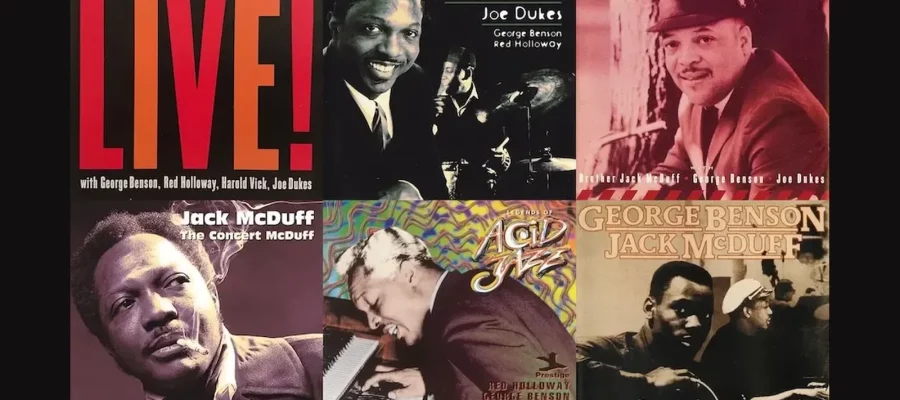
In Part I, I wrote about what kind of players McDuff, Dukes, Benson, and Holloway each were. From here, I’ll trace the four players’ recordings in chronological order.
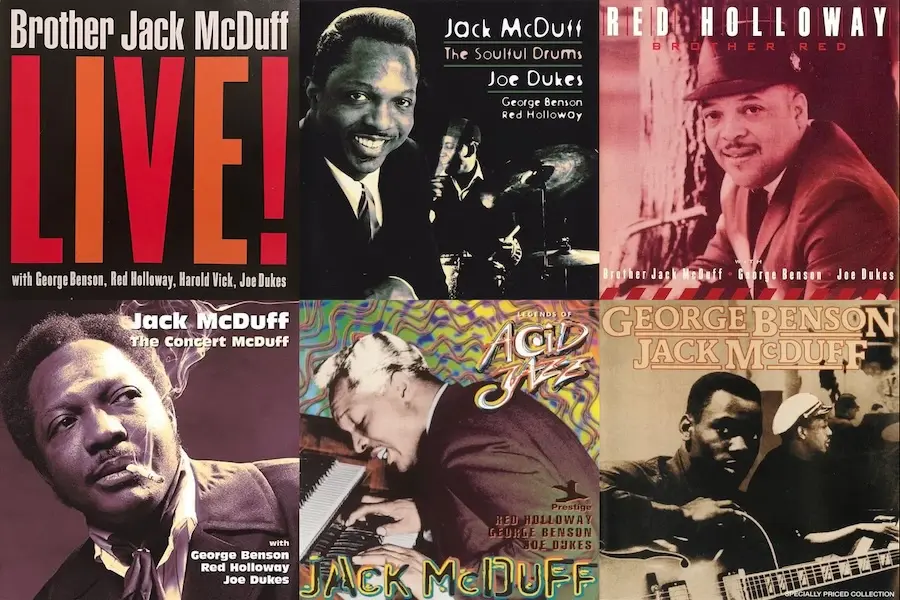
From Newark in June 1963, to San Francisco in October of that year, Los Angeles in February 1964, Europe that summer, and then on to the New York studios in 1964-65. I’ll be listening session by session, following how the band changed over the course of two years.
I’ll also touch on the editing techniques used in the live albums (overdubbed applause, fadeout processing) at various points. “Live album = complete record of a live performance” isn’t always the case, as you’ll hear.
1. Newark, Front Room, June 5, 1963
The first recording from 1963, the year Benson joined. A live set at Newark’s Front Room, released as the LP Brother Jack Live! (PR 7274). The current CD is PRCD-24147-2, coupled with the Jazz Workshop recordings discussed below.
PR 7274 and the next PR 7286 each captured a single night’s live set on one LP. They’re different in character from later CDs (PRCD-24256-2, PRCD-24141-2, etc.) that compile tracks from multiple sessions. For these two, I’ll listen through every track in LP sequence.
The LP opens with an MC.
“The Front Room is proud to present America’s most exciting jazz organist — Brother Jack McDuff!”
But right after this MC, there’s an unnatural edit cutting to applause, which then crossfades into A-1. Within the first few seconds, this live album reveals itself as something other than a complete record of a live performance.
The groove machine makes its first appearance on A-1: Rock Candy. McDuff’s left-hand-plus-foot bass and Dukes’s solid drums are clearly the source of all the groove. As I noted in Part I, the playing “pushes aggressively forward without the tempo budging an inch.” Dead-on accurate yet never mechanical, just relentlessly hot. Your body moves on its own. Benson’s solos lean on repeated riffs, but the moment he switches to comping, he locks in with McDuff and Dukes’s groove and adds superb accents. Holloway’s solo draws you in with its earthy tone, but he’s not the type to pull ahead of the other three. He blows in a way that fuses with the whole quartet. No matter how many times I hear it, I’m caught in the spell of this fearsome groove.
When the song ends, McDuff speaks.
“Thank you very much, ladies and gentlemen. That was a little ditty we call Rock Candy. We hope you dug it.”
Before that, you can hear audience members shouting “one more!” “one more!” At the top of a set, “one more!” makes no sense. On the LP, it’s arranged as MC intro followed by A-1, but Rock Candy was actually performed later in the set, or else the excited cheers were overdubbed from another song or even another performance entirely. Either way, editing is at work.
A-2: It Ain’t Necessarily So opens with McDuff producing a percussive, piano-like tone. This is likely the Hammond’s harmonic percussion function at work. The bass rhythm figure (a Pink Panther-style anticipation) and Benson’s 9th-chord comping are exquisite.
A-3: Sanctified Samba. Before this track begins, McDuff has an MC:
“You know, this Latin music is quite the thing now. … they call me Brother Jack for a reason. … once you get that church in you, it’s kind of hard to backslide all the way. But anyway, here’s our version of the sanctified song.”
McDuff’s own words, showing that the gospel/church element was deliberate. The song calls itself a samba but the content is closer to Watermelon Man. This band was clearly under the influence of Watermelon Man, which had been a massive hit in the Mongo Santamaría version in early 1963, sparking the Latin jazz and later boogaloo boom. Hot Barbeque (1965), discussed below, falls in the same lineage. Benson’s solo here still has some rough edges, but when he switches to comping, he integrates perfectly. Twenty years old, just after joining the band. Note: at 0:42, right after the theme ends, there’s an obvious edit (splice), and one chorus was probably cut. As the last track on side A, the post-song applause is boosted by fader and then fades out. The LP side-break processing survives intact on the CD.
Following McDuff’s patter, B-1: Whistle While You Work begins.
“Y’all ever see ‘Snow White and the Seven Dwarfs’ when you were kids? If so, remember this tune.”
Dukes’s intro, a ride bell plus rimshot in a samba-ish shuffle, is impossibly cool. McDuff’s bass line is a two-beat feel rather than a walking line, matched to the lightness of the song. The first half of McDuff’s solo uses what you might call the “art of subtraction“: deliberately dropping notes to create ghost-note-like space. The showband instinct to reimagine a Disney tune this way is entertaining in itself. Holloway plays flute, appearing only for the opening theme and near the ending; he takes no solo. (The PR 7274 liner notes mention “tongue-in-cheek flute work by Red Holloway,” confirming Holloway on flute.)
B-2: A Real Goodun’. Before the performance, McDuff tells the story behind the title.
“Here’s a little blues tune we got together in East St. Louis. … an old timer at the bar yelled over and said, ‘What’s that?’ I says, I don’t know my man, we haven’t got a name yet. He says, ‘Boy, that’s a goodun’.’ So that’s what we call it, A Real Goodun’.”
A slow blues, but the groove doesn’t weaken one bit when the tempo drops. From uptempo (Rock Candy) to slow (this track), the groove holds across every tempo range. Benson’s solo is thoroughly bluesy, earthier than even Kenny Burrell.
Listen carefully to the right channel: audience voices are vividly preserved during the performance. A man with a deep voice repeats “yeah!” “hoo!” and around the 5-minute mark, a woman’s voice calls out “Holy Roller!” It’s slang for Pentecostal believers who rock their bodies when seized by the Holy Spirit, a world continuous with McDuff’s “once you get that church in you.” Near the end, you hear “Hey, don’t stop now, Jack,” then the repeated cries of “Let’s go, Jack!” and “Thank you, Jack!” This was no quiet gig. The audience voices, together with the big belly laugh from the stage near the end of the song, carry the atmosphere of the 1963 Front Room in Newark as it was.
B-3: Undecided is the final track on this LP. McDuff calls out “With the hot sauce. With the hot sauce.” before the performance begins. Rock Candy’s “just cook!”, Sanctified Samba’s “once you get that church in you,” and now “with the hot sauce.” McDuff’s stage patter consistently uses food metaphors to express musical intensity. This culinary imagery runs all the way to the 1965 song title Hot Barbeque.
In the PR 7274 liner notes, Morris Mobley writes: “four pieces, playing an old standard, Undecided and sounding like Basie’s whole orchestra.” Remember the anecdote from Part I about Count Basie himself sitting in the front row to see Dukes. A quartet reputed to produce a Basie-like sound, and Basie himself came to hear them.
The hi-hat bark observation starts with this track (see Part I). The bark appears at nearly identical structural positions in the master and alternate take. Evidence of a “designed convention.” Comparing the alt take (on PRCD-24270-2) to the master: master = an edited product, alt = a record closer to the raw performance. This contrast is laid bare across two takes of a single song. Around 7:35, the timbre of Holloway’s sax and the ambient sound change abruptly, an edit point, probably a one-chorus cut.
On the editing of PR 7274: Having listened through all the tracks, the systematic editing approach on this album becomes clear:
- Pasted-in MCs: The emcee introduction at the top of the set and McDuff’s between-song patter may have been spliced in from recordings made at different times or locations (the near-absence of audience reaction after the MC at the end of B-2 is one clue)
- Overdubbed soloist-marker applause: Rather than at natural break points where real applause greets a solo change, short bursts of applause are faded in and out at the top of a new soloist’s chorus, a pattern repeated three times in Undecided. An editorial signpost saying “the next solo starts here.” On side A (Rock Candy) this is done more prominently; on side B (A Real Goodun’, Undecided) more subtly
- Replaced end-of-song applause: On all three B-side tracks, overdubbed applause (with shouts and whistles) crossfades over the natural applause right after the performance ends
- Chorus cuts: Edit points at Sanctified Samba 0:42 and Undecided 7:35
- Resequenced track order: The “one more!” shouts after Rock Candy strongly suggest the LP’s track order differs from the actual setlist
- CD sourced from the production master: The fadeout at the end of side A (Sanctified Samba) survives on the CD intact. As with albums like Bill Evans’s Sunday at the Village Vanguard, the CD was apparently made not from the session master (unedited tape) but from the production master edited for the LP
Yet the raw audience voices preserved in the right channel (“yeah!” “Holy Roller!” “don’t stop now, Jack”) survive in places the editor’s hand didn’t reach, keeping the atmosphere of that 1963 Newark night intact. A “product that reconstructs the live experience”: that is the character of PR 7274.
2. San Francisco, Jazz Workshop, October 3, 1963
Four months after the Front Room. Released as the LP Brother Jack Alive! at the Jazz Workshop (PR 7286). The forward drive is noticeably greater. On PRCD-24147-2, the Front Room tracks are in stereo while the Jazz Workshop tracks are in mono. I’ve confirmed that the original LP PRST-7286 (stereo) is in fact simulated stereo, so the session master itself was probably mono.
A-1: Blues 1 & 8 is an ultra-uptempo blues. A flawless groove that doesn’t waver a fraction. McDuff’s bass line groove in particular is at its peak. The structure passes solos around one chorus at a time, matching Benson’s description in the Smithsonian interview (p. 38): 12 bars plus 8 bars, with the last 4 bars cleared for everyone to drop out and set up the transition into the next chorus.
Dukes’s drum solo (1:23-1:45 and elsewhere) shows heavy Art Blakey influence in its rolls and rimshots. The Smithsonian’s “them same lumpy rolls that Art used to play” and Flophouse Magazine’s “Art Blakey-like single-stroke rolls” come to life right here.
And at 3:34, a chicken sound bursts out at the start of Benson’s solo. This is the moment the Smithsonian testimony (p. 38), about a gimmicky sound born by accident during a 4-bar break that became a band staple for a year and a half, becomes something you can actually hear on record. Its placement at the solo entrance matches the testimony. The applause that follows sounds like genuine audience response, not an overdub. Benson’s own words, “the audience went to pieces,” are preserved as sound.
This chicken sound can also be confirmed on video. A 1964 summer Antibes Jazz Festival film captures this very tune, Blues 1 & 8, and the chicken sound is clearly visible at 3:00-3:04. The tempo is even faster than the Jazz Workshop version, but the same trick holds strong nine months later. In the same footage, at 0:08-0:26, McDuff playing bass with his left hand and left foot (right hand on melody) is plainly visible. And don’t miss the close-up of Joe Dukes during the drum solo at 3:40-4:00.
A-2: Passing Through (Harvest) has flute and tenor competing on the theme, an unusually calypso-flavored piece for this band. A cover of a Chico Hamilton Quintet tune (composed by Charles Lloyd), it was also released as a single, 45-286. Over in a flash (2:39).
A-3: Dink’s Blues is a slow-tempo blues. Benson’s comping in slow tempos is superb, but in his solo there are moments where he seems to overthink and trip over his own hands. Both the achievement and the limits of Benson as of October 1963 are audible.
A-4: Grease Monkey is a short performance (2:32). Possibly played short deliberately with a single release (45-299) in mind. Compared to the same tune on PR 7347 (Kenny Burrell, studio), Burrell doesn’t even take a solo and keeps things tight like a session pro, while Benson takes a freewheeling solo, wrong notes and all. The difference in how the two guitarists approached their role is plain to hear.
B-1: Vas Dis is an uptempo minor waltz, and even the mighty McDuff and Dukes wobble slightly in the first half. An honest record; they weren’t superhuman. The second half, with Dukes’s percussive solo over McDuff’s undulating bass, drives relentlessly forward and is essential listening. Peak forward momentum. The Jazz Workshop set as a whole shows more forward drive than the Front Room.
B-2: Somewhere In The Night. Benson solos in octaves, Wes Montgomery style. It was during this very Jazz Workshop engagement that Wes’s brother Buddy Montgomery came backstage and said “I told you you could play jazz” (Smithsonian pp. 39-40). Benson is playing Wes’s signature technique at the very venue where Wes’s brother acknowledged him as a jazz guitarist. Whether the timing lines up exactly is unclear; the source says only “in between sets.” But it was at minimum during the same engagement.
B-3: Jive Samba is the final LP track. Composed by Nat Adderley, it takes the Cannonball Adderley Sextet version’s feel as a jumping-off point and reworks it into the band’s own vehicle. The original ending, where alto and trumpet quietly play a unison “C E♭ E F” phrase, gets transplanted by the McDuff version to the end of the theme within the body of the song, expanded into a full structural device, and layered with rapid snare and cymbal strokes. The original’s “quiet closing salute” becomes a “door that opens the show.” A fine example of the band’s creative thinking in covering material.
From 2:15, the Dukes solo unfolds exactly as described in Part I: drum solo, four shouts of “My Soul!”, a self-directed call and response, then “My My My” leading back to the theme. The Smithsonian testimony about Dukes going wild at the end of the show (“at the end of the show he would play a roll on the bass drum”) is most likely captured in this track. You flip the LP, the needle on side B nears the final groove, and Dukes raises his voice, batters the drum kit, and brings the band back to the theme. A fitting close. Going out in style.
Editing on PR 7286: A different pattern of editing from the heavily edited PR 7274.
- Replaced end-of-song applause: Common to all tracks. A big crowd roar fades in over the post-performance ambient sound, then fades out
- Between-track crossfades: The fadeout of one track overlaps with the opening of the next, creating the effect that “the excitement never stops”
- Overdubbed soloist-marker applause: On Dink’s Blues, right after the flute solo begins (1:01), at the start of Benson’s solo (2:08), and right after a trill during McDuff’s solo (3:49): three spots. On Grease Monkey, during the theme (0:22) and right after Benson’s solo begins (1:02). The same editing technique used on PR 7274 appears on PR 7286 as well
- CD sourced from the production master: The end of side A (Grease Monkey) has overdubbed applause laid over a fadeout, the LP’s side-break processing surviving intact on the CD. As with PR 7274, the CD appears to be mastered from the production master
The picture changes on side B, though. Vas Dis and Somewhere In The Night are completely unedited during the performances themselves; only the ending applause gets the overdub treatment. And most importantly, the Dukes showcase on Jive Samba, the “My Soul!” shouts, the self-directed call and response, the “My My My” return to the theme, is preserved entirely raw. Even the editor left this showcase untouched. Or perhaps there was no need to touch it.
The cheering on these two live albums turns out to be largely the work of post-production. But knowing that actually makes the unedited moments stand out more sharply: the “Holy Roller!” and “don’t stop now, Jack” in the right channel of PR 7274, and Dukes’s shouts on PR 7286. The nights of 1963, in Newark and San Francisco, were too hot to need decorating.
3. Los Angeles, February 6-7, 1964
Two days, three leader credits (McDuff / Holloway / Benson). Many tracks are only available on the Holloway-led Cookin’ Together (PR 7325; on CD as PRCD-24141-2, Brother Red).
B-1 Brother Red puts Holloway out front, but the ironclad groove is identical to any McDuff-led date. Benson’s comping shines throughout. McDuff hangs back more than usual, letting Holloway lead. Yet underneath the gentle grease, a thick, murky groove churns, though it is easy to miss. A different leader credit, the same working band in practice.
B-4 Shout Brother. Benson’s solo sounds noticeably more “vocal” than usual for this period. The seeds of his later lyricism are here. This is a relative difference within his playing at this stage, though, not a comparison to his later years.
A-2 This Can’t Be Love is the audible proof of the “paradox of the absent bass” discussed in the McDuff section of Part I. When McDuff switches to piano and his foot bass drops out, he drifts slightly behind the beat, a moment that teaches you, by its absence, exactly what powered the groove. On the slow ballad B-3 No Tears, McDuff is likewise on piano.
4. Summer in Europe, July 1964
A live recording from Stockholm’s Golden Circle (LP The Concert McDuff, PR 7362; CD PRCD-24270-2), plus footage from the Antibes Jazz Festival around the same time.
B-3 Four Brothers. The Woody Herman band’s saxophone-section showpiece, taken at an absurd tempo and handled by McDuff, Holloway, and Benson as a three-voice soli. Four sax parts reduced to three voices, at breakneck speed. Listen, and you understand why this difficult tune was the subject of the Smithsonian testimony (pp. 36-37): Benson learned the second harmony by ear in 20 minutes, while Holloway, who could read music, needed three days.
Holloway’s tenor solo, too, is full of power, and Benson’s comping behind it is downright uncanny. Benson’s own solo shows considerably more cohesion. One year out from the Front Room, age 21. And the hi-hat bark appears at key points: the third recording context confirming the bark (Newark 1963-06 Undecided, both takes; then Stockholm 1964-07). Dukes’s convention, sustained across a year and an ocean, becomes definitive here.
Audience sound on PR 7362: Before songs begin and right after solos end, there’s applause and crowd noise that sounds like a large audience in a big hall. The Golden Circle was a club, so big-hall sound is out of place. Overdubbing is likely on PR 7362 as well. Editing traces on live album number three.
The large-ensemble sessions arranged by Benny Golson (Silk and Soul / Prelude) also date from this period, but their character is different from the quartet recordings, so I won’t pursue them here (organized in the matrix in Part III).
5. NYC Studios, May 1964 to October 1965
From live to studio. The nature of the product changes in this period.
Soulful Drums exists in two versions: the PR 7259 version (1963, with Burrell on guitar and Wright on alto) and the PR 7324 version (1964-05-14, with Benson on guitar and Holloway on tenor). Only Dukes and McDuff are common to both, a fixed-point comparison with different guitarists. The 7324 version is more complex in both tempo and structure than 7259, and Benson actively interjects where Burrell played it understated. It’s a drum feature, yet the groove’s foundation is still McDuff’s bass.
Greasy Drums (1964-05-14) is a slow 8-beat shuffle at around BPM 65. The remaining three players lock into a fixed riff behind the drum solo, producing a track that grows on you with every listen. If Dukes had landed “on the ONE” in the James Brown sense, emphasizing beat one, this would have been practically an ancestor of JB funk. Superb drumming, but soul jazz. The performance embodies both the proximity to funk and the line that separates them.
Two Bass Hit [La Ronde] (1964-05-14) is bebop at BPM 160. Dukes’s groove during McDuff’s solo is understated in volume but drives hard. Benson’s comping stays active, careful never to step out in front of McDuff. Dukes’s extended drum solo (3:38-6:38), quoting Salt Peanuts rhythms on the way in, is heavy with Blakey influence.
Au Privave (1964-07) is a strong bop-flavored performance with Holloway. The interplay between Benson and McDuff’s right hand is the highlight. This one also fades out.
East Of The Sun (1964-07, without Holloway) is a slow, mellow piece. With Holloway gone from the soundstage, Benson’s understated comping contributions become clearly audible.
Hot Barbeque (1965-10-19) comes from the last recording session covered in this article. The title track of the album of the same name (PR 7422). The shout of “Hot Barbeque!” rings with the same cadence as “Watermelon Man!” if you ask me. The rhythm borrows from The Sidewinder, the chord progression recalls Watermelon Man, and the call-out evokes Watermelon Man. A song that transparently shows Prestige aiming at the 1965 boogaloo market. Benson’s guitar solo is restrained but considerably more cohesive now. Age 22, two and a half years out from the Front Room. That said, the relentless drive of the Front Room and Jazz Workshop has receded. The groove-machine intensity has faded, replaced by a more polished commercial product.
Yet the same session also produced The Three-Day Thang, a boppish, straight-ahead number that sounds far closer in spirit to the 1963 Front Room than to the boogaloo market. At around 2:40, Dukes drops a hi-hat bark — this time on the 6th sixteenth note rather than his usual 14th, though within the two-beat grouping the relative position is the same. The bark persists from the Front Room in June 1963 all the way to this final studio date in October 1965. Benson’s solo is cohesive and tuneful, suggesting that his time with McDuff was steadily shaping both his technique and his musical identity.
Repertoire evolution: At the Front Room, Disney tunes (Whistle While You Work) and standards (Undecided, It Ain’t Necessarily So). At the Jazz Workshop, bossa nova flavors (Jive Samba, Somewhere In The Night) and calypso (Passing Through). In the studio period, boogaloo products of the Watermelon Man/Sidewinder type (Hot Barbeque) emerge. The band’s repertoire moves with the trends of the soul jazz market.
The fadeout problem in studio recordings: Greasy Drums (1964-05), East Of The Sun, Au Privave: fadeouts are conspicuous in the studio recordings. Was this standard Prestige studio practice at the time, or a matter of LP runtime? Either way, it means that no complete take, played through to the actual ending, ever made it to market.
Finding These on CD: A Reverse-Lookup Guide
If reading this far has made you want to hear these recordings, the CDs below are your starting points. I’ll focus on the current Prestige CDs (PRCD numbers).
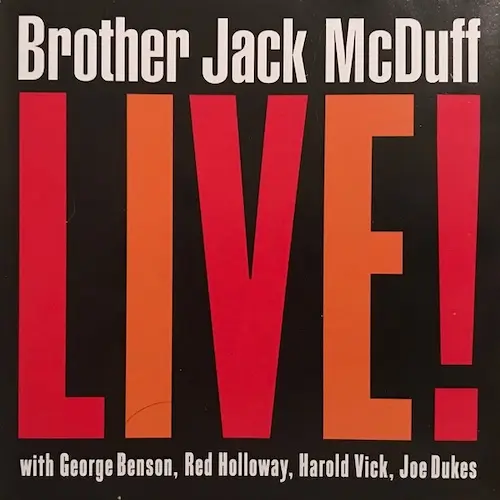
PRCD-24147-2 (Live!)
Front Room (original LP PR 7274) + Jazz Workshop (original LP PR 7286) coupled together. The disc most frequently referenced in this series. Rock Candy, Blues 1 & 8, Undecided, Jive Samba: they’re all here. Start with this one.
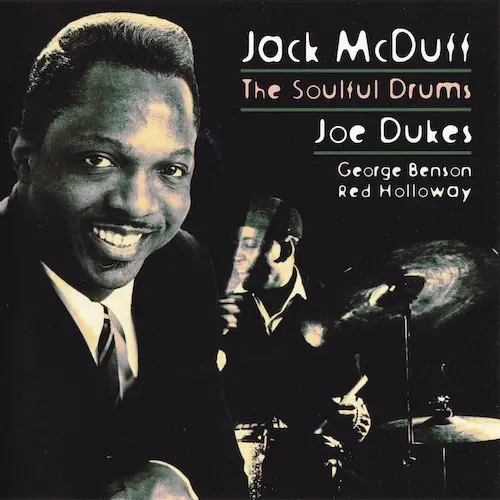
PRCD-24256-2 (The Soulful Drums)
A Dukes feature disc. Original LPs are PR 7324 (The Soulful Drums of Joe Dukes) + PR 7422 (Hot Barbeque) and more. Soulful Drums, Greasy Drums, Two Bass Hit, etc. Note: track 1, Soulful Drums, is the PR 7324 version (with Benson), a different recording from the PR 7259 version (with Burrell).
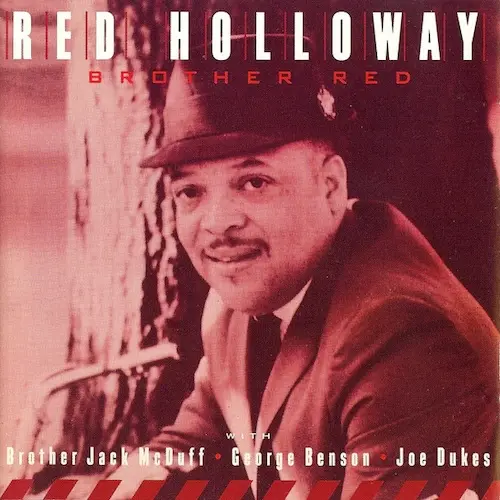
PRCD-24141-2 (Brother Red)
The Holloway-led LA sessions. Original LPs are PR 7325 (Cookin’ Together) + part of PR 7323 (The Dynamic Jack McDuff) + Redwood City by The Nomos. Brother Red, Shout Brother, and This Can’t Be Love are only available on this disc. Note: the booklet credits for Benny Golson contain errors (detailed in Part III).
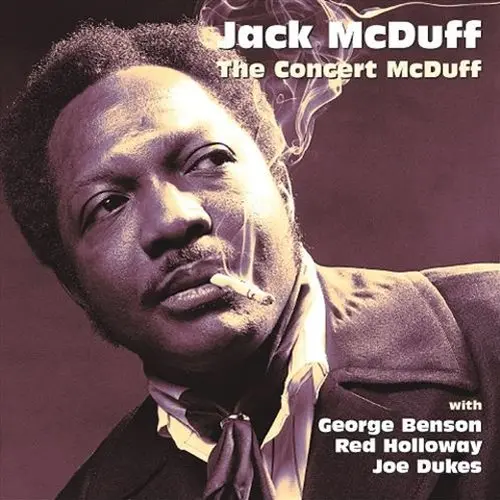
PRCD-24270-2 (The Concert McDuff)
The Stockholm live recordings (original LP PR 7362) + an alternate take of Undecided (first issued on PR 7492). The breakneck three-voice soli on Four Brothers can be heard here.
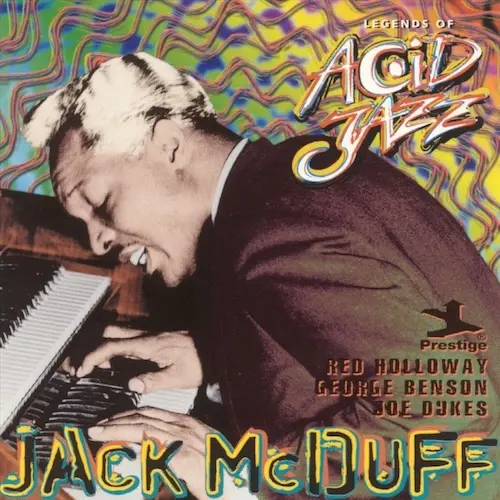
PRCD-24184-2 (Legends of Acid Jazz)
Au Privave, East Of The Sun (both originally on PR 7492), and more. Holloway drops out partway through, so you can compare the soundstage with and without him on a single disc.
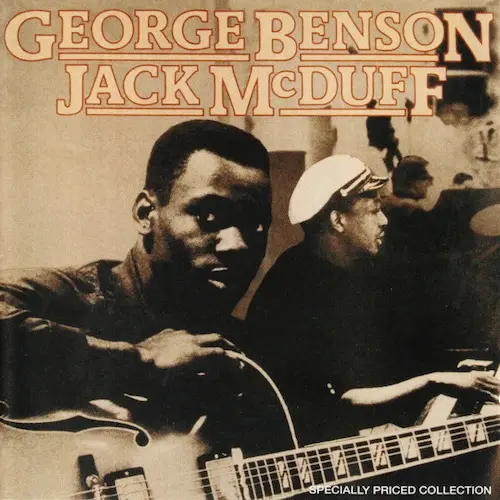
PRCD-24072 (George Benson / Jack McDuff)
A 2-in-1 of Hot Barbeque (original LP PR 7422) and Benson’s New Boss Guitar (original LP PR 7310). Centered on the 1965 studio sessions, this disc includes the last session covered in this article.
A word of caution: not every track on every CD features all four players. Some discs include tracks with Pat Martino on guitar, tracks without Holloway, or tracks without Dukes. If you want to follow only the quartet’s performances, cross-reference with the matrix in Part III.
After Two Years of Listening
I’ve listened through five groups of sessions. From the overwhelming raw early energy of the Front Room, to the forward-leaning combustion of the Jazz Workshop, the overlapping leader credits in LA, the breakneck ensemble playing in Stockholm, and on to the boogaloo product of the studio era. The groove machine kept running, changed shape, and eventually scattered.
Along the way, in Part I and now Part II, I’ve noted several points where sources disagree: “the back cover of PR 7286 says…,” “TJD says…,” “jazzdisco.org says….” Following the recordings of these four players, you find that booklet credits, discography databases, even our own discography can get things wrong.
Part III will sort through those discrepancies (errors found in TJD, the correction of the year Benson joined, the flute/soprano sax attribution question), along with a condensed matrix of sessions, original LPs, and CDs.
This is the second of a three-part series. Part I: Two Miraculous Years / Part III: Discographical Data