As promised at the end of Part II, this final installment covers discographical verification and cross-reference matrices mapping sessions, original LPs, and CDs.
While researching this series, it was driven home to me that there is no such thing as a “perfect primary source” in discography. Let me start with that.
Booklets, TJD, and Even My Own Discography Get It Wrong
Spend enough time working with discographies and one thing becomes clear: no source is perfect.
Booklet errors
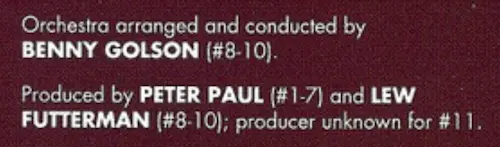
Open the booklet for PRCD-24141-2 Brother Red and you’ll find tracks 8-10 (from PR 7323 The Dynamic Jack McDuff, recorded 1964-02-06/07 in LA) credited to the Benny Golson big band. But this session (the B side of PR 7323) was recorded by the McDuff quartet alone; Golson was not involved. The error likely crept in because the A side of PR 7323 features the Benny Golson Big Band.
TJD error: My Three Sons
Tom Lord’s The Jazz Discography (TJD) is the standard reference for jazz recording data. TJD [B6168] places My Three Sons under the May 1, 1964 George Benson leader session (drums: Montego Joe; Joe Dukes was not on this date).
However, the liner notes for OJCCD-461-2 The New Boss Guitar of George Benson state clearly that track 8, My Three Sons, was “recorded May 14, 1964, with Joe Dukes (d), previously issued on PR 7324 The Soulful Drums.” No alternate take from the May 1 session exists. The only recording of this tune comes from Joe Dukes’s leader session on 1964-05-14 [D6891]. This is a concrete example of TJD misassigning a track to the wrong session.
TJD error: the guitarist on PR 7476
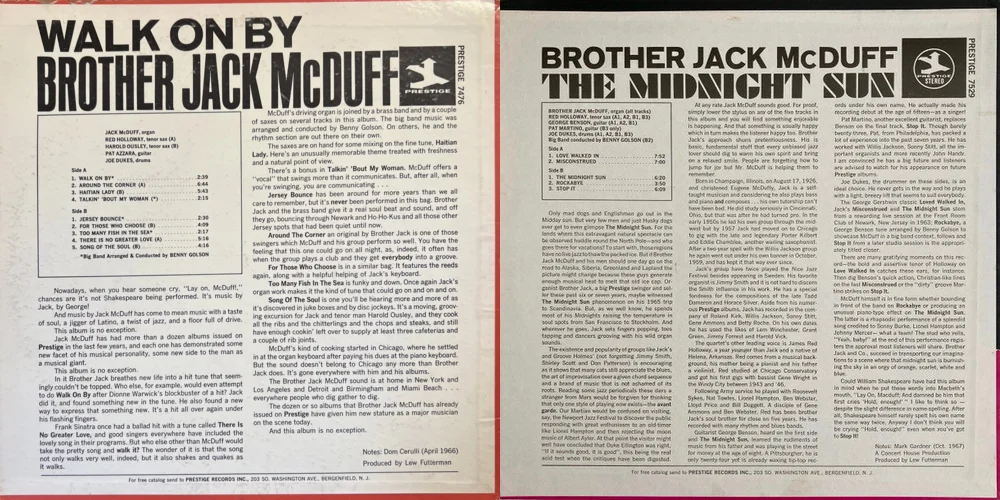
TJD [M4144] lists George Benson as the guitarist on the February 1966 Benny Golson big band session (PR 7476 Walk On By). But the back cover of the original PR 7476 LP clearly reads “Pat Azzara, guitar.” Pat Azzara is Pat Martino’s birth name (Patrick Carmen Azzara). The liner notes make no mention of Benson. This is a Martino session; the last Prestige date where Benson appeared with the quartet was Hot Barbeque (PR 7422) on 1965-10-19.
The year Benson joined, and secondary sources
As discussed in Part I, many sources put Benson’s arrival in 1962, but Benson himself corrected this: “No, I joined him in ’63.” (Smithsonian Jazz Oral History, p. 35). Secondary sources are no exception. The Flophouse Magazine review of The Soulful Drums (Francois, 2016) listed “George Benson (drums)” in the personnel. Benson is, of course, a guitarist. I make this kind of simple slip myself, so I’m not one to talk, but it’s one more example of why data needs to be checked against multiple sources.
The answer to the title variation: Moohah
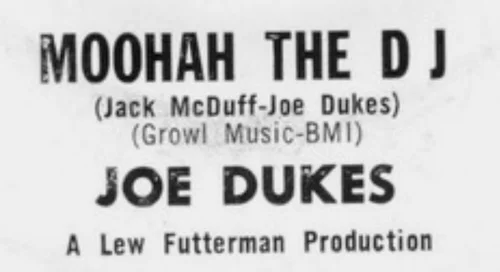
Track 6 on PR 7324 The Soulful Drums appears as “Moonah The D.J.” in TJD and “Moohah The DJ” in Flophouse Magazine. The answer came from Benson himself (Smithsonian, p. 46):
“There was actually a guy… a disk jockey, from his hometown, Memphis, Tennessee. His name was Moohah, and Joe honored him by naming a song after him.”
George Benson, Smithsonian Jazz Oral History, 2011Moohah was a real DJ from Joe Dukes’s hometown, Memphis. The variations in the title presumably arose from different transcriptions of a real person’s name.
The ts/ss/fl attribution problem
Let me expand on a problem mentioned in Part I. On Live! At the Jazz Workshop (PR 7286), Red Holloway and Harold Vick appear together, but which player handles tenor sax (ts), soprano sax (ss), and flute (fl) on which tracks is contradicted across five sources:
- PR 7286 back cover: no fl/ss instruments listed in the personnel
- A review (by damimijazz) apparently based on Ruppli’s The Prestige Label: Vick = fl, Holloway = ss
- PR 7286 liner notes: focused entirely on McDuff’s biography, with no mention of fl/ss. Personnel lists both Holloway and Vick as “tenor sax” only
- jazzdisco.org: likewise lists both Holloway and Vick as “tenor sax” only
- TJD: “Red Holloway, Harold Vick (ts, fl)” with no per-track breakdown
With neither the label nor the liner notes offering a definitive answer, this remains unresolved unless the musicians themselves can be asked. Even jazzdisco.org, a discography I co-edit, has not been able to settle this ts/ss/fl attribution.
PR 7286: stereo or mono?
In Part II, I noted that the Jazz Workshop tracks on PRCD-24147-2 are in mono (while the Front Room material is in stereo). Here’s more on that.
The original LP, PRST-7286, was issued with the PRST prefix, indicating a stereo pressing. But when I checked a needle-drop of an original pressing, the “stereo” turned out to be fake stereo. Neither the jacket nor the label bears any “simulated stereo” or “re-processed stereo” notice (confirmed via Discogs label photos).
The session master itself was mono. If a genuine stereo master had existed, there would have been no reason to apply fake-stereo processing. This was not unique to Prestige at the time, but I’m recording it here as a case of a mono master sold as stereo with no disclosure.
All three live albums were edited
In Part II, I detailed the overdubbed applause, spliced MCs, and cut choruses on PR 7274 (Front Room) and PR 7286 (Jazz Workshop).
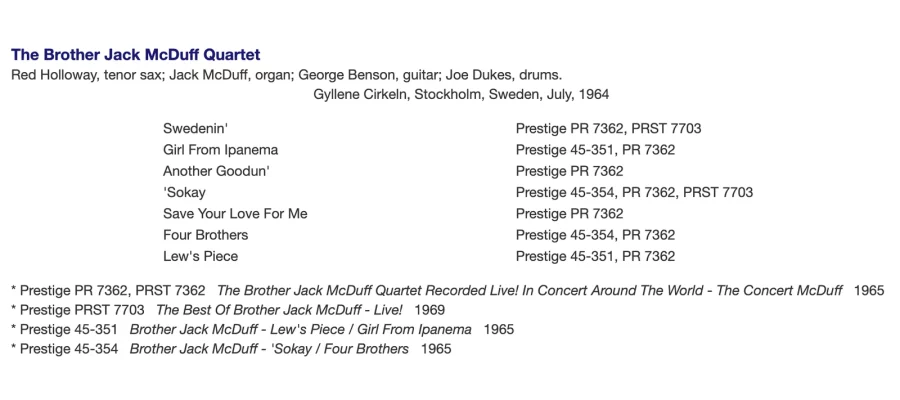
I’ve found the same kind of editing on PR 7362 (The Concert McDuff, Golden Circle, Stockholm). It’s most obvious on The Girl From Ipanema, where a burst of large-hall applause suddenly fades in mid-song, then fades right back out. The Golden Circle was a club; a big-hall reverb doesn’t belong. That means all three Prestige live albums by this quartet (PR 7274 / PR 7286 / PR 7362) used overdubbed applause.
I once wrote about Bill Evans’s The Complete Live At The Village Vanguard 1961 (Riverside / Victor Japan). In Evans’s case, the original LPs were the producer’s “work,” shaped through sequencing, fade-outs, and track selection, but the 2002 Complete box restored the unedited session masters. That was a genuinely groundbreaking release.
What about the McDuff live albums? The CDs containing PR 7274 / PR 7286 / PR 7362 material appear to have been mastered from production masters (the edited tapes). If the session masters still exist, a reissue along the lines of the Evans Complete box would let us hear what these performances actually sounded like in the room. But so far, no release has ever appeared without the overdubbed applause. Given how many CD reissues have come and gone without one, the unedited session masters may no longer exist.
That’s why you go back to the records
Booklets get it wrong. TJD gets it wrong. Secondary reviews get it wrong. Even jazzdisco.org, a discography I co-edit, isn’t perfect. And yet (or rather, precisely because of all this) the record itself is the final authority. Read the credits on the label, listen to the music, and confirm with your own ears. The two matrices below are the accumulated result of that work.
Releases by Session
Below is a summary table mapping every Prestige recording session involving McDuff-Holloway-Benson-Dukes to its LP and CD releases.
| Date | Session | Original LP | Current CD | Notes |
|---|---|---|---|---|
| 1963-06-05 | Front Room, Newark / McDuff qt. | PR 7274; PR 7492; PR 7529 | PRCD-24147-2; PRCD-24270-2 | 10 tracks. Undecided alt, Love Walked In, and The Midnight Sun on PRCD-24270-2 |
| 1963-10-03 | Jazz Workshop, SF / McDuff qt. + Vick | PR 7286 | PRCD-24147-2 | 7 tracks. fl/ss attribution unresolved. Recorded in mono |
| 1963-12-24 | NYC / McDuff qt. + Golson big band | PR 7333 | PRCD-24283-2 | 9 tracks. Prelude |
| 1964 | Antibes / McDuff qt. | None | Moon Ride Freres | 3 tracks. Non-Prestige |
| 1964-02-06 | LA / Holloway leader qt. | PR 7325 | PRCD-24141-2 | 7 tracks. Cookin’ Together |
| 1964-02-06/07 | LA / McDuff qt. | PR 7323 | PRCD-24141-2 | 3 tracks. Golson error in booklet |
| 1964-02-06/07 | LA / The Nomos | PR 7791; 45-301 | PRCD-24141-2; PRCD-24256-2 | Long Distance is unissued |
| 1964-05-14 | NYC / Dukes leader qt. | PR 7324 | PRCD-24256-2 | 6 tracks. TJD’s placement of My Three Sons is incorrect |
| 1964-07 | Golden Circle, Stockholm / McDuff qt. | PR 7362 | PRCD-24270-2 | 7 tracks. The Concert McDuff |
| 1964-07 | Stockholm / McDuff qt. + Golson big band | PR 7404 | PRCD-24184-2 | 4 tracks |
| 1964-07 | NYC studio / McDuff qt. | PR 7404-7666 (multiple) | PRCD-24184-2 and others | 9 tracks. Holloway out on some. Exact date unknown |
| 1965 | NYC studio / McDuff qt. | PR 7404; PR 7642 | PRCD-24274-2; PRCD-24242-2 (tr. 13) | 4 tracks. Exact date unknown |
| early 1965 | NYC / McDuff qt. + Golson big band | PR 7529; PR 7642; PR 7666 | PRCD-24283-2 | 3 tracks. TJD credits Benson as guitarist, but LP back cover lists Martino. Transitional period; unconfirmed |
| 1965-10-19 | NYC / McDuff qt. | PR 7422 | PRCD-24256-2; PRCD-24072 | 7 tracks. Hot Barbeque |
Notes
- The three sessions marked “exact date unknown” (1964-07 NYC, 1965 NYC, early 1965 Golson big band) are listed in TJD only to the month or year; specific dates have not been established
- Some studio recordings (Greasy Drums, East Of The Sun, Au Privave, etc.) end in fade-outs. Complete takes have not been released, so how the performances actually ended is unknown
- The table above focuses on core quartet sessions. The May 1, 1964 George Benson leader session (without Dukes) and tracks featuring Pat Martino are not included. On CD, these tracks sometimes appear alongside the quartet recordings, so refer to the reverse-lookup guide in Part II as well
- PRCD-24242-2 Silken Soul has 13 tracks, but Benson appears on only track 13 (Silk And Soul). The remaining 12 feature Pat Martino
- BGP (E) CDBGPD053 is a UK CD reissue containing tracks from Front Room (PR 7274) and Hot Barbeque (PR 7422). It is omitted from the table above but represents another available source
- PRCD-24287-2 The Prestige Years is a multi-session compilation containing Rock Candy, Grease Monkey, Jive Samba, Hot Barbeque, and Opus De Funk
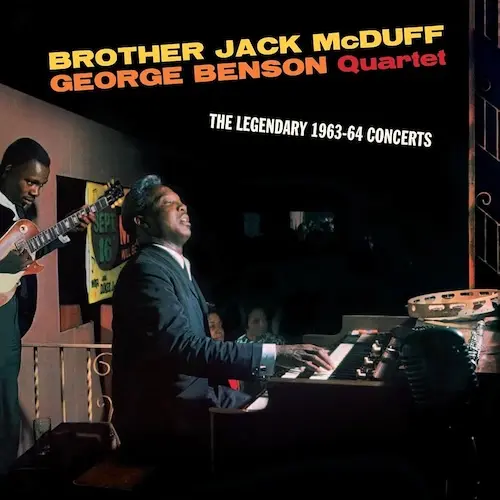
One final note. In 2024, the UK label Fingerpoppin’ Records released The Legendary 1963-64 Concerts (117032), a 2-CD set drawing from four sessions: Front Room, Jazz Workshop, Antibes, and Golden Circle, 28 tracks in all. It’s close to a complete collection of live recordings by this quartet. The audio comes from the same production masters as previous releases, but the set includes Chicken Feet, previously available only on the French single Col (F) ESRF1423, and an alternate take of Sanctified Samba in mono. It’s the single best title to listen to alongside the matrix above.
Original LPs: Session Contents
The matrix above was organized by session: “Where did this session end up?” This one works in reverse: “What’s on this LP?” Original LPs containing Benson-era recordings are listed in catalog-number order.
LPs Consisting Entirely of Recordings by the Quartet
| Original LP | Title | Session | Notes |
|---|---|---|---|
| PR 7274 | Brother Jack Live! | 1963-06-05 Front Room | 6 tracks |
| PR 7286 | At the Jazz Workshop | 1963-10-03 Jazz Workshop | 7 tracks (+ Vick) |
| PR 7323 | The Dynamic Jack McDuff | A: 1963-12 Golson big band / B: 1964-02 LA qt. | Side A is big band |
| PR 7324 | The Soulful Drums | 1964-05-14 NYC | 6 tracks. Dukes as leader |
| PR 7325 | Cookin’ Together | 1964-02-06 LA | 7 tracks. Holloway as leader |
| PR 7333 | Prelude | 1963-12-24 NYC | 9 tracks. Golson big band |
| PR 7362 | The Concert McDuff | 1964-07 Stockholm | 7 tracks. Golden Circle |
| PR 7404 | Silk and Soul | 1964-07 Stockholm Golson + NYC + 1965 NYC | 3 sessions mixed, but all Benson era |
| PR 7422 | Hot Barbeque | 1965-10-19 NYC | 7 tracks |
LPs Mixing Benson-Era and Other Guitarists
McDuff was on Prestige for a long time, with guitarists rotating through: Green, Burrell, Benson, then Martino. Later LPs and compilations mix recordings from multiple eras onto a single disc.
| Original LP | Title (year) | Benson era | Other guitarists | Notes |
|---|---|---|---|---|
| PR 7481 | Greatest Hits (1967) | Rock Candy, Grease Monkey | Green (1960-61) 2 tracks, Burrell (1962-63) 2 tracks | Benson on only 2 of 8 tracks |
| PR 7492 | Hallelujah Time (1967) | Undecided alt, Au Privave, Hallelujah Time, East Of The Sun | Martino 2 tracks | |
| PR 7529 | The Midnight Sun (1967) | Love Walked In, Misconstrued, The Midnight Sun | Martino 1 track (Stop It). Rockabye is Golson big band (guitarist unconfirmed) | Back cover reads “George Benson, guitar (A1, A2, B1)” |
| PR 7567 | Soul Circle (1968) | Lew’s Piece, Opus De Funk | Martino 2 tracks, Eddie Diehl 1 track | 3 guitarists on one disc |
| PR 7642 | I Got A Woman (1969) | I Got A Woman, Twelve Inches Wide | Martino 2 tracks. English Country Gardens is Golson big band (guitarist unconfirmed) | |
| PR 7666 | Steppin’ Out (1969) | Our Miss Brooks (1964-07) | Green (1961) 1 track, Burrell (1963) 2 tracks, Martino (1966) 1 track. Shortnin’ Bread is Golson big band (guitarist unconfirmed) | 4 guitarists on one disc, spanning 5 years (1961-1966) |
| PR 7703 | Best Of — Live! (1969) | All 6 tracks (Front Room + Jazz Workshop + Golden Circle) | None | Live best-of. Benson only |
| PR 7771 | Best Of — Big Soul Band (1970) | Stockholm Golson 4 tracks | Martino 5 tracks (Walk On By and others) |
Notes
- The three tracks marked “guitarist unconfirmed” (Rockabye, English Country Gardens, Shortnin’ Bread) are all from Golson big band sessions. TJD credits Benson, but LP back cover credits indicate Martino. With guitar barely audible in these recordings, aural verification is impossible, so they remain unconfirmed
- PR 7476 Walk On By (1966) is listed by TJD as a Benson session, but the back cover personnel reads “Pat Azzara, guitar” (= Pat Martino). All tracks are Martino’s, so this LP is not included in the table above
- PR 7778 Best Of Red Holloway (1970) and PR 7791 Soul/Jazz Giants (1970) also contain some tracks with Benson, but they fall outside the McDuff band context and are omitted here
Closing
Over three installments, I’ve traced the Prestige recordings of McDuff, Holloway, Benson, and Dukes. Part I covered the four players, Part II followed the music chronologically, and this Part III verified and organized the discography.
From Newark in June 1963 to New York in October 1965: 14 sessions produced over eighty tracks. Regardless of whose name is on the label or how the release was packaged, when these four got together, the groove machine started running. This is the record of that.
I hope this series gives you a reason to dig back into those scattered recordings and hear the quartet again.
This is Part III (the final installment) of a three-part series. Part I: Two Miraculous Years / Part II: Listening in Chronological Order