2026/08/04

Revisiting “Tijuana Moods”: セッションテープに残された声と継ぎ目

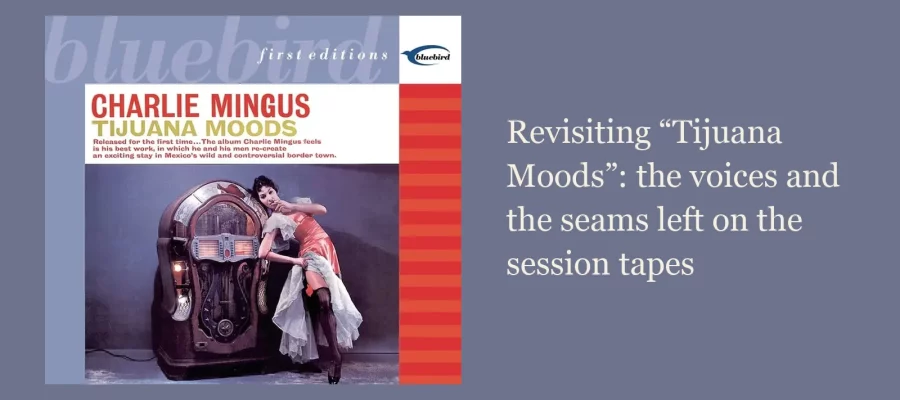
Front cover of the 2001 Bluebird First Editions two-CD reissue of Charles Mingus's Tijuana Moods (Bluebird 09026-63840-2), reusing the 1962 RCA Victor LP artwork

2001 年の 2CD Tijuana Moods(Bluebird 09026-63840-2、Ben Young 監修)。未発表のセッションフラグメントを多数収録した盤で、この記事が主に聴き直すのもこの 2CD です。

Charles Mingus の Tijuana Moods (RCA Victor LSP-2533) およびボーナストラック入りの 2CD (Bluebird 09026-63840-2) について当ブログで記事を書いたのは2006年、いまから20年前のことです。あのとき私は、2001年のBluebird 2CDリイシューを「隅々まで聴けば聴くほど、謎が解明されると同時に、更なる謎は深まるばかり」と書きました。その後もこのアルバムを聴き続け、文献にあたり、そして最近になって、この2CDをあらためて隅々まで、それも波形とスペクトログラムまで含めて聴き直す機会がありました。分かったこと、訂正すべきこと、新たに浮かんだ問いを、20年ぶりの続編としてまとめておきます。

なお、同じMingusのテープ編集手法「アイランドホッピング」を扱った姉妹記事として、Charles Mingus “Pre-Bird” と、テープの「切れ端」に残された声を同時に公開しています。あちらは1960年のMercuryセッション、こちらは1957年のRCA Victorセッションの話です。あわせて読んでいただくと、Mingusが録音スタジオをどう使っていたかが立体的に見えてくると思います。

Continue reading
2026/08/04

Revisiting “Tijuana Moods”: the voices and the seams left on the session tapes

Front cover of the 2001 Bluebird First Editions two-CD reissue of Charles Mingus's Tijuana Moods (Bluebird 09026-63840-2), reusing the 1962 RCA Victor LP artwork

The 2001 two-CD Tijuana Moods (Bluebird 09026-63840-2), supervised by Ben Young and including many previously unissued session fragments. This is the edition the present article mainly revisits.

It was in 2006, twenty years ago now, that I wrote about Charles Mingus’s Tijuana Moods (RCA Victor LSP-2533) and its two-CD reissue with bonus tracks (Bluebird 09026-63840-2) on this blog. Back then I wrote of the 2001 Bluebird 2CD reissue that "the more closely I listened to every corner of it, the more mysteries were solved, and at the same time the deeper the new mysteries grew." I have kept listening to this album since, kept reading the literature, and recently I had the chance to go back through that 2CD from end to end once more, this time down to the waveforms and spectrograms. What I learned, what needs correcting, and what new questions came up: I am putting them together here as a sequel, twenty years on.

As a companion piece dealing with the same Mingus tape-editing method, "island-hopping," I am publishing Charles Mingus’s Pre-Bird, and the voices left on the offcuts at the same time. That one is about the 1960 Mercury session; this one is about the 1957 RCA Victor session. Read together, I think they give a stereoscopic view of how Mingus used the recording studio.

Continue reading
2023/11/07

Things I learned on Phono EQ curves, Pt. 18

EQカーブの歴史、ディスク録音の歴史を学ぶ本シリーズ。前回 Pt.17 では、1948年〜1953年(つまり1954年のRIAA規格策定前)の、米国における民生用レコードのEQカーブの状況を調査し学びました。

On the previous part 17, I learned the situation of the consumer records in the U.S. since 1948 until 1953 (i.e. before the RIAA Standard was formulated in 1954), especially the disc EQ curves used for those records manufactured in the U.S.

また、ハイファイブーム勃興期の当時に販売されていたアンプの、マグネットカートリッジ用のフォノイコについても調査しました。

At the same time, I did a brief research of phono EQ units (for magnetic cartridges) in the amplifiers that were sold in the era, when the rise of “Hi-Fi” movement became obvious.

今回の Pt.18 では、ついに、1953年NARTB規格、1954年改訂AES再生カーブ、1954年RIAA規格の成立のストーリーに入ります。

This Pt. 18 — finally — will deal with the stories of the formulation of the following standards: 1953 NARTB Recording and Reproducing Standards; 1954 new AES Playback Curve; 1954 RIAA Standard Recording and Reproducing Characteristic.

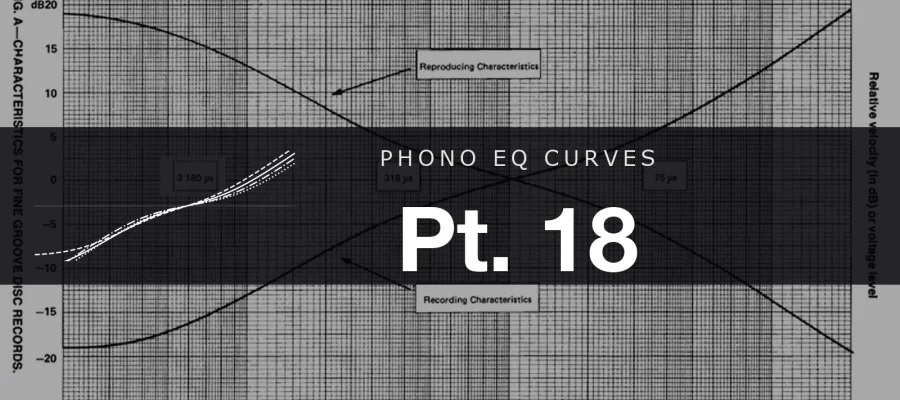
Characteristics For Fine Groove Disc Records

source: “RIAA Dimensional Standards: Bulletin No. E 1: Standard Recording and Reproducing Characteristics
1954年1月29日に策定された、RIAA標準録音再生規格文書(の1978年11月6日改訂版)に掲載された、RIAA録音再生カーブのグラフ
RIAA Recording / Reproducing Curves, from the version revised on Nov. 6, 1978.

Continue reading