2026/08/04

Charles Mingus “Pre-Bird” と、テープの「切れ端」に残された声

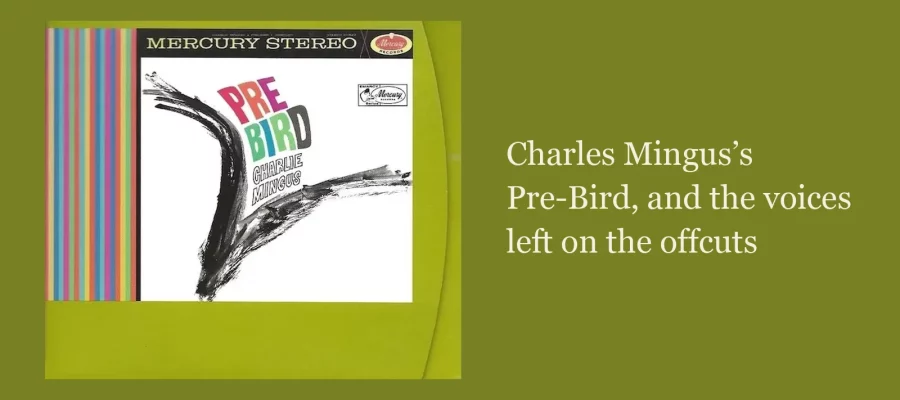
Charles Mingus’s Pre-Bird, and the voices left on the offcuts

Charles Mingus の Pre-Bird (Mercury MG-20627/SR-60627) は、私が Mercury のジャズ系 LP を意識して集め始めたごく初期に手に入れた 1 枚です。1960年5月、ニューヨークの Plaza Sound で録音されたこのアルバムは、曲によって 10人のコンボから Gunther Schuller が指揮する 22人の大編成まで、編成が大きく変わるのが特徴です。

Charles Mingus’s Pre-Bird (Mercury MG-20627/SR-60627) was one of the first records I picked up when I started collecting Mercury’s jazz LPs with any seriousness. Recorded in May 1960 at Plaza Sound in New York, it changes instrumentation drastically from track to track, from a ten-piece combo to a twenty-two-piece orchestra conducted by Gunther Schuller.

Cash Box magazine, September 9, 1961, page 23: a capsule review of Charles Mingus's Pre-Bird (Mercury SR 60627), reproduced with the album jacket

Cash Box, September 9, 1961, p.23, “Cash Box Album Reviews.” A notice from the year the LP appeared. The reviewer grants the title its premise and then sets it aside: “the performances are strictly post-Bird, more precisely—current Mingus.”

A-1 “Take The ‘A’ Train” では左チャンネルから “A Train” のメロディ、右チャンネルから “Exactly Like You” のメロディが同時に流れ、B-1 “Do Nothin’ Till You Hear From Me” でも “I Let a Song Go Out of My Heart” との対位法的なマッシュアップ (contrapuntal pairing) が仕掛けられています。Ellington の楽曲を 2 曲ずつ対にして両面の冒頭に配するという、大胆な構成です。

On A-1, “Take The ‘A’ Train,” the melody of “A Train” comes out of the left channel while “Exactly Like You” comes out of the right, both at once; B-1, “Do Nothin’ Till You Hear From Me,” sets up the same kind of contrapuntal pairing with “I Let a Song Go Out of My Heart.” Putting two paired Ellington pieces at the head of each side is a bold piece of programming.

Lorraine Cusson のヴォーカルをフィーチャーした A-3 “Eclipse” や A-5 “Weird Nightmare” では不穏な美しさが漂います。のちに Mingus のリーダー作で圧倒的な存在感を示すことになる Eric Dolphy は、B-2 “Bemoanable Lady” での印象的なアルトソロを除くとむしろ控えめで、このアルバムではどちらかといえば Booker Ervin のテナーが前面に出ています。そしてアルバムを締めくくる B-3 “Half-Mast Inhibition” では、Mingus が 18歳の頃に書いた野心的な楽曲を Schuller 指揮の 22人編成で再現しており、ジャズと現代音楽の融合を目指したいわゆる「サード・ストリーム」の実践として、調性と無調性の境界を行き来する圧倒的な 8 分間が展開されます。タイトルの “Pre-Bird” は、Mingus が Charlie Parker の音楽に出会う以前に書いた楽曲を中心に構成されていることに由来します。

A-3 “Eclipse” and A-5 “Weird Nightmare,” both featuring Lorraine Cusson’s vocal, have an uneasy beauty about them. Eric Dolphy, who would later dominate Mingus’s own dates, stays largely in the background here, apart from a striking alto solo on B-2 “Bemoanable Lady”; it is Booker Ervin’s tenor that comes forward more often. The album closes with B-3 “Half-Mast Inhibition,” a piece Mingus had written at eighteen, realized by Schuller and the large ensemble: eight minutes that move back and forth across the line between tonality and atonality, and one of the more convincing results of what was then called Third Stream. The title refers to the fact that most of the material predates Mingus’s encounter with Charlie Parker’s music.

私がこのアルバムを最初に手に入れたのは、1973年頃に出た Phonogram のリイシュー盤 (Mercury MG-20627 のモノーラルプレス。直輸入の日本盤は IMPF 11004) でした。その直後に Mercury のオリジナルのステレオ盤 (SR-60627) も入手し、以来ずっと愛聴盤の一つです。

The first copy I owned was a Phonogram reissue from around 1973, a mono pressing of Mercury MG-20627 (the Japanese direct import carried the number IMPF 11004). I found an original Mercury stereo pressing (SR-60627) not long after, and the record has stayed in rotation ever since.

Mercury SR-60627 ジャケット表 (Charles Mingus: Pre-Bird)

Mercury SR-60627 — Pre-Bird LP (stereo)

A-1. PB 3442-4 Take the "A" Train (interplates "Exactly Like You") 3:34
A-2. PB 3439-5 Prayer for Passive Resistance 3:49
A-3. PB 3440-5 Eclipse 3:45
A-4. PB 3431-5 Mingus Fingus No. 2 3:22
A-5. PB 3438-4 Weird Nightmare 3:35
B-1. PB 3441-4 Do Nothin' Till You Hear From Me (interplates "I Let A Song Out of My Heart") 3:33
B-2. PB 3432-3 Bemoanable Lady 4:32
B-3. PB 3430   Half-Mast Inhibition 8:12

Charles Mingus plays bass on all tracks accompanied by:

Tracks A-1〜A-3, A-5, B-1:
Ted Curson (tp), Jimmy Knepper (tb), Eric Dolphy (as, fl, b-cl),
Yusef Lateef (ts, fl), Booker Ervin (ts), Joe Farrell (ts, fl),
Paul Bley (p), Dannie Richmond (ds).
Track A-2: omit Bley. Track B-1: Sir Roland Hanna (p) replaces Bley.
Track A-3: add Lorraine Cusson (Lorraine Cousins) and band (voc). Track A-5: add Lorraine Cusson (Lorraine Cousins) (voc), omit Richmond.
Recorded May 25, 1960, probably at Plaza Sound, New York City.

Tracks A-4, B-2, B-3:
Marcus Belgrave, Ted Curson, Hobart Dotson, Clark Terry, Richard Williams (tp),
Eddie Bert, Charles Greenlee, Slide Hampton, Jimmy Knepper (tb), Don Butterfield (tuba),
Robert DiDomenica (fl), Harry Schulman (oboe), Eric Dolphy (as, fl, b-cl),
John LaPorta (as, cl), Bill Barron, Joe Farrell (ts), Yusef Lateef (ts, fl),
Danny Bank (bs), Charles McCracken (cello),
Sir Roland Hanna (p), Dannie Richmond (ds), Sticks Evans, George Scott (perc).
Track B-3: add Max Roach (perc) and Gunther Schuller (cond).
Recorded May 24, 1960 at Plaza Sound, New York City.

Original recordings produced by Leonard Feather.
Mercury SR-60627 Label (Side-A)

Mercury SR-60627 Label (Side-A)

Continue reading
2026/08/04

Revisiting “Tijuana Moods”: セッションテープに残された声と継ぎ目

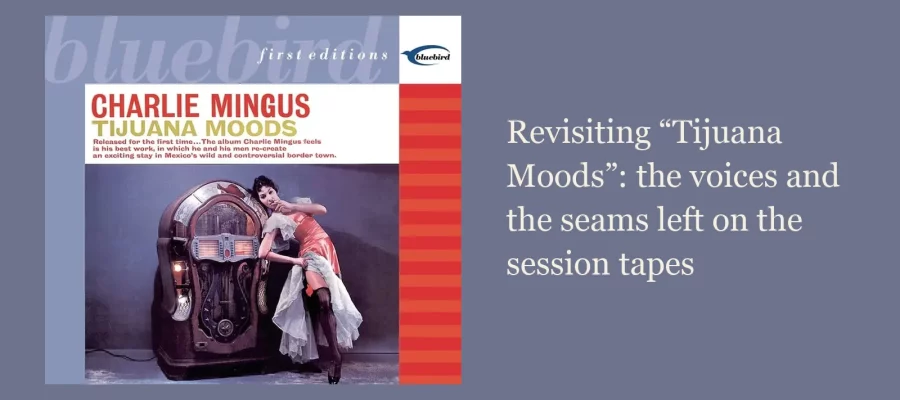
Front cover of the 2001 Bluebird First Editions two-CD reissue of Charles Mingus's Tijuana Moods (Bluebird 09026-63840-2), reusing the 1962 RCA Victor LP artwork

2001 年の 2CD Tijuana Moods(Bluebird 09026-63840-2、Ben Young 監修)。未発表のセッションフラグメントを多数収録した盤で、この記事が主に聴き直すのもこの 2CD です。

Charles Mingus の Tijuana Moods (RCA Victor LSP-2533) およびボーナストラック入りの 2CD (Bluebird 09026-63840-2) について当ブログで記事を書いたのは2006年、いまから20年前のことです。あのとき私は、2001年のBluebird 2CDリイシューを「隅々まで聴けば聴くほど、謎が解明されると同時に、更なる謎は深まるばかり」と書きました。その後もこのアルバムを聴き続け、文献にあたり、そして最近になって、この2CDをあらためて隅々まで、それも波形とスペクトログラムまで含めて聴き直す機会がありました。分かったこと、訂正すべきこと、新たに浮かんだ問いを、20年ぶりの続編としてまとめておきます。

なお、同じMingusのテープ編集手法「アイランドホッピング」を扱った姉妹記事として、Charles Mingus “Pre-Bird” と、テープの「切れ端」に残された声を同時に公開しています。あちらは1960年のMercuryセッション、こちらは1957年のRCA Victorセッションの話です。あわせて読んでいただくと、Mingusが録音スタジオをどう使っていたかが立体的に見えてくると思います。

Continue reading
2026/08/04

Revisiting “Tijuana Moods”: the voices and the seams left on the session tapes

Front cover of the 2001 Bluebird First Editions two-CD reissue of Charles Mingus's Tijuana Moods (Bluebird 09026-63840-2), reusing the 1962 RCA Victor LP artwork

The 2001 two-CD Tijuana Moods (Bluebird 09026-63840-2), supervised by Ben Young and including many previously unissued session fragments. This is the edition the present article mainly revisits.

It was in 2006, twenty years ago now, that I wrote about Charles Mingus’s Tijuana Moods (RCA Victor LSP-2533) and its two-CD reissue with bonus tracks (Bluebird 09026-63840-2) on this blog. Back then I wrote of the 2001 Bluebird 2CD reissue that "the more closely I listened to every corner of it, the more mysteries were solved, and at the same time the deeper the new mysteries grew." I have kept listening to this album since, kept reading the literature, and recently I had the chance to go back through that 2CD from end to end once more, this time down to the waveforms and spectrograms. What I learned, what needs correcting, and what new questions came up: I am putting them together here as a sequel, twenty years on.

As a companion piece dealing with the same Mingus tape-editing method, "island-hopping," I am publishing Charles Mingus’s Pre-Bird, and the voices left on the offcuts at the same time. That one is about the 1960 Mercury session; this one is about the 1957 RCA Victor session. Read together, I think they give a stereoscopic view of how Mingus used the recording studio.

Continue reading
2026/06/30

Phono EQ Curves Liner Notes III — Fortune 1939 “Phonograph Records”

Phono EQ Curves に関する筆者の学習過程を、これまで Pt.0Pt.25 として連載してきました。本シリーズ Phono EQ Curves Liner Notes は、その続編ではなく、別の角度からのアプローチです。LP のジャケット裏に書かれた解説(ライナーノーツ)のように、本編とは別の物語を、別の温度感で記録するためのシリーズです。

Over the years I have documented my own learning process on phono EQ curves as a serial, running from Pt.0 through Pt.25. This series, Phono EQ Curves Liner Notes, is not a sequel to that serial but an approach from a different angle. Like the liner notes printed on the back of an LP jacket, it sets out to record a story apart from the main feature, at a different temperature.

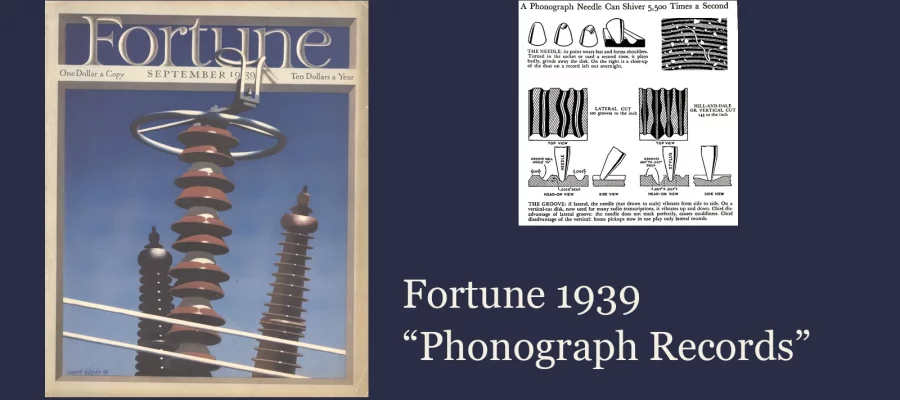
第 3 弾 Liner Notes III は、レコードではなく一冊の古い雑誌を扱います。Fortune 誌 1939年9月号(Volume XX, Number 3)に掲載された無署名の長編特集記事「Phonograph Records」を一次史料として精読し、EQカーブという言葉がまだ誰の口にものぼっていなかった時代のレコード産業の全景を読み解く回です。

This third installment, Liner Notes III, deals not with a record but with a single old magazine. In it, I closely read the unsigned long-form feature “Phonograph Records” from Fortune’s September 1939 issue (Volume XX, Number 3) as a primary source, and try to work out the full panorama of the record industry in an era when the phrase “EQ curve” had not yet crossed anyone’s lips.

Fortune magazine, Vol. XX, No. 3, September 1939 cover art by Herbert Bayer

Cover of the September 1939 issue of Fortune (Vol. XX, No. 3). Illustration by Herbert Bayer. “Phonograph Records,” the article read closely in this essay, appears in this issue.
Fortune 誌 1939年9月号(Vol. XX, No. 3)表紙。Herbert Bayer によるイラスト。本稿で精読する「Phonograph Records」はこの号に掲載されている

Continue reading
2026/06/26

Preservation and Storage of Sound Recordings (1959) — A First Reading

レコードの敵は素材ごとに違った — 1959年の議会図書館レポートを読む

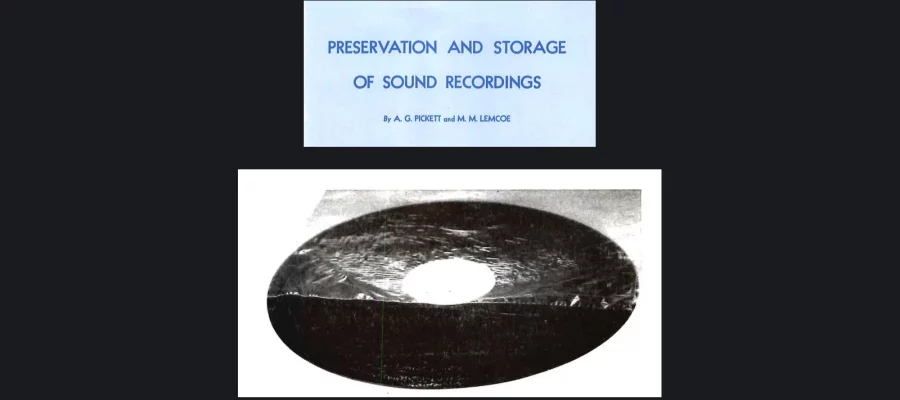
数年前、フォノEQカーブや録音再生機材、レコード製造工程などを調査しているときに見つけ、念のため手元に保管していたPDFがあります。先日、ふとこれを精読してみようと思い立ち、読んでみると、レコード保存における劣化要因について詳細に調査研究されたレポートで、われわれコレクターにとっても非常に参考になるものでした。

A few years ago, while researching phono EQ curves, recording and playback equipment, and record manufacturing processes, I came across a PDF and saved a copy just in case. Recently I decided to sit down and read it properly. It turned out to be a detailed study of the factors behind storage deterioration of sound recordings, and very much worth the time for anyone who collects records.

以下、1950年代末に編纂された、74ページにも及ぶこの濃厚なレポートで述べられている注目点を概説してみようと思います。

Below is an overview of the main points from this dense, 74-page report compiled in the late 1950s.

Cover page of Preservation and Storage of Sound Recordings by A. G. Pickett and M. M. Lemcoe, Library of Congress, 1959

A. G. Pickett and M. M. Lemcoe, Preservation and Storage of Sound Recordings, Library of Congress, 1959.

Continue reading
2026/06/14

Phono EQ Curves Liner Notes II-c — Capitol H-477 The Duke Plays Ellington (1953) and T-477

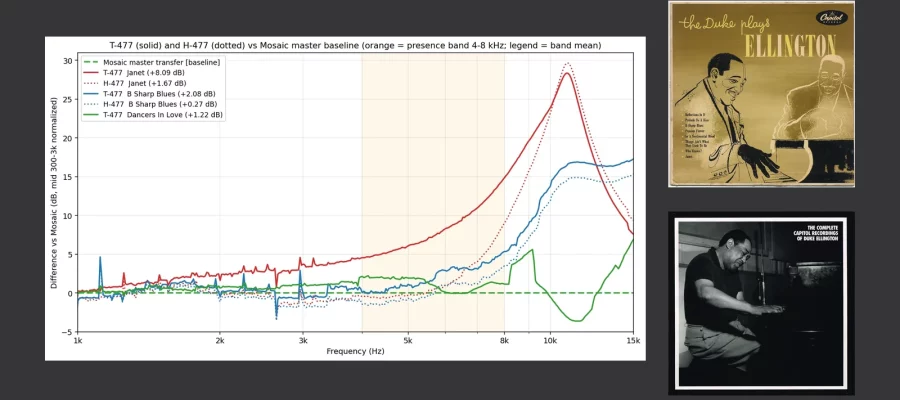
Phono EQ Curves Liner Notes IIII-a / II-b / II-c の 3 部作で、 20年前のブログ記事で主観的に書いた問いに、 客観的な計測の道具の力を借りて再度向き合います。本稿はその第3部 Liner Notes II-c として、 Liner Notes II-a + Liner Notes II-b の延長で、 そこで扱ったセッションの半年あまり前(1953年4月)に録音された Capitol H-477 “The Duke Plays Ellington” と、 数年後の 12インチ再発 T-477 に同じ手法を適用します。

Phono EQ Curves Liner Notes II is a three-part work (II-a / II-b / II-c) revisiting a question I wrote about subjectively in a blog post twenty years ago, this time with objective measurement. This third part, Liner Notes II-c, extends Liner Notes II-a and Liner Notes II-b, applying the same methods to Capitol H-477 “The Duke Plays Ellington“, recorded in April 1953, some seven months before the sessions covered there, and to its 12-inch reissue T-477 released a few years later.

Continue reading
2026/06/14

Phono EQ Curves Liner Notes II-b — H-488 Reissue and Remaster Lineage (1955-1998)

Phono EQ Curves Liner Notes IIII-a / II-b / II-c の 3 部作で、 20年前のブログ記事で主観的に書いた問いに、 客観的な計測の道具の力を借りて再度向き合います。本稿はその第1部 Liner Notes II-a に続く第2部 Liner Notes II-b で、 同じ Capitol H-488 “Songs For Young Lovers” セッションマスターから派生した再発・リマスター系を LTAS で横並びに読み解きます。

Phono EQ Curves Liner Notes II is a three-part work (II-a / II-b / II-c) revisiting a question I wrote about subjectively in a blog post twenty years ago, this time with objective measurement. This second part, Liner Notes II-b, continues from Liner Notes II-a and reads the reissue and remaster lineage branching from the same Capitol H-488 “Songs For Young Lovers” session master, side by side, on LTAS.

Continue reading
2026/06/14

Phono EQ Curves Liner Notes II-a — Capitol H-488 Songs For Young Lovers (1954)

Phono EQ Curves に関する筆者の学習過程を、これまで Pt.0Pt.25 として連載してきました。本シリーズ Phono EQ Curves Liner Notes は、その続編ではなく、別の角度からのアプローチです。 LP のジャケット裏に書かれた解説(ライナーノーツ)のように、本編とは別の物語を、別の温度感で記録するためのシリーズです。

For the past few years, I have been documenting my own learning around phono EQ curves in the long-running series Pt.0Pt.25. This new series, Phono EQ Curves Liner Notes, is not a continuation of that body of work but rather a different approach altogether. Like the liner notes printed on the back of an LP jacket (separate from the music itself, written in a different register), these pieces are meant to record stories and findings that sit alongside, rather than inside, the main series.

第1弾 Liner Notes I では、Nicholas Bergh さんから提供いただいた RCA Victor 社内エンジニアリングノート 1955年4月18日付ページの発見報告を扱いました。第2弾 Liner Notes II は II-a / II-b / II-c の 3 部作で、 20年前のブログ記事で主観的に書いた問いに、 客観的な計測の道具の力を借りて再度向き合います。本稿はその第1部 Liner Notes II-a として、 Capitol H-488 “Songs For Young Lovers” (Frank Sinatra) を題材に、 1953〜1954年の Capitol 録音 EQ カーブを LTAS(長期平均スペクトル)解析で読み解く試みです。

The first installment, Liner Notes I, reported on the discovery of a page from an internal RCA Victor engineering notebook dated April 18, 1955, courtesy of Nicholas Bergh. The second installment, Liner Notes II, is a three-part work (II-a / II-b / II-c) revisiting a question I wrote about subjectively in a blog post twenty years ago, this time with objective measurement. This is the first part, Liner Notes II-a, taking Capitol H-488 “Songs For Young Lovers” (Frank Sinatra) as its subject, reading the 1953-1954 Capitol recording EQ curves through LTAS (Long-Term Average Spectrum) analysis.

Continue reading
2026/05/13

Phono EQ Curves Liner Notes I — RCA Engineering Notebook 1955-04-18

Phono EQ Curves に関する筆者の学習過程を、これまで Pt.0Pt.25 として連載してきました。本シリーズ Phono EQ Curves Liner Notes は、その続編ではなく、別の角度からのアプローチです。LP のジャケット裏に書かれた解説 (ライナーノーツ) のように、本編とは別の物語を、別の温度感で記録するためのシリーズです。

For the past few years, I have been documenting my own learning around phono EQ curves in the long-running series Pt.0Pt.25. This new series, Phono EQ Curves Liner Notes, is not a continuation of that body of work but rather a different approach altogether. Like the liner notes printed on the back of an LP jacket (separate from the music itself, written in a different register), these pieces are meant to record stories and findings that sit alongside, rather than inside, the main series.

第 1 弾 Liner Notes I は、Nicholas Bergh さんのご厚意で提供を受けた、RCA Victor 社内エンジニアリングノートの 1955年4月18日付のページについての発見報告です。

The first installment, Liner Notes I, is a report on a discovery: a single page from an internal RCA Victor engineering notebook dated April 18, 1955, generously shared with me by Nicholas Bergh.

RCA New Orthophonic Equalizer Old Type & New Type from 4-18-55

source: RCA Victor Engineering Book, Notebook No.1, page 6, dated 4-18-55
photo courtesy of Nicholas Bergh
RCA Victor 社内エンジニアリングノート 1, p.6 (1955-04-18)。Nicholas Bergh さん提供

Continue reading
2026/04/14

「フォノEQカーブの歴史」を再構築しました

RCA Victor 45rpm record sleeve, 12-5-49

New Orthophonic Frequency Test Record (RCA Victor 12-5-49, 1952 or 1953)
from my own collection

2年以上にわたって連載してきた Things I learned on Phono EQ curves, Pt.0Pt.25 の内容を、固定ページセクション フォノEQカーブの歴史 として再構築しました。連載は時系列で調査順に書かれているため、「結論だけ知りたい」「特定の論点だけ確認したい」という読者には辿りにくい面がありました。そこで、読者の問いを起点に整理し直しています。

I have restructured the contents of my two-year-plus blog series Things I learned on Phono EQ curves, Pt.0 through Pt.25 into a dedicated section: History of Phono EQ Curves. The original series was written chronologically in my research order, which made it hard for readers who just wanted a conclusion or wanted to check a specific point. The new section is reorganized starting from the reader’s questions, not from my research timeline.

Continue reading