
This article is presented in Japanese and English on the same page.
- ステレオ LP の再生針は 0.7 mil だと多くの人が思っている。ところが規格には 0.5 mil と書かれている。
- 0.5 と 0.7 は、改訂の前後ではない。 1957〜58年の同じ冬に、レコード会社の団体 (RIAA) と機器メーカーの団体 (EIA) が、それぞれ別に出した数字である。
- 両者が根拠とした Corrington の歪解析は「1 mil より小さく」としか述べていない。 0.5 も 0.7 も、論文からは出てこない。どこで止めるかを決めたのは、歪ではなく針圧だった。
- 0.5 mil の針は実際に店で買えた。プロ用アームを持つ人のための選択肢である。ただし少数派で、1959年は 36機種中 4機種。
- 軽針圧が当たり前になっても、0.5 mil が主流になることはなかった。 1966年で球面針 28機種中 7機種。同じ頃すでに、掲載機種の 4割強が球面針ではなくなっていた。
- 規格のほうは 1980年代に、球面針の先端半径の規定そのものを落とす。その理由を書いた史料をまだ見つけられていない。
- Most people assume that the playback stylus for stereo LPs is 0.7 mil. The standard, however, says 0.5 mil.
- 0.5 and 0.7 are not the before and after of a revision. In the same winter of 1957–58, the record companies’ association (RIAA) and the equipment makers’ association (EIA) each issued its own figure, separately.
- The Corrington distortion analysis that both cited says only that the radius should be smaller than the 1 mil then in common use. Neither 0.5 nor 0.7 comes out of the paper. What decided where to stop was tracking force, not distortion.
- 0.5 mil styli could actually be bought in stores. They were an option for people with professional-type tone arms. They were a minority, though: 4 of 36 models in 1959.
- Even after light tracking forces became the norm, 0.5 mil never became the mainstream. In 1966 it was 7 of 28 spherical-stylus models. By then, just over 40% of the listed models were no longer spherical at all.
- The standards, for their part, dropped the tip-radius specification for spherical styli altogether in the 1980s. I have not yet found a document that gives the reason.
変更履歴 / Revision History
- 2026年9月15日: 初版公開
- September 15, 2026: Initial publication
Introduction
ステレオ LP 用の針先半径は 0.7 mil。交換針を選ぶとき、私たちはたいていそう思っています。
The stylus tip radius for stereo LPs is 0.7 mil. That is what most of us assume when choosing a replacement stylus.
わたしも長いあいだ、モノーラル LP 用は 1.0 mil、ステレオ LP 用は 0.7 mil だとなんとなく思っていました。ついでに言うと、78回転盤用は 3.0 mil が標準で、盤質や時代によって 2.5 mil〜4.0 mil だと長らく理解していました。
For a long time I too vaguely assumed 1.0 mil for mono LPs and 0.7 mil for stereo LPs. For that matter, I long understood 3.0 mil to be the standard for 78s, with 2.5 mil to 4.0 mil depending on the disc material and the era.
ところが今回、ステレオ LP の規格書を読み直してみると、針先半径が 0.5 mil と書かれているのを初めて知りました。規格には 0.5 とあるのに、店頭に並んでいたのは主に 0.7 だった。調べてみると、0.5 mil のステレオ針もかつては実際に売られていたようですが、最近はほとんど目にしない気がします。
This time, however, on rereading the specification for stereo LPs, I learned for the first time that it gives a stylus tip radius of 0.5 mil. The standard says 0.5, yet what lined the shop shelves was mainly 0.7. Looking into it, 0.5 mil stereo styli do seem to have been sold at one time, but I have the impression that they are rarely seen these days.
実は、0.5 と 0.7 は「最初に決めた数字が後から改められた」という関係ではありませんでした。ふたつの団体が、同じ冬に、それぞれ別の数字を出していました。主な典拠は、H. E. Roys が 1977年に JAES に書いた回顧 “The Coming of Stereo” です。
As it turns out, 0.5 and 0.7 were not a case of “the first figure was later revised.” Two organizations, in the same winter, each put out a different figure. My main source is H. E. Roys’s 1977 retrospective in JAES, “The Coming of Stereo.”
Roys は RCA Victor の技術者でありながら、レコード会社側の RIAA 技術委員会の委員であり、同時に機器側の EIA R7 委員会の委員長でもありました。これから追うふたつの数字は、どちらもこの人が席を持っていた団体から出ています。
Roys was an RCA Victor engineer, and at the same time a member of the RIAA engineering committee on the record-company side and chairman of the EIA R7 committee on the equipment side. Both of the figures we are about to follow came from organizations in which this one man held a seat.
How the two figures were settled
November 1957 to January 1958
始まりは欧州側からでした。 1957年11月28日、チューリッヒに欧州のレコード会社 7社が集まり、ステレオ盤の再生針先半径として 0.5〜0.6 mil、溝底半径 0.2 mil を勧告しました。
It started on the European side. On November 28, 1957, seven European record companies met in Zurich and recommended a playback stylus tip radius of 0.5–0.6 mil and a groove bottom radius of 0.2 mil for stereo discs.
その結論が米国側に届いたのは、3週間後の会合の席でした。 12月17日と 18日に開かれた RIAA (Recording Industry Association of America、米国レコード会社の団体) の会合に EMI の G. F. Dutton が招かれ、チューリッヒでの勧告を報告します。同じ会合で、RCA の M. S. Corrington が歪の解析を報告しました。 45/45 方式では左右どちらのチャンネルにも縦方向の成分が含まれるため、横振動だけのモノーラル盤よりも第2高調波歪が強く出ます。だから針先は小さくなければならない。 RIAA はこれらを受けて、0.5〜0.75 mil、溝底 0.2 mil を勧告しました。
That conclusion reached the American side at a meeting three weeks later. G. F. Dutton of EMI was invited to the RIAA (Recording Industry Association of America, the association of American record companies) meeting held on December 17 and 18, and reported the Zurich recommendation. At the same meeting, M. S. Corrington of RCA presented a distortion analysis. In the 45/45 system both channels contain a vertical component, so second-harmonic distortion comes out stronger than on a mono disc with lateral modulation alone. The stylus tip therefore has to be small. Taking these into account, the RIAA recommended 0.5 to 0.75 mil, with a groove bottom radius of 0.2 mil.
ここまでは、ひとつの流れに見えます。欧州も米国のレコード会社も、下限は 0.5 です。
Up to this point it looks like a single current. Europe and the American record companies both put the lower limit at 0.5.
ところが年が明けた 1958年1月7日、シカゴで開かれた EIA (Electronic Industries Association、再生機器の製造側の団体) の R7.3 (Record Changers) / R7.5 (Pickups and Needles) 両委員会は、0.8 ± 0.1 mil、針圧 6〜8 g という数字を出しました。根拠は、レコードチェンジャーの製造各社への調査です。歪の計算ではなく、いま作っている機械が何 g で針を載せているか、という現実のほうを見た数字でした。
But on January 7, 1958, in the new year, the EIA (Electronic Industries Association, the association of playback equipment manufacturers) R7.3 (Record Changers) and R7.5 (Pickups and Needles) committees, meeting in Chicago, came out with 0.8 ± 0.1 mil and a tracking force of 6–8 g. The basis was a survey of record changer manufacturers. The figure looked not at distortion calculations but at the reality of how many grams the machines then in production were placing on the stylus.
January 21, 1958
1958年1月21日の EIA 合同会合には 44社 60名が集まりました。午前中に Corrington が解析の詳報を行い、RCA の Burt が「1.0 mil では歪が耳につき、0.5 mil なら良好」という試聴結果を報告します。 Haddy と Schlesswig も小径を推奨しました。シカゴで出たばかりの 0.8 という数字は、この場で疑問が出されています。
The EIA joint meeting of January 21, 1958 drew 60 people from 44 companies. In the morning Corrington presented his analysis in detail, and Burt of RCA reported listening results: “Distortion encountered with a 1.0-mil tip was objectionable, whereas the results with a 0.5-mil tip were good.” Haddy and Schlesswig also recommended a small radius. The 0.8 figure that had just come out of Chicago was questioned on the spot.
午後、R7.3 / R7.5 の両委員会が再開され、0.7 ± 0.1 mil、針圧 6 ± 1 g で合意しました。「良いステレオ再生のため」という理由が添えられています。
In the afternoon the R7.3 and R7.5 committees reconvened and agreed on 0.7 ± 0.1 mil with a tracking force of 6 ± 1 g. The stated reason was “in the interest of providing good stereo reproduction.”
0.8 が 0.7 に下がったのですから、EIA は歪の側へ歩み寄ったことになります。ただし 0.5 には届かず、針圧も 6 g のままです。
Since 0.8 came down to 0.7, the EIA moved toward the distortion side. It did not reach 0.5, though, and the tracking force stayed at 6 g.
What the 0.7 figure rests on
What the Corrington paper actually says
両団体とも、Corrington の解析にもとづいたと言っています。ならば、その論文のどこかに 0.5 と 0.7 の分かれ目があるはずだ。そう思って読むと、少し肩透かしを食います。
Both organizations said they based their figures on Corrington’s analysis. Then somewhere in that paper there ought to be the dividing line between 0.5 and 0.7. Read with that expectation, it is a bit of a letdown.
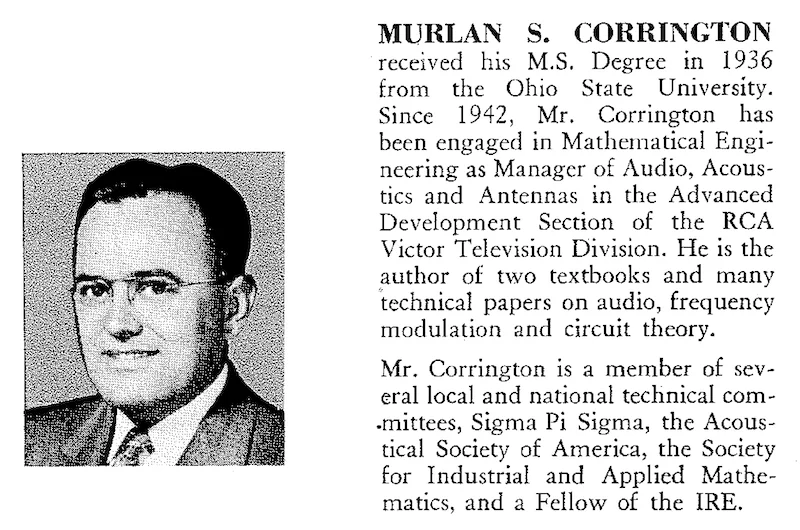
同じページの記事 “Why Engineers Should Write Papers” の著者紹介として置かれている
The biographical note on Murlan S. Corrington in RCA Engineer, Vol. 1, No. 1 (June-July 1955), p.2
It is placed as the author’s note for “Why Engineers Should Write Papers” on the same page
source: RCA Engineer, Vol. 1, No. 1 (June-July 1955)
M. S. Corrington と T. Murakami の “Tracing Distortion in Stereophonic Disc Recording” は RCA Review の 1958年6月号に載りました。計算は針先半径 0.75、0.50、0.25 mil の 3点について行われています。 0.7 という値は、論文のどこにも出てきません。結論は、第2高調波が支配的な歪であり、その大きさは針先半径にほぼ正比例すること。録音レベルは従来の片チャンネル横方向録音より下げるべきであること。そして針先半径は「現在一般に使われている 1 mil より小さくすべき」であること。ここまでです。なお、45/45 と V-L (縦横) 方式は、チャンネル単体で見れば歪の制約は同じ、とも書かれています。
“Tracing Distortion in Stereophonic Disc Recording” by M. S. Corrington and T. Murakami appeared in the June 1958 issue of RCA Review. The calculations were carried out for three tip radii: 0.75, 0.50, and 0.25 mil. The value 0.7 appears nowhere in the paper. The conclusions are that the second harmonic is the dominant distortion and that its magnitude is nearly proportional to the tip radius; that the recording level should be lower than in conventional single-channel lateral recording; and that “the stylus radius should be less than the 1 mil commonly used.” That is as far as it goes. The paper also notes that, taken channel by channel, the 45/45 and V-L (vertical-lateral) systems are subject to the same distortion constraint.
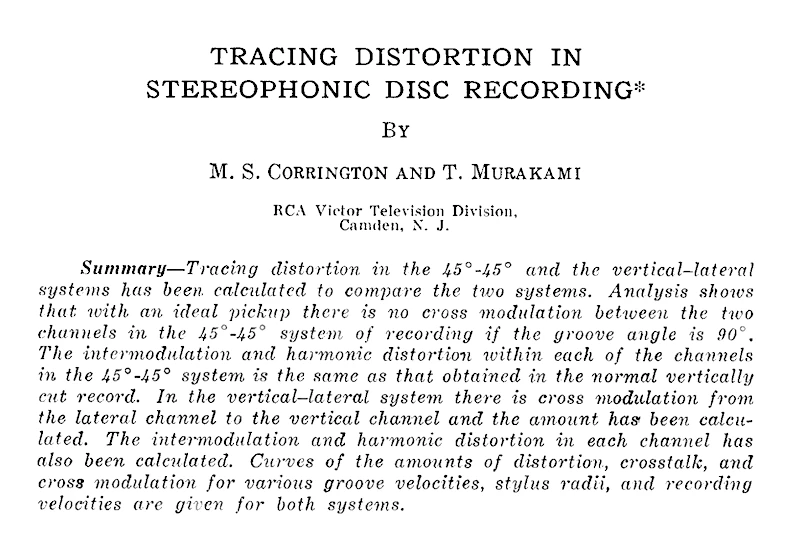
M. S. Corrington and T. Murakami, “Tracing Distortion in Stereophonic Disc Recording”, RCA Review Vol. 19, No. 2 (June 1958) p.216
The first page of the paper discussed in the text
source: RCA Review, Vol. 19, No. 2 (June 1958)
つまり論文は「1 mil より小さく」と言っただけで、0.5 とも 0.7 とも言っていません。歪が半径に比例するのですから、小さいほど良い。どこで止めるかは、歪以外の事情で決まります。 RIAA も EIA も、この論文にもとづいて数字を出したと言えます。そして、どちらの数字も論文から直接は出てきません。
So the paper said only that the radius should be smaller than 1 mil, and named neither 0.5 nor 0.7. Since distortion is proportional to radius, smaller is better. Where to stop is decided by considerations other than distortion. Both the RIAA and the EIA can be said to have based their figures on this paper. And neither figure comes directly out of it.
The tracking-force wall
歪以外の事情とは針圧です。針先を小さくすると盤との接触面積が減るため、同じ針圧なら盤にかかる圧力は上がります。 0.5 mil を使うには、針圧を下げなければなりません。
That other consideration was tracking force. A smaller tip reduces the contact area with the disc, so at the same tracking force the pressure on the disc goes up. To use 0.5 mil, the tracking force has to come down.
Electronic Technician 1958年3月号の “Report on Stereo Cartridges” は、この関係をそのまま書いています。 0.5 mil には 4 g 以下の針圧が要る。しかし当時のレコードチェンジャーは 5〜10 g で動いている。そこで 0.7 mil が妥協点になる見込みだ、と。 EIA が 1月に見ていたのも、この数字です。
“Report on Stereo Cartridges” in the March 1958 issue of Electronic Technician states this relationship plainly. 0.5 mil requires a tracking force of 4 g or less. But the record changers of the day ran at 5–10 g. So 0.7 mil was expected to become the compromise. This is the same figure the EIA had been looking at in January.
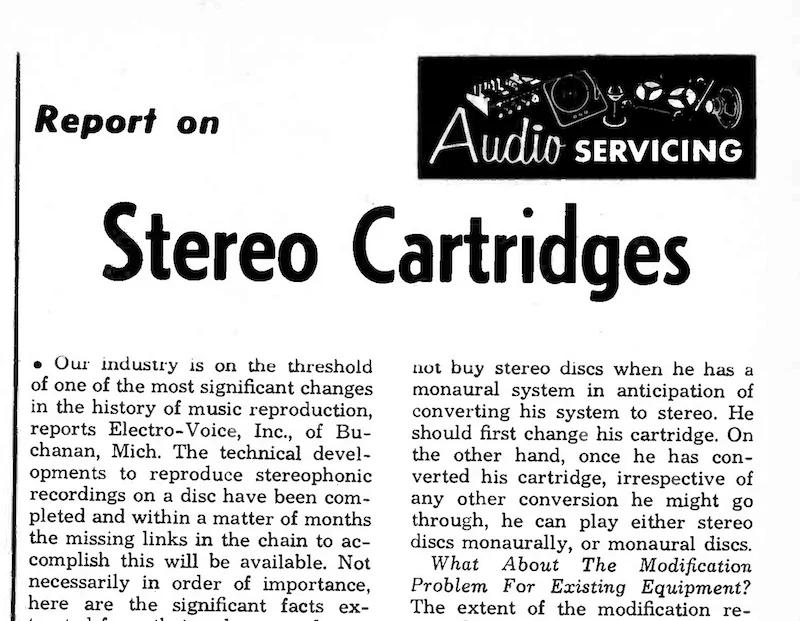
“Report on Stereo Cartridges”, Electronic Technician, March 1958, p.35 (Audio Servicing 欄)
The opening of the article cited in the text
source: Electronic Technician, March 1958
同じ年の High Fidelity 10月号に載った ESL (Electro-Sonic Laboratories) の GYRO/BALANCE アームの広告は、0.7 mil で 6 g の針圧は、1 mil で 12〜14 g と同程度の接触圧だと説明しています。
An advertisement for the GYRO/BALANCE arm from ESL (Electro-Sonic Laboratories), in the October issue of High Fidelity the same year, explains that 0.7 mil at 6 g gives about the same contact pressure as 1 mil at 12–14 g.
では 0.5 mil は消えたのか、と思いたくなりますが、実際には消えていませんでした。 GE は GC-7 (0.7 mil、チェンジャー用、針圧 7 g) と GC-5 (0.5 mil、プロ用アーム向け、2〜4 g) を併売していました。 Radio & TV News 1958年9月号の広告には、この 2機種が並んでいます。数年後の Audio 1963年8月号でも、Shure は 0.5 mil には 1 g 未満、0.7 mil には 1.5〜3 g という針圧を示しています。 0.5 mil の針は実在し、市販もされていました。ただし、軽い針圧で動くアームを持つ人のためのものでした。
One is tempted to conclude that 0.5 mil disappeared, but in fact it did not. GE sold the GC-7 (0.7 mil, for changers, 7 g tracking force) and the GC-5 (0.5 mil, for professional tone arms, 2–4 g) side by side. An advertisement in the September 1958 issue of Radio & TV News shows the two models together. A few years later, in the August 1963 issue of Audio, Shure likewise gave tracking forces of under 1 g for 0.5 mil and 1.5–3 g for 0.7 mil. The 0.5 mil stylus existed and was on the market. It was, however, for people who had a tone arm that worked at a light tracking force.
March 1958: two documents
1958年3月には、それぞれの団体が自分たちの数字を文書にします。
In March 1958 each organization put its own figure into writing.
RIAA は 3月25日の理事会で技術委員会の結論を承認し、Bulletin E3 として出しました。文書の本体は 45/45 方式を定める 6 項で、そのあとに「さらに以下を推奨する」として 3 項が続きます。再生針の望ましい先端半径を 0.5 mil とすること、溝の開き角を 90 度とすること、仕上がった盤の溝底半径を 0.2 mil 以下とすること。3 項のうち、再生する側について書かれているのは 0.5 mil の一項だけで、あとの 2 項は盤そのものの形です。
The RIAA approved the engineering committee’s conclusions at its board meeting on March 25 and issued them as Bulletin E3. The body of the document is six items defining the 45/45 system, followed by three items introduced with “It is further recommended that:”. The desirable tip radius of the playback stylus is 0.5 mil; the included angle of the groove is 90 degrees; and the bottom radius of the groove on the finished record is 0.2 mil or less. Of the three items, only the 0.5 mil one concerns the playback side. The other two describe the shape of the disc itself.
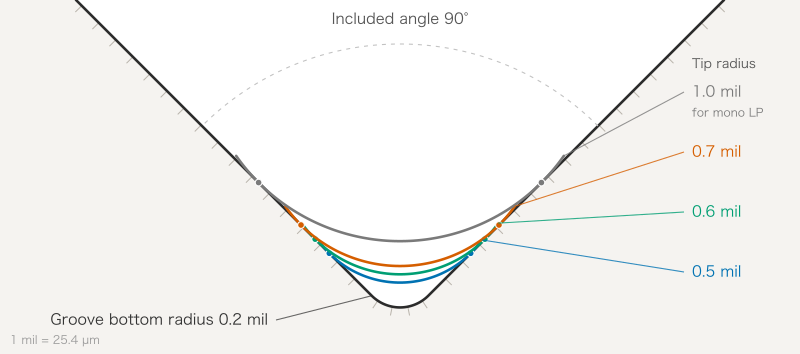
図中 included angle = 溝の開き角、tip radius = 針先半径、groove bottom radius = 溝底半径、for mono LP = モノーラル用
寸法は RIAA Bulletin E3 (1958年3月) による。溝底半径 0.2 mil は同文書の上限値
針先が触れるのは溝の壁で、溝の底ではない。小さい針ほど深く沈む
Where a spherical stylus sits in a 90-degree groove, drawn for each tip radius (figure by the author)
Dimensions follow RIAA Bulletin E3 (March 1958); the 0.2 mil groove bottom radius is the upper bound given there
The stylus contacts the groove walls, not the groove bottom. The smaller the tip, the deeper it sits
EIA は 3月27日の会合で、R7.5 の委員長だった Jensen が 0.7 ± 0.1 mil、6 ± 1 g を再報告しました。ただしこの日の記録には、盤の摩耗についてもっと知ってから受け入れたい (“desirable to know more about record wear before accepting”) とあります。 EIA 側は 3月末の時点でも、まだ確定していませんでした。
At the EIA meeting of March 27, Jensen, chairman of R7.5, re-reported 0.7 ± 0.1 mil and 6 ± 1 g. But the record of that day notes it was “desirable to know more about record wear before accepting.” As of the end of March, the EIA side still had not made it final.
同じ 3月、Westrex の Davis と Frayne は IRE Convention で 0.70 mil を示しました。歪の小ささと高域特性では小径が有利、盤の寿命では大径が有利で、そのあいだの良い妥協点だという説明です。実機の針圧は 6 g でした。
In the same March, Davis and Frayne of Westrex presented 0.70 mil at the IRE Convention. Their explanation was that a small radius has the advantage in low distortion and high-frequency response, a large radius in record life, and 0.70 mil is a good compromise between them. The tracking force of their actual equipment was 6 g.
10月の High Fidelity に載った Norelco のレビューには “0.7 mil used on stereo discs” とあります。 RIAA の文書が 0.5 と言い、EIA が確定を先送りしているあいだに、市場のほうは 0.7 で動き始めていました。
A Norelco review in the October issue of High Fidelity reads “0.7 mil used on stereo discs.” While the RIAA document said 0.5 and the EIA was deferring its decision, the market had begun moving on 0.7.
翌 1959年、RCA Victor が出した冊子 Latest Developments in Stereo には、Corrington らの歪解析にもとづいて、レコード業界の技術委員会が針先半径を公称 0.7 mil へ縮小することを勧告した、という趣旨の記述があります。 Corrington の所属先である RCA が委員会の勧告を 0.7 と書き、RIAA 理事会が承認した E3 には “desirable .5 mils” とある。同じ解析を根拠に、ふたつの数字が文書に残りました。
The following year, 1959, the RCA Victor booklet Latest Developments in Stereo states that, based on the distortion analysis by Corrington and others, “engineering committees of the record industry recommended a reduction in stylus radius to a nominal size of 0.7 mil.” RCA, Corrington’s employer, wrote the committee recommendation as 0.7, while E3, approved by the RIAA board, says “desirable .5 mils.” From the same analysis, two figures ended up in documents.
その同じ冊子には、2〜3 g という軽さで良好にトレースするステレオ用ピックアップが市販されるようになった、とも書かれています。 6 g のチェンジャーに合わせた 0.7 が文書になったころ、それとは別の機械がもう売られていたことになります。
The same booklet also states: “Stereo pickups that track well with playing weights as low as two to three grams have also appeared commercially.” By the time 0.7, matched to the 6 g changer, was put into writing, a different kind of machine was already on sale.
The rise and fall of 0.5 mil
You could choose to buy 0.5 mil
0.5 mil は規格文書に残りましたが、市場は 0.7 で動き始めました。ところが当時の雑誌広告を見ると、0.5 mil 針も売られていたのです。
0.5 mil stayed in the standards document, but the market started moving on 0.7. Looking at the magazine advertisements of the time, though, 0.5 mil styli were on sale too.
GE の GOLDEN CLASSIC は、Radio & TV News の 1958年9月号から 12月号まで繰り返し広告が載っています。 GC-7 は 0.7 mil のダイヤ針で 23.95ドル、GC-5 は 0.5 mil のダイヤ針で 26.95ドル。翌 1959年7月号から 1960年6月号にかけて Electronics World に連続して載った VR-22 系も同じ作りで、VR-22-5 (初期の表記は VR-225) が 0.5 mil で 27.95ドル、VR-22-7 (同じく VR-227) が 0.7 mil で 24.95ドルです。広告文には、0.5 mil の側に “For professional-type tone arms”、0.7 mil の側に “For record changer or turntable” とあります。半径で分けているというより、用途で分けている。同じシリーズの中で、プロ用アームを持つ人には 0.5 を、チェンジャーやターンテーブルの人には 0.7 を、という売り分けでした。
GE’s GOLDEN CLASSIC was advertised repeatedly in Radio & TV News from the September 1958 issue through the December issue. The GC-7 was a 0.7 mil diamond stylus at $23.95, the GC-5 a 0.5 mil diamond stylus at $26.95. The VR-22 series, advertised continuously in Electronics World from the July 1959 issue to the June 1960 issue, followed the same pattern: the VR-22-5 (written VR-225 in the early ads) was 0.5 mil at $27.95, and the VR-22-7 (likewise VR-227) was 0.7 mil at $24.95. The ad copy reads “For professional-type tone arms” on the 0.5 mil side and “For record changer or turntable” on the 0.7 mil side. The split is by application rather than by radius. Within the same series, 0.5 was sold to people with professional tone arms and 0.7 to people with changers or turntables.
GE だけではありません。 Columbia の “Professional 55” は 0.5 mil のダイヤ針で、トランスクリプション用ターンテーブル向けとして Electronics World の 1959年7月号と 8月号に載っています。
It was not only GE. Columbia’s “Professional 55,” a 0.5 mil diamond stylus intended for transcription turntables, appeared in the July and August 1959 issues of Electronics World.
Shure はどうだったでしょうか。 Electronics World 1959年8月号に載った Shure の M3D (45.00ドル、プロ用、針圧 3グラム) と M7D (24.00ドル、チェンジャー用) は、どちらも 0.7 mil です。型番の 3 と 7 は針先半径ではありません。ただし同社の 1963年のカタログでは、M33-5 (0.0005インチ) と M33-7 (0.0007インチ) が並び、こちらは半径で分かれています。価格はどちらも 36.50ドルと同額でした。
What about Shure? The Shure M3D ($45.00, professional, 3 g tracking force) and M7D ($24.00, for changers) in the August 1959 issue of Electronics World are both 0.7 mil. The 3 and 7 in the model numbers are not tip radii. In the company’s 1963 catalog, however, the M33-5 (0.0005 inch) and M33-7 (0.0007 inch) sit side by side, and there the split is by radius. Both were priced the same, at $36.50.
このように 0.7 と 0.5 の双方が選択可能でしたが、こぞって 0.5 mil が採用されていたわけではないようです。例えば、1959年の Maco Hi-Fi Handbook が調べた 36機種 (選定の基準は同書に書かれていません) の内訳をみると、0.7 mil が 25、0.5 mil が 4、0.6 mil が 3、0.75 mil が 3、0.8 mil が 1 となっています。また、同書は 0.7 をモノ用の 1 mil とステレオ用に推奨された 0.5 mil のあいだの妥協と位置づけています。その他、Electronics World 1959年10月号でも、ステレオ針の大半は 0.7 mil で、0.5 mil ほど小さいものは 1〜2機種だ、という趣旨の記述が認められます。
So both 0.7 and 0.5 were available, but it does not appear that 0.5 mil was adopted across the board. For example, of the 36 models surveyed in the 1959 Maco Hi-Fi Handbook (the selection criteria are not stated in the book), 25 were 0.7 mil, 4 were 0.5 mil, 3 were 0.6 mil, 3 were 0.75 mil, and 1 was 0.8 mil. The same book positions 0.7 as a compromise between the 1 mil for mono and the 0.5 mil recommended for stereo. Similarly, the October 1959 issue of Electronics World contains a statement to the effect that most stereo styli are 0.7 mil and only one or two models go as small as 0.5 mil.
After the tracking-force wall came down
0.5 mil が少数派だった理由として、ここまでの資料が挙げているのは針圧でした。 5〜10 g のチェンジャーでは 0.5 mil は使えない。では、軽い針圧が当たり前になったら、0.5 mil は増えたのでしょうか。
The reason the sources so far give for 0.5 mil being a minority was tracking force. On a 5–10 g changer, 0.5 mil cannot be used. So once light tracking forces became the norm, did 0.5 mil increase?
針圧のほうは、たしかに下がっていきます。 1959年の RCA の冊子が 2〜3 g、 1963年の Shure は 0.5 mil 用で 1 g 未満です。
Tracking forces did indeed come down. The 1959 RCA booklet gives 2–3 g, and Shure in 1963 gives under 1 g for 0.5 mil.
日本でも同じ年に動きがあります。 1963年、オーディオテクニカは AT-3 を「我国最初の軽針圧ステレオカートリッジ」として広告しました (スイングジャーナル 1963年6月号)。針圧 0.5グラムからトレースを始め、1グラムでビリつきが無い、とあります。ラインアップは AT-3 (0.7 mil、6,900円)、AT-3S (0.5 mil、7,400円)、AT-3H (0.7 mil の高出力型、6,900円) の 3つ。軽針圧を掲げたカートリッジに、0.5 mil の型が用意されていました。
There was movement in Japan in the same year. In 1963, Audio-Technica advertised the AT-3 as 「我国最初の軽針圧ステレオカートリッジ」, the first light-tracking stereo cartridge in Japan (Swing Journal, June 1963 issue). The ad says it begins tracking at 0.5 g and is free of buzzing at 1 g. The lineup was three models: the AT-3 (0.7 mil, ¥6,900), the AT-3S (0.5 mil, ¥7,400), and the AT-3H (a high-output version with 0.7 mil, ¥6,900). A cartridge sold on its light tracking force came with a 0.5 mil variant.
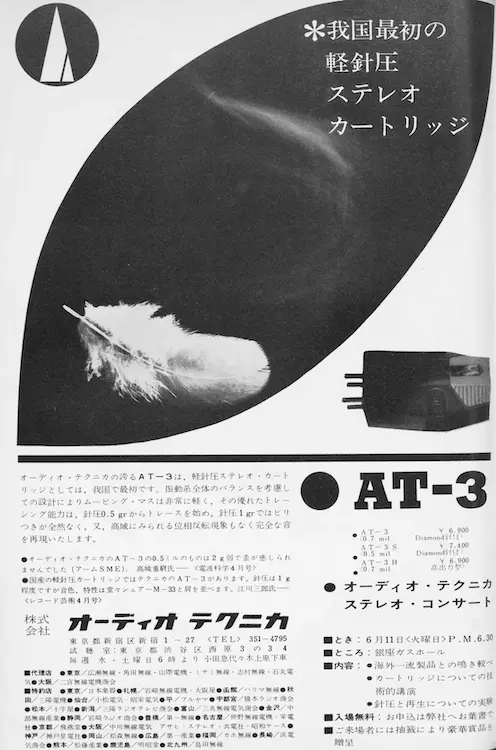
The Audio-Technica AT-3 advertisement cited in the text
『スイングジャーナル』17(6),スイングジャーナル社,1963-06. 国立国会図書館デジタルコレクション https://dl.ndl.go.jp/pid/2300004 (参照 2026-09-15)
同じ号の記事 (p.148) では、品川無線のグレース F-6AD と F-6AH が紹介されています。交換針に 0.5ミルと 0.7ミルがあって相互に交換でき、プログラム・ソースによって交換してみるのも面白い、と誌面は勧めています。価格は F-6AD (0.7ミル針付) が 5,000円、F-6AH (0.5ミル針付) が 5,600円。 0.5 と 0.7 は、どちらかを選んで終わりではなく、盤によって付け替えるものとしても扱われていました。
An article in the same issue (p.148) introduces the Grace F-6AD and F-6AH from Shinagawa Musen. The replacement styli come in 0.5 mil and 0.7 mil and are interchangeable, and the magazine suggests it is interesting to swap them depending on the program source. The prices were ¥5,000 for the F-6AD (with 0.7 mil stylus) and ¥5,600 for the F-6AH (with 0.5 mil stylus). 0.5 and 0.7 were treated not only as a one-time choice but also as something to swap according to the record.
同じ年に刊行された岡原勝『ステレオ再生の基礎』(ラジオ技術社) は、この F-6 系の F-6D と F-6H を、ひとつの仕様表にまとめて載せています。針圧は 2〜5グラムが共通で、表のなかで両者が違うのは、交換針が G6-LD (0.7ミル) か G6-LH (0.5ミル) か、それだけです。
Masaru Okahara’s Sutereo Saisei no Kiso (Fundamentals of Stereo Reproduction, Radio Gijutsu-sha), published the same year, lists the F-6D and F-6H of this F-6 series in a single specification table. The tracking force, 2–5 g, is common to both. The only difference between them in the table is whether the replacement stylus is the G6-LD (0.7 mil) or the G6-LH (0.5 mil).
米国の GE と並べると、違いは 0.5 の側ではなく 0.7 の側に出ます。 GE の 0.5 mil (GC-5) は 2〜4 g、グレースの 0.5 mil は 2〜5グラムで、ほとんど同じです。違うのは 0.7 で、GE の GC-7 は 7 g のチェンジャー用でした。米国で 0.7 mil が選ばれた背景にはチェンジャーとの妥協がありましたが、日本の 0.7 は、軽針圧を掲げたカートリッジの交換針のひとつでした。ただし仕様表が示すのは本体の範囲までで、針ごとの推奨値ではありません。
Set beside GE in the United States, the difference shows up on the 0.7 side rather than the 0.5 side. GE’s 0.5 mil (GC-5) was 2–4 g and Grace’s 0.5 mil was 2–5 g, nearly the same. What differs is 0.7: GE’s GC-7 was a 7 g stylus for changers. Behind the choice of 0.7 mil in the United States lay the compromise with changers, whereas Japan’s 0.7 was one of the replacement styli for a cartridge sold on its light tracking force. The specification table, however, shows only the range for the cartridge body, not a recommended value for each stylus.
High Fidelity 1966年2月号の購入ガイドには 48機種が載っています。そのうち、針先の寸法が 1つだけ示されている球面針の機種は 28機種で、内訳は 0.7 mil が 17、0.5 mil が 7、0.6 mil が 3、0.52 mil が 1 です。 0.5 mil の 7機種は 1社に固まらず、Euphonics、General Electric (2機種)、IMF/Decca、Shure、Sonotone、Stanton に散っています。いずれも推奨針圧は 1〜3グラム級です。
The buying guide in the February 1966 issue of High Fidelity lists 48 models. Of these, 28 are spherical-stylus models with a single tip dimension given: 17 at 0.7 mil, 7 at 0.5 mil, 3 at 0.6 mil, and 1 at 0.52 mil. The seven 0.5 mil models are not concentrated in one company but spread across Euphonics, General Electric (2 models), IMF/Decca, Shure, Sonotone, and Stanton. All have recommended tracking forces in the 1–3 g class.
1959年の 4機種と、1966年の 7機種。増えているように見えます。ただし、この 2つの数字は分母の取り方が違います。 1959年の 36機種は、当時まだ楕円針が市販されていませんから、全機種が単一の半径を持つ球面針です。 1966年の 28機種は、48機種のうち球面針だけを数えたものです。全機種を分母にすれば 4/36 から 7/48 で、上がってはいますが、幅はずっと小さくなります。軽針圧のカートリッジが増えたことで 0.5 mil を載せられる機種が増えた、とは読めます。ただ、それが 0.5 mil を多数派に押し上げることはありませんでした。
Four models in 1959 and seven in 1966. It looks like an increase. But the two figures use different denominators. The 36 models of 1959 are all spherical styli with a single radius, since elliptical styli were not yet on the market. The 28 models of 1966 are only the spherical ones out of 48. Taking all models as the denominator, it goes from 4/36 to 7/48: up, but by a much smaller margin. It can be read as the growth in light-tracking cartridges increasing the number of models that could carry 0.5 mil. But that never pushed 0.5 mil into the majority.
Still not the mainstream
1966年の時点で、0.7 mil は球面針 28機種のうち 17機種で、なお過半数です。針圧が 1〜3グラムまで下がっても、0.7 は 0.7 のままでした。
As of 1966, 0.7 mil accounted for 17 of the 28 spherical-stylus models, still a majority. Even with tracking forces down to 1–3 g, 0.7 stayed 0.7.
もうひとつ、同じガイドで目を引くのは、球面針でない機種の数です。楕円針などの機種が 21機種あり、掲載機種の 4割強が、すでに球面針ではありません。楕円針は「後から来て 0.5 を押し出した」のではなく、0.5 mil の球面針が 7機種まで増えたのと同じ時期に、すでに並んでいました。
Another thing that stands out in the same guide is the number of models without a spherical stylus. There are 21 models with elliptical or other styli, so just over 40% of the listed models were already not spherical. The elliptical stylus did not “come later and push 0.5 out.” It was already on the shelves at the same time 0.5 mil spherical styli grew to seven models.
0.5 mil の機種は、その後も残ります。流通の総合カタログ Radio’s Master には、1968年版まで GE の VR-1000-5 (0.0005インチ) とその交換針が載っています。消えてはいません。
0.5 mil models remained afterward. The trade catalog Radio’s Master lists GE’s VR-1000-5 (0.0005 inch) and its replacement stylus through the 1968 edition. It had not disappeared.
いっぽうで丸針のほうは、0.6 mil に寄っていきます。 Shure の M75G / M75-6 は 1968年の資料で 0.6 mil、V15 Type III-G も 0.6 mil です。
Meanwhile, the spherical stylus drifted toward 0.6 mil. Shure’s M75G / M75-6 are 0.6 mil in 1968 literature, and the V15 Type III-G is also 0.6 mil.
そして、いま売られている丸針も 0.5 ではありません。 JICO は交換針のカタログで、丸針の標準を先端部 R0.7mil と書いています。ナガオカの現行の交換針とカートリッジは 0.6mil です。 0.5 mil を公表している現行のステレオ交換針は、私が探した範囲では見つかりませんでした。
And the spherical styli sold today are not 0.5 either. JICO, in its replacement stylus catalog, gives the standard for a spherical stylus as a tip of R0.7mil. Nagaoka’s current replacement styli and cartridges are 0.6mil. Within the range of my search, I found no current stereo replacement stylus that publishes 0.5 mil.
0.5 mil は消えた値ではなく、主流になれないまま長く残った値でした。そして球面針そのものが、次第に楕円針へと置き換えられていきました。
0.5 mil was not a value that vanished, but one that lingered for a long time without ever becoming mainstream. And the spherical stylus itself was gradually replaced by the elliptical.
The standards afterward
規格のほうはどうなったでしょうか。以下の各国規格は、yosh 氏による比較表にもとづきます。
What became of the standards? The national standards below are based on the comparison table compiled by yosh.
RIAA Bulletin E3 は 1963年10月16日に改訂されましたが、ステレオ盤の再生針の望ましい先端半径は 0.5 mil のままとされます。改訂版は、さきほどの 3 項のうち溝の開き角と溝底半径を、盤の寸法規格 (Bulletin E4) に委ねています。 E3 に残ったのは、再生針の 0.5 mil でした。ただしこれは、yosh 氏の比較表と aardvarkmastering.com の転記という、系統の違うふたつの二次資料が一致して伝えているところで、わたしは 1963年版の原本を見ていません。 1958年版のほうは High Fidelity 1958年10月号が全文を転載しており、そちらは誌面で確認しました。 IEC 98-1964 はステレオ用として 0.013〜0.018 mm (0.5〜0.7 mil) と幅を持たせました。同内容の BS 1928-1965 には注記があり、モノ・ステレオ両用途で好ましい範囲は 0.015〜0.018 mm (0.6〜0.7 mil) とされています。
RIAA Bulletin E3 was revised on October 16, 1963, but the desirable tip radius of the playback stylus for stereo discs is said to have remained 0.5 mil. The revised version hands two of the three earlier items, the included angle of the groove and the groove bottom radius, over to the disc dimension standard (Bulletin E4). What remained in E3 was the 0.5 mil for the playback stylus. This, however, is what two secondary sources of different lineage, yosh’s comparison table and the transcription at aardvarkmastering.com, agree in reporting, and I have not seen the original 1963 edition. The 1958 edition was reprinted in full in the October 1958 issue of High Fidelity, and that one I have verified on the page. IEC 98-1964 gave a range for stereo, 0.013–0.018 mm (0.5–0.7 mil). BS 1928-1965, which has the same content, carries a note giving 0.015–0.018 mm (0.6–0.7 mil) as the preferred range for both mono and stereo use.
JIS S 8502-1973 は少し様子が違います。モノーラルについては 0.013〜0.025 mm (0.5〜1 mil) と書かれていますが、ステレオの針先半径の項は無い。その代わり試験条件のほうを見ると、S/N 試験は針圧 4 ± 1 g、耐久試験 (100回再生) は針圧 6 ± 1 g とされ、いずれも針先半径 0.018 mm +0.002/−0.003、つまり 0.7 mil で行うとされています。勧告値としては書かず、試験の前提として 0.7 mil と 6 g を置く。 EIA が 1958年1月21日の午後に合意した組み合わせが、15年後の日本の試験条件に入っている、と読めます。
JIS S 8502-1973 is a little different. For mono it gives 0.013–0.025 mm (0.5–1 mil), but there is no clause for the stereo stylus tip radius. Instead, in the test conditions, the S/N test is at a tracking force of 4 ± 1 g and the durability test (100 plays) at 6 ± 1 g, both with a tip radius of 0.018 mm +0.002/−0.003, that is, 0.7 mil. Rather than writing it as a recommended value, it places 0.7 mil and 6 g as the premise of the tests. It can be read as the combination the EIA agreed on in the afternoon of January 21, 1958 having entered the Japanese test conditions fifteen years later.
そして DIN 45547-1981 と IEC 98-1987 では、球状の針先半径の規定そのものが無いとされます。
And in DIN 45547-1981 and IEC 98-1987, there is said to be no specification at all for the spherical stylus tip radius.
ちょうどこの間に、楕円針が広まっています。手元の資料で最も早いのは Audio 1963年8月号の Ortofon の広告で、同号の製品欄では近く発売予定とされています。 11月号の広告はピンチ効果、内周歪、そして底当たり (bottoming) の低減を掲げます。 1964年8月号には ADC、Empire、London、Ortofon、Stanton、Pickering、Shure と複数社の楕円針が並びます。
Elliptical styli were spreading during just this period. The earliest in the material I have is an Ortofon advertisement in the August 1963 issue of Audio, and the product column in the same issue says it is to be released shortly. The November issue ad claims reductions in pinch effect, inner-groove distortion, and bottoming. In the August 1964 issue, elliptical styli from several companies appear together: ADC, Empire, London, Ortofon, Stanton, Pickering, and Shure.
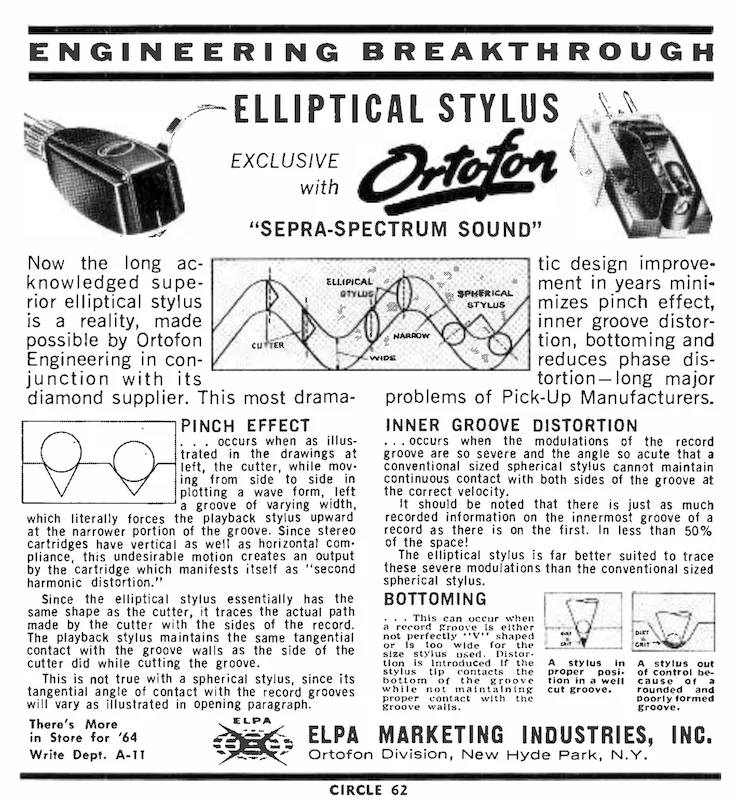
Ortofon (ELPA Marketing Industries, Inc.) の楕円針の広告、Audio, November 1963, p.62
The November 1963 advertisement mentioned in the text
Ortofon (ELPA Marketing Industries, Inc.) advertisement for elliptical styli, Audio, November 1963, p.62
source: Audio, November 1963
ただし、楕円針が出たことで 0.5 か 0.7 かという選択が要らなくなった、と書いた資料は見つけられていません。 1966年の購入ガイドで球面針以外がすでに 4割強を占めていたことも、同じ時期に並んで起きていたというだけです。長径・短径の具体的な値も、これらの広告には出てきません。楕円針の普及、球状針先半径の規定が消えたこと、この両者の因果関係を示す資料は、手元にはありません。
I have not, however, found a source that says the arrival of the elliptical stylus made the choice between 0.5 and 0.7 unnecessary. That non-spherical styli already made up just over 40% of the 1966 buying guide is likewise only something that happened alongside, in the same period. Nor do these advertisements give specific major- and minor-axis dimensions. I have nothing at hand that shows a causal link between the spread of the elliptical stylus and the disappearance of the spherical tip-radius specification.
Closing
RIAA は 1963年の改訂でも、ステレオ盤の再生針の望ましい先端半径を 0.5 mil と書き続けたとされます。機器側の EIA と市場は 1958年に 0.7 mil と 6 g を選び、0.7 はそのまま多数派であり続けました。 0.5 mil は、プロ用アームを持つ人のための選択肢として店で買えました。軽針圧化が進んでも 0.5 mil が主流になることはなく、球面針の側は 0.6 mil へ寄り、高級機は球面針そのものをやめていきました。私が「ステレオ針は 0.7 mil」と思い込んでいたのは、市場の答えのほうを覚えていたからでした。
The RIAA is said to have kept writing 0.5 mil as the desirable tip radius of the stereo playback stylus even in its 1963 revision. The EIA on the equipment side and the market chose 0.7 mil and 6 g in 1958, and 0.7 remained the majority. 0.5 mil could be bought in stores as an option for people with professional tone arms. Even as tracking forces grew lighter, 0.5 mil never became mainstream. The spherical stylus drifted toward 0.6 mil, and the higher-end models gave up the spherical stylus altogether. My assumption that “a stereo stylus is 0.7 mil” came from remembering the market’s answer.
なぜ、DIN 45547-1981 と IEC 98-1987 は球面針の先端半径の規定を落としたのか、その理由を書いた資料をまだ確認できていません。
I have not yet been able to confirm a source that explains why DIN 45547-1981 and IEC 98-1987 dropped the tip-radius specification for spherical styli.
同様に、1950年代から 1970年代にかけて、ステレオ盤の再生針についてどのように報じられ、使う側がどう選び分けていたか、どんな議論が行われていたか、についても、当時の雑誌や書籍で十分に追えていません。
Likewise, I have not been able to follow adequately, in the magazines and books of the time, how stereo playback styli were reported on from the 1950s to the 1970s, how users chose between them, and what debates took place.
このあたりのことについて、なにかご存知の方、資料をお持ちの方がいらっしゃいましたら、ぜひお知らせください。
If you know anything about these matters or have material on them, I would be glad to hear from you.
References
- "Why Engineers Should Write Papers", RCA Engineer, Vol. 1, No. 1, June-July 1955, p.2.
- "Report on Stereo Cartridges", Electronic Technician, March 1958, pp.35, 56-57.
- C. C. Davis and John G. Frayne, "The Westrex StereoDisk System", 1958 IRE National Convention Record, Part 7, March 24-27, 1958, pp.62-72.
- M. S. Corrington and T. Murakami, "Tracing Distortion in Stereophonic Disc Recording", RCA Review, Vol. 19, No. 2, June 1958, pp.216-231.
- RIAA Bulletin E3, approved March 25, 1958; full text reprinted in "Noted with Interest", High Fidelity, October 1958, pp.9-10. The same issue carries the Electro-Sonic Laboratories advertisement for the GYRO/BALANCE arm (p.32) and the review of the Norelco AG-3121 (p.146).
- General Electric "Golden Classic" advertisements (GC-5, GC-7), Radio & TV News, September to December 1958.
- Maco Hi-Fi Handbook, 1959.
- RCA Victor, Latest Developments in Stereo, 1959.
- Columbia "Professional 55" advertisements, Electronics World, July and August 1959.
- Shure M3D and M7D advertisement, Electronics World, August 1959.
- Electronics World, October 1959, on the prevalence of 0.7 mil stereo styli.
- General Electric VR-22 series advertisements, Electronics World, July 1959 to June 1960.
- Shure Brothers, 1963 phonograph cartridge catalog (M33-5, M33-7).
- Ortofon (ELPA Marketing Industries) advertisement and product notes, Audio, August 1963, pp.43, 52; Shure stylus force figures, p.52.
- Audio-Technica AT-3 advertisement (p.12) and Grace F-6AD / F-6AH product notes (p.148), 『スイングジャーナル』17(6),スイングジャーナル社,1963-06. 国立国会図書館デジタルコレクション (参照 2026-09-15).
- 岡原勝 著『ステレオ再生の基礎』, ラジオ技術社, 1963 2版, p.253. 国立国会図書館デジタルコレクション (参照 2026-09-14).
- Ortofon (ELPA Marketing Industries) advertisement, Audio, November 1963, p.62.
- Audio, August 1964, elliptical styli from ADC, Empire, London, Ortofon, Stanton, Pickering and Shure.
- "Buyers’ Guide to Stereo Cartridges", High Fidelity, February 1966, pp.47-48.
- Shure Brothers, 1968 phonograph cartridge catalog (M75G, M75-6).
- Radio’s Master, 1968 edition (General Electric VR-1000-5).
- Shure Brothers, 1976 phonograph cartridge catalog (V15 Type III-G).
- H. E. Roys, "The Coming of Stereo", Journal of the Audio Engineering Society, Vol. 25, No. 10/11, October/November 1977, pp.824-827.
- yosh, "JIS S8502", アナログレコード再生のページ (参照 2026-09-12). Comparative table of IEC 98-1964, BS 1928-1965, JIS S 8502-1973, DIN 45547-1981 and IEC 98-1987.
- RIAA bulletins transcribed at aardvarkmastering.com (参照 2026-09-12).
- JICO, Replacement Stylus Catalog, November 2025, p.2.
- Nagaoka, DJ-44G and MP-100 product pages.