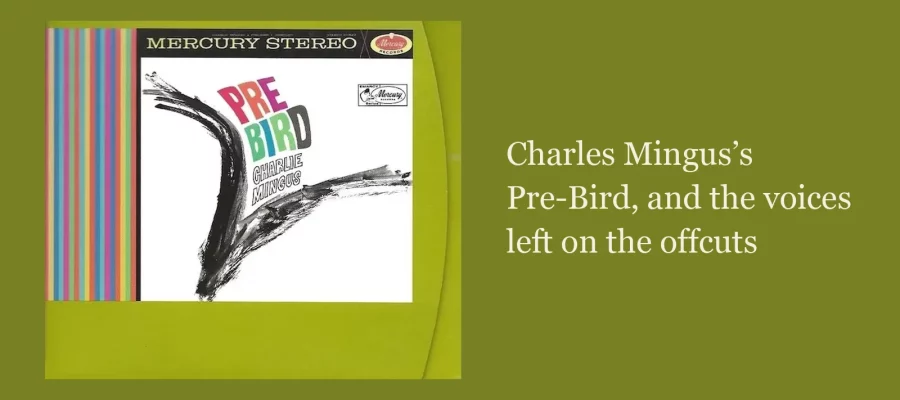
Charles Mingus’s Pre-Bird, and the voices left on the offcuts
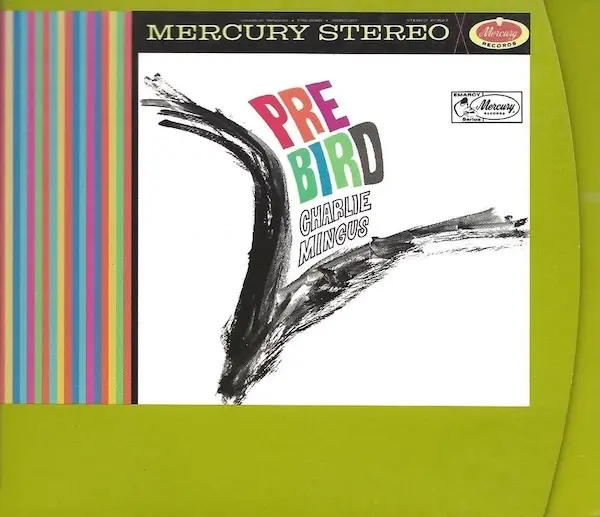
Charles Mingus の Pre-Bird (Mercury MG-20627/SR-60627) は、私が Mercury のジャズ系 LP を意識して集め始めたごく初期に手に入れた 1 枚です。1960年5月、ニューヨークの Plaza Sound で録音されたこのアルバムは、曲によって 10人のコンボから Gunther Schuller が指揮する 22人の大編成まで、編成が大きく変わるのが特徴です。
Charles Mingus’s Pre-Bird (Mercury MG-20627/SR-60627) was one of the first records I picked up when I started collecting Mercury’s jazz LPs with any seriousness. Recorded in May 1960 at Plaza Sound in New York, it changes instrumentation drastically from track to track, from a ten-piece combo to a twenty-two-piece orchestra conducted by Gunther Schuller.
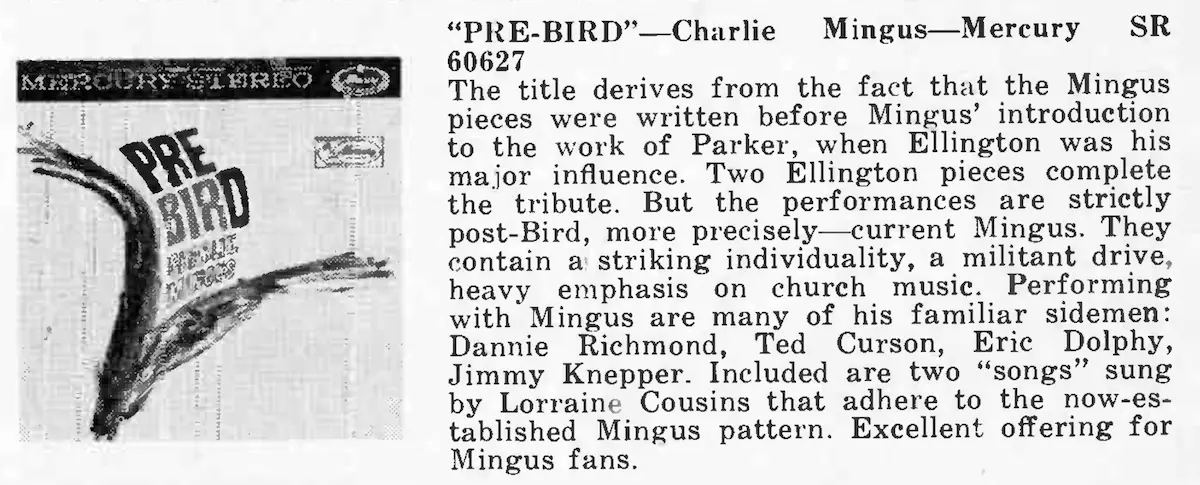
A-1 “Take The ‘A’ Train” では左チャンネルから “A Train” のメロディ、右チャンネルから “Exactly Like You” のメロディが同時に流れ、B-1 “Do Nothin’ Till You Hear From Me” でも “I Let a Song Go Out of My Heart” との対位法的なマッシュアップ (contrapuntal pairing) が仕掛けられています。Ellington の楽曲を 2 曲ずつ対にして両面の冒頭に配するという、大胆な構成です。
On A-1, “Take The ‘A’ Train,” the melody of “A Train” comes out of the left channel while “Exactly Like You” comes out of the right, both at once; B-1, “Do Nothin’ Till You Hear From Me,” sets up the same kind of contrapuntal pairing with “I Let a Song Go Out of My Heart.” Putting two paired Ellington pieces at the head of each side is a bold piece of programming.
Lorraine Cusson のヴォーカルをフィーチャーした A-3 “Eclipse” や A-5 “Weird Nightmare” では不穏な美しさが漂います。のちに Mingus のリーダー作で圧倒的な存在感を示すことになる Eric Dolphy は、B-2 “Bemoanable Lady” での印象的なアルトソロを除くとむしろ控えめで、このアルバムではどちらかといえば Booker Ervin のテナーが前面に出ています。そしてアルバムを締めくくる B-3 “Half-Mast Inhibition” では、Mingus が 18歳の頃に書いた野心的な楽曲を Schuller 指揮の 22人編成で再現しており、ジャズと現代音楽の融合を目指したいわゆる「サード・ストリーム」の実践として、調性と無調性の境界を行き来する圧倒的な 8 分間が展開されます。タイトルの “Pre-Bird” は、Mingus が Charlie Parker の音楽に出会う以前に書いた楽曲を中心に構成されていることに由来します。
A-3 “Eclipse” and A-5 “Weird Nightmare,” both featuring Lorraine Cusson’s vocal, have an uneasy beauty about them. Eric Dolphy, who would later dominate Mingus’s own dates, stays largely in the background here, apart from a striking alto solo on B-2 “Bemoanable Lady”; it is Booker Ervin’s tenor that comes forward more often. The album closes with B-3 “Half-Mast Inhibition,” a piece Mingus had written at eighteen, realized by Schuller and the large ensemble: eight minutes that move back and forth across the line between tonality and atonality, and one of the more convincing results of what was then called Third Stream. The title refers to the fact that most of the material predates Mingus’s encounter with Charlie Parker’s music.
私がこのアルバムを最初に手に入れたのは、1973年頃に出た Phonogram のリイシュー盤 (Mercury MG-20627 のモノーラルプレス。直輸入の日本盤は IMPF 11004) でした。その直後に Mercury のオリジナルのステレオ盤 (SR-60627) も入手し、以来ずっと愛聴盤の一つです。
The first copy I owned was a Phonogram reissue from around 1973, a mono pressing of Mercury MG-20627 (the Japanese direct import carried the number IMPF 11004). I found an original Mercury stereo pressing (SR-60627) not long after, and the record has stayed in rotation ever since.
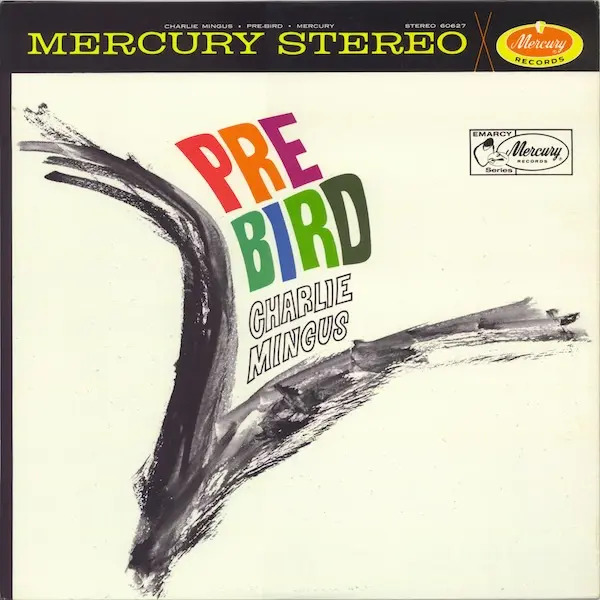
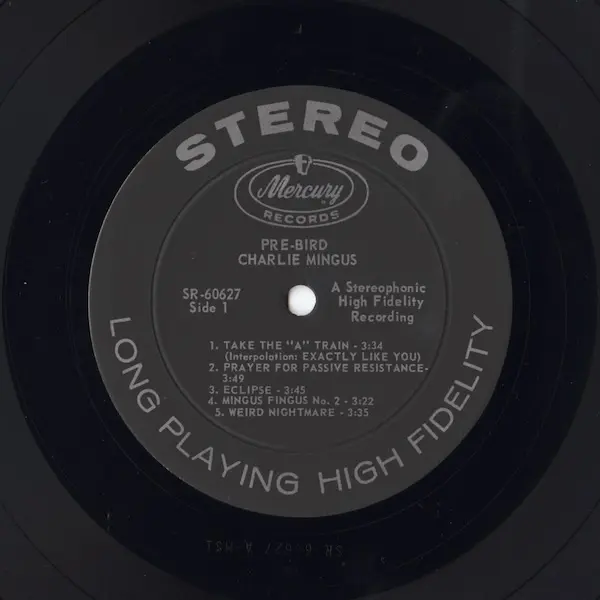
A-1. PB 3442-4 Take the "A" Train (interplates "Exactly Like You") 3:34
A-2. PB 3439-5 Prayer for Passive Resistance 3:49
A-3. PB 3440-5 Eclipse 3:45
A-4. PB 3431-5 Mingus Fingus No. 2 3:22
A-5. PB 3438-4 Weird Nightmare 3:35
B-1. PB 3441-4 Do Nothin' Till You Hear From Me (interplates "I Let A Song Out of My Heart") 3:33
B-2. PB 3432-3 Bemoanable Lady 4:32
B-3. PB 3430   Half-Mast Inhibition 8:12

Charles Mingus plays bass on all tracks accompanied by:

Tracks A-1〜A-3, A-5, B-1:
Ted Curson (tp), Jimmy Knepper (tb), Eric Dolphy (as, fl, b-cl),
Yusef Lateef (ts, fl), Booker Ervin (ts), Joe Farrell (ts, fl),
Paul Bley (p), Dannie Richmond (ds).
Track A-2: omit Bley. Track B-1: Sir Roland Hanna (p) replaces Bley.
Track A-3: add Lorraine Cusson (Lorraine Cousins) and band (voc). Track A-5: add Lorraine Cusson (Lorraine Cousins) (voc), omit Richmond.
Recorded May 25, 1960, probably at Plaza Sound, New York City.

Tracks A-4, B-2, B-3:
Marcus Belgrave, Ted Curson, Hobart Dotson, Clark Terry, Richard Williams (tp),
Eddie Bert, Charles Greenlee, Slide Hampton, Jimmy Knepper (tb), Don Butterfield (tuba),
Robert DiDomenica (fl), Harry Schulman (oboe), Eric Dolphy (as, fl, b-cl),
John LaPorta (as, cl), Bill Barron, Joe Farrell (ts), Yusef Lateef (ts, fl),
Danny Bank (bs), Charles McCracken (cello),
Sir Roland Hanna (p), Dannie Richmond (ds), Sticks Evans, George Scott (perc).
Track B-3: add Max Roach (perc) and Gunther Schuller (cond).
Recorded May 24, 1960 at Plaza Sound, New York City.

Original recordings produced by Leonard Feather.
Something audible on the 1999 CD
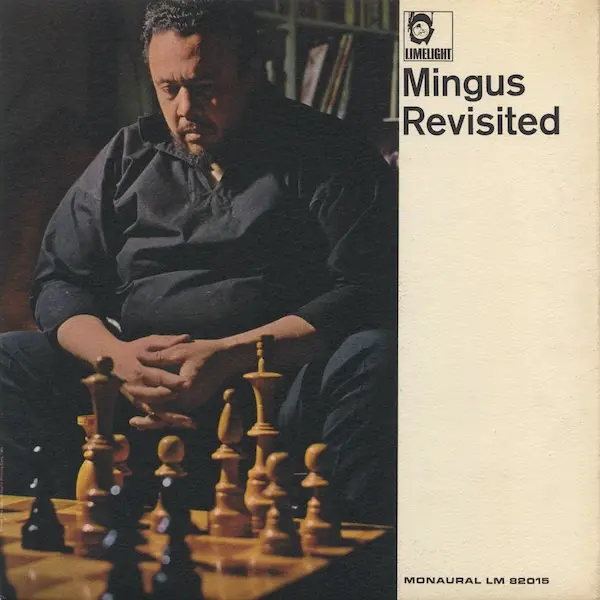
このアルバムは、1965年に Limelight レーベルから Mingus Revisited (LM-82015/LS-86015) として LP リイシューされました。Limelight は、1959年の EmArcy 消滅後しばらくジャズ専門の傍系レーベルを持たなかった Mercury が、1964年末にジャズ専門レーベルとして立ち上げ直したものです。EmArcy カタログの再発もその一環で、この Pre-Bird のほか、Cannonball & Coltrane(原題 Cannonball Adderley Quintet in Chicago)なども Limelight から再発されました。
The album was reissued on LP in 1965 by Limelight as Mingus Revisited (LM-82015/LS-86015). Limelight was Mercury’s attempt to rebuild a dedicated jazz imprint at the end of 1964, several years after EmArcy had been wound down in 1959, and reissues from the EmArcy catalogue were part of that effort. Pre-Bird was one of them; Cannonball & Coltrane, originally issued as Cannonball Adderley Quintet in Chicago, was another.
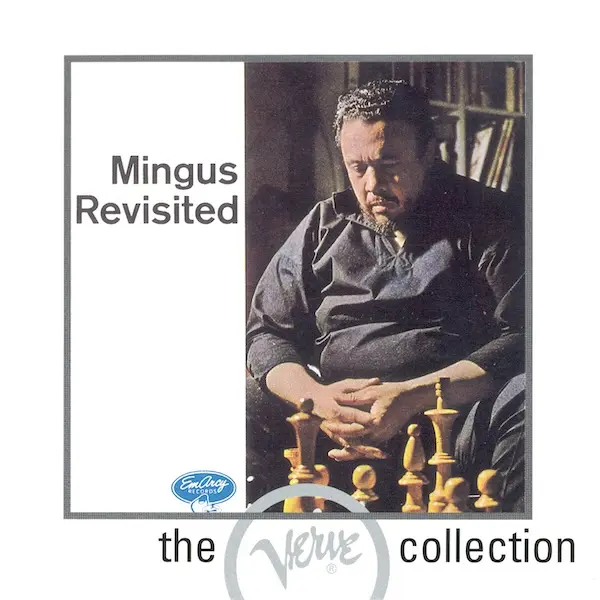
Mingus Revisited は 1986年に EmArcy 826 496-2 として初の CD 化がされました(1990年代前半に “Jazz: The Verve Collection” の 1 枚、Verve 538 460-2 として再発)。EmArcy 826 496-2 のライナーには、日本フォノグラムの常盤清氏によってオリジナルアナログマスターテープからリマスターされた、と書かれています(Verve 538 460-2 はリマスター表記なし)。
Mingus Revisited first reached CD in 1986 as EmArcy 826 496-2, and again in the early 1990s as Verve 538 460-2, one of the “Jazz: The Verve Collection” titles. The liner of 826 496-2 credits Kiyoshi Tokiwa of Nippon Phonogram with remastering directly from the original analogue master tapes; 538 460-2 carries no remastering credit.
そして 1999年、Verve Master Edition (314 538 636-2) として改めて CD リイシューされました。音源のリサーチとリストアを担当したのは、Mingus のディスコグラフィー研究で知られる Ben Young です。こちらの CD は、96 kHz/24-bit ハイレゾトランスファーによるマスタリングで、担当は Kevin Reeves 氏です。
Then in 1999 it was reissued once more as a Verve Master Edition (314 538 636-2). Source research and restoration were handled by Ben Young, known for his discographical work on Mingus, and the mastering was done by Kevin Reeves from a 96 kHz/24-bit transfer.
最近、この 1999 CD をリッピングして改めて聴き直していたところ、妙なことに気がつきました。再生ボタンを押しても、しばらく音楽が始まらないのです。
I ripped that CD recently and sat down with it again, and something was wrong. I pressed play, and for a while no music started.
LP の裏ジャケットには A-1 “Take The ‘A’ Train” の演奏時間が 3:34 と記載されています。CD のライナーにも同じく 3:34。ところが、実際の Track 1 の長さを計ってみると、4分19秒もあります。約 44 秒の差があるわけです。
The back of the LP jacket gives 3:34 for A-1, “Take The ‘A’ Train.” The CD liner says 3:34 as well. Measure the actual track, though, and it runs 4:19. That leaves a gap of about forty-four seconds.
注意深く聴き直すと、冒頭の 42 秒間、左チャンネルからごく小さな声が聞こえてきます。音量を上げてみると、それはスタジオでの会話でした。
Listening closely, there is a very faint voice in the left channel for the first forty-two seconds. Turn it up and it becomes conversation in the studio.
What was said just before take four
左チャンネルのゲインを大幅に上げ、文字起こしを試みました。以下はその内容です(非常に小さな声なので、聞き取り間違いの可能性もあります)。
I raised the gain on the left channel considerably and tried to transcribe it. The voices are very quiet, so some of this may be misheard.
“Okay, we’re still rolling.”
「オーケー、(テープは) まだ回ってる」
“We start right on the trumpet solo.” — “Right on the trumpet solo.” — “No, take from the top, huh?” — “All right.”
「トランペットソロから始める」「トランペットソロからね」「いや、頭から行こう」「了解」
“Charlie, is the outchorus going to be the same as the first chorus where they play unison? Is the outchorus going to have unison bass bars and then the two melodies for the second eight?”
「チャーリー、アウトコーラスは最初のコーラスと同じユニゾンでやるの? アウトコーラスはベースのユニゾンから入って、セカンド 8 (小節) で 2 つのメロディを重ねるの?」
“No, no.” — “How are you going to do it?” — “We’ll be straight. Both melodies at the same time.”
「いや、違う」「じゃあどうやるの?」「ストレートにいく。両方のメロディを同時に」
“Okay. Okay, Train. Take four.”
「オーケー。オーケー、”Train”。テイク 4」
“You rolling?” — “One, two, three, four.”
「回ってる?」「ワン、ツー、スリー、フォー」
Mingus とプロデューサー(あるいはエンジニア)が、テイク 4 に入る直前にアウトコーラスのアレンジを確認しているやりとりです。「2 つのメロディを同時に」という Mingus の指示は、まさにこの曲の特徴である左右チャンネルの二重メロディ構造に直結しています。
Mingus and the producer, or possibly the engineer, are settling the arrangement of the outchorus in the last moments before take four. Mingus’s instruction, both melodies at the same time, is the double-melody structure that defines the finished track.
Trouble at the session
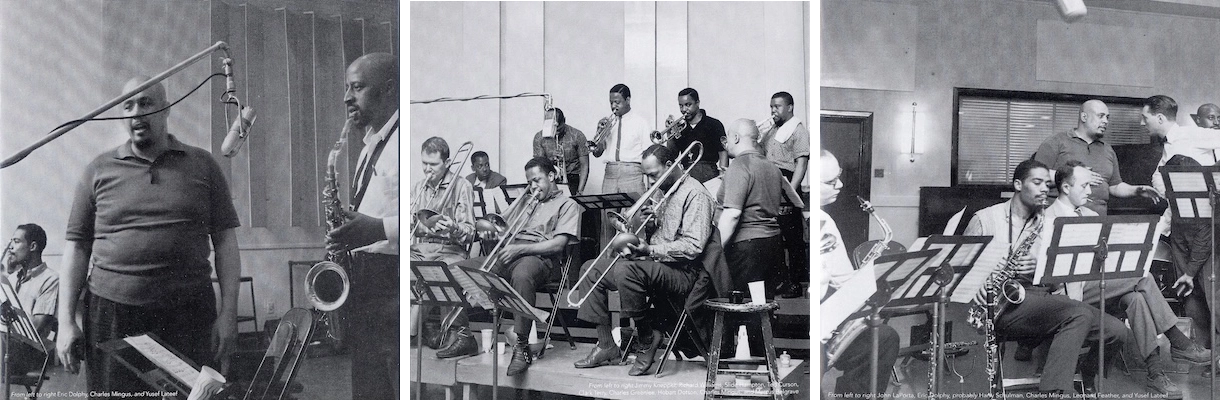
この録音セッションがどのような現場だったのか。プロデューサーの Leonard Feather は、1979年にスイングジャーナル誌のために長い回想を書いており、1987年の自伝 The Jazz Years でも、より短い形で同じ出来事に触れています。まず書籍の側から。
Leonard Feather, who produced the date, wrote a long account of it in July 1979 for the Japanese magazine Swing Journal. He came back to the same events in his memoir The Jazz Years (1987), in a much shorter form. The book opens the episode this way.
Of all my experiences as a producer, none was more traumatic than the attempt, in 1960, to record an album for Mercury Records with Charles Mingus.
プロデューサーとしての私のあらゆる経験の中で、1960年に Mercury Records で Charles Mingus のアルバムを録音しようとしたこと以上に壮絶な体験はなかった。
Leonard Feather, The Jazz Years (1987) p.211当初はクインテットでの録音が予定されていました。Feather と Mingus は Langston Hughes のアルバムで問題なく仕事をしており、Mercury もクインテットでの録音を承認します。Mingus が「ホーンを 1、2 本加えたい」と言ったときも、それは通りました。ところが Feather がリハーサルに足を運ぶと。
The plan had been a quintet. Feather and Mingus had worked together without difficulty on the Langston Hughes album, and Mercury agreed to the quintet date; when Mingus asked whether he could add a couple of horns, that was agreed to as well. Then Feather went to a rehearsal.
One afternoon I walked into a rehearsal to find that not two, but four men had been added. Mingus also mentioned some old arrangements he wanted to try out – material that dated back to his days in the Lionel Hampton Orchestra of the 1940s. ‘The music is available and paid for,’ he said, ‘so it would be a shame not to use it. Let’s add a few men for some of the tracks.’
ある日の午後、リハーサルに顔を出すと、加わっていたのは 2人ではなく 4人だった。Mingus はさらに、試してみたい古いアレンジがあるとも言った。1940年代に Lionel Hampton 楽団にいた頃までさかのぼる素材である。「あの譜面はもう手元にあるし、支払いも済んでいる」と彼は言った。「使わないのはもったいない。何曲かで何人か足そう」
Leonard Feather, The Jazz Years (1987) p.211編成は最終的に 14人にまで膨れ上がり、Mercury 側は難色を示しました。Mingus は Musicians Union と Feather に脅迫的な電報を送りつけ、大編成での録音を要求。さらには Feather の自宅に電話をかけ、本人が不在だったため妻の Jane に、自分は癌で余命数ヶ月だから、このアルバムはどうしても作った方がいい、歴史的価値があるはずだ、と訴えたといいます。
The band reached fourteen pieces. Mercury balked. Mingus sent long, threatening telegrams to the Musicians Union and to Feather, and when he telephoned the house and found Feather out, he told Jane Feather that he was dying of cancer and had only months to live, so the record would be historically valuable.
After two days of crisis during which it seemed the album might never be made, I walked into the studio on the date of the session and could hardly believe my eyes. We had a twenty-two-piece orchestra, with Gunther Schuller conducting!
アルバムが作れないかもしれないと思われた 2日間の騒動の末、セッション当日にスタジオに足を踏み入れた私は、自分の目を疑った。22人編成のオーケストラが、Gunther Schuller の指揮のもとに控えていたのだ。
Leonard Feather, The Jazz Years (1987) p.212Swing Journal の記事では、この場面がさらに生々しく描かれています。
In the Swing Journal article, the same scene is drawn far more vividly.
そうして、その朝がやってきた。1960年5月24日,火曜日の早朝,ニューヨークの50丁目55番地にあるノラ・スタジオで私達のセッションは始まろうとしていた。音出しは午前8時である。足を一歩踏み入れた瞬間,私は自分の眼を疑った。14名どころか、スタジオは、一時にはとても数え切れぬほど沢山のミュージシャンでごった返していたのである。トランペットが5人,トロンボーンが4人,チューバ,チェロ、オーボエ,クラシックのフルート奏者が各1名,パーカッションが3人,そして6人のサックス・セクションとピアニストがいた。リード奏者の中には、私とは初顔合わせだったと記憶する、メイナード・ファーガソン楽団の若いジョー・ファレルがいた。私の知る限りでは、その時が彼のレコード・デビューだったかと思う。彼はエリック・ドルフィー,ジョン・ラポータ、ビル・バロン、ユセフ・ラティーフ,ダニー・バンクがひときわ目立つ一団と席を並べていた。中でも驚いたのは、ミンガスがコンダクターまで雇っていたことだった。しかも、そのガンサー・シュラーとは、サード・ストリーム音楽のパイオニアとして当時その名もときめく存在だったのである。
And so the morning arrived. May 24, 1960, early on a Tuesday morning, and our session was about to begin at Nola Studios, 55 West 50th Street, New York. Downbeat was 8 AM. The moment I set foot inside, I could not believe my eyes. Far from fourteen, the studio was crowded with more musicians than I could count at a glance. Five trumpets, four trombones, one each on tuba, cello, oboe and classical flute, three percussionists, and a six-piece saxophone section with a pianist. Among the reed players was a young Joe Farrell of the Maynard Ferguson band, whom I recall meeting for the first time; as far as I know, that was his recording debut. He was seated in a section that stood out for Eric Dolphy, John LaPorta, Bill Barron, Yusef Lateef and Danny Bank. What astonished me most was that Mingus had hired a conductor at all, and that the conductor was Gunther Schuller, a name very much in the spotlight then as a pioneer of Third Stream.
Leonard Feather,「轟き渡るミンガスの醍醐味」, Swing Journal 1979年7月号 p.186 (訳: 小山さち子。英文は筆者訳 / English rendering mine)ここで引用の向きが、この記事の他の箇所と逆になっていることをお断りしておきます。Feather はこの記事を英語で書きましたが、活字になったのは小山さち子氏の日本語訳だけで、英語原稿の所在は分かっていません。したがって記録として存在するのは日本語の方であり、上の英文は日本語から私が訳したもので、Feather の原文が復元されたものではありません。彼自身の英語が必要な箇所では、The Jazz Years からの引用を使っています。
A word about the direction of translation here, which is the reverse of what this article does elsewhere. Feather wrote the piece in English, but it was published only in Sachiko Koyama’s Japanese translation, and his manuscript has not been located. The Japanese text is therefore the text of record, and the English above is my own rendering of it, not Feather’s wording restored. Where his exact English matters, the quotations from The Jazz Years carry it.
オーケストラが、長尺の<ハーフ・マスト・インヒビション>をリハーサルしている間,私はスタジオとブースの間を飛び回りながら,何とかこの混乱に秩序をもたらそうという努力をした。
While the orchestra rehearsed the lengthy “Half-Mast Inhibition,” I ran back and forth between the studio floor and the booth, trying to bring some order to the confusion.
Leonard Feather,「轟き渡るミンガスの醍醐味」, Swing Journal 1979年7月号 p.186 (訳: 小山さち子。英文は筆者訳 / English rendering mine)ここで Feather は録音場所を「ノラ・スタジオ」(Nola Studios, 57丁目の Steinway Building 内) と述懐していますが、1999年 CD リイシューのライナーおよび各種ディスコグラフィでは Plaza Sound と記載されています。どちらが正確かは確定できませんが、後者は Ben Young がセッションシートに基づいて記した可能性もありそうです。
Feather’s account places the session at Nola Studios, while the 1999 CD liner and the standard discographies give Plaza Sound. I cannot say which is correct. The latter may rest on session sheets that Ben Young was able to consult.
Feather の回想には後日談が付いています。
The book adds a postscript.
The album was entitled Pre-Bird. In a predictable postscript, Mingus later sent a bill to Mercury for several thousand dollars in charges for the charts he had said were ‘available and paid for’. He was duly paid, and in retrospect I understood how right he had been in desperately wanting to put this music on record.
アルバムは Pre-Bird と題された。予想どおりの後日談として、Mingus はのちに Mercury へ請求書を送ってきた。「もう手元にあるし支払いも済んでいる」と彼が言っていた譜面の代金として、数千ドルである。その金は正当に支払われた。そして振り返ってみて私は、彼がこの音楽をどうしても記録に残そうとしたことが、どれほど正しかったかを理解したのである。
Leonard Feather, The Jazz Years (1987) p.211-212冒頭のスタジオ会話で聞こえる、テイク 4 直前の落ち着いたやりとりは、この混沌とした制作過程のほんの一瞬を切り取ったものだったのです。
The unhurried exchange audible before take four is one moment out of all that.
Traces of island-hopping
この会話がなぜ 1999年の CD に収録されているのか。それを理解するには、Mingus のレコーディング手法に触れる必要があります。
Why is that conversation on a 1999 CD at all? The answer runs through the way Mingus made records.
Mingus は、Ben Young いわく「業界で “アイランドホッピング” (island-hopping) と呼ばれることもある」テープ編集技法を用いてアルバムを制作していました。島から島へ渡り歩くように、使える部分 (島) だけを拾いながら曲の終わりまで進んでいく、というイメージです。曲の先頭から演奏を始め、途中で気に入らなくなるとそこでストップし、次のテイクでは続きから録音する。これを繰り返し、最終的にフラグメントをスプライシング(テープの切り貼り)で 1 曲にまとめ上げるのです。
Mingus worked with a tape-editing method that Ben Young notes is sometimes called island-hopping in the trade. The image is of crossing from island to island, taking only the usable stretches and working forward to the end of the piece. He would begin a take from the top, stop when something stopped satisfying him, then pick up from that point on the next take, and repeat. The fragments were spliced together into a finished performance.
偶発的なミスを修正するための編集ではなく、最初から編集を前提として録音に臨む。テープ編集そのものを作曲や演奏と同等の創作行為として位置づけていた点が、Mingus のアプローチの特徴でした。
This is not editing to repair an accident. Mingus recorded with editing in view from the start, treating the splice as an act of composition on the same footing as writing and playing.
以前、当ブログで Tijuana Moods の記事 を書いた際にも、このアイランドホッピングについて紹介しました。Tijuana Moods (1957年録音、1962年リリース) はまさにこの手法の典型で、2001年の BMG/Bluebird 2CD リイシューでは、最終リリースに使われなかった断片も多数収録されています。
I have written about island-hopping once before, in a 2006 post about Tijuana Moods. That album, recorded in 1957 and not released until 1962, is the clearest case of the method, and the 2001 BMG/Bluebird two-CD reissue carries a great many fragments that never reached the released master.
この Pre-Bird でも、アイランドホッピングは全面的に用いられています。1999 CD のライナーには、こう書かれています。
Pre-Bird was made the same way throughout. The 1999 liner is explicit about it.
The take numbers shown for these performances are only passingly useful: Every selection was made by splicing together segments from multiple takes and most were edited copiously and in great detail. As it is not possible to present the uncut versions of these pieces, this reissue endeavors to show at least where the edits were made in the well-known master takes of these pieces. During CD playback each track begins at index 1, and the index number increases by one at the point of each edit. The index number visible at the conclusion of the piece therefore shows how many different segments were spliced together to make the final product.
これらの演奏に付記されたテイク番号は、あくまで参考程度のものにすぎない。すべてのトラックは複数のテイクからセグメントをスプライシングして作られており、そのほとんどが綿密かつ詳細に編集されている。未編集のノーカット版を収録することは不可能であるため、本リイシューでは、少なくともよく知られたマスターテイクのどこで編集が行われたかを示すことを試みた。CD 再生中、各トラックは index 1 から始まり、編集が行われた箇所で index 番号が 1 ずつ増える。曲の終わりに表示される index 番号が、最終プロダクトを作るためにスプライシングされたセグメントの総数を示している。
Ben Young, Pre-Bird 1999 CD liner notesでは、実際の数はどうだったのか。各トラックの終端の index を読み取ると、こうなりました。
So what are the actual numbers? Reading the final index of each track off my copy of the CD gives this.
| # | 曲名 / Title | セグメント数 / Segments |
|---|---|---|
| 1 | Take the “A” Train | 6 |
| 2 | Prayer for Passive Resistance | 16 |
| 3 | Eclipse | 5 |
| 4 | Mingus Fingus No. 2 | 10 |
| 5 | Weird Nightmare | 16 |
| 6 | Do Nothin’ Till You Hear From Me | 16 |
| 7 | Bemoanable Lady | 8 |
| 8 | Half-Mast Inhibition | 1 |
8曲で合計 78セグメント。最多は 16 で、3曲が並びます。継ぎ方も細かく、Prayer for Passive Resistance には 0.7秒の間に index が 6回進む箇所があります。
Seventy-eight segments across eight tracks. Three pieces tie for the most at 16, and the splices can come very close together: at one point in Prayer for Passive Resistance the index advances six times within 0.7 seconds.
目を引くのは Half-Mast Inhibition です。曲目表でも唯一テイク番号が付いていないこの曲は index が 1 のまま終わっており、テープに継ぎ目がなかった可能性を示唆しますが、断定はできません。Brian Priestley(Mingus: A Critical Biography, 1982 の著者)はライナーで、収録曲中最も古い作品であり、すべてが譜面に書き切られて即興の余地がまったくない、と述べています。だとすれば、そもそも編集の必要がなかったのかもしれません。
The one that stands out is Half-Mast Inhibition. The only track listed without a take-number suffix, it ends still on index 1, which suggests, but does not prove, that the tape itself was seamless. Brian Priestley (author of Mingus: A Critical Biography, 1982) writes in the liner that it is the earliest composition here, “completely written out, with no space for improvisation.” If so, there may simply have been nothing to edit.
From the spaces between the islands
ここで、冒頭の会話に戻ります。
Back, then, to the conversation at the head of the disc.
アイランドホッピングでは、セッションマスターテープから使いたい部分を直接切り出し、つなぎ合わせてプロダクションマスターを作ります。その結果、セッションマスターテープは文字通り切り刻まれた状態で残ります。ライナーが「未編集のノーカット版を収録することは不可能」と明記しているのは、そういう事情です。
In island-hopping, the wanted passages are cut straight out of the session masters and assembled into a production master. What is left of the session masters is, literally, cut to pieces. That is what the liner means when it says the uncut versions cannot be presented.
つまり、「セッションマスターをノーカットで CD に収録した結果、冒頭にスタジオ会話が入った」という説明は成り立ちません。未編集のセッションマスターは、もう存在しないのですから。
So the explanation that someone put an unedited session master onto the CD and the studio talk came along with it does not hold. There is no unedited session master left to put there.
では、この会話はどこから来たのか。
Where did it come from, then?
おそらく、1999年の CD リイシューにあたって Ben Young がマスターテープを調査した際、アイランドホッピングで「島」として使われた部分の他に、切り取られて残った「あいだ」の部分も見つかったのでしょう。テイクとテイクのあいだに録音されていたスタジオでの会話。プロダクションマスターには使われなかった、いわばテープの「切れ端」です。
Most likely this. When Ben Young went through the tapes for the 1999 reissue, he would have found not only the islands that had been used but the material between them: the talk recorded between takes, cut away and never carried into the production master. Offcuts.
Ben Young はその切れ端の中から、”Take The ‘A’ Train” のテイク 4 直前の会話を拾い上げ、CD のトラック 1 の冒頭にひっそりと配置しました。LP の時間表記 3:34 をそのまま CD ライナーにも転記しつつ、実際の音源には約 44 秒の「おまけ」が付いている。ノンクレジットの、ささやかなボーナスです。
From those offcuts he took the exchange from just before take four of “Take The ‘A’ Train” and placed it quietly at the head of track 1. The LP timing of 3:34 was carried straight over into the CD liner, while the audio itself runs about forty-four seconds longer. An uncredited bonus, and a modest one.
Fragments that never surfaced
Tijuana Moods の 2001年 BMG/Bluebird 2CD リイシュー (のちに 2012年の 10CD ボックスセット The Complete Columbia & RCA Albums Collection にも同構成で収録) では、未使用のセッションマスターの断片が豊富にボーナストラックとして収録されていました。各テイクの未使用部分、完走しなかったフラグメント、リハーサルの断片。それらを聴くことで、Mingus がどのようにアルバムを組み立てていったのかを追体験することができました(詳しくは同時公開の Tijuana Moods の続編記事を参照)。
The 2001 BMG/Bluebird two-CD Tijuana Moods, whose contents were later carried over into the 2012 ten-CD box The Complete Columbia & RCA Albums Collection, came with a generous set of unused session-master fragments as bonus tracks: unused portions of takes, performances that broke down partway, scraps of rehearsal. Listening through them, you can follow how Mingus assembled the album. (For details, see the companion piece on Tijuana Moods, published at the same time as this article.)
一方、この Pre-Bird の 1999 CD リイシューには、冒頭のスタジオ会話以外に、そうした断片的な音源は収録されていません。テイク間の会話は見つかっても、演奏のフラグメントまでは残存していなかったのかもしれません。あるいは、残っていたとしても、今回のリイシューの方針には含めなかったのかもしれません。
The 1999 Pre-Bird has nothing of that kind beyond the opening conversation. Perhaps the talk between takes survived where the musical fragments did not. Perhaps they did survive, and fell outside the scope of this particular reissue.
Feather 自身、1979年の時点で同じことを気にしていました。演奏の出来を評したくだりに、括弧書きでこう挟んでいます。
Feather was already asking the same question in 1979. In the middle of a passage weighing up the performances, he dropped this into parentheses.
残りのテイクが今もマーキュリーの保管室のどこかに埋もれているかどうか疑問である。もしあるならばそれらはリリースされるべきである。
I doubt whether the remaining takes are still buried somewhere in Mercury’s vault. If they are, they ought to be released.
Leonard Feather,「轟き渡るミンガスの醍醐味」, Swing Journal 1979年7月号 p.187 (訳: 小山さち子。英文は筆者訳 / English rendering mine)20年後、Ben Young はテープを調べ、切れ端が残っていることを確かめました。ただし日の目を見たのは 42 秒の会話だけで、Feather が「リリースされるべきである」と書いた残りのテイクの方は、いまも出ていません。
Twenty years later Ben Young went through the tapes and established that offcuts had in fact survived. What reached the public, though, was forty-two seconds of conversation. The remaining takes that Feather thought ought to be released are still unissued.
もしいつか、この録音セッションの未使用フラグメントが発掘されることがあれば、Gunther Schuller を含む大編成でのセッションの全貌がもう少し見えてくるかもしれません。冒頭に残された 42 秒間の会話は、その可能性をわずかに覗かせてくれます。
If the unused fragments from these sessions are ever dug out, the large-ensemble dates with Schuller might come into somewhat clearer view. The forty-two seconds at the head of the disc offer a narrow glimpse of that possibility.
ディスコグラフィ / Discography
- Pre-Bird (1961, LP) — Mercury MG-20627 (mono) / SR-60627 (stereo)
- Mingus Revisited (1965, LP reissue) — Limelight LM-82015 (mono) / LS-86015 (stereo)
- Mingus Revisited (1986, CD) — EmArcy 826 496-2
- Digitally remastered directly from the original analog master tapes by Kiyoshi Tokiwa, Nippon Phonogram
- Mingus Revisited (1990s, CD, Jazz: The Verve Collection) — Verve 538 460-2
- Pre-Bird (1999, CD, Verve Master Edition) — Verve 314 538 636-2
- Supervised, researched and restored by Ben Young
- Mastered by Kevin “Oh Yeah!” Reeves at PolyGram Studios
参考文献 / References
- Leonard Feather, The Jazz Years: Earwitness to an Era, Da Capo Press, 1987, pp.211-212.
- Leonard Feather(訳: 小山さち子), 「轟き渡るミンガスの醍醐味」, Swing Journal 1979年7月号 pp.184-187.
- Brian Priestley, “Reissuing Pre-Bird”, Pre-Bird (Verve 314 538 636-2, 1999) ブックレット pp.4-5.
関連記事 / Related posts
- Tijuana Moods / Charlie Mingus — 当ブログ 2006年の記事。アイランドホッピングの詳細と Tijuana Moods 2CD の分析 / a 2006 post on this blog, with a fuller account of island-hopping and an analysis of the Tijuana Moods two-CD set