2026/06/30

Phono EQ Curves Liner Notes III — Fortune 1939 “Phonograph Records”

Phono EQ Curves に関する筆者の学習過程を、これまで Pt.0Pt.25 として連載してきました。本シリーズ Phono EQ Curves Liner Notes は、その続編ではなく、別の角度からのアプローチです。LP のジャケット裏に書かれた解説(ライナーノーツ)のように、本編とは別の物語を、別の温度感で記録するためのシリーズです。

Over the years I have documented my own learning process on phono EQ curves as a serial, running from Pt.0 through Pt.25. This series, Phono EQ Curves Liner Notes, is not a sequel to that serial but an approach from a different angle. Like the liner notes printed on the back of an LP jacket, it sets out to record a story apart from the main feature, at a different temperature.

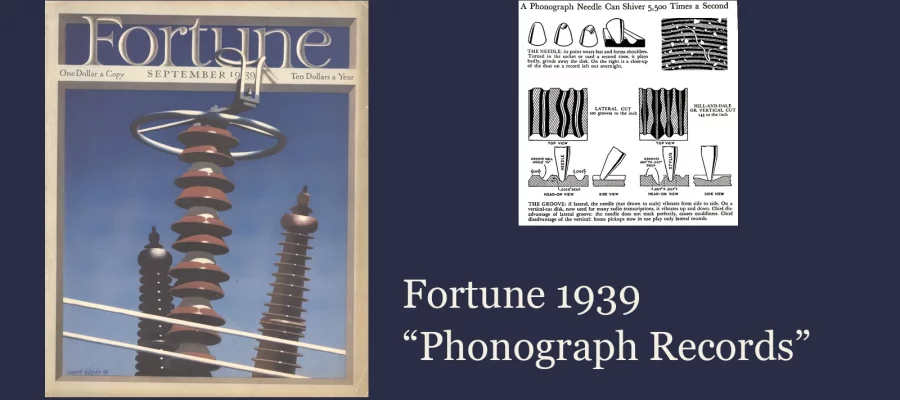
第 3 弾 Liner Notes III は、レコードではなく一冊の古い雑誌を扱います。Fortune 誌 1939年9月号(Volume XX, Number 3)に掲載された無署名の長編特集記事「Phonograph Records」を一次史料として精読し、EQカーブという言葉がまだ誰の口にものぼっていなかった時代のレコード産業の全景を読み解く回です。

This third installment, Liner Notes III, deals not with a record but with a single old magazine. In it, I closely read the unsigned long-form feature “Phonograph Records” from Fortune’s September 1939 issue (Volume XX, Number 3) as a primary source, and try to work out the full panorama of the record industry in an era when the phrase “EQ curve” had not yet crossed anyone’s lips.

Fortune magazine, Vol. XX, No. 3, September 1939 cover art by Herbert Bayer

Cover of the September 1939 issue of Fortune (Vol. XX, No. 3). Illustration by Herbert Bayer. “Phonograph Records,” the article read closely in this essay, appears in this issue.
Fortune 誌 1939年9月号(Vol. XX, No. 3)表紙。Herbert Bayer によるイラスト。本稿で精読する「Phonograph Records」はこの号に掲載されている

Continue reading
2024/10/30

How Records Were/Are Manufactured (2)

前編 に続き、戦後のレコード製造工程や原材料の歴史、特に 射出成形スチレン盤 について改めて調べてみた、そんな記録です。

Following on from the first part, this article is a record of a renewed look into the history of postwar record manufacturing processes and raw materials, particularly injection molding and styrene records.

「射出成形盤はいつ頃から製造されたか」、「米国における圧縮成形 vs 射出成形のバトルはどのようなものだったか」、「圧縮成形のスチレン盤は存在したか」、そして「Mercury の例の廉価盤はなにか」などをみていくわけですが、2回目となる今回は、RCA Victor が1957年と1976年に社内技術紀要に掲載した2つの解説論文をたよりに、レコード製造技術の概要を改めてみていきます。

We’ll be looking at questions such as “WHen did injection-molded records start to be produced?”, “What was the battle like between compression molding and injection molding in the US?”, “Did compression-molded styrene records exist?”, and “What was that budget Mercury records?”. In this second article, we’ll take another look at the outline of manufacturing technology, relying on two explanatory articles published by RCA VIctor in their internal technical bulletins in 1957 and 1976.

RCA Victor は、米国レコード業界を牽引する立場でもあり、長年に渡りレコード製造技術の自社開発を積極的に行っていましたし、またそれらの成果を学術論文や社内技術紀要などに比較的積極的に公開していたため、このような資料が残っていることには感謝しかありません。

RCA Victor had been a leader in the US record industry, and for many years it actively developed its own record manufacturing technology. It also actively published the results of these efforts and researches in academic papers and internal technical journals, so we are very grateful that such materials have survived.

Continue reading
2011/05/01

Feb. 3, 1932: The First Stereo Sound Recording Known To Exist

時は1932年2月3日。現存する最古のステレオ録音(とみなすことができるもの)が記録されました(ただし、意図的にステレオ録音されたものではなかった、とされてはいますが)。デューク・エリントン (Duke Ellington) オーケストラによるメドレー録音です。その6日後にも、別のメドレーが録音されました。

It was on February 3, 1932 when the oldest stereo recording known to exist was waxed (although it was not an “intended stereo recording” but an “accidental stereo recording”) – a seven minute medley by Duke Ellington and His Orchestra.

何種類か CD化 されているほか、「First stereo sound recording」(Benjamin S. Beck) で紹介されている以下のリンクでもその有名な音源を聴くことができます。

You can listen to the two “accidental stereo recordings” on several CD releases (such as “The Best Of The Duke Ellington Centennial Edition”) as well as with the following links (as appeared on the “First stereo sound recording” webpage by Benjamin S. Beck):

Continue reading