グルーヴマシンの録音を追いかけて (III): ディスコグラフィカルなデータ
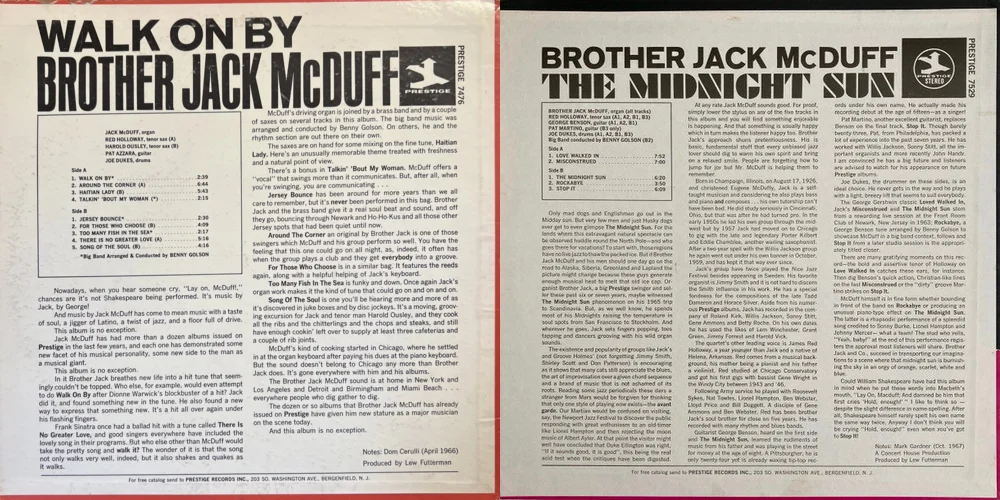
Part II の最後で予告した通り、最終回ではディスコグラフィの検証と、セッション・原盤・CD の対応マトリクスをまとめます。
このシリーズを調べる過程で、ディスコグラフィの世界にも「完璧な一次資料」は存在しないことを痛感しました。まず、その話から始めさせてください。
Continue reading
Part II の最後で予告した通り、最終回ではディスコグラフィの検証と、セッション・原盤・CD の対応マトリクスをまとめます。
このシリーズを調べる過程で、ディスコグラフィの世界にも「完璧な一次資料」は存在しないことを痛感しました。まず、その話から始めさせてください。
Continue readingPart I では、McDuff、Dukes、Benson、Holloway の 4 人がそれぞれどんなプレイヤーだったかを書きました。ここからは、この 4 人の録音を時系列で辿ってみます。
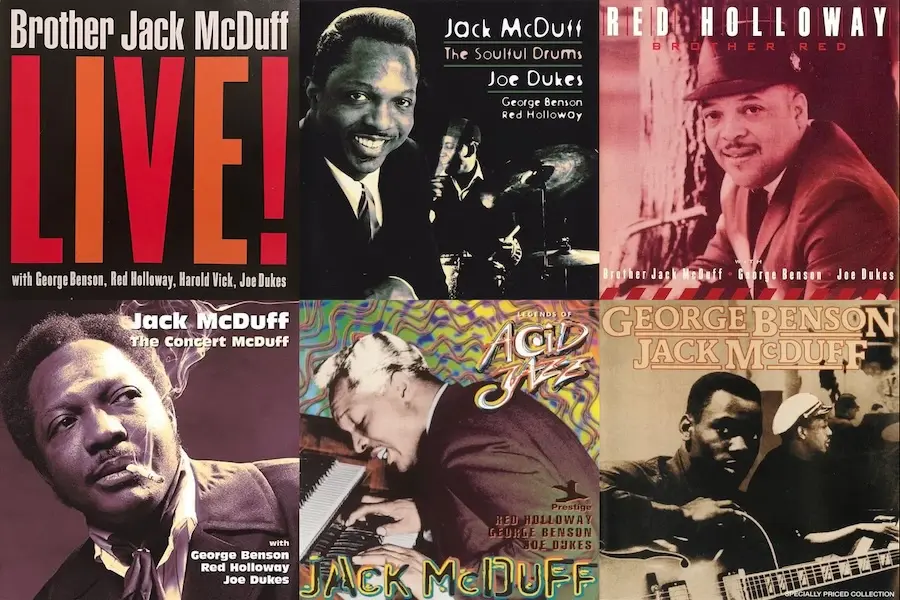
1963 年 6 月の Newark から、同年 10 月の San Francisco、1964 年 2 月の Los Angeles、同年夏のヨーロッパ、そして 1964〜65 年の New York スタジオへ。2 年間のうちにバンドがどう変わっていったのか、セッション単位で聴いていきます。
なお、ライブ盤の編集手法(拍手のオーバーダブやフェードアウト処理)にも各所で触れます。「ライブ盤 = ライブの完全な記録」とは限らない、ということが、聴いていくとわかります。
ここからは語り口を少し変えて、音源に向き合う実況風の筆致でいきます(笑)。
Continue readingこの 4 人の演奏が、昔からたまらなく好きなんです。
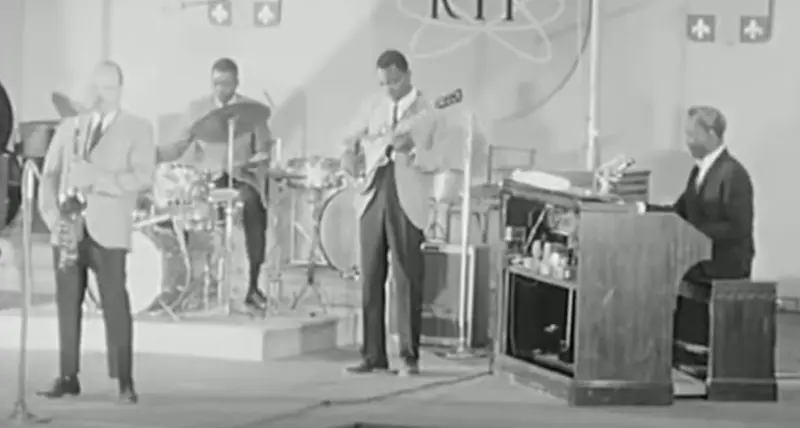
1964 年夏、Antibes Jazz Festival での 4 人。左から Red Holloway (ts)、Joe Dukes (ds)、George Benson (g)、Brother Jack McDuff (org)。
Brother Jack McDuff(ジャック・マクダフ)のオルガン、Red Holloway(レッド・ホロウェイ)のテナー、George Benson(ジョージ・ベンソン)のギター、Joe Dukes(ジョー・デュークス)のドラムス。1963 年から 1965 年にかけて Prestige レーベルに残された録音は、聴くたびに体が勝手に動き出します。何度聴いても飽きません。末恐ろしいグルーヴマシンの魔力に、私はずっと虜になっています。
ところが、この 4 人の録音を体系的に聴こうとすると、すぐに困ったことになります。
録音自体は 1963 年から 1965 年の 2 年間に集中しているのに、同じセッションの曲が全然違う LP に収録されたりしていて、体系的に音源を追うのが難しいのです。McDuff は Prestige に長く在籍し、ギタリストが Grant Green → Kenny Burrell → George Benson → Pat Martino と入れ替わりました。後期の LP はこれらの時代をまたいで収録しています。たとえば Steppin’ Out (PRST 7666) は 6 曲中に Green、Burrell、Benson、Martino の 4 人のギタリストが混在し、録音年も 1961 年から 1966 年まで 5 年にわたります。後年の CD 再発でもやはり同じで、Silk and Soul (PRCD-24242-2) は 13 曲中 Benson が弾いているのは 1 曲だけです。どの盤にこの 4 人の演奏が入っているのかを把握するだけで、ちょっとした調査が必要になります。
このシリーズでは、散らばった録音をセッション単位で束ね直して、4 人のバンドとして聴き直してみたいと思います。Part I ではまず、この 4 人がそれぞれどんなプレイヤーで、なぜ噛み合っていたのかを書きます。Part II では時系列順に録音を辿り、Part III でディスコグラフィの整理と検証を行います。
Continue reading
As promised at the end of Part II, this final installment covers discographical verification and cross-reference matrices mapping sessions, original LPs, and CDs.
While researching this series, it was driven home to me that there is no such thing as a “perfect primary source” in discography. Let me start with that.
Continue readingIn Part I, I wrote about what kind of players McDuff, Dukes, Benson, and Holloway each were. From here, I’ll trace the four players’ recordings in chronological order.
From Newark in June 1963, to San Francisco in October of that year, Los Angeles in February 1964, Europe that summer, and then on to the New York studios in 1964-65. I’ll be listening session by session, following how the band changed over the course of two years.
I’ll also touch on the editing techniques used in the live albums (overdubbed applause, fadeout processing) at various points. “Live album = complete record of a live performance” isn’t always the case, as you’ll hear.
Continue readingI have been hopelessly in love with this quartet’s playing for a very long time.
The quartet at the Antibes Jazz Festival, summer 1964. From left: Red Holloway (ts), Joe Dukes (ds), George Benson (g), Brother Jack McDuff (org).
Brother Jack McDuff on organ, Red Holloway on tenor, George Benson on guitar, Joe Dukes on drums. Every time I listen to the recordings they left on Prestige Records between 1963 and 1965, my body starts moving on its own. I never get tired of them. I have been captivated by the spell of this fearsome groove machine for years.
The trouble is, the moment you try to listen to this quartet’s recordings systematically, you run into problems.
The recordings themselves are concentrated in just two years, 1963 to 1965, yet tracks from the same session ended up scattered across completely different LPs, making it hard to follow the music in any orderly way. McDuff had a long tenure on Prestige, and his guitarists rotated through Grant Green, Kenny Burrell, George Benson, and Pat Martino. Later LPs drew from sessions spanning these different eras. For example, Steppin’ Out (PRST 7666) has four different guitarists across its six tracks (Green, Burrell, Benson, and Martino), with recording dates stretching five years from 1961 to 1966. CD reissues were no better: Silk and Soul (PRCD-24242-2) has thirteen tracks, but Benson plays on only one. Just figuring out which releases contain this quartet’s performances requires a bit of detective work.
In this series, I want to reassemble the scattered recordings session by session and listen to them fresh as a four-piece band. Part I covers who these four players were and why they clicked. Part II traces the recordings in chronological order, and Part III tackles the discographical data.
Continue reading先日、mhatta さんに 教えてもらって 速攻で購入した CD。 なんといっても Monk と Steve Lacy の共演が聴ける (!!) というだけでそそられます。
The other day mhatta-san let me know the release of the CD – we can finally listen to the Monk quartet with Steve Lacy on soprano sax!
(. . . the rest of the English edition of this article will hopefully be available in the near future . . .)
詳しい内容は聴いてからのお楽しみ、あるいは mhatta 氏の日記を参照して頂くとして、Monk の未発表音源に飢えている身としては、かなり悶絶ものであります。以下、楽しみをとっておきたい方は御覧になられませんように。
![[Monk in Philadelphia 1960 w/ Steve Lacy]](https://microgroove.jp/img/RLR88623_F.jpg)
(本エントリは、私が別の web に 2004年 8月 9日付で掲載していたものを転載したものです)
(this entry was originally made public at my another web site on August 9, 2004)
1954年10月にリリースを開始した EmArcy レーベルでは、当初シングル盤 (45回転と 78回転) もリリースされていました。これらの中にはシングルオンリーでしか日の目をみなかった音源がいくつかあるのですが、これもその 1枚です (1954年 3月24日録音)。後に “The Complete Art Blakey on EmArcy” (日本フォノグラム 195J-10085) という LP に (同セッションの未発表曲 2曲と共に) 収録されました。A面の “In The Basement” は実にカッコいいハードバップです (パーソネルはレーベル写真を参照)。録音も実に素晴らしいガッツのあるものです。
EmArcy label, the most famous subsidiary of the Mercury label, was started in October 1954. In the very early era, EmArcy also had a number of 78rpm/45rpm single releases which faded out soon. Some of the releases contain invaluable tracks which can be heard only on these single releases. This Art Blakey’s 45rpm (recorded on March 24, 1954) is one of such discs – both tracks can be heard on this 45rpm and equivalent 78rpm only (later Nippon Phonogram released the LP “The Complete Art Blakey on EmArcy”, 195J-10085, which contained these tracks as well as previously-unreleased tracks). The A-side track “In The Basement” is one of the finest hard-bop tracks (see the label photo for the personnel). Recording quality is also supreme – very powerful indeed.
しかし、この曲でかなりカッチョええテナーをブリブリとかましているミュージシャン、Henry Durant なる人については何も情報が分かりません。1954年〜1955年にごくわずかのレコーディングセッションに顔を出しただけで、その後表にはでてこられていない様です。
On these tracks, we can hear way-cool tenor saxophone player whose name is Henry Durant. Unfortunately there are few information on him available. As far as I know he appeared on a few recording sessions in circa 1954-1955.
この Henry Durant なるテナーサックスプレーヤーについて何か情報を御存じの方がおられましたら、是非御教授下さい。
If you have any information on this seldom-known tenor saxophonist Henry Durant, pleaset le me know.
![[16007 Side-A]](/img/16007A.jpg)
![[16007 Side-B]](/img/16007B.jpg) In The Basement c/w Little Girl Blue / Art Blakey
In The Basement c/w Little Girl Blue / Art Blakey
![[16007x45 Side-A]](/img/16007x45A.jpg)
![[16007x45 Side-B]](/img/16007x45B.jpg) In The Basement c/w Little Girl Blue / Art Blakey
In The Basement c/w Little Girl Blue / Art Blakey