Phono EQ Curves に関する筆者の学習過程を、これまで Pt.0〜Pt.25 として連載してきました。本シリーズ Phono EQ Curves Liner Notes は、その続編ではなく、別の角度からのアプローチです。LP のジャケット裏に書かれた解説(ライナーノーツ)のように、本編とは別の物語を、別の温度感で記録するためのシリーズです。
Over the years I have documented my own learning process on phono EQ curves as a serial, running from Pt.0 through Pt.25. This series, Phono EQ Curves Liner Notes, is not a sequel to that serial but an approach from a different angle. Like the liner notes printed on the back of an LP jacket, it sets out to record a story apart from the main feature, at a different temperature.
第 3 弾 Liner Notes III は、レコードではなく一冊の古い雑誌を扱います。Fortune 誌 1939年9月号(Volume XX, Number 3)に掲載された無署名の長編特集記事「Phonograph Records」を一次史料として精読し、EQカーブという言葉がまだ誰の口にものぼっていなかった時代のレコード産業の全景を読み解く回です。
This third installment, Liner Notes III, deals not with a record but with a single old magazine. In it, I closely read the unsigned long-form feature “Phonograph Records” from Fortune’s September 1939 issue (Volume XX, Number 3) as a primary source, and try to work out the full panorama of the record industry in an era when the phrase “EQ curve” had not yet crossed anyone’s lips.
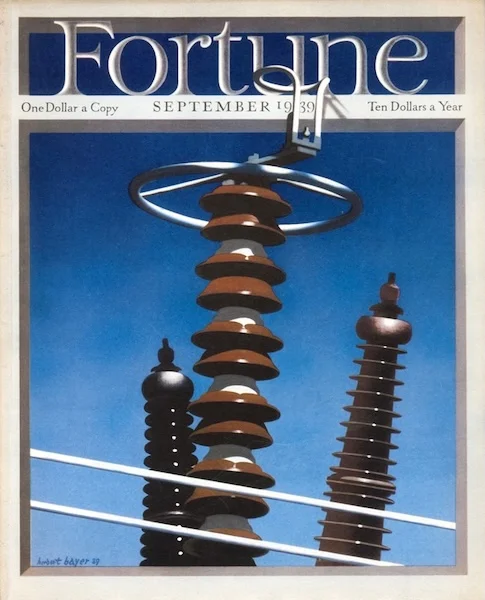
Fortune 誌 1939年9月号(Vol. XX, No. 3)表紙。Herbert Bayer によるイラスト。本稿で精読する「Phonograph Records」はこの号に掲載されている
変更履歴 / Revision History
- 2026年6月30日: 初版公開
- June 30, 2026: First edition published
本シリーズ Phono EQ Curves Liner Notes は、これまでの連載「Things I learned on Phono EQ Curves Pt.0〜Pt.25」 の補完シリーズです(連載続編ではなく、別シリーズとして位置付けます)。詳しくは 連載の読み方ガイド をご覧ください。
This series, Phono EQ Curves Liner Notes, is a companion to the earlier serial “Things I learned on Phono EQ Curves Pt.0 through Pt.25” (positioned as a separate series, not a continuation of the serial). For more, see the guide to reading the serial.
本稿は、筆者自身の学習・調査過程を記したものです。間違いの指摘や異論は遠慮なくお寄せください。
This essay is a record of my own learning and research process. Please do not hesitate to point out errors or raise objections.
III.1 September 1939, a World That Did Not Yet Call It a “Curve”
息も絶え絶えでお先真っ暗だったレコード産業が、なんとか復活の兆しをみせだした頃。Fortune 誌 1939年9月号(Vol. XX, No. 3)の特集記事「Phonograph Records」(pp. 72-75, 92, 94, 98, 100, 102) は、その瞬間を捉えた記事といえます。記事は、瀕死の床から起き上がったばかりの人物を追い回す芸能記事を思わせる、こんな一文から始まります。
The record industry was gasping for breath, its future pitch black, and had only just begun to show signs of recovery. The feature “Phonograph Records” (pp. 72-75, 92, 94, 98, 100, 102) in the September 1939 issue of Fortune (Vol. XX, No. 3) captures that moment. It opens with a sentence that reads like an entertainment piece chasing down someone who has just risen from their deathbed:
“From fat to lean and halfway back again: for its current boom the record industry can thank juke-boxes, light- and heavy-music lovers, and technology.”
栄華から衰退、そしてその中間点まで戻った話。現在の好況をレコード産業が感謝すべきは、ジュークボックス(の登場)と軽い音楽 (light-music)・重い音楽 (heavy-music) の愛好家たち、そして技術(の進化)である。
Fortune, Vol. XX, No. 3 (September 1939), p.72原文の “light-music” はまだしも、”heavy-music”(シリアスなクラシック音楽の意味でしょう)という表現は今ではまず見ないものですが、それはさておき。
The original’s “light-music” is one thing, but “heavy-music” (meaning serious classical music, presumably) is a phrase you almost never see today. Be that as it may.
太って、痩せ細って、半分だけ戻ってきた。この記事が書かれたとき、レコード産業はまさにその「半分だけ戻ってきた」途中にいました。1932年と1933年、レコードは近年で最悪の年を迎えていました(当時の販売枚数の急落については Pt.3 3.2.1 も参照)。記事では、それを単なる不況ではなく終焉として受け止めていた業界の空気を、こう書きとめています。
Fat, then lean, then halfway back. When this article was written, the record industry was right in the middle of that “halfway back.” In 1932 and 1933 records had gone through the worst years of recent memory (on the steep drop in sales at the time, see also Pt.3 §3.2.1). The article records the mood in the trade, which took this not as a mere slump but as an ending:
“What made records different was the strong suspicion, if not conviction, among many record men that the year of 1932 or 1933 would be the industry’s last.”
レコードが他と違ったのは、1932年か1933年がこの産業の最後の年になるのではないかという、疑念を越えてほとんど確信に近いものが、業界関係者の多くに広がっていたことだ。
Fortune, Vol. XX, No. 3 (September 1939), p.72ところが記事が書かれた1939年、工場からはふたたびレコードがあふれ出していました。
By 1939, when the article was written, records were once again pouring out of the factories.
“From the low of some 10,000,000 disks, industry production went up to 33,000,000 in 1938 and will doubtless exceed 50,000,000 this year.”
約1,000万枚という底から、業界の生産量は1938年に3,300万枚へと上昇し、今年は間違いなく5,000万枚を超えるだろう。
Fortune, Vol. XX, No. 3 (September 1939), p.72死にかけた産業が、息を吹き返した。記事はまさにそのタイミングを捉えています。
A dying industry had caught its breath again. The article captures exactly that timing.
ここで媒体の性格を確認しておきます。Fortune は1930年に創刊された、ビジネスエリート向けの月刊誌です。当時の慣例どおり記事は無署名で、誰が書いたのかは記されていません。書き手はレコードの技術者でも、音楽評論家でもないと推測されます。レコード産業を一つの「ビジネス」として外側から観察する、第三者の目です。だからこの記事は、製造工程、コスト構造、業界の勢力図、そして技術革新を、等しい筆致で並べていきます。約1万語に及ぶこの全景描写は、技術史の内側にいる人間が決して書きそうにない角度から、1939年のレコードの世界を説明しています。
A word here about the publication itself. Fortune, launched in 1930, was a monthly magazine for the business elite. As was the custom then, the article carries no byline, and there is no record of who wrote it. The writer was, I would guess, neither a recording engineer nor a music critic. This is the eye of a third party, observing the record industry from the outside as a “business.” So the article lines up manufacturing processes, cost structures, the balance of power in the trade, and technical innovation, all in the same even hand. Running to roughly ten thousand words, this panoramic description explains the world of records in 1939 from an angle someone inside the technical history would never have taken.
数年前に連載 Pt.5 を執筆した時に、当該誌はすでに手元にありましたが、その時は、縦振動の盤を民生用に出すべきだという当時の声の傍証として、末尾のある一節を部分的に引用した程度でした。今回あらためて全文を精読し直してみて、当時は素通りしていた記述の一つ一つに、新しい発見がありました。本稿は、その「読み直し」の体験そのものを、当記事読者の皆さんと一緒に一次史料をめくり直すかたちで書いたものです。
When I wrote Pt.5 of the serial a few years ago, I already had the issue in hand, but at the time I did no more than quote part of one passage near the end, as corroboration for the contemporary call to release vertical-cut discs for home use. Reading the whole thing closely again now, I found something new in each of the descriptions I had walked straight past back then. This essay is written out of that experience of “rereading,” in the form of paging back through the primary source together with you, the reader.
ここで、読む上での注意点をひとつ。この記事に出てくる数字を、工学的な精度で読んではいけません。たとえばアコースティック録音の実効帯域について、記事は p.73 では「220〜3,500サイクル」と書きながら、ページが変わった p.74 では「30〜12,000サイクルのうち、350〜3,000サイクルしか再生できていなかった」と書きます。同じ現象を語る数字が、数ページのうちに食い違っているのです。これは書き手の不注意というより、当時、専門家以外は、まだ誰も帯域を厳密に測って語る習慣を持っていなかったことの現れかもしれません。ですから本稿では、記事の数字を、正確な測定値としてではなく、時代認識を映す鏡として読みます。「1939年の人々が、自分たちの音をどれくらいの広さだと感じていたか」を示す目盛りとして、です。
One caution about reading it. Do not read the numbers in this article with engineering precision. On the effective bandwidth of acoustic recording, for instance, the article says “220 to 3,500 cycles” on p.73, then on p.74, a page later, writes that “of a 30 to 12,000 cycle range, only 350 to 3,000 cycles were being reproduced.” Numbers describing the same phenomenon contradict each other within a few pages. This is probably less a matter of carelessness on the writer’s part than a sign that, at the time, no one outside the specialists yet had the habit of measuring bandwidth strictly before talking about it. So in this essay I read the article’s numbers not as accurate measurements but as a mirror of how the era saw itself, as a scale showing how wide the people of 1939 felt their own sound to be.
その目で読むと、この一枚の全景写真の隅々に、のちにEQカーブの歴史を形づくることになる主題が、まだ名前を持たないまま写り込んでいるのが見えてきます。
Read with that eye, and in every corner of this single panoramic photograph you start to see the themes that would later shape the history of the EQ curve, captured in the frame while still nameless.
III.2 Caruso’s Voice Lived in the Sound That Was Never Cut
まず注目したいのは、記事の序盤、エンリコ・カルーソー (Enrico Caruso, 1873-1921) を描いたくだりです。
The first thing I want to look at is the passage early in the article describing Enrico Caruso (1873-1921).
記事ではまず、レコード産業黎明期の最大のスターだったカルーソーの声の芸術性を、声帯の振動という客観的な数字に還元してみせています。基本音域はおよそ2オクターブ半、周波数にして100〜700サイクル。そこに、わざと身もふたもない比較が差し込まれています。「豚を呼ぶ者の声帯もまったく同じである」。カルーソーの声を偉大たらしめたのは基音そのものではなく、その上に乗る倍音の数と音域、そしてその使い方だった、と。倍音は1秒間に最大12,000回も振動していた、と記事には書かれています。
The article begins by reducing the artistry of Caruso’s voice, the biggest star of the record industry’s early days, to the objective numbers of vocal-cord vibration. His basic range was about two and a half octaves, or 100 to 700 cycles. Then a deliberately blunt comparison is dropped in: “So do the vocal cords of a hog caller.” What made Caruso’s voice great was not the fundamentals themselves but the number and range of the overtones riding on top of them, and how he used them. Those overtones, the article says, vibrated as many as 12,000 times a second.
問題は、記事が「震える音の大海 (quivering ocean of sound)」と表したカルーソーの声が、ワックス原盤の溝にどう刻まれたか、です。記事は淡々とこう記しています。
The question is how Caruso’s voice, which the article calls a “quivering ocean of sound,” was actually cut into the groove of the wax master. The article puts it plainly:
“The voice of Caruso and the accompanying instruments were vibrating from 30 to 12,000 times a second, but the graver was rendering only the sounds vibrating from 220 to 3,500 times a second.”
カルーソーの声と伴奏楽器は1秒間に30〜12,000回振動していたが、カッター針が刻んでいたのは220〜3,500回の振動だけだった。
Fortune, Vol. XX, No. 3 (September 1939), p.73倍音の大半どころか、一部の基音さえも溝には刻まれませんでした。レコードを再生して出てくる音は、帯域が極端に狭く、生演奏・歌唱そのものから遠くかけはなれた貧弱な音です。それなら当時の聴き手は、その不完全さに気づいて拒絶したはずです。ところが記事では、人間の耳がそうはしなかったと書いています。
Not just most of the overtones but even some of the fundamentals went uncut. The sound coming back off the record was extremely narrow in bandwidth, a thin thing far removed from the live performance or singing itself. By rights, listeners of the day should have noticed the deficiency and rejected it. Yet the article says the human ear did no such thing:
“If the mind had been as accurately discerning as a machine, it would have rejected what it heard as miserably inadequate. Instead it supplied the absent fundamentals.”
もし人間の心が機械のように正確に識別する能力を持っていたなら、聞こえるものを惨めなほど不十分として拒絶しただろう。しかし実際には、心は欠落した基音を自ら補った。
Fortune, Vol. XX, No. 3 (September 1939), p.73 (excerpt)聴き手は、鳴っていない音を聴いていました。失われた基音を、耳と脳が勝手に補ってしまっていたのです。記事ではこの直感を、当時としては最先端の心理音響実験で裏づけています。脚注に、こうあります。
Listeners were hearing a sound that was not there. The ear and the brain were filling in the missing fundamentals on their own. The article backs this intuition with what was, for the time, cutting-edge psychoacoustic experiment. A footnote reads:
“This was verified experimentally, some years ago, in the Bell Telephone Laboratories … The fundamental and the first three or four overtones were filtered out of a reproduced note, but the listener, when asked to strike the note on the piano, invariably plunked the missing fundamental.”
これは数年前、Bell Telephone Laboratories で実験的に検証された。再生音から基音と最初の3つか4つの倍音がフィルタで除去されたが、聴取者にその音をピアノで叩いてみてくれと頼むと、いつも決まって欠落している基音の鍵盤を叩いた。
Fortune, Vol. XX, No. 3 (September 1939), p.73 (footnote)今日この現象は「ミッシング・ファンダメンタル(失われた基音)」として知られています。基音を取り除いても、倍音の列さえあれば、脳はそこにあるはずの基音を「聴いて」しまう。
Today this phenomenon is known as the missing fundamental. Remove the fundamental, and as long as the row of overtones is there, the brain still “hears” the fundamental that ought to be present.
私がこの脚注に注目するのは、録音・再生・聴取という営みの本質と歴史をある意味言い当てているからです。レコードは、最初から不足した音を、耳と知識で補うことで初めて成立していました。特にカルーソーが録音した当時の技術では、溝に刻める音の情報には限りがあり、その限界を、聴き手の脳が無意識に埋めていたのです。鳴っていない基音を倍音から復元するだけではありません。生演奏はこう響くはずだ、この旋律はここでこう膨らむはずだ、という知識や経験により、狭い帯域、しかも帯域バランスも正確とは言えない再生から、本来の生き生きとした音色の音楽を聴き取っていた。後年、記録可能な周波数帯域が徐々に広がっていくなか、エンジニアたちは足りない高域を持ち上げて記録し(プリエンファシス)、再生側で戻す(ディエンファシス)という精緻な約束ごと(それはやがて録音特性、EQカーブと呼ばれることになります)を組み上げていきます。けれどそのはるか以前から、人間の側はすでに自前の「脳内補完装置」や「脳内EQカーブ」で、音楽を享受していたのです。
What draws me to this footnote is that, in a sense, it names the essence and the history of recording, playback, and listening all at once. From the very beginning, a record only worked because the ear and prior knowledge made up for the sound that was missing. With the technology of Caruso’s recording era in particular, there was a limit to how much sound information the groove could hold, and the listener’s brain filled that limit unconsciously. It is not only a matter of reconstructing an absent fundamental from its overtones. Knowing how live music ought to ring, how this melody ought to swell at this point, listeners drew the original, vivid timbre of the music out of a narrow band whose tonal balance was not even accurate. In later years, as the recordable frequency range gradually widened, engineers built up an exacting set of conventions, boosting the deficient high frequencies on the way in (pre-emphasis) and restoring them on playback (de-emphasis), conventions that would eventually be called recording characteristics, or EQ curves. But long before any of that, people were already enjoying music with their own built-in mental compensator, a kind of EQ curve in the head.
この「脳内で補う」話に関して、記事にはもう一箇所、残酷なまでの比喩表現が出てくるのですが、それは本稿最後の III.8 で改めて紹介します。
On this theme of “filling in within the brain,” the article has one more metaphor, a cruel one, which I will come back to in the final section, III.8.
III.3 The Best Phonograph in the World Was at the Radio Station, Not in the Home
この記事が書かれた1939年当時、レコードを再生する装置は、いったいどこまでの音を出せたのか。記事はその天井を、はっきりと数字で示しています。p.75 の図版「THE SOUND」のキャプションに、こうあります。
In 1939, when this article was written, just how much sound could a record-playing machine actually produce? The article gives that ceiling in plain numbers. The caption to the “THE SOUND” figure on p.75 says:
“Good home machines and records rarely encompass 70 to 5,500 cycles; cheap machines, 200 to 4,000.”
良質な家庭用機器とレコードでも、70〜5,500サイクルを包含することは稀である。安価な機器では200〜4,000サイクル程度にとどまる。
Fortune, Vol. XX, No. 3 (September 1939), p.75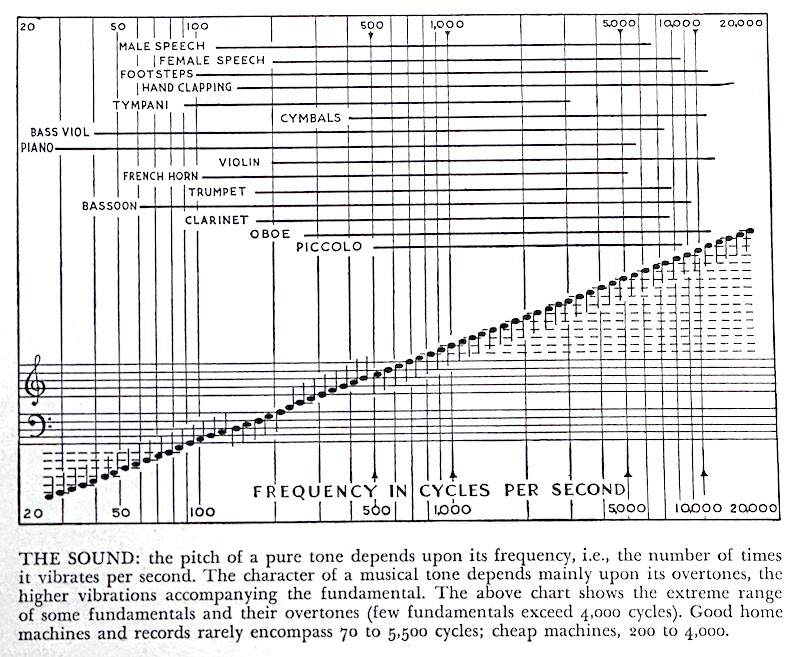
A figure showing the frequency ranges of instruments and voices. The lower caption reads “good home machines and records rarely encompass 70 to 5,500 cycles” and “cheap machines, 200 to 4,000.”
楽器と声の周波数範囲を示す図。下部キャプションに「良質な家庭用機器とレコードでも70〜5,500サイクルが関の山」「安価な機器では200〜4,000サイクル」とある
つまり、よくできた蓄音機ですら70〜5,500 Hz、廉価な機械なら200〜4,000 Hz が関の山でした。一方で記事は、本当の意味での高音質、すなわち上は8,000 Hz 以上、下は40 Hz 程度まで歪みなく伸びるレコードは、家庭には存在しない、と断言します。
In other words, even a well-made phonograph topped out at 70 to 5,500 Hz, and a cheap machine at 200 to 4,000 Hz. The article, meanwhile, flatly states that no record offering true high fidelity, reaching undistorted up past 8,000 Hz and down to around 40 Hz, existed in the home:
“There are now no home records of true high fidelity, that is, with an undistorted range extending up to 8,000 or more and down to say 40 cycles.”
現在、真のハイファイ(すなわち8,000サイクル以上から40サイクル程度まで歪みのない範囲を持つ)家庭用レコードは存在しない。
Fortune, Vol. XX, No. 3 (September 1939), p.102ところが、と記事は続けます。そういうレコードも蓄音機も、現に存在し、毎日鳴っている。ただし家庭ではなく、ラジオ局で。例として挙がるのが、放送局に貸し出される World Broadcasting System のトランスクリプション盤のライブラリです。
And yet, the article goes on, such records and such machines did exist, and were playing every day. Just not in the home, in radio stations. The example it gives is the library of World Broadcasting System transcription discs leased out to broadcasters:
“Some of them are capable of reproducing over a range of 30 to 10,000 cycles—of encompassing every fundamental and overtone casually discernible by ninety-nine out of a hundred human beings.”
その一部は30〜10,000サイクルの範囲を再生する能力を持ち、100人中99人が容易に聞き分けられるすべての基音と倍音を包含する。
Fortune, Vol. XX, No. 3 (September 1939), p.102一般家庭向け(民生用)レコードは、70〜5,500 Hz で、慎重な扱いを要するシェラック盤、多くが鉄の再生針。一方放送局用のトランスクリプション盤は、30〜10,000 Hz、軽量プラスチック盤、ダイヤモンドの再生針。1939年において、世界最高のメディアと再生環境はリビングルームではなく、放送局の機材室にありました。プロと家庭のあいだには、こんなにも帯域差があったのです。そして放送用の盤は、耐久性でも家庭用を圧倒していました。家庭用レコードが100〜150回の再生で摩耗してしまうのに対し、放送用トランスクリプション盤は500〜2,000回の再生に耐える、と記事は書きます。
Consumer records for the ordinary household: 70 to 5,500 Hz, fragile shellac discs that needed careful handling, mostly played with steel needles. Broadcast transcription discs: 30 to 10,000 Hz, lightweight plastic, diamond styli. In 1939 the finest medium and playback setup in the world was not in the living room but in the equipment room of a radio station. The gap in bandwidth between the professional and the home was that wide. And the broadcast discs overwhelmed the home product in durability too. Where a home record wore out after 100 to 150 plays, a broadcast transcription disc, the article says, stood up to 500 to 2,000.
ただし、家庭用の狭い帯域が、人を感動させなかったという意味ではありません。III.2 で見たカルーソーの欠けた基音がそうであったように、音楽の感動は帯域の広さだけで決まるものではないからです。けれど技術史として見るなら、家庭のレコードはまだ狭く、放送局のレコードはすでに広かった。これが当時の状況でした。
This does not mean the home’s narrow band failed to move anyone. As with Caruso’s missing fundamentals in III.2, the power of music to move us is not settled by bandwidth alone. But seen as technical history, the home record was still narrow and the radio station’s record was already wide. That was the situation at the time.
連載 Pt.5 でこの記事に触れたとき、私はこの帯域図を「当時の家庭用再生がいかにハイファイから遠かったか」を示す資料として紹介しました。けれども記事全体を読み直すと、この帯域図はもうひとつの事実を映しています。家庭の限界の話であると同時に、放送業界という別世界がすでに高音質を実用化していた、という話なのです。摩耗に強い盤、軽いピックアップ、広い帯域。標準化の手が最初に伸びる先が、家庭ではなく放送の世界だったこと(NAB録音再生規格策定は1942年)を、この記事は、そのことを知らないまま、その根拠となる事実をすべて書き残しています。
When I touched on this article in Pt.5, I introduced this bandwidth chart as material showing how far home playback of the day was from hi-fi. But rereading the article as a whole, the chart reflects another fact too. It is a story about the limits of the home, and at the same time a story about how a separate world, the broadcast industry, had already put high fidelity into practice. Wear-resistant discs, light pickups, wide bandwidth. That the hand of standardization would reach the broadcast world first, not the home (the NAB recording and reproducing standard was set in 1942), is something this article records in full, in every supporting fact, without knowing it.
III.4 How Surface Noise and the 35-Cent Disc Killed the Highs
次も注目です。記事の終盤、p.102 に、こんな一文がさりげなく置かれています。
The next point is worth attention too. Late in the article, on p.102, this sentence sits almost in passing:
“Surface noise is more vexatious than ever, especially as background for sounds in the higher frequencies, which therefore are often suppressed in phonographs, almost invariably in juke-boxes.”
サーフェスノイズは以前にも増して厄介である。とりわけ高域の音のバックグラウンドとして深刻であり、そのため高域は蓄音機で、そしてジュークボックスではほぼ例外なく、しばしば抑制される。
Fortune, Vol. XX, No. 3 (September 1939), p.102高域は「しばしば抑制されていた(often suppressed)」。理由はサーフェスノイズです。盤の表面の「ザー」というノイズは、高い音の背後でいちばん耳障りになる。だから高域を削ってノイズを目立たなくする。蓄音機ではしばしば、そしてジュークボックスではほとんど例外なく。後年のディエンファシスにつながる発想が、当時は深刻な「サーフェスノイズ対策」として描かれています。
The highs were often suppressed. The reason was surface noise. The hiss on the disc surface is most grating behind high-frequency sound. So you trim the highs to make the noise less noticeable. Often in phonographs, almost without exception in juke-boxes. The idea that would later lead to de-emphasis is described here as a serious “countermeasure against surface noise.”
なぜそんなにノイズが出たのか。記事では、その原因が盤そのものに練り込まれていたと書いています。
Why was there so much noise? The article says the cause was kneaded into the disc itself:
“It is caused partly by abrasives in the materials to wear the steel needle down. The theory has been, with heavy pickups, that either the needle or the record had to wear; and consumers preferred to throw away needles rather than records.”
その原因の一部は、スチール針を削るためにレコード素材に混入された研磨剤にある。重いピックアップとの組み合わせでは、針かレコードかどちらかが摩耗するしかないというのが理論であり、消費者はレコードを捨てるよりも針を捨てることを選んだ。
Fortune, Vol. XX, No. 3 (September 1939), p.102盤には、鉄針をわざと摩耗させるための研磨剤が混ぜてありました(実際には、シェラック樹脂より多く原材料に混ぜられていた粘土状の充填材が、研磨剤の役割を果たしていました)。重い針か、盤か、どちらかが必ず削れる。ならば安い針のほうを犠牲にしよう、という設計思想です。摩耗する針、ざらつく表面、そこから逃れるための高域カット。この3つは必然性をもって関連していたということです。
The disc had abrasive mixed in to wear the steel needle down on purpose. (In practice it was the clay-like filler, blended into the raw material in greater quantity than the shellac resin itself, that did the abrading.) Either the heavy needle or the disc had to give. So sacrifice the cheaper needle: that was the design thinking. A needle that wears, a gritty surface, and a cut to the highs to escape it. These three were connected by necessity.
そこには、技術だけではなく経済も関連していた、と考えることもできます。記事では当時の市場を次のように描いています。
You could also say economics, not just technology, was bound up in this. The article describes the market of the day this way:
“THESE two groups, the juke-boxes and the individual customers for light music, buy 88 or 90 per cent of all records, but account for only 70 per cent of dollar sales. The third group, the big spenders who are responsible for the other 30 per cent of the money, are those who go under (but hardly rejoice in) the infelicitous name of music lovers.”
この二つのグループ、すなわちジュークボックスと軽い音楽の個人客が、レコード全体の88ないし90パーセントを購入しているが、金額ベースでは売上の70パーセントに過ぎない。残り30パーセントの金額を担う第三のグループ、大口消費者は、音楽愛好家という不恰好な呼び名で括られる(が、それを喜ぶ者はまずいない)人々である。
Fortune, Vol. XX, No. 3 (September 1939), p.98枚数の88〜90パーセントは、ジュークボックスと軽い音楽の客が買っていました。そしてジュークボックスに入る盤の圧倒的多数は、35セント盤でした。
Juke-boxes and light-music customers bought 88 to 90 percent of all records by unit. And the overwhelming majority of the discs going into juke-boxes were 35-cent records:
“The overwhelming majority of records in juke-boxes are the thirty-five-cent disks; hence their share of dollar sales is not so large as of unit sales.”
ジュークボックスのレコードの圧倒的大多数は35セント盤であり、したがって金額ベースのシェアは枚数ベースほど大きくない。
Fortune, Vol. XX, No. 3 (September 1939), p.94記事のコスト表(p.94)によれば、35セント盤の利益は1枚あたりわずか $.0075。これに対して、平均 $1.80 のクラシック盤の利益は $.20 です。回転率と摩耗と価格が支配するこの大量市場で、音質はそもそも商品の主要な争点ではありませんでした。ジュークボックスの喧騒の中で、削られた高域を惜しむ客などいません。高域を消したのは、第一にノイズ対策であり、同時に、この経済そのものでした。盤の表面で鳴るノイズと、35セントという価格。この2つが、1939年当時にトーンコントロールによる高域抑制でのレコード再生が一般的だった要因と考えられます。
By the article’s cost table (p.94), the profit on a 35-cent disc was a mere $.0075 each. Against that, a classical disc averaging $1.80 returned $.20. In this mass market, ruled by turnover and wear and price, sound quality was not a leading concern of the product in the first place. Amid the din of a juke-box, no customer mourns a trimmed high end. The highs were killed first as a noise countermeasure, and at the same time by this economics itself. The noise on the disc surface and the 35-cent price: these two are, I think, why playing records with the highs held down by the tone control was so common in 1939.
私は連載の Pt.9 で、シェラック盤のサーフェスノイズと、高域をどう扱うかという問題を論じました。あのとき技術と回路の側から書いたことの、生々しい同時代の裏づけが、この Fortune の数行にあります。後年の人々が、高域を持ち上げて記録し再生で戻すという精密な体系(今日の私たちがプリエンファシス/ディエンファシスと呼ぶもの)を組み上げていくとき、彼らが洗練させていたのは、まさにこの「粗い高域抑制」だったのです。
In Pt.9 of the serial I discussed the surface noise of shellac discs and the question of how to handle the highs. What I wrote then from the side of technology and circuits finds vivid, contemporary corroboration in these few lines of Fortune. When later generations built up the precise system of recording with the highs boosted and restoring them on playback (what we now call pre-emphasis and de-emphasis), what they were refining was exactly this “crude suppression of the highs.”
III.5 Reading a Primary Source by the Words It Never Uses
この Fortune の記事を読み通して私がもっとも驚いたのは、curve(周波数特性カーブ)。characteristic(特性)。turnover(ターンオーバー)。pre-emphasis(プリエンファシス) / de-emphasis(ディエンファシス)。time constant(時定数)。equalization(イコライゼーション)。EQカーブの歴史を語るとき私たちが当たり前に使うこれらの言葉が、この約1万語の記事に技術用語としては一つも登場しないことでした。
What surprised me most in reading this Fortune article through was this. Curve (the frequency-response curve). Characteristic. Turnover. Pre-emphasis and de-emphasis. Time constant. Equalization. These words, which we use without a second thought when we talk about the history of the EQ curve, do not appear even once, as technical terms, in these roughly ten thousand words.
唯一の例外は、皮肉なことに溝の物理的な湾曲を指す箇所でした。ラテラル溝の欠点を説明して、針が左右にふらつく、と書く、その箇所です。
The one exception, ironically, was a place referring to the physical curving of the groove. It comes where the article explains the drawback of the lateral groove, that the needle wanders side to side:
“…the needle does not track down its center as it should, but flounders from side to side as it takes the curves.”
針が本来あるべき溝の中心を正確にトレースせず、カーブを切るときに左右にふらつく。
Fortune, Vol. XX, No. 3 (September 1939), p.102ここでの「curves(カーブ)」は、溝のうねりという物理的なカーブです。周波数特性を意味する「カーブ」は、この記事のどこにもありません。
The “curves” here are the physical curves of the groove’s undulation. A “curve” in the sense of frequency response appears nowhere in this article.
そのかわり、周波数はいつも「帯域幅(frequency range)」として語られます。「30〜12,000サイクルの周波数範囲」「縦振動レコードはわずかに広い周波数範囲を持つ」。帯域の広さ、つまり上と下の端がどこまで届くかは、繰り返し問われます。けれど、その帯域の中で音をどんな形に整えるか、という「帯域の形」の発想は、まだどこにもありません。広いか狭いかは語れても、どんなカーブかは、まだ問いになっていないのです。
Frequency is always spoken of instead as “frequency range.” “A frequency range of 30 to 12,000 cycles.” “Vertical-cut records have a slightly wider frequency range.” How wide the band is, that is, how far the top and bottom edges reach, comes up again and again. But the idea of “the shape of the band,” of what form to give the sound within that band, is still nowhere to be found. Wide or narrow can be discussed; what kind of curve is not yet a question.
これは年代から見れば当然のことではあります。録音特性を時定数で語る語彙が業界に流れ込むのは1947年以降であり、今日おなじみの時定数が公的な標準の中で正式に書き下されるのは、さらに後のことです。1939年にその言葉がないのは、不思議でも何でもありません。
Given the date, this is only natural. The vocabulary for describing recording characteristics in terms of time constants flowed into the industry only from 1947 on, and the time constants familiar today were set down formally in a public standard later still. That the words are absent in 1939 is no mystery at all.
けれど、年代として当然であることと、それを目の前で見ることとは違います。標準化されるべき現象は、この誌面に満ちています。高域は抑制され(III.4)、家庭と放送のあいだに帯域差があり(III.3)、縦振動と横振動で帯域が違う(III.6)。にもかかわらず、それらを統一的に指し示す用語がこの1939年の記事には登場していません。おそらくは、研究開発する専門家以外には、まだ一般的ではなかったのでしょう。その「言葉が一般で使われるようになる直前」の一瞬を、この記事が捉えている、そのように解釈できそうです。
But knowing it is natural for the date is different from seeing it in front of you. The pages are full of phenomena that called out to be standardized. The highs are suppressed (III.4), there is a bandwidth gap between home and broadcast (III.3), and vertical and lateral cuts have different bandwidths (III.6). And yet no term that points to all of these together appears in this 1939 article. Most likely it was not yet common outside the specialists doing the research and development. The article, I think we can say, catches the instant just before those words came into general use.
ここにディエンファシスの芽がある、ここにターンオーバーの前史がある。1939年以後の技術史を知っている私たちは、そのように記事から読み解こうとしがちです。しかし、記事そのものにはそんなことが直接的に書かれているわけではありません。1939年の誌面に「カーブ」は登場していない。けれど、カーブとして標準化されるべき音響上・経済上・機械上の状況証拠は、すでにそこに書かれている。放送局向けには3年後に、民生用レコードでは15年後に、標準規格が策定された。この先は「現代から過去をどう解釈するか」の領域です。
Here is the bud of de-emphasis; here is the prehistory of turnover. Those of us who know the technical history after 1939 are prone to read the article that way. But the article itself does not say any of that directly. The word “curve” does not appear on the 1939 page. What is already written there is the acoustic, economic, and mechanical circumstantial evidence for what would be standardized as a curve. The standard was set three years later for broadcast and fifteen years later for consumer records. Beyond this point lies the territory of how we interpret the past from the present.
私たちはえてして歴史を一方向の必然的な流れとして受け止めがちですが、実際は「結果に対する後付けの理屈」や「こうであって欲しい」という思いで歴史を上書きしてしまう恐れもある。そのことを肝に銘じながら読み進めています。
We tend to take history as a one-way, inevitable current, but in truth there is a risk of overwriting it with reasoning fitted to the outcome after the fact, or with how we wish it had gone. I read on with that firmly in mind.
私の連載でいえば、ここは Pt.5 で扱った Orthacoustic 録音特性(1939年12月)の直前、そして Pt.8 で扱う業界団体による1942年の標準化よりも前の、ちょうど空白の入口にあたります。標準化が「これから起こる」側から見るとき、その前夜の言葉のなさが、逆に「雄弁な無言」とでも言いたくなるほどの説得力を持って見えてきます。
In terms of my serial, this falls right at the mouth of the blank: just before the Orthacoustic recording characteristic (December 1939) covered in Pt.5, and before the 1942 standardization by the trade body covered in Pt.8. Seen from the side where standardization is about to happen, the absence of words on the eve of it takes on a force you almost want to call an eloquent silence.
III.6 The Technology Always Came From Outside
興味深いことに、この記事では、「レコード会社は、自分を救う技術を、いつも社外から、しぶしぶ受け取った」という主張が見え隠れしています。記事では、十数年を隔てた二つの場面で描いています。
Interestingly, one claim flickers in and out of this article: that the record companies always received the technology that saved them from outside, and reluctantly. The article shows it in two scenes more than a decade apart.
一つめは1920年代。ラジオに押されて壊滅しかけたレコード産業を救ったのは、業界の内側から出た技術ではありませんでした。記事では、はっきりこう書いています。
The first is the 1920s. What saved the record industry, nearly wiped out under pressure from radio, was not technology that came from inside the trade. The article says it plainly:
“The armament had to come from outside, and it was unwelcome at first.”
武器は外から来なければならなかったし、最初は歓迎されなかった。
Fortune, Vol. XX, No. 3 (September 1939), p.74その「外」とは、Western Electric、すなわち電話会社の研究部門(のちの Bell Telephone Laboratories)でした。J. P. Maxfield らのもとで、音を電気信号に変えて増幅し刻針を駆動する電気録音が生まれ、刻める帯域は一気に広がります。ところが、その技術を持ち込まれたレコード会社の反応は、当初は冷たいものでした。
That “outside” was Western Electric, the research arm of the telephone company (later Bell Telephone Laboratories). Under J. P. Maxfield and others, electrical recording was born, converting sound into an electrical signal, amplifying it, and driving the cutting stylus, and the recordable bandwidth widened all at once. Yet the record companies, handed this technology, responded coldly at first:
“When Western Electric took all this to the phonograph people, though, it got a cool reception. Victor officials, for instance, wrinkled their noses and pronounced the new records abhorrent to anyone accustomed to the ‘true or miniature’ reproduction of the old Victrola.”
しかし Western Electric がこのすべてを蓄音機業界に持ち込んだとき、反応は冷ややかだった。Victor の幹部たちは例えば、鼻にしわを寄せ、新しいレコードは旧来の Victrola の「真の、あるいはミニチュア的な」再生に慣れた者には忌まわしいものだと宣告した。
Fortune, Vol. XX, No. 3 (September 1939), p.75採用に踏み切れたのは、売上が崩れ、ほかに道がなくなってからでした。そしてこの場面に、有名な一言が置かれています。Western Electric との交渉にあたった Victor の E. E. Shumaker(のちの社長)の述懐です。
They could only commit to adopting it once sales had collapsed and there was no other road left. And here the article places a famous remark, the recollection of Victor’s E. E. Shumaker (later president), who handled the negotiations with Western Electric:
“Thank God,” said E. E. Shumaker (later Victor’s President), who negotiated with Western Electric, “that these electric records were developed by the telephone company and not by a competitor.”
E. E. Shumaker(後に Victor の社長)は Western Electric と交渉した人物だが、こう言った。「ありがたいことに、この電気録音レコードは電話会社が開発してくれたのであって、競合他社ではなかった。」
Fortune, Vol. XX, No. 3 (September 1939), p.92技術が同業他社からではなく、電話会社の技術開発部門から来たことに胸をなでおろす。もしかしたら、自分たちが作れなかったことの悔しさを、遠回しに表現しているのかもしれませんね。
Relief that the technology came from a telephone company’s development arm and not from a competitor in the same trade. Perhaps, in a roundabout way, he was also voicing the chagrin of not having been able to build it themselves.
二つめの場面は、記事が書かれている1939年そのものです。今度の争点は、横振動(ラテラル)と縦振動(ヒル・アンド・デール)のどちらが優れているか、です。記事では、現時点では縦振動のほうがわずかに広い帯域を持つ、と書いています。同じ条件で録音した両者を良い蓄音機で聴き比べれば、その差は印象的だ、とまで述べています。
The second scene is 1939 itself, the year the article was written. This time the point at issue is which is better, lateral or vertical (hill-and-dale). The article says that, for the moment, vertical cutting has a slightly wider bandwidth. It goes so far as to say that if you compare the two recorded under the same conditions on a good phonograph, the difference is striking.
ではなぜ家庭では横振動ばかりなのか。p.75 の溝の比較図のキャプションが、その答えを身もふたもなく言います。
So why is the home all lateral? The caption to the groove-comparison figure on p.75 gives the answer with no varnish on it:
“Chief disadvantage of the vertical: home pickups now in use play only lateral records.”
縦振動の主な欠点:現在使用されている家庭用ピックアップはラテラルのレコードしか再生できない。
Fortune, Vol. XX, No. 3 (September 1939), p.75 (figure caption)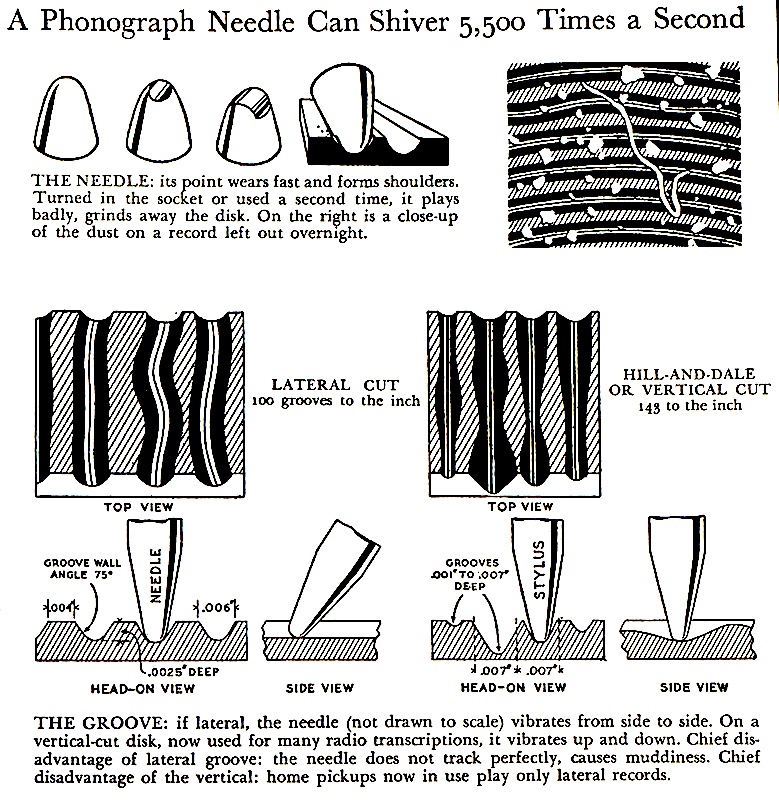
A cross-section comparison of lateral and vertical grooves. The needle is drawn reaching the bottom of the groove. The figure reflects the common sense of the time, before the side-wall support method proposed by Hunt and Pierce spread.
横振動(lateral)と縦振動(vertical)の溝断面比較図。針が溝の底に達するように描かれている。Hunt と Pierce が提案した側壁支持方式が広まる以前の、当時の常識を映した図
縦振動盤のほうが帯域が広いのに、横振動しか再生できない蓄音機がすでに普及しているから、横振動盤が優位である。これは技術の優劣の話ではありません。実際にユーザの手にある大量の再生機(installed base)によって、選択肢が縛られているのです。横振動はその技術的優位性により「選ばれた」のではなく、残るべくして「残った」のです。
The vertical-cut disc has the wider bandwidth, yet the lateral disc holds the advantage, because phonographs that can only play lateral are already widespread. This is not a story about which technology is superior. The choice is bound by the huge installed base of players actually in users’ hands. Lateral was not “chosen” on its technical merit; it “stayed” because it was bound to.
その横振動の弱点を理論的に解こうとしていた人々も、記事はちゃんと書きとめています。Pt.6 でも紹介した、Harvard の F. V. Hunt 教授と J. A. Pierce です。
The article also duly notes the people trying to solve lateral’s weakness in theory: Harvard’s Professor F. V. Hunt and J. A. Pierce, whom I introduced in Pt.6:
“Professor F. V. Hunt and Mr. J. A. Pierce, working in the Cruft Laboratory at Harvard, have devised a theoretical solution involving a ball stylus that does not track in the bottom of the groove but rides the sides, maintaining a positive contact all the time. Since this imposes special requirements on the reproducer, commercial exploitation has met with difficulties, and the record companies have not demonstrated any particular enthusiasm for it.”
Harvard の Cruft Laboratory で研究する F. V. Hunt 教授と J. A. Pierce 氏は、溝の底を走るのではなく両側面に乗り、常に確実な接触を維持する丸針(ball stylus)による理論的解決策を考案した。これは再生装置に特殊な要件を課すため、商業化には困難が伴っており、レコード会社もこれに対して特段の熱意を示していない。
Fortune, Vol. XX, No. 3 (September 1939), p.102ここで先ほどの溝の図版に戻ります。図の針は、溝の「底」に達するように描かれています。Hunt と Pierce が提案したのは、針を底ではなく両側の壁に乗せる方式でした。つまりあの図版は、側壁支持という発想が広まる「直前」の、針が溝底をなぞっていた時代の、視覚的な手がかりなのです。そしてその新しい発想に対して、レコード会社は「特段の熱意を示していない」。ここでも、救いの技術は外(大学の研究室)から来て、業界はまた冷淡に応じています。
Back to that groove figure for a moment. The needle in it is drawn reaching the “bottom” of the groove. What Hunt and Pierce proposed was to ride the needle on the two side walls instead of the bottom. So that figure is a visual clue from the era when the needle traced the groove bottom, “just before” the idea of side-wall support spread. And to that new idea the record companies “showed no particular enthusiasm.” Here again the saving technology comes from outside, a university laboratory, and the trade responds coldly once more.
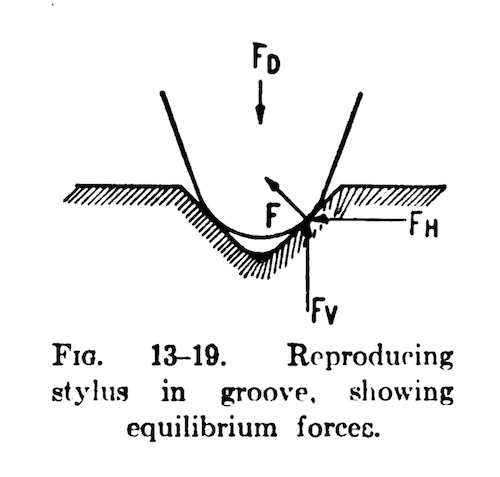
The side-wall support method theorized by Hunt and Pierce. The stylus makes pinpoint contact not with the groove bottom but with the two 45-degree walls.
Hunt と Pierce が理論化した側壁支持方式。針は溝の底ではなく、45度の両壁にピンポイントで接触する
私が連載 Pt.6 で論じた、横振動の勝利をめぐる長い因果(Pt.6 6.2/6.3)と、この1939年の記事の記述を照らし合わせると、興味深い対応が見えてきます。ただし、Hunt と Pierce の丸針と側壁支持がその後どのように低歪再生を理論的に確立したか、という技術史と、この記事が描いている同時代の風景(縦振動がわずかに優位だが、横振動専用の再生機がすでに家庭に普及している)とは、区別して考える必要があります。1939年の記事はその先の展開を知りません。
Set the long chain of cause and effect behind lateral’s victory that I discussed in Pt.6 (Pt.6 §6.2/§6.3) against the descriptions in this 1939 article, and an interesting correspondence emerges. But we need to keep two things separate: the technical history of how Hunt and Pierce’s ball stylus and side-wall support went on to establish low-distortion playback in theory, and the contemporary scene this article paints (vertical slightly ahead, but lateral-only players already widespread in the home). The 1939 article does not know what comes next.
そして、「業界が新技術をなかなか受け入れない」という遅さこそが、Pt.0〜25 で学んだ歴史的経緯そのものです。標準化とは、正しい技術が自動的にデファクトスタンダードを獲得する過程ではありません。その時代にすでにある機械と技術、盤、会社、価格、耳と嗜好。それらをもとに、時には粘り強い議論が行われ、時には妥協があり、時には自然淘汰が起こる、そんな過程です。1939年の Fortune の誌面は、その過程の出発点あるいは前夜を捉えた静止画といえるでしょう。
And that slowness, the trade’s reluctance to take up new technology, is exactly the historical course I learned across Pt.0 through Pt.25. Standardization is not a process in which the correct technology automatically wins the role of de facto standard. It works from the machines and technologies, the discs, the companies, the prices, the ears and tastes already present in an era. On that basis there is sometimes dogged argument, sometimes compromise, sometimes natural selection. The pages of Fortune in 1939 are a still photograph of the starting point, or the eve, of that process.
この記事では1939年当時の状況が描かれましたが、その後、1942年の放送局用トランスクリプション盤における最初の規格策定(Pt.8)とその後の改訂、戦後の技術革新と民生用レコードでの独自規格乱立(Pt.14, Pt.17)を経て、やっと1954年に米国のレコード業界全体の統一規格が策定されました(Pt.18)。15年をかけたその道のりもまた、長い議論と妥協と自然淘汰の産物であったことを、この1939年の記事は改めて実感させてくれます。
This article portrays the situation as of 1939. After that came the first standard for broadcast transcription discs in 1942 (Pt.8) and its later revisions, postwar technical innovation, and a proliferation of proprietary standards on consumer records (Pt.14, Pt.17), before a unified standard for the whole U.S. record industry was finally set in 1954 (Pt.18). That this fifteen-year road was, again, the product of long argument, compromise, and natural selection is something the 1939 article brings home anew.
III.7 Fortune’s Prophecy, and Where It Went
記事の末尾では、初めて具体的な提案をしています。縦振動の盤を、横振動と同時に少しのコストで作り置きしておき、数年後、新旧両方を再生できる新型蓄音機の発表とともに世に出せばいい、そうすれば、家庭用蓄音機の世界でも「(当時の)真のハイファイ(歪のない 40〜8,000 Hz の帯域)」が導入できる、という、予言めいた提案です。そしてこう締めくくります。
At the very end, the article makes a concrete proposal for the first time. Produce vertical-cut discs alongside lateral ones at little extra cost and stockpile them; then, a few years later, release them together with a new phonograph able to play both old and new, and the world of the home phonograph too could have “true high fidelity” (for its day), an undistorted 40 to 8,000 Hz band. It is a proposal that now reads almost like a prophecy. And it closes like this:
“This course, exploited for all it is worth, might be just the shot in the arm the record industry will be needing.”
この方針を最大限に活用すれば、レコード産業がやがて必要とするであろうカンフル剤になりうる。
Fortune, Vol. XX, No. 3 (September 1939), p.102「カンフル剤(shot in the arm)」。これは、私が Pt.5 でこの記事から引いた、まさにその一節です。当時の私は、これを「縦振動の盤を民生化すべきだという同時代の声」の例として読みました。けれど記事全体を読み終えた今、そして Pt.0〜25 を書き終えている現在、記事中のこの提案が書かれてからの約9年で、何が起きたか、私たちは知っています。
“A shot in the arm.” This is the very passage I quoted from this article in Pt.5. Back then I read it as an example of the contemporary call to bring vertical-cut discs to the consumer market. But now that I have read the whole article, and now that I have finished writing Pt.0 through Pt.25, we know what happened in the roughly nine years after this proposal was written.
縦振動の盤は、ついに民生用として復活しませんでした。記事が思い描いた「縦横両用の新型蓄音機」も現れませんでした(アコースティック録音時代には Brunswick Model 105 のような縦横両用蓄音機がありましたが、一般的になりませんでした)。その意味で、予言は外れています。しかも、この記事が書かれたわずか数ヶ月後の1939年12月、横振動の側で RCA/NBC Orthacoustic 録音特性が登場し、それが1942年の NAB 標準規格へとつながっていきます(Pt.5 5.2)。記事が縦振動に賭けていたまさにその時、標準化の道は横振動の側で開かれようとしていたのです。
The vertical-cut disc never did come back for consumer use. The “new dual lateral-vertical phonograph” the article imagined never appeared either. (In the acoustic recording era there had been dual-format machines like the Brunswick Model 105, but they never caught on.) In that sense the prophecy was wrong. What is more, only a few months after this article was written, in December 1939, the RCA/NBC Orthacoustic recording characteristic appeared on the lateral side, and it led on to the 1942 NAB standard (Pt.5 §5.2). At the very moment the article was betting on vertical, the road to standardization was opening on the lateral side.
ところが、記事が縦振動の盤に託していた中身、すなわち軽量プラスチックの盤、軽いピックアップ(当初はスチールアロイ針やサファイア針、のちにダイヤモンド針)、放送局なみの広帯域は、別の形で民生機の世界で実現します。1948年の Columbia の LP です(Pt.11–12)。縦振動という「方向」ではなく、放送用技術の民生化という「構造」のほうで、記事の見立ては当たりました。さらに、III.6 で記事が冷淡な扱いを嘆いた Hunt と Pierce の軽量ピックアップの系譜は、戦後のレコード再生のほとんどすべての土台になっていきます(Pt.6 6.3)。記事が「家庭にはまだないが、放送局にはすでにあり、毎日使われている」と書いた高音質技術は、まさにその通りの道筋でリビングルームへ降りてきたのです。
And yet what the article had entrusted to the vertical-cut disc, the lightweight plastic disc, the light pickup (steel-alloy and sapphire styli at first, diamond later), and broadcast-grade wide bandwidth, was realized in the consumer world in another form: Columbia’s LP of 1948 (Pt.11–12). The article’s intuition proved right, not in the “direction” of vertical cutting but in the “structure” of bringing broadcast technology to the consumer. And the line of light pickups descending from Hunt and Pierce, whose cold reception the article laments in III.6, would become the foundation of nearly all postwar record playback (Pt.6 §6.3). The high-fidelity technology the article described as “not yet in the home, but already in the radio station and used every day” came down into the living room by exactly that route.
予言は、方向を外して的中しました。縦振動ではなかった。けれど「いま放送局だけにある高音質が、いつか家庭に降りてくる」という構造の予感は、正確でした。
The prediction missed on direction but hit the mark. It was not vertical. But the structural intuition, that the high fidelity then found only in the radio station would one day come down to the home, was accurate.
そして見落としてはならないのは、その9年のあいだに生まれたものの大きさです。放送用録音盤の標準化、特に戦後から加速する録音再生技術の革新、そして RIAA カーブへの収斂。これらEQカーブの歴史の主役たちは、この Fortune の誌面には影も形もありません。1939年のこの記事は、自らが捉えている全景のすぐ外側で何が始まろうとしているかを知りません。知らないまま、その理由をすべて誌面の中に収めている、そんな印象を受けます。
And what must not be overlooked is the scale of what was born in those nine years. The standardization of broadcast recording discs, the innovation in recording and playback technology that accelerated especially after the war, and the convergence on the RIAA curve. These protagonists in the history of the EQ curve are nowhere to be seen on these pages of Fortune. This 1939 article does not know what is about to begin just outside the panorama it has captured. My impression is that, without knowing it, it holds all the reasons for it within its own pages.
III.8 What a Primary Source Shows Depends on When You Read It
III.2 で触れた「脳内で補う」話に関して、もう一箇所の比喩表現を紹介すると予告しました。カルーソーの録音を描いたくだりで、記事にはこう書かれていました。
On the theme of “filling in within the brain” that I raised in III.2, I promised one more metaphor. In the passage describing Caruso’s recording, the article had written this:
“What issued from a phonograph playing the final record was the truncated ghost of the performance, the gelded echo of an echo.”
最終的なレコードを蓄音機で再生して出てくるものは、演奏を切り詰めた幽霊、去勢された、こだまのこだまだった。
Fortune, Vol. XX, No. 3 (September 1939), p.73切り詰められた幽霊。去勢された、こだまのこだま。レコードに刻まれた音が、いかに本物から削ぎ落とされていたかを、これ以上ないほど残酷な比喩で言い切っています。
The truncated ghost. The gelded echo of an echo. It states, in about as cruel a metaphor as there could be, how much the sound cut into a record had been stripped away from the real thing.
しかし、III.2 で見たとおり、その幽霊のような盤の中で、カルーソーの声は確かに生きていました。耳が欠けた基音を補い、人は鳴っていない音を聴いていた。切り詰められた幽霊と、その中に宿った生きた声。この矛盾こそ、録音という営みがずっと抱えてきたものです。溝に刻めるものには限りがあり、その限界を、ある時代は聴き手の脳が補ってきました。録音技術における周波数帯域拡張の歴史とは、つきつめれば「切り詰められた幽霊に、どうやって失われた音を返すか」をめぐる、長い工夫の歴史だったといえます。その歴史の延長線上、あるいは平行の歴史として、EQカーブの歴史が位置付けられます。
But as we saw in III.2, inside that ghostly disc Caruso’s voice was indeed alive. The ear supplied the missing fundamentals, and people heard a sound that was not there. A truncated ghost, and the living voice dwelling inside it. This contradiction is what the work of recording has carried all along. There is a limit to what the groove can hold, and in one era the listener’s brain made up for that limit. The history of extending the frequency band in recording technology was, at bottom, a long history of ingenuity around one question: how to give the lost sound back to a truncated ghost. The history of the EQ curve sits on the extension of that history, or runs parallel to it.
本稿を書きながら、私は自分の読みの変化に何度も気づかされました。2022年、Pt.5 を書いていたとき、この Fortune の記事は私にとって「縦振動の盤の品質を裏づける傍証」でしかありませんでした。末尾の数行を引いて、それ以上精読することなく Fortune 誌は埋もれてしまっていました。ところが2026年、2年間の調査を経た目で全文を読み直すと、同じ記事なのに、Pt.0 から Pt.25 までで私が追いかけてきた主題の、ほとんどすべての前史が読み取れるのです。高域抑制(III.4)、語彙の不在(III.5)、外から来る技術への抵抗と普及済み機器による経路依存(III.6)。記事は2年前と一字も変わっていません。変わったのは、読む私のほうでした。
Writing this essay, I was made aware of the change in my own reading again and again. In 2022, when I was writing Pt.5, this Fortune article was no more to me than corroboration for the quality of the vertical-cut disc. I quoted a few lines from the end, and without reading any further the issue of Fortune got buried. But in 2026, rereading the whole thing with eyes that have been through two years of research, the same article yields the prehistory of nearly every theme I chased from Pt.0 through Pt.25. The suppression of the highs (III.4), the absence of the vocabulary (III.5), resistance to technology from outside and the path dependence imposed by the installed base (III.6). The article has not changed by a single character from two years ago. What changed was me, the reader.
一次史料は、いつ読むかで見えるものが変わります。調査の蓄積が、同じ文字列から引き出せるものを変える。これは反省であると同時に、一次史料に向き合うことの、いちばんの面白さでもあります。
What a primary source shows depends on when you read it. The accumulation of research changes what you can draw out of the same string of characters. This calls for self-reflection, and at the same time it is the greatest pleasure of facing a primary source.
この Liner Notes シリーズで、毎回ちがう角度からレコードの歴史を深掘りしてきました。Liner Notes I が、一枚の技術ノートと、それを巡る人との出会いから歴史に迫った回で、Liner Notes II が、録音再生EQカーブに客観的な計測手法を持ち込む試みの回でしたが、この Liner Notes III は、一冊の古い雑誌を読み直すことで、「カーブ」という言葉が生まれる以前の歴史に迫った回です。キザな言い方をすると、盤に針を落とすように、私は誌面に目を落としました。そこから聴こえてきたのは、まだ名前を持たない、ざわめきのようなものでした。
Across this Liner Notes series I have dug into the history of records from a different angle each time. Liner Notes I approached history through a single technical note and a meeting with the person behind it; Liner Notes II was an attempt to bring objective measurement methods to the recording and playback EQ curve; and this Liner Notes III approaches the history before the word “curve” was born by rereading one old magazine. To put it in a slightly affected way: as you drop a needle onto a disc, I dropped my eyes onto the page. What rose up from it was something like a murmur, still without a name.
本稿で引用した Fortune 誌の英文は、筆者が所有する実誌をスマートフォンで撮影した画像をもとに文字起こししたものです。Claude(Anthropic の大規模言語モデル)の二つのバージョンに独立して作業させ、両者の出力が食い違った箇所だけを原本と照合して確定しました。AI の扱いについては Liner Notes I の方針を踏襲しています。
The English text from Fortune quoted in this essay was transcribed from photographs I took with a smartphone of the physical issue I own. I had two versions of Claude (Anthropic’s large language model) work on it independently, and checked against the original only where their outputs disagreed. On the handling of AI, I follow the policy set out in Liner Notes I.
» Phono EQ Curves Liner Notes IV へ続く »
» Phono EQ Curves Liner Notes IV, to be continued »