レコードの敵は素材ごとに違った — 1959年の議会図書館レポートを読む
数年前、フォノEQカーブや録音再生機材、レコード製造工程などを調査しているときに見つけ、念のため手元に保管していたPDFがあります。先日、ふとこれを精読してみようと思い立ち、読んでみると、レコード保存における劣化要因について詳細に調査研究されたレポートで、われわれコレクターにとっても非常に参考になるものでした。
A few years ago, while researching phono EQ curves, recording and playback equipment, and record manufacturing processes, I came across a PDF and saved a copy just in case. Recently I decided to sit down and read it properly. It turned out to be a detailed study of the factors behind storage deterioration of sound recordings, and very much worth the time for anyone who collects records.
以下、1950年代末に編纂された、74ページにも及ぶこの濃厚なレポートで述べられている注目点を概説してみようと思います。
Below is an overview of the main points from this dense, 74-page report compiled in the late 1950s.
The 1959 Report
1959年、米議会図書館がレコードの保存寿命を本気で調べた報告書があります。”Preservation and Storage of Sound Recordings” というタイトルで、ロックフェラー財団の助成を受け、テキサスの Southwest Research Institute に委託されたものです。RCA、Columbia、Deccaといった主要メーカーも製造情報を提供しています。高温などで劣化を早める試験や化学分析で、素材ごとに何が原因で傷むのかを調べた報告書です。なお再生による摩耗は対象外で、あくまで保管環境での劣化に焦点を当てた研究です。
In 1959, the Library of Congress published a report that took a serious look at how long records actually last. Titled “Preservation and Storage of Sound Recordings,” the study was funded by a Rockefeller Foundation grant and carried out at the Southwest Research Institute in Texas. RCA, Columbia, and Decca all contributed manufacturing information. Through accelerated aging tests and chemical analysis, the report examined what causes deterioration in each type of recording material. Playback wear was specifically excluded; the focus was entirely on storage degradation.
この報告書には、現在閲覧可能な版が2つあります。1958年4月付の Progress Report No. 5 (M. M. Lemcoe 単著、Southwest Research Institute から議会図書館への中間報告)と、1959年に議会図書館から正式に刊行された最終報告書(A. G. Pickett and M. M. Lemcoe 共著) です。今回読んだのは後者、1959年の最終報告書です。
Two versions of this report are available today: a Progress Report No. 5, dated April 1958 (authored by M. M. Lemcoe alone, an interim report from Southwest Research Institute to the Library of Congress), and the final report published by the Library of Congress in 1959 (co-authored by A. G. Pickett and M. M. Lemcoe). What I read for this article is the latter, the 1959 final report.
素材ごとに劣化の「敵」が全然違うのが印象的でした。
What struck me was how different the “enemies” are for each material.
シェラック盤 / Shellac Discs
議会図書館の棚にあった古いシェラック盤12枚を化学分析したところ、3枚はシェラックを全く含んでいませんでした。第二次大戦中の天然シェラック供給の不安定化と、その後の合成代替樹脂の普及で、名前だけ「シェラック盤」のまま中身が別物になっていた盤が実際に存在していたわけです。
When twelve old shellac discs from the Library of Congress shelves were chemically analyzed, three turned out to contain no shellac at all. Wartime disruption of natural shellac supplies and the subsequent spread of synthetic substitute resins meant that discs called “shellac” could in fact be made of something else entirely.
そもそもいわゆるシェラック盤は、大半が鉱物の粉(石灰岩や粘板岩)でできていて、シェラックやその代替樹脂はそれらを固める接着剤のような役割でした。重量でいえば鉱物が約70%、シェラック類は30%未満です。シェラックは時間とともに分子同士がつながって硬く、もろくなります。ただしこの反応は進むほど遅くなるので、急速に崩壊するわけではありません。一方で水分やカビには弱く、混ぜ物の多い配合では深刻な劣化が報告されています。
A so-called shellac disc is mostly mineral powder (limestone and slate), with shellac or its substitute acting as a binder. By weight, mineral filler accounts for roughly 70%, shellac-type resins for less than 30%. Over time, shellac molecules cross-link, making the material harder and more brittle, though this reaction is self-decelerating and does not lead to rapid collapse. Moisture and mold are the real vulnerabilities; discs with heavily adulterated compounds showed significant deterioration.
ヴァイナル盤 / Vinyl Discs
ヴァイナル盤(塩化ビニルと酢酸ビニルを組み合わせた素材)の化学的寿命について、報告書は「通常の図書館環境で化学的劣化による破壊は1世紀以内には生じないはず」と推定しています。約21℃(70°F)での保管ならその倍に延びるとのこと。湿度はヴァイナル自体にはほぼ影響しません(カビを抑えるためだけに管理が必要)。
For vinyl discs (a copolymer of polyvinyl chloride and polyvinyl acetate), the report estimates that chemical degradation should not destroy a disc within a century under normal library conditions, and that storage at around 70°F (21°C) could double that figure. Humidity has almost no effect on the vinyl itself; it matters only for mold prevention.
ところが報告書が最も警戒しているのは化学劣化ではなく物理的変形、つまり「反り」です。反りには3種類あります。重みで少しずつたわむもの(垂直保管と低温で対策可能)、暑くなったり冷えたりの繰り返しで進むもの(わずか5回の温度サイクルで水平保管の盤が破壊された例があります)、そしてプレス時に盤の内部に残ったひずみが後からほどけて起きるものです。
Yet the report’s primary concern is not chemical degradation but physical deformation: warping. Three types are identified. Gradual sag under the disc’s own weight (mitigated by vertical storage and low temperature). Cumulative distortion from repeated temperature cycling (in one test, as few as five cycles destroyed a horizontally stored disc). And latent strain from the pressing process that releases over time.
この3番目が厄介で、報告書は「この反りを防ぐ唯一の方法は成形工程を改善することであり、抑制する唯一の方法は保管温度を下げることである」と書いています。しかも加熱して押し固める時間、温度、圧力といった製造条件の微妙な差が内部のひずみや寿命に影響するにもかかわらず、具体値は企業秘密として開示されていません。報告書は「レコードの寿命は製造時に組み込まれるものである」とも述べており、保存寿命が、買い手には見えない製造条件に左右される部分があるということです。
The third type is the most troublesome. The report states that the only way to prevent this warping is to improve the molding process itself, and the only way to slow it is to lower the storage temperature. Pressing time, temperature, and pressure all affect internal strain and therefore shelf life, yet these values were proprietary and not disclosed. As the report puts it, the life span of a record is a property built into it at the time of manufacture. Part of a disc’s longevity depends on manufacturing conditions invisible to the buyer.
私はLP盤(ヴァイナル)も78回転盤(シェラック)も基本的にすべて縦向きに保管していますが、聴くために出した盤をつい部屋で横向きのまましばらく放置してしまうことがあります。今回のレポートで、高温環境での横向き長期保管が反りを助長することを改めて突きつけられ、縦向き保管をもっと徹底しなければと思いました(笑)
I store all my LPs (vinyl) and 78s (shellac) vertically as a rule, but I do sometimes leave a disc lying flat after pulling it out to listen, and it can end up staying that way longer than I care to admit. This report was a pointed reminder that horizontal storage in warm conditions promotes warping. Time to be more disciplined about putting them back upright.
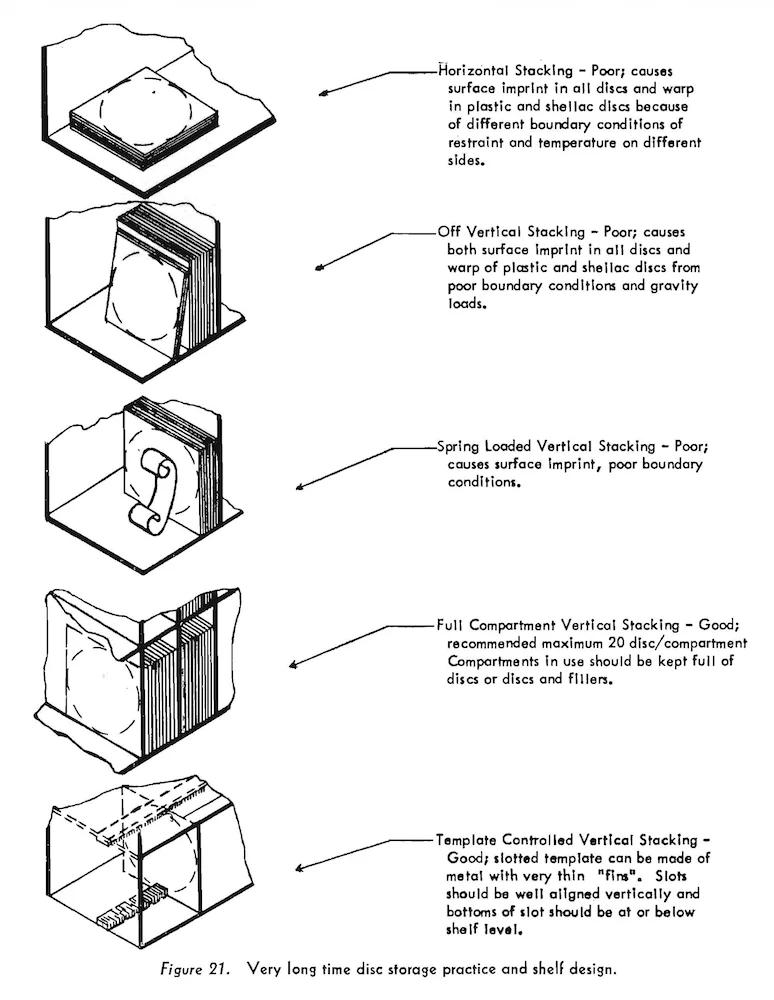
報告書の Figure 21 には、長期保管における望ましくない方法と望ましい方法が、5つのイラストで示されています。水平積み重ね (Horizontal Stacking)、斜め立て (Off Vertical Stacking)、バネ式ブックエンドによる垂直保管 (Spring Loaded Vertical Stacking) の3つは「Poor」と判定されています。水平積みは全盤に表面転写を起こし、ヴァイナルやシェラック盤では反りも引き起こします。斜め立ては重力荷重による反りが加わります。バネ式は境界条件が悪く、やはり表面転写が起きます。
Figure 21 in the report illustrates five storage methods for long-term preservation. Three are rated “Poor”: Horizontal Stacking (causes surface imprint on all discs, plus warping of vinyl and shellac discs), Off Vertical Stacking (combines surface imprint with warp from gravity loads), and Spring Loaded Vertical Stacking (causes surface imprint due to poor boundary conditions).
一方、望ましいとされるのは、仕切り付き垂直保管 (Full Compartment Vertical Stacking) と、スロット式テンプレートによる垂直保管 (Template Controlled Vertical Stacking) の2つです。前者は1区画あたり最大20枚が推奨で、隙間がある場合はフィラーで埋めて盤が傾かないようにすること。後者は薄い金属フィンで1枚ずつ溝に立てる方式で、溝の位置を垂直に揃え、溝の底を棚面と同じか、それ以下にすることが推奨されています。
Two methods are rated “Good”: Full Compartment Vertical Stacking (recommended maximum of 20 discs per compartment; compartments in use should be kept full of discs or fillers to prevent leaning) and Template Controlled Vertical Stacking (a slotted template made of metal with very thin fins, with slots well aligned vertically and slot bottoms at or below shelf level).
反りとは別に、報告書がもう一つ警告しているのが、保管材料による盤面への転写です。盤を水平に積み重ねると、一見すると荷重は均一にかかるように思えます。しかし実際には、内袋にシワがあったり、盤の間にホコリがあると、荷重はそのシワやホコリの線接触・点接触に集中します。その圧力が音溝間の平面部 (land) に食い込み、再生音質を損ねることが報告されています。
Apart from warping, the report raises another warning: surface imprinting from storage materials. When discs are stacked horizontally, the load may appear uniform, but in practice any wrinkles in the sleeve or dust grains between discs concentrate the weight into line or point contacts. That pressure digs into the lands between grooves and impairs playback quality.
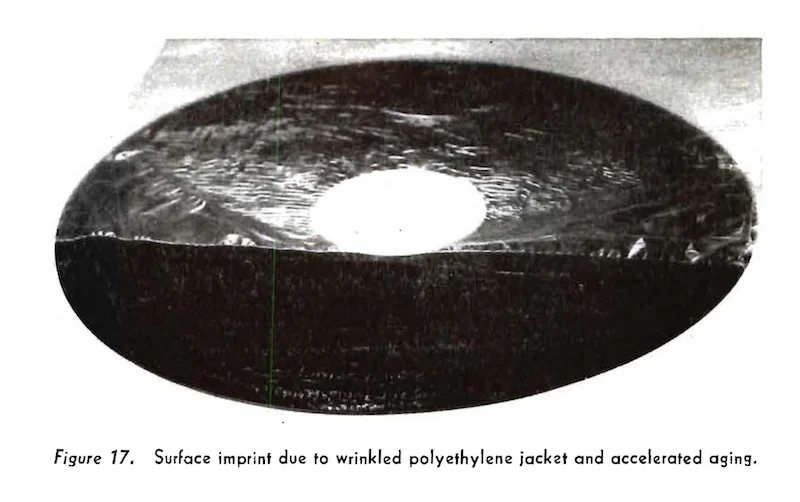
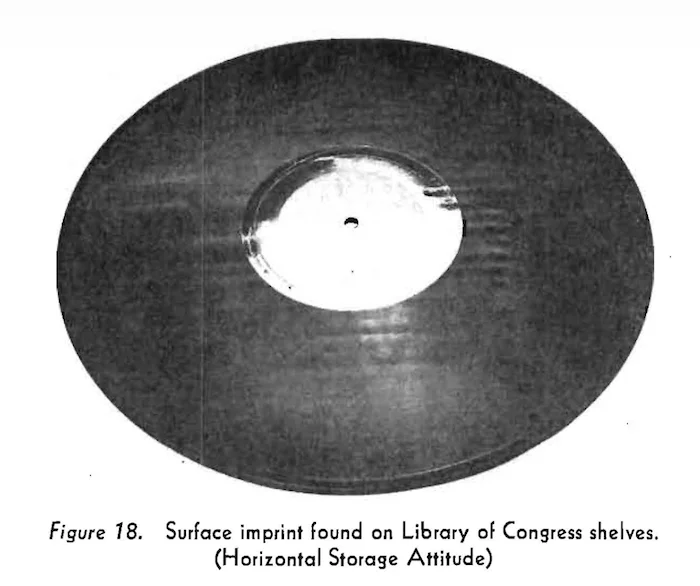
報告書の Figure 17 は、ポリエチレン製内袋のシワが盤面に転写された実験結果の写真です。盤を3枚重ねて 110°F(43°C)で 100 時間放置しただけで、内袋のシワの跡がくっきりと盤面に刻まれています。Figure 18 は、議会図書館の棚に保管されていた実際の盤で、厚紙セパレーターの波形模様が盤面に転写された事例です。
Figure 17 in the report is a photograph of polyethylene jacket wrinkles imprinted onto a disc surface. Stacking just three discs at 110°F (43°C) for 100 hours was enough to leave a clear impress of the wrinkles on the playing surface. Figure 18 shows a real-world case from the Library of Congress shelves, where corrugations from a cardboard separator had transferred onto the disc surface.
古いレコードのコレクターであれば、いわゆる「ビニ焼け」に悩まされた経験があるのではないでしょうか。1970年代には「レコード保護用」として販売されたポリエチレン製のジェネリックスリーヴが広く普及しましたが、長期保管の結果、盤面に曇ったような跡が残ったという報告が多数あります。1959年のこの報告書は、まさにその現象を実験室で再現し、警告していたことになります。ポリエチレン製スリーヴに関する拙ブログの調査記事「ラーメン丼柄のスリーヴ」も参考にしてみてください。
Any collector of older records has likely encountered the problem known in Japan as “bini-yake” (vinyl burn): a cloudy, haze-like imprint left on the disc surface. In the 1970s, polyethylene generic inner sleeves were widely sold as a “record protection” upgrade from paper sleeves, yet after decades of storage many collectors found these sleeves had left permanent marks on their records. This 1959 report had already demonstrated and warned against this very problem in the laboratory. For more on this topic, see my earlier blog post “ラーメン丼柄のスリーヴ / LEBO PEERLESS Generic Sleeve” (in Japanese only).
アセテート盤 / Acetate Discs
アセテート盤(録音用ラッカー原盤)の最低既知寿命は、旧配合の良質な盤で約15年とされています。「アセテート」という名前ですが、実体は1930年代半ば以降ニトロセルロースラッカーであり、酢酸セルロースではありません。やわらかさを保つためのひまし油が徐々に失われることと、ニトロセルロース自体が酸を出しながら分解し、その酸がさらに分解を加速すること。この二つの劣化が同時に進みます。
The minimum known life expectancy for a good-quality acetate disc (lacquer recording blank) of the older formulation is about fifteen years. Despite the name “acetate,” the coating material has been cellulose nitrate lacquer since the mid-1930s, not cellulose acetate. Two degradation processes run in parallel: gradual loss of the castor oil plasticizer, and decomposition of the nitrocellulose itself, which releases acids that in turn accelerate further breakdown.
1958年製の新しい配合ではより長寿命が期待されるとしつつも、「素材の既知の不安定性から、無期限に長い保管寿命を持つとは考えられない」と報告書は述べています。
While newer formulations from 1958 onward were expected to last longer, the report concludes that “because of the known instability of the material, an indefinitely long storage life cannot be expected.”
スチレン盤 / Styrene Discs
スチレン盤はこの調査から除外されています。報告書の理由は「蓄積ディスク全体に占める割合がわずかなため」ですが、同時に「将来より一般的なディスク素材になるであろう兆候がある」とも書いており、重要なカテゴリであることは認識していました。
Styrene discs were excluded from the study. The stated reason was that they made up only a small fraction of accumulated discs, though the report also noted “indications that [styrene] may become a more common disc material in the future,” acknowledging its growing importance.
1950年代は各社が射出成形スチレン盤で競っていた時期でもあります。メーカー側から十分な情報提供が得られなかった可能性も考えられます。スチレン盤の製造史については、拙ブログの連載 “How Records Were/Are Manufactured (1)“〜”(6)” で扱っています。
The 1950s was a period when multiple labels were competing with injection-molded styrene discs; manufacturers may not have been willing to share enough information for the study. I covered the manufacturing history of styrene discs in a six-part series on this blog: “How Records Were/Are Manufactured (1)” through “(6).”
企業秘密と調査の限界 / Proprietary Information
RCA、Columbia、Deccaの3社は調査に協力し、配合や製造技術に関する知識を提供しました。しかし報告書には「各社の意向を尊重し、独自の配合や製造技術は本報告では一切開示しない」と明記されています。科学的調査に不可欠な情報でしたが、読者には公開されていません。
RCA, Columbia, and Decca cooperated with the study and shared knowledge of their compounds and manufacturing techniques. The report, however, states explicitly that proprietary formulations and processes are not disclosed, in deference to each company’s wishes. Information essential to the scientific inquiry remains hidden from the reader.
万能な保存法があるわけではなく、素材ごとに敵を見分ける必要がある。1950年代のレコードを収集・保管している方には、今でも有用な報告書です。この報告書の精読を進め、新たに興味深い知見があればまたご紹介しようと思います。
There is no universal preservation method; each material has its own enemies that must be identified and addressed. For anyone collecting or storing records from the 1950s era, this report remains useful. As I continue working through this report, I hope to share more if I find anything worth noting.
報告書 PDF / Report PDFs
- A. G. Pickett and M. M. Lemcoe. Preservation and Storage of Sound Recordings. Washington: Library of Congress, 1959. (PDF)
- M. M. Lemcoe. Preservation and Storage of Sound Recordings. Progress Report No. 5, Project No. 721-2. Southwest Research Institute, April 25, 1958. (PDF)