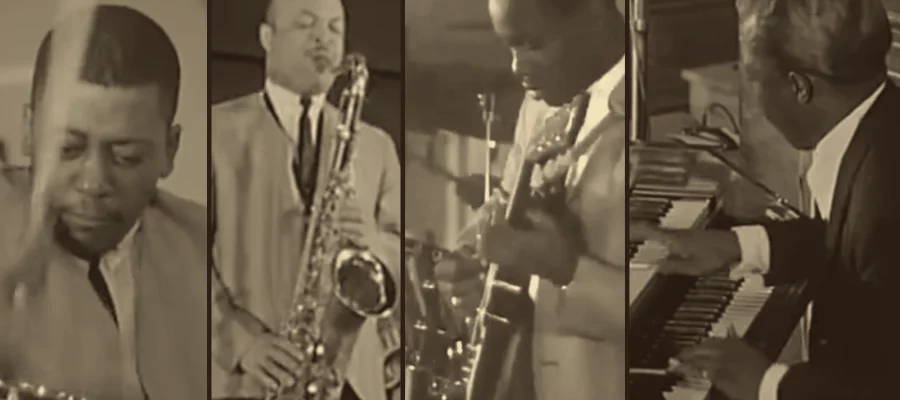
I have been hopelessly in love with this quartet’s playing for a very long time.
Brother Jack McDuff on organ, Red Holloway on tenor, George Benson on guitar, Joe Dukes on drums. Every time I listen to the recordings they left on Prestige Records between 1963 and 1965, my body starts moving on its own. I never get tired of them. I have been captivated by the spell of this fearsome groove machine for years.
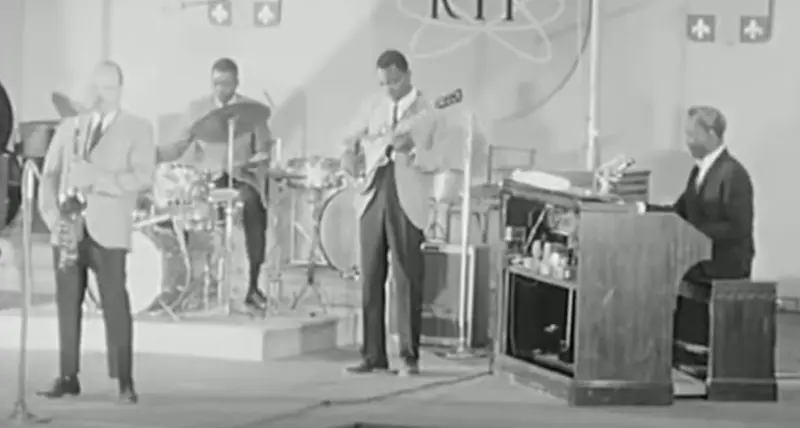
The trouble is, the moment you try to listen to this quartet’s recordings systematically, you run into problems.
The recordings themselves are concentrated in just two years, 1963 to 1965, yet tracks from the same session ended up scattered across completely different LPs, making it hard to follow the music in any orderly way. McDuff had a long tenure on Prestige, and his guitarists rotated through Grant Green, Kenny Burrell, George Benson, and Pat Martino. Later LPs drew from sessions spanning these different eras. For example, Steppin’ Out (PRST 7666) has four different guitarists across its six tracks (Green, Burrell, Benson, and Martino), with recording dates stretching five years from 1961 to 1966. CD reissues were no better: Silk and Soul (PRCD-24242-2) has thirteen tracks, but Benson plays on only one. Just figuring out which releases contain this quartet’s performances requires a bit of detective work.
In this series, I want to reassemble the scattered recordings session by session and listen to them fresh as a four-piece band. Part I covers who these four players were and why they clicked. Part II traces the recordings in chronological order, and Part III tackles the discographical data.
McDuff: Everything Starts with the Bass
After listening through every track again, this is what hit me hardest. The groove of this band is rooted in the bass lines McDuff plays with his left hand and foot pedals.
McDuff started out as a bassist. The liner notes to the 1963 Live! At the Jazz Workshop (PR 7286) put it this way:
“the leader played piano and the only weak spot was bass. So Brother Jack McDuff became the bass player. (Notice the amazing bass line he plays on the organ.) … Within a year he had become so proficient that he was offered a job as bass player with one of the top jazz bands in the country.”
Liner notes, Brother Jack Alive! at the Jazz Workshop (PR 7286, 1963)An organist who came up as a bassist, and his bass lines were already being called “amazing” by a contemporary reviewer over sixty years ago. Listening today, I find that assessment still completely accurate. Play Rock Candy (1963-06-05, live at the Front Room, PR 7274) and you hear a groove that pushes aggressively forward without the tempo budging an inch. The bedrock underneath it all is McDuff’s bass.
The full power of McDuff’s bass playing reveals itself when it is absent. On This Can’t Be Love from Cookin’ Together (1964-02-06, LA, PR 7325), McDuff unusually plays piano, leaving bass duties to Wilfred Middlebrooks. What happens? That insistent, driving groove vanishes. McDuff’s piano playing sounds slightly behind the beat. Perhaps a musician who spent years on the light, switch-action keys of an organ has trouble matching the hammer-to-string timing of a piano. Either way, the moment McDuff’s left-hand-and-pedal bass disappears, the source of this band’s groove is laid bare. Paradoxically, this track is proof that McDuff’s bass was driving everything.
McDuff is also masterful at varying intensity even when he is not going full throttle. Listen to the first half of his solo on Whistle While You Work (1963-06-05, Front Room, PR 7274): he deliberately leaves notes out, using space like ghost notes, the “art of subtraction.” The PR 7286 liner note phrase “use of dynamics and stop changes” fits perfectly.
McDuff’s stage patter is another treat. The PR 7274 live recording preserves his between-song MC work: before Sanctified Samba he says “once you get that church in you, it’s kind of hard to backslide all the way,” and before Undecided he shouts “With the hot sauce.” The title Rock Candy, the PR 7274 liner note quote “just cook!”, and the 1965 Hot Barbeque (1965-10-19, recorded at Regent Sound in NY, PR 7422) all show McDuff consistently using food metaphors to describe musical heat. It was the slang of the era, but the showman knew how to work it.
There is something else worth noting: the bass rhythm figure on It Ain’t Necessarily So (also from the Front Room, PR 7274). On a 12/8 grid, the figure anticipates from the last triplet eighth (the 12th) into the downbeat of the next bar (the 1st). This is the same rhythmic structure as The Pink Panther theme. This device of leaping from the end of one bar into the top of the next pulls the whole band forward even on a slow tempo. Dukes’s hi-hat bark, which I will discuss later, also lands near the end of the bar (the 14th sixteenth note). The propulsive force of this band seems to have part of its secret hidden in the tail end of the measure.
Dukes: The Engineered Showman
I hear four sides to Joe Dukes’s drumming.
The first is his individual power.
The liner notes to Screamin’ (PR 7259, 1963) offer an apt contemporary assessment:
“‘Soulful Drums’ is really something, this is a fabulous framework for the big talent of Joe Dukes, this is the way I like to hear drums, instead of the drums goin’ for themselves, Jack keeps the organ thing behind and around Joe’s message. Wherever Joe Dukes came from, it is sure that he spent much time in the woodshed, his control is beautiful.”
Liner notes, Screamin' (PR 7259, 1963)Not drums going off on their own (“instead of the drums goin’ for themselves”), but playing within a structure where McDuff’s organ wraps around him from behind. The beauty is in the control. Already in 1963, Dukes was being described as a man of control.
The second is his stamina on stage.
Benson’s testimony (Smithsonian Jazz Oral History, 2011):
“But when he was on that bandstand, he was the knockout cat of the night. Everybody came from everywhere. No musician would pass up the chance to see Joe Dukes.”
George Benson, Smithsonian Jazz Oral History, 2011The episode involving members of Count Basie’s band is just as intense:
“Count Basie himself sat right in front of Joe Dukes, because at the end of the show he would play a roll on the bass drum and play the drums backwards, like thundering and lightning.”
George Benson, Smithsonian Jazz Oral History, 2011The recording of that “end of the show” is most likely Jive Samba (Jazz Workshop 1963-10-03, the final track on the LP’s B side, PR 7286). Teruyuki Yoshida (banshodo.com) heard “anger” in Dukes’s playing from this period, and I can see why.
But listening through all the recordings again end to end, a slightly different picture emerged for me. From the opening bars, Dukes strikes toms, snare, cymbals, rimshots, cowbell, every percussion surface available. During the mid-song drum solo he shouts “My Soul!” four times, launches into a “Yeah Yeah Yeah Yeah!” self-call-and-response, and finally uses “My My My” as a cue to bring the whole band back to the theme. More than anger, what I hear is a drummer running the show. His voice whips up the audience while simultaneously cueing the band. That is the command presence Basie was watching from the front row.
Incidentally, if you listen to just the right channel of the Front Room recording, you can hear audience members shouting “yeah!” “Holy Roller!” “don’t stop now, Jack.” The Front Room that night was thick with deep, down-home heat (more on this in Part II).
The third is his hi-hat bark.
Listening to Dukes, you will occasionally hear a single short burst cut through the regular closed hi-hat groove. A sharp pop where he strikes the hi-hat hard, slightly open, and snaps it shut immediately. This technique is called a hi-hat bark. Players like Purdie and Gadson build it into continuous patterns, but Dukes drops just one unexpected hit into an otherwise normal groove. That surprise is what sparks the whole band.
I looked closely at where the bark lands in the measure. Dividing one bar into sixteen sixteenth notes, Dukes’s bark falls on the 14th, the sixteenth note right after beat 4 (the “e” of 4 in standard counting). Near the tail of the bar, like a springboard into the next downbeat. The reason it sounds so sudden is precisely this fractional beat placement.
This hi-hat bark is especially prominent in the two takes of Undecided (1963-06-05, Front Room):
| master (PR 7274) | alt take (PR 7492) | |
|---|---|---|
| bark count | 5 occurrences | 6 occurrences |
| timestamps | 0:41 / 1:01 / 3:44 / 5:16 / 7:27 | 0:36 / 0:57 / 3:38 / 3:54 / 5:10 / 7:19 |
The master and alternate take line up almost in parallel (the alt runs slightly ahead due to tempo difference). The barks appear at nearly the same structural points in both takes. In other words, this is not spontaneous inspiration. He is setting them up at the same spots in the song.
I also confirmed barks in Four Brothers (1964-07, Golden Circle, PR 7362). A Dukes signature that persists across a year and an ocean.
A comparison with Bernard Purdie is instructive. Purdie’s typical patterns use the 14th+16th, or 12+14+16, or cross the barline at 16+2. Dukes uses the 14th alone, a single shot. Where Purdie built systematic patterns, Dukes was hitting the same position sporadically but consistently. He may have been a precursor.
The fourth is Dukes’s roots. George Benson says his hero was Art Blakey:
“His hero was from my hometown. It was Art Blakey, and he played them same lumpy rolls that Art used to play, them single-stroke rolls.”
George Benson, Smithsonian Jazz Oral History, 2011Flophouse Magazine (2016) also describes “Art Blakey-like single-stroke rolls,” and these accounts match what I thought the very first time I heard Dukes: “that roll sounds like Blakey.” In the drum solo on Blues 1 & 8 (Jazz Workshop 1963-10-03) around 1:23 to 1:45, those Blakey-descended rolls and rimshots are clearly audible.
One last thing: Dukes’s name still appears in music education today. In drum educator John R. Hearnes’s teaching materials (2026), Joe Dukes’s “Hot Barbeque” is listed as a sample recording alongside Art Blakey, Max Roach, Elvin Jones, Philly Joe Jones, Tony Williams, and Buddy Rich.
Benson sums up Dukes the person this way:
“He was so magnificent as a musician, a drummer. I thought he was one of the greatest things that ever happened to mankind as far as musicianship was concerned.”
George Benson, Smithsonian Jazz Oral History, 2011Benson also says Dukes was a “spectacular young fellow” and “a nuisance” at the same time. There was friction within the band. But when Dukes returned to Memphis and reunited with his mother after six years (“His mother saw him, and she cried her eyes out. … I thought of him differently after that.”), Benson’s view of him changed. The monster on stage, the son in front of his mother. The depth of Joe Dukes as a person cannot be captured by his playing alone.
Benson: A Comping Genius, a Soloist in Progress
George Benson joined McDuff’s band in 1963. Many sources say 1962, but Benson himself corrected this: “No, I joined him in ’63.” (Smithsonian, p. 35).
The story of how he joined is dramatic. The 19-year-old Benson was facing jail the next day on an assault charge against his wife. That same night, through Don Gardner (a prominent singer, songwriter, and drummer of the era, then serving as president of the Philadelphia Clef Club of Jazz and Performing Arts), he heard that McDuff was looking for a guitarist and sat in. McDuff called his manager in New York, said he was taking the kid, and handed Benson $35. Benson paid $27 for court costs out of that and left with McDuff that night. He was fired on the first day. But he came back a few weeks later, and the next two years are the subject of this series. “Jack McDuff saved my life,” Benson has said.
What comes through in the 1963-65 recordings is not the young face of the star who would go on to Breezin’. It is a musician functioning organically as part of a band for several years.
Benson himself puts it this way:
“My solos weren’t good. My solos were mediocre.”
George Benson, Smithsonian Jazz Oral History, 2011And:
“I made him sound good. If you listen to those records, I’m kicking behind Jack. Jack loved that stuff.”
George Benson, Smithsonian Jazz Oral History, 2011After listening through all the quartet’s recordings again, I can confirm this is no exaggeration. Take Rock Candy. Benson’s guitar solo leans heavily on repeated riffs, but the moment he switches to comping, he locks in with McDuff and Dukes’s groove and adds beautiful accents. The three of them together produce a unity you could listen to endlessly. On Sanctified Samba (Front Room 1963-06-05), his solo still has rough edges, but his comping is flawless.
Of course, Benson grew over those two years. His solo on Four Brothers (Stockholm 1964-07) is far more cohesive, and Shout Brother (LA 1964-02-06) shows early signs of the lyricism that would define his later career. Where his predecessor Kenny Burrell played with understated craftsmanship, the young Benson was earthy, bluesy, and freewheeling (specific comparisons in Part II). But even while still developing, what remained consistent throughout was the quality of his comping.
One more note. Writing about Benson’s later playing, musicologist Aaron J. West observed that “his style is based on distinctive alternations between blues-derived phrases and bebop-derived phrases” (Caught Between Jazz and Pop, 2008, p. 84; his analysis covers the post-Breezin’ years). Listen back to the Prestige period with that in mind, and the back-and-forth between bluesy phrases and boppish runs is already audible all over these recordings. To my ears, this was not a device acquired in stardom but a constitution formed night after night on the bandstand with McDuff.
Hank Garland: Why Benson Chose the Guitarist’s Path
As a side note, the musician who set Benson on the path to guitar was country/jazz guitarist Hank Garland.
When Benson was 17, living in Pittsburgh, he first heard Garland’s Jazz Winds From A New Direction (recorded 1960) at a Saturday listening session at the home of his neighbor Chad “Carrie” Evans.
“We put that record on, and we could not take it off. It captivated us from bar one.”
George Benson, Folio Weekly, December 21, 2004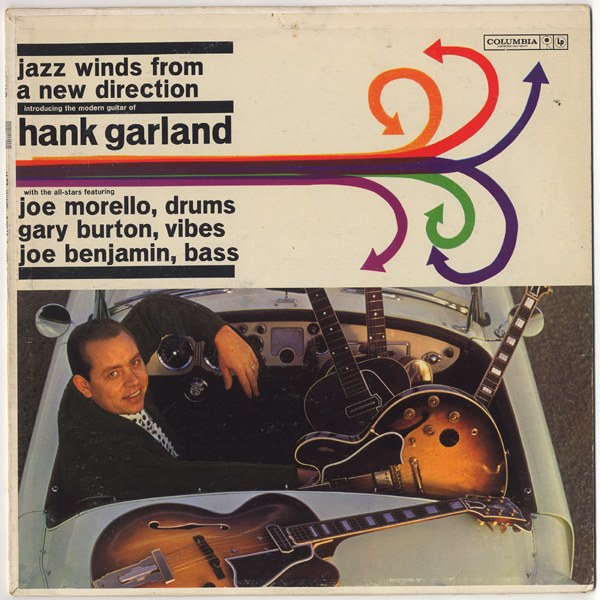
I wrote a blog post about this album a while back
In the Smithsonian interview, Benson said:
“I haven’t heard that since Charlie Christian, because he would light a song up.”
George Benson, Smithsonian Jazz Oral History, 2011“Hank Garland, whom I met later. He became one of my big mentors.”
George Benson, Smithsonian Jazz Oral History, 2011Garland was known as a country guitar master, but Jazz Winds revealed his jazz talent. Then the following year (fall 1961), a car accident ended his career. Right after the period when Benson would have been absorbing Garland’s influence, the object of his admiration disappeared from the music scene. In 1963, Benson joined McDuff’s band.
In 1992, ahead of Benson’s Jacksonville concert, a letter arrived from Garland. He said he liked Benson’s work and wanted to come see the show.
“To me, that was like receiving a Grammy.”
George Benson, Folio Weekly, December 21, 2004Garland did come to the show that day. Before playing, Benson introduced Garland from the stage, pointing him out in the audience as “one of the greatest guitarists ever.” A spotlight hit Garland, and the crowd reportedly gave him a standing ovation. Thirty years had passed since that Saturday afternoon listening to Jazz Winds.
Holloway: Gentle Grease
How to describe Red Holloway’s tenor? “Big-toned” and “R&B-inflected” are the usual labels, and they are accurate enough. But compared to the honking tenor lineage of Illinois Jacquet, Arnett Cobb, Red Prysock, and Big Jay McNeely, Holloway is different. He does not steamroll over the band. He rides on the McDuff-Benson-Dukes groove, or rather blends into it until the four become one. Gentle grease, that is Holloway’s restraint as a band member.
Listen to Brother Red (1964-02-06, LA, PR 7325) and it becomes clear. The other three pull back to give Holloway the spotlight, but underneath the gentle grease you can hear a thick, murky groove churning, though it is easy to miss. A different leader credit, the same working band in practice.
Holloway also played another role within the band: he was Benson’s ally.
“Red Holloway, he always got on me. He said, ‘I envy you.’ He said, ‘Because it takes me three days to learn these parts, and I read music.’ He said, ‘You – in 20 minutes you got your part down.'”
George Benson, Smithsonian Jazz Oral History, 2011“He said, ‘You’re going to be a monster guitar player.’ He said, ‘Don’t pay no attention to what them cats is talking about.'”
George Benson, Smithsonian Jazz Oral History, 2011When Benson learned the second harmony for Four Brothers (1964-07, Golden Circle, PR 7362) by ear in twenty minutes, Holloway, the one holding the chart, was “scuffling through” his own part. Faced with that reversal, Holloway responded not with jealousy but with encouragement.
A note on the Live! At the Jazz Workshop (PR 7286) lineup: the session features a two-tenor front line with Holloway and Harold Vick, but the question of who plays flute and who plays soprano sax remains unresolved. The jacket back, TJD, jazzdisco.org, and other sources all differ. In this article, I will only go so far as to note that flute is audible, but the player assignment varies by source and is unconfirmed.
What the Four Built Together
McDuff’s bass drives the engine. Dukes’s drums provide the spark. Benson’s comping fills the gaps. Holloway’s tenor sings with gentle warmth. Each of them is a fine player on his own, but the groove they produce when all four are together is something only this combination can generate. Listen to Rock Candy. Or Blues 1 & 8. Your body will start moving. No matter how many times you hear it.
Now let’s trace how this groove machine came into being and how it changed over time. On to Part II.
This is the first in a three-part series. Part II: Listening in Chronological Order / Part III: Discographical Data