Phono EQ Curves Liner Notes II は II-a / II-b / II-c の 3 部作で、 20年前のブログ記事で主観的に書いた問いに、 客観的な計測の道具の力を借りて再度向き合います。本稿はその第1部 Liner Notes II-a に続く第2部 Liner Notes II-b で、 同じ Capitol H-488 “Songs For Young Lovers” セッションマスターから派生した再発・リマスター系を LTAS で横並びに読み解きます。
Phono EQ Curves Liner Notes II is a three-part work (II-a / II-b / II-c) revisiting a question I wrote about subjectively in a blog post twenty years ago, this time with objective measurement. This second part, Liner Notes II-b, continues from Liner Notes II-a and reads the reissue and remaster lineage branching from the same Capitol H-488 “Songs For Young Lovers” session master, side by side, on LTAS.
Liner Notes II は II-a / II-b / II-c の 3部構成です。
- Liner Notes II-a: Capitol H-488 “Songs For Young Lovers” の初期プレス D2 / D8 のあいだに見える物理的差異と、 SimAES filter による録音 EQ カーブ判別
- Liner Notes II-b: 同じ H-488 セッションマスターから派生した再発・リマスター系 5 リリース (W-587 / ECJ-50017 / W-1432 / MFSL 1-130 / 1998 CD) の音作りの違い
- Liner Notes II-c: H-488 セッションの半年あまり前(1953年4月)に録音された Capitol H-477 “The Duke Plays Ellington” と 12インチ再発 T-477、および II-a / II-b / II-c 通算「LTAS で分かること / 分からないこと」 まとめ
Liner Notes II is a three-part work (II-a / II-b / II-c).
- Liner Notes II-a: Physical differences visible between Capitol H-488 “Songs For Young Lovers” early pressings D2 and D8, and recording EQ curve identification through the SimAES filter
- Liner Notes II-b: Five reissue and remaster releases branching from the same H-488 session master (W-587 / ECJ-50017 / W-1432 / MFSL 1-130 / 1998 CD), and the differences in sound design
- Liner Notes II-c: Capitol H-477 “The Duke Plays Ellington”, recorded in April 1953, some seven months before the H-488 sessions, with its 12-inch reissue T-477; closing with a summary across II-a / II-b / II-c, “What LTAS can show / what it cannot”
変更履歴 / Revision History
- 2026年6月14日: 初版公開
- June 14, 2026: Initial publication
本稿では、 同じ H-488 セッションマスターを起点に派生した再発・リマスター系 5 リリース (1955年 W-587 / 1977年 ECJ-50017 / 1962年 W-1432 / 1983年 MFSL 1-130 / 1998年 CD “The Capitol Years”)を LTAS で横並びに置き、 さらに基準を D8 → 1998 CD → MFSL 1-130 と切り替えて読みます。 W-587 系譜の高域強調、 W-1432 の独自プレゼンスブースト、 MFSL のマスターテープ直系と読める複数の傍証(リードテープの無音 + 11fifty.com が指摘するスタジオ環境音 + 当時の広告・インタビューでの主張)、 1998 CD の独自低域ブーストといった、 時代ごとの音作りの違いと、 同じセッションマスターから派生した系譜の見え方が浮かび上がります。
Liner Notes II-b places side by side, on LTAS, the reissue and remaster lineage branching from the same H-488 session master across five releases (= 1955 W-587, 1977 Japanese ECJ-50017, 1962 W-1432, 1983 MFSL 1-130, and the 1998 CD “The Capitol Years”), then re-reads them by switching the reference between D8, the 1998 CD, and MFSL 1-130. The W-587 lineage’s high-frequency boost, W-1432’s distinct presence boost, MFSL’s master-tape-direct origin read through several pieces of circumstantial evidence (= the silent leader-tape segment, the room ambience noted by 11fifty.com, and the advertising/interview statements at the time), and the 1998 CD’s distinct low-frequency boost emerge as differences in sound design at each era, alongside the lineage branching from the same session master.
本シリーズ Phono EQ Curves Liner Notes は、これまでの連載「Things I learned on Phono EQ Curves Pt.0〜Pt.25」の補完シリーズです(連載続編ではなく、別シリーズとして位置付けます)。詳しくは 連載の読み方ガイド をご覧ください。
This series, Phono EQ Curves Liner Notes, is a companion to the existing series “Things I learned on Phono EQ Curves Pt.0–Pt.25” (positioned as a separate series rather than a continuation of it). For details, please see the guide to reading the series.
本稿は、筆者自身の学習・調査過程を記したものです。 間違いの指摘や異論は遠慮なくお寄せください。
This piece is a record of the author’s own learning and inquiry. Corrections and disagreements are most welcome.
II.3 The H-488 Reissue and Remaster Lineage
本稿 Liner Notes II-b では、 Liner Notes II-a の延長として、 同じ H-488 セッションマスターを起点に派生した再発・リマスター系を横並びに置きます。 1955年の 12インチ再発 W-587、 1977年の日本盤 ECJ-50017、 1962年の再パッケージ W-1432、 1983年のオーディオファイル向けハーフスピードマスタリング MFSL 1-130、 そして 1984/85年のディジタルリマスター由来 1998 CD “The Capitol Years” の 5 リリースです。これらを 長期平均スペクトル(以下 LTAS) で横並びに置き、 さらに基準を D8 → 1998 CD → MFSL 1-130 と切り替えながら、 同じセッションマスターからどのような音作りが派生してきたのか、 そして時代ごとに「“Songs For Young Lovers” の音」 がどのような語彙で作り直されてきたのかを読み解いてみます。
This Liner Notes II-b, as a continuation of Liner Notes II-a, places side by side the reissue and remaster lineage branching from the same H-488 session master: the 1955 12-inch reissue W-587, the 1977 Japanese pressing ECJ-50017, the 1962 repackage W-1432, the 1983 audiophile half-speed master MFSL 1-130, and the 1998 CD “The Capitol Years” derived from a 1984/85 digital remaster. Across these five releases on the long-term average spectrum (LTAS),and by switching the reference between D8, the 1998 CD, and MFSL 1-130, the chapter reads how the sound design diverged from the same session master, and how “the sound of “Songs For Young Lovers”” was rebuilt in different vocabulary at each era.
W-587 / ECJ-50017 / W-1432 — The 1955-77 remaster lineage
H-488 の 12インチ再発として、まず Capitol W-587 “Swing Easy! & Songs For Young Lovers”(1955年春頃にリリースされたとされる)があります。 A面が H-528 “Swing Easy!”、B面が H-488 “Songs For Young Lovers” という 2in1 構成で、本曲「I Get A Kick Out Of You」は B面5曲目に収録されています。続いて 1962年7月、Sinatra の Reprise 移籍後に Capitol が原盤に 4曲を追加して(さらに曲順を変えて)再発したのが W-1432 です。
The first 12-inch reissue of H-488 is Capitol W-587 “Swing Easy! & Songs For Young Lovers” (said to have been released around spring 1955), a 2-in-1 with H-528 “Swing Easy!” on Side A and H-488 “Songs For Young Lovers” on Side B; the present track “I Get A Kick Out Of You” sits at B-5. Then in July 1962, after Sinatra’s move to Reprise, Capitol reissued the original album with four added tracks (and a reshuffled track order) as W-1432.
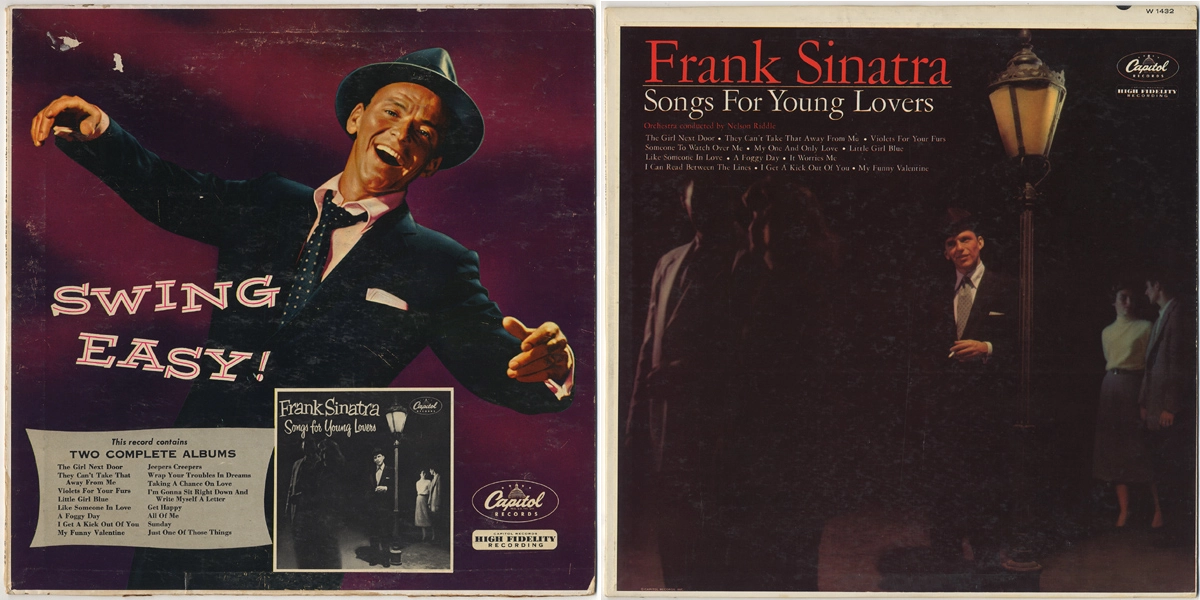
左: Capitol W-587 ジャケ表(1955年春頃、 H-528 と H-488 の 2in1 構成)。 右: Capitol W-1432 ジャケ表(1962年、 H-488 に 4曲追加した再発)。
また、W-587 系譜の日本盤として、1977年に東芝 EMI からリリースされた “Swing Easy! & Songs For Young Lovers” (ECJ-50017) も比較対象に加えます。リマスタリング担当者のクレジットは見当たりませんが、W-587 のプロダクションマスターのコピーが日本に送られ、日本でカッティングされたものではないかと、筆者は推測しています。
A Japanese pressing in the W-587 lineage, “Swing Easy! & Songs For Young Lovers” (ECJ-50017), released by Toshiba EMI in 1977, also joins the comparison. No remastering credit is visible on the ECJ-50017 jacket, but my conjecture is that a copy of the W-587 production master was sent to Japan and cut domestically.
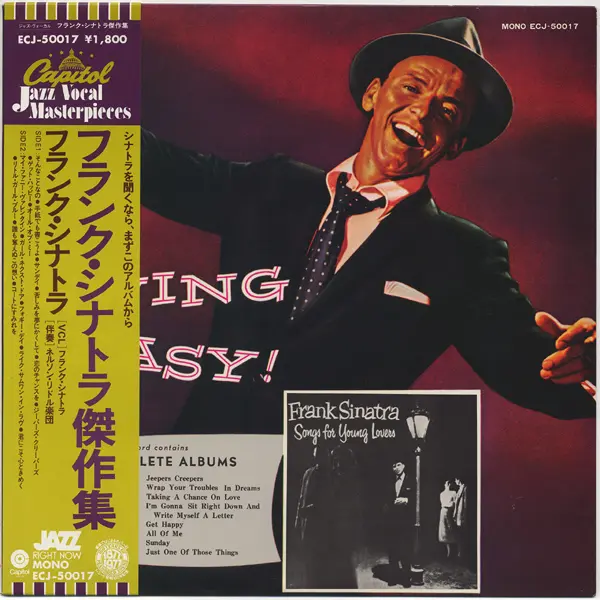
ECJ-50017 ジャケ表(1977年 東芝EMI、 W-587 系譜の日本盤)。
これら 3 枚の LTAS を D8(1955年通常盤)を基準にして見ると、リマスターごとの音作りの性格がはっきりと立ち上がります。
Looking at the LTAS of these three against D8 (the 1955 standard pressing) as reference, the tonal-shaping character of each remaster comes through clearly.
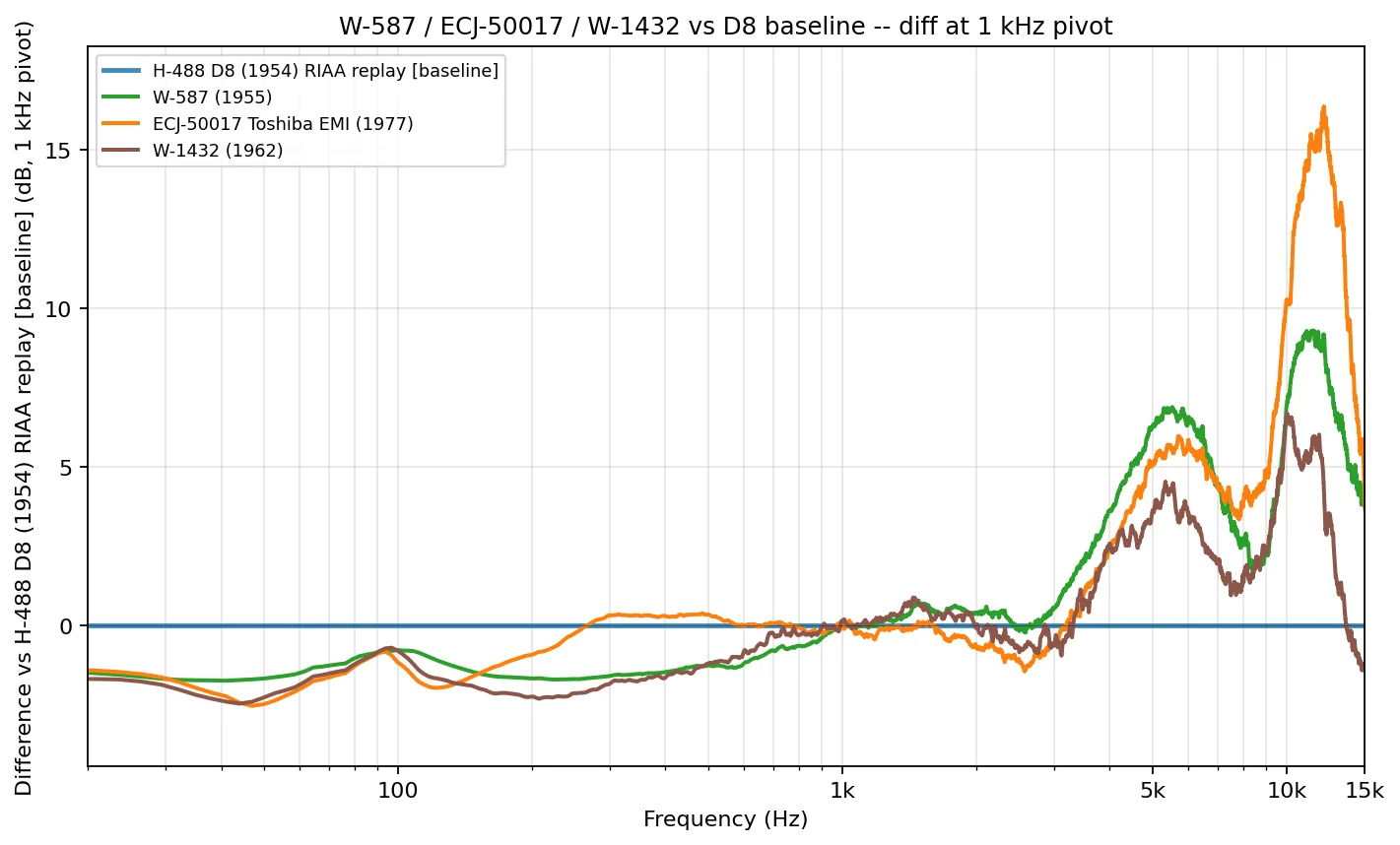
【Fig D】 W-587(緑、 1955)、 ECJ-50017(橙、 1977)、 W-1432(茶、 1962) と D8(青、 0 dB を基準)の LTAS 差分。 1 kHz で正規化。 W-587 と ECJ-50017 は D8 比で同方向の高域形状を示し(5〜12 kHz で +2.6〜+15.8 dB、 8 kHz の谷を除けば +5 dB 以上、 = H-488 D2/D8 のカッティングチェーン由来の凹みを持たない高域形状)、 W-1432 も中高域は同形状だが 12 kHz 以上でロールオフし 15 kHz では D8 より下 (−1.32 dB)(筆者解析、 2026年6月2日)。
| Frequency | D8 (baseline) | W-587 (1955) | ECJ-50017 (1977) | W-1432 (1962) |
|---|---|---|---|---|
| 50 Hz | ±0.00 | −1.67 | −2.48 | −2.27 |
| 100 Hz | ±0.00 | −0.77 | −1.14 | −0.78 |
| 200 Hz | ±0.00 | −1.66 | −0.93 | −2.24 |
| 500 Hz | ±0.00 | −1.25 | +0.34 | −1.18 |
| 2 kHz | ±0.00 | +0.39 | −0.65 | −0.08 |
| 5 kHz | ±0.00 | +6.27 | +5.07 | +3.63 |
| 8 kHz | ±0.00 | +2.58 | +3.91 | +1.39 |
| 10 kHz | ±0.00 | +6.93 | +10.26 | +6.50 |
| 12 kHz | ±0.00 | +8.81 | +15.82 | +5.26 |
| 15 kHz | ±0.00 | +3.82 | +3.82 | −1.32 |
| crest factor (dB) | 15.21 | 16.05 | 15.59 | 16.20 |
crest factor(クレストファクタ) = 信号のピーク値と実効値の比 (dB)、値が大きいほど立ち上がりが鋭く保たれている指標。
crest factor = ratio of peak to RMS amplitude (dB); higher values indicate that transients are preserved more sharply.
W-587 は D8 比で 5〜12 kHz の領域に +6〜+9 dB の大きな上向き差を示し(5 kHz で +6.27 dB / 10 kHz で +6.93 dB / 12 kHz で +8.81 dB、 D8 を基準にした場合)、 15 kHz でも +3.82 dB と高域全帯域で一様に D8 を上回ります。これは RIAA 規格の許容公差では説明できない量です。ただ、 本章で順に見ていく W-1432 / ECJ-50017 / MFSL 1-130 / 1998 Capitol Years なども、 程度の差こそあれ 5〜12 kHz 帯に同方向の盛り上がりを示します。すると、 W-587 および後続のリイシューが高域 EQ ブーストを施した、 と解釈するよりも、 むしろ H-488 D2/D8 のほうがカッティングチェーン側で同帯域に凹みを抱えていて、 後続のリイシュー系統がその凹みを持たない高域形状を残している、 と解釈する方が自然です(後続が素のマスターテープに近い、 という仮説として読みます)。 II-a で、 カッティングチェーンが新しい世代に更新された可能性がある、 と仮説を述べましたが、 W-587 が製作された頃にはその更新が済んでいて、 まさに、 当時の Capitol が「Full Dimensional Sound」 の名の下に宣伝していたハイファイ志向に合致する音になった、 と読めるのです。
W-587 sits +6 to +9 dB above D8 across the 5–12 kHz band (+6.27 dB at 5 kHz, +6.93 dB at 10 kHz, +8.81 dB at 12 kHz, all relative to D8), and at 15 kHz it remains +3.82 dB above (a uniform separation across the high-frequency band). The amount is beyond what the RIAA specification’s tolerance can account for. However, as the rest of this chapter will show, W-1432, ECJ-50017, MFSL 1-130, and the 1998 Capitol Years all share the same direction of lift in the 5–12 kHz band to varying degrees. Rather than interpreting W-587 and the subsequent reissues as having applied HF EQ boosts, it seems more natural to read H-488 D2/D8 as carrying a dip in that band introduced somewhere in the cutting chain, with the other reissue lineages preserving a balance free of that dip (read as a hypothesis closer to the source master tape). In Liner Notes II-a, I raised the hypothesis that Capitol’s cutting chain may have been updated to a new generation; on that reading, the update was in place by the time W-587 was produced, and the sound fits squarely with the hi-fi orientation Capitol advertised under “Full Dimensional Sound” at the time.
W-1432 はそれとは別の印象を与える音です。 W-587 を基準にして見ると、 5〜8 kHz は W-1432 のほうが 1〜2.5 dB ほど低く(5 kHz で −2.64 dB、 8 kHz で −1.18 dB)、 10 kHz 付近で W-587 とほぼ同等まで持ち上がり(−0.43 dB)、 12 kHz 以上で急峻にロールオフしていきます(12 kHz で −3.55 dB、 15 kHz で −5.14 dB)。つまり 10 kHz を中心とした局所的なプレゼンス強調と、 12 kHz 以上の高域ロールオフ、 という二段構えの形状です。これは 1960年代の LP マスタリングでしばしば見られる音作り、 つまりボーカルや楽器のプレゼンスを前面に出しつつ、 帯域端を絞って中域を聴かせる方向を Capitol が採用した、 と読むことができます。
W-1432 gives a different impression. Taking W-587 as the reference, W-1432 sits 1 to 2.5 dB below W-587 in the 5–8 kHz range (−2.64 dB at 5 kHz, −1.18 dB at 8 kHz), then rises to roughly W-587’s level at 10 kHz (−0.43 dB), before rolling off sharply above 12 kHz (−3.55 dB at 12 kHz, −5.14 dB at 15 kHz). The shape is two-tiered: a localized presence lift around 10 kHz, combined with a steep high-end rolloff above 12 kHz. This can be read as Capitol adopting the LP mastering practice often seen in the 1960s — bringing the presence of vocals and instruments forward while trimming the band-edge to let the midrange come through.
ECJ-50017 を LTAS で見ると、 W-587 と同じく H-488 D2/D8 の凹みを持たない高域形状を示し(5 kHz で +5.07 dB / 10 kHz で +10.26 dB / 12 kHz で +15.82 dB、 D8 を基準にした場合)、 W-587 系列のカッティング系譜を引き継いでいるように見えます。一方で 12 kHz でのピーク値は W-587 の +8.81 dB よりさらに +7 dB ほど高く、 日本側でのカッティング段で追加の高域強調が加わっている可能性も読み取れます。また、 クレストファクタが W-587 の 16.05 dB に対し ECJ-50017 は 15.59 dB と少し下回ることも、 W-587 のカッティングマスターのコピー世代を経由しているという仮説と整合します。
On the LTAS, ECJ-50017 shows the same kind of HF shape as W-587 — without the H-488 D2/D8 cutting-chain dip (+5.07 dB at 5 kHz, +10.26 dB at 10 kHz, +15.82 dB at 12 kHz, all relative to D8), appearing to inherit the W-587 cutting lineage. At 12 kHz, however, the peak runs about +7 dB higher than W-587’s +8.81 dB, suggesting that an additional HF boost may have been applied at the Japanese cutting stage. The crest factor (15.59 dB for ECJ-50017 versus 16.05 dB for W-587, slightly lower) is also consistent with the hypothesis that ECJ-50017 went through a copy generation of W-587’s cutting master.
参考のために、 さきほどの Fig D(H-488 D8 基準)を W-587 基準で描きなおしたグラフを以下に示します。
For reference, here is the same Fig D data re-plotted with W-587 as the baseline instead of H-488 D8.
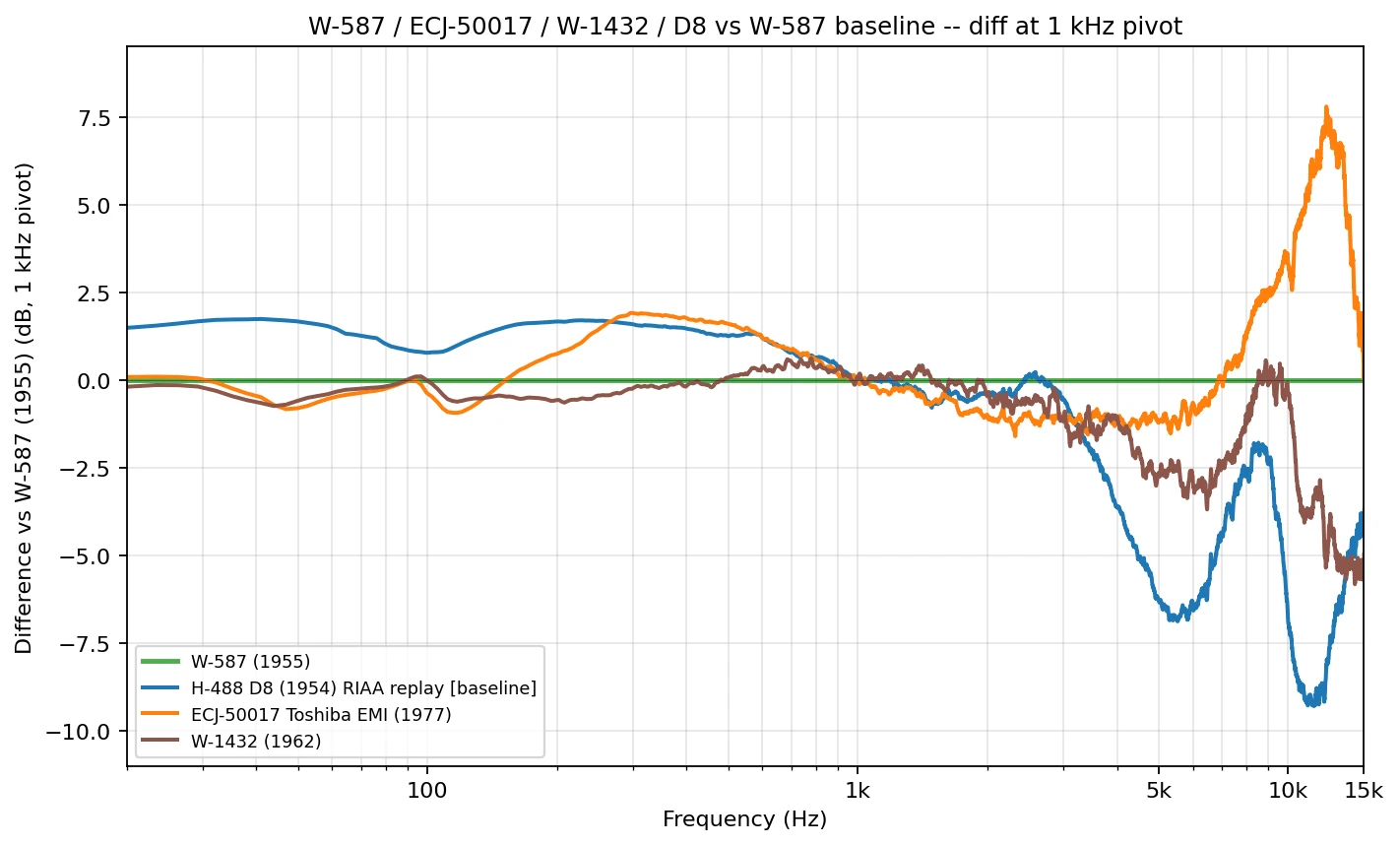
【Fig D2】 Fig D と同じデータを、 W-587(1955) を基準 (0 dB) に置きなおしてプロットしたもの。こうして見ると、 H-488 D8(1955) だけが外れ値として浮かび上がる: 100 Hz から 12 kHz の広い帯域で W-587 より 1〜9 dB 下に位置しており、 これは H-488 D2/D8 のカッティングチェーン由来の凹みを反映している。 ECJ-50017(1977) は 5 kHz まで W-587 と ±1 dB 以内で重なり、 8〜12 kHz では +3〜+7 dB と日本側カッティング段の追加高域強調が見える。 W-1432(1962) は 5〜8 kHz で W-587 よりわずかに下(−1〜−2.5 dB)、 10 kHz で W-587 とほぼ同等まで持ち上がり(−0.43 dB)、 12 kHz 以上で急峻にロールオフ(12 kHz で −3.55 dB、 15 kHz で −5.14 dB)。 10 kHz 中心のプレゼンス強調 + 12 kHz 以上の高域ロールオフ、 という 1960年代の LP マスタリング慣行を反映している(筆者解析、 2026年6月9日)。
MFSL 1-130 — An objective look at the legendary sound
次に、マニアの間で長年「すごい音」と評価されてきた MFSL 1-130(1983年)を、LTAS と物的傍証で客観的に位置づけてみます。
Next, MFSL 1-130 (1983) — long described among collectors as having a “legendary sound” — is examined with the same LTAS-plus-physical-evidence approach.
1983年に Mobile Fidelity Sound Lab がリリースした、ハーフスピードマスタリングによる LP 16枚組豪華ボックスセット “Sinatra” (SC-1) に収録された1枚、“Swing Easy! / Songs For Young Lovers” (MFSL-1-130) は、筆者が 2006年に当該ブログ記事を書いていた頃から「すごい音がする」と Steve Hoffman Music Forum でたびたび噂されていた、オーディオファイル向けリイシューです。 MFSL は Capitol が保管するオリジナルマスターテープから、 1953〜54年のマスターを 30年ぶりに、 手を加えない素の状態でトランスファーしたと伝えられています。
Released by Mobile Fidelity Sound Lab in 1983, the 16-LP deluxe half-speed-mastered box set “Sinatra” (SC-1) included “Swing Easy! / Songs For Young Lovers” (MFSL-1-130) as one of its discs. This audiophile reissue had been celebrated on the Steve Hoffman Music Forum for its “legendary sound” since around 2006, when the original blog post was written. MFSL is reported to have transferred the 1953-54 masters, unprocessed, from the original master tapes held by Capitol, for the first time in 30 years.
筆者は、2024年に念願かなってこのボックスセットを入手し、聴いた瞬間に「これは別物だ」と感じました。特にバスドラのキック低音の生々しさは、噂通りのものでした。
The author finally acquired this box set in 2024. On first listen, it sounded like a different recording. The raw immediacy of the kick drum in the low end matched its reputation.
LTAS で MFSL 1-130 を D8 と並べたとき、聴感の印象がそのまま数字として現れました。 5 kHz で +8.39 dB、8 kHz で +7.78 dB、10 kHz で +14.67 dB、12 kHz で +17.97 dB、15 kHz で +9.03 dB と、高域全帯域で大幅な差です。さらにクレストファクタも 16.70 dB と、これまでに見てきた他のリリース(D8 / D2 / W-587 / W-1432 / ECJ-50017 で 15.21〜16.20 dB)よりやや高く、立ち上がりがよく保たれていることが分かります。高域の伸びと立ち上がりの鋭さ、この 2 指標が同時に客観的に裏付けられている形です。 MFSL の音作りそのものの詳細、特にバスドラの突出は、別途バスドラ独立記事で改めて扱います。
When MFSL 1-130 is placed alongside D8 in LTAS, the listening impression shows up directly in the numbers. The high-frequency band shows large differences: +8.39 dB at 5 kHz, +7.78 dB at 8 kHz, +14.67 dB at 10 kHz, +17.97 dB at 12 kHz, and +9.03 dB at 15 kHz. The crest factor of 16.70 dB also runs slightly higher than the other releases examined so far (D8 / D2 / W-587 / W-1432 / ECJ-50017, ranging 15.21 to 16.20 dB), indicating well-preserved transient response. The high-frequency extension and the sharp transients are both corroborated objectively here. A separate article on the kick drum will take up the details of MFSL’s sound design, especially that prominent low end.
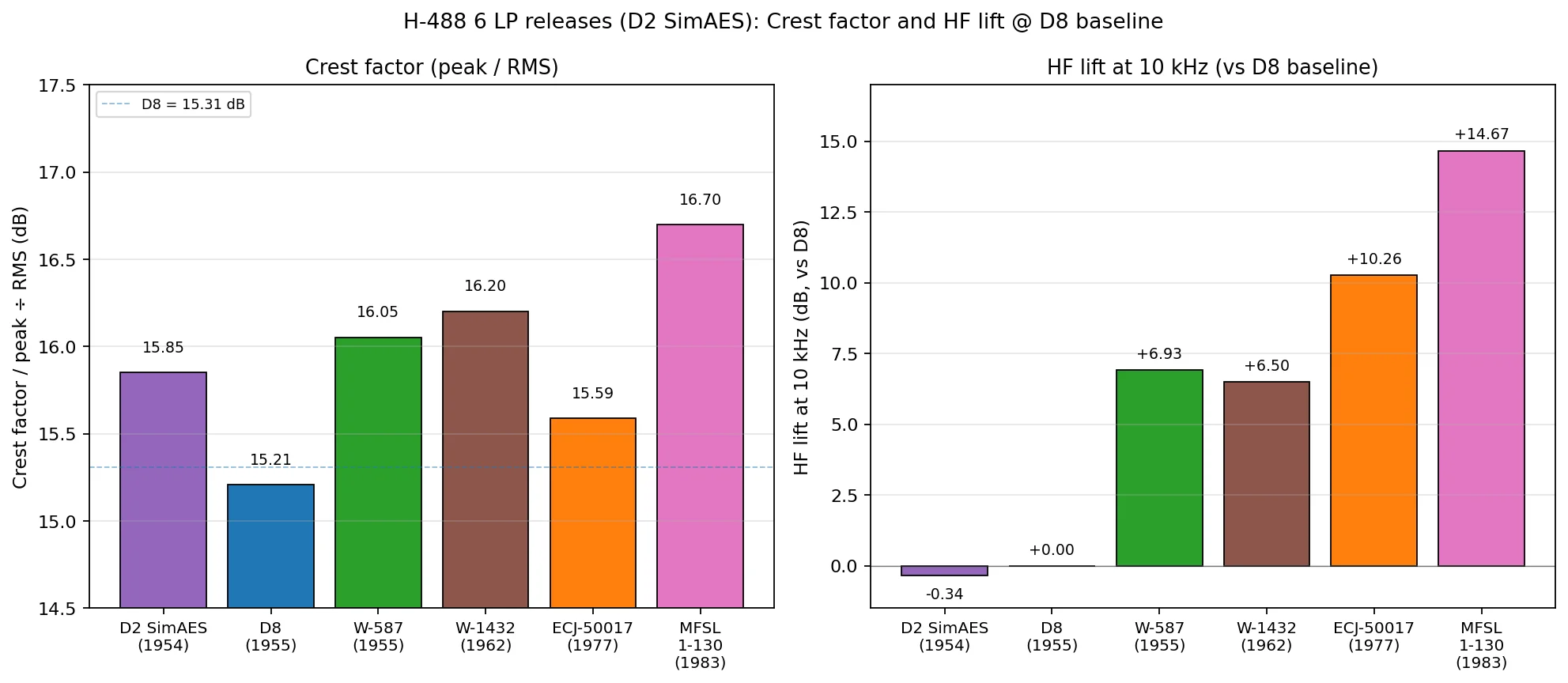
【Fig E】 H-488 系譜 6 LP releases (D2 は SimAES 補正後)の crest factor と高域強調(10 kHz @ D8 比)の比較。 MFSL 1-130 が両指標とも 6 LP 中最上位 (crest 16.70 dB / +14.67 dB) で、「立ち上がりがよく保たれ + 高域の伸びも大きい」という MFSL の特性を同時に裏付け(筆者解析、 2026年6月3日)。
LTAS とは別軸の物的傍証として、曲間のスパイラルグルーヴ(曲間で広いピッチに切られた溝)のスペクトログラムも MFSL のマスターテープ直由来を裏付けます。 B 面 4 曲目と 5 曲目のあいだの曲間(= マスタリング時のリードテープスプライシング区間)を W-587 と並べて見ると、MFSL では曲間が高域帯まで完全な無音(黒)に沈み込む一方、W-587 では曲間にも全帯域にうっすらとヒスが乗ったままです。
Independently of LTAS, the spectrogram of the inter-track spiral groove (= the wide-pitch groove cut between tracks) also points to a master-tape-direct origin for MFSL. Placing the gap between tracks B4 and B5 (= the leader-tape splicing segment from the mastering stage) side by side with W-587 shows that on MFSL the gap drops to complete silence (= black) across the high-frequency band, while W-587 retains a faint hiss across all bands even in the gap.
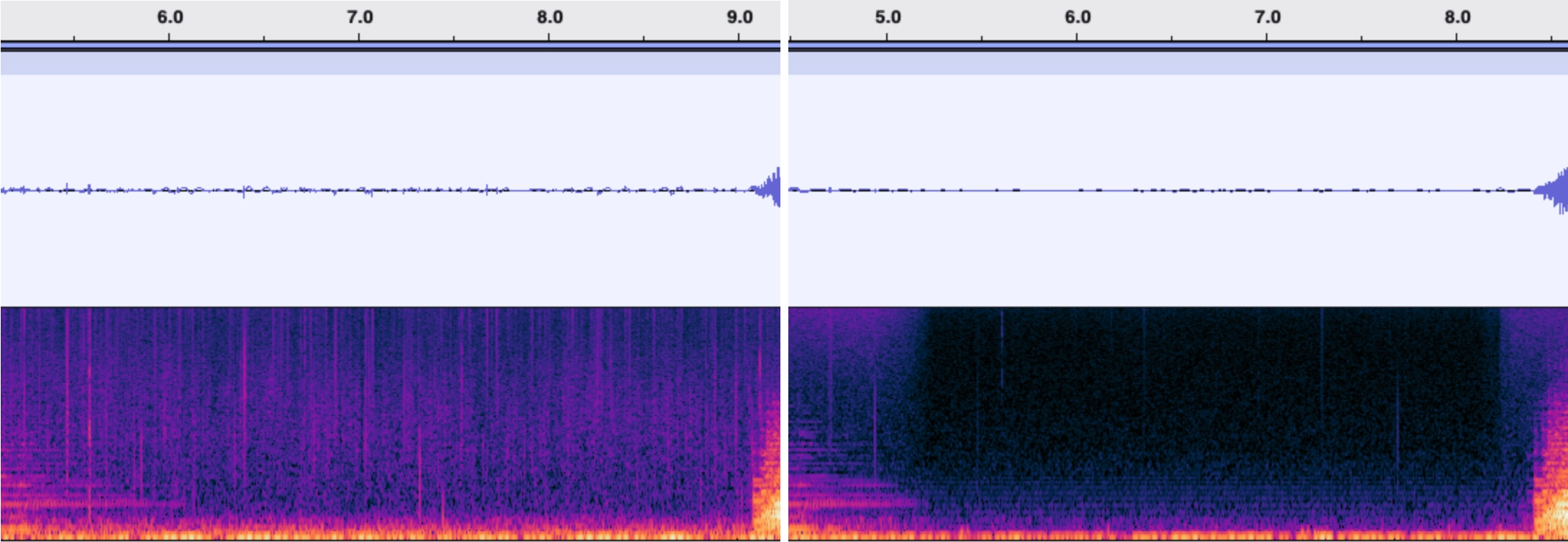
【Fig F】 W-587(左)と MFSL 1-130(右)の B 面 4 曲目と 5 曲目の曲間スパイラルグルーヴの波形 + スペクトログラム比較。 MFSL では曲間が高域帯まで黒く沈み込み(= マスターテープを物理的に接続しているリードテープ区間の完全な無音がそのまま刻まれている)、W-587 では曲間にも全帯域にうっすらと色が乗ったままである(筆者解析、 2026年6月5日)。
これは、MFSL のカッティングソースが、磁気テープ由来のヒスノイズを原理的に持たないリードテープ区間(磁性体の塗布がない区間)をそのまま物理的に持っていた、 = マスターテープ直カッティング、と説明すれば整合します。対する W-587 はプロダクションマスター(量産カッティング用にマスタリング段から複製されたマスター)のコピー世代を経由しているため、コピー先テープの磁性体ヒスがリードテープ区間にも乗ってしまった、という解釈が自然です。 1980年代当時の MFSL はオリジナルセッションマスターテープからカッティングしていた、と公式広告およびインタビュー類で繰り返し語られてきた経歴があり(Mobile Fidelity Sound Lab 広告, Audio, 1983年4月, p. 22; Sam Sutherland, “Deluxe Sinatra,” Billboard, 1983年8月20日, p. 6; Cash Box, 1984年9月28日, p. 10)、これが LTAS とは別軸の音響物理的な指標 (Fig F) からも追加で裏付けられている、という構図です。
This is consistent with MFSL’s cutting source physically retaining the leader-tape segment (which carries no magnetic coating and therefore, by construction, no magnetic-tape hiss): direct cutting from the master tape. For W-587, by contrast, the cutting source passed through a production master (a copy made from the mastering-stage master for mass-cutting), so the magnetic hiss of the copy tape was printed onto the leader-tape segment as well. MFSL has long stated in advertising and interviews that in the 1980s it cut directly from the original session master tapes (Mobile Fidelity Sound Lab advertisement, Audio, April 1983, p. 22; Sam Sutherland, “Deluxe Sinatra,” Billboard, August 20, 1983, p. 6; Cash Box, September 28, 1984, p. 10). Fig F now adds a further acoustic-physical line of evidence (independent of LTAS) supporting that claim.
また、オーディオファイル系の解説サイトである 11fifty.com も、「MFSL 1-130 は My Funny Valentine 冒頭に 1 秒ほどのスタジオ環境音(= 演奏開始直前のスタジオ内の物音、 演奏者の動きの音)を含む唯一の盤である」と音声サンプル付きで独立に指摘しており (11fifty.com, “1953 – Songs for Young Lovers“)、これも MFSL がマスターテープ頭から無編集でカッティングしている傍証として、 Fig F とは独立軸で整合します。
Independently, the audiophile annotation site 11fifty.com has noted, with audio samples, that “MFSL 1-130 is the only pressing that includes about one second of room ambience at the head of My Funny Valentine (= studio-room sounds and performer movements just before the take begins)” (11fifty.com, “1953 – Songs for Young Lovers“). This too (independent of Fig F) points to MFSL cutting from the head of the master tape without editing.
1998 CD — The digital remaster lineage
次に、1984年のディジタルリマスター由来とされる、1998年 UK 21枚組 CD ボックスセット中の 1枚を、同じ手法で並べてみます。
The next case is a CD from the 1998 UK 21-disc box set (reportedly derived from a 1984 digital remaster), examined with the same approach.
さらに時代を下って、Capitol UK が 1998年にリリースした 21CD ボックス “The Capitol Years” (Capitol/EMI 7243 4 96985 2 9) の Disc 01 を見てみます。これは 1984年からバラ売り発売されていたディジタルリマスター LP 群を 1985年に 20LP ボックス “The Capitol Years” (Capitol Sinatra 20) にまとめ直し、さらに 1998年に “The Rare Sinatra” 1枚分を加えて CD 化 21枚組にリイシューしたものです。リマスター担当者のクレジットは、1984年のバラ売り LP・1985年の 20LP ボックス・1998年の 21CD ボックスのいずれにも記載がありません。
Further down the timeline comes Disc 01 of the 21-CD box “The Capitol Years” (Capitol/EMI 7243 4 96985 2 9), released by Capitol UK in 1998. The set collects the digital-remaster LPs that had been individually released from 1984, gathered into a 20-LP box “The Capitol Years” (Capitol Sinatra 20) in 1985, then reissued in 1998 as a 21-CD set with the addition of one more disc, “The Rare Sinatra.” No remastering engineer credit appears on the 1984 individual LPs, the 1985 20-LP box, or the 1998 21-CD box.
LTAS で見ると、 W-587 / MFSL 系列と同じく、 H-488 D2/D8 の凹みを持たない高域形状を、 ディジタル領域でも保っていることが分かりました。 5 kHz で +9.73 dB、10 kHz で +12.49 dB、12 kHz で +16.45 dB と、 W-587 / MFSL に近い形状を示します。さらに、 クレストファクタが 19.56 dB と、 LP 経由の他リリース (15.21〜16.70 dB) より明らかに高く、 これは LP の溝に物理的に書き込めるダイナミクスの上限を持たないディジタル媒体の性格そのものです。 1984/85年のディジタルリマスターを起点とするこのマスターは、 H-488 D2/D8 の凹みを持たない高域バランスを、 LP 物理制約から解放されたディジタル媒体の上で保ったリマスター、 と言えそうです(低域については後述のとおり、 別の介入が見えてきます)。
On the LTAS, this 1998 CD preserves the same kind of HF shape as W-587 / MFSL into the digital domain — without the H-488 D2/D8 cutting-chain dip. At +9.73 dB at 5 kHz, +12.49 dB at 10 kHz, and +16.45 dB at 12 kHz, the shape closely matches W-587 and MFSL. The crest factor of 19.56 dB also runs clearly higher than the other LP-routed releases (15.21–16.70 dB), since digital media have no equivalent of the LP groove’s dynamic ceiling. This master, derived from the 1984/85 digital remaster, can be read as one that preserves the high-frequency balance free of the H-488 D2/D8 cutting-chain dip on a digital medium freed from the LP groove’s physical constraints (the low end, as discussed below, shows an intervention of its own).
| Frequency | D8 (baseline) | MFSL 1-130 (1983) | Capitol 1998 CD |
|---|---|---|---|
| 50 Hz | ±0.00 | +0.78 | −2.66 |
| 100 Hz | ±0.00 | +2.05 | +6.87 |
| 200 Hz | ±0.00 | −0.50 | +1.77 |
| 500 Hz | ±0.00 | −0.68 | +1.00 |
| 2 kHz | ±0.00 | −0.09 | −0.53 |
| 5 kHz | ±0.00 | +8.39 | +9.73 |
| 8 kHz | ±0.00 | +7.78 | +6.78 |
| 10 kHz | ±0.00 | +14.67 | +12.49 |
| 12 kHz | ±0.00 | +17.97 | +16.45 |
| 15 kHz | ±0.00 | +9.03 | +3.23 |
| crest factor (dB) | 15.21 | 16.70 | 19.56 |
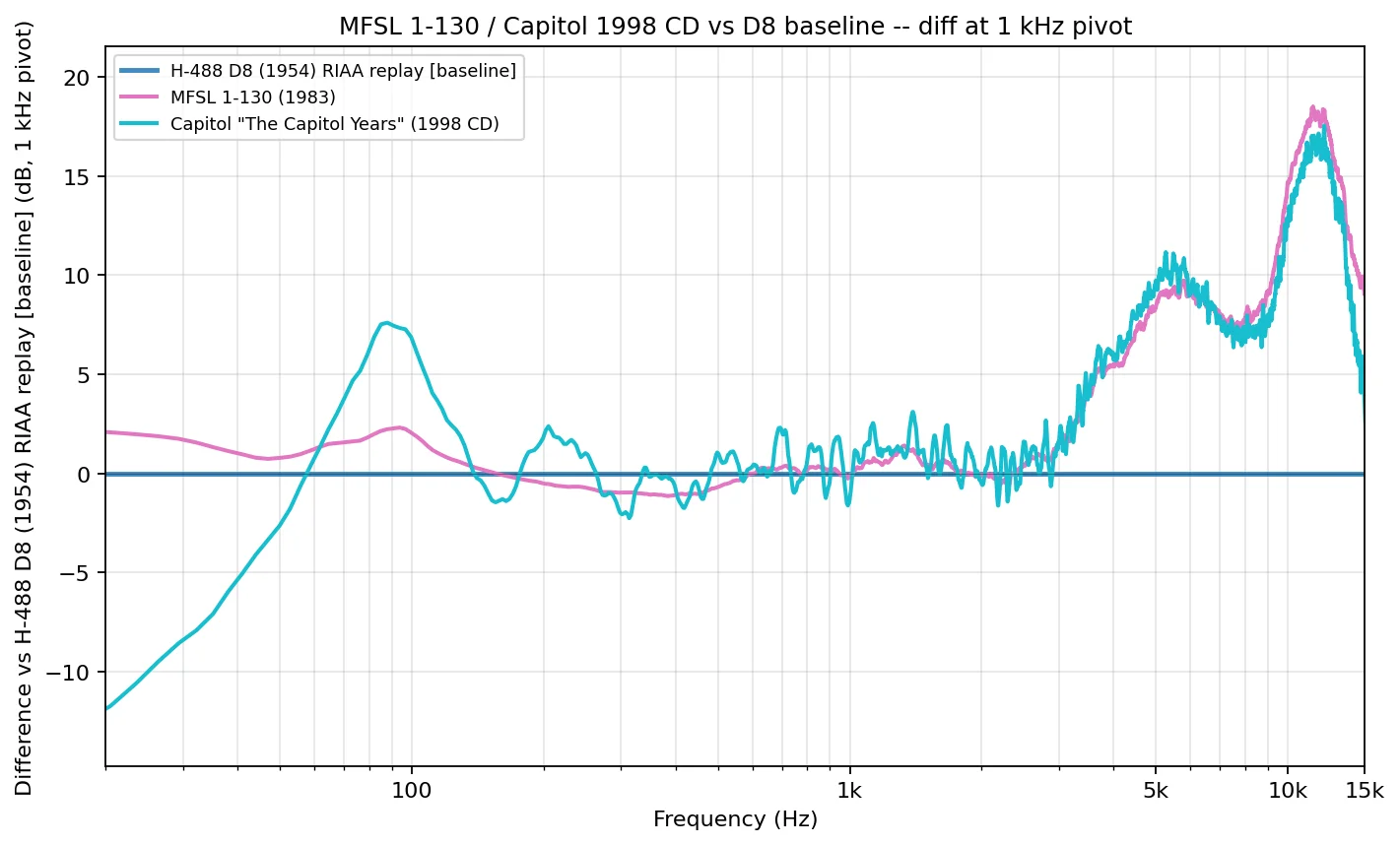
【Fig G】 MFSL 1-130(ピンク、 1983)、 Capitol 1998 CD(水色、 1998)と D8(青、 0 dB を基準)の LTAS 差分。 1 kHz で正規化。両者とも高域帯(5〜12 kHz で +7〜+18 dB)を大きく持ち上げる W-587 系の音作り方向だが、クレストファクタは MFSL 16.70 dB に対し 1998 CD は 19.56 dB と LP の溝の振幅上限を持たないディジタル媒体の性格を示す(筆者解析、 2026年6月2日)。
ところで、興味深いことに、この “The Capitol Years” 1998 マスターは MFSL 1-130 と同じく、バスドラのキックの生々しさを失っていません。曲全体の帯域バランスは MFSL のほうがよりナチュラルですが、キック局所のトランジェント保存という点では 1984/85 ディジタルリマスターも MFSL とほぼ同等の系譜に属するように見えます。「すごいキック音はマスターテープには存在している」という仮説として整理できる、1998 CD と MFSL を貫く 1本の線です。詳細はバスドラ独立記事で改めて扱います。
Notably, this “The Capitol Years” 1998 master, like MFSL 1-130, does not lose the raw immediacy of the kick drum. The overall tonal balance is more natural on MFSL, but for the localized kick-drum transients, the 1984/85 digital remaster appears to belong to roughly the same lineage as MFSL. The 1998 CD and MFSL share a single thread: the working hypothesis that the legendary kick-drum sound was already present on the master tape. A dedicated bass-drum article will take up the details.
ここまでの一連の解析・観察から推測されることをまとめます。 1954〜55年の H-488 初期プレス D1/D2 や D8/D8 は、H-488 用に意図的に高域を落としてカッティングされた、あるいは、当時のカッティングアンプやカッターヘッドの制約などの事情でオリジナルセッションマスターテープの高域を盤に記録しきれなかった、カッティングチェーン由来の凹みを持つ系譜。 1955年の W-587 は、プロダクションマスターのコピー世代を経由しつつ、更新された新世代のカッティングチェーンを通ることで、高域がマスターテープ寄りに開いた系譜、と強く推測されます(1962年の W-1432 はそれとはまた別系統)。これに対して、1983年の MFSL 1-130 はオリジナルセッションマスターテープから直接カッティングされたとされ、1984/85年の “The Capitol Years” 系ディジタルリマスターも、オリジナルセッションマスターテープから直接ディジタルリマスターした可能性のある別系譜です。 Capitol 1955年以降の再発カタログでは、これらの系譜が並走しており、「“Songs For Young Lovers” の音」が時代ごとに別々の語彙で作り直されてきた、そのひとつとして “The Capitol Years” が位置付けられる、というのが、本章のいったんの暫定結論です。
Putting together the analyses and observations so far: the 1954-55 H-488 early pressings (D1/D2 and D8/D8) strongly appear to carry a dip introduced in the cutting chain, either cut with the highs deliberately reduced for H-488, or failing to record the full high-frequency content of the original session master tape onto the disc under the constraints of the cutting amplifier and cutter head of the day; the 1955 W-587, while passing through a production-master copy generation, strongly appears to have been cut on the updated next-generation chain, with highs opening up toward the master tape (with the 1962 W-1432 on yet another branch). The 1983 MFSL 1-130, by contrast, is reported to have been cut directly from the original session master tapes, and the 1984/85 “The Capitol Years” digital-remaster line may likewise have been digitally remastered directly from the original session master tapes, on a separate branch. From 1955 onward, Capitol’s reissue catalog carries these branches in parallel, with “the sound of “Songs For Young Lovers“” rebuilt in a different vocabulary at each era, and “The Capitol Years” sits at one such point. That is the chapter’s provisional summary so far.
A different view when the reference changes
ここまで H-488 D8 を基準に置いて、 D2 / W-587 / ECJ-50017 / W-1432 / MFSL 1-130 / 1998 CD の 6リリースが D8 からどう離れているかを読んできました。一方、同じデータを別の音源を基準に置き換えて見直すと、単一音源基準では見えなかった別の側面 が視覚的に浮かび上がります。ここでは Capitol Years 1998 CD を基準にした場合、そして MFSL 1-130 を基準にした場合の、二つの視点を並べてみます。
With H-488 D8 as the reference, the six releases (D2 / W-587 / ECJ-50017 / W-1432 / MFSL 1-130 / 1998 CD) have been read in terms of how far each departs from D8. Replacing the reference source with a different release and re-reading the same data brings a different facet, invisible under any single reference, into view. Two such perspectives follow: with the Capitol Years 1998 CD as the reference, and with MFSL 1-130 as the reference.
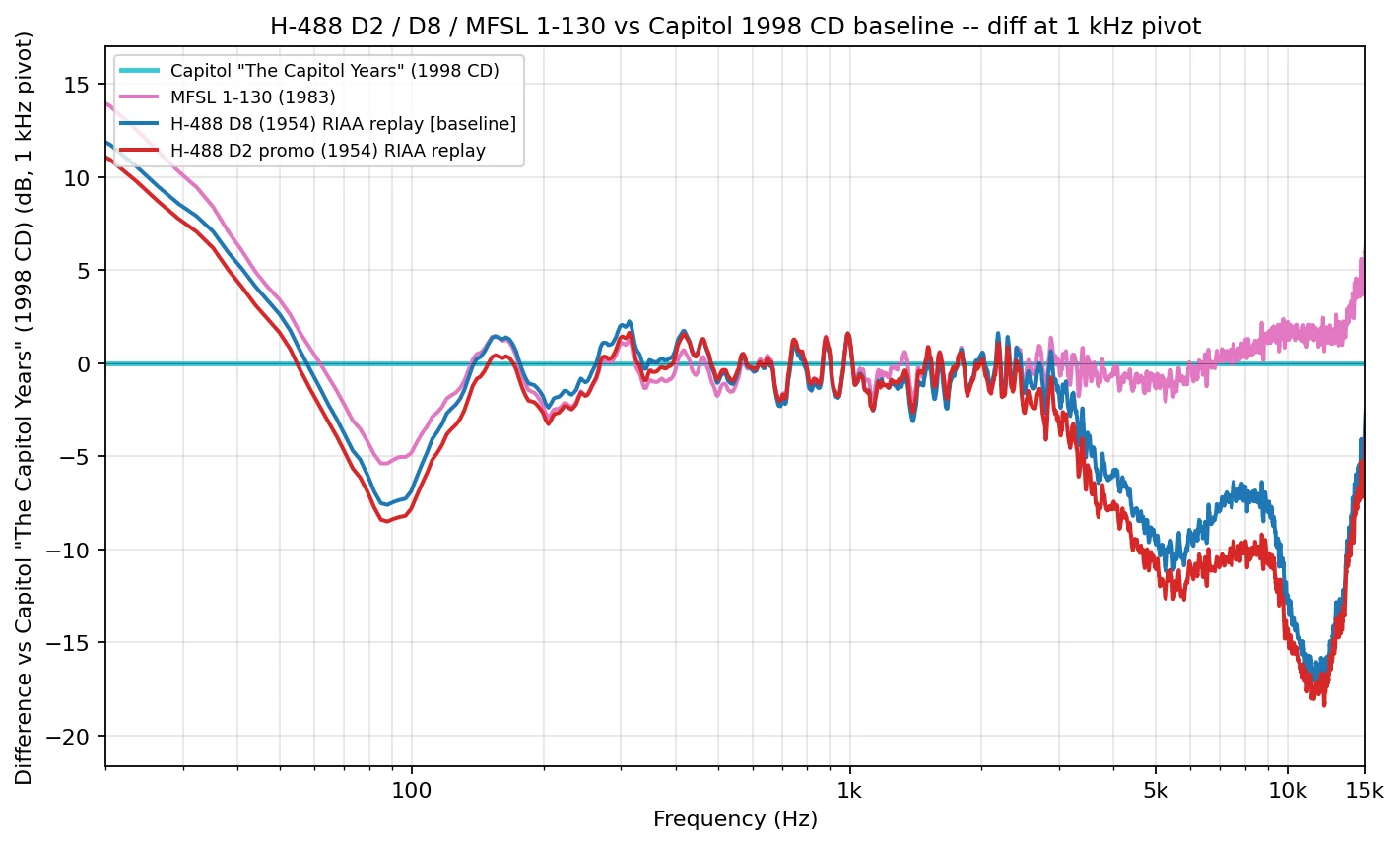
【Fig H】 H-488 D2(赤)、D8(青)、MFSL 1-130(ピンク)と Capitol Years 1998 CD を基準(水色、 0 dB)とした LTAS 差分。 1 kHz で正規化。低中域帯 (50〜200 Hz) で 3音源共通のディップ、高域帯 (5〜12 kHz) で D2/D8 が −7〜−17 dB の大きなディップを示し、 MFSL は ±2 dB 内で 1998 CD と近接(筆者解析、 2026年6月2日)。
まず Capitol Years 1998 CD を基準とした場合 (Fig H)、印象的なのは低中域帯 (50 Hz〜3 kHz) で、 H-488 D2 / D8 / MFSL 1-130 の 3つの音源がそろって 1998 CD から離れていることです。特に 80〜100 Hz のディップ、 200 Hz のディップが、これら 3つで同一に近い形を取り、 1998 CD から −4 〜 −7 dB のディップとして現れます。これは H-488 D2 (1954)、 D8 (1955)、 MFSL 1-130 (1983) が、異なる時代に異なるカッティングチェーンでカッティングされていながら、同一のセッションマスターテープを起点に持つ強い共通点として読めます。一方、 3 kHz 以上の高域帯では D2 / D8 だけが −7 〜 −17 dB の大幅なディップを示し、 MFSL は 1998 CD と ±2 dB 内で近接します。この高域の乖離は、 1955年当時の Capitol カッティングチェーンの物理的な高域帯特性 (カッターヘッドの高域特性、カッティングアンプの特性、ラッカーカッティング時の高域損失など)、および、当時の意図的な高域抑制の実質的な加工量、と仮説的に読むことができます。
First, with the Capitol Years 1998 CD as the reference (Fig H), what stands out is in the low-to-mid band (50 Hz – 3 kHz): H-488 D2, D8, and MFSL 1-130 all depart together from the 1998 CD. The dips around 80–100 Hz and 200 Hz appear in nearly identical shapes across these three sources, registering as −4 to −7 dB dips relative to the 1998 CD. This reads as a strong shared trait: H-488 D2 (1954), D8 (1955), and MFSL 1-130 (1983), cut at different eras through different cutting chains, all trace back to the same session master tape. In the high-frequency band above 3 kHz, by contrast, only D2 and D8 show a large dip of −7 to −17 dB, while MFSL stays within ±2 dB of the 1998 CD. This high-frequency divergence can be read hypothetically as the physical high-frequency response of the 1955-era Capitol cutting chain (the cutter head’s HF response, the cutting amplifier’s HF response, HF losses during lacquer cutting, and so on), together with the effective amount of intentional high-frequency attenuation applied at the time.
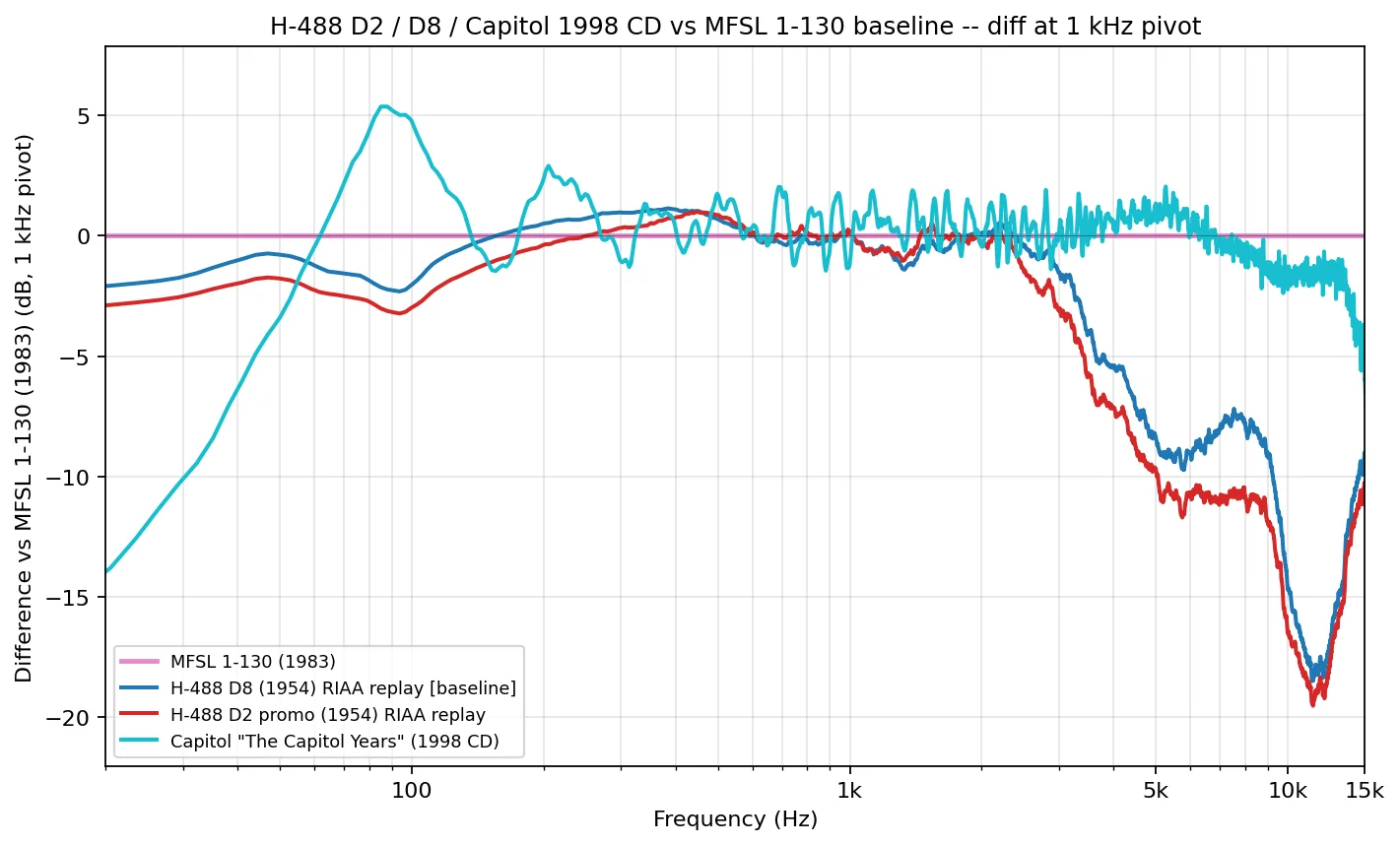
【Fig I】 H-488 D2(赤)、 D8(青)、 Capitol Years 1998 CD(水色)と MFSL 1-130 を基準(ピンク、 0 dB)とした LTAS 差分。 1 kHz で正規化。低中域帯 (50 Hz〜3 kHz) で D2/D8 が ±3 dB 内に張り付く一方、 1998 CD だけが 100 Hz +4.81 dB / 200 Hz +2.27 dB の独自の低域ブーストを示す。高域帯では D2/D8 が −8〜−18 dB のディップ、 1998 CD は MFSL と ±2 dB 内(筆者解析、 2026年6月2日)。
視点を切り替えて MFSL 1-130 を基準にすると、別の側面が見えます (Fig I)。低中域帯 (50 Hz〜3 kHz) では H-488 D2 / D8 が MFSL から ±3 dB 内に張り付き、むしろ Capitol Years 1998 CD だけが 100 Hz で +4.81 dB、 200 Hz で +2.27 dB の上向きの突出を示します。これは 1998 CD だけが他 3音源とは別系統の低域ブーストを持つことを意味します。 1998年 EMI “The Capitol Years” 21枚組ボックスのリマスタリングエンジニアのクレジットは公開情報からは確認できず、加工経路の詳細は不明ですが、 この系譜のどこか(1984/85年のリマスター段、 または 1998年の CD 化段)で、 セッションマスターテープからのフラットトランスファーに対して低域強調が加えられたことを、 LTAS が間接的に示唆します。なお、 この低域ブーストの傾向は、 1998 UK 21CD box を評した Bruce Eder の AllMusic レビュー が “the sound is significantly richer”(音は明らかに豊か)と主観評価で表現しており、 LTAS の定量観察と方向が一致しています。
Now, with MFSL 1-130 as the reference, a different facet emerges (Fig I). In the low-to-mid band (50 Hz – 3 kHz), H-488 D2 and D8 remain close to MFSL within ±3 dB, while only the Capitol Years 1998 CD shows an upward jump of +4.81 dB at 100 Hz and +2.27 dB at 200 Hz. This means that only the 1998 CD carries its own low-frequency boost, on a separate branch from the other three sources. The remastering engineer for the 1998 EMI “The Capitol Years” 21-disc box does not appear in any public source, and the processing chain remains unknown in detail, but LTAS indirectly suggests that somewhere along this line (at the 1984/85 remastering stage, or at the 1998 CD reissue stage) a low-frequency emphasis was added to what would otherwise be a flat transfer from the session master tape. This direction is consistent with Bruce Eder’s AllMusic review of the 1998 UK 21-CD box, which describes the sound as “significantly richer,” a subjective evaluation pointing in the same direction as the LTAS observation.
Fig H(Capitol Years 1998 CD を基準にしたグラフ)と Fig I(MFSL 1-130 を基準にしたグラフ)を並べて読むと、同じ 4音源の LTAS データでも、基準を切り替えるだけで別の構造が見えてきます。帯域別に整理すると、低中域帯では D2 / D8 / MFSL の 3音源が共通点を持ち(同一マスター系統 + LP 媒体の共通制約)、そこから 1998 CD だけが独自の低域ブーストで乖離します。一方高域帯では MFSL / 1998 CD が近接し(マスターテープ系統の高域が両者に保持されている)、 D2 / D8 だけが 1955年 Capitol カッティングチェーンの物理的損失で大きく落ちている、という二重の構造です。
Reading Fig H (with the 1998 CD as reference) and Fig I (with MFSL 1-130 as reference) side by side, the same four-source LTAS data shows different structure under each reference. Organized by band: in the low-to-mid band, three of the four (D2 / D8 / MFSL) share a common envelope (= the same master lineage plus the shared physical constraints of the LP medium), with only the 1998 CD departing through its own low-frequency boost. In the high-frequency band, MFSL and the 1998 CD sit close together (= the master-tape lineage’s HF content is preserved in both), while only D2 and D8 drop substantially through the physical losses of the 1955 Capitol cutting chain. Two distinct axes thread through the same data.
もちろん、セッションマスターテープに筆者がアクセスできない以上、「どの音源がどの帯域でマスターテープに忠実か」を断言することはできませんし、ここで述べているのは仮説の枠を出ません。ただし、同一マスター由来の共通点、 1955年 Capitol カッティングチェーンの高域損失、 1998 CD の独自の低域ブースト、この 3つは LTAS データの内部で互いに矛盾せず整合します。 H-488 と “Songs For Young Lovers” の系譜は、単一の基準では一枚の絵にしか見えませんが、基準を切り替えると、マスター系統 + 1955年カッティング機材 + 1980年代以降のディジタルリマスターという三つの異なる加工が透けて見える、という方法論的気づきが、本章の最後に残りました。
Without access to the session master tapes, it is of course impossible to assert which source is faithful to the master tape in which band, and the discussion here remains within hypothesis. Yet three observations — the common envelope shared by sources of the same master lineage, the high-frequency losses of the 1955 Capitol cutting chain, and the 1998 CD’s independent low-frequency boost — sit consistently together inside the LTAS data, without contradiction. Under a single reference, the H-488 / “Songs For Young Lovers” lineage looks like a single picture; but switching the reference makes three distinct processing layers visible through the same data: master lineage, 1955 cutting equipment, and the digital remastering from the 1980s onward. That methodological observation closes this chapter.
The five layers side by side, and what lies outside
本章で扱った 6つのリリースの外にも、Sinatra “Songs For Young Lovers” 系の H-488 楽曲には別系統の CD がいくつか存在します。たとえば 1987年の Capitol CDP 7 48470 2 (Larry Walsh リマスター)は、別途解析したところ初期 CD らしい低域の痩せと高域のクリフエッジカット(急峻なカットオフ)が確認できました。また、Bob Norberg リマスター系として TOCJ-5772 (1993)、72434 96089 2 4 (1998)、TOCJ-9308 (2001) があり、これらは英国/欧州側でリリースされた “The Capitol Years” とは別系統の、米国/日本側のリマスター系譜です。これらのうち TOCJ-9308 と、2004年の “The Platinum Collection”(Capitol 7243 8 64765 2 4、ただし CCCD)は筆者手元にあり、同じ LTAS 解析を加えました。“Songs For Young Lovers” は 2013年と 2015年にも別のエンジニアによってリマスタリングされており、これらを併せると、ディジタル化以後の “Songs For Young Lovers” は 5 つのマスタリング系譜 に分かれます。詳細は下記の補足にまとめます。ただし真の Bob Norberg 系統の基準音源となる 1998年の US 初版 CD(7243 4 96089 2 4) は、現時点では未入手のままです。
Outside the six releases treated in this chapter, several other CD lineages exist for the H-488 / “Songs For Young Lovers” material. The 1987 Capitol CDP 7 48470 2 (Larry Walsh remaster), analyzed separately, shows the early-CD-typical low-end trim and a cliff-edge cutoff in the high frequencies (a steep upper cutoff). The Bob Norberg remaster line — TOCJ-5772 (1993), 72434 96089 2 4 (1998), and TOCJ-9308 (2001) — forms a separate US/Japan lineage from the UK/European “The Capitol Years” branch. Of these, TOCJ-9308 and the 2004 “The Platinum Collection” (Capitol 7243 8 64765 2 4, on a CCCD pressing) are in the author’s hands and have been analyzed in the same way. “Songs For Young Lovers” was also separately remastered in 2013 and again in 2015 by different engineers; taken together, the post-digital release history of “Songs For Young Lovers” divides into five mastering lineages. The details are gathered in the side note below. The Bob Norberg line’s true anchor — the 1998 US first-edition CD (7243 4 96089 2 4) — however remains unobtained at present.
“Songs For Young Lovers” のリイシュー CD(= H-488 / W-587 / W-1432 を元にしたアルバム、 およびそれらを含むボックスセット)、 および当該アルバム収録曲「I Get A Kick Out Of You」 が収められた Capitol 公式コンピレーション CD を Discogs ベースで整理してみると、 ディジタルマスタリングは次の 5 系統に分かれます。担当エンジニアごとに編集判断が異なり、同じセッションマスターから派生していても聞こえ方は別物になります。
- UK EMI 1984-(担当未確認、1985 UK 20LP ボックス “The Capitol Years” 用が源流、1987 UK CD “The Sinatra Collection”、1998 UK 21CD ボックス “The Capitol Years”)
- Larry Walsh 1987-(Capitol Recording Studios、1987 US CDP 7 48470 2、1992 US 16CD “Concepts” ボックス。1990 US 3CD “The Capitol Years” は再リマスターの可能性あり)
- Bob Norberg 1998-(Capitol Studios、1998 US 7243 4 96089 2 4、2000 US “Concepts” 再発、2001 JP TOCJ-9308、2004 US “The Platinum Collection”)
- Mike Jones 2013(Universal Mastering Studios、2013 US “ICON”)
- Robert Vosgien 2015-(Capitol Studios、2015 US “Ultimate Sinatra” 4CD + “Songs For Young Lovers” HDtracks 24/192、2023 US “Platinum” 2CD は流用推定)
Cross-referencing Discogs’s catalogs, the source material covered here consists of CD reissues of “Songs For Young Lovers” (= albums derived from H-488 / W-587 / W-1432 and the box sets containing them) together with the Capitol official compilation CDs that include the analyzed track “I Get A Kick Out Of You”. Across all of these, the digital mastering divides into the following five lineages. Each remastering engineer brings a different set of editorial choices, so even when they share the same session master, the audible result diverges.
- UK EMI 1984- (engineer unconfirmed; source: 1985 UK 20LP box “The Capitol Years“; later used in 1987 UK CD “The Sinatra Collection” and the 1998 UK 21CD box “The Capitol Years“)
- Larry Walsh 1987- (Capitol Recording Studios; 1987 US CDP 7 48470 2; 1992 US 16CD “Concepts” box. The 1990 US 3CD “The Capitol Years” may be a separate Walsh remaster)
- Bob Norberg 1998- (Capitol Studios; 1998 US 7243 4 96089 2 4; 2000 US “Concepts” reissue; 2001 JP TOCJ-9308; 2004 US “The Platinum Collection“)
- Mike Jones 2013 (Universal Mastering Studios; 2013 US “ICON“)
- Robert Vosgien 2015- (Capitol Studios; 2015 US “Ultimate Sinatra” 4CD plus “Songs For Young Lovers” HDtracks 24/192; the 2023 US “Platinum” 2CD is presumed to reuse this source)
このうち手元で LTAS 解析できたのは、UK EMI 1984- 系(= 1998 UK ボックスの “Songs For Young Lovers”)、Larry Walsh 1987- 系(= 1987 US 初版 CD)、Bob Norberg 1998- 系の 2 リリース(= 2001 JP TOCJ-9308 + 2004 US “The Platinum Collection”)、Robert Vosgien 2015- 系(= “Songs For Young Lovers” HDtracks 24/192)の 4 系統 5 リリース です。これに 1983 MFSL 1-130(LP)と H-488 D8(LP)を加えた 7 リリースの LTAS を、MFSL 1-130 を基準音源として並べると、次の数値になります。
Among these, four lineages across five releases could be analyzed with the materials at hand: UK EMI 1984- (the “Songs For Young Lovers” from the 1998 UK box), Larry Walsh 1987- (the 1987 US first-edition CD), Bob Norberg 1998- (two releases: the 2001 JP TOCJ-9308 and the 2004 US “The Platinum Collection“), and Robert Vosgien 2015- (the “Songs For Young Lovers” HDtracks 24/192). With the 1983 MFSL 1-130 (LP) and H-488 D8 (LP) added, the LTAS of all seven releases — taking MFSL 1-130 as the reference — gives the following numbers.
| Hz | EMI UK ’98 | Walsh ’87 | Norberg ’01 | Norberg ’04 | Vosgien ’15 HD | D8 |
|---|---|---|---|---|---|---|
| 50 | -3.44 | -2.82 | -2.38 | -2.46 | -1.52 | -0.78 |
| 100 | +4.82 | +2.98 | +2.74 | +5.89 | -6.07 | -2.05 |
| 1k | 0 (ref) | 0 (ref) | 0 (ref) | 0 (ref) | 0 (ref) | 0 (ref) |
| 5k | +1.34 | -1.17 | -1.87 | +1.98 | -4.08 | -8.39 |
| 10k | -2.18 | -5.49 | -2.95 | -2.20 | -5.12 | -14.67 |
| 15k | -5.80 | -13.54 | -3.81 | -11.80 | -7.50 | -9.03 |
| crest factor (dB) | 19.56 | 19.02 | 14.62 | 16.81 | 17.06 | 15.21 |
読みどころは 4 点です。 (1) Walsh 1987 と Norberg 2004 は 15 kHz で -11〜-13 dB の二大高域ロールオフ系統。 1980 年代初期 CD マスタリングの慣行と、2000 年代中盤コンピレーション用編集の方針が、世代の異なる理由で同方向に出ています。 (2) Vosgien 2015 だけ 100 Hz が凹む方向、他はすべて盛り上がる方向。 2015 公式リマスタリングが脚色しないフラット志向に振った、もしくはマスターテープの実際の低域(= 1953年録音の低域応答の上限)に近づけた可能性があります。 (3) Norberg 2001 と 2004 は同じエンジニア名義でも、LTAS 上は明確に別マスター。 2001 を基準にして 2004 を見ると、100 Hz +3.14、5 kHz +3.86、15 kHz -7.98 dB、クレストファクタ +2.19 dB と系統的な変化があり、2004 ライナーの「Mastering Supervisor: Ron Christie」 を反映している可能性もあります。 (4) 中域 1〜3 kHz はディジタル 5 系列すべてが MFSL 比 ±2 dB 以内。中域はセッションマスター由来の基盤が共通、低域・高域が「マスタリング介入 + システム制約」 で分かれる、という二段の読み方ができます。
Four points stand out. (1) Walsh 1987 and Norberg 2004 form the two HF-rolloff lineages, both at -11 to -13 dB at 15 kHz. Early-1980s CD mastering convention and mid-2000s compilation editing converge in the same direction for different generational reasons. (2) Only Vosgien 2015 dips at 100 Hz; the others all bump upward. The 2015 official remaster either swung toward a flatter, less colored balance, or moved closer to the upper bound of the actual master-tape bass response (i.e., the 1953 session’s bass response). (3) Norberg 2001 and 2004 carry the same engineer name, but on LTAS they are clearly different masters: with 2001 as the reference, 2004 sits at 100 Hz +3.14, 5 kHz +3.86, 15 kHz -7.98 dB, with crest factor +2.19 dB — a systematic shift that may reflect the “Mastering Supervisor: Ron Christie” credited on the 2004 sleeve. (4) The midrange between 1 and 3 kHz lies within ±2 dB of MFSL across all five digital lineages: the midrange carries the common session-master signature, while LF and HF diverge under the combined influence of mastering choices and system constraints.
留保事項もいくつかあります。 2004 “The Platinum Collection” は CCCD(Copy-Controlled CD)のため、通常 CD 再生と PC リッピングで結果が違う可能性が排除できません(= ディスク自身が意図的なエラーを含む)。ただし LTAS で見える形状は規則的な周波数応答変化で、リッピングエラー由来のランダムノイズやクリックとは異なるパターンです。 Bob Norberg 系の本来の基準音源となる 1998 US 初版 CD(Capitol 7243 4 96089 2 4) は未入手で、これを入手すれば「1998 ≒ 2001 TOCJ 流用、2004 は別マスター」「1998 ≒ 2004」「Norberg 名義はリリースごとに別作業」 の 3 通りのどれであるかを判別できます。また、1985〜1995 年あたりの初期日本盤 CD(CP32-5561 / TOCJ-5303 / TOCJ-5772 / TOCJ-5958 等)のマスタリング担当も大半が未確認で、TOCJ-5958(1995)は帯に「HS-2088 20bit 88.2kHz MASTERING」 記載があり東芝 EMI の HS-2088 系独自リマスタリングと推定できる程度です。
Several caveats remain. The 2004 “The Platinum Collection” is a CCCD (Copy-Controlled CD), so deliberate disc-level errors cannot be ruled out as a source of differences between normal CD playback and PC ripping. However, the shape visible on LTAS is a systematic frequency-response change, distinct from the random-noise or click pattern typical of ripping errors. The true anchor of the Bob Norberg line — the 1998 US first-edition CD (Capitol 7243 4 96089 2 4) — is not yet in the author’s hands; obtaining it would settle one of three possibilities: “1998 ≒ 2001 TOCJ reuse, 2004 a separate master,” “1998 ≒ 2004,” or “the Norberg name covers different work on every release.” Most of the early Japanese CDs from roughly 1985 to 1995 (CP32-5561 / TOCJ-5303 / TOCJ-5772 / TOCJ-5958, etc.) likewise have their mastering engineers unconfirmed; only TOCJ-5958 (1995) carries an obi indicating “HS-2088 20bit 88.2kHz MASTERING,” which suggests Toshiba EMI’s own HS-2088 line of remastering, no further details.
ここまで見てきた 6つのリリースを並べると、H-488 “Songs For Young Lovers” は単一の音源ではなく、カッティングカーブの切り替わりを挟む D2 (1954) と D8 (1955)、再発時のリマスター性格 (W-587 / W-1432)、マスターテープ直系のオーディオファイル盤 (MFSL 1-130)、ディジタル世代の再解釈 (1998 CD) という、5段階の「音のタイムカプセル」を作っていることが見えてきます。 20年前に主観で書いた「最初期は AES カーブの可能性」という問いは、その系譜のいちばん古い 1枚 (D2) を、物理証拠と LTAS と Re-EQ で改めて読み直す作業でもありました。
Placing the six releases side by side, H-488 “Songs For Young Lovers” emerges not as a single source but as five layers of sonic history: D2 (1954) and D8 (1955) framing the cutting-curve switch, the remastering character of the reissues (W-587 / W-1432), the master-tape-direct audiophile pressing (MFSL 1-130), and the digital-era reinterpretation (1998 CD). The subjective question raised 20 years ago (“the earliest pressing may carry the AES curve”) also turned out to be an exercise in re-reading the oldest disc in that lineage (D2) through physical evidence, LTAS, and Re-EQ.
Coming up: Continued in Liner Notes II-c
本稿では、 Capitol H-488 “Songs For Young Lovers” の再発・リマスター系を 5 リリース横並びで読みました。 1955年の 12インチ再発 W-587、 1977年の日本盤 ECJ-50017、 1962年の再パッケージ W-1432、 1983年の MFSL 1-130、 そして 1984/85年のディジタルリマスター由来 1998 CD “The Capitol Years” まで、 LTAS と物的傍証を併用しながら、 時代ごとの音作りの違いと、 同じセッションマスターから派生した系譜の見え方を読み解いてきました。
This Liner Notes II-b has read the reissue and remaster lineage of Capitol H-488 “Songs For Young Lovers” across five releases side by side: the 1955 W-587, the 1977 Japanese ECJ-50017, the 1962 W-1432, the 1983 MFSL 1-130, and the 1998 CD “The Capitol Years” derived from a 1984/85 digital remaster. LTAS and physical evidence have been used together to read the differences in sound design at each era, and how the lineage branching from the same session master comes into view.
続く Liner Notes II-c では、 H-488 セッションの半年あまり前(1953年4月)に録音された Capitol H-477 “The Duke Plays Ellington” と、 数年後に 12インチ化されてリリースされ直し、 4曲追加 + 高域の強調が加わった T-477 に同じ手法を適用します。 Sinatra のヴォーカル + 編曲というプログラムから、 Ellington のソロピアノ + ベース + ドラムスというより質感の異なるプログラムに換えると、 LTAS で読める録音 EQ カーブの特性はどう見えるのか。 H-488 で見えた 1955年 Capitol カッティングチェーンの特性は、 H-477 / T-477 でも再現するのか、 それとも異なる景色になるのか。
Liner Notes II-c applies the same approach to Capitol H-477 “The Duke Plays Ellington”, recorded in April 1953, some seven months before the H-488 sessions, together with T-477, the 12-inch reissue released a few years later with four added tracks and extra high-frequency emphasis. When the program changes from Sinatra’s vocal-plus-arrangement to Ellington’s solo piano with bass and drums (a different sonic texture), how do the recording EQ characteristics read on LTAS? And does the 1955-era Capitol cutting chain seen in H-488 reproduce on H-477 / T-477, or does a different picture emerge?
そして Liner Notes II-c の末尾には、 II-a / II-b / II-c の 3 本を通じての 「LTAS で分かること / 分からないこと」 のまとめを置きます。 LTAS という解析手法で何が客観的に切り分けられ、 何が原理的に切り分けられないままか、 そしてその先(カッティングマスター系譜の判別、 マスタリングエンジニアの音作り判断、 個別プレスの物理特性)を見るために何が必要か、 を整理して、 本シリーズ Liner Notes II の区切りとします。
At the end of Liner Notes II-c, a summary across all three (II-a / II-b / II-c) will appear under the heading “What LTAS can show / what it cannot.” The closing pass will lay out what LTAS as an analysis method can objectively separate, what it cannot in principle, and what further tools are needed to look past that boundary (identification of cutting-master lineages, judgment calls about a remastering engineer’s sound design, the physics of individual pressings). That will mark the end of this Liner Notes II series.
» Phono EQ Curves Liner Notes II-c, to be continued »