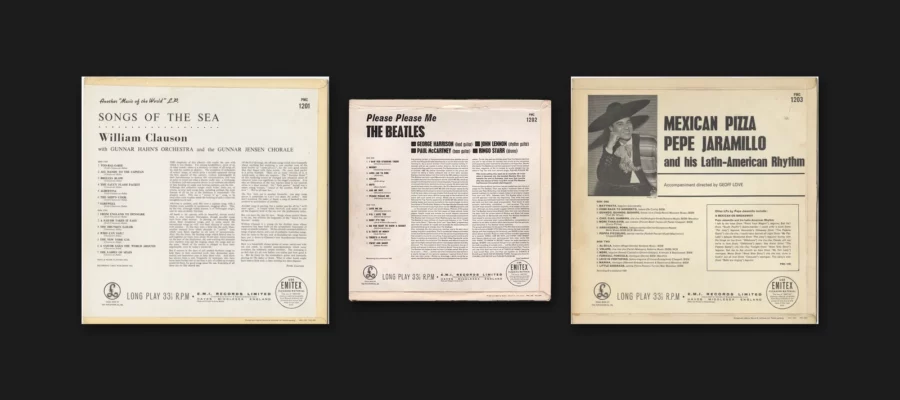
This article is presented in Japanese and English on the same page.
前の記事 (Pt. 2)では、Please Please Me の隣接盤である PMC 1201 と PMC 1203 を、盤面と番号から見てきました。この記事では、2枚の隣接盤のアーティストについて、そして収録された音楽内容について、みていきましょう。
In the previous article (Pt. 2) I looked at PMC 1201 and PMC 1203, the records next to Please Please Me, from the vinyl itself and from their catalogue and matrix numbers. In this article, let me look at the artists on the two records, and at the music they contain.
変更履歴 / Revision History
- 2026年10月27日: 初版公開
- 27 October 2026: Initial publication
PMC 1201: Songs Of The Sea
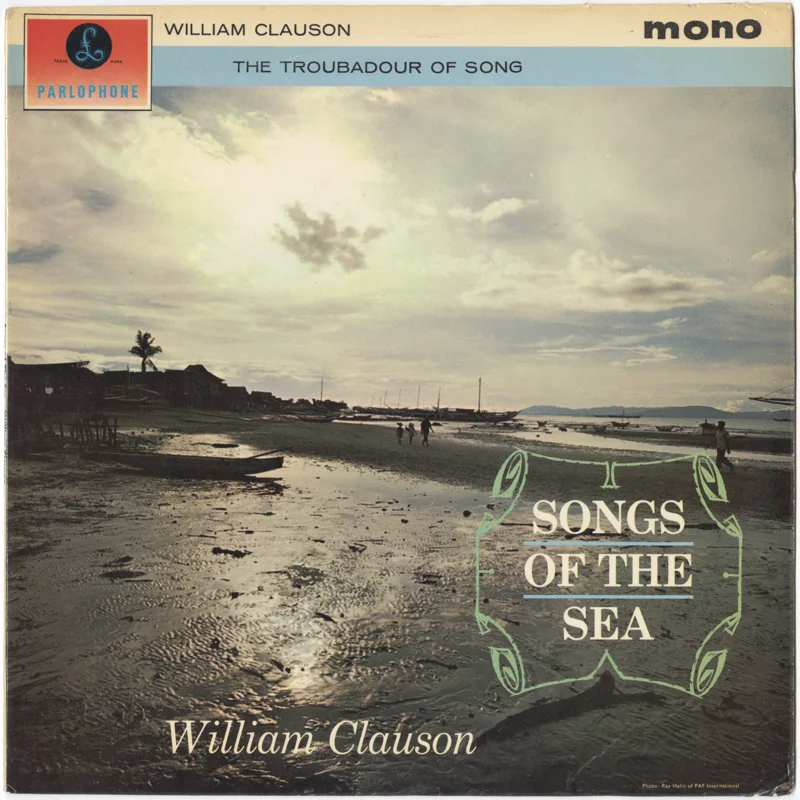
Front cover of PMC 1201, Songs Of The Sea (William Clauson)
Who Made It
まず PMC 1201 の ウィリアム・クラウソン (William Clauson)。 1930年、オハイオ州に、スウェーデンからの移民の両親のもとで生まれました。幼いころから一家でスウェーデンと米国を行き来して育ち、1954年にスウェーデンへ戻っています。 1962年にはスウェーデンの人気テレビ番組 Hylands hörna に出ていて、スウェーデンではよく知られた歌手でした。
First, William Clauson of PMC 1201. He was born in Ohio in 1930 to parents who had emigrated from Sweden. From early childhood the family moved back and forth between Sweden and the United States, and in 1954 he returned to Sweden. In 1962 he appeared on the popular Swedish television programme Hylands hörna, and he was a well-known singer in Sweden.
英国の EMI との関係は、PMC 1201 より前から始まっています。 1956年、英 HMV から LP Folk Songs And Ballads (CLPC 11) が出ました。伴奏は John Gregory のグループで、ライナーは English Folk Dance and Song Society のディレクター Douglas Kennedy が書いています。 Discogs で国を英国に絞って数えると、Clauson の英国 LP はこの1枚と PMC 1201 の2枚です。
His connection with EMI in Britain goes back before PMC 1201. In 1956 the LP Folk Songs And Ballads (CLPC 11) came out on British HMV. The accompaniment was by John Gregory’s group, and the liner notes were written by Douglas Kennedy, the director of the English Folk Dance and Song Society. Counting on Discogs with the country narrowed to the UK, Clauson’s British LPs come to two: this one and PMC 1201.
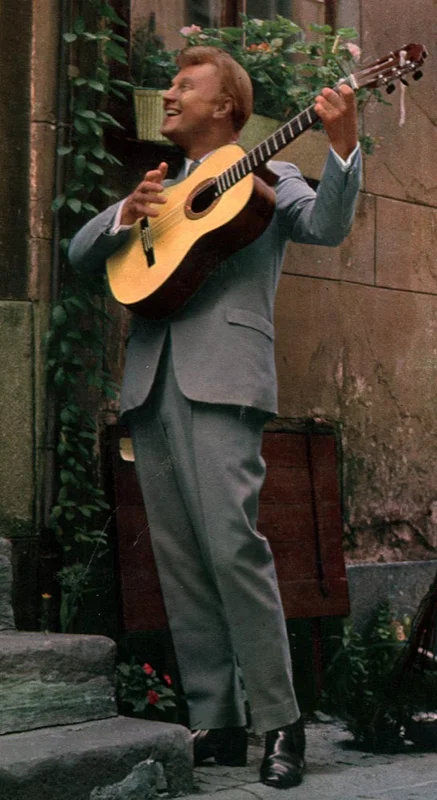
William Clauson in 1966. From the cover photo of the LP Serenaden i prästgatan (Polydor LPHM 46255).
(Photo: Lars-Åke Pallén / Wikimedia Commons, public domain)
詩人 Carl Sandburg は Clauson を “a Viking of song” と評していて、この評は1956年の盤のライナーにも引かれています。 PMC 1201 の表ジャケットには “THE TROUBADOUR OF SONG” の文字が刷られています。
The poet Carl Sandburg called Clauson “a Viking of song”, and that phrase is quoted in the liner notes of the 1956 record too. The front cover of PMC 1201 carries the words “THE TROUBADOUR OF SONG”.
伴奏については、裏ジャケットの表題部に “with GUNNAR HAHN’S ORCHESTRA and the GUNNAR JENSEN CHORALE” とあります。
As for the accompaniment, the title block on the back cover reads “with GUNNAR HAHN’S ORCHESTRA and the GUNNAR JENSEN CHORALE”.
グンナル・ハーン(Gunnar Hahn、1908〜2001)はストックホルムのピアニスト、アコーディオン奏者、編曲家で、民謡と民俗舞踊を素材にした人です。スウェーデン語版 Wikipedia は、1950年代にはラジオで彼の音楽がよく流れ、当時の「民俗音楽はこう鳴るものだ」という感覚を形づくった、と書いています。
Gunnar Hahn (1908 to 2001) was a pianist, accordionist and arranger in Stockholm who worked with folk songs and folk dances as his material. According to the Swedish Wikipedia, his music was often heard on the radio in the 1950s and shaped what people at the time felt folk music ought to sound like.
この Hahn の自筆の編曲譜が、Musik- och teaterbiblioteket という図書館の個人アーカイブに残っていました。目録を引いてみると、PMC 1201 の14曲すべての編曲譜が見つかります。年の書いてある12件は、どれも1961年か1962年です。
Hahn’s handwritten arrangements survive in a personal archive at a library called Musik- och teaterbiblioteket. Looking through the catalogue of Gunnar Hahn’s archive, I found arrangements for all 14 songs on PMC 1201. The 12 entries that give a year all say 1961 or 1962.
ですから、録音は1962年ごろと見られます。前の記事で見た、スウェーデンの図書館の目録の「1963年5月発売」とも順序が合います。
So the recording appears to date from around 1962. That also fits, in order of events, with the entry in the Swedish national library’s database that I looked at in the previous article, which has the record issued in May 1963.
裏ジャケットの作者表記には “Swift-Clauson-arr.Hahn” が6曲、”Clauson-arr.Hahn” が8曲あります。盤に姓しかないこの “Swift” は、英国の詩人 Basil Swift と見られます。同じ1963年にストックホルムの出版社と Oxford University Press から出た歌集 Sing a merry Song が、Clauson の曲、Swift の詞、Hahn の編曲という3人の組み合わせで作られているからです。名の Basil は、この歌集の LIBRIS(スウェーデン国立図書館の総合目録)の書誌に “Words by Basil Swift” とあり、Discogs の登録でも編集者が補っています。
In the writer credits on the back cover, 6 songs are credited “Swift-Clauson-arr.Hahn” and 8 “Clauson-arr.Hahn”. This “Swift”, given only by surname on the record, appears to be the British poet Basil Swift. This is because a songbook, Sing a merry Song, published in the same year, 1963, by a Stockholm publisher and Oxford University Press, was made by the same combination of three people: music by Clauson, words by Swift, arrangements by Hahn. The first name Basil comes from the bibliographic record of this songbook in LIBRIS (the union catalogue of the Swedish national library), which says “Words by Basil Swift”, and an editor has supplied it on the Discogs entry as well.
Gunnar Jensen Chorale については、盤の表記のまま記しておきます。どういう合唱団なのかは分かりません。
As for the Gunnar Jensen Chorale, I leave the name as it is printed on the record. I do not know what kind of choir it was.
What Is on It
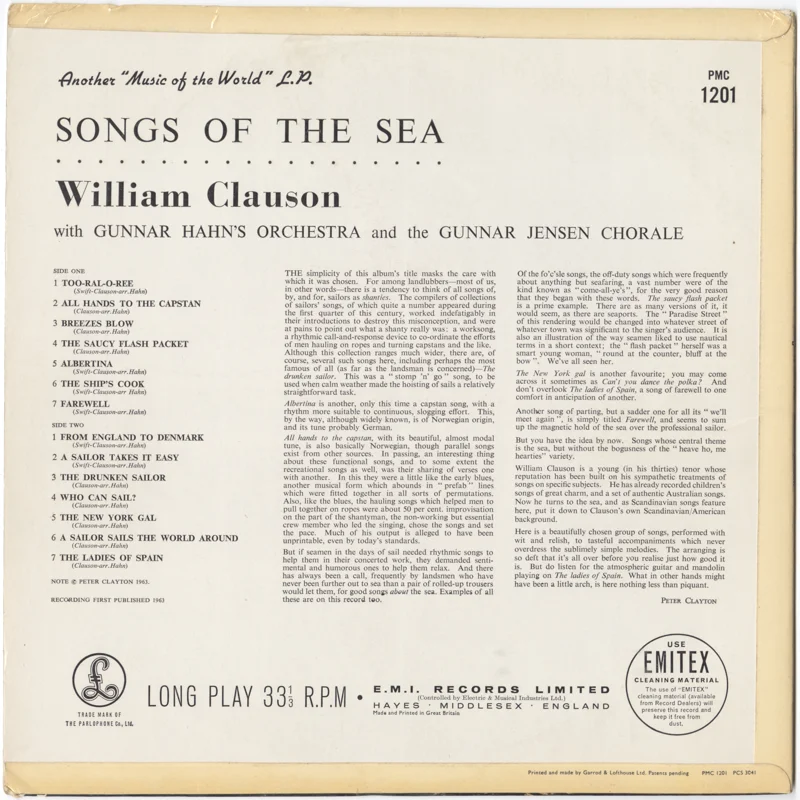
Back cover of PMC 1201, Songs Of The Sea (William Clauson)
PMC 1201 Songs Of The Sea のライナーで、Peter Clayton は “as Scandinavian songs feature here” と、北欧の歌が入っていることを書いています。どの曲がどこから来たのかは、上で触れた Gunnar Hahn の編曲譜の目録に、曲ごとの記載があります。「ノルウェーの船乗りの歌による」「ボーヒュースレーンの船乗りの歌による」「オーランドの船乗りの歌」といった書き方です。目録に記載のない曲は、Hugill(1961年)と Sternvall(1935年)の本、それに Clayton のライナーで補いました。
In the liner notes of PMC 1201, Songs Of The Sea, Peter Clayton notes that Scandinavian songs are included, with the words “as Scandinavian songs feature here”. Which song came from where is noted song by song in the catalogue of Gunnar Hahn’s archive that I mentioned above. The entries say things like: based on a Norwegian sailors’ song, based on a sailors’ song from Bohuslän, a sailors’ song from Åland. For the songs whose catalogue entries give no origin, I filled in from the books by Hugill (1961) and Sternvall (1935) and from Clayton’s liner notes.
14曲すべてが英語で歌われています。曲ごとの対応を、曲名、元の歌、出どころの3列の表にまとめます。
All 14 songs are sung in English. Here is a table of the correspondences, song by song, in three columns: the song, the original song, and where it comes from.
| 曲 | 元の歌 | 出どころ |
|---|---|---|
| A1 Too-ral-o-ree | (題の記載なし) | ノルウェー。目録に「ノルウェーの船乗りの歌による」とあります |
| A2 All Hands To The Capstan | ボーヒュースレーンの船乗りの歌 | スウェーデン(西岸のボーヒュースレーン)。目録に「ボーヒュースレーンの船乗りの歌による。詞 W. Clauson」とあります |
| A3 Breezes Blow | “Vinden drar, skeppet far” の英語詞版 | オーランド諸島。目録に「オーランドの船乗りの歌」とあります |
| A4 The Saucy Flash Packet | 英語圏の船歌(目録の副題は “Come all ye young sailors”) | 英語圏。どの歌にあたるかは、ここでは決めずにおきます |
| A5 Albertina | “Skonnert Albertina” | 北欧の船乗りの歌。 Hugill と Sternvall はノルウェー起源とします |
| A6 The Ship’s Cook | ドイツの旋律(題の記載なし)に Basil Swift の英語詞 | ドイツ(旋律)。目録に「詞 Basil Swift。ドイツの旋律による」とあります |
| A7 Farewell | “En sjöman älskar havets våg” の英語版と見られます | スウェーデン |
| B1 From England To Denmark | “Från Engeland till Skottland” の英語版と見られます | スウェーデン |
| B2 A Sailor Takes It Easy | 目録に元の記載なし | 記載なし |
| B3 The Drunken Sailor | “Drunken Sailor” | 英国の船歌 |
| B4 Who Can Sail? | “Vem kan segla förutan vind?” | オーランド諸島の民謡とされる歌 |
| B5 The New York Gal | “New York Girls”(別名 “Can’t you dance the polka?”。 Clayton のライナーもこの別名を挙げています) | アメリカの船歌 |
| B6 A Sailor Sails The World Around | 目録に元の記載なし | 記載なし |
| B7 The Ladies Of Spain | “Spanish Ladies” | 英国の船歌 |
| Song | Original song | Origin |
|---|---|---|
| A1 Too-ral-o-ree | (no title given) | Norway. The catalogue says it is based on a Norwegian sailors’ song |
| A2 All Hands To The Capstan | A sailors’ song from Bohuslän | Sweden (Bohuslän, on the west coast). The catalogue says it is based on a sailors’ song from Bohuslän, with words by W. Clauson |
| A3 Breezes Blow | English-language version of “Vinden drar, skeppet far” | The Åland Islands. The catalogue calls it a sailors’ song from Åland |
| A4 The Saucy Flash Packet | An English-language sea song (the catalogue gives the subtitle “Come all ye young sailors”) | English-speaking world. I leave open here which song it corresponds to |
| A5 Albertina | “Skonnert Albertina” | A Nordic sailors’ song. Hugill and Sternvall give it a Norwegian origin |
| A6 The Ship’s Cook | A German melody (no title given) with English words by Basil Swift | Germany (melody). The catalogue says words by Basil Swift, based on a German melody |
| A7 Farewell | Appears to be an English version of “En sjöman älskar havets våg” | Sweden |
| B1 From England To Denmark | Appears to be an English version of “Från Engeland till Skottland” | Sweden |
| B2 A Sailor Takes It Easy | No original given in the catalogue | Not given |
| B3 The Drunken Sailor | “Drunken Sailor” | British sea song |
| B4 Who Can Sail? | “Vem kan segla förutan vind?” | A song said to be a folk song of the Åland Islands |
| B5 The New York Gal | “New York Girls” (also known as “Can’t you dance the polka?”. Clayton’s liner notes give this other name too) | American sea song |
| B6 A Sailor Sails The World Around | No original given in the catalogue | Not given |
| B7 The Ladies Of Spain | “Spanish Ladies” | British sea song |
数えると、英米の船歌が4曲(A4・B3・B5・B7)、北欧の船乗りの歌の英語版が6曲から7曲、ドイツの旋律に新しい英語詞を付けたものが1曲、目録に元の記載のないものが2曲です。北欧の内訳は、ノルウェーが A1、スウェーデンが A2・A7・B1、オーランド諸島が A3・B4、それに A5 です。 A1 と A6 については、目録が元の歌を「ノルウェーの船乗りの歌」「ドイツの旋律」と書くだけで、題までは分かりません。
Counting up, there are 4 British and American sea songs (A4, B3, B5 and B7), 6 or 7 English versions of Nordic sailors’ songs, 1 song with new English words set to a German melody, and 2 for which the catalogue gives no original. The Nordic ones break down as Norway for A1, Sweden for A2, A7 and B1, the Åland Islands for A3 and B4, plus A5. For A1 and A6, the catalogue only describes the originals as a Norwegian sailors’ song and a German melody, so the titles are not known.
つまりこの盤は、英語で歌われる、英米と欧州(とくに北欧)の船歌集です。英語詞の作者として作者表記と目録に名があるのは、Clauson と Swift の2人です。なお、Clayton のライナーと編曲者の目録は、2曲の出どころについて食い違っています1。
In short, this record is a collection of British, American and European (especially Nordic) sea songs, sung in English. The two people named as writers of the English words, in the credits and in the catalogue, are Clauson and Swift. Clayton’s liner notes and the arranger’s catalogue disagree, by the way, about the origin of two songs1.
How It Sounds
盤起こし中はスピーカから、そして移動中には盤起こし音源をヘッドフォンから、とにかくアルバムを聴き込むことにしました2。第一印象は、なんというか、とっても不思議なフォークソング集だ、というものでした。
I decided to listen to the album as much as I could: through the speakers while I was digitising the record, and through headphones from the digitised files while I was out and about2. My first impression was that this is, how shall I put it, a very puzzling but intriguing collection of folk songs.
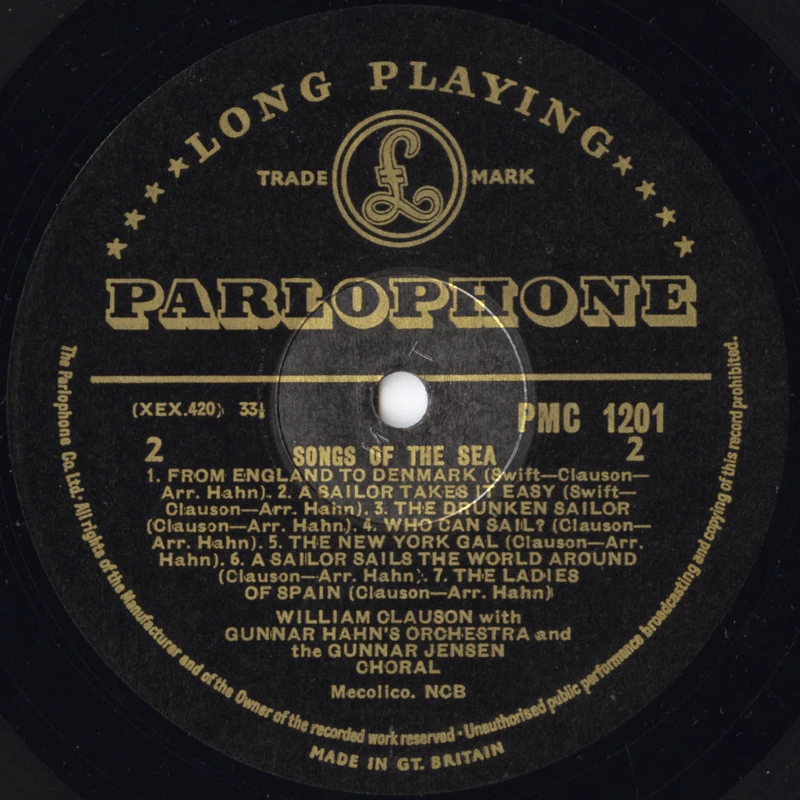
Side B label of PMC 1201, Songs Of The Sea (gold print). The tax code MT, embossed in the centre, is faintly visible
A1 Too-ral-o-ree はストリングスのイントロから入り、ウインナワルツのフォーマットでゆったりとメロディアスに流れていく、お上品な音楽です。
A1 Too-ral-o-ree opens with a string introduction and then flows along, slow and melodious, in the form of a Viennese waltz: very genteel music.
A3 Breezes Blow はオーランド諸島の船乗り歌ですが、ゆったりしたテンポで、耳馴染みの良い子守唄のようなメロディが流れます。 A4 The Saucy Flash Packet は伴奏なしの力強いヴォーカルから始まり、後ろにバンドネオンかアコーディオンと、ギターのリフが聞こえます。こちらは、なんというか、ドイツやスイスの雰囲気に聞こえました。
A3 Breezes Blow is a sailors’ song from the Åland Islands, but it goes at a relaxed tempo, with an easy, lullaby-like melody. A4 The Saucy Flash Packet starts with a strong unaccompanied vocal, and behind it you can hear a bandoneon or an accordion and a guitar riff. This one sounded to me, how shall I put it, German or Swiss in atmosphere.
A6 The Ship’s Cook は、トイピアノの可愛いイントロのあと、メロディの要所要所で金属板を叩くような音が入ります。鍛冶屋を模したような音ですが、題名が Ship’s Cook ですから、調理中の喧騒を描いているのでしょうか。終わりのほうで突然メロディが短調になり、歌もコーラスも声が低くなったと思ったら、最後だけ急に陽気に戻って、ホイッスルと金属音で終わります。
A6 The Ship’s Cook has a cute toy-piano introduction, after which a sound like someone striking a metal plate comes in at the main points of the melody. It sounds like an imitation of a blacksmith, but since the title is Ship’s Cook, is it meant to depict the clatter of cooking? Near the end the melody suddenly turns to a minor key and both the singer and the chorus drop their voices, and then, right at the very end, it abruptly turns cheerful again and finishes with a whistle and a clang of metal.
B面に移ると、B2 A Sailor Takes It Easy では “hooray” が何度も何度も出てきます。このアルバム、Hooray 多いですね(笑)。
Moving on to side B, in B2 A Sailor Takes It Easy the word “hooray” comes up again and again. There is a lot of Hooray on this album 🙂
B3 The Drunken Sailor は短調で、男性コーラスとヴォーカルが一緒になって歌っています。題名からしても、酒場で肩を組みながら歌っているような場面が浮かびます。 “Shave his hairy belly with a rusty razor”(毛むくじゃらの腹を錆びた剃刀で剃ってやれ)という句が聞き取れました。
B3 The Drunken Sailor is in a minor key, with the male chorus and the lead vocal singing together. The title alone brings to mind a scene of men singing arm in arm in a tavern. I could make out the line “Shave his hairy belly with a rusty razor”.
B5 The New York Gal はポルカっぽい軽快な曲で、B7 The Ladies Of Spain はマイナー調のワルツ、メロディはいかにもイギリス(スコットランド?)の民謡のように聞こえます。
B5 The New York Gal is a lively, polka-like number, and B7 The Ladies Of Spain is a waltz in a minor key, with a melody that sounds every bit like a British (Scottish?) folk song.
オンマイクのドライな音が多い現代の音に慣れた人の耳には、ホールエコーまたはリヴァーブが少し多めの録音と感じられるかも、という印象を持ちました。
My impression was that, to ears used to today’s sound, with its many close-miked, dry recordings, this might come across as a recording a little heavy on hall echo or reverb.
上の表で見たとおり、歌の出どころはノルウェー、スウェーデン、オーランド諸島、英国、アメリカ、それにドイツの旋律。いっぽう私の耳に聞こえてきたのは、ウインナワルツ、子守唄、ドイツやスイスの雰囲気、ポルカ、マイナー調のワルツにスコットランド民謡っぽさ。船乗りの歌を集めた1枚なのに、聞こえてくる土地や音楽アレンジのバラエティに富んでいる、言い方を変えるとバラバラです(笑)。
As the table above shows, the songs come from Norway, Sweden, the Åland Islands, Britain, America, and a German melody. What reached my ears, on the other hand, was a Viennese waltz, a lullaby, a German or Swiss atmosphere, a polka, a minor-key waltz and a touch of Scottish folk song. For a record of sailors’ songs, it is rich in variety in the places you hear and in the musical arrangements, or, to put it another way, all over the place 🙂
この盤については、正直なんとも的確なコメントのしようがない、というのが本音です(笑)。
To be honest, I just cannot find any apt comment to make about this record 🙂
Clauson が Hylands hörna に出演したときの映像が YouTube にありました。
There is a video on YouTube of Clauson appearing on Hylands hörna.
PMC 1203: Mexican Pizza
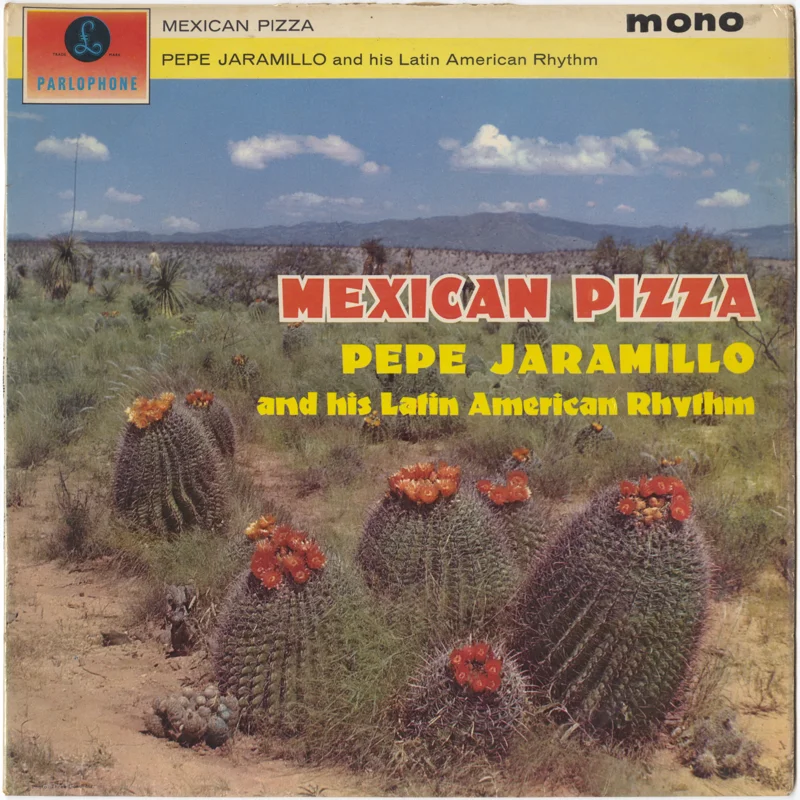
Front cover of PMC 1203, Mexican Pizza (Pepe Jaramillo)
Who Made It
PMC 1203 の ペペ・ハラミヨ(ハラミジョ)(Pepe Jaramillo) は、メキシコ生まれのピアニストです。 1957年12月29日には、BBC の番組表(Radio Times をもとにした BBC Genome)に、この日のラジオ番組 Follow the Stars の出演者の1人として名前が載っています。
Pepe Jaramillo of PMC 1203 is a Mexican-born pianist. On 29 December 1957 his name appears in the BBC listings (BBC Genome, which is based on Radio Times) as one of the performers on that day’s radio programme Follow the Stars.
EMI では Norman Newell(Jaramillo のプロデューサーとされる人物です)に見出され、ジェフ・ラヴ (Geoff Love) の編曲・指揮で録音を重ねました。 Parlophone からは1959年から1965年までに11枚、EMI 全体では30枚を超える LP が出ています。
At EMI he was discovered by Norman Newell (the man said to have been Jaramillo’s producer), and he went on to record again and again with Geoff Love arranging and conducting. Parlophone issued 11 of his LPs between 1959 and 1965, and across EMI as a whole the total comes to more than 30.
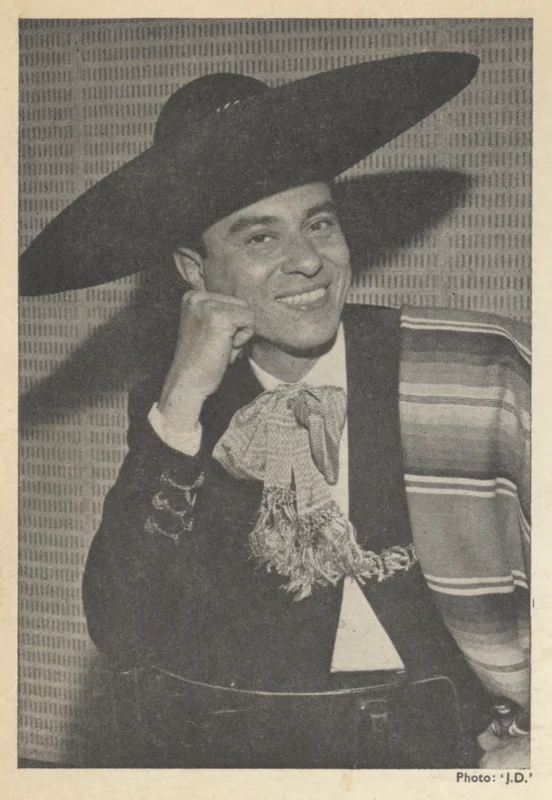
The photo of Pepe Jaramillo on the back cover of my copy of PMC 1203, Mexican Pizza
盤の名義にある “his Latin-American Rhythm” は、1966年の盤の解説では Geoff Love の率いるリズム隊を指しています。奏者の名前は分かりません。
According to the notes on a 1966 record, the phrase “his Latin-American Rhythm” in the billing on the record refers to a rhythm section led by Geoff Love. I don’t know the names of the players.
その録音は、売り方のうえで2つの顔を持っていました。 LP Salud Mexico(PMC 1147、1961年)の解説は “a record for easy listening any time of day or night” と書き、EP Latin American Cha Cha Cha(GEP 8867、1962年)の解説は “this kind of music for dancing” と書いています。聴く盤としても、踊る盤としても売る。 EMI の宣伝文そのものが、両用を売り文句にしていたわけです。
Those recordings were sold with two faces. The notes to the LP Salud Mexico (PMC 1147, 1961) call it “a record for easy listening any time of day or night”, while the notes to the EP Latin American Cha Cha Cha (GEP 8867, 1962) speak of “this kind of music for dancing”. A record to listen to, and a record to dance to. EMI’s own publicity copy was selling both uses.
手元の PMC 1203 を盤起こしした音源で、テンポを測ってみたところ、A3 (94 BPM) を除く13曲が109〜136 BPM に収まります。曲の中でもテンポはほぼ一定で、曲を3等分して測った差はおおむね 1 BPM 前後です。一定のテンポが続くというこの性質は、GEP 8867 の解説にある “metronomic accuracy” という語と合います。
When I measured the tempos on the audio I had transferred from my copy of PMC 1203, 13 of the songs fell between 109 and 136 BPM, the exception being A3 (94 BPM). The tempo also stays nearly constant within each song: when I split a song into three equal parts and measured each part, the differences were generally around 1 BPM. This steadiness of tempo matches the phrase “metronomic accuracy” in the notes to GEP 8867.
BBC のテレビの番組表では、Jaramillo の肩書きは一貫して “Pianist” です。 PMC 1203 の裏ジャケットに刷られているのは、曲目とリズム名、作者と出版社の表記、Geoff Love のクレジット、それに前作 PMC 1183 の広告で、解説の文章はありません。
In the BBC television listings, Jaramillo’s billing is consistently “Pianist”. What is printed on the back cover of PMC 1203 is the track list with the name of the rhythm for each song, the composer and publisher credits, the credit for Geoff Love, and an advertisement for the previous album, PMC 1183. There are no liner notes.
こうして見ると、Jaramillo と Clauson の2人はどちらも英 EMI と何年にもわたる関係を持っていたことが分かります。
Looking at it this way, it is clear that Jaramillo and Clauson both had relationships with EMI in Britain that lasted for years.
What Is on It
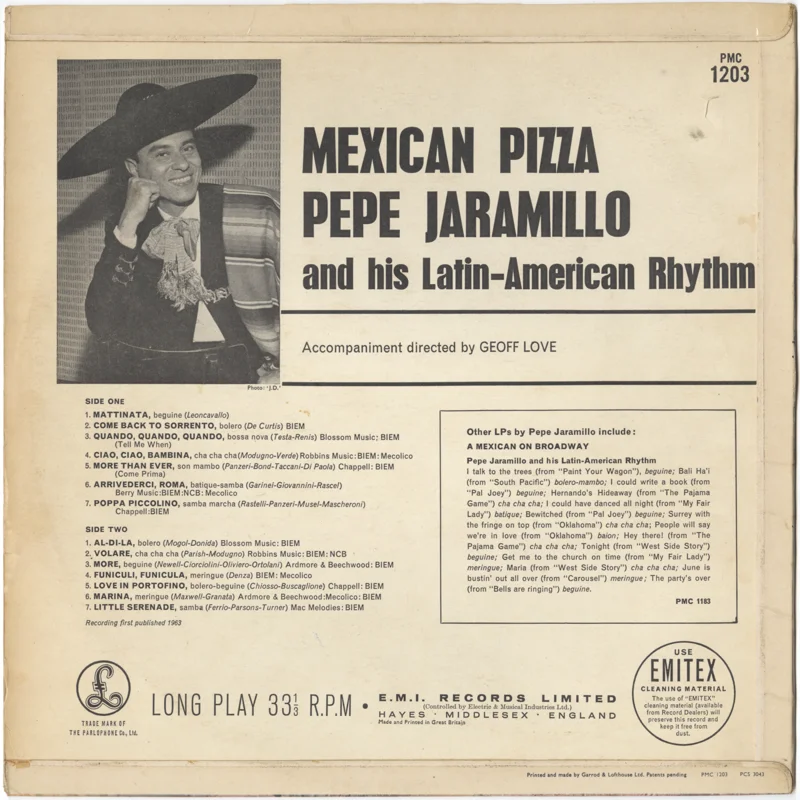
Back cover of PMC 1203, Mexican Pizza (Pepe Jaramillo)
PMC 1203 Mexican Pizza のほうは、14曲すべてがイタリアの歌です。初出の場で分けると、サンレモ音楽祭の曲が5曲、流行歌のレコードが5曲、19世紀から20世紀初頭の歌曲が3曲、映画の主題曲が1曲になります。歌曲の3曲は A1 Mattinata(1904年)、A2 Come Back To Sorrento (“Torna a Surriento”)、B4 Funiculi, Funicula(1880年)で、残る11曲は1952年以降に世に出た曲です。
PMC 1203 Mexican Pizza, on the other hand, is a record on which all 14 songs are Italian. Grouped by where they first appeared, 5 came from the Sanremo Music Festival, 5 were first heard on pop records, 3 are songs from the 19th century and the early 20th, and 1 is a film theme. The 3 older songs are A1 Mattinata (1904), A2 Come Back To Sorrento (“Torna a Surriento”) and B4 Funiculi, Funicula (1880); the other 11 came out in 1952 or later.
選曲は、英国の耳に馴染んだ曲が中心です。 1963年より前に、何らかの版が英国のシングル・チャートに入っていた曲が、14曲のうち9曲あります(Official Charts の記録です)。 B2 Volare は ディーン・マーティン (Dean Martin) の盤で2位、A7 Poppa Piccolino は ダイアナ・デッカー (Diana Decker) の盤で2位、A5 More Than Ever の原曲 “Come Prima” は マリーノ・マリーニ (Marino Marini) の盤で2位まで上がっています。
The selection centres on songs familiar to British ears. Of the 14, 9 had entered the UK singles chart in some version before 1963 (according to the Official Charts records). B2 Volare reached No. 2 in Dean Martin’s version, A7 Poppa Piccolino reached No. 2 in Diana Decker’s version, and “Come Prima”, the original of A5 More Than Ever, climbed as high as No. 2 in Marino Marini’s version.
小さな話を2つ。 A面の1曲目 Mattinata は、Leoncavallo が1904年に書いた歌で、英語版 Wikipedia はこれを Gramophone Company(EMI の前身)のために書かれた最初の歌としています。この歌は1904年4月に、エンリコ・カルーソー (Enrico Caruso) が作曲者 Leoncavallo のピアノ伴奏で録音したもの (G. C.-52034) です。そのことを念頭に1曲目に配置された、と深読みすることも可能ですが、詳細は不明です。
Two small points. The first track on side A, Mattinata, was written by Leoncavallo in 1904, and the English Wikipedia calls it the first song written for the Gramophone Company (the forerunner of EMI). In April 1904 Enrico Caruso recorded it with the composer, Leoncavallo, at the piano (G. C.-52034). One could read into this and suppose it was placed first with that in mind, but I don’t know the details.
もう1つは B3 More。 1962年のイタリアの記録映画 Mondo Cane の主題曲で、英語詞を書いたのは Norman Newell、上で Jaramillo のプロデューサーとされる人物として名前を挙げた人です。 14曲の中では、この曲だけが1963年に流行りはじめた新しい曲と見られます。
The other is B3 More. It is the theme from the 1962 Italian documentary film Mondo Cane, and the English lyrics were written by Norman Newell, whom I mentioned above as the man said to have been Jaramillo’s producer. Of the 14 songs, this appears to be the only new one, a song that had only started to catch on in 1963.
並べてみると、2枚とも、いろんな土地の歌を別の土地の装いで出した盤だと言えそうです。北欧の船乗りの歌が英語の詞と Gunnar Hahn の伴奏をまとい、イタリアの歌がラテンのリズムをまとっている、そう見えます。
Put side by side, both records, it seems fair to say, present songs from various lands in the dress of another land. Nordic sailors’ songs wearing English lyrics and Gunnar Hahn’s accompaniments, Italian songs wearing Latin rhythms. That is how they look to me.
How It Sounds
Mexican Pizza も、Songs Of The Sea とは別の意味で不思議な音楽でした。
Mexican Pizza too was puzzling but intriguing music, though in a different sense from Songs Of The Sea.
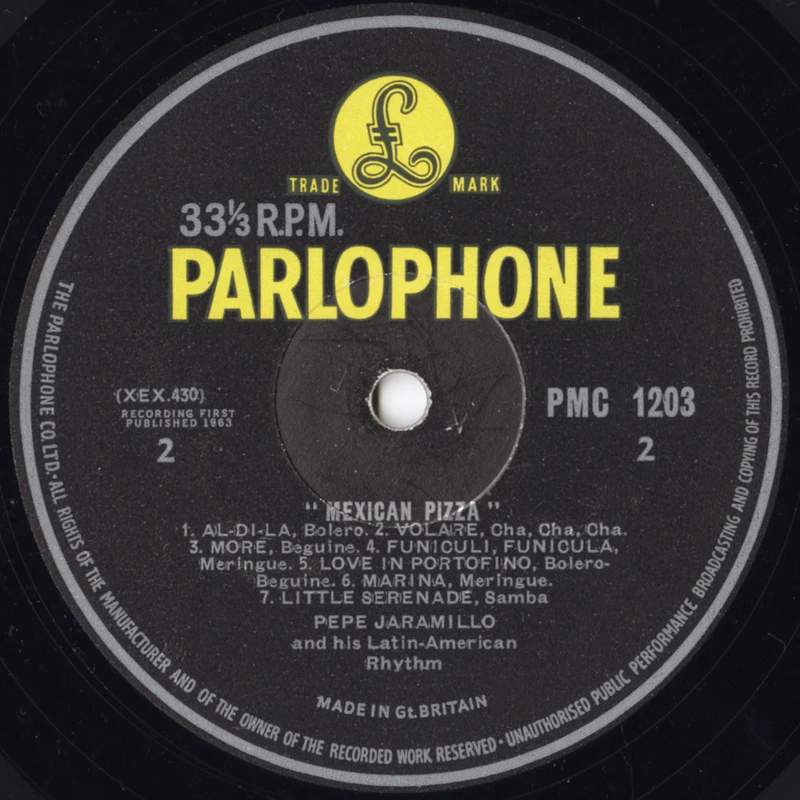
Side B label of PMC 1203, Mexican Pizza (yellow print). The tax code KT, embossed in the centre, is faintly visible
A1 から A6 まで聴いたところで気づいたのは、どの曲もほぼ同じミドルテンポだということです。サロンミュージックというかラウンジミュージックというか、ピアノのブロックコードによるメインメロディが前面にあるのも全曲に共通していて、バンジョーやエレキギターが華を添え、パーカッションはほとんど出しゃばりません。ホセ・メリス (Jose Melis) あたりを思い起こさせますが、そちらよりさらにゆったりとして、起伏があまりない演奏です。
By the time I had listened from A1 to A6, I had noticed that every song is at almost the same mid-tempo. Call it salon music or lounge music, the main melody in block chords on the piano is out front on every track, banjo and electric guitar add colour, and the percussion hardly ever pushes forward. It reminds me of someone like Jose Melis, but it is more relaxed still, a performance with little in the way of ups and downs.
盤質は両面とも申し分なく、曲間も(この当時の盤としては)かなり静かです。 B面は、盤質のせいか A面より少しフィデリティの上がった音に聞こえます(大きな差ではありません)。 B2 はピアノソロのイントロから始まりますが、アンサンブルになるとやはりミドルテンポ。これはお上品なダンスミュージックなんでしょうか?
The vinyl is immaculate on both sides, and the gaps between tracks are (for a record of this age) quite quiet. Side B sounds a little higher in fidelity than side A, perhaps because of the condition of the vinyl (not a big difference). B2 opens with a piano solo intro, but once the ensemble comes in it is mid-tempo again. Is this genteel dance music, then?
両面を通して聴き終えての感想は、うーむ、ほぼ全曲が同じテンポですね…、というものでした。あまり変化がないというか、起伏がなくて、通しで聴くのはけっこう大変でした(笑)。やはりラウンジ用の BGM 的なレコードなんでしょうかねぇ。
My impression after listening through both sides was: hmm, nearly every song is at the same tempo. There is little variety, little in the way of ups and downs, and getting through the whole thing in one sitting was quite hard work 🙂 Is it, after all, the kind of record meant as background music for a lounge? I wonder.
ちなみに、Disc 誌1963年12月7日号、Nigel Hunter 担当の欄に載った LP 評は、この盤に★2つをつけています。題名の由来から書き始めた短い評は、こう締められています。 “a very good percussion section gets little chance to relieve the boredom”(とても良いパーカッション陣も、退屈をまぎらす機会をほとんど与えられていない)。私が聞いた感想と1963年の評者の感想は面白いほど似ており、なんだか不思議です。
Incidentally, the LP review in Nigel Hunter’s column in the 7 December 1963 issue of Disc gives this record two stars. The short review, which opens with the origin of the title, closes like this: “a very good percussion section gets little chance to relieve the boredom”. My impression and the 1963 reviewer’s are so alike it is almost funny, and it makes me wonder why.
ただ、当時から Jaramillo の音楽に親しんでこられたファンのレビューが、Amazon や HMV などベスト盤 CD についており、流れるように聞かせる、安堵感のある演奏、ラテンを楽団ではなくサロン風に演奏しているのが良い、といった非常に好意的な意見が並んでいました。
That said, fans who have been listening to Jaramillo’s music since those days have left reviews on the pages for his best-of CDs at Amazon, HMV and other sites, and what I found there was very favourable, saying among other things that the music flows along, that the playing puts you at ease, and that it is good to hear the Latin numbers played in a salon style rather than by a full band.
Pepe Jaramillo が演奏している動画は見つかりませんでしたが、Apple Music に Holidays in Italy (feat. His Latin American Rhythm) という配信があり、Mexican Pizza と同じ14曲が入っています。なぜか PMC 1203 より半音高い音源ですが、どういう音楽かを知っていただくには手っ取り早いと思うので、載せておきます。
I could not find a video of Pepe Jaramillo playing, but Apple Music has a release called Holidays in Italy (feat. His Latin American Rhythm) with the same 14 songs as Mexican Pizza. For some reason it is a semitone higher than PMC 1203, but it is a quick way to hear what this music is like, so I have included it here.
What Doesn’t Get Recorded
さまざまな資料を探してみたところ、同じ年に隣の番号で出た2枚でも、私が見つけられた範囲内では、得られた情報量には大きな差がありました。
I searched through all sorts of sources, and the amount of information I could turn up on the two records differed enormously, at least as far as I was able to find, even though they came out in the same year under neighbouring catalogue numbers.
Mexican Pizza (PMC 1203) は、Disc の1963年12月7日号に評が載り、同じ Disc の12月14日号と Record Mirror の12月21日号では EMI の広告に名前が入り、翌1964年1月号の Record Mail の一覧にも並んでいました。
Mexican Pizza (PMC 1203) was reviewed in the 7 December 1963 issue of Disc, its name appeared in EMI’s advertisements in the 14 December issue of Disc and in the 21 December issue of Record Mirror, and it was also listed in the January 1964 issue of Record Mail.
Songs Of The Sea (PMC 1201) のほうは、私が調べた範囲の業界誌では発売を伝える記事が見つからず、手がかりはスウェーデンの図書館の目録と、盤そのものでした。
For Songs Of The Sea (PMC 1201), on the other hand, I found no article announcing its release in the trade papers I went through, and the only clues were the catalogue of a Swedish library and the record itself.
マトリクスの番号にも、英国の Parlophone の LP で見つからないものがありました。 Please Please Me の XEX 421 / XEX 422 のすぐ次にあたる XEX 423〜426 で、海の向こうのカナダ盤で見つかりました。カナダの Capitol が1963年7月に出した Jimmy Shand の LP 2枚のレーベルに、この4つの番号が印刷されています。その次の XEX 427 / XEX 428 は、私が調べた範囲の Parlophone の LP には、対応する盤が見つからないままです。
Among the matrix numbers, too, there were some I could not find on any British Parlophone LP. XEX 423 to 426, the numbers immediately after XEX 421 / XEX 422 of Please Please Me, turned up overseas, on Canadian records: these four numbers are printed on the labels of two Jimmy Shand LPs that Capitol in Canada issued in July 1963. The next pair, XEX 427 / XEX 428, still has no matching record among the Parlophone LPs I have looked at.
それでも、60年後にこの2枚を手に取ると、レーベルの金文字と黄文字、中央に型押しされたタックスコード、デッドワックスのマトリクスから、いつごろ工場を出た盤かを推定することができました。これらの印は、EMI の工場で事務的に使われたものですが、時系列を特定するヒントになるからです。
Even so, picking up these two records 60 years later, I was able to estimate roughly when each copy left the factory, from the gold and yellow print on the labels, the tax code embossed in the centre, and the matrix numbers in the deadwax. These marks were there for administrative use at EMI’s factory, but they do give hints for working out the chronology.
1963年の Please Please Me は、Parlophone の LP の1枚としてプレスされ、店頭に出ていました。カタログ番号で前と後ろにあたる2枚が、これら Parlophone の LP が陳列されていた頃の景色を追体験させてくれているかのようです。
In 1963, Please Please Me was pressed and put in the shops as one Parlophone LP among others. The two records before and after it in the catalogue numbers feel as if they let me relive the scene from the days when these Parlophone LPs were on display.
2枚には EMI の汎用の内袋(カンパニースリーブ)も付いていて、針の摩耗に気をつけるようにという注意と、’EMITEX’ のクリーニングクロスの宣伝が刷られています。
Both records also came with EMI’s general-purpose inner sleeve (the company sleeve), printed with a warning to watch out for stylus wear and an advertisement for the ‘EMITEX’ cleaning cloth.
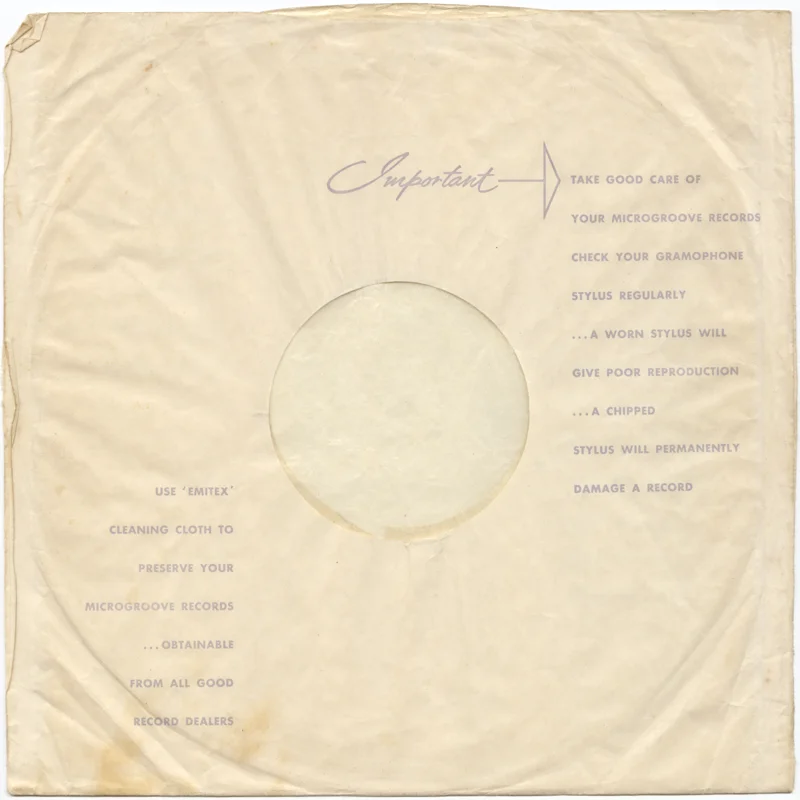
The EMI company sleeve that came with my copies of PMC 1201 and PMC 1203
我が家のレコードラックでは、Please Please Me の初回盤の両隣にあたる2枚が、真ん中を空けたまま並んでいます。私にとって PMC 1201 と PMC 1203 は、1963年の Parlophone の LP、しかも Please Please Me の両隣のアルバム2枚、という認識であり続けるでしょうし、音楽の内容的にも、私が好んで繰り返し聴く内容ではないかもしれません(笑)。それでも、この2枚を愛聴していた当時の英国の方々はきっといたはずで、そのような文化や生活空間へ思いをはせるタイムスリップの道具として、これからも折に触れて針を落とすことになりそうです。
In the record rack at home, the two records that sit on either side of the first pressing of Please Please Me stand with the space between them left empty. To me, PMC 1201 and PMC 1203 will probably always be two Parlophone LPs from 1963, and what is more, the two albums on either side of Please Please Me. As music, too, they may not be the kind of thing I choose to play over and over 🙂 Even so, there must surely have been people in Britain at the time who loved these two records, and as a way of travelling back in time and letting my thoughts drift to that culture and the everyday spaces they lived in, I expect I will keep dropping the needle on them now and then.
Notes
- Clayton のライナーは A2 を "basically Norwegian"、A5 Albertina の旋律を "probably German" と書いていますが、目録は A2 をボーヒュースレーンの歌とし、ドイツの旋律を A6 The Ship’s Cook に付けています。どちらが正しいかは分かりません。 ↩
Clayton’s liner notes describe A2 as "basically Norwegian" and the melody of A5 Albertina as "probably German", whereas the catalogue gives A2 as a song from Bohuslän and attaches the German melody to A6 The Ship’s Cook. I do not know which is correct. ↩ - 2枚の盤起こしは以下のシステムで行いました。 Michell Orbe SE ターンテーブル、SME 3009-R のアーム、AT33xMONO/II のカートリッジで再生し、Musical Surroundings SuperNova II フォノイコライザ、Benchmark LA4 プリアンプの出力から KORG DS-DAC-10R で 24 bit / 96 kHz で録っています。 ↩
I digitised the two records with the following system. They were played on a Michell Orbe SE turntable with an SME 3009-R tonearm and an AT33xMONO/II cartridge, through a Musical Surroundings SuperNova II phono equaliser and a Benchmark LA4 preamplifier, and recorded from the preamplifier output with a KORG DS-DAC-10R at 24 bit / 96 kHz. ↩
References
Trade Press
- Disc, 7 December 1963, p.12, "LPs" in the column "Album releases with Nigel Hunter" (the individual reviews are unsigned)
- Disc, 14 December 1963, p.4, advertisement for the EMI programmes on Radio Luxembourg
- Record Mirror, 21 December 1963, EMI’s Christmas LP advertisement
- Record Mail (EMI’s monthly new-release paper), January 1964, p.11, "TOP LPs"
Catalogues and Databases
- LIBRIS (the union catalogue of the National Library of Sweden): Sing a merry Song. 18 songs arranged for voice and piano/guitar by Gunnar Hahn, Stockholm : Reuter & Reuter Förlags ; London, etc : Oxford University Press, [1963]: https://libris.kb.se/1bwstc4fz4ttj02j
- Musik- och teaterbiblioteket, Gunnar Hahns arkiv (A457): https://sok.musikochteaterbiblioteket.se/Record/arkiv-A457/HierarchyTree?recordID=arkiv-A457
- BBC Genome: 29 December 1957, 21:00, the BBC radio programme Follow the Stars
- Official Charts Company: Dean Martin "Volare" ( https://www.officialcharts.com/songs/dean-martin-volare/ ), Diana Decker "Poppa Piccolino" ( https://www.officialcharts.com/songs/diana-decker-poppa-piccolino/ ), Marino Marini "Come Prima" ( https://www.officialcharts.com/songs/marino-marini-and-his-quartet-come-prima/ )
Discogs and 45cat
- Discogs, PMC 1201 Songs Of The Sea: https://www.discogs.com/release/18609211
- Discogs, PMC 1203 Mexican Pizza: https://www.discogs.com/release/2498648
- Discogs, CLPC 11: https://www.discogs.com/release/11101530
- 45cat, Capitol (Canada) T-6033 Jimmy Shand Jimmy Shand’s Party (XEX 423 / XEX 424 on the label photos; release date as given by 45cat): https://www.45cat.com/vinyl/album/t6033
- 45cat, Capitol (Canada) T-6032 Jimmy Shand Scottish Country Dances (XEX 425 / XEX 426 on the label photos; release date as given by 45cat): https://www.45cat.com/vinyl/album/t6032
Other
- Swedish Wikipedia, "Gunnar Hahn": https://sv.wikipedia.org/wiki/Gunnar_Hahn
- English Wikipedia, "Mattinata (Leoncavallo)": https://en.wikipedia.org/wiki/Mattinata_(Leoncavallo)