Phono EQ Curves Liner Notes II は II-a / II-b / II-c の 3 部作で、 20年前のブログ記事で主観的に書いた問いに、 客観的な計測の道具の力を借りて再度向き合います。本稿はその第3部 Liner Notes II-c として、 Liner Notes II-a + Liner Notes II-b の延長で、 そこで扱ったセッションの半年あまり前(1953年4月)に録音された Capitol H-477 “The Duke Plays Ellington” と、 数年後の 12インチ再発 T-477 に同じ手法を適用します。
Phono EQ Curves Liner Notes II is a three-part work (II-a / II-b / II-c) revisiting a question I wrote about subjectively in a blog post twenty years ago, this time with objective measurement. This third part, Liner Notes II-c, extends Liner Notes II-a and Liner Notes II-b, applying the same methods to Capitol H-477 “The Duke Plays Ellington“, recorded in April 1953, some seven months before the sessions covered there, and to its 12-inch reissue T-477 released a few years later.
Liner Notes II は II-a / II-b / II-c の 3部構成です。
- Liner Notes II-a: Capitol H-488 “Songs For Young Lovers” の初期プレス D2 / D8 のあいだに見える物理的差異と、 SimAES filter による録音 EQ カーブ判別
- Liner Notes II-b: 同じ H-488 セッションマスターから派生した再発・リマスター系 5 リリース (W-587 / ECJ-50017 / W-1432 / MFSL 1-130 / 1998 CD) の音作りの違い
- Liner Notes II-c: H-488 セッションの半年あまり前(1953年4月)に録音された Capitol H-477 “The Duke Plays Ellington” と 12インチ再発 T-477、および II-a / II-b / II-c 通算「LTAS で分かること / 分からないこと」 まとめ
Liner Notes II is a three-part work (II-a / II-b / II-c).
- Liner Notes II-a: Physical differences visible between Capitol H-488 “Songs For Young Lovers” early pressings D2 and D8, and recording EQ curve identification through the SimAES filter
- Liner Notes II-b: Five reissue and remaster releases branching from the same H-488 session master (W-587 / ECJ-50017 / W-1432 / MFSL 1-130 / 1998 CD), and the differences in sound design
- Liner Notes II-c: Capitol H-477 “The Duke Plays Ellington”, recorded in April 1953, some seven months before the H-488 sessions, with its 12-inch reissue T-477; closing with a summary across II-a / II-b / II-c, “What LTAS can show / what it cannot”
変更履歴 / Revision History
- 2026年6月14日: 初版公開
- June 14, 2026: Initial publication
本稿では、 1953年4月録音の Capitol H-477 “The Duke Plays Ellington”(Duke Ellington Trio)と、 数年後の 12 インチ再発 T-477 を、 共通 8 曲の LP 同士比較 + Mosaic Records のマスターテープディジタルトランスファーとの対比 + 立ち上がりエンベロープ解析を組み合わせて読み解きます。 H-477 のカッティングカーブは、 複数の傍証を総合すると Sinatra H-488 D2 と同様に Capitol 400N-12.7(AES 系)がもっとも有力で、 T-477 は曲によって異なる手段で「ドラムを前に出す」 編集判断(= 静的な高域 EQ + 一部曲での動的処理)が加えられた再発として読めます。同時に明らかになった解析手法側の限界は、 II.5 で II-a / II-b / II-c を通じた LTAS の留保条件として整理しました。三部作の要点は、 FAQ「EQカーブの違いを客観的に計測できるか」 にもまとめてあります。
This article reads Capitol H-477 “The Duke Plays Ellington” (Duke Ellington Trio, recorded April 1953) against its 12-inch reissue T-477 from a few years later, combining an LP-to-LP comparison of the eight shared tracks, a reference comparison against Mosaic Records’ digital transfer of the master tapes, and transient envelope analysis. Weighing several lines of circumstantial evidence, the most likely cutting curve for H-477 is Capitol 400N-12.7 (AES family), the same reading as for Sinatra H-488 D2. T-477 reads as a reissue carrying a “bring the drums forward” editorial decision, implemented through different means from track to track (static high-frequency EQ, plus dynamic processing on some tracks). The limits of the analysis methods, which surfaced along the way, are organized in II.5 as the reservations that apply to LTAS across II-a / II-b / II-c. The key points of the trilogy are also summarized in the FAQ “Can differences between phono EQ curves be measured objectively?“.
本シリーズ Phono EQ Curves Liner Notes は、これまでの連載「Things I learned on Phono EQ Curves Pt.0〜Pt.25」の補完シリーズです(連載続編ではなく、別シリーズとして位置付けます)。詳しくは 連載の読み方ガイド をご覧ください。
This series, Phono EQ Curves Liner Notes, is a companion to the existing series “Things I learned on Phono EQ Curves Pt.0–Pt.25” (positioned as a separate series rather than a continuation of it). For details, please see the guide to reading the series.
本稿は、筆者自身の学習・調査過程を記したものです。 間違いの指摘や異論は遠慮なくお寄せください。
This piece is a record of the author’s own learning and inquiry. Corrections and disagreements are most welcome.
II.4 H-477 and T-477 — The same method, different constraints
本章 Liner Notes II-c では、 Sinatra “Songs For Young Lovers” のセッションの半年あまり前、 1953年4月にロサンゼルスの Capitol Studios で録音された Capitol H-477 “The Duke Plays Ellington” (Duke Ellington Trio、 10インチ 8曲入り、 1954年リリース)と、 数年後にリリースされた 12インチ再発 T-477 (H-477 の 8 曲に 4 曲を追加した 12 曲入り)に、 II-a と II-b で組み立てた解析手法を適用します。
This chapter, Liner Notes II-c, applies the analytical toolkit assembled in II-a and II-b to Capitol H-477 “The Duke Plays Ellington” (Duke Ellington Trio, a 10-inch with eight tracks, released in 1954), recorded at Capitol Studios in Los Angeles in April 1953, some seven months before the Sinatra “Songs For Young Lovers” sessions, and to T-477, the 12-inch reissue released a few years later (twelve tracks: the eight from H-477 plus four added).
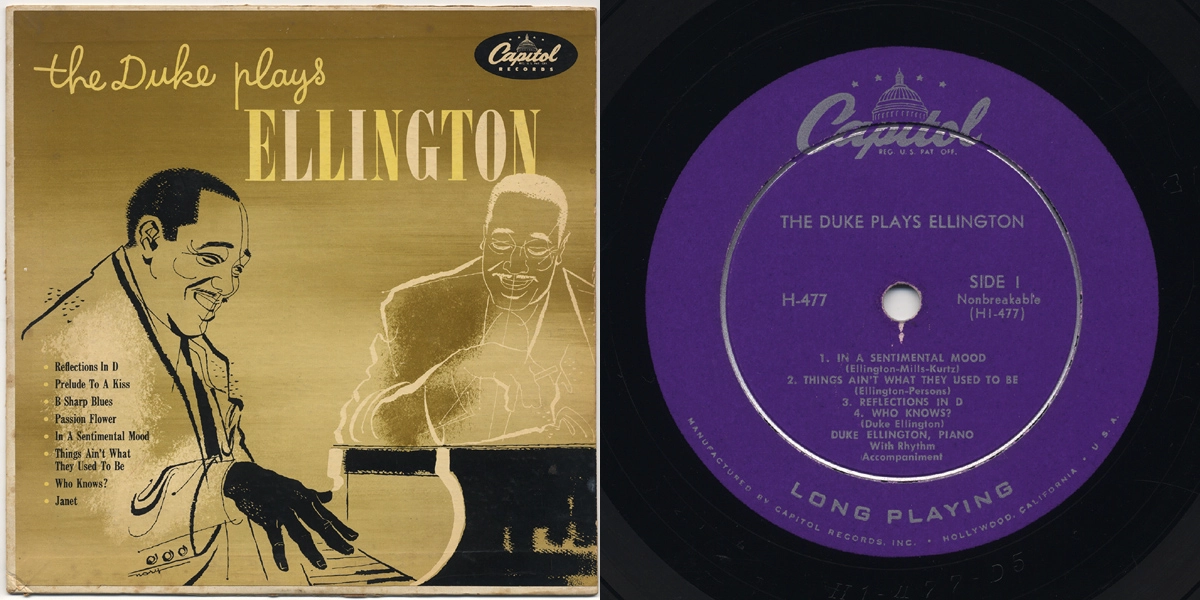
左: ジャケ表([HIGH FIDELITY] 印刷なし)。右: SIDE A レーベル(紫色 Capitol、深溝あり、 D5 マトリクス)。 H-477 10インチ 1954年初版。
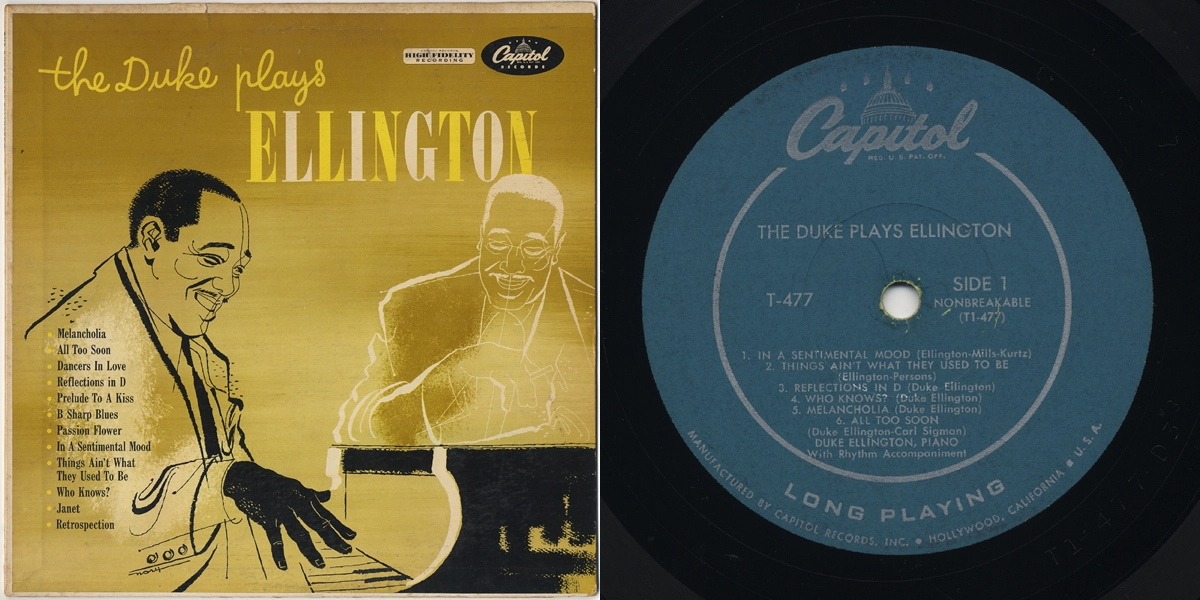
左: ジャケ表([HIGH FIDELITY] 印刷あり)。右: SIDE A レーベル(ターコイズ Capitol、深溝なし、 D5 マトリクス)。 T-477 12インチ再発盤。
ただし、 II-a の H-488 D2/D8(同一カタログのマトリクス違い)のように「同じセッションマスターから、 異なるカッティングカーブでカットされた 2 種」 という、 解析にとって都合のよい対比は得られません。 H-477(10インチ)と T-477(12インチ)は別カタログ・別世代であり、 さらに T-477 は 4 曲追加された再パッケージで、 録音 EQ カーブ(AES/RIAA)の判別とリマスタリング介入の有無が交絡します。 1953年4月の Ellington Trio セッションが、 別の解析手法と別の留保条件のもとでどう読めるか、 という章になります。
However, there is no analytically convenient pairing here like II-a‘s H-488 D2/D8 (two matrix variants under the same catalog number), where the same session master was cut with two different curves. H-477 (10-inch) and T-477 (12-inch) are different catalog numbers from different generations, and T-477 is a repackage with four added tracks, so the identification of the recording EQ curve (AES/RIAA) and the presence of remastering intervention become entangled. This chapter is about how the April 1953 Ellington Trio session can be read under a different set of methods and a different set of reservations.
本章では、 H-477 と T-477 の共通 8 曲(= Band 位置まで一致)の LP 同士比較を、 II-a で確立した「SimAES 変換を介した LP 同士比較」 の手法で読み、 さらに比較の基準として、 Mosaic Records “The Complete Capitol Recordings of Duke Ellington”(= Capitol セッションマスターテープのディジタルトランスファーで、 現時点で利用できるもっともマスターに近い外部基準。 ただし、 ブックレットに transfer/mastering の担当クレジットはなく、 無加工であるとの明記も確認できていません)との対比を組み合わせます。その上で、 (1) H-477 のカッティングカーブの傍証、 (2) T-477 のリマスターの性格、 (3) LTAS で見えにくい立ち上がり領域の差、 という 3 つの論点を順に読み解いていきます。
The chapter reads the eight tracks shared between H-477 and T-477 (matching down to band positions) through the LP-to-LP comparison via SimAES conversion established in II-a, and adds, as a reference, a comparison against Mosaic Records’ “The Complete Capitol Recordings of Duke Ellington” — a digital transfer of the Capitol session master tapes, treated here as the closest available external reference to the master (the booklet carries no transfer/mastering credit, and no explicit statement of being unprocessed is available). On that basis, three topics follow in order: (1) circumstantial evidence for the cutting curve of H-477, (2) the character of the T-477 remaster, and (3) differences in the transient domain that LTAS has trouble showing.
II.4.1 Circumstantial evidence for the H-477 cutting curve (SimAES + LP-to-LP comparison)
II-a では、 H-488 D2(= AES カット候補)と D8(= RIAA カット)の判別に、 SimAES フィルタ(= ディジタル領域での AES/RIAA カーブ変換)と LP 同士の差分を組み合わせ、 D2 が AES 系の 400N-12.7 でカットされた傍証を示しました。 H-477 と T-477 にも同じ枠組みでカッティングカーブの傍証を取れますが、 Sinatra と違い「同じ音源を別カーブでカット」 ではなく「別世代カット + 別 EQ カーブの可能性」 という、 もう一段複雑な構造です。
In II-a, the identification of H-488 D2 (the AES-cut candidate) against D8 (the RIAA cut) combined the SimAES filter (an AES/RIAA curve conversion in the digital domain) with LP-to-LP differences, yielding circumstantial evidence that D2 was cut on the AES-family 400N-12.7. The same framework can gather circumstantial evidence for H-477 and T-477, but the structure is one step more complicated than the Sinatra case: not “the same source cut with two curves” but “cuts from different generations, possibly on different EQ curves.”
ここでは共通 8 曲のうち B Sharp Blues(= H-477 / T-477 ともに B-2)を取り上げます。 T-477 は RIAA 移行後の 12 インチ再発であり、 RIAA でカットされていると考えるのが自然です。そう仮定した上で、 H-477 の盤起こし(RIAA 再生)に II-a と同じ SimAES フィルタを適用して AES 再生相当に変換したものと、 T-477 の RIAA 再生の LTAS を比較します。
The track examined here is B Sharp Blues (B-2 on both H-477 and T-477). T-477 is a 12-inch reissue from after the RIAA transition, so assuming a RIAA cut is the natural reading. On that assumption, the H-477 rip (RIAA playback) is converted to its AES-playback equivalent with the same SimAES filter used in II-a, and its LTAS is compared against the RIAA playback of T-477.
LP 由来の click ノイズを除去するデクリック処理を済ませた音源で、 4〜8 kHz 帯域の差分は、 5 kHz で −0.49 dB、 8 kHz で −0.40 dB と、 ほぼゼロに収まりました。 II-a で D2 を SimAES 変換して D8 と比べたときは、 5 kHz はゼロ近傍(−0.08 dB)に収まる一方、 8 kHz には −1.69 dB の補償しきれないディップが残り、 カーブの微差(400N-12.7)や機材世代差といった追加の仮説を重ねて読む必要がありました。今回はその種の説明を要する残差がなく、 判別帯の全体がフラットにゼロ近傍へ収まっています。
With both sources declicked (removing LP-borne click noise), the 4–8 kHz difference lands at −0.49 dB at 5 kHz and −0.40 dB at 8 kHz: essentially zero. When II-a ran the same comparison (D2 converted through SimAES against D8), 5 kHz landed near zero (−0.08 dB) but 8 kHz kept an uncompensated dip of −1.69 dB, which had to be read through additional hypotheses such as a small curve difference (400N-12.7) or an equipment-generation gap. Here there is no residual calling for that kind of explanation; the whole diagnostic band sits flat near zero.
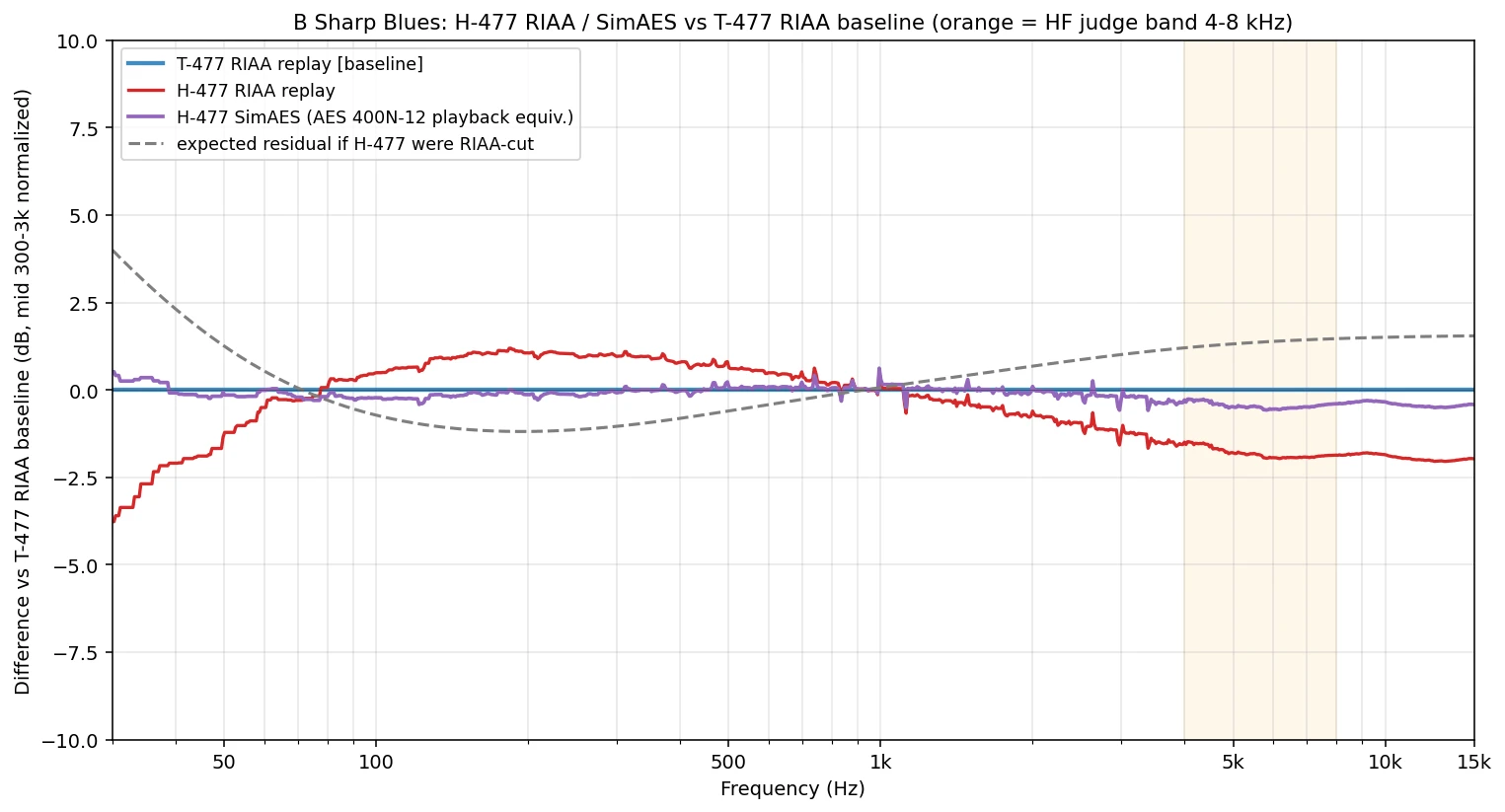
【Fig J】 B Sharp Blues の LTAS 差分。 T-477 の RIAA 再生を基準 0 dB とし、 中域 300 Hz-3 kHz で正規化したもの。変換前の H-477(赤)は高域で基準より 1.5〜2 dB 下にあるが、 SimAES 変換後(紫)は判別帯 4〜8 kHz でほぼ基準に重なる(5 kHz で −0.49 dB / 8 kHz で −0.40 dB)。グレーの破線は、 もし H-477 が実は RIAA カットだった場合に残るはずの理論残差(5〜8 kHz で +1.3〜+1.5 dB)(筆者解析、 2026年6月10日)。
もし H-477 が実は RIAA カットなら、 SimAES 変換は不要な高域リフト(= AES と RIAA の再生カーブの理論差、 5〜8 kHz で +1.3〜+1.5 dB)をそのまま残差として残すはずです。観察された残差がほぼゼロであることは、 H-477 が AES 系のカーブでカットされていて、 AES 再生相当に変換すると T-477 側と高域バランスが揃う、 という読みと整合します。
If H-477 were actually a RIAA cut, the SimAES conversion would leave its unneeded high-frequency lift (the theoretical difference between the AES and RIAA playback curves, +1.3 to +1.5 dB at 5–8 kHz) sitting in the residual. The near-zero residual observed is consistent with the reading that H-477 was cut on an AES-family curve, whose high-frequency balance lines up with T-477 once converted to the AES-playback equivalent.
H-488 D2/D8 の判別が、 残ったディップに追加の仮説を重ねながらの読みだったのと比べると、 今回は変換だけで基準線に乗る、 「H-477 は AES 系、 T-477 は RIAA」 という想定どおりの、 教科書のように素直な対応です。本節の冒頭で見たとおり比較の構造は今回の方が複雑なのに、 結果はこちらの方が素直に出た、 という対比でもあります。ただし、 この判別マージンは 1.5 dB 程度しかなく、 そこに II.4.2 で見る T-477 のリマスターによる高域の持ち上げも混入します。リマスターの量を独立に知る手段がない以上、 LP 同士の残差がゼロに近いことだけからカッティングカーブを確定することはできません。
Compared with the H-488 D2/D8 identification, which had to be read through additional hypotheses to explain the remaining dip, this one lands on the baseline with the conversion alone: “H-477 on an AES-family curve, T-477 on RIAA,” exactly as assumed, a textbook-clean correspondence. As the opening of this section noted, the comparison structure is the more complicated of the two, yet the result was the more straightforward of the two. That said, the identification margin is only about 1.5 dB, and the high-frequency lift from the T-477 remaster (see II.4.2) bleeds into it. With no independent way to know the amount of remastering, a near-zero LP-to-LP residual alone cannot settle the cutting curve.
そこで低域側の手がかりを足します。低域のターンオーバー周波数(400 Hz か 500 Hz か)の判別では、 リマスターの影響が混じる T-477 ではなく、 Mosaic を基準にできます(使用カートリッジはテストレコード実測で低域まで平坦なため、 低域帯での LP とディジタルの比較は高域帯より信頼できます)。 H-477 の盤起こしを SimAES(= 400 Hz ターンオーバー)と Sim500B-12(= II-a の側注で提示した 500 Hz ターンオーバー + 50 Hz シェルフ案)のそれぞれで変換して Mosaic と比べてみました。
So a low-frequency clue is added. For identifying the bass turnover (400 Hz or 500 Hz), the reference can be Mosaic rather than the remaster-affected T-477 (the cartridge in use measures flat down through the low band on a test record, so LP-to-digital comparison is more reliable in the low band than in the highs). The H-477 rip was converted with SimAES (400 Hz turnover) and with Sim500B-12 (the 500 Hz turnover + 50 Hz shelf variant proposed in a side note of II-a), and each was compared against Mosaic.
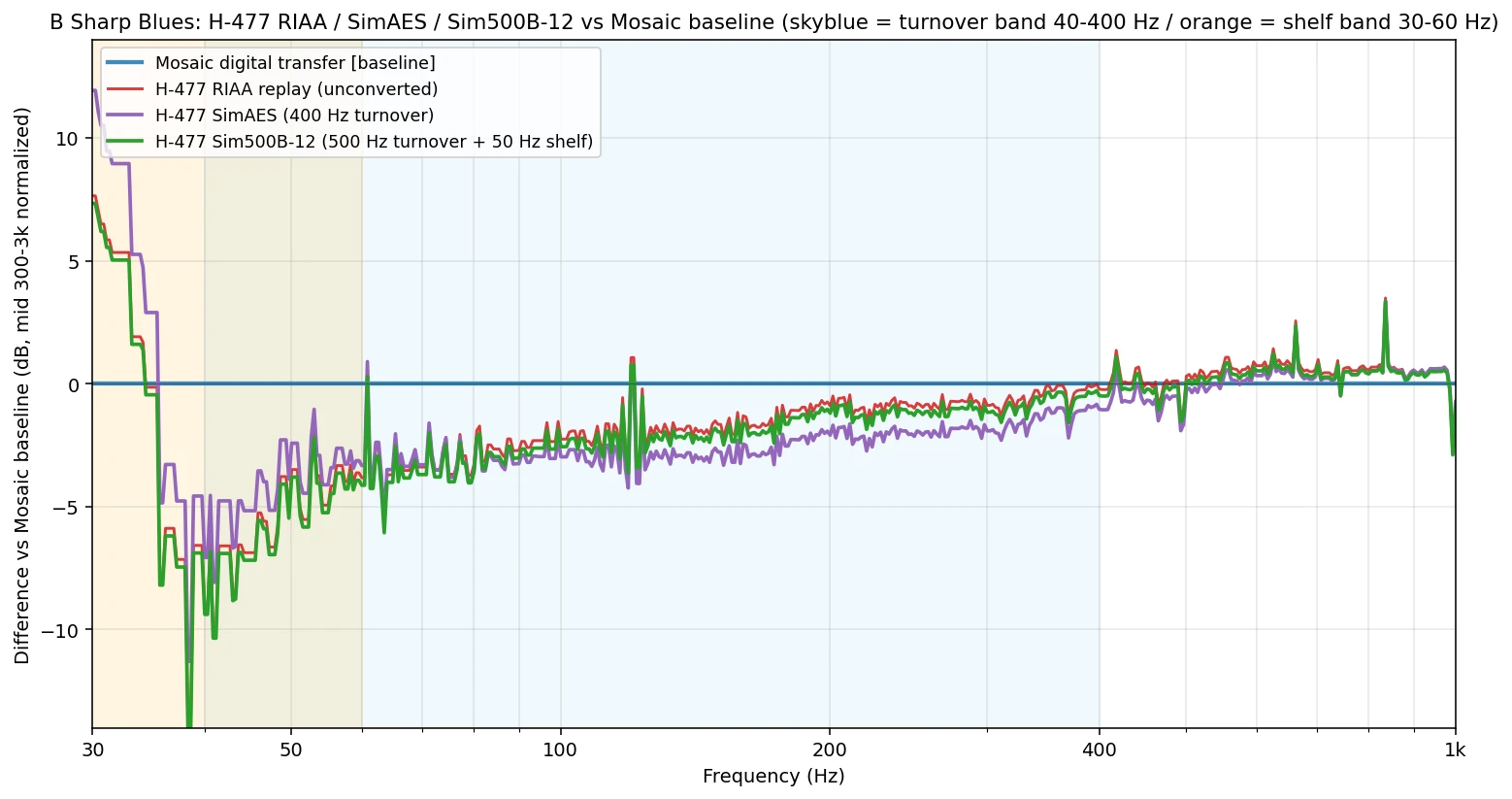
【Fig J2】 B Sharp Blues の低域 LTAS 差分。 Mosaic のディジタルトランスファーを基準 0 dB とし、 中域 300 Hz-3 kHz で正規化したもの(縦軸は Fig J より広い)。 H-477 は無変換(RIAA 再生、 赤)、 SimAES 変換(400 Hz ターンオーバー、 紫)、 Sim500B-12 変換(500 Hz ターンオーバー + 50 Hz シェルフ、 緑)の 3 通り。 60 Hz 以下はランブルやカッティング時の深低域の扱いなど、 カーブ以外の要因が支配して ±10 dB 級で暴れ、 比較的滑らかな 100〜400 Hz でも 3 通りの違いは互いに 1 dB 前後で、 同じスケールの共通残差に埋もれる。帯域 RMS 距離(無変換 / SimAES / Sim500B-12 の順に、 40〜400 Hz で 3.02 / 3.01 / 3.26 dB、 30〜60 Hz で 5.95 / 5.71 / 6.14 dB)は変換の違いにほとんど反応せず、 この素材の低域ではターンオーバーを判別できない(筆者解析、 2026年6月11日)。
結果は、 この素材の低域ではターンオーバーを判別できない、 というものでした。 Fig J2 のとおり、 60 Hz 以下はランブルやカッティング時の深低域の扱いなど、 カーブ以外の要因が支配して ±10 dB 級で暴れます。比較的滑らかな 100〜400 Hz でも、 無変換、 SimAES、 Sim500B-12 の 3 通りの残差は互いに 1 dB 前後しか違わず、 ターンオーバー帯(40〜400 Hz)の RMS 距離も、 無変換 3.02 / SimAES 3.01 / Sim500B-12 3.26 dB とほぼ横並びで、 この指標は変換の違い(= カーブ仮説の違い)にほとんど反応していません。 Fig J で変換がきれいに効いて見えたのと対照的ですが、 これは偶然ではありません。
The result: on this material, the low band cannot discriminate the turnover. As Fig J2 shows, below 60 Hz the comparison is dominated by factors other than the curve (rumble, the handling of deep bass at cutting time) and swings on the order of ±10 dB. Even in the comparatively smooth 100–400 Hz range, the three residuals (unconverted, SimAES, Sim500B-12) differ from one another by only about 1 dB, and the RMS distances over the turnover band (40–400 Hz) line up at 3.02 / 3.01 / 3.26 dB respectively; the metric barely responds to the choice of conversion (that is, to the curve hypothesis). The contrast with Fig J, where the conversion showed up so cleanly, is no accident.
ひとことで言えば、 高域はカーブ仮説間の差が静かな帯域に現れるのに対し、 低域は差が小さい帯域ほど信号が静かで、 差が大きくなる帯域ほど信号がランブル等で大きく暴れる、 という不利な配置だからです(詳しくは下の囲みをご覧ください)。言えるのは、 500B-12 案を積極的に支持する結果は出なかった、 というところまでです(II-a が今後の課題として開いた pre-RIAA 期 Capitol 盤の横断調査に対しては、 低域では判別できないサンプルだった、 という記録になります)。
In short: in the highs, the difference between curve hypotheses appears in a quiet band, while in the lows, the quieter the band the smaller the difference, and the larger the difference the more rumble and the like swing the signal (the box below has the details). What can be said stops here: no result actively supporting the 500B-12 variant emerged. (For the survey across pre-RIAA Capitol pressings that II-a left open as future work, this goes on record as a sample whose low band cannot discriminate.)
理由は 3 つ重なっています。第一に、 判別シグナルとノイズの帯域配置です。高域判別では、 AES と RIAA の理論差(4〜8 kHz で +1.3〜+1.4 dB)が、 ノイズの少ない判別帯に同じ符号でまとまって現れます。低域側の理論差は、 比較的静かな 100〜400 Hz では −1 dB 前後と小さく、 70 Hz 付近で符号も反転します。差が +2〜4 dB に育つのは 30〜60 Hz ですが、 そこはランブルなどが ±10 dB 級で暴れる帯域です。
Three things stack up. First, the band placement of signal and noise. In the high-frequency identification, the theoretical difference between AES and RIAA (+1.3 to +1.4 dB across 4–8 kHz) appears with a single sign, as a plateau, in a quiet diagnostic band. The low-frequency theoretical difference is small (around −1 dB) in the comparatively quiet 100–400 Hz range and even flips sign around 70 Hz; it grows to +2 to +4 dB only at 30–60 Hz, exactly where rumble and the like swing on the order of ±10 dB.
第二に、 比較の相手です。 Fig J は LP 同士の比較で、 カートリッジや再生系の共通要因が差分から消えます。 Fig J2 は LP とディジタルの比較で、 カッティング時の低域の扱いや盤の個体差がすべて残差に残ります(共通残差 3 dB 級)。
Second, what is being compared. Fig J is an LP-to-LP comparison, where factors common to the cartridge and playback chain cancel out of the difference. Fig J2 is an LP-to-digital comparison, where the handling of deep bass at cutting time and disc-to-disc variation all stay in the residual (a common residual on the order of 3 dB).
第三に、 Fig J2 で緑(Sim500B-12)と赤(無変換)が重なるのは、 判別の失敗ではなく設計上の必然です。 Sim500B-12 の低域定義(500 Hz ターンオーバー + 50 Hz シェルフ)は RIAA の低域と同一で、 違いは高域時定数だけだからです。実質の判別は、 SimAES(400 Hz、 シェルフなし)を他の 2 つと区別できるかどうかにかかっています。
Third, the overlap of green (Sim500B-12) and red (unconverted) in Fig J2 is not a failed discrimination but a built-in outcome: the low-frequency definition of Sim500B-12 (500 Hz turnover + 50 Hz shelf) is identical to RIAA’s low end, differing only in the high-frequency time constant. The real test is whether SimAES (400 Hz, no shelf) can be told apart from the other two.
LP 同士の高域残差の整合と、 初版の物理的特徴(深溝ありのレーベル + [HIGH FIDELITY] 表記のないジャケット = 1954 年前半の流通形態と整合)を考え合わせると、 H-477 のカッティングカーブは、 Sinatra H-488 D2 と同様に Capitol 400N-12.7(= AES 系)がもっとも有力、 というのが本章の読みです。ただし、 どの手がかりも単独では決め手にならない、 という限定つきの推測です。高域帯の Mosaic 直接比較に伴う制約は、 II.4.2 と II.5 で改めて触れます。
Putting together the high-frequency LP-to-LP agreement and the physical traits of the first pressing (deep-groove label plus a jacket without the [HIGH FIDELITY] print, consistent with how Capitol product circulated in the first half of 1954), this chapter’s reading is that the most likely cutting curve for H-477 is Capitol 400N-12.7 (AES family), the same as Sinatra H-488 D2. It remains a qualified inference: no single clue is decisive on its own. The constraints around direct high-band comparison against Mosaic come up again in II.4.2 and II.5.
II.4.2 The character of the T-477 remaster (Mosaic master as reference)
次に、 T-477 が H-477 と比べてどのような音作りの違いを持ち、 それがマスターテープ起源(= 同一セッションマスター由来)か再カッティング段での介入か、 を、 マスター比較の外部基準として扱う Mosaic Box(= “The Complete Capitol Recordings of Duke Ellington”, CD2)を基準にして見ていきます。 II-a / II-b での D8 基準のような「LP 内部の基準」 ではなく、 マスターテープ由来の基準を持てるのが Ellington 章の利点です。
Next, the question is how T-477 differs from H-477 in its sound, and whether that difference is master-tape-borne (from the shared session master) or an intervention at the recutting stage. The reference is the Mosaic box (“The Complete Capitol Recordings of Duke Ellington“, CD2), treated as an external master-comparison baseline. Where II-a / II-b had to rely on a reference internal to the LPs (D8), the Ellington chapter gets a reference of master-tape origin, and that is its advantage.
なお、 この Mosaic Box のブックレットには、 Mosaic としては珍しく、 マスタリングやトランスファーの担当クレジットがありません。音響修復やマスタリングを行った場合にはその旨と担当者を明記してきた同レーベルの慣行を踏まえると、 これは意識的な音作りを加えていないトランスファーである可能性を示唆します(ただし一次史料での明示確認には至っていません)。後述の通り、 独立した物理盤である H-477 がこの Mosaic と高い整合を示すことも、 この読みと符合します。
A note on the Mosaic box: unusually for the label, its booklet carries no mastering or transfer credit. Given Mosaic’s practice of stating explicitly, with names, whenever audio restoration or mastering was done, the absence is read as suggesting that this transfer adds no conscious sound-shaping (though no primary source confirms this explicitly). As shown below, the close agreement between this Mosaic and H-477 (an independent physical pressing) fits the same reading.
ただし、 II.4.1 の末尾で触れた通り、 LP とディジタルトランスファーの直接比較には、 カートリッジと盤の相互作用が混入し得ます。そこで本節の比較はプレゼンス帯(= 4〜8 kHz)に限定します。主軸の解析環境である Hana MH カートリッジは、 テストレコードの 22 トーン実測で 30 Hz-15 kHz にわたり平坦な応答を確認しており、 この帯域の差分にカートリッジ由来の色付けはほぼ乗りません。
As noted at the end of II.4.1, though, direct LP-to-digital comparison can pick up cartridge-disc interaction. The comparisons in this section are therefore limited to the presence band (4–8 kHz). The main analysis cartridge, a Hana MH, measures flat from 30 Hz to 15 kHz across the 22 tones of a test record, so cartridge-borne coloration contributes little to differences in this band.
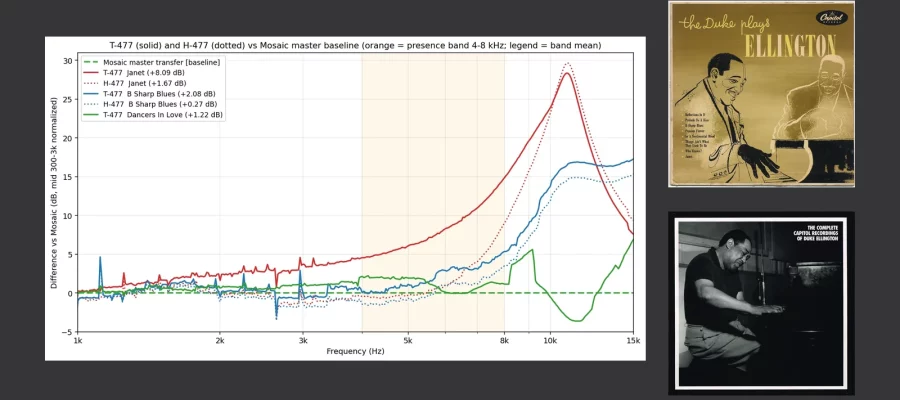
共通 8 曲のうち 3 曲(= B Sharp Blues、 Janet、 Dancers In Love)を選び、 各盤を中域 300〜3 kHz で正規化した LTAS のプレゼンス帯(= 4〜8 kHz)の差分を Mosaic 基準で取ると(Fig K)、 T-477 は Janet で +8.09 dB、 B Sharp Blues で +2.08 dB、 Dancers In Love で +1.22 dB と曲別の値を取ります(3 曲とも同一の自動デクリック処理を適用した盤起こしです)。一方、 H-477 は比較できる 2 曲とも T-477 より大幅にマスターに近く、 B Sharp Blues で +0.27 dB、 Janet で +1.67 dB に収まります(Dancers In Love は H-477 未収録です)。なお、 Fig K で 8 kHz より上に見える各カーブの急な持ち上がりは、 楽音ではなく LP 側のサーフェスノイズです。この 1953年録音では 8 kHz から上で楽音成分が深く沈み、 ディジタル基準の Mosaic に対して LP のノイズフロアが浮き上がって見えています。 H-477 と T-477 が似た形で発散するのも、 どちらも盤のノイズフロアを見ているためです。本節の比較をプレゼンス帯(4〜8 kHz)に限定した理由がここにあります(再生側・解析側の留保条件は II.5 で改めて整理します)。
Taking three of the eight shared tracks (B Sharp Blues, Janet, Dancers In Love), normalizing each source over the 300 Hz-3 kHz midrange, and reading the presence-band (4–8 kHz) LTAS difference against Mosaic (Fig K), T-477 takes track-specific values: +8.09 dB on Janet, +2.08 dB on B Sharp Blues, +1.22 dB on Dancers In Love (all three rips share the same automatic declick processing). H-477, by contrast, stays far closer to the master on both comparable tracks: +0.27 dB on B Sharp Blues and +1.67 dB on Janet (Dancers In Love is not on H-477). Note that the steep rise every curve shows above 8 kHz in Fig K is not musical content but LP surface noise. On this 1953 recording the musical content sinks deep above 8 kHz, so what lifts against the digital Mosaic reference is the LP noise floor; H-477 and T-477 diverge in similar shapes because both are then showing their noise floors. This is why the comparison in this section is limited to the presence band (4–8 kHz). (Playback-side and analysis-side reservations are organized in II.5.)
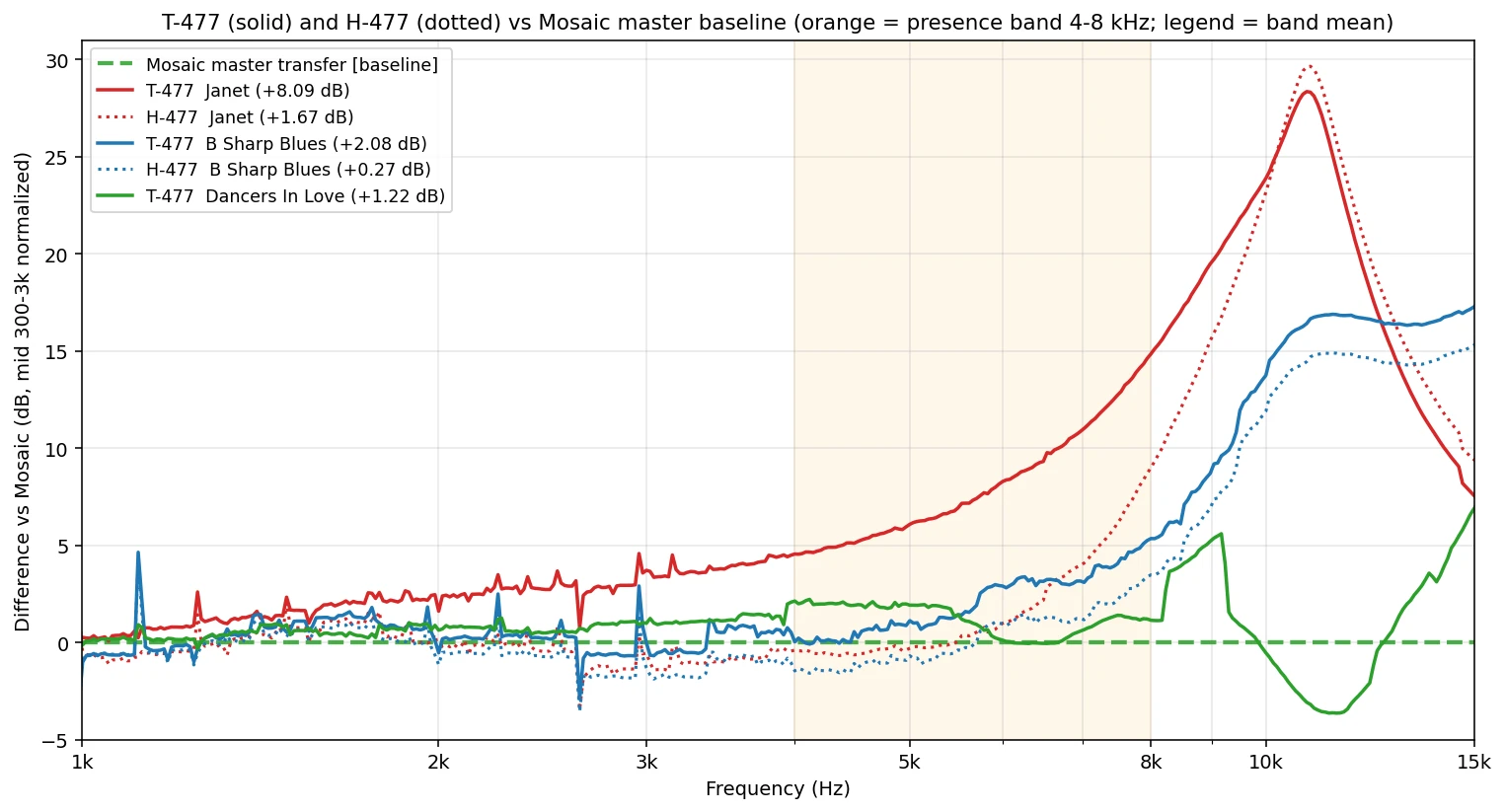
【Fig K】 3 曲の LTAS 差分。 Mosaic のマスターテープトランスファーを基準 0 dB とし、 中域 300 Hz-3 kHz で正規化。実線は T-477(プレゼンス帯 4〜8 kHz 平均で Janet +8.09 dB / B Sharp Blues +2.08 dB / Dancers In Love +1.22 dB)、 点線は H-477(Janet +1.67 dB / B Sharp Blues +0.27 dB)。 T-477 は曲によって大きく異なり、 H-477 はマスターに近い。 8 kHz より上は LP 各カーブがサーフェスノイズへ発散する(比較対象外)(筆者解析、 2026年6月13日)。
ここから読み取れるのは、 H-477(= 1954年リリースの 10インチ初版)が Mosaic 基準で比較的マスターに近いのに対し、 T-477(= 数年後の 12インチ再発)では曲によって音作りの介入度合いが大きく異なる、 ということです。ここで II-b との方法論の違いが効いてきます。 II-b の Sinatra 系譜ではマスターテープを直接参照できなかったため、 基準を H-488 D8 から W-587 に切り替えた途端、 「再発側の高域強調」 に見えていたものが「初期盤側の凹み」 へと解釈が反転しました。一方 Ellington にはマスターテープのディジタルトランスファー(Mosaic)という基準があるため、 Janet の +8.09 dB は基準の取り方に左右されない、 マスター比の観察として読めます。再発段階で高域を持ち上げる音作りが行われていた、 と読めるわけです。
This suggests that H-477 (the 10-inch first issue, released 1954) stays comparatively close to the master against the Mosaic baseline, while on T-477 (the 12-inch reissue from a few years later) the degree of sound-shaping intervention varies widely from track to track. This is where the methodological difference from II-b starts to matter. In II-b’s Sinatra lineage, with no direct access to the master tape, the moment the reference switched from H-488 D8 to W-587, what had looked like “high-frequency emphasis on the reissue side” flipped into “a dip on the early-pressing side.” For Ellington there is a master-tape digital transfer (Mosaic) to serve as the reference, so Janet’s +8.09 dB reads as an observation against the master, independent of how the reference is chosen: sound-shaping that lifted the highs was applied at the reissue stage.
なお、 この「H-477 は Mosaic 基準でマスターに近い」 という観察は、 II-b で見た「同時期の Sinatra H-488 初期盤は高域に凹みを持つ」 という観察と並べると、 もうひとつ見えてくることがあります。どちらも同じ Capitol の Melrose Avenue スタジオで 1953年に録音され、 1954年前半にリリースされた 2 タイトルなのに、 一方は凹み、 一方は凹んでいない。つまり II-b の凹みは、 当時の Capitol のカッティング工程全体に共通する性質ではなく、 タイトルごとの個別の事情に由来する可能性が高い、 ということです。候補としては、 ボーカル中心の H-488 とピアノトリオの H-477 とで高域の扱いを変えた編集判断や、 カッティングの担当者・機材・ラインの違いなどが考えられますが、 特定には至りません。
Setting this “H-477 stays close to the master against the Mosaic baseline” observation beside II-b‘s “the early Sinatra H-488 pressings carry a high-frequency dip” brings out one more point. Both titles were recorded at Capitol’s Melrose Avenue studio in 1953 and released in the first half of 1954, yet one dips and the other does not. The II-b dip, then, was likely not a property common to Capitol’s whole cutting operation at the time but something rooted in title-specific circumstances. Candidates include an editorial decision to treat the highs differently between the vocal-centered H-488 and the piano-trio H-477, or differences in cutting personnel, equipment, or line; none can be pinned down.
ただし、 曲別の差(= Janet +8.09 dB vs B Sharp Blues +2.08 dB)を「全曲共通のリマスター EQ」 で説明するのは困難です。もし全曲一律の EQ ブーストが加えられているなら、 LTAS の差分は曲別ではなく一律の値になるはずです。観察された曲別の差は、 (1) 曲別に異なる EQ が適用された、 (2) 静的 EQ ではなく信号レベルに応じる動的処理(= コンプレッサ / 高域ダイナミック EQ 等)が介在した、 という 2 つの可能性のどちらか(あるいは両方)を示唆します。これは LTAS だけでは決着できない論点で、 次節 II.4.3 で立ち上がりエンベロープ解析を通じて踏み込んでいきます。
The track-to-track spread (Janet +8.09 dB vs B Sharp Blues +2.08 dB) is hard to explain as “one remaster EQ applied to all tracks.” A uniform EQ boost across the album would show up in the LTAS differences as a uniform value, not track-specific ones. The observed spread points to one of two possibilities, or both: (1) different EQ was applied per track, or (2) dynamic processing that responds to signal level (a compressor, dynamic high-frequency EQ, and the like) intervened rather than static EQ. LTAS alone cannot settle this, and the next section, II.4.3, digs into it through transient envelope analysis.
II.4.3 What LTAS alone cannot capture (transient envelope analysis)
LTAS は信号を「ある時間範囲の中で周波数ごとに平均したエネルギー」 として記述するため、 ブラシやスティック当たりのような短時間の立ち上がりは、 平均化されて見えにくくなります。 II.4.2 で見た T-477 の曲別の差(= Janet +8.09 dB vs B Sharp Blues +2.08 dB)を、 LTAS とは別の指標で見直してみます。
LTAS describes a signal as energy averaged per frequency over a stretch of time, so short transients (brush work, stick attacks) get averaged down and become hard to see. The track-specific T-477 differences seen in II.4.2 (Janet +8.09 dB vs B Sharp Blues +2.08 dB) deserve a second look through a different set of metrics.
ここでは 4〜8 kHz をバンドパスフィルタで取り出し、 Hilbert 変換でエンベロープ(= 瞬時振幅の包絡線)を計算し、 中域 300〜3 kHz の RMS で正規化したうえで、 RMS(= 平均)、 p99(= 上位 1% の境界値)、 p99.9(= 上位 0.1% の境界値)、 クレストファクタ(= peak / RMS, dB)の 4 指標を T-477 と Mosaic で比較します。 4 指標のうち RMS は LTAS の差分とほぼ同じ情報を持つ一方、 p99 / p99.9 / クレストファクタは短時間の立ち上がりほど強く反映する性質があります。
The procedure: extract 4–8 kHz with a bandpass filter, compute the envelope (the instantaneous-amplitude contour) via the Hilbert transform, normalize by the RMS of the 300 Hz-3 kHz midrange, and compare four metrics between T-477 and Mosaic: RMS (the average), p99 (the 99th-percentile level), p99.9 (the 99.9th-percentile level), and crest factor (peak / RMS, dB). Of the four, RMS carries nearly the same information as the LTAS difference, while p99, p99.9, and crest factor respond more strongly the shorter the transient.
crest factor(クレストファクタ) = 信号のピーク側(本章では上位 0.1% の境界値)と実効値の比 (dB)、値が大きいほど立ち上がりが鋭く保たれている指標。本章では 4〜8 kHz 帯域を取り出したエンベロープに対して計算しています。
crest factor = ratio of the peak side of the signal (here the 99.9th-percentile envelope level) to RMS (dB); higher values indicate that transients are preserved more sharply. In this chapter it is computed on the envelope of the extracted 4–8 kHz band.
3 曲(B Sharp Blues、 Janet、 Dancers In Love)で T-477 − Mosaic を取ると(Fig L)、 Janet は RMS +7.76 dB / p99 +7.50 dB / p99.9 +8.50 dB / クレスト +0.74 dB と、 4 指標全部がほぼ同じ +7〜+8 dB で動きます。 Dancers In Love は RMS +2.33 / p99 +3.03 / p99.9 +1.38 / クレスト −0.94 で、 こちらも最上位値(p99.9)やクレストファクタが突出する気配はありません。ところが B Sharp Blues は RMS +1.34 / p99 +0.93 / p99.9 +5.30 / クレスト +3.96 と、 平均と上位値で挙動が大きくずれます。
Taking T-477 − Mosaic on the three tracks (Fig L): Janet moves as a block, RMS +7.76 dB / p99 +7.50 dB / p99.9 +8.50 dB / crest +0.74 dB, all four metrics within the same +7 to +8 dB. Dancers In Love reads RMS +2.33 / p99 +3.03 / p99.9 +1.38 / crest −0.94, again with no sign of the top percentile (p99.9) or the crest factor breaking away. B Sharp Blues, however, reads RMS +1.34 / p99 +0.93 / p99.9 +5.30 / crest +3.96: the average and the upper percentiles part ways.
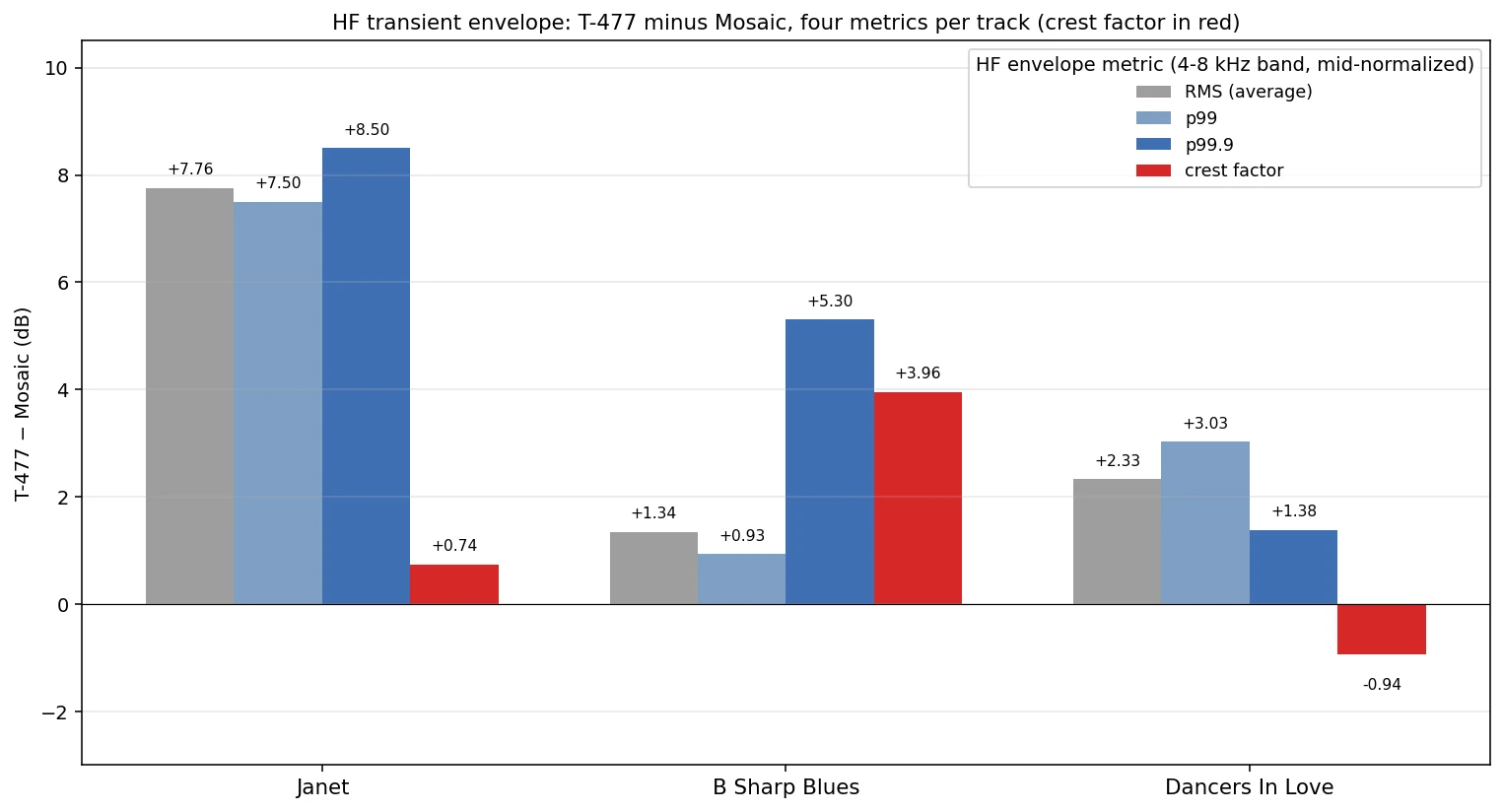
【Fig L】 4 つのエンベロープ指標(4〜8 kHz 帯域、 中域正規化)での T-477 − Mosaic。 Janet は 4 指標とも +7〜+8 dB で一様に動き、 Dancers In Love は最上位値の突出なし。 B Sharp Blues だけは RMS +1.34 dB に対し p99.9 +5.30 dB / クレストファクタ +3.96 dB(赤)と乖離し、 静的 EQ だけでは説明しにくく、 レベル依存の動的処理を示唆する挙動(筆者解析、 2026年6月13日)。
Janet と Dancers In Love の「クレストファクタがほぼ動かない」 パターンは、 静的な高域 EQ ブースト(= 信号レベルによらず一律に高域帯を持ち上げる処理)で素直に説明できます。一方 B Sharp Blues の「平均値は小さく、 上位値だけが大きく持ち上がる」 パターンは、 静的 EQ では説明できません。信号レベルに応じて効きが変わる動的処理(コンプレッサ / 高域ダイナミック EQ / マルチバンド 等)が介在していると読むのが自然な解釈です。言い換えると、 B Sharp Blues の T-477 では、 ブラシやピアノ上方のアタックといった短時間の立ち上がりが、 平均レベルとは独立に強調されています。
The “crest factor barely moves” pattern on Janet and Dancers In Love is what a static high-frequency EQ boost (lifting the high band uniformly, regardless of signal level) would produce. The B Sharp Blues pattern (a small average shift with only the upper percentiles lifted) is not something static EQ can produce. The natural interpretation is that dynamic processing whose action depends on signal level (a compressor, dynamic high-frequency EQ, multiband processing, and the like) intervened. Put differently, on the T-477 of B Sharp Blues, short transients (brushes, the attack in the piano’s upper range) are emphasized independently of the average level.
LTAS だけ見ていると B Sharp Blues は「リマスターほぼ介入なし」 と読めますが、 立ち上がりエンベロープで見ると「立ち上がりだけが選択的に強調された介入あり」 と読める。同じ音源を異なる解析手法で見ると、 互いに補完する情報が得られる、 という方法論的な教訓があります。ただし、 具体的な動的処理の機構(= 何のコンプレッサか、 どの帯域か、 どのレシオか)は LTAS と立ち上がりエンベロープの組み合わせからは特定できません。「挙動は事実、 機構は推測」 という段階的な記述に留めるのが妥当です。
On LTAS alone, B Sharp Blues reads as “remaster: nearly untouched”; through the transient envelope, it reads as “intervention present, with transients selectively emphasized.” The methodological lesson: different analysis methods applied to the same source return information that complements each other. The specific mechanism of the dynamic processing (which compressor, which band, what ratio) cannot be identified from LTAS plus transient envelope, though. It is best described in graded terms: the behavior is fact, the mechanism is conjecture.
II.4.4 The “bring the drums forward” hypothesis (motive / means / effect)
II.4.2 と II.4.3 で見えた T-477 のリマスターの性格(= 静的な高域 EQ ブースト + 一部曲での立ち上がり選択強調)は、 単独の音作りの選択というより、 1953年4月の Ellington Trio セッションの「素性」 に対する、 12インチ移行期(1955年以降)の Capitol の編集判断の表れとして読める仮説を、 ここで提示します。
Here is my hypothesis: the character of the T-477 remaster seen in II.4.2 and II.4.3 (static high-frequency EQ boost, plus selective transient emphasis on some tracks) can be read less as an isolated sound-shaping choice than as Capitol’s editorial judgment, in the 12-inch transition era (1955 onward), responding to the native character of the April 1953 Ellington Trio session.
まず動機です。 1953年4月の Ellington Trio セッションは、 筆者が 30 年以上にわたって聴いてきた印象として、 ドラムがオフ気味に収録されており、 全体に帯域も狭めです(II.4.5 でこの聴感を 12 曲の LTAS でも裏付けます)。 12 インチで T-477 として出し直す段階で、 「ドラムをもう少し前に出した方が、 当時のハイファイ市場での訴求力が上がる」 という編集判断が働いた可能性があります。 II-b で見たように、 同時期の Capitol は Sinatra 系譜でもカッティングチェーンを新世代へ更新していたとみられ、 マスターテープの高域をより素直に盤へ通すようになっていました。機材の更新で高域を「通す」(Sinatra W-587)と、 EQ や動的処理で高域を「足す」(Ellington T-477)とでは実装はまったく別ですが、 どちらも、 主にクラシックのリリースで「Full Dimensional Sound」 を掲げてハイファイ志向を強めていた当時の Capitol の姿勢が、 ポピュラー系のカタログにも及んだ現れ、 と位置づけられそうです。
First, the motive. In my listening across more than three decades, the April 1953 Ellington Trio session has the drums recorded somewhat off-mic and a narrower overall bandwidth (II.4.5 backs this impression with LTAS across the twelve tracks). When Capitol reissued the material as the 12-inch T-477, an editorial judgment may well have been at work: bringing the drums somewhat forward would play better in the hi-fi market of the day. As II-b showed, Capitol appears to have been updating its cutting chain to a new generation around the same time in the Sinatra lineage, passing the master tape’s highs onto the disc more directly. Passing the highs through by equipment update (Sinatra W-587) and adding highs by EQ or dynamic processing (Ellington T-477) are entirely different implementations, but both can be placed as expressions of the same posture: the Capitol that was pushing hi-fi under the “Full Dimensional Sound” banner, mainly on classical releases, extending that posture into the popular catalog.
次に手段です。プレゼンス帯(4〜8 kHz)の EQ ブースト(= Janet で +8 dB 強、 他の 2 曲では +1〜+2 dB)と、 一部曲での動的処理(= B Sharp Blues での立ち上がり選択強調)の組み合わせが、 ブラシ・スティック当たり・ピアノ上方のアタック、 そして Dancers In Love で聴けるフィンガースナップ(指鳴らし)といった「立ち上がり成分」 を選択的に前に出すのに有効に作用します。マスターテープ上に存在する成分を再生側 EQ ではなく、 カッティング段階を見据えた編集判断で前に出すか引っ込めるか、 というレイヤーの介入です。
Next, the means. The combination of presence-band (4–8 kHz) EQ boost (over +8 dB on Janet, +1 to +2 dB on the other two tracks) and dynamic processing on some tracks (the selective transient emphasis on B Sharp Blues) works effectively to bring forward the transient content: brushes, stick attacks, the attack in the piano’s upper range, and the finger snaps audible on Dancers In Love. The intervention sits at the layer of editorial judgment looking toward the cutting stage: whether content present on the master tape gets pushed forward or pulled back, rather than left to playback-side EQ.
最後に効果です。 Janet で実測された T-477 − Mosaic = +8.09 dB がもっとも顕著な例で、 ブラシのシズル感やドラム周りの存在感を Mosaic(マスターテープ由来)よりも明確に押し上げています。 B Sharp Blues では、 LTAS では控えめな +2.08 dB に見える差が、 立ち上がりエンベロープではクレストファクタ +3.96 dB という「立ち上がりだけ大きく持ち上がる」 形で現れ、 同じ方向の編集判断が曲ごとに異なる手段で実装されている可能性を示唆します。
Last, the effect. The measured T-477 − Mosaic = +8.09 dB on Janet is the most pronounced case, clearly lifting the brush sizzle and the presence around the drums above Mosaic (master-tape origin). On B Sharp Blues, a difference that looks modest on LTAS (+2.08 dB) appears in the transient envelope as crest factor +3.96 dB, transients alone lifted substantially, suggesting that the same direction of editorial judgment was implemented through different means per track.
通底テーマとして、 これは Pt.0〜25、 特に Pt.24 で扱ってきたリマスタリング史の中核論点(= マスターに存在する成分を、 再生側 EQ ではなくカッティング段階を見据えた編集判断で前に出す・引っ込める)の Ellington 例として位置づけられます。 Sinatra H-488 の初期盤が高域を抑えたカッティング(= II-b で見た凹み、 引っ込める方向)、 MFSL 1-130 がマスターテープ直由来のキックドラム保存、 そして T-477 がドラム周りのプレゼンス + 立ち上がり強調(= 前に出す方向)、 という、 同じテーマを別の素材・別の時代に当てはめた異なる回答群、 として読めるかと思います(セッションエンジニアやマスタリングクレジットの一次史料は未確認です)。
As a through-line, this is the Ellington instance of the core question in remastering history covered across Pt.0-25 and especially in Pt.24: content present on the master being pushed forward or pulled back by editorial judgment looking toward the cutting stage, rather than by playback-side EQ. The early Sinatra H-488 pressings with their high-frequency-restrained cutting (the II-b dip; the pull-back direction), MFSL 1-130 with its kick drum preserved straight off the master tape, and T-477 with its drum-area presence and transient emphasis (the push-forward direction) can be read as different answers to the same question, applied to different material in different eras. (Primary sources for session engineers or mastering credits remain unconfirmed.)
II.4.5 Recorded bandwidth as a constraint (reflecting the performance, not equipment history)
ここで一つ、 解析手法の制約から派生する論点を扱っておきます。 II-a で議論したカッティングカーブの判別では、 高域帯(5〜10 kHz)に楽音が乗っていることが前提でした。ところが H-477 の曲(特に Janet)は、 中域比で 8 kHz 以上が急落する狭帯域の録音で、 AES/RIAA の判別に必要な高域ロールオフの差が、 楽音不足で十分に出ない、 という制約が見えてきます。
One more topic, this one derived from a constraint of the method. The cutting-curve identification discussed in II-a presupposed musical content in the high band (5–10 kHz). The H-477 tracks (Janet especially) are narrow-bandwidth recordings whose level falls off steeply above 8 kHz relative to the midrange, so the high-frequency rolloff difference needed for AES/RIAA identification does not fully develop for want of musical content.
これが「録音設備の限界」 なのか「演奏内容の反映」 なのかを確かめるため、 H-477 と T-477 の共通 8 曲 + T-477 追加 4 曲の合計 12 曲を、 Mosaic Box のディジタルトランスファーで揃え、 中域 300〜3 kHz で正規化した LTAS の高域 −40 dB 点(= 中域比で −40 dB を下回り始める周波数)を 12 曲分計測しました(Fig M)。結果は、 もっとも狭い 3 曲(Melancholia / Retrospection / Reflections In D、 すべてバラード系)で 4.8〜5.6 kHz、 Janet は 6.7 kHz、 そしてもっとも広い Dancers In Love が 12.2 kHz と、 12 曲のあいだで 2.5 倍を超える開きがありました。
To test whether this is an equipment limit or a reflection of the performances, all twelve tracks (the eight shared between H-477 and T-477 plus the four T-477 additions) were lined up in the Mosaic box’s digital transfer, and the high-frequency −40 dB point of the LTAS (the frequency where the level first falls 40 dB below the 300 Hz-3 kHz midrange) was measured for each (Fig M). The result: the three narrowest tracks (Melancholia / Retrospection / Reflections In D, all ballads) sit at 4.8–5.6 kHz, Janet at 6.7 kHz, and the widest, Dancers In Love, at 12.2 kHz, a spread of more than 2.5x across the twelve tracks.
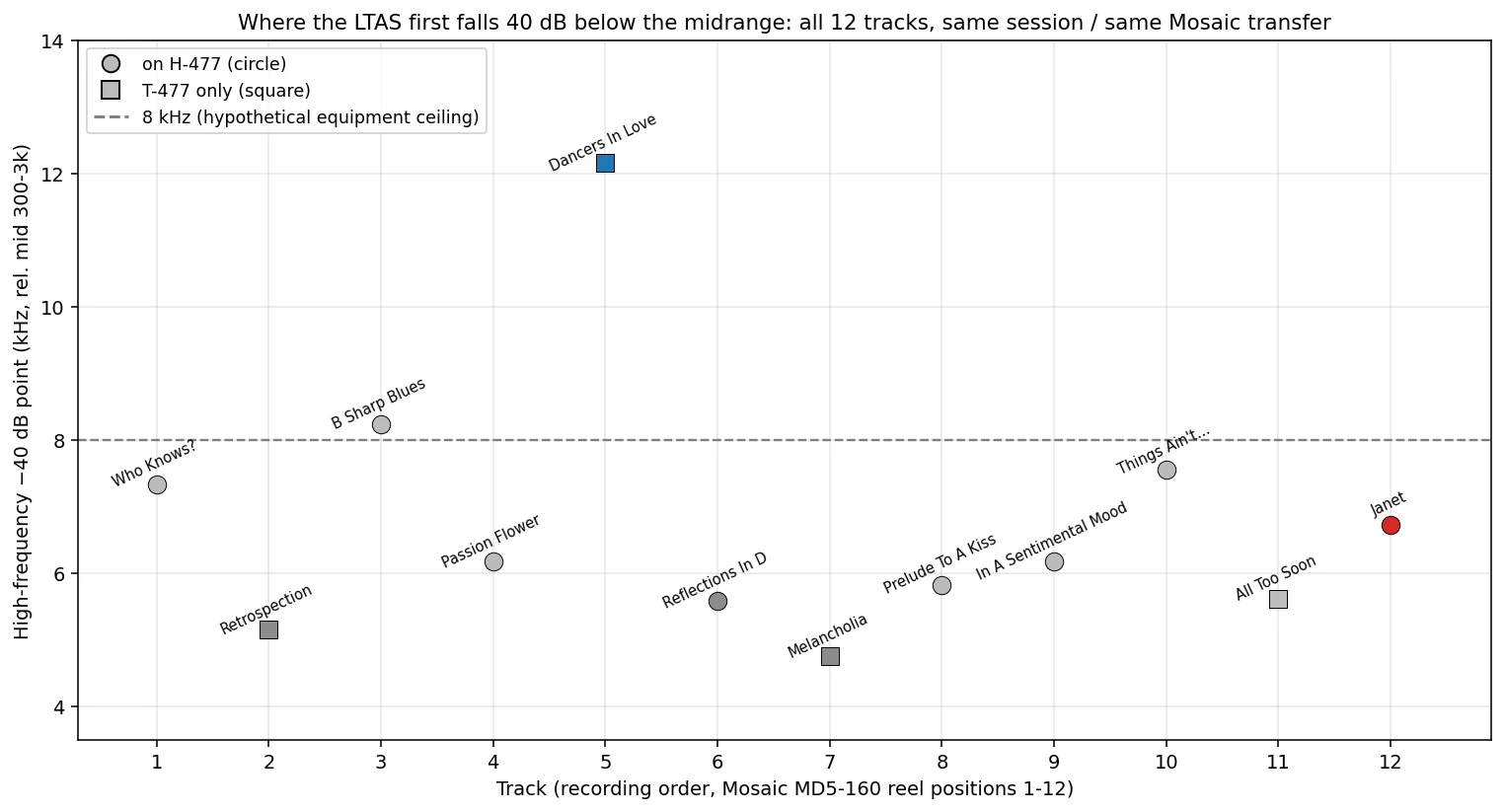
【Fig M】 12 曲の高域 −40 dB 点(LTAS が中域 300 Hz-3 kHz 比で −40 dB を初めて下回る周波数)。 Mosaic トランスファーで計測。バラード 3 曲は 4.8〜5.6 kHz、 Janet(赤)は 6.7 kHz、 もっとも広い Dancers In Love(青)は 12.2 kHz に達する。同一セッション内とみなせる条件で 2.5 倍超の開きがあり、 少なくとも一律 8 kHz で頭打ちになる設備上限説(グレー破線)とは合わない(筆者解析、 2026年6月13日)。
同じセッション・同じスタジオ・同じ録音設備・同じピアノトリオ編成・同じ Mosaic マスタリングで、 12 曲のあいだで 4.8〜12.2 kHz の開きが出る、 ということは、 録音設備の高域上限ではなく、 演奏内容(= ブラシの活発さ、 ドラムの叩き方、 アタックの鋭さ)が高域上限を支配している、 と読むのが自然です。仮に録音設備の高域上限が 8 kHz だったとすれば、 Dancers In Love で −40 dB 点が 12.2 kHz まで延びることは物理的に起き得ないからです。
A 4.8–12.2 kHz spread across twelve tracks from the same session, the same studio, the same recording equipment, the same piano-trio lineup, and the same Mosaic mastering is naturally read as the performances (how active the brushwork, how the drums are struck, how sharp the attacks) governing the high-frequency extent, not an equipment ceiling. Had the equipment’s high-frequency limit been 8 kHz, a −40 dB point reaching 12.2 kHz on Dancers In Love would be physically impossible.
さらに、 筆者の長年の聴感として、 1953年4月 LA セッション(H-477 全 12 曲)と 1953年12月 NY セッション(Mosaic Box の別曲群)のあいだで、 ピアノの帯域感(= 上方の伸び・響きの艶)は明確には変わらない、 という観察があります。もし Capitol が 1953年4月から12月のあいだに録音設備を更新していたなら、 ピアノ単独の帯域感にも改善が出るのが自然です。改善が見られない以上、 4月 vs 12月の音の違い(= 12月のほうがドラムが前に出る)も、 録音設備の更新ではなく、 ドラム周りの収録条件差(= ドラマー、 ドラム用マイクのセッティング、 担当エンジニア)の方向で説明される可能性が高い、 と考えられます。
There is also a long-term listening observation of mine: between the April 1953 LA session (all twelve H-477 tracks) and the December 1953 NY session (other tracks in the Mosaic box), the piano’s sense of bandwidth (upward extension, the sheen of its resonance) does not clearly change. Had Capitol updated its recording equipment between April and December 1953, an improvement would naturally show in the piano’s bandwidth on its own. Since none appears, the April-versus-December difference in sound (drums sitting more forward in December) is more plausibly explained along the lines of drum-related recording conditions (the drummer, the drum microphone setup, the engineer in charge) than by an equipment update.
なお、 当時の Capitol の録音現場では、 EQ を駆使して音を作り込むというよりも、 マイクの選択と配置、 そしてエコーチェンバーの使い方が音作りの主体でした。ミキシングコンソールに備わっていたのは高域 2 ポジション + 低域 2 ポジションの簡素な EQ だけだった、 と当時のエンジニアが証言しています(Charles L. Granata, “Sessions with Sinatra” (2003), pp. 110-111)。録音の帯域の姿を決めていたのは、 機材の性能限界や EQ 処理というより、 マイクをどう選びどう立てるかという収録方針と、 その日の演奏内容だった、 ということです。
For context, sound at Capitol’s recording sessions in this era was shaped mainly by microphone choice and placement and by the use of echo chambers, not by manipulating EQ extensively. Engineers of the period recall that the mixing console offered only a simple EQ with two high-frequency positions and two low-frequency positions (Charles L. Granata, “Sessions with Sinatra” (2003), pp. 110-111). What set the recorded bandwidth was less the equipment’s performance limits or EQ processing than the recording policy (which microphones, placed how) and what was played that day.
ここから言えることは、 二つあります。一つは、 H-477 単独で AES 再生相当と RIAA 再生を比較しても、 Janet 等の狭帯域曲では高域ロールオフの差が出る帯域(5〜10 kHz)に楽音が乏しく、 LTAS では判別がつかないということです。 II-a の D2/D8 判別が成立したのは、 Sinatra の Capitol Studios 1953年11月セッションで高域が(中域比 −40 dB 点で)13 kHz まで延びていたからで、 H-477 の 1953年4月セッションでは同じ手法が曲を選びます。「録音帯域による」 という条件付き判別、 になります。もう一つは、 「LTAS が狭帯域に見えるからといって、 録音設備の限界とは限らない」 という解釈の落とし穴で、 これは II.5 でまとめる LTAS の留保条件の一例として挙げられます。
Two things follow. One: comparing AES-equivalent and RIAA playback on H-477 alone cannot discriminate on narrow-bandwidth tracks like Janet, because the band where the rolloff difference appears (5–10 kHz) carries too little musical content for LTAS. The II-a D2/D8 identification worked because the Sinatra sessions at Capitol Studios in November 1953 extended (at the −40 dB point relative to the midrange) to 13 kHz; on the April 1953 H-477 session, the same method only works on some tracks. The identification comes with a condition: it depends on the recorded bandwidth. Two: “narrow-looking LTAS does not necessarily mean an equipment limit” is an interpretive trap, and it joins the LTAS reservations collected in II.5.
II.5 What LTAS can show / what it cannot — A summary across II-a / II-b / II-c
II-a / II-b / II-c を通じて、 LTAS が「同じセッションマスターから派生した盤同士の音作りの違い」 と「カッティングカーブの間接的な傍証」 を読み取る道具として使えることを示してきました。一方で、 LTAS で何が確定でき、 何ができないかは、 解析を回す前におおかた決まっています。手元の盤がどうカットされ、 どうプレスされ、 どう再生され、 どう比較されるか、 という条件が、 言えることの上限をあらかじめ決めてしまうからです。ここで本シリーズの留保条件を、 カッティングセッション側 / プレス側 / 再生側 / 解析手法側、 の 4 つの軸で整理しておきます。
Across II-a / II-b / II-c, LTAS has proven usable as a tool for reading differences in sound among pressings derived from the same session master, and for gathering indirect evidence about cutting curves. At the same time, what LTAS can and cannot settle is largely decided before the analysis ever runs: how the discs at hand were cut, pressed, played, and compared sets the ceiling on what can be said. Here the reservations behind this series are organized along four axes: the cutting-session side, the pressing side, the playback side, and the analysis-method side.
II.5.A Reservations on the cutting-session side
カッティング段の物理要因(カッティングアンプの特性、 カッターヘッドの個体差・世代差、 カッティングエンジニアの当日の調整やラッカー盤の品質)は、 LTAS から直接は読み取れません。カッティングカーブ(AES/RIAA など)の選択は再生カーブの切り替え(またはディジタル変換)で復元できますが、 カッターヘッドの高域特性やカッティングアンプの周波数応答の個体差は、 一次史料(公開済みの機材スペック、 録音セッションログ、 当時の技術文書など)に依存します。
Physical factors at the cutting stage (the cutting amplifier’s response, unit-to-unit and generation-to-generation variation in cutter heads, the engineer’s adjustments on the day, lacquer quality) cannot be read directly from LTAS. The choice of cutting curve (AES, RIAA, and so on) can be recovered by switching the playback curve (or by digital conversion), but unit-level variation in cutter-head high-frequency response or cutting-amplifier frequency response depends on primary sources: published equipment specifications, session logs, engineering documents of the period.
さらに、 同じセッションマスターから同じカッティングチェーンで複数回カットしても、 カッターヘッドの温度、 針の摩耗、 アンプの安定性、 当日の温度・湿度、 エンジニアの微調整などで、 ±1〜2 dB 程度のばらつきが乗る可能性があります。 II-a で扱った H-488 D2 と D4 で観察された差は、 まさにこの「同じカーブ(と推定される)・同時期の別カッティングのあいだのばらつき」 の実例でした。 LTAS で観察される差が ±1〜2 dB の範囲に収まる場合、 カッティング機材の物理的なゆらぎなのか、 マスター側の差なのか、 単独では切り分けられません。
Beyond that, even repeated cuts from the same session master through the same cutting chain can pick up variation on the order of ±1–2 dB: cutter-head temperature, stylus wear, amplifier stability, the day’s temperature and humidity, the engineer’s fine adjustments. The difference observed between H-488 D2 and D4 in II-a was exactly this kind of variation, between separate cuts of the same period on (what is presumed to be) the same curve. When an LTAS difference stays within ±1–2 dB, physical drift in the cutting equipment cannot be separated from a master-side difference on that observation alone.
II.5.B Reservations on the pressing side
プレス段では、 同じスタンパでもプレスごとに個体差があります。スタンパ自体が数千枚プレスすると摩耗するため、 新品のスタンパでプレスされた盤と比べると、 スタンパ交換直前にプレスされた盤では溝の角が丸まる傾向があります。これは高域帯(= 溝に刻まれた波形の立ち上がりの速さに依存)に影響する可能性があり、 1 枚目と 2000 枚目では LTAS で観察される高域レスポンスがわずかに異なり得ます。
At the pressing stage, discs vary individually even under the same stamper. A stamper wears over thousands of pressings, so a disc pressed just before a stamper change tends to have more rounded groove corners than one pressed when the stamper was new. This can affect the high band (which depends on how fast the waveform cut into the groove rises), so the first disc and the two-thousandth can differ slightly in the high-frequency response LTAS observes.
また、 1950年代前半の塩ビ(PVC)ビスケットの品質差も無視できません。当時の業界全体として、 塩ビ材質の品質と均質性は十分高くなく、 サーフェスノイズの質やノイズフロアの高さがビスケットごとに差が出る要因でした。 1953〜55年頃、 より高品質のプレスで知られた RCA Victor Indianapolis 工場へのプレス委託に切り替えていった Mercury の事例(マトリクス刻印で確認可能)が示唆するように、 時期ごとに、 そして工場ごとにレコード材質やプレス品質にばらつきが大きかったと考えられます。
Quality variation in early-1950s vinyl (PVC) biscuits also matters. Industry-wide, the quality and homogeneity of vinyl stock were not yet high, and the character of surface noise and the height of the noise floor varied from biscuit to biscuit. As suggested by the case of Mercury, which over 1953-55 shifted its pressing to the RCA Victor Indianapolis plant known for higher-quality work (traceable through matrix stampings), record material and pressing quality likely varied widely by period and by plant.
プレス差や材質差が LTAS 上にどの程度の影響として現れるかは、 同一マトリクスの多数盤を同一環境で比較しない限り定量できず、 本シリーズの単独観察では「可能性は否定できない」 範囲に留まります。
How strongly pressing and material differences register on LTAS cannot be quantified without comparing many copies of the same matrix under the same conditions; within this series’ single-copy observations, they stay in the territory of “cannot be ruled out.”
II.5.C Reservations on the playback side
再生側では、 カートリッジ・トーンアーム・盤の組み合わせで決まる高域帯の特性が、 LTAS の結果に直接乗ります。カートリッジの高域共振、 針形状(球面 / マイクロライン 等)、 トーンアームの慣性、 盤の溝形状とカートリッジ接触点の相性、 などが組み合わさり、 LP 由来の高域レスポンスは数 dB のオーダーで動き得ます。
On the playback side, the high-frequency behavior set by the cartridge, tonearm, and disc combination lands directly in the LTAS result. Cartridge high-frequency resonance, stylus profile (spherical, MicroLine, and so on), tonearm inertia, and the fit between groove geometry and the cartridge’s contact points combine to move LP-derived high-frequency response on the order of several dB.
再生側の変動は、 機材の組み合わせだけではなく、 同じ機材・同じ盤での「別の日の盤起こし」 のあいだにも現れます。本章の解析の過程でも、 H-477 の同じ面を別の日に盤起こしした 2 つの音源のあいだに、 再生 EQ の違いに由来する分を除いても、 プレゼンス帯で +1.8 dB 程度、 1 kHz でも +1.4 dB 程度の系統差が見つかりました(Fig N)。トラッキング調整や盤のクリーニング状態など、 その回の条件の何かが違ったと考えられます(特定はできていません)。一方、 同じ日に連続して盤起こしした Sinatra H-488 D2 では、 物理的な再生カーブ切り替えとディジタル変換の結果が ±0.1 dB で一致しています。 1 dB 単位の議論をする際には、 比較する盤起こしを同じ日の連続作業で揃えること、 そして可能ならディジタル変換(= 同じ盤起こしから派生させる方法)を選ぶことが重要になります。
Playback-side variation appears not only across equipment combinations but between rips of the same disc on the same equipment made on different days. In the course of this chapter’s analysis, two rips of the same H-477 side made on different days showed a systematic difference of about +1.8 dB in the presence band and about +1.4 dB even at 1 kHz, after removing what the playback EQ difference accounts for (Fig N). Something about that day’s conditions (tracking adjustment, the state of disc cleaning) must have differed; it has not been identified. By contrast, on the Sinatra H-488 D2 rips made back-to-back on the same day, the physical playback-curve switch and the digital conversion agree within ±0.1 dB. For arguments at the 1 dB level, the rips being compared should be made in one continuous session on the same day, and digital conversion (deriving variants from a single rip) is the safer choice where possible.
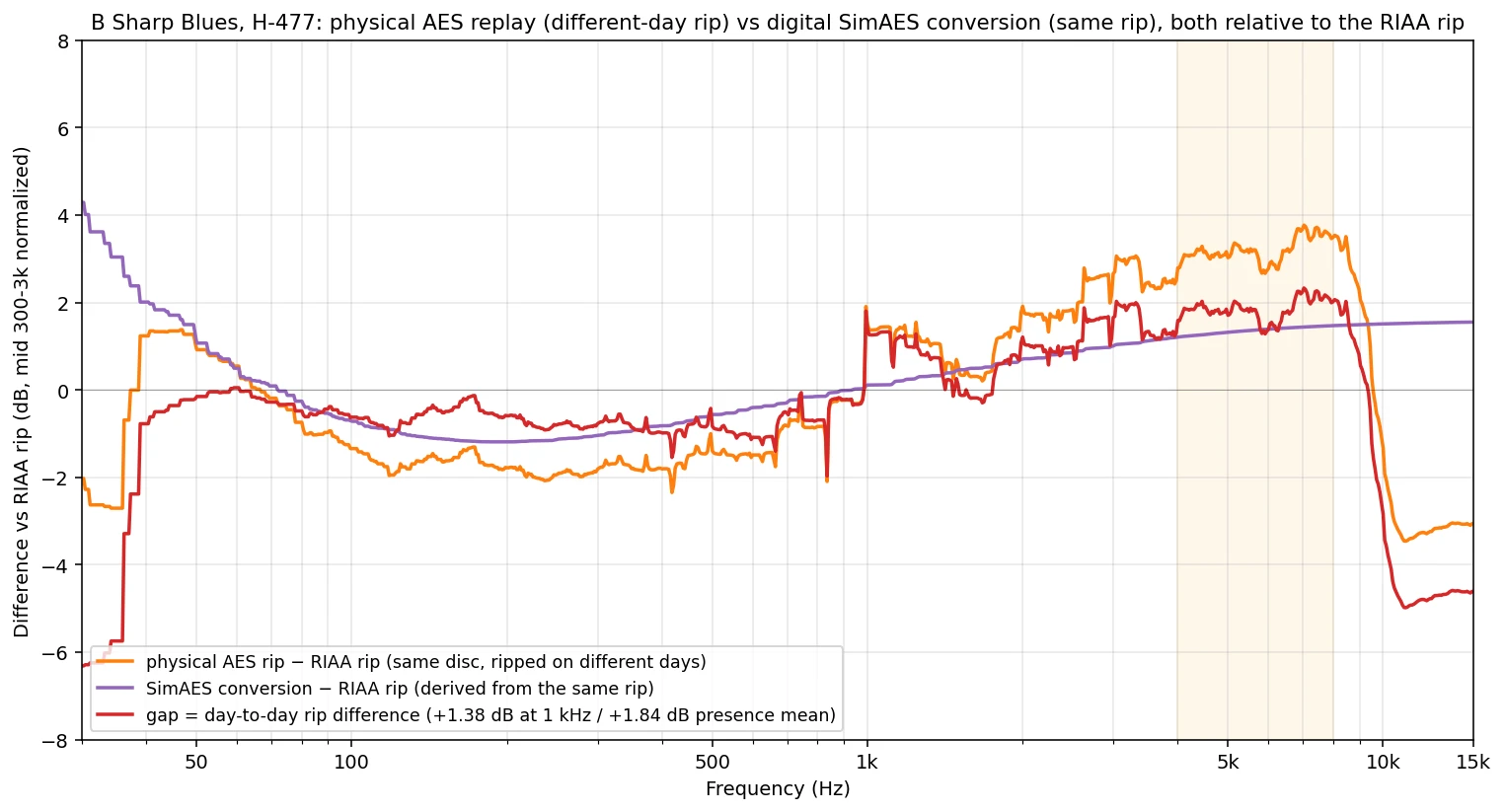
【Fig N】 同じ H-477 の面(B Sharp Blues)を別の日に盤起こしした 2 音源の比較。物理 AES 再生の盤起こし(橙)と、 RIAA 盤起こしからディジタル派生させた SimAES 変換(紫)を、 いずれも RIAA 盤起こし基準で表示。両者の乖離(赤)が別日盤起こしの系統差で、 1 kHz で +1.38 dB、 プレゼンス帯平均で +1.84 dB(筆者解析、 2026年6月13日)。
II-a / II-b / II-c では Hana MH カートリッジを主軸の解析環境として使っています。同じ盤を別の組み合わせ(例: Ortofon CG25Di + SME 3009-R)で再生すると、 8〜12 kHz 帯域に大きな共振ピーク(最大 +13 dB)と 9〜10 kHz のトレース不足、 15 kHz の谷(−17 dB)が現れます(Fig O)。これは個別の組み合わせ固有の現象で、 主軸の Hana MH では再現しません。 LP 再生環境の高域特性が解析結果に直接乗ることの、 物的な例です。
II-a / II-b / II-c use a Hana MH cartridge as the main analysis environment. Playing the same disc on a different combination (for example, Ortofon CG25Di + SME 3009-R) produces a large resonance peak in the 8–12 kHz band (up to +13 dB), under-tracing at 9–10 kHz, and a notch at 15 kHz (−17 dB), as Fig O shows. The phenomenon is specific to that combination and does not reproduce on the main Hana MH setup. It is physical evidence of how directly the playback environment’s high-frequency behavior lands in the analysis.
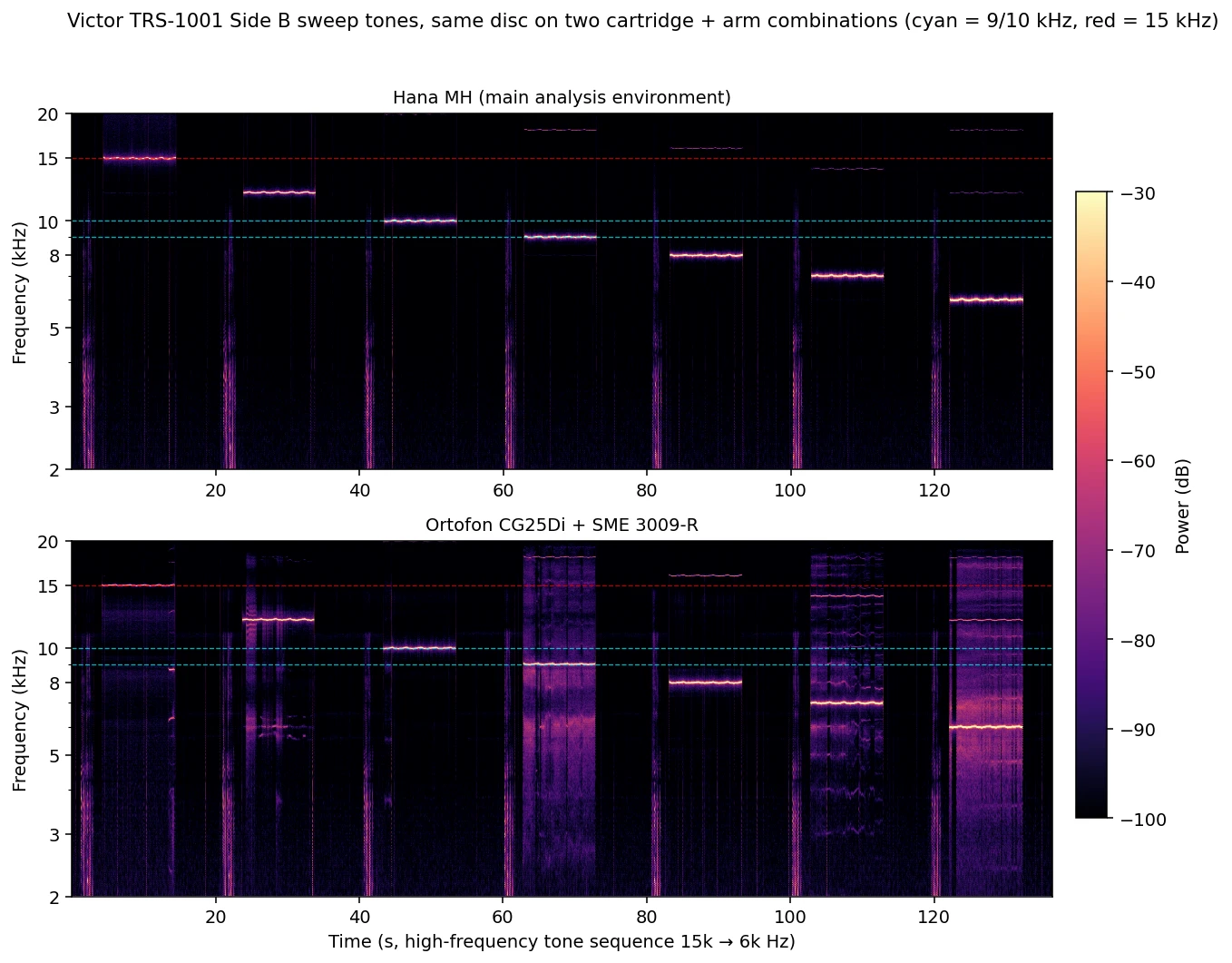
【Fig O】 同じ Victor TRS-1001 のテストトーン盤を 2 つのカートリッジ + アームの組み合わせで再生したスペクトログラム(上: 主軸の Hana MH、 下: Ortofon CG25Di + SME 3009-R)。高域トーン区間で、 CG25Di の組み合わせだけが 8〜12 kHz のトーン周辺に強いスプリアス成分を広げ、 9〜10 kHz(水色破線)でトレース不足、 15 kHz(赤破線)のトーンが弱まる。 Hana MH では再現しない(筆者解析、 2026年6月13日)。
4 つのカートリッジ(Hana MH / DENON DL-103R / Ortofon CG25Di / GE VRII)での体系的な比較と、 共振問題の深掘りは、 別記事「LP 再生環境の影響を聴き分ける」(起草予定)で扱う予定です。
A systematic comparison across four cartridges (Hana MH / DENON DL-103R / Ortofon CG25Di / GE VRII), and a closer look at the resonance problem, is planned for a separate article on listening for the influence of the LP playback environment (in preparation).
II.5.D Reservations on the analysis-method side
LTAS は長期平均スペクトル、 つまり信号を「ある時間範囲で周波数ごとに平均したエネルギー」 として記述する道具です。ブラシやスティック当たりのような短時間の立ち上がりは、 平均化されて見えにくくなります。本稿 II.4.3 で見た T-477 B Sharp Blues の例(LTAS では +2.08 dB の控えめな差にしか見えなかったものが、 立ち上がりエンベロープのクレストファクタでは +3.96 dB の明確な差として現れた)は、 LTAS の制約を実例で示すケースでした。
LTAS is a long-term average spectrum: a tool that describes a signal as energy averaged per frequency over a stretch of time. Short transients such as brush work and stick attacks get averaged down and become hard to see. The T-477 B Sharp Blues example in II.4.3 (what looked like a modest +2.08 dB difference on LTAS appearing as a clear +3.96 dB difference in transient-envelope crest factor) was a working demonstration of this limit.
より厳密な検証には、 同一マトリクスの多数盤を同一環境で盤起こしして比較する、 という解析設計が必要です。ただ現実には、 状態が揃った多数盤を入手し、 同一の解析環境で比較することは難しく、 本シリーズも 1 個体観察を組み合わせるかたちで進めてきました。 LTAS は「方向性を示す道具」 として使い、 「確定の道具」 とは見なさない、 という解析設計上の意識づけが、 本シリーズの土台になっています。
Stricter verification would call for an analysis design that rips and compares many copies of the same matrix in the same environment. In practice, sourcing many copies in comparable condition and comparing them in one environment is hard, and this series has proceeded by combining single-copy observations. The working stance underneath this series is to use LTAS as a tool that indicates tendencies, not one that settles questions.
II-a / II-b / II-c を通じて、 LTAS は (1) 同じセッションマスターから派生した盤同士の音作りの違いを定量的に並べる道具、 (2) カッティングカーブの間接的な傍証を取る道具、 として有効でした。一方で、 (3) 録音帯域の狭い盤では AES/RIAA 判別が成立しない(H-477 単独の再生カーブ切り替えの例)、 (4) 平均的な差と動的な差は LTAS だけでは区別できない(B Sharp Blues の立ち上がり強調)、 (5) 判別は比較の組み方により答えが変わる(Mosaic 基準 / SimAES 変換 + LP 同士比較 / 同一盤の再生カーブ切り替え、 で異なる帰結が出ることがある)、 (6) 低域帯はランブルやカッティング時の深低域の扱いなど、 カーブ以外の要因が支配して、 ターンオーバーの判別が成立しないことがある(B Sharp Blues の Fig J2)、 という制約も明確に見えました。
Across II-a / II-b / II-c, LTAS proved effective as (1) a tool for laying out, quantitatively, the differences in sound among pressings derived from the same session master, and (2) a tool for gathering indirect evidence about cutting curves. Its limits showed just as clearly: (3) AES/RIAA identification fails on narrow-bandwidth discs (the case of switching playback curves on H-477 alone), (4) average differences and dynamic differences cannot be told apart on LTAS alone (the B Sharp Blues transient emphasis), (5) the answer can change with how the comparison is framed (Mosaic reference, SimAES conversion + LP-to-LP comparison, and playback-curve switching on a single disc can lead to different conclusions), and (6) in the low band, factors other than the curve (rumble, the handling of deep bass at cutting time) can dominate and defeat turnover identification (B Sharp Blues, Fig J2).
「LTAS は方向性を示す道具で、 確定の道具ではない」。こう書くと妥協のように聞こえるかもしれませんが、 むしろ逆です。道具の限界が分かっているからこそ、 どこまでは言い切ってよく、 どこから先は推測として書くべきか、 の線引きができます。そして LTAS が捉えられない部分は、 スペクトログラムでのリードテープ痕跡の観察、 立ち上がりエンベロープ、 同一マトリクスの多数盤比較といった別の道具で、 少しずつ補っていけます。本シリーズは、 その「道具の組み合わせ」 の最初の一歩のつもりです。
LTAS indicates tendencies; it does not settle questions. Written out like that, it may sound like a concession. It is the opposite. Knowing the tool’s limits is precisely what makes it possible to draw the line: how far one can assert, and where conjecture has to take over. And what LTAS cannot capture can be filled in, piece by piece, with other tools: leader-tape traces observed on spectrograms, transient envelopes, many-copy comparison of the same matrix. This series is meant as a first step in that combining of tools.
本章で扱った 4 つの留保軸(カッティング / プレス / 再生 / 解析手法)を、 「EQカーブの違いを客観的に計測できるか」 という問いのかたちに集約した要約版 FAQ も用意しました。シリーズ全体を短く見渡す見取り図として、 そちらもご覧ください。
The four axes of reservation covered in this chapter (cutting / pressing / playback / analysis method) are also condensed into a summary FAQ built around one question: “Can differences between phono EQ curves be measured objectively?” For a short map of the whole series, please see that page as well.
II.6 Closing remarks
この Liner Notes II 3部作では、 LTAS という道具を使って、 EQ カーブの推定やリマスタリングの度合いを観察できないか試してみました。
Across Liner Notes II-a, II-b, and II-c, the aim has been to test, using LTAS as a tool, whether EQ curves can be estimated and degrees of remastering observed.
LTAS 単体ではほとんどの場合確定的なことは言えませんが、 ディスコグラフィ情報や同一マトリクスの傍証、 一次史料の記述などと組み合わせることで、 ある推定の確度を上げる助けになる場面がいくつかありました。これは大きな収穫です。
On its own, LTAS rarely settles a question. But combined with discography information, same-matrix evidence, and primary-source documents, there were several places where it helped raise the confidence of an inference. That payoff has been significant.
この手法を他のさまざまなタイトルへ広げていこうとすると、 同一マトリクスや類似マトリクスの盤を多数揃える必要があり、 ここが最も大変な部分ではないかと感じます。中古市場で目当ての盤を探し当てるには時間も労力もかかるため、 体系的な活用には地道な素材集めの積み重ねが必要になりそうです。
Extending this method to many other titles would call for assembling a large number of pressings with the same or similar matrices, and that is likely the hardest part. Tracking down the right copies on the used market takes time and effort, so any systematic use of the approach will probably depend on a slow, steady accumulation of source material.
ディスク EQ カーブは、 さまざまな説が飛び交うトピックです。そのなかで少しでも客観的な指標となりえる手段が一つ加わったのではないか、 という感触を、 一連の解析を通じて持つことができました。
Phono EQ curves are a topic where many theories circulate. After this series of analyses, it seems that one more means of objective measurement, however modest, may now have a place in the conversation.
» Phono EQ Curves Liner Notes III へ続く »
» Phono EQ Curves Liner Notes III, to be continued »