Phono EQ Curves に関する筆者の学習過程を、これまで Pt.0〜Pt.25 として連載してきました。本シリーズ Phono EQ Curves Liner Notes は、その続編ではなく、別の角度からのアプローチです。 LP のジャケット裏に書かれた解説(ライナーノーツ)のように、本編とは別の物語を、別の温度感で記録するためのシリーズです。
For the past few years, I have been documenting my own learning around phono EQ curves in the long-running series Pt.0–Pt.25. This new series, Phono EQ Curves Liner Notes, is not a continuation of that body of work but rather a different approach altogether. Like the liner notes printed on the back of an LP jacket (separate from the music itself, written in a different register), these pieces are meant to record stories and findings that sit alongside, rather than inside, the main series.
第1弾 Liner Notes I では、Nicholas Bergh さんから提供いただいた RCA Victor 社内エンジニアリングノート 1955年4月18日付ページの発見報告を扱いました。第2弾 Liner Notes II は II-a / II-b / II-c の 3 部作で、 20年前のブログ記事で主観的に書いた問いに、 客観的な計測の道具の力を借りて再度向き合います。本稿はその第1部 Liner Notes II-a として、 Capitol H-488 “Songs For Young Lovers” (Frank Sinatra) を題材に、 1953〜1954年の Capitol 録音 EQ カーブを LTAS(長期平均スペクトル)解析で読み解く試みです。
The first installment, Liner Notes I, reported on the discovery of a page from an internal RCA Victor engineering notebook dated April 18, 1955, courtesy of Nicholas Bergh. The second installment, Liner Notes II, is a three-part work (II-a / II-b / II-c) revisiting a question I wrote about subjectively in a blog post twenty years ago, this time with objective measurement. This is the first part, Liner Notes II-a, taking Capitol H-488 “Songs For Young Lovers” (Frank Sinatra) as its subject, reading the 1953-1954 Capitol recording EQ curves through LTAS (Long-Term Average Spectrum) analysis.
Liner Notes II は II-a / II-b / II-c の 3部構成です。
- Liner Notes II-a: Capitol H-488 “Songs For Young Lovers” の初期プレス D2 / D8 のあいだに見える物理的差異と、 SimAES filter による録音 EQ カーブ判別
- Liner Notes II-b: 同じ H-488 セッションマスターから派生した再発・リマスター系 5 リリース (W-587 / ECJ-50017 / W-1432 / MFSL 1-130 / 1998 CD) の音作りの違い
- Liner Notes II-c: H-488 セッションの半年あまり前(1953年4月)に録音された Capitol H-477 “The Duke Plays Ellington” と 12インチ再発 T-477、および II-a / II-b / II-c 通算「LTAS で分かること / 分からないこと」 まとめ
Liner Notes II is a three-part work (II-a / II-b / II-c).
- Liner Notes II-a: Physical differences visible between Capitol H-488 “Songs For Young Lovers” early pressings D2 and D8, and recording EQ curve identification through the SimAES filter
- Liner Notes II-b: Five reissue and remaster releases branching from the same H-488 session master (W-587 / ECJ-50017 / W-1432 / MFSL 1-130 / 1998 CD), and the differences in sound design
- Liner Notes II-c: Capitol H-477 “The Duke Plays Ellington”, recorded in April 1953, some seven months before the H-488 sessions, with its 12-inch reissue T-477; closing with a summary across II-a / II-b / II-c, “What LTAS can show / what it cannot”
変更履歴 / Revision History
- 2026年6月17日: 一部をより正確な記述に変更
- June 17, 2026: Revised some passages for greater accuracy
- 2026年6月14日: 初版公開
- June 14, 2026: Initial publication
本稿では、 Capitol H-488 “Songs For Young Lovers” の初期プレス D2 (1954年初期) と D8 (1955年中期) の物理的差異を起点に、 LTAS と SimAES filter を併用して録音 EQ カーブを判別します。 D2 は AES 400N-12 系列の Capitol 独自カーブ (400N-12.7) でもっとも整合よく読め、 D8 は RIAA 採用直後の 500R-13.7 系列でカッティングされた、 という暫定的な見立てに至ります。ただし D2 の低域側には 400N-12.7 だけでは説明しにくい残差も見え、 独自仮説 500B-12(LF RIAA + HF AES 系 -12 の混成)が今後の検証課題として残ります。ただし H-488 D2 と D4 の 2 枚のみで導かれた暫定仮説のため、 pre-RIAA 期 Capitol 盤の横断調査が今後の宿題として残ります。
Liner Notes II-a starts from the physical differences between early pressings D2 (early 1954) and D8 (mid-1955) of Capitol H-488 “Songs For Young Lovers,” and identifies the recording EQ curves using LTAS together with the SimAES filter. The provisional reading places D2 on Capitol’s house variant of the 400N-12 family (= 400N-12.7) as the most consistent fit, with D8 on the 500R-13.7 family that followed RIAA adoption. The low end of D2, however, leaves a residual that 400N-12.7 alone cannot fully account for, and a hybrid hypothesis 500B-12 (= LF RIAA + HF AES-family -12) remains as a task for future verification. As this is a provisional hypothesis drawn from only two pressings (D2 and D4), a survey across the pre-RIAA Capitol catalog remains a task for future work.
本シリーズ Phono EQ Curves Liner Notes は、これまでの連載「Things I learned on Phono EQ Curves Pt.0〜Pt.25」の補完シリーズです(連載続編ではなく、別シリーズとして位置付けます)。詳しくは 連載の読み方ガイド をご覧ください。
This series, Phono EQ Curves Liner Notes, is a companion to the existing series “Things I learned on Phono EQ Curves Pt.0–Pt.25” (positioned as a separate series rather than a continuation of it). For details, please see the guide to reading the series.
本稿は、筆者自身の学習・調査過程を記したものです。 間違いの指摘や異論は遠慮なくお寄せください。
This piece is a record of the author’s own learning and inquiry. Corrections and disagreements are most welcome.
II.1 Returning to a 2006 Question
2006年4月から7月にかけて、筆者は本サイト microgroove.jp に “The Duke Plays Ellington” (Capitol H-477) と “Songs For Young Lovers” (Capitol H-488) を相次いで取り上げました。 H-488 の初期プレス(深溝レーベル、ジャケ表に [HIGH FIDELITY] 印刷またはステッカーなし)について、公開直後は AES カーブと断言する書き方をしていましたが、客観的に証明する手段がないことから、のちに「最初期の H-488 が AES カーブでカッティングされていた可能性も十分にありそうです」と慎重な書き方に変更しました。 RIAA 移行以前の Capitol は、AES(400N-12、正確には 400N-12.3)に近い独自カーブ、400N-12.7 を使っていたとされています。
Between April and July 2006, I wrote two posts on this site, microgroove.jp, covering “The Duke Plays Ellington” (Capitol H-477) and “Songs For Young Lovers” (Capitol H-488) in close succession. About the earliest pressing of H-488 (deep-groove label, no [HIGH FIDELITY] print or sticker on the front cover), I had at first written confidently that it used the AES curve. Without an objective way to prove it, however, I later softened the wording to “it seems entirely plausible that the very earliest H-488 was cut with the AES curve.” Pre-RIAA Capitol is said to have used 400N-12.7, a house curve close to AES (400N-12, more precisely 400N-12.3).
フォノEQカーブの歴史研究の軌跡は、本サイトで Pt.0 から Pt.25 まで連載しました。連載が終了して、改めてそれらのまとめや発展内容をつづった独立ページ群「フォノEQカーブの歴史」の制作を開始した頃、LTAS (Long-Term Average Spectrum, 長期平均スペクトル) という解析手法に出会いました。これを活用することで、これまでもっぱら主観的な試聴で語られてきた録音 EQ カーブの違いを、客観的な計測で扱い直せるかもしれない、20年前のあの問いに別の角度から迫ることが可能かもしれない。そう思い始めたのが、本稿 Liner Notes II-a(および続編 II-b / II-c)の出発点です。
I documented my own research into the history of phono EQ curves in Pt.0 through Pt.25 on this site. After that serialization wound up, I began work on a separate body of pages (A History of Phono EQ Curves) to gather and extend what I had learned. Around that time I came across an analysis technique called LTAS (Long-Term Average Spectrum). With it, perhaps the differences in recording EQ curves, until then discussed almost entirely through subjective listening, could be revisited with objective measurement. The question I had raised twenty years back could be approached from a new angle. That was the hunch that started this piece, Liner Notes II-a, along with its sequels II-b and II-c.
長期平均スペクトル(以下 LTAS) は、楽曲全体を 1本の周波数スペクトルとして平均化する手法です。瞬間ごとの音色やフレーズの違いをならし、その盤・その音源が全体としてどの帯域をどれだけ持っているかを 1本の曲線として見せてくれます。試聴では「高域が大人しい」「低域が太い」といった印象でしか語れなかった帯域バランス、さらには録音 EQ カーブの違いを、同じスケールに並べて引き算で比較できる、これが LTAS の強みです。
The Long-Term Average Spectrum (LTAS) averages a whole piece of music into a single frequency spectrum. It smooths out moment-to-moment differences in timbre and phrasing, showing as one curve how much energy a record or source carries in each band overall. Tonal balance that listening could only describe as “subdued highs” or “thick bass,” and beyond that, differences in the recording EQ curve itself, can be set side by side on the same scale and read off by subtraction. That is what LTAS makes possible.
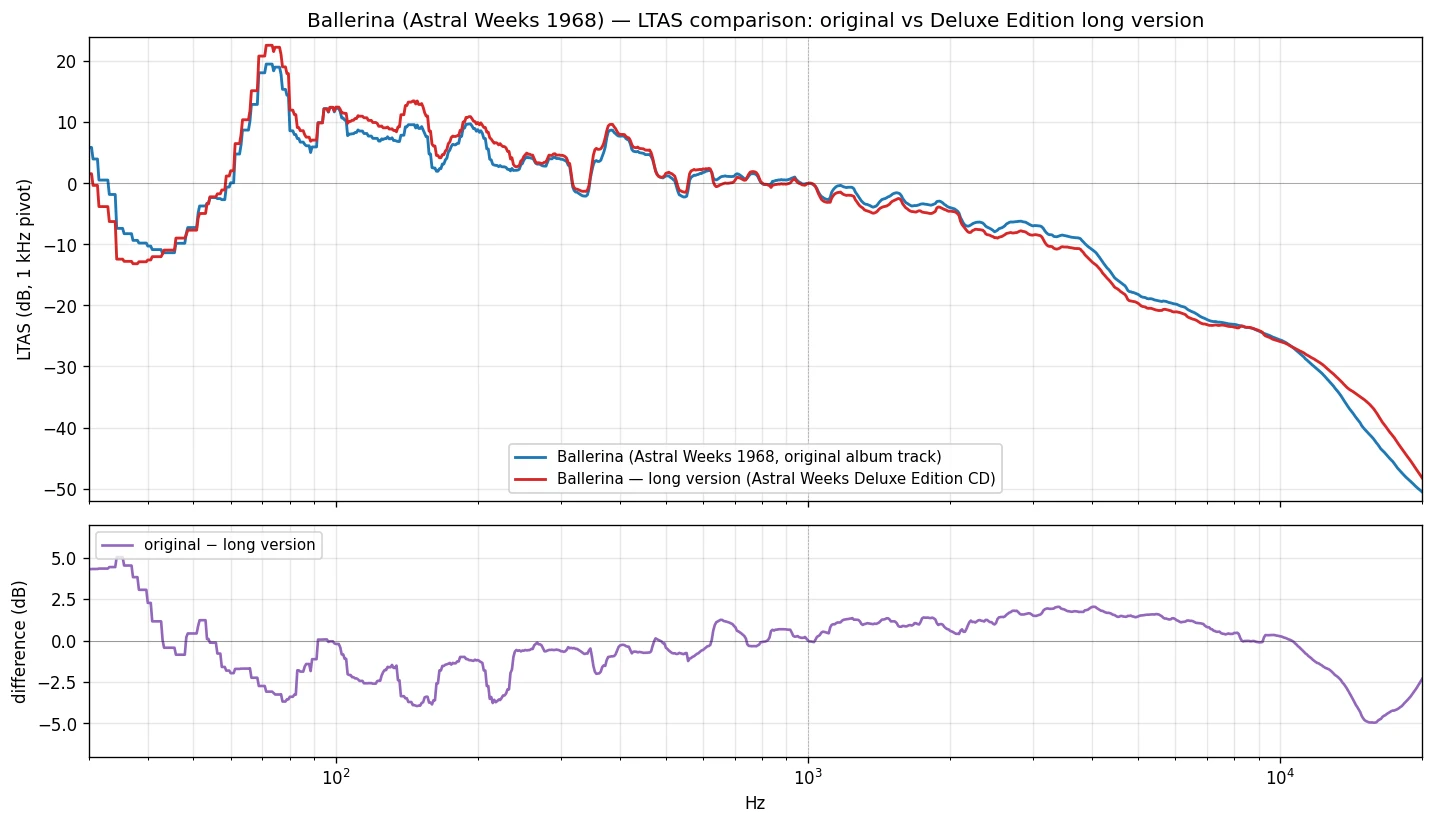
【例】 Van Morrison 「Ballerina」(Astral Weeks、 1968年)の 2 ソース LTAS 比較、 ともに 2015 Expanded Edition CD 収録。上: トラック 07(青、 1968年 LP マスタリング: Brooks Arthur 氏)と トラック 11 long version(赤、 より前段のマスター由来、 リマスター: Bernie Grundman Mastering の Chris Bellman 氏)を 1 kHz で 0 dB に揃えて重ねた。下: 差分(original − long version)は、 同一テイクに 1968年当時 Brooks Arthur 氏が LP マスタリング段で加えた音作り方向(低域カット 80 Hz で −3.4 dB、 中域プレゼンスのブースト 3〜5 kHz で +1.5 dB、 高域カット 15 kHz で −4.7 dB)を示す。詳細は Pt.24 24.3.1 を参照(筆者解析、 2026年6月8日)。
LTAS を活用した本サイト内の既存ページには、以下のものがあります。
Existing pages on this site that use LTAS include the following.
録音カーブの違いを自分の耳で確かめられるレコードはあるか?
Folkways FPX-100 / FX-6100 (1954年)に 3種類のカーブで収録された同一演奏を、 LP 盤起こしと配信版の LTAS で実測検証しています。
Are there records where you can hear the difference between recording curves with your own ears?
Measures the same performances captured on Folkways FPX-100 / FX-6100 (1954) with three different EQ curves, comparing LP rips and the digital release by LTAS.
Somethin’ Else 3-way LTAS — RVG Edition で新たに加えられた処理を計測する
Cannonball Adderley の名盤 (1958年録音)の 3種類の CD を LTAS で比較し、 RVG Edition 1999 で新たに加えられた処理を計測しています。
Somethin’ Else 3-way LTAS — measuring the processing newly added at the RVG Edition stage
Compares three CD releases of Cannonball Adderley’s classic (recorded 1958) by LTAS, measuring the processing newly added at the 1999 RVG Edition.
比較の手順はこうです。
The comparison procedure runs as follows.
まず、検証したい LP をあるカートリッジで再生し、RIAA フォノイコライザ経由、A/D コンバータでディジタル(デジタル)として取り込みます。
First, the LP under examination is played on a chosen cartridge, run through an RIAA phono equalizer, and captured as digital via an A/D converter.
その後、スクラッチノイズは全帯域に乗るノイズで LTAS の精度を下げる要因となるため、ソフトウェア的にデクリック処理を行い、L+R 平均で LTAS を取ります。
Because scratch noise spreads across the entire frequency band and would degrade LTAS precision, software declicking comes first, then an LTAS is computed on the L+R sum.
それを、RIAA で確実にカッティングされたことが分かっているほかの LP を同じカートリッジ + 同じRIAA フォノイコライザで再生し取り込んだもの、そして、セッションマスターテープからあまり手を加えずにリイシューされたと思われる CD などのディジタル音源と並べ、各帯域の引き算を読み取ります。録音時の EQ カーブが違えば、再生側 RIAA を通した残差として、数 dB 単位の差が立ち上がるはずです。
That is then set side by side with another LP, one known to have been cut with RIAA, captured through the same cartridge and the same RIAA phono equalizer, and with a digital source such as a CD believed to have been reissued from the session master tape with minimal further processing. The differences band by band are then read off by subtraction. If the recording EQ curve differs, a residual of several dB should rise after the playback RIAA.
今回は、手持ちのカートリッジの中から、ステレオカートリッジを使って盤起こしを行いました。モノーラルカートリッジも複数所有しているのですが、あえてステレオカートリッジを使った理由については別記事(執筆予定)をご覧ください。
For this study, the LP rips were made with a stereo cartridge from among those on hand. I also own several mono cartridges; the reason for choosing stereo nonetheless will be covered in a separate article (in preparation).
ただし、LP 側にも注意が要ります。同じタイトルでも、再発やリマスターのたびに、当時のエンジニアが音作りを加えていることが少なくありませんが、これは1950年代や1960年代の盤でも例外ではありません。録音 EQ カーブの違いと、リマスターでの音作りは、LTAS の上では同じく「帯域バランスの差」として現れてしまいます。そのため本シリーズの解析では、同じタイトルでも初期プレスとリマスター盤を分け、リマスター由来の差はリマスター由来として読み解くことを心がけます。
A caveat on the LP side is in order. Within a single title, reissues and remasters often carry their own sonic shaping by the engineer of the day; even pressings from the 1950s and 1960s are no exception. On an LTAS, differences in recording EQ curve and shaping during remastering appear together as a “shift in tonal balance.” So in this series’ analyses, even within a single title, the early pressing and the remaster are kept apart, and differences traceable to the remaster are read as such.
本稿 Liner Notes II-a のメインの論点は、「Capitol H-488 “Songs For Young Lovers” の初期プレスは本当に 400N-12.7(AES カーブである 400N-12 に近い、Capitol 独自のカーブと言われているもの)でカッティングされていたのか」で、D2 / D8 の比較を行います。
The central question of this Liner Notes II-a is whether the earliest pressing of Capitol H-488 “Songs For Young Lovers” was, in fact, cut with 400N-12.7 (a curve said to be Capitol’s house variant, close to the AES curve 400N-12). To examine that, D2 and D8 are compared.
続く II-b では、H-488 を基準としたときの W-587 / W-1432 のリマスター性格、以前から「すごい音がする」と噂されていた MFSL Box、さらに 1984/85年ディジタルリマスター由来の 1998 CD まで、ひととおり並べて、リマスター傾向の系譜を読み解いていきます。そして II-c では、拡張の論点として、同じ手法を H-477 “The Duke Plays Ellington” にも適用すると何が見えてくるかを扱います。
In the next installment, Liner Notes II-b, taking H-488 as the reference, the remastering character of W-587 / W-1432, the MFSL Box long rumored to “sound spectacular,” and the 1998 CD derived from a 1984/85 digital remaster are laid out one after another and read as a lineage of remastering trends. Then in Liner Notes II-c, the same method is extended to H-477 “The Duke Plays Ellington”, examining what comes into view.
当然ながら、LTAS は万能ではありません。高域が十分に捉えられていない古い録音、78回転シェラック盤のように S/N 比が十分にとれないメディア、会話音源のように録音帯域が狭い素材、などでは、判別は原理的に困難です。また、もちろん、音質の良し悪しが判別できるわけでもありません。
LTAS is not a panacea, of course. Reliable distinction becomes difficult in principle for older recordings whose highs were never fully captured, media without an adequate signal-to-noise margin such as 78-rpm shellac discs, or material with an inherently narrow recorded bandwidth such as speech sources. And, naturally, it tells us nothing about whether a record sounds any good.
では何が分かり、何が分からないままなのか。続く各章で、一緒に確かめていきましょう。
So what does it tell us, and what remains unresolved? The following sections take up those questions.
II.2 D2 and D8 — Starting from the physical differences within the same album
本章で扱うのは、 Capitol H-488 “Songs For Young Lovers” の初期プレスのうち、 マトリクス番号 D1/D2(1954年初期)と D8/D8(1955年中期)の 2つです。同じセッションマスターから派生していると考えられますが(テープ世代の異同は未確認)、 マトリクス番号が違うだけで音が違って聞こえます。そこから出発して、 LTAS と、 RIAA 再生カーブと AES 再生カーブの差分をソフトウェア的に実装したディジタルフィルタ(以下、SimAES filter)を補助的に併用しながら、 「H-488 初期プレスは本当に 400N-12 系列の Capitol 独自カーブでカッティングされていたのか」 という問いに近づいていきます。
This chapter takes up two early pressings of Capitol H-488 “Songs For Young Lovers,” separated by matrix number: D1/D2 (early 1954) and D8/D8 (mid-1955). They are believed to come from the same session master (though the tape generation used for each matrix has not been independently confirmed), yet sound different across matrix numbers. Starting there, with LTAS and a digital filter implementing the difference between the RIAA and AES playback curves in software (hereafter, the SimAES filter) as an auxiliary tool, we approach the question step by step: was the earliest pressing of H-488 really cut with Capitol’s house variant of the 400N-12 family?
まず、Capitol H-488 という10インチLPのマトリクス違い、D1/D2 と D8/D8 を比較してみます。
First comes a comparison of the matrix variants of the 10-inch LP Capitol H-488 (D1/D2 versus D8/D8).
H-488 の初期プレスには、いくつかの版違いがあります。本作業で使ったのは、ジャケ表に [HIGH FIDELITY] 印刷もステッカーもない D1/D2 マトリクス・深溝あり黄レーベルプロモ盤、そしてジャケ表に [HIGH FIDELITY] 印刷ありの D8/D8 マトリクス・深溝なし紫レーベル通常盤、この 2枚で、ともに Scranton プレスです。
The earliest pressings of H-488 come in several variants. The two used here are: a D1/D2 matrix yellow-label promo with deep groove and no [HIGH FIDELITY] print or sticker on the front cover, and a D8/D8 matrix purple-label standard pressing without deep groove, with the [HIGH FIDELITY] print on the cover, both pressed at Capitol’s Scranton plant.
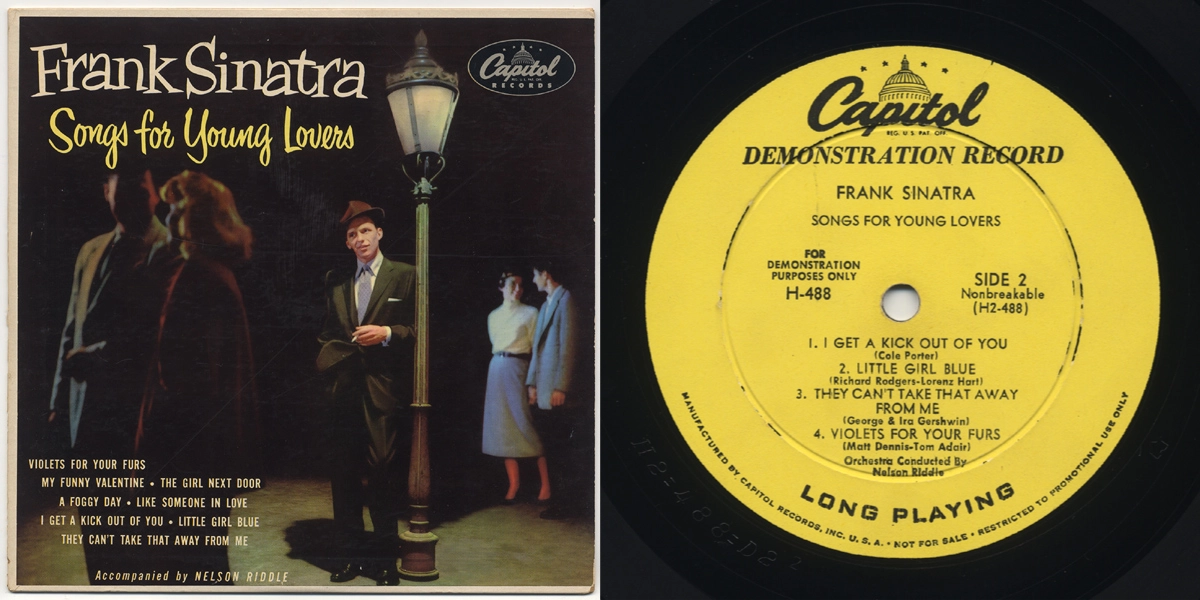
左: ジャケ表([HIGH FIDELITY] 印刷なし)。右: SIDE B レーベル(黄色 Demonstration Record、深溝あり、 D2 マトリクス)。 H-488 1954年初頭プロモ盤。
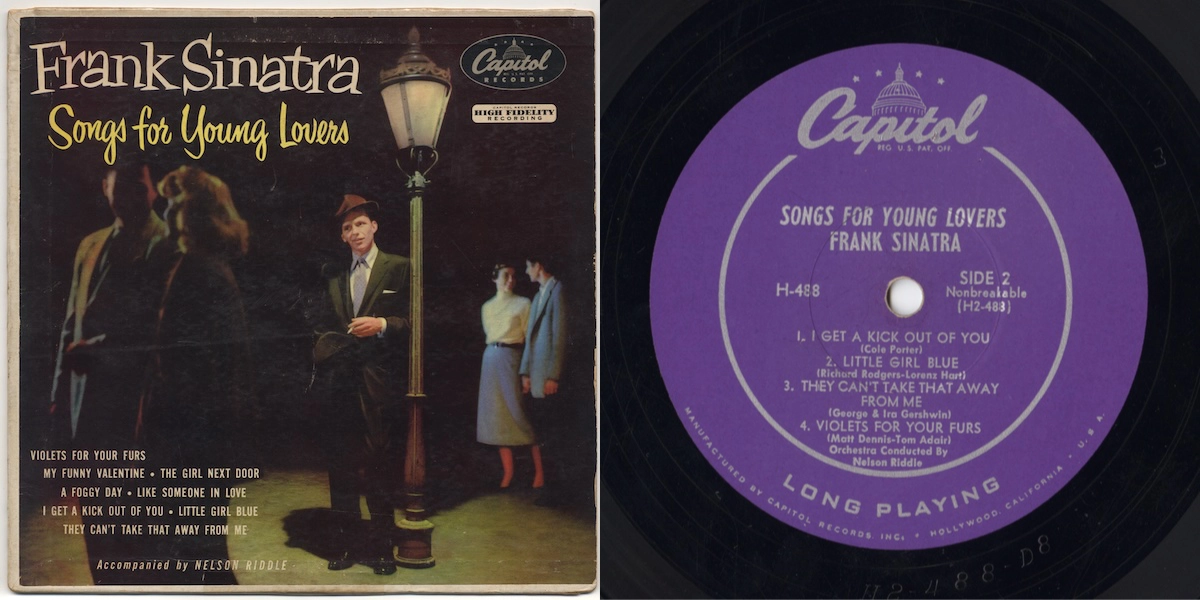
左: ジャケ表([HIGH FIDELITY] 印刷あり)。右: SIDE B レーベル(紫色 Capitol、深溝なし、 D8 マトリクス)。 H-488 1955年通常盤。
D1/D2 プロモ盤 は 1954年初頭のリリース当時(The Billboard 誌での初出は、1954年1月30日号 p.34 “NEW RECORDS TO WATCH” においてでした)、D8/D8 通常盤 はおそらく 1955年に出荷されたものと考えられます。当然ながら、いずれも、1953年11月5-6日 Hollywood の Capitol Studios 録音セッションで収録されたもので、違いはマトリクス番号、 深溝の有無、 ジャケ印刷といった物理的な体裁だけ、ですが、この版違いがカッティング時の録音 EQ カーブの違いを反映しているのではないか、というのが筆者が 20年前に立てた仮説でした。この仮説は同時に、D1/D2 と D8/D8 のあいだに EQ などのリマスタリング処理は施されておらず、純粋にカッティング時の録音 EQ カーブの違いだけが現れているのではないか、という想定にも立っていました。
The D1/D2 promo dates from the early 1954 release (the first listing in The Billboard was in the January 30, 1954 issue, p.34, “NEW RECORDS TO WATCH”); the D8/D8 standard pressing is most likely from a 1955 shipment. Both were of course captured at the same November 5–6, 1953 session at Capitol Studios in Hollywood, and the differences are only matters of physical presentation (matrix numbers, the deep groove, the cover print), yet the hypothesis I formed twenty years back was that these variants reflect a difference in the recording EQ curve at the cutting stage. The hypothesis assumed, at the same time, that no remastering EQ or other processing had been applied between D1/D2 and D8/D8: that what appears is purely the difference in recording EQ curves at cutting.
まず両盤を同じフォノチェーン(Hana MH + SME Series IV + Michell Orbe SE + Benchmark LA4 + KORG DS-DAC-10R、いずれも RIAA 再生で固定)で 24/96 ステレオにディジタル化し、デクリック処理を施したうえで LTAS を取りました。
Both discs were first digitized to 24/96 stereo through the same phono chain (Hana MH + SME Series IV + Michell Orbe SE + Benchmark LA4 + KORG DS-DAC-10R, all set to RIAA playback), and LTAS was computed after software declicking.
1 kHz を 0 dB に正規化して両盤の帯域バランス差を見ると、D8 を基準にした場合、D2 は 5 kHz で −1.33 dB、8 kHz で −3.10 dB、10 kHz で −1.78 dB と、高域帯で 1〜3 dB の ディップ(谷、くぼみ)を示します。ただしこの段階では、この高域帯のディップがカッティングカーブの違い(D2 = AES 系統(当時の再生機器マニュアルや雑誌で Capitol に対して一貫して推奨されていた「ターンオーバー AES(400 Hz)、ロールオフ −12 dB」に対応する録音カーブ。Capitol の実際のカーブが AES Standard と厳密に一致するかは未解明) + RIAA 再生の不整合)によるものか、あるいはカートリッジと盤面の相互作用、カッティング機材の世代差など、他の要因の合成なのかを LTAS 単独では切り分けられません。
Normalizing both discs to 0 dB at 1 kHz and reading off the tonal-balance difference, with D8 as reference, D2 sits at −1.33 dB at 5 kHz, −3.10 dB at 8 kHz, and −1.78 dB at 10 kHz (a high-frequency dip of 1 to 3 dB). At this stage, however, LTAS alone cannot tell us whether this HF dip comes from a difference in the cutting curve (D2 = AES family, mismatched with RIAA playback) or from other factors (cartridge–groove interaction, generational differences in the cutting equipment, and so on). “AES family” here means the recording curve corresponding to the “AES turnover (400 Hz), rolloff −12 dB” setting consistently recommended for Capitol LPs in contemporary equipment manuals and magazine guides. Whether Capitol’s actual curve matched the AES Standard exactly is unresolved.
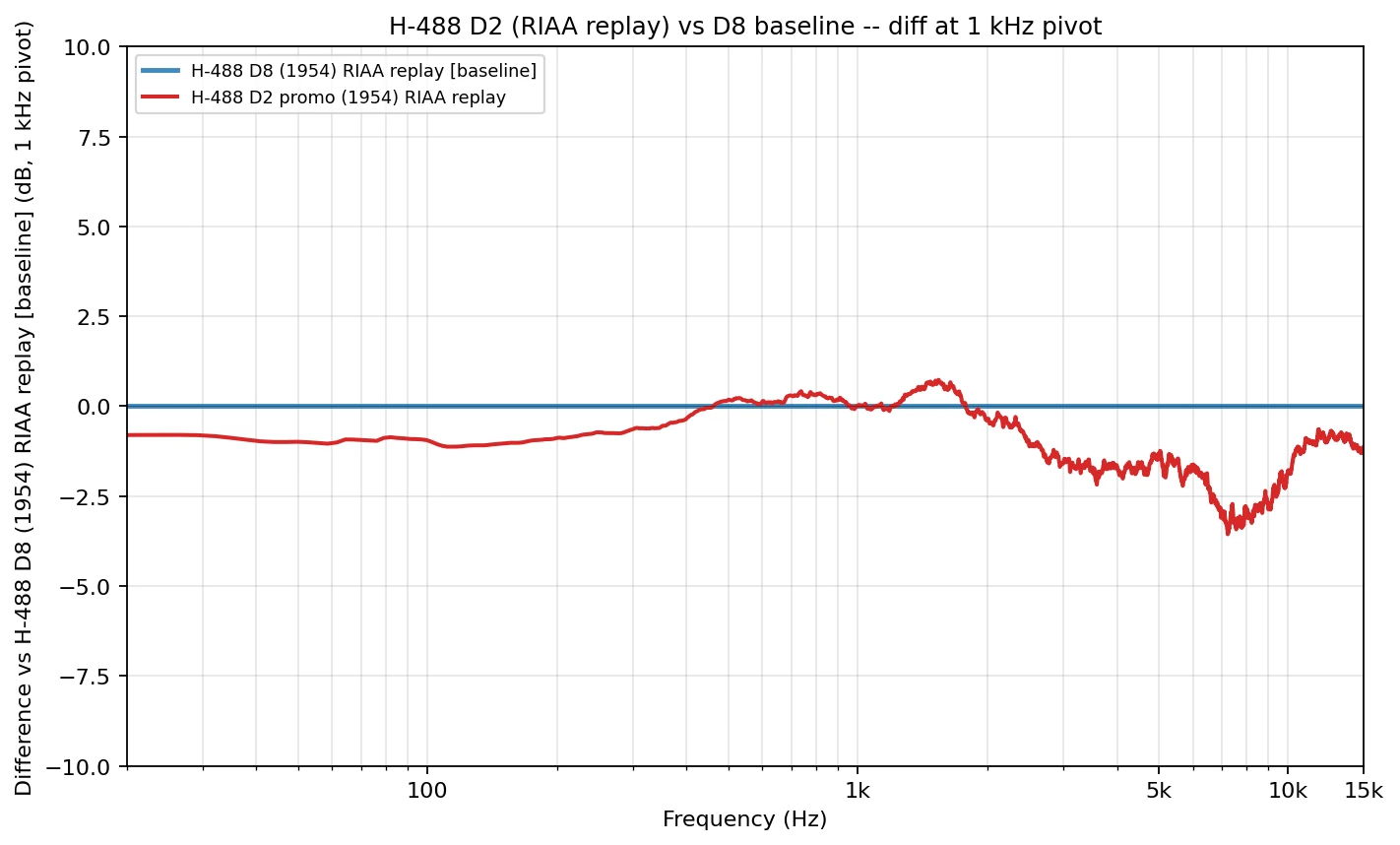
【Fig A】 H-488 D2 プロモ盤(赤)と D8 通常盤(青、基準 0 dB)の LTAS 差分。 1 kHz を 0 dB に正規化し、 D8 を基準として D2 が示す帯域バランス差を見たもの。 D2 は高域帯 (5〜15 kHz) で D8 より 1〜3 dB 下にある(筆者解析、 2026年6月2日)。
ところが、聴感では別の印象を受けます。 D2 を RIAA で再生すると高域が篭って聴こえるのに、Re-Equalizer III(以下 Re-EQ III)で再生カーブを「TURNOVER: 400」と「ROLLOFF: 12」( = AES カーブ ≒ さまざまなカーブ一覧サイトで Capitol カーブとして言及される「400N-12.7」)に切り替えて物理的に再生し直すと、自然な音の感触に近づく。これが繰り返し聴き比べた結果の筆者の判断でした。ただし、これだけでは主観の域を出ません。
Yet listening gives a different impression. Playing D2 through RIAA, the highs come through veiled; but switching to Re-Equalizer III (hereafter Re-EQ III), with the playback curve set to “TURNOVER: 400” and “ROLLOFF: 12” (= AES curve ≒ 400N-12.7, the curve listed as the Capitol curve on various curve catalog sites), and playing the disc back physically, the sound moves closer to a natural feel. That was the conclusion I reached after repeated listening. On its own, though, this remains a subjective impression.
そこで、 AES カーブで再生したものも LTAS 解析に加えることにしました。
So I decided to bring an AES-curve playback into the LTAS analysis as well.
当初、筆者は Re-EQ III を使って D2 を AES 400/12 で物理再生し直し、同じ ADC で再録音したものを解析対象としようと考えました。しかし、Re-EQ III の内部実装の特性(高域シェルフのコーナー周辺の応答特性、Re-EQ III と Benchmark LA4 の経路間の高域応答特性差、その他)といった、アナログ段のチェーン増加の影響を本論から切り離すため、より直接的な手法に変更しました。つまり、RIAA で盤起こししたディジタル音源に対し、ディジタル処理を施して、より忠実に AES 再生相当のディジタル音源を生成する、というものです。
Initially, the plan was to use Re-EQ III to play D2 back physically with AES 400/12, re-record through the same ADC, and run that as the analysis target. But to keep the response of Re-EQ III’s internal implementation — the HF shelf corner behavior, the HF response difference between the Re-EQ III and Benchmark LA4 paths, and so on, all of which add more analog stages to the chain — out of the discussion, I switched to a more direct method: apply digital processing to the RIAA-played digital capture to generate, more faithfully, a digital source equivalent to AES playback.
RIAA で盤起こししたディジタル音源をソフトウェア的に AES 相当に変換するフィルタ SimAES は、次のように作りました。
The SimAES filter (a software conversion from a RIAA-cut digital rip to the AES-playback equivalent) was built as follows.
1951年1月号 Audio Engineering 誌の学会誌セクション pp.22, 44-45 に発表された “AES Standard Playback Curve”(p.22 に周波数応答特性グラフと数値表、pp.44-45 に録音再生用LCR回路の実装例あり)によれば、AES 400/12 再生カーブは低域ターンオーバー 400 Hz・高域ロールオフ 2500 Hz の 2段 1 次シェルフ(時定数 τ_LF = 397.9 µs / τ_HF = 63.66 µs)として表現できます。これと RIAA 再生カーブ(時定数 τ = 75 / 318 / 3180 µs)の差分を、IIR フィルタとしてソフトウェア的に実装しました(scipy の bilinear transform + SOS cascade、1 kHz で 0 dB に正規化、96 kHz サンプルレート)。
According to the “AES Standard Playback Curve” published in the January 1951 issue of Audio Engineering, in its society section at pp.22, 44–45 (p.22 carries the frequency-response graph and numerical table; pp.44–45, an LCR circuit example for recording and playback), the AES 400/12 playback curve can be expressed as a two-stage first-order shelf, with a low-frequency turnover at 400 Hz and a high-frequency rolloff at 2,500 Hz (time constants τ_LF = 397.9 µs / τ_HF = 63.66 µs). The difference between this and the RIAA playback curve (time constants τ = 75 / 318 / 3,180 µs) was implemented in software as an IIR filter (scipy’s bilinear transform + SOS cascade, normalized to 0 dB at 1 kHz, 96 kHz sample rate).
このフィルタを H-488 D2 を RIAA で盤起こしした wav ファイルに適用して、AES 再生相当に変換した「D2 SimAES」を生成しました。これにより、カートリッジ (Hana MH) + レコード溝 + プリアンプ (Benchmark LA4) 経路の影響を完全に共通化したうえで、純粋に再生カーブの差分のみを比較できます。 AES 再生カーブと RIAA 再生カーブ、 およびその差分(= SimAES フィルタ)を、 Fig B として下に示します。
This filter was then applied to a wav file of H-488 D2 ripped at RIAA to produce “D2 SimAES,” the AES-playback equivalent. This makes it possible to fully equalize the cartridge (Hana MH), groove, and preamp (Benchmark LA4) path, comparing purely the difference in playback curve. The AES and RIAA playback curves and their difference (= SimAES filter) are shown as Fig B below.
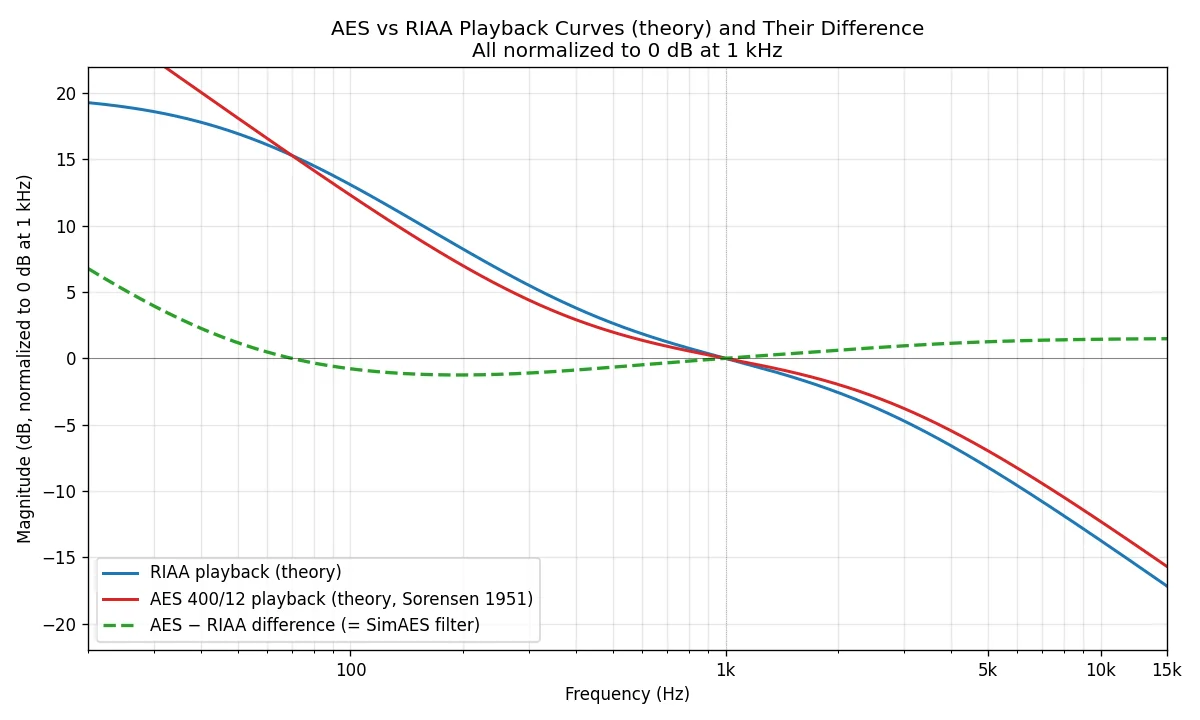
【Fig B】 理論 RIAA 再生カーブ(青実線)と AES 400/12 再生カーブ(赤実線、 AES 1951)、およびその差分(緑破線、 = SimAES filter)。すべて 1 kHz で 0 dB に正規化(筆者解析、 2026年6月3日)。
まず、RIAA で盤起こしした音源に SimAES フィルタを通して AES 相当に生成した 24/96 ディジタルファイル「D2 SimAES」を、Mac Studio から(ガルバニック絶縁アイソレータを介して)USB 接続された D/A コンバータ (Mytek Brooklyn DAC+) 経由でスピーカで再生、聴感チェックしました。 RIAA 再生で盤起こしした「D2」と比べると、とても自然な聴き心地と感じました。同時に、Re-EQ III でターンオーバー 400、ロールオフ 12 に設定して再生するよりも、鮮度の高さを感じるのが興味深いです。
First, the 24/96 digital file “D2 SimAES” (generated from the RIAA capture by passing it through the SimAES filter to produce the AES equivalent) was played from the Mac Studio via a USB-connected D/A converter (Mytek Brooklyn DAC+, behind a galvanic-isolation interface) through speakers, and checked by ear. Compared with “D2” captured at RIAA playback, it had a notably natural feel. At the same time, it sounds fresher and more sharply defined than playback through Re-EQ III set to TURNOVER 400, ROLLOFF 12.
続いて、「D2(RIAA再生)」「D2 SimAES」「D8(RIAA再生)」をグラフで比較します。同じ SimAES フィルタをあえて D8 にも適用した(RIAA カーブのレコードを AES カーブで再生した状態に相当)「D8 SimAES」をサニティチェック(整合性確認)として並べることで、フィルタ自身の周波数特性が正しく適用されているか( = D8 RIAA カッティング + RIAA 再生の音を AES 再生相当に変換すると、ちょうど AES と RIAA の理論差だけ周波数特性が変わるか)を確認します。
Next, “D2 (RIAA playback),” “D2 SimAES,” and “D8 (RIAA playback)” are compared on a graph. As a sanity check, the same SimAES filter is also deliberately applied to D8 (the equivalent of playing a RIAA-cut record back with the AES curve), producing “D8 SimAES,” which is placed alongside. This lets us confirm that the filter’s own frequency response is being applied correctly: that converting a D8 (RIAA cut + RIAA playback) signal to the AES-playback equivalent changes the frequency response by exactly the theoretical AES-vs-RIAA difference.
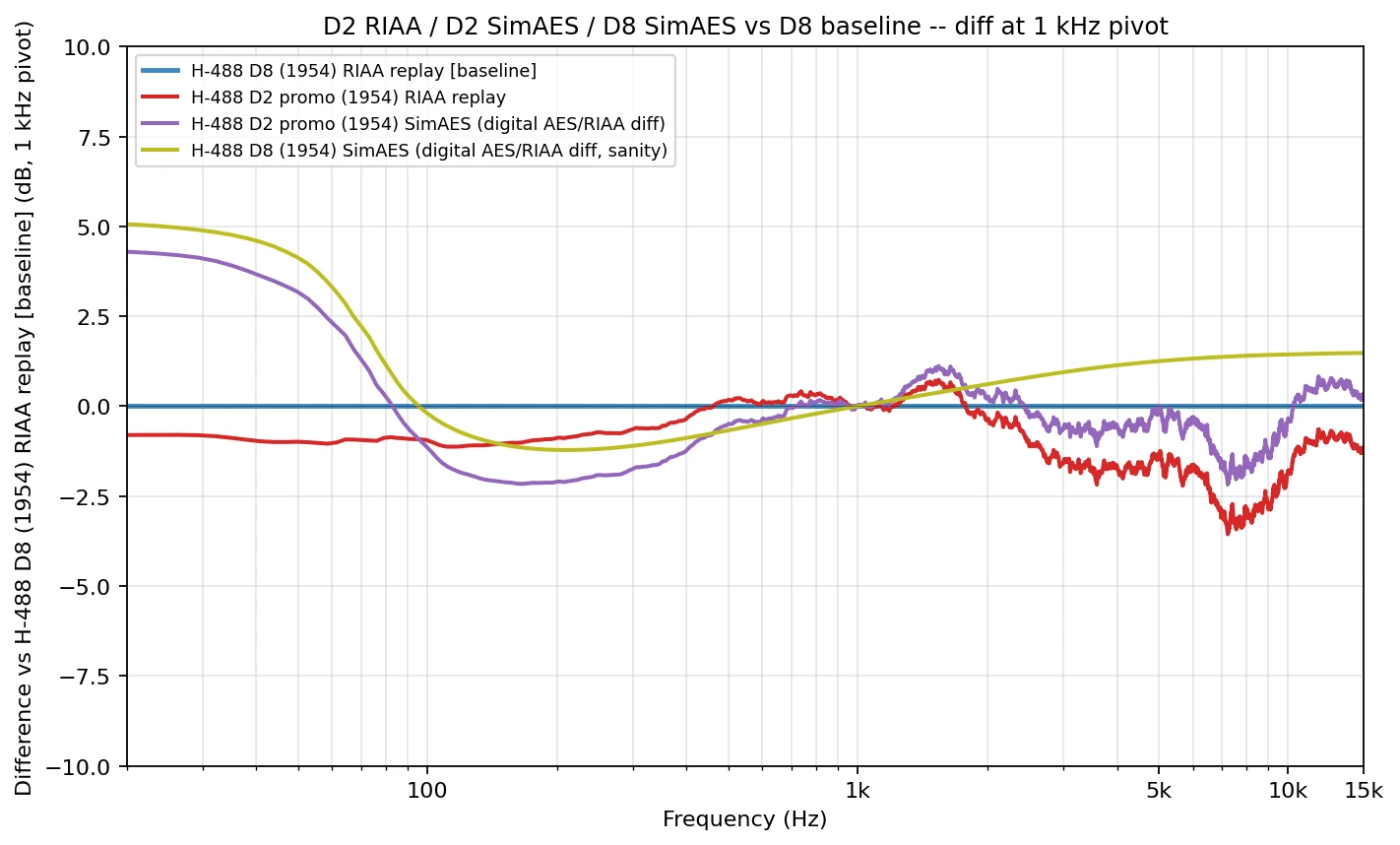
【Fig C】 D2 RIAA(赤)、 D2 SimAES(紫)、 D8 SimAES(黄緑)の LTAS 差分。 D8(青、 0 dB)を基準。 D2 SimAES は高域帯の多くの周波数点(5、 10、 15 kHz)で D8 と ±0.5 dB 以内に近づくが、 8 kHz では −1.69 dB の残差が残る(= AES 系カッティングと概ね整合するが完全一致ではない)。 D8 SimAES は filter 自身の周波数特性(高域 +1.4 dB プラトー(平坦部)、サニティチェック)を示す(筆者解析、 2026年6月2日)。
| Frequency | D8 (baseline) | D2 (RIAA) | D2 (SimAES) | D8 (SimAES, sanity) |
|---|---|---|---|---|
| 50 Hz | ±0.00 | −0.79 | +3.59 | +4.36 |
| 100 Hz | ±0.00 | −0.85 | −1.05 | −0.27 |
| 200 Hz | ±0.00 | −0.89 | −2.10 | −1.22 |
| 500 Hz | ±0.00 | +0.18 | −0.49 | −0.67 |
| 2 kHz | ±0.00 | −0.40 | +0.21 | +0.61 |
| 5 kHz | ±0.00 | −1.33 | −0.08 | +1.25 |
| 8 kHz | ±0.00 | −3.10 | −1.69 | +1.40 |
| 10 kHz | ±0.00 | −1.78 | −0.34 | +1.44 |
| 15 kHz | ±0.00 | −1.27 | +0.21 | +1.48 |
| crest factor (dB) | 15.21 | 15.54 | 15.85 | 15.12 |
crest factor(クレストファクタ) = 信号のピーク値と実効値の比 (dB)、値が大きいほど立ち上がりが鋭く保たれている指標。
crest factor = ratio of peak to RMS amplitude (dB); higher values indicate that transients are preserved more sharply.
この表とグラフからは、2つのことが読み取れます。
Two things can be read from this table and graph.
第1に、サニティチェックとして置いた D8 SimAES は、IIR フィルタ自身の周波数特性をそのまま反映しています。 5 kHz で +1.25 dB、10 kHz で +1.44 dB、15 kHz で +1.48 dB という高域プラトー(平坦部)は、AES (−12 dB at 10 kHz) と RIAA (−13.6 dB at 10 kHz) の理論差 1.6 dB とほぼ一致しており、フィルタが理論通り動いていることを物理 D8 自身を介して確認できます。
First, D8 SimAES, set up as the sanity check, directly reflects the IIR filter’s own frequency response. The high-frequency plateau — +1.25 dB at 5 kHz, +1.44 dB at 10 kHz, +1.48 dB at 15 kHz — closely matches the theoretical AES-vs-RIAA difference of 1.6 dB (AES at −12 dB at 10 kHz, RIAA at −13.6 dB at 10 kHz), confirming that the filter behaves as theory predicts, with D8 itself as a physical reference.
第2に、D2 SimAES は高域帯 (5〜15 kHz) で D8 を基準にして ±2 dB 以内に収まり、5 / 10 / 15 kHz の各点では ±0.5 dB 以内です。これは、D2 のカッティングが AES 400/12 系列であった場合、SimAES filter でディジタル領域で再変換すれば D8 (RIAA カッティング + RIAA 再生) と同じ周波数特性に戻る、という物理予想と整合する結果です。 D2 を RIAA で再生したときに聞こえた「高域の篭り」 は、 カッティングカーブが AES 系統だった場合、 RIAA 再生時にはマスターテープに記録された高域部が充分に補償されないため、 と考えるのが自然です。
Second, D2 SimAES falls within ±2 dB of D8 across the high-frequency band (5–15 kHz), and within ±0.5 dB at the 5, 10, and 15 kHz points. This is consistent with the physical prediction that if D2’s cutting belongs to the AES 400/12 family, then re-converting it in the digital domain with the SimAES filter should bring it back to the same frequency response as D8 (RIAA cut + RIAA playback). The “veiled highs” heard when D2 was played at RIAA are most naturally explained as follows: if the cutting curve is AES-family, then RIAA playback does not fully compensate for the HF content on the master tape.
ただし、注意すべき残差が 2つあります。 1つ目は 8 kHz の −1.69 dB のディップ、もう 1つは 200 Hz の −2.10 dB のディップ(下記 Side note 参照)です。両者とも、もし D2 のカッティングが「厳密に AES 400/12」であれば SimAES filter で完全に補償されて 0 dB 付近に戻るはずの帯域で、補償しきれない量の差として残っています。
Two residuals are worth noting, however. One is the −1.69 dB dip at 8 kHz; the other is the −2.10 dB dip at 200 Hz (see side note below). Both fall in bands that, if D2’s cutting were “strictly AES 400/12,” would be fully compensated by the SimAES filter and return to near 0 dB, yet they remain as differences the filter cannot fully cancel.
この残差の説明として、いくつかの可能性が考えられます。 1つは、D2 カッティングカーブが厳密には AES 400/12.0 ではなく、さまざまなカーブ一覧サイトで Capitol カーブとして言及される「400N-12.7」(高域が AES より 0.7 dB 程度控えめ)のような微妙に異なるカーブであったため、AES 400/12.0 で逆変換すると完全に補償しきれない、というもの。
Several possibilities suggest themselves for these residuals. One is that D2’s cutting curve was not strictly AES 400/12.0 but a subtly different curve such as “400N-12.7” (about 0.7 dB more conservative in the highs than AES) — the curve listed as the Capitol curve on various curve catalog sites — so that reversing with AES 400/12.0 cannot fully compensate.
もう1つは、Capitol が 1953年夏〜1955年春頃に RIAA に切り替える過程で、カッティングチェーンの物理機材(カッターヘッドの高域応答特性、カッティングアンプの高域シェルフのコーナー周辺の応答特性、ラッカーマスターの調整など)も世代更新された可能性で、その世代差が D2(Capitol カーブ時代のカッティング)と D8(RIAA 切替後のカッティング)のあいだに、再生カーブの違いだけでは説明しきれない物理的な「指紋」として残った、というものです。実際、200 Hz 帯の残差は聴感比較(D2 SimAES と D8 を直接聴き比べると、D8 のほうが Sinatra の中低音域がやや厚い)としても確認できます。
Another is that during Capitol’s transition to RIAA from around summer 1953 through spring 1955, the physical equipment in the cutting chain (the cutter head’s HF response, the HF shelf-corner behavior of the cutting amplifier, lacquer-master settings, and so on) may also have been updated across generations, leaving a generational difference between D2 (cut in the Capitol-curve era) and D8 (cut after the RIAA switch) as a physical “fingerprint” that the playback-curve difference alone cannot account for. The 200 Hz residual is in fact corroborated by listening: directly comparing D2 SimAES against D8, the D8 has a somewhat fuller midbass on Sinatra’s voice.
カッティングチェーン変遷の直接的な一次資料(Capitol の社内ログ、機材スペック、ラッカーマスター発注書など)は、筆者の知る限り公開されていないため、この機材世代差仮説は現時点では仮説の段階に留まりますが、LTAS だけでは見えなかったカッティングカーブの違いが、SimAES filter という数学的な手続きを噛ませることで量的に立ち上がってきた、そしてそのうえで残差として、より細かい物理的世代差の手がかりまで見えてきた、というのが、本作業からの暫定結論です。
Direct primary sources on the cutting-chain transition — Capitol’s internal logs, equipment specifications, lacquer-master order records — are not, to my knowledge, in the public domain, so the equipment-generation hypothesis remains a hypothesis for now. Still, the provisional conclusion of this work is that a cutting-curve difference invisible to LTAS alone has been brought out quantitatively by interposing the SimAES filter, and that on top of that, finer hints of a physical generational difference begin to surface as residuals.
ここに「物理証拠」を 1段重ねます。 D2 のジャケ表には [HIGH FIDELITY] の印刷がなく、D8 には印刷があります。ディスコグラファー Frank Daniels 氏の Capitol H-488 ディスコグラフィ (friktech.com) によれば、ジャケへの [HIGH FIDELITY] 印刷は 1955年1月以降の運用で、それ以前は印刷なし、あるいは在庫ジャケへの後付けシール対応でした。 D2 = 印刷なし(つまり1954年中の初期出荷)と、D2 = AES カッティングという LTAS による結論は、物理証拠と音響証拠が同じ方向を向いています。
One layer of “physical evidence” is added on top. The D2 cover carries no [HIGH FIDELITY] print, while D8 does. According to discographer Frank Daniels’s Capitol H-488 discography on friktech.com, the [HIGH FIDELITY] cover print was Capitol’s practice from January 1955 onward; before that, no print, or a sticker added to existing stock. D2 = no print (i.e., shipped during 1954) and D2 = AES cutting (the LTAS conclusion) point in the same direction: physical evidence and acoustic evidence align.
さらに、 筆者は H-488 のもう 1枚、 マトリクス D4/D4 (深溝あり、 [HIGH FIDELITY] 印刷なし、 紫レーベル通常盤)も所有しており、 これも別途同じフォノチェーン + デクリック処理で LTAS 解析しました。 D8 を基準にした帯域バランス差は 6〜10 kHz で D2 と同じ方向にディップを示し、 D1/D2 と同じ傾向、 つまり AES 系統のカッティングと推定される、 という結果でした。細かい 1〜2 dB レベルの違いはカッティング個体差として説明できる範囲です。初期プレス群の AES カッティング推定が、 D1/D2 単独でなく D4/D4 でも独立に再現された、 と言えそうです。
Further, I own another H-488 — matrix D4/D4, deep groove, no [HIGH FIDELITY] print, purple-label standard pressing — which was analyzed separately through the same phono chain and declick pipeline. With D8 as the reference, the tonal-balance difference shows a dip in the same direction as D2 across 6–10 kHz, the same tendency as D1/D2, pointing again to AES-family cutting. Fine differences of 1–2 dB are within the range explainable by cut-to-cut variation. The AES-cutting estimate for the early-pressing group can be said to have been reproduced independently in D4/D4, not just in D1/D2.
ところで、D8 を SimAES filter にかけた「D8 SimAES」の音は、興味深いことに、次稿で扱う W-587 リマスターの音にどことなく似て聞こえます。これは偶然ではなく方向の一致で、Liner Notes II-b で見るように W-587 は H-488 初期盤より高域がマスターテープ寄りに開いたバランスを持ち、D8 SimAES は RIAA カット盤を AES 再生相当にディジタル変換した結果として高域が一様に持ち上がる音、と、異なる経路で「D8 より高域が開いた音」を生むためです。ディジタル演算で作った音(D8 SimAES)と、実際のカッティングチェーンの世代差が生んだ音(W-587)が、結果として近い帯域バランスに行き着くことがある、というのも、本作業から得られた小さな発見です。
As a side observation, the sound of “D8 SimAES” (D8 run through the SimAES filter) is curiously reminiscent of the W-587 remaster discussed in the next installment. This is not a coincidence; both point in the same tonal direction. As Liner Notes II-b will show, W-587 carries a high-frequency balance that opens up toward the master tape relative to the early H-488 pressings, while D8 SimAES, being a RIAA-cut disc converted to the AES-playback equivalent, is a sound with a uniform HF lift, different paths both producing a sound with more open highs than D8. That a sound built by digital arithmetic (D8 SimAES) and a sound produced by a generational change in the cutting chain (W-587) can end up with a similar balance, by different routes, is a small finding from this work.
ここまでの解析では、pre-RIAA 期の Capitol は、Dialing Your Disks 以来ずっと引き継がれてきた通説である AES 400N-12 系列 (400N-12.7) が最適再生カーブであるという前提で H-488 D2 を分析してきましたが、 上で述べた通り、SimAES で D8 を基準に比較すると、 80 Hz 以下に +3 dB 程度の低域の盛り上がりが残ります(200 Hz を中心とした帯域には -1〜-2 dB 程度の凹みも残ります)。この残差の形状は、 AES 再生カーブと RIAA 再生カーブの差分そのものに似ています。
Until this point, the analysis of H-488 D2 has rested on the conventional view inherited from Dialing Your Disks and the curve catalogs since, that pre-RIAA Capitol is best played back through the AES 400N-12 family (specifically 400N-12.7). Yet, as noted above, the SimAES residual against the D8 baseline still shows a +3 dB low-frequency lift below 80 Hz (along with a -1 to -2 dB dip centered around 200 Hz). The shape of this residual resembles the difference between the AES and RIAA playback curves themselves.
そこで、1949年 NAB / 1953年 NARTB / RIAA と同じ 500 Hz ターンオーバー(時定数 318μs) + 50 Hz ベースシェルフ(時定数 3,180μs) にしつつ、 高域ロールオフだけ AES と同じ -12 dB (時定数 63.66μs) に保ったカーブ「500B-12」 (500R-12 と意味的に同一) を仮定し、 対応する SimX フィルタ (Sim500B-12) で再計測しました。
A further candidate curve, “500B-12” (≡ 500R-12), was therefore tested: take 1949 NAB / 1953 NARTB / RIAA’s 500 Hz turnover (time constant 318 μs) and 50 Hz bass shelf (time constant 3,180 μs), and keep only the high-frequency rolloff at AES’s -12 dB (time constant 63.66 μs). A corresponding Sim500B-12 filter was built and applied.
すると、 低域の残差は解消され、 D8 の RIAA 再生とほぼ同等とみなせる結果になりました。同じ手順を D4/D4 で繰り返しても、 D2 とほぼ同じパターンが再現されます。つまり pre-RIAA 期の Capitol カッティングカーブは、 従来言われている 400N-12.7 ではなく 500B-12 (500R-12) であった可能性も出てきます。これは Dialing Your Disks で Capitol 自身が「To 1955: 400, 12.7」 と回答していたこととは反する仮説です。
The low-frequency residual then disappears, and the result becomes effectively equivalent to D8’s RIAA playback. The same procedure on D4/D4 reproduces the same pattern as D2. This raises the possibility that the pre-RIAA Capitol cutting curve was not the customary 400N-12.7 but rather 500B-12 (= 500R-12), a hypothesis that runs against Capitol’s own answer “To 1955: 400, 12.7” in Dialing Your Disks.
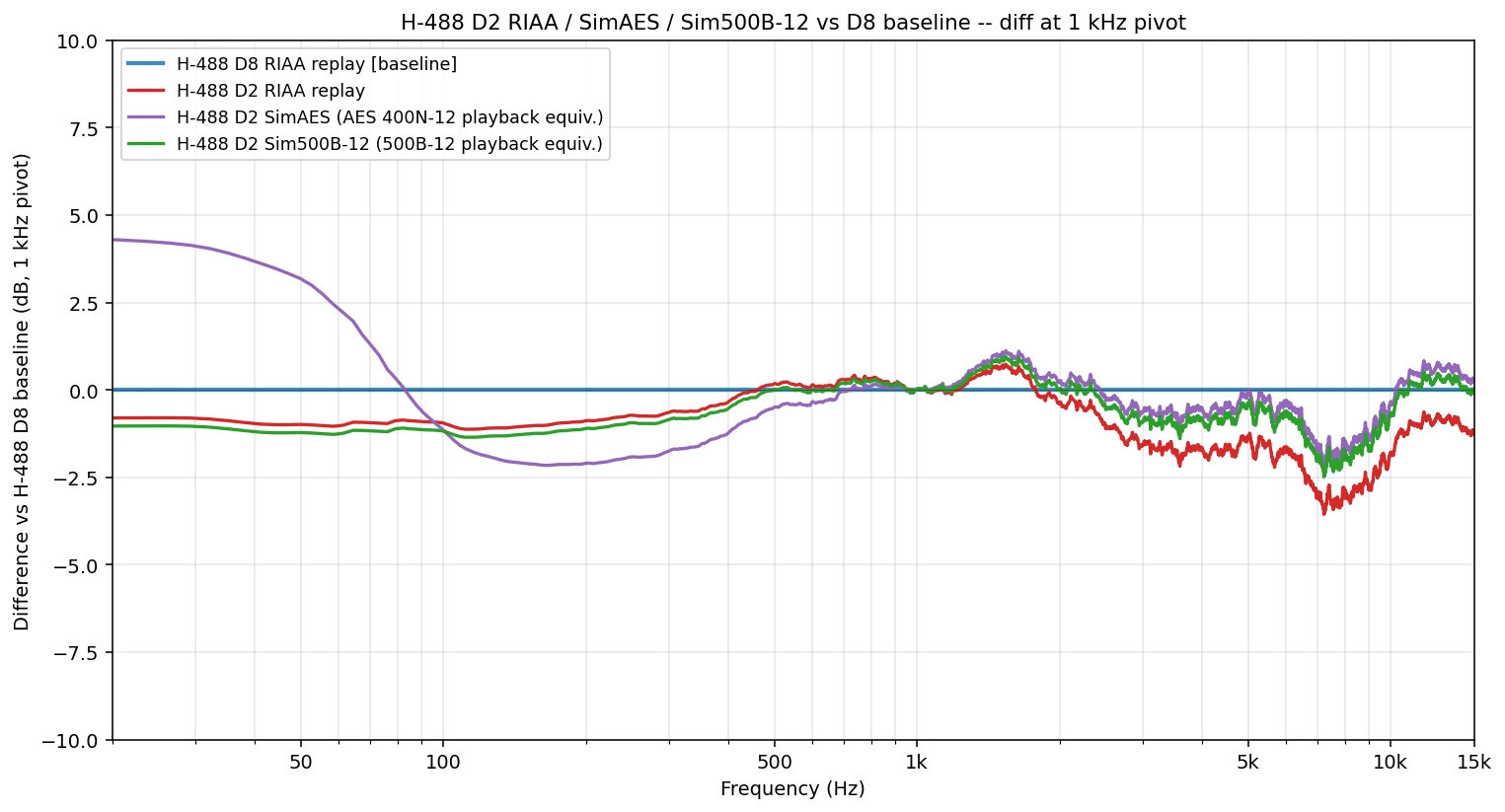
【Fig C2】 H-488 D2 の LTAS を、 3 種類の再生カーブ仮定で D8 RIAA 再生 (基準 0 dB、 1 kHz で正規化) と比較。 D2 RIAA 再生 (赤)、 D2 SimAES (紫、 AES 400N-12 再生相当)、 D2 Sim500B-12 (緑、 500 Hz ターンオーバー + 50 Hz ベースシェルフ + -12 dB 高域ロールオフ)。 Sim500B-12 は 1 kHz 以下で D2 RIAA 再生にほぼ重なり、 SimAES に見られた +3 dB の低域持ち上がりが解消されている。高域帯では SimAES が D8 と ±0.3 dB 内に収まり、 Sim500B-12 は 10 kHz 近辺で -0.6 dB 程度のディップが残る (筆者解析、 2026年6月8日)。
ただし、 これは H-488 D2 と D4 の 2 枚のみで導かれた暫定仮説です。 pre-RIAA 期の Capitol 盤を多数横断的に解析しないと、 決定的な判断はできません。今後の課題として開いた状態にしておきます。
This conclusion, however, rests on only two discs (H-488 D2 and D4). A definitive judgment will require a cross-sectional analysis across many pre-RIAA Capitol pressings. The question is left open as future work.
Coming up: Continued in Liner Notes II-b
本稿では、 Capitol H-488 “Songs For Young Lovers” の初期プレス D2 と D8 のあいだに見える物理的差異から出発して、 LTAS と SimAES filter を併用して読み解く録音 EQ カーブの判別を試みました。 D2 は AES 400N-12 系列の Capitol 独自カーブで、 D8 は RIAA 採用直後の 500R-13.7 系列でカッティングされた、 という暫定的な見立てに至りました。同時に、 D2 については別仮説(500B-12 系列)も浮上し、 通説の単純な置き換えで済む話ではない、 という宿題も残しています。
This Liner Notes II-a started from the physical differences visible between Capitol H-488 “Songs For Young Lovers” early pressings D2 and D8, and read the recording EQ curves through LTAS and the SimAES filter together. The provisional reading places D2 on Capitol’s house variant of the 400N-12 family and D8 on the 500R-13.7 family that followed RIAA adoption. At the same time, an alternative hypothesis (the 500B-12 family) also surfaced for D2, leaving a further task: the received account cannot simply be replaced without broader verification.
続く Liner Notes II-b では、 同じ H-488 セッションマスターを起点に派生した再発・リマスター系を横並びに置きます。 1955年の 12インチ再発 W-587、 1977年の日本盤 ECJ-50017、 1962年の再パッケージ W-1432、 1983年のオーディオファイル向けハーフスピードマスタリング MFSL 1-130、 そして 1984/85年のディジタルリマスター由来 1998 CD “The Capitol Years” という 5 リリースで、 同じセッションマスターからどのような音作りが派生してきたのか、 再発・リマスターごとの性格をひとつずつ読み解いていきます。
Liner Notes II-b places side by side the reissue and remaster lineage branching from the same H-488 session master: the 1955 12-inch reissue W-587, the 1977 Japanese pressing ECJ-50017, the 1962 repackage W-1432, the 1983 audiophile half-speed master MFSL 1-130, and the 1998 CD “The Capitol Years” derived from a 1984/85 digital remaster. Across these five releases, the chapter reads how the sound design diverged from the same session master, release by release.
さらに Liner Notes II-c では、 H-488 セッションの半年あまり前(1953年4月)に録音された Capitol H-477 “The Duke Plays Ellington” と、 数年後に 12インチ化されてリリースされ直し、 4曲追加 + 高域の強調が加わった T-477 に同じ手法を適用します。 Sinatra のヴォーカル + 編曲というプログラムから、 Ellington のソロピアノ + ベース + ドラムスというより質感の異なるプログラムに換えると、 LTAS で読める録音 EQ カーブの特性はどう見えるのか。 H-488 で見えた 1955年 Capitol カッティングチェーンの特性は、 H-477 / T-477 でも再現するのか、 それとも異なる景色になるのか。 II-c の末尾には、 II-a / II-b / II-c を通じての 「LTAS で分かること / 分からないこと」 のまとめを置き、 本シリーズ Liner Notes II の区切りとします。
Liner Notes II-c then applies the same approach to Capitol H-477 “The Duke Plays Ellington“, recorded in April 1953, some seven months before the H-488 sessions, together with T-477, the 12-inch reissue released a few years later with four added tracks and extra high-frequency emphasis. When the program changes from Sinatra’s vocal-plus-arrangement to Ellington’s solo piano with bass and drums (a different sonic texture), how do the recording EQ characteristics read on LTAS? And does the 1955-era Capitol cutting chain seen in H-488 reproduce on H-477 / T-477, or does a different picture emerge? At the end of II-c, a summary across II-a / II-b / II-c will appear under the heading “What LTAS can show / what it cannot,” marking the end of this Liner Notes II series.
» Phono EQ Curves Liner Notes II-b, to be continued »