
This article is presented in Japanese and English on the same page.
- 1958年3月25日、CBS 研究所の Peter C. Goldmark ら 3人の論文が IRE の全国大会で読まれた。ステレオのプレーヤではステレオで鳴り、モノーラルのプレーヤでは LP と区別がつかない「互換ステレオ盤」の提案である。この盤は市販されなかった。
- 当時のモノーラルのピックアップは針が縦にほとんど動けず、ふつうの 45/45 方式のステレオ盤をかけると盤が傷むと業界では見られていた。すると、同じ作品をモノーラル盤とステレオ盤の 2種類で作る「二重在庫」しかない。
- 互換ステレオ盤は 45/45 方式と同じ溝で、左右の差の信号を絞り、縦の振れの最大値を横のおよそ 8分の1 に抑えたレコードである。考えたのは、45/45 の標準化を進めていた当人たちだった。
- 消えた理由として史料から見えるのは 2つである。同業者が「モノーラルとしてもステレオとしても良くない」と判定したこと、そして規格が決まったその週に、大手が互換盤ではなく二重在庫を選んだことである。Columbia レコード自身も、互換ステレオ盤を選ばなかった。
- 論文を書いた 3人は、4年後のディスク録音の歴史で互換ステレオ盤に触れていない。大手の選択は 1960年代のモノーラル盤とステレオ盤の並走になった。米国の LP 販売(ラックを除く小売)の枚数で、ステレオ盤は 1966年でも 38.6% だった。
- On March 25, 1958, a paper by Peter C. Goldmark and two other CBS Laboratories engineers was read at the IRE National Convention. It proposed a “compatible stereo disc” that would play in stereo on a stereo phonograph and would be indistinguishable from an LP on a mono phonograph. The disc never went on sale.
- The mono pickups of the day were built so that the stylus could hardly move vertically, and the industry’s view was that playing an ordinary 45/45 stereo disc with one would damage it. That left no choice but “double inventory”: making the same title in mono and stereo versions.
- The compatible stereo disc used the same groove as 45/45. It reduced the difference signal between left and right, holding the maximum vertical motion to about one-eighth of the lateral motion. The people who thought of it were the very ones who had been pushing the standardization of 45/45.
- The sources show two reasons for its disappearance. Others in the industry judged it “neither good on the monaural side, nor on the stereo side.” And in the very week the standard was set, the majors chose double inventory over the compatible disc. Columbia Records itself did not choose the compatible stereo disc either.
- Four years later, the three authors of the paper wrote a history of disc recording that does not mention the compatible stereo disc. The majors’ choice became the parallel run of mono and stereo records through the 1960s. In 1966, stereo records still accounted for only 38.6% of U.S. LP sales by units (retail, excluding racks).
変更履歴 / Revision History
- 2026年10月6日: 初版公開
- October 6, 2026: Initial publication
Introduction
1958年3月25日、ニューヨークのウォルドーフ・アストリア・ホテル。IRE(無線技術者協会)の全国大会の一室で、CBS 研究所の技術者 3人による 1本の論文が読まれました。題は「The Columbia Compatible Stereophonic Record」。ステレオ・プレーヤにかければステレオで鳴り、ふつうのモノーラル・プレーヤにかければ LP と区別がつかない、という互換ステレオ盤の提案です。
On March 25, 1958, at the Waldorf-Astoria Hotel in New York, a paper by three engineers from CBS Laboratories was read in one of the rooms of the IRE (Institute of Radio Engineers) National Convention. Its title was “The Columbia Compatible Stereophonic Record.” It proposed a record that would play in stereo on a stereo phonograph and would be indistinguishable from an LP on an ordinary mono phonograph.
筆頭著者は Peter C. Goldmark。10年前に LP レコードを世に出した、その人です。Columbia と CBS が 1948年6月18日に LP をお披露目したのも、同じホテルでした(当サイトの Pt.11 の 11.1 節を参照)。Radio & TV News 誌の Milton S. Snitzer は、1958年の発表を次のように書き出しています。
The lead author was Peter C. Goldmark, the same man who had brought the LP record into the world ten years earlier. Columbia and CBS had unveiled that LP to the press on June 18, 1948, in the same hotel (see Pt.11, section 11.1, on this site). Milton S. Snitzer of Radio & TV News opened his report on the 1958 announcement as follows.
THE father of the modern LP record, Peter C. Goldmark, president of CBS Laboratories, has just unveiled another whopper.
現代の LP レコードの父、CBS 研究所長の Peter C. Goldmark が、またしても大物を披露した。
Milton S. Snitzer, "New Compatible Stereo Disc," Radio & TV News, June 1958, p.53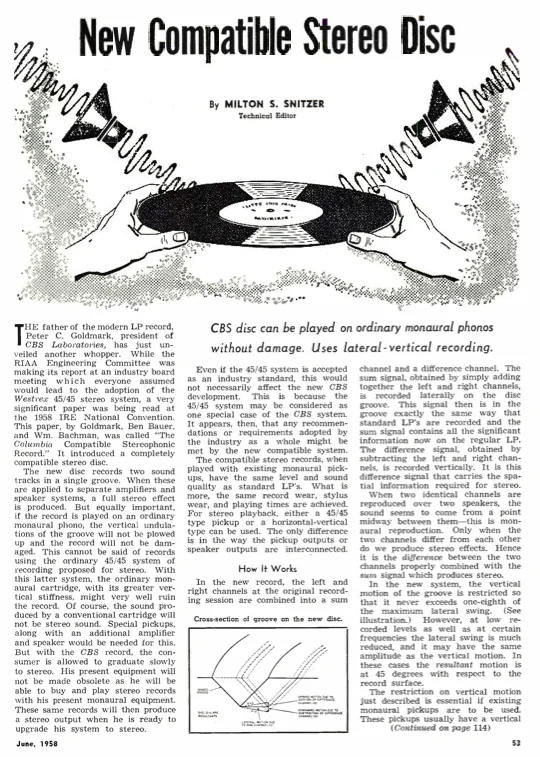
CBS 研究所の互換ステレオ盤の発表を伝えている
The first page of Snitzer’s article, which opens with the “another whopper” line quoted above
It reports the announcement of the CBS Laboratories compatible stereo disc
source: Milton S. Snitzer, “New Compatible Stereo Disc”, Radio & TV News, June 1958, p.53
LP の父が出した次の一手です。「またしても大物」という Snitzer の書き出しは、今度もうまくいくに違いない、という伝え方に見えます。
This was the next move from the father of the LP. Snitzer’s opening, “another whopper,” seems to tell readers that this one, too, was bound to succeed.
ところが、この互換ステレオ盤は市販されませんでした。発表から 3週間ほどで、肝心の Columbia レコードが、互換ステレオ盤ではなく、ふつうのステレオ盤を出すと表明します。4年後、論文を書いた 3人がディスク録音の歴史を 7ページにわたって書いたとき、互換ステレオ盤には 1行も割いていません。
Yet the compatible stereo disc never went on sale. About three weeks after the announcement, Columbia Records, the company that mattered most here, declared that it would release an ordinary stereo disc and not the compatible stereo disc. Four years later, when the three authors of the paper wrote a seven-page history of disc recording, they did not give the compatible stereo disc a single line.
互換ステレオ盤とは、なんだったのでしょうか。そして、なぜ消えたのでしょうか。
What was the compatible stereo disc? And why did it vanish?
The Problem and the Proposal
Old Styli Damage Stereo Records
1958年の初め、ステレオ・レコードの方式はほぼ決まりかけていました。Westrex 社の「45/45 方式」です。前の年の 1957年には、英国の Decca の縦横方式(左右を縦と横の振れに振り分ける方式)と聞き比べられ、年末までに米国と欧州の技術者たちは 45/45 方式のほうを選んでいました。詳しい経緯は、RCA の技術者 H. E. Roys の回想「The Coming of Stereo」(1977年)にあります。
At the start of 1958, the system for stereo records was all but decided: the 45/45 system from Westrex. In 1957, the year before, it had been compared in listening tests with British Decca’s vertical-lateral (V-L) system, which assigns the two channels to vertical and lateral motion, and by the end of that year engineers in the United States and Europe had chosen the 45/45 system. The details are in “The Coming of Stereo” (1977), a retrospective by the RCA engineer H. E. Roys.
45/45 方式では、V 字形の溝の左右の壁に、左右のチャンネルを 1つずつ刻みます。左右に同じ音が入っていれば、針は左右(横)にだけ振れます。これはモノーラル LP の溝と同じ動きです。左右の音が違うと、その差の分だけ針は上下(縦)にも振れます。ステレオらしさは、この縦の動きに乗っています。
In the 45/45 system, the left and right channels are cut one each into the two walls of the V-shaped groove. If both channels carry the same sound, the stylus moves only from side to side (laterally). That is the same motion as in the groove of a mono LP. When the two channels differ, the stylus also moves up and down (vertically) by the amount of the difference. The stereo effect rides on this vertical motion.
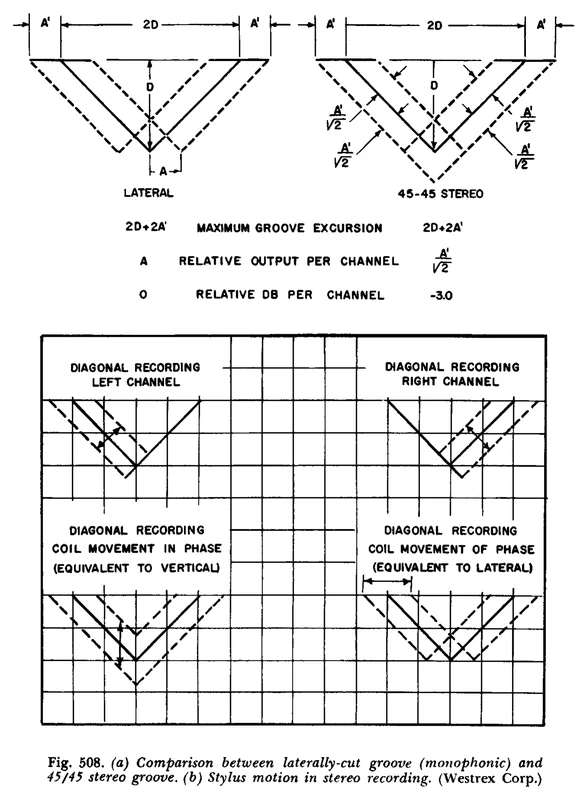
本文の「左右に同じ音」で溝が横に振れる場合は、下段の右下にあたる
In the lower half, “IN PHASE” and “OF PHASE” (as printed) refer to the direction in which the cutter’s two coils move, not to whether left and right carry the same sound
The case in the text where both channels carry the same sound and the groove moves laterally is the one at lower right
source: John Sunier, The Story of Stereo: 1881-, Gernsback Library, 1960, p.101

ステレオの溝では左右の壁が別々に動き、左右の音が違うと溝が縦にも振れる
振れは誇張してあり、実寸ではない
An animation of the upper half of the figure above (created by the author)
In the stereo groove the two walls move separately, and the groove also moves vertically when the two channels differ
The motion is exaggerated and not to scale
ところが、当時のモノーラルのピックアップは、針が横に動くように作られていて、縦にはほとんど動けません。1958年1月、RCA Victor の技術・製造委員会は、モノーラル装置でステレオ盤をかけた試験の結果を「互換でない」と発表しました。
The mono pickups of the day, however, were built so that the stylus moved laterally, and it could hardly move vertically at all. In January 1958, the Engineering and Manufacturing Committee of RCA Victor Records announced the result of its tests of stereo discs played on mono equipment: they “are not compatible.”
“Standard and high fidelity cartridges now in use are designed to have excellent freedom for lateral motion of the stylus but comparatively little freedom for vertical motion. The result is that a stylus on present day pick-ups cannot successfully trace all of the vertical modulation in the stereo record groove.”
いま使われている標準のカートリッジも、ハイファイのカートリッジも、針が横に動く自由度は十分にあるが、縦に動く自由度は比較的小さい。そのため、現在のピックアップの針は、ステレオ盤の溝の縦の変調を追いきれない。
"Victor Finds Faults in Stereo Disk Test," Billboard, January 20, 1958, p.30問題は、針が溝を追いきれないことにとどまりませんでした。1月21日、規格を詰めていた業界の合同会合では、ある声明の準備が始まっています。既存の機器のかなりの割合で、ステレオ盤をかけるとレコードがいくらか傷む、という内容です(Roys の 1977年の回想による)。
The trouble did not end with a failure to trace the groove. On January 21, a joint industry meeting that was working out the standard began preparing a statement. It said that on a considerable proportion of existing equipment, playing a stereo disc would damage the record to some degree (according to Roys’s 1977 retrospective).
Bert Whyte も、Radio & TV News 誌のレコード評欄の 4月号で、45/45 方式が出てきた頃のことを書いています。当時は、ステレオでもモノーラルでもかけられる「ユニバーサル盤」が作れるという触れ込みでした。Whyte はこう続けています。
Bert Whyte also wrote about the early days of the 45/45 system in his record review column in the April issue of Radio & TV News. When the 45-45 “first made its appearance,” he writes, “the notion was fostered that this method would allow for the production of” a “universal” pressing, one that could be played in either stereo or mono. He continues:
… that is until some investigators from RCA looked into the situation and concluded that the average monaural pickup would damage a stereo disc.
……RCA の調査員たちが調べて、平均的なモノーラル・ピックアップはステレオ盤を傷める、と結論するまでは。
Bert Whyte, "Certified Record Revue," Radio & TV News, April 1958翌月、Whyte は、縦方向のしなやかさ(コンプライアンス)がとびぬけて高いモノーラル・ピックアップでもないかぎり、ステレオ盤はかけるだけで傷む、という見方が業界で受け入れられた、と書いています。縦に硬い針が、上下にうねる溝を無理に通るからです。
The following month, Whyte wrote that the industry had come to accept the view that simply playing a stereo disc would damage it, unless the mono pickup had exceptionally high vertical compliance. The reason is that a vertically stiff stylus is forced through a groove that undulates up and down.
となると、レコード会社は同じ作品をモノーラル盤とステレオ盤の 2種類で作り、店はその両方を棚に置くしかありません。当時の言葉で「二重在庫 (double inventory)」です。
That left record companies no choice but to make the same title in two versions, mono and stereo, and left dealers no choice but to stock both. The term at the time was “double inventory.”
この時期(特に 1958年)にステレオ・レコードについて「互換性 (compatibility)」という言葉が使われる場合、2つの意味があることに注意が必要です。
When the word “compatibility” is used about stereo records in this period (especially in 1958), keep in mind that it can mean two things.
1つ目は、ふつうの 45/45 ステレオ盤を、モノーラルの針でかけられるかという、文字どおりの「互換性」を指す場合。RCA と Whyte が否定したのはこちらです。
The first is compatibility in the literal sense: whether an ordinary 45/45 stereo disc can be played with a mono stylus. This is the one that RCA and Whyte denied.
2つ目は、「モノーラルの針でもかけられるようにしたステレオ盤」、つまり冒頭で紹介した CBS 研究所発表の「互換ステレオ盤」を指す場合です。
The second refers to a stereo disc made so that a mono stylus can play it too, that is, the “compatible stereo disc” announced by CBS Laboratories and introduced at the top of this article.
ふつうの 45/45 ステレオ盤に、従来のモノーラル機器との互換性がないと判明したため、互換ステレオ盤が考案されました。
The compatible stereo disc was devised because ordinary 45/45 stereo discs turned out not to be compatible with existing mono equipment.
CBS’s Answer: Tame the Vertical Motion
CBS 研究所が「互換ステレオ盤」に込めた発想は、溝の新しい形を発明することではありませんでした。溝そのものは、45/45 方式とまったく同じです。論文自身も、自分たちの方式についてこう書いています。
The idea that CBS Laboratories put into its “compatible stereo disc” was not the invention of a new groove shape. The groove itself is exactly the same as in the 45/45 system. The paper says so about its own method:
… the method just described is equivalent to the so-called 45/45 system.
……いま述べた方式は、いわゆる 45/45 方式と等価である。
Goldmark, Bauer, Bachman, "The Columbia Compatible Stereophonic Record," IRE Transactions on Audio, Vol. AU-6, No. 2, 1958, p.26前の節で見たように、45/45 方式の溝では、左右に同じ音が入っていれば針は横に振れ、左右の音が違えばその分だけ縦に振れます。これを言い直すと、針の横の振れは左右の和 (L+R)、縦の振れは左右の差 (L−R) にあたります。和は、モノーラルで聞いたときの音そのものです。これは溝に手を加える操作ではなく、同じ溝での針の動きの言い表し方です。
As the previous section showed, in a 45/45 groove the stylus moves laterally when both channels carry the same sound, and moves vertically by the amount that the two channels differ. Put another way, the lateral motion of the stylus corresponds to the sum of left and right (L+R), and the vertical motion to their difference (L−R). The sum is exactly what you hear when listening in mono. Sum and difference are simply another way of describing how the stylus moves in the same groove.
CBS が変えたのは、縦の振れの量だけです。CBS は聴取試験から、音のエネルギーの大部分は和の信号が運んでいて、ステレオ感を出すのに必要な差の信号はわずかで足りる、と結論しました。そこで CBS は、マスターテープとカッターのあいだで、左右の信号を電気的に和と差に変えます。そして差の信号を、周波数と音量に応じて自動的に絞り込みます。この絞り込みをする増幅器を、論文は “electronic brain” (電子頭脳) と呼び、ASRA と名づけました。ASRA は Automatic Stereophonic Recording Amplifier の略です。45/45 型のカッターで切るときは、和と、絞った差を、もう一度左右の信号に組み直して溝に刻みます。
The only thing CBS changed was the amount of vertical motion. From listening tests, CBS concluded that the sum signal carries most of the sound energy, and that only a small amount of the difference signal is needed to produce the stereo effect. So, between the master tape and the cutter, CBS converts the left and right signals electrically into sum and difference. It then automatically reduces the difference signal according to frequency and level. The paper calls the amplifier that does this reducing an “electronic brain” and names it ASRA, short for Automatic Stereophonic Recording Amplifier. When cutting with a 45/45 type cutter, the sum and the reduced difference are recombined into left and right signals and cut into the groove.
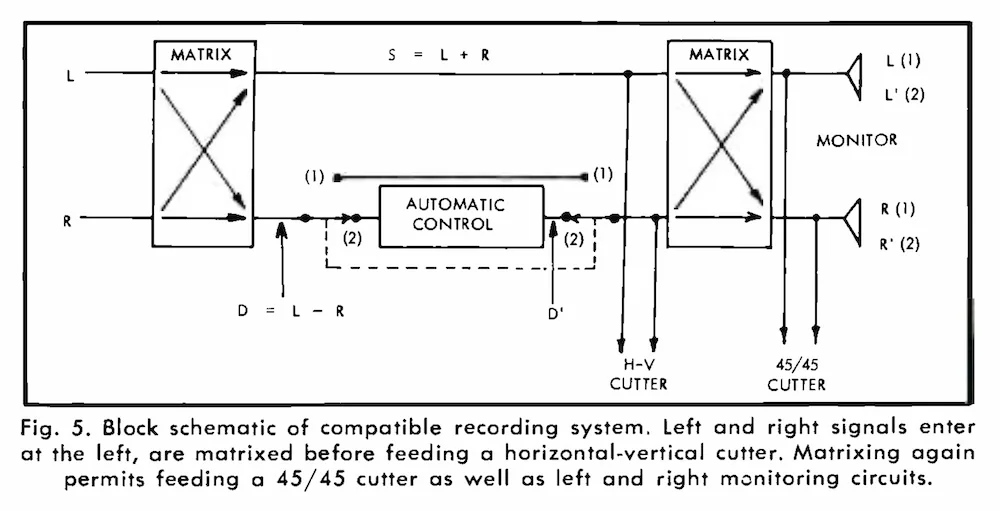
“AUTOMATIC CONTROL” の箱が、本文の ASRA にあたる
The signal path described in the text: left and right are converted to sum and difference, and only the difference is reduced automatically
The box labeled “AUTOMATIC CONTROL” corresponds to the ASRA of the text
source: Peter C. Goldmark, Benjamin B. Bauer, William S. Bachman, “The Compatible Stereophonic Record”, Audio, May 1958, p.28
縦の振れの最大値は、横の振れのおよそ 8分の1 に抑えられます。音量が小さいときや特定の周波数では縦と横が近くなることもありますが、大きな縦の振れは出ません。縦にほとんど動けないモノーラルの針でも溝を追えるので、盤は傷まず、聞こえるのは和の信号、つまりふつうの LP の音です。ステレオのピックアップでかければ、絞った差の信号から左右が戻ります。
The maximum vertical motion is held to about one-eighth of the lateral motion. At low levels or at certain frequencies the vertical and lateral motions can come close to each other, but no large vertical motion occurs. Even a mono stylus that can hardly move vertically can follow the groove, so the disc is not damaged, and what you hear is the sum signal, which is the sound of an ordinary LP. When the disc is played with a stereo pickup, the reduced difference signal restores left and right.
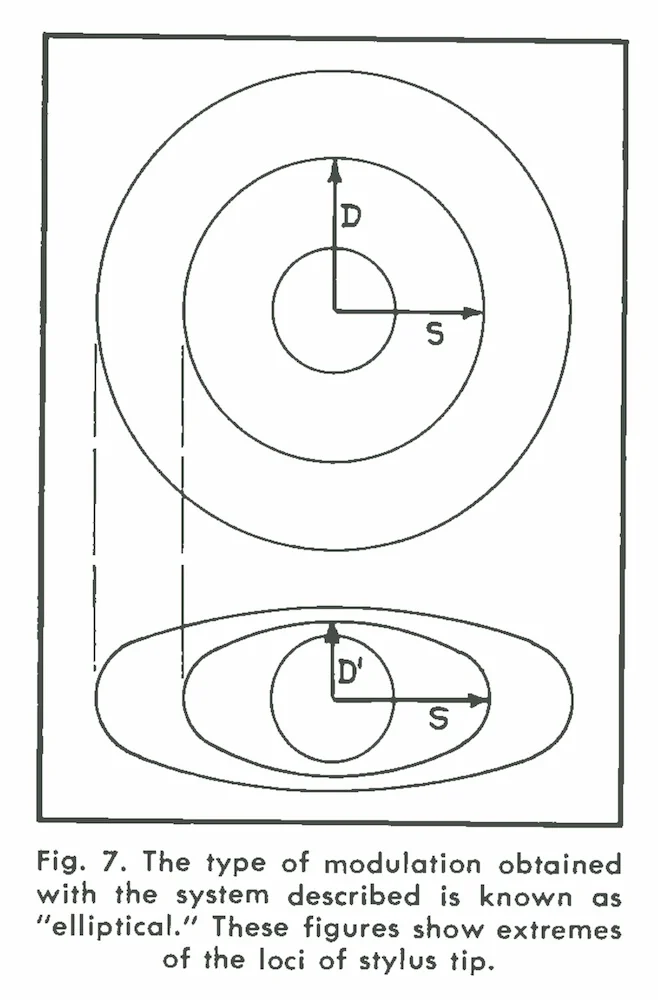
上は従来のステレオ方式で、縦の振れが横と同じ大きさまで出うる。下は縦の振れを抑えた互換盤
How reducing the difference signal changes the motion of the stylus tip
Above, a conventional stereo system, in which the vertical motion can grow as large as the lateral; below, the compatible disc with its vertical motion held down
source: Peter C. Goldmark, Benjamin B. Bauer, William S. Bachman, “The Compatible Stereophonic Record”, Audio, May 1958, p.67
論文の要旨は、この目標を 1文で言っています。
The paper’s summary states this goal in one sentence.
A “compatible” stereophonic record is one which will reproduce full stereophonic sound when played on a stereophonic phonograph and will be indistinguishable from an LP record when played on a monaural phonograph.
「互換」ステレオ盤とは、ステレオのプレーヤでかければ完全なステレオ音で鳴り、モノーラルのプレーヤでかければ LP レコードと区別がつかないレコードのことである。
Goldmark, Bauer, Bachman, IRE Transactions on Audio, 1958, p.25 (Summary)Snitzer は、これをカラーテレビの方式と同じ構造だと説明しています。広い帯域の明るさ(白黒)の信号に、狭い帯域の色の信号を足す、という構造です。白黒の受像機でもカラー放送が映るように、モノーラルのプレーヤでもステレオ盤が鳴る、というわけです。
Snitzer explains this as having the same structure as the color television system: a narrow-band color signal added to a wide-band brightness (black-and-white) signal. Just as a black-and-white set can show a color broadcast, a mono phonograph can play the stereo disc.
Snitzer は同じ記事で、買い手の側の利点も、期待を込めて書いています。互換盤なら、消費者は手持ちのモノーラル装置のままステレオ盤を買ってかけ、ゆっくりステレオに移れる (graduate slowly)、というものです。いまの装置は古くならず、装置をステレオにしたときには、同じ盤がステレオで鳴る、とも述べています。
In the same article, Snitzer also writes hopefully about the advantages for the buyer. With the compatible disc, consumers can keep the mono equipment they have, buy stereo discs and play them, and move over to stereo gradually (graduate slowly). He adds that their present equipment will not become obsolete, and that once they convert it to stereo, the same discs will play in stereo.
論文の 2人目と 3人目の著者、Benjamin B. Bauer と William S. Bachman は、45/45 方式の標準化を進めていた中心人物でもありました。Roys の回想によれば、Bauer は 1957年11月の EIA の委員会の会合で、45/45 の基本の取り決め 2つを提案し、2つとも採択されました。Bachman は 1958年1月の会合で、RIAA の委員会の勧告、つまり「45/45 を標準とする」勧告の承認を諮った当人です。互換盤は、45/45 方式の外から来た対抗馬ではありません。45/45 の標準化を進めた当の人たちが、その枠の中で考えた別の使い方でした。
The paper’s second and third authors, Benjamin B. Bauer and William S. Bachman, were also central figures in the standardization of the 45/45 system. According to Roys’s retrospective, at a meeting of the EIA committees in November 1957 Bauer made two standard proposals for the 45-45 system, and “both proposals were voted upon and accepted.” At the January 1958 meeting it was Bachman who “called for a vote of approval for the recommendations made by the RIAA Committee, namely, that the 45-45 system be approved as the standard system.” The compatible disc was not a rival that came from outside the 45/45 system. It was another way of using 45/45, thought up within that framework by the very people who were standardizing it.
Unveiled, Criticized, Set Aside
The Standard Was Set That Same Week
論文が読まれた 3月25日、RIAA(アメリカレコード協会)の理事会は 45/45 方式を業界の標準として承認しました。Snitzer は、この重なりを次のように書いています。
On March 25, the day the paper was read, the RIAA board of directors approved the 45/45 system as the industry standard. Snitzer described the coincidence as follows.
While the RIAA Engineering Committee was making its report at an industry board meeting which everyone assumed would lead to the adoption of the Westrex 45/45 stereo system, a very significant paper was being read at the 1958 IRE National Convention.
誰もが Westrex の 45/45 ステレオ方式の採択につながると思っていた業界の理事会で、RIAA 技術委員会が報告をしているちょうどそのとき、1958年の IRE 全国大会では非常に重要な論文が読まれていた。
Snitzer, Radio & TV News, June 1958, p.53翌日の 3月26日(水曜日)、Goldmark は記者会見を開いて互換盤を実演しました。Broadcasting 誌によれば、商業的な用途はまだ十分に検討されていない、と Goldmark は述べています。そのうえで、放送局、とくにステレオを試験的に流している FM 局で、いくらか使い道がありそうだと示唆しました。
The next day, Wednesday, March 26, Goldmark held a press conference and demonstrated the compatible disc. According to Broadcasting, Goldmark said that the commercial applications of the record had not yet been fully explored. The magazine added that he “indicated the record could have some use for broadcasting stations, particularly fm outlets experimenting with stereophonic sound.”
RCA は、この記者会見より前に互換盤を聞いていました。Roys の 19年後の回想によれば、Columbia は 3月17日、RCA に互換盤を実演して見せています。RCA は多くの試験を重ね、家庭用機器・研究所・レコードの各部門で最終の試聴をしています。結論は、互換盤の品質は LP にもフル・ステレオ盤にも劣る、というものでした。RCA のレコード部門は、フル・ステレオ盤を作り、LP はこれまでどおり作り続けると決めます。
RCA had heard the compatible disc before this press conference. According to Roys’s recollection 19 years later, Columbia demonstrated the compatible disc to RCA on March 17. RCA ran many tests, and its home instruments, laboratories, and record divisions held final listening sessions. They concluded that the compatible disc was inferior in quality both to the LP and to the full stereo disc. RCA’s record division decided to make full stereo discs and to go on making LPs as before.
Billboard 誌の 3月31日号は、2ページ目の左の 3段に大見出しを掲げました。「’Compatible’ Disk Unveiled; Wide Discussion in Trade」です。右端の段には「COLUMBIA’S NEW DISK SETS OFF NO HY-STEREO」という記事があります。ヒステリー (hysteria) とステレオ (stereo) を掛けて ヒステレオ (hy-stereo) とし、Columbia の新しい盤は騒ぎを起こさなかった、という見出しです。この記事は、大手各社の幹部の反応を並べています。最も厳しかったのは RCA Victor の George Marek です。
The March 31 issue of Billboard ran a banner headline across the left three columns of page 2: “‘Compatible’ Disk Unveiled; Wide Discussion in Trade.” In the rightmost column was a story headed “COLUMBIA’S NEW DISK SETS OFF NO HY-STEREO.” The headline puns on hysteria and stereo to say that Columbia’s new disc had caused no uproar. The story lines up reactions from executives at the major labels. The harshest came from George Marek of RCA Victor.
“Such a disk is neither good on the monaural side, nor on the stereo side.”
そういう盤は、モノーラルとしても良くないし、ステレオとしても良くない。
George Marek (RCA Victor), Billboard, March 31, 1958, p.2同じ記事で米国の Decca の Leonard Schneider は「完全なステレオではないから反対する」と言っています。同じ面の別の記事では、Westrex の広報担当者が「ステレオの最良の特質を商売の都合で削るような方式は望ましくない」と述べました。Radio & TV News の 6月号では、Whyte も、ほかの会社の大半は互換盤を「モノーラルとしてもステレオとしても良くない」という理由で退けたようだ、と伝えました。RCA の Marek の言葉と第三者の同時代の記録が、ほぼ同じ言葉で一致しています。
In the same story, Leonard Schneider of American Decca says, “We simply object to it because it is not wholly stereophonic.” In another story on the same page, a Westrex spokesman said that “any system which tended to tailor down the best attributes of stereo to meet certain commercial considerations would be undesirable.” In the June issue of Radio & TV News, Whyte too reported that most of the other companies “seemed to reject the idea” on the grounds that the result was “neither good monaural nor good stereo.” What RCA’s Marek said and this contemporary record by a third party agree in nearly the same words: Marek’s were “neither good on the monaural side, nor on the stereo side.”
同じ記事によれば、Marek は、RCA Victor も Columbia と同じく「いわゆる互換盤」を持っていて、自分はそのどちらにも否定的だ、とも指摘しています。互換盤は CBS だけの思いつきではなく、大手 2社がそれぞれ手元に持ちながら、ともに選ばなかったものでした。代わりに Marek が選んだのが、二重在庫です。
The same story also reports that Marek “noted that Victor as well as Columbia had a so-called compatible disk, and that he took a dim view of both.” The compatible disc was not an idea peculiar to CBS. Two of the majors each had one in hand, and neither chose it. What Marek chose in its place was double inventory.
“We propose double inventory. We will do this slowly, so as to avoid disruption . . . and we will tell the trade that there is nothing obsolete in the monaural disk which can be played on the new machines and will sound even better. There does exist a compatibility in machines.”
われわれは二重在庫を提案する。混乱を避けるために、ゆっくり進める……そして業界には、モノーラル盤は何も古くならない、新しい機械でもかけられるし、もっと良く鳴る、と伝えるつもりだ。機械の側には互換性がある。
George Marek (RCA Victor), Billboard, March 31, 1958, p.2二重在庫のほうが費用はかかる、それでもモノーラル盤の品質を落とさずに済む、と RCA の Marek は続けています。選んだのは、品質のために費用を払う道でした。
RCA’s Marek went on to say that double inventory costs more, but that it avoids lowering the quality of the mono disc. The company chose to pay for quality.
A Reversal in Three Weeks
互換ステレオ盤への批判に、CBS 研究所はすぐには引きませんでした。翌週、Goldmark はマディソン街の CBS のスタジオで追加の会見を開き、批判にこう応じています。
CBS Laboratories did not back down right away in the face of the criticism. The following week, Goldmark held a further press conference at a CBS studio on Madison Avenue and answered his critics this way.
“We are minding our own business and if anybody cares to belittle it, that’s their business.”
われわれは自分の仕事をしているだけだ。それをけなしたい人がいるなら、それはその人の勝手だ。
Peter C. Goldmark, "Developer Explains System," Billboard, April 7, 1958, p.20同じ記事で Goldmark は、10年前の、LP についての記事の切り抜きが手元のファイルにある、と言っています。そして、この盤を持っていない、聞いてさえいないかもしれない人からの非難は「酸っぱい葡萄」を思わせる、とも言いました。
In the same article, Goldmark said: “I have some clippings in my file of stories from 10 years ago, about the LP record. Accusations from people who don’t have our record, who may not have even heard it, remind me of fruit—sour grapes.”
同じ記事の p.2 には、互換ステレオ盤についての Goldmark のこういう発言も載っています。
Page 2 of the same article also carries this statement by Goldmark about the compatible stereo disc.
“What we are putting out,” he said, “is a record that is compatible with regular LP record players which at the same time can be played on any stereophonic phonograph.”
「われわれがいま世に出そうとしているのは」と彼は言った。「ふつうの LP プレーヤと互換で、同時にどのステレオ・プレーヤでもかけられるレコードだ。」
Peter C. Goldmark, "Developer Explains System," Billboard, April 7, 1958, p.21958年3月から 4月のこの時点で、ステレオ LP を市販している大手レーベルは 1社もありませんでした。Goldmark の言い方は、すでに売っているという意味には取れません。いま披露していて、近く出すつもりだ、という意気込みの言葉と読めます。
At this point, in March and April 1958, not one major label had a stereo LP on the market. Goldmark’s wording cannot be taken to mean that the disc was already on sale. I read it as a statement of intent: we are showing it now and mean to release it soon.
Columbia レコードの側は、この言い方に乗りませんでした。同じ記事の続き (p.20) によれば、副社長の Herbert M. Greenspon は、Goldmark の「われわれが世に出そうとしているレコード」という言い方への論評を断っています。そのうえで、Goldmark 方式でも他の方式でも、ステレオ盤を市販する予定はいまのところない、と記者に繰り返しました。
Columbia Records did not go along with this wording. According to the continuation of the same article (p.20), vice president Herbert M. Greenspon declined to comment on Goldmark’s phrase “What we are putting out.” He then repeated to the reporter that Columbia had no plans at present to market stereo discs, whether by the Goldmark system or by any other.
前の週の 3月31日号に、Greenspon の同じ趣旨の発言が載っています。
The previous week’s issue, dated March 31, carries a statement by Greenspon to the same effect.
“The announcement of the compatible record represents much research on the part of Dr. Goldmark and his associates and it was made to add to the general fund of information on the subject of stereo disks,” Greenspon declared. “We have no plans for bringing out stereo records employing the system at this time.”
「互換盤の発表は、Goldmark 博士とその同僚たちによる多くの研究の成果であり、ステレオ盤というテーマについての知見の蓄えを増やすために行われた」と Greenspon は言明した。「現時点で、この方式を使ったステレオ盤を出す予定はない。」
Herbert Greenspon (Columbia Records), "STEREO DISKS NOT IMMEDIATE," Billboard, March 31, 1958, p.2Columbia レコードにとって、互換ステレオ盤は、ステレオ盤についての知見を増やすための研究発表でした。売り物ではない、という線引きです。研究所の所長は近く出すつもりで語り、レコード会社の副社長は 2号続けて、出す予定はないと答えています。
For Columbia Records, the compatible stereo disc was a research announcement, made to add to what was known about stereo discs. The company drew a line: it was not a product. The head of the laboratory spoke as if a release were near, and the vice president of the record company answered, in two consecutive issues, that there were no plans to bring it out.
その翌週、Billboard の 4月14日号に、Columbia レコード社長 Goddard Lieberson の声明が載りました。見出しは「Columbia Plans Full Stereo Disk」。Columbia は近く、ふつうの 45/45 方式の、完全なステレオ LP を出す、という内容です。記事の地の文は、これで互換盤の憶測が鎮まった、と書いています。
The week after that, the April 14 issue of Billboard carried a statement by Goddard Lieberson, president of Columbia Records. The headline was “Columbia Plans Full Stereo Disk.” The statement said that Columbia would soon release a full stereo LP on the ordinary 45/45 system. The article’s own text says that this put an end to the speculation about the compatible disc.
Lieberson は声明の中で、CBS 研究所の互換盤を「見事な技術的突破」と持ち上げつつ、こう続けました。
In his statement, Lieberson praised the CBS Laboratories compatible disc as “a brilliant technical breakthrough,” and then went on:
“It should be borne in mind that stereophonic effect is by no means an absolute quality with rigidly specified characteristics. Much remains to be investigated in the area of artistic taste and public acceptance.”
ステレオ効果は、厳密に規定された特性を持つ絶対的な性質などではまったくない、ということを心に留めておくべきだ。芸術的な好みと大衆の受け入れという点で、調べるべきことはまだ多く残っている。
Goddard Lieberson, Billboard, April 14, 1958, p.12声明は、互換盤を捨てるとも、いまは出さないだけだとも言っていません。Cash Box 誌も同じ声明を引いています。そこでは Lieberson は、ステレオ盤を出すと述べたすぐ次の文で、そのステレオ盤は Columbia のモノーラル・カタログに何の影響も与えない、と念を押しています。
The statement says neither that the compatible disc was being abandoned nor that it was merely being held back for now. Cash Box quotes the same statement. There, in the sentence immediately after he says Columbia will release a stereo disc, Lieberson stresses that the stereo disc will have no effect whatever on Columbia’s mono catalog.
Audio 誌は 5月号で論文の全文を転載し、編集部の注を添えました。論文の発表は Columbia レコードがこの方式の盤を出すことを意味しない、むしろ Columbia はその後、標準の 45/45 盤を出すと発表した、という注です。3月25日の論文から 4月中旬の声明まで、3週間ほどの出来事です。
Audio reprinted the paper in full in its May issue and added an editor’s note. The note said that the publication of the paper did not mean Columbia Records would release discs made by this system, and that Columbia had in fact since announced it would release standard 45/45 discs. From the paper on March 25 to the statement in mid-April, all this took about three weeks.
The Patent Filed That May
互換ステレオ盤の研究は、そこで止まりませんでした。CBS は 5月16日に特許を出願し、1961年12月12日に米国特許 3,013,125 として認められます。発明者は Goldmark、Bauer、John M. Hollywood の 3人で、論文の 3人目の著者だった Bachman の名はありません。特許の明細書(発明内容を詳細に説明する文書)は、モノーラルの針がステレオ盤で困る仕組みを、こう説明しています。
Research on the compatible stereo disc did not stop there. CBS filed a patent application on May 16, and it was granted on December 12, 1961, as U.S. Patent 3,013,125. The inventors are Goldmark, Bauer, and John M. Hollywood. Bachman, the third author of the paper, is not named. The patent specification explains why a mono stylus has trouble with a stereo disc as follows.
The reproducing stylus utilized in non-stereophonic phonographs, however, has a relatively high impedance to vertical deflection and, therefore, instead of responding to the vertical track modulation resiliently, the stylus tends to remain in a relatively fixed vertical position.
しかし、ステレオでないプレーヤに使われている再生針は、縦の振れに対する抵抗(インピーダンス)が比較的高い。そのため、溝の縦の変調にしなやかに応じるかわりに、針は縦方向にはほぼ決まった位置にとどまろうとする。
Goldmark, Bauer, Hollywood, U.S. Patent 3,013,125, col.1続けて、そのため縦の変調で盤にかかる実際の針圧が変わり、縦の変調が極端になると横方向のトレースが崩れて歪んだ音が出る、と書かれています。業界では、ステレオ盤は古い針で傷む、と見られていました。CBS の特許が問題にしているのは、盤の傷みではなく、音の歪みとトレースの崩れです。
The specification goes on to say that the vertical modulation therefore changes the actual stylus force on the record, and that when the vertical modulation becomes extreme, lateral tracking breaks down and the sound is distorted. The industry’s view was that old styli damage stereo records. What the CBS patent addresses is distorted sound and loss of tracking, and it does not speak of damage to the record.
縦の振れの絞り方としてまず、差の信号を周波数の帯に分け、帯ごとにふつうのリミッターをかける方法が挙げられています。例は、50〜100サイクルから 6,400〜12,800サイクルまでの、オクターブごとの帯です。モノーラルの針がどの周波数で溝を追えなくなるかに合わせて、帯ごとに作動するレベルを変えられます。1つの帯が制限されても、ほかの帯はそのまま通ります。次に挙げられているのは、各帯の差の信号を、針に生じる振幅・速度・加速度の成分に分け、成分ごとに別のレベルで制限してから元に戻す方法です。トレースを崩しやすい成分、たとえば加速度だけを低いレベルで抑え、影響の小さい振幅は残せます。こうすると帯の数を減らせます。例は 50〜1,000、1,000〜4,000、4,000〜15,000サイクルの 3帯です。
As a first way of restricting the vertical motion, the patent describes dividing the difference signal into frequency bands and applying an ordinary limiter to each band. The example given is a set of octave bands running from 50–100 cycles up to 6,400–12,800 cycles. The level at which each band’s limiter operates can be set according to the frequencies at which a mono stylus stops tracking the groove. When one band is limited, the others pass unchanged. In the next method, the difference signal in each band is separated into components corresponding to the amplitude, velocity, and acceleration produced at the stylus. Each component is limited at its own level, and the components are then recombined. A component that readily upsets tracking, acceleration for example, can be held to a low level by itself, while amplitude, which matters less, is left alone. This reduces the number of bands needed. The example given has three: 50–1,000, 1,000–4,000, and 4,000–15,000 cycles.
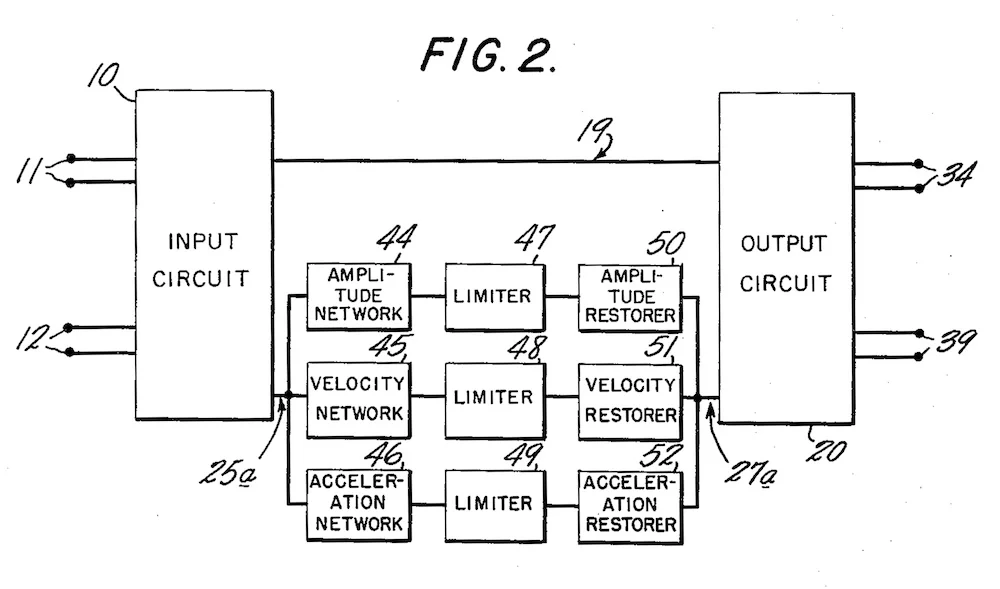
1958年5月16日に出願され、1961年12月12日に認められた特許の図面 2枚目にある
Block diagram of the method that separates the difference signal into amplitude, velocity and acceleration components and limits each one
From the second drawing sheet of the patent filed on May 16, 1958 and granted on December 12, 1961
source: U.S. Patent 3,013,125, “Stereophonic Recording”, P. C. Goldmark et al., filed May 16, 1958, patented Dec. 12, 1961, Sheet 2
特許の FIG.2 は、この成分に分ける方法のブロック図です。差の信号が振幅・速度・加速度の 3系統に分かれ、それぞれ制限を受けてから 1つに戻ります。縦を絞った分だけ和の側をエキスパンダーで持ち上げ、全体の音のエネルギーを保つ構成も書かれています。縦の振れをモノーラルの針が追える範囲に収める、という考え方は論文と変わっていません。Whyte も 6月号の時評の終わりに、こう書いています。
FIG. 2 of the patent is a block diagram of this component-splitting method. The difference signal divides into three paths, for amplitude, velocity, and acceleration; each is limited, and the three are then recombined. The patent also describes an arrangement in which an expander raises the sum side by the amount the vertical motion has been reduced, so that the overall sound energy is maintained. The idea of keeping the vertical motion within the range a mono stylus can follow is unchanged from the paper. Whyte, too, wrote at the end of his June column:
In spite of this Columbia is continuing its experiments and it will be interesting to see what they come up with.
それでも Columbia は実験を続けており、何を出してくるか見ものだ。
Bert Whyte, "Certified Record Revue," Radio & TV News, June 1958After the Compatible Disc
The Odd Name Given to Ordinary Stereo Records
結局米国業界は、互換盤ではなく、ふつうの 45/45 盤を出す道を選びました。1958年の夏から秋にかけて、大手各社のステレオ LP が順に店に並びはじめます。Billboard の誌面で追うと、予告の時期は Mercury が 7月20日、Columbia が 7月28日の週(20タイトル、1枚 5.98ドル)、Capitol が 8月18日です。RCA Victor は 6月の予定が後ろにずれて、8月第1週の号で「今週発売」と報じられました。Decca は 10月です。
In the end, the U.S. industry chose to release ordinary 45/45 discs and not the compatible disc. From the summer into the fall of 1958, the majors’ stereo LPs began to reach the stores one after another. Followed through the pages of Billboard, the announced dates were July 20 for Mercury, the week of July 28 for Columbia (20 titles at $5.98 each), and August 18 for Capitol. RCA Victor’s discs, planned for June, slipped back, and the issue for the first week of August reported them as “released this week.” Decca followed in October.
米国のレコード店に毎月置かれていた LP カタログ Schwann Long Playing Record Catalog は、1958年6月号からステレオ盤を載せはじめました。この号のステレオ盤の欄にはすでに、Audio Fidelity や Stereo(Contemporary のステレオ専用レーベル)など中小の盤が載っていましたが、大手の盤は 1枚もありません。筆者所蔵のこの号の表紙には、右上に「JUNE 1958」、中央に「NEW! STEREO RECORDS PAGE 98」とあります。
The Schwann Long Playing Record Catalog, the LP catalog that American record stores carried every month, began listing stereo records with its June 1958 issue. The stereo section of that issue already listed discs from smaller labels such as Audio Fidelity and Stereo (Contemporary’s stereo-only label), but not a single disc from a major. On the cover of my own copy of this issue, the upper right reads “JUNE 1958” and the center reads “NEW! STEREO RECORDS PAGE 98”.
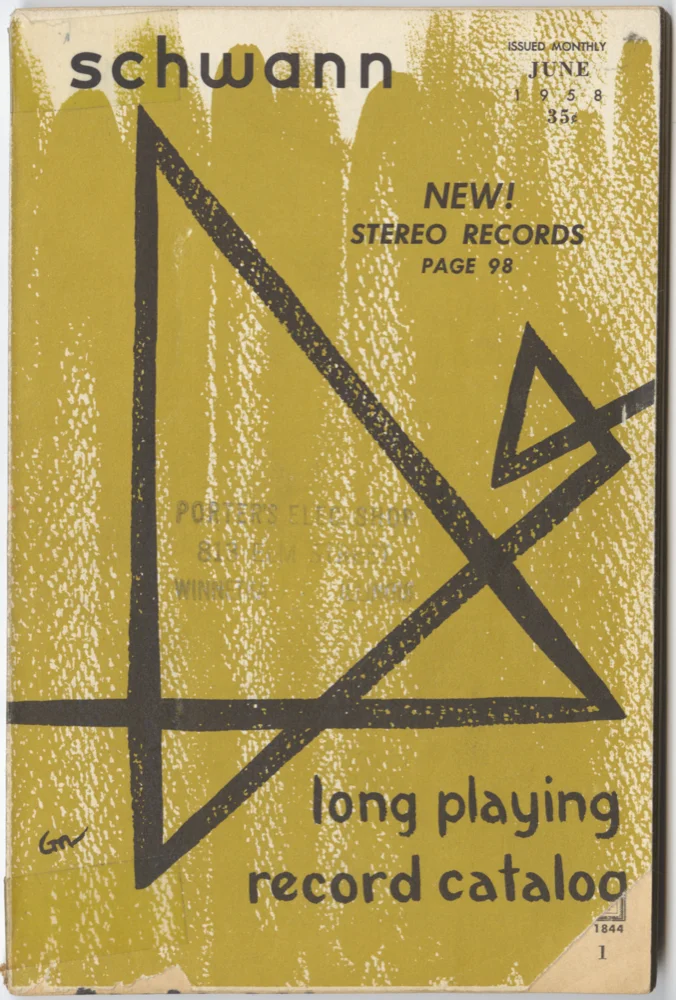
Cover of the June 1958 issue of the Schwann Long Playing Record Catalog, the first to list stereo records (author’s collection)
このとき、ふつうの 45/45 ステレオ盤には妙な呼び名が付いていました。「非互換 (noncompatible)」です。前の節で見た Lieberson の声明も、原文では Columbia が出す盤をそう呼んでいます。「a noncompatible, true stereophonic LP disk」(非互換の、真のステレオ LP 盤) です。Cash Box 誌は、この声明を「Columbia To Issue Non-Compatible Stereophonic Disk」という見出しで伝えました。RCA の Living Stereo は「互換ではない、つまり標準の再生装置ではかけられない」と紹介されました。Billboard は、Imperial も 9月に「非互換のステレオ盤」を 12タイトル出す、と伝えています。
At this point the ordinary 45/45 stereo disc carried an odd name: “noncompatible.” Lieberson’s statement, seen in the previous section, uses that word in the original for the disc Columbia would release: “a noncompatible, true stereophonic LP disk.” Cash Box reported the statement under the headline “Columbia To Issue Non-Compatible Stereophonic Disk.” Billboard introduced RCA’s Living Stereo records with the words “They are not compatible, that is, they cannot be played on standard playing equipment.” It also reported that Imperial would release “12 noncompatible stereo packages in September.”
ただし、ふつうのステレオ盤は互換でない、という見方そのものは CBS より前からありました。1月の RCA の技術・製造委員会がすでに、モノーラル装置でかけたステレオ盤は「互換でない (are not compatible)」と発表しています。これは試験結果の説明で、盤の呼び名ではありません。もとからあった「互換」という言葉に CBS が「互換盤」という製品の意味を持たせた結果、その対概念として、ふつうのステレオ盤が「非互換」と呼ばれるようになったのです。
The view that an ordinary stereo record is not compatible did not begin with CBS, however. RCA Victor’s Engineering and Manufacturing Committee had already announced in January that stereo records played on mono equipment “are not compatible”. That was a description of test results, not a name for the disc. When CBS gave the existing word “compatible” a product meaning, the “compatible disc,” the ordinary stereo record came to be called “noncompatible” as its counterpart.
7月14日号の Billboard は「Confusion Reigns in Stereo Disk Recipes」という記事を載せています。業界は単一の技術規格 (45/45) を受け入れたのに、各社の「互換性」の説明を聞いているとそうは思えない、という内容です。記事が引く Omega のジャケットには、こうあります。
The July 14 issue of Billboard ran an article titled “Confusion Reigns in Stereo Disk Recipes”. Its point was that the industry had accepted a single technical standard (45/45), yet nobody would think so from listening to each company’s account of “compatibility.” The article quotes an Omega jacket, which reads as follows.
“This is a non-compatible stereophonic disk to be played only with stereophonic reproduction equipment.”
これは非互換のステレオ盤で、ステレオ再生装置だけでかけてください。
Omega のジャケットの文言、Billboard, July 14, 1958, p.2 よりその一方で、Columbia はモノーラル盤のジャケットに、こう刷ると発表しました。
Columbia, meanwhile, announced that it would print the following on the jackets of its mono records.
“If you are the owner of a new stereophonic system, this record will play with even more brilliant, true-to-life fidelity. In short, you can purchase this record with no fear of its becoming obsolete in the future.”
新しいステレオ装置をお持ちなら、このレコードはさらに輝かしく、生々しい忠実度で鳴ります。つまり、このレコードは将来古くなる心配なしにお買い求めいただけます。
Columbia のモノーラル盤のジャケットの文言、Billboard, July 14, 1958, p.18 より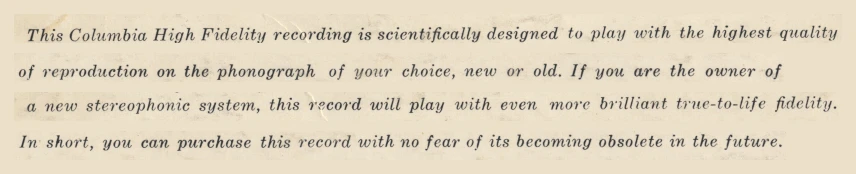
実物では 2行の文を、折り返して 4行に並べ直した
The wording Billboard reported, as actually printed at the bottom of the back cover of a mono Columbia LP: Hank Garland’s 1961 album “jazz winds from a new direction”, CL 1572 (author’s collection)
On the jacket the text runs as two long lines; it has been rewrapped into four here
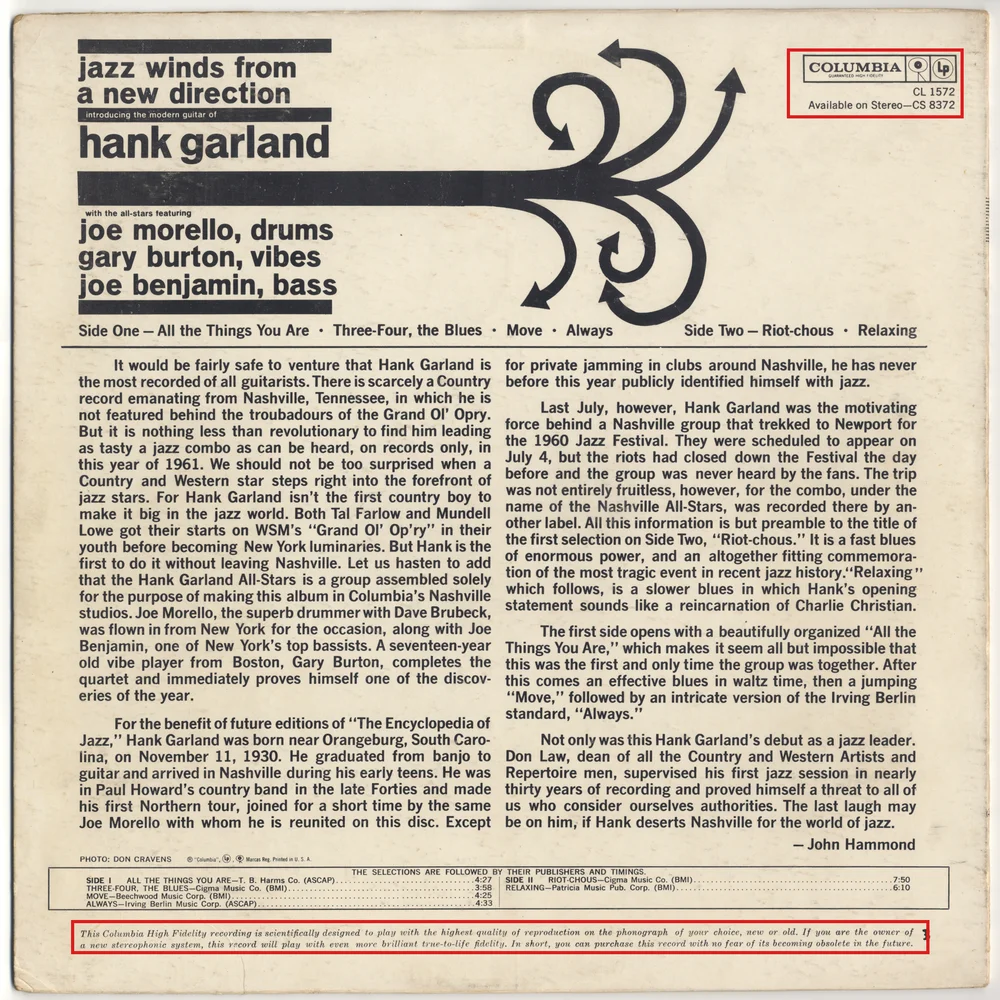
下端の枠が上の図の文
右上の枠の「Available on Stereo—CS 8372」は、同じアルバムのステレオ盤が別の番号 (CS 8372) で出ていたことを示す。「二重在庫」の実例
The whole of the same back cover. The red boxes were added by the author
The box at the bottom edge marks the text shown above
“Available on Stereo—CS 8372” in the upper-right box shows that the same album was also issued as a stereo record under a separate number, an instance of the “double inventory”
3月に Marek が言った「機械の側の互換性」と同じ向きです。同じ 3月31日号で、Mercury の社長 Irving B. Green はもっとはっきり言っていました。
This points the same way as what Marek had said in March: “There does exist a compatibility in machines.” In the same March 31 issue, Mercury’s president, Irving B. Green, had put it more plainly.
“If you want to talk about a compatible record, the standard monaural record is really the compatible one. It will play monaurally on stereo equally as well as on monaural equipment.”
互換盤の話をしたいなら、標準のモノーラル盤こそが本当の互換盤だ。ステレオ装置でもモノーラル装置でも、同じようにモノーラルで鳴る。
Irving B. Green (Mercury), Billboard, March 31, 1958, p.2ステレオ盤をモノーラル機でかける道はふさいだまま、モノーラル盤はステレオ機でも安心してかけられる、と言って売ります。互換盤のかわりに、この一方通行の互換性が、二重在庫の時代の売り文句になりました。
The road from stereo record to mono player stayed closed, while the mono record was sold with the assurance that it could safely be played on a stereo player as well. In place of the compatible disc, this one-way compatibility became the sales pitch of the double-inventory era.
Fading from the Industry’s Memory
秋には、互換ステレオ盤はもう過去の話でした。Billboard の 10月13日号は、FM のステレオ放送の方式が乱立しているのと比べて、レコード業界をこう振り返っています。
By the fall, the compatible stereo disc was already a thing of the past. The October 13 issue of Billboard, contrasting the record industry with the proliferation of competing systems for FM stereo broadcasting, looked back on it this way.
“Unlike the stereo situation in the record field—in which the firms quickly agreed on the Westrex 45-45 system and have stuck with it, apart from a brief Columbia Records flurry on “compatibility”—the situation is very fluid in multiplexed FM radio.”
レコードのステレオの状況、つまり各社がすぐに Westrex の 45-45 方式で合意し、Columbia レコードの「互換性」をめぐる短い騒ぎを除けばそれを守ってきたのとは違って、多重 FM 放送の状況は非常に流動的だ。
Charles Sinclair, Billboard, October 13, 1958, p.1「短い騒ぎ」。半年でこう書かれるところまで来ていました。
A “brief Columbia Records flurry.” Within half a year, that was how it was being written about.
Radio & TV News の 10月号は、互換盤が完璧主義の人たちの怒りを買った、と伝えています。編集部自身も、公平な聞き手として、デモの素材にいくらかの歪みを聞き取れた、と述べたうえで、それでも多くの人は、CBS が互換性に「頑張りすぎて」、「互換に寄せすぎた」のではないかと考えているらしい、と書いています。同じ記事で編集部は、CBS の開発の背後にある考え方を何らかの形で取り入れたものが、今後のステレオ盤に影響するだろう、と予想していました。ほとんどの、ことによるとすべてのレコード会社が、目立った歪みなしに針を縦より横に大きく振らせる何らかの手直しを使うことになるだろう、という予想です。ただし、いまの時点では誰も公には何も言わないだろう、とも書いています。縦の振れを抑えるという ASRA の発想が、名前を変えてカッティングの現場に残ったことを示す史料は、まだ見つかっていません。
The October issue of Radio & TV News reported that the compatible record “aroused the ire of” the perfectionist group. The editors themselves say that, as impartial listeners, they “were able to detect some distortion in the demonstration material.” Even so, they add, many seem to think that maybe CBS “bent over backwards” on the compatibility issue and got it “too compatible.” In the same article the editors predicted that “some adaptation of the philosophy behind the CBS development will probably influence the future of stereo discs.” Their forecast was that “most, if not all, the record companies will end up using some record device, or at least some adaptation that will allow greater horizontal stylus motion than vertical, without noticeable distortion.” “But nobody will say anything officially at this juncture,” they wrote. I have not yet found any source showing that the ASRA idea of restraining the vertical motion survived in cutting practice under another name.
1962年、Proceedings of the IRE の 5月号に、Bachman・Bauer・Goldmark の 3人が、ディスク録音と再生の歴史を「Disk Recording and Reproduction」の題で書きます。4年前の論文と、まったく同じ顔ぶれです。7ページの概説の中で、ステレオ盤は 45/45 方式として説明され、比べる相手は、はじめの節で触れた縦横方式でした。互換盤への言及は 1か所もありません。
In 1962, in the May issue of Proceedings of the IRE, Bachman, Bauer, and Goldmark wrote a history of disc recording and reproduction, titled “Disk Recording and Reproduction.” They are exactly the same three authors as on the paper of four years earlier. In this seven-page survey the stereo record is explained as the 45/45 system, and the system it is compared with is the vertical-lateral system mentioned in the first section. The compatible disc is not mentioned anywhere.
Goldmark の自伝 Maverick Inventor(1973年)にも、互換ステレオ盤の話は出てきません。「stereo」の語が出るのは 1か所だけで、自宅の作りつけのステレオで新しい LP を試していた、という家庭の場面です (p.269)。
Goldmark’s autobiography, Maverick Inventor (1973), does not bring up the compatible stereo disc either. The word “stereo” appears in only one place, a domestic scene in which he is trying out new LPs on the built-in stereo at home (p.269).
So What Was the Compatible Record?
互換ステレオ盤は、45/45 方式とは別の方式ではありませんでした。45/45 方式の溝の中で、縦の振れを旧い針が追える分だけに絞ったレコードです。考えたのは、45/45 の標準化を進めていた当人たちでした。
The compatible stereo disc was not a system separate from 45/45. It was a record that, within the 45/45 groove, cut the vertical motion down to what an old stylus could follow. The people who thought of it were the very ones who had been pushing the standardization of 45/45.
それが消えた理由として史料から見えるのは、2つです。1つは、同業者が聞き比べて「モノーラルとしてもステレオとしても良くない」と判定したこと。もう 1つは、規格が決まったその週に、大手が互換盤ではなく、ふつうのステレオ盤とモノーラル盤を並べて売る二重在庫を選んだことです。Columbia レコード自身も、互換ステレオ盤を選びませんでした。互換盤も二重在庫も、手持ちのモノーラル・カタログを守るための方法だった点では同じだと読めます。大手が選んだのは、ステレオ盤の音を削らないほうでした。
The sources show two reasons for its disappearance. One is that others in the industry listened, compared, and judged it “neither good on the monaural side, nor on the stereo side.” The other is that, in the very week the standard was set, the majors chose double inventory, selling ordinary stereo records and mono records side by side, over the compatible disc. Columbia Records itself did not choose the compatible stereo disc either. The compatible disc and double inventory can both be read as ways of protecting an existing mono catalog, and in that respect they were the same. The majors chose the one that did not cut into the sound of the stereo record.
LP の父の次の一手は、こうして店に並ばないまま終わりました。そして大手のこの選択が、1960年代のモノーラル盤とステレオ盤の並走になります。Billboard の 1969年の別冊によれば、米国の LP 販売(ラックを除く小売)の枚数で、ステレオ盤は 1961年に 25.6%、1966年でも 38.6% でした。
So the next move by the father of the LP ended without ever reaching the stores. And this choice by the majors became the parallel run of mono and stereo records through the 1960s. According to a 1969 Billboard supplement, stereo records accounted for 25.6% of U.S. LP sales by units (retail, excluding racks) in 1961, and still only 38.6% in 1966.
A “Compatible” Record, Ten Years Later
Record World 誌の 1967年6月3日号は、CBS Records の副社長兼ジェネラル・マネージャー Clive Davis の、業界紙向けの記者会見を報じています。記事によれば Davis はそこで、モノーラルとステレオの「互換盤」は開発すべきでない、というレーベルとしての考えを強調しました。それはモノーラルとステレオの両方の音質を下げるだけだから、という理由です。Davis 本人の言葉としては、業界が音質の面で達成したものを手放さざるをえない方向へ進むのを見るのはきわめて残念だ、という 1文が引かれています。1958年の社内の判断を、9年後に言い直したような言葉です。
The June 3, 1967 issue of Record World reported on a trade press conference given by Clive Davis, vice president and general manager of CBS Records. According to the article, Davis there underscored the label’s belief that there should be no development of a mono-stereo “compatible record,” “because that would mean only lessened quality for both mono and stereo sound reproduction.” The article quotes Davis himself in one sentence: “It would be most unfortunate,” he said, “to see the industry take a direction which would necessitate the surrender of its achievements in sound quality.” The words read like a restatement, nine years later, of the decision made inside the company in 1958.
その 8か月後、1968年2月17日号の Billboard に、Buddah レコードが「互換」のシングル盤を 3枚出すという記事が載りました。モノーラルの装置でもステレオの装置でも、それぞれモノーラル盤、ステレオ盤と同じ忠実度で鳴る、という触れ込みです。記事はその方式について、こう書いています。
Eight months after that, the February 17, 1968 issue of Billboard carried an article saying that Buddah Records would release three “compatible” singles. The claim was that they would play on either monaural or stereo equipment with the same fidelity as either a monaural or a stereo record. The article describes the system as follows.
“The system, developed by Columbia Records, enables the consumer to play the record on either monaural or stereo equipment with the same fidelity as either a monaural or a stereo record.”
その方式は Columbia レコードが開発したもので、消費者はこのレコードを、モノーラルの装置でもステレオの装置でも、モノーラル盤やステレオ盤と同じ忠実度でかけられる。
Aaron Sternfield, "Buddah Gives Stereo Singles Added Spurt," Billboard, February 17, 1968, p.3Columbia の関係者は、方式の詳細を明かしませんでした。記事は、この方式が 1958年の CBS 研究所の実験の続きだとも、別のものだとも書いていません。Whyte が「何を出してくるか見ものだ」と書いてから、10年近くが経っていました。
The people at Columbia did not disclose the details of the system. The article says neither that the system was a continuation of the 1958 CBS Laboratories experiments nor that it was something different. Nearly ten years had passed since Whyte wrote that “it will be interesting to see what they come up with.”
1960年代の終わりに、モノーラル盤とステレオ盤の並走はなぜ終わったのでしょうか。そのとき「互換盤」は、なぜもう一度呼び戻されたのでしょうか。連作の次回「Why Did the Parallel Run of Mono and Stereo LPs End? (1967–68)」で扱います。
Why did the parallel run of mono and stereo records end at the close of the 1960s? And why was the “compatible record” called back at that moment? I will take these questions up in the next installment of this series, “Why Did the Parallel Run of Mono and Stereo LPs End? (1967–68).”
References
- "Victor Finds Faults in Stereo Disk Test", Billboard, January 20, 1958, p.30.
- Peter C. Goldmark, Benjamin B. Bauer and William S. Bachman, "The Columbia Compatible Stereophonic Record", IRE Transactions on Audio, Vol. AU-6, No. 2, March-April 1958, pp.25-28.
- Billboard, March 31, 1958, p.2: "’Compatible’ Disk Unveiled; Wide Discussion in Trade"; Ren Grevatt, "CBS Discloses Stereo Step" (continued on p.9); "Columbia’s New Disk Sets Off No Hy-Stereo"; "Stereo Disks Not Immediate".
- "’Space Age’ Dominates IRE Meet", Broadcasting, March 31, 1958, p.80.
- "Developer Explains System", Billboard, April 7, 1958, pp.2, 20.
- "Columbia Plans Full Stereo Disk", Billboard, April 14, 1958, pp.2, 12.
- Bert Whyte, "Certified Record Revue", Radio & TV News, April, May and June 1958 (April p.90, June p.104).
- "Columbia To Issue Non-Compatible Stereophonic Disk", Cash Box, April 26, 1958, p.30.
- Peter C. Goldmark, Benjamin B. Bauer and William S. Bachman, "The Compatible Stereophonic Record", Audio, May 1958, pp.26, 28, 66-67.
- Milton S. Snitzer, "New Compatible Stereo Disc", Radio & TV News, June 1958, pp.53, 114.
- Schwann Long Playing Record Catalog, Vol. 10, No. 6, June 1958 (author’s collection).
- "Entire RCA Line Goes Stereo With First Disks Due in June", Billboard, June 2, 1958, p.2.
- "Imperial Hops Stereo Disk Bandwagon", Billboard, June 30, 1958, p.2.
- Bernie Asbell, "Mercury ‘No Bonus or Deal’ Policy Jolt for One-Stops", Billboard, July 7, 1958, p.2.
- "Confusion Reigns in Stereo Disk Recipes", Billboard, July 14, 1958, pp.2, 18.
- "Cap, Angel Set for August Stereo Drive", Billboard, July 21, 1958, p.2.
- "Columbia Issues 20 Stereo Albums", Billboard, July 21, 1958, p.3.
- "Victor Stereo Album Bow Blankets Market Thoroly", Billboard, August 4, 1958, p.3.
- "Behind the Stereo Scene", Radio & TV News, October 1958, pp.42-43, 146-147.
- Charles Sinclair, "FM Multiplex Keys Stereo Aircast Pro-Con Debate", Billboard, October 13, 1958, p.1.
- "2 Classical, 3 Pop Sets Top Decca Stereo Debut", Billboard, October 20, 1958, p.8.
- Peter C. Goldmark, Benjamin B. Bauer and John M. Hollywood, "Stereophonic Recording", U.S. Patent 3,013,125, filed May 16, 1958, patented December 12, 1961.
- John Sunier, The Story of Stereo: 1881-, Gernsback Library, 1960, p.101 (Fig. 508).
- W. S. Bachman, B. B. Bauer and P. C. Goldmark, "Disk Recording and Reproduction", Proceedings of the IRE, Vol. 50, No. 5, May 1962, pp.738-744.
- "CBS Ups All Monos $1 As of June 5: Davis", Record World, June 3, 1967, pp.4, 10.
- Aaron Sternfield, "Buddah Gives Stereo Singles Added Spurt", Billboard, February 17, 1968, p.3.
- "Stereo vs. Monaural Percentage of LP Sales 1961-1968", Billboard 1969-1970 International Music-Record Directory, August 30, 1969, p.13.
- Peter C. Goldmark with Lee Edson, Maverick Inventor: My Turbulent Years at CBS, Saturday Review Press/E. P. Dutton, 1973.
- H. E. Roys, "The Coming of Stereo", Journal of the Audio Engineering Society, Vol. 25, No. 10/11, October/November 1977, pp.824-827.