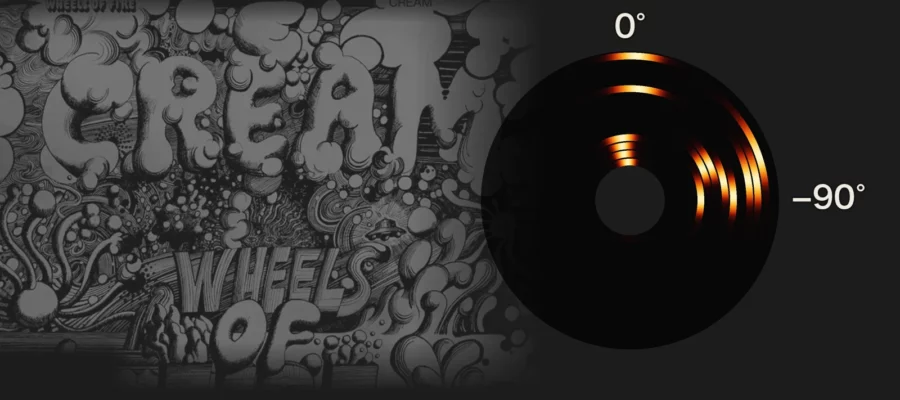
『Wheels of Fire』に刻まれた90度のゆくえ: Cream のディジタル版9種と当時の LP 5種で Haeco-CSG を測る(本稿は英語と日本語を併記しています)
- The 2026 box set of Cream’s Wheels of Fire includes a “De-CSG version,” in which the CSG processing applied to the master tape has been removed in software, and it drew a good deal of attention.
- Analyzing the digital reissues on CD, SACD, and other formats led me to judge that three of the nine studio tracks have no CSG.
- Needle drops of LPs, examined the same way, showed no CSG on any of the nine tracks on the period US, UK, and Japanese pressings. The 1985 Mobile Fidelity pressing, however, has CSG on the same six tracks as the CDs.
- Many puzzles remain, such as whether an earliest LP pressing with CSG exists and whether a master tape without CSG ever existed.
- I would like to extend the analysis, so I would be grateful for needle drops.
- Cream『Wheels of Fire』2026年ボックスセットに、マスターテープに施された CSG 処理をソフトウェアで取り除いた「De-CSG 版」が収録され、話題となった。
- CD・SACD など各種ディジタル再発音源を解析した結果、スタジオ録音9曲のうち3曲は CSG なしと判断した。
- LP の盤起こし音源も同様に調べたところ、当時の英米日の LP では、9曲のどれにも CSG は検出されなかった。ただし1985年の Mobile Fidelity 盤には、CD と同じ6曲に CSG が入っていた。
- CSG 入りの最初期 LP が存在するのか、CSG なしのマスターテープが存在していたのかなど、謎が多く残る。
- より広範に解析を行いたいので、盤起こし音源のご提供をお願いしたい。
My first encounter with Cream came surprisingly early, before 1984, the year I started listening seriously to British and American rock (an earlier article). An LP box set at my parents’ house, World Music Best Collection, included “White Room” and “Sunshine of Your Love,” and I heard them over and over. I also heard Cream on an NHK-FM special featuring BBC recordings, and I remember thinking “Politician (Top Gear, Jan. 14, 1968)” was especially cool.
私の Cream との出会いは、意外と早いものでした。英米のロックを本格的に聴き始めた1984年(以前の記事)より前のことです。実家にあった「世界の音楽ベスト・コレクション」という LP ボックスに「White Room」と「Sunshine of Your Love」が収録されており、何度も耳にしていたのです。また、NHK-FM で流れていた BBC 音源の特集番組で Cream の演奏を聴き、特に「Politician (Top Gear, Jan. 14, 1968)」がかっこいいなと思った覚えもあります。
Even so, I never got as far as buying Disraeli Gears or Wheels of Fire. The only one I bought was a secondhand Japanese LP of Live Cream, and after that I spent many years listening to the four-CD set Those Were The Days from 1997.
それでも『Disraeli Gears』や『Wheels of Fire』といったアルバムを買うには至りませんでした。 1枚だけ『Live Cream』の日本盤中古LPを買った程度で、その後は1997年に出た4枚組 CD『Those Were The Days』を長らく聴いてきました。
Then the Super Deluxe Edition of Cream’s Wheels of Fire was released worldwide on June 12, 2026. The multitrack masters are said to have been lost in the Atlantic warehouse fire of February 8, 1978, and all that remains is the two-track stereo master with a process called Haeco-CSG baked into it. This box set, it was said, included for the first time a “De-CSG version” made by removing the CSG from that master with software.
そんな Cream の『Wheels of Fire』の Super Deluxe Edition が、2026年6月12日に世界同時発売されました。マルチトラックのマスターは1978年2月8日の Atlantic の倉庫火災で失われたとされ、残っているのは Haeco-CSG という処理が刻まれた2トラックのステレオ・マスターだけ。このボックスセットには、そのマスターからソフトウェアで CSG を取り除いた「De-CSG 版」が初めて収められた、というのです。

(Polydor / Universal 8819371)
Buy this at Amazon.com
As it happened, I was in the middle of repeated measurements for the article on CSG in the Beau Brummels’ Bradley’s Barn. On that album, CSG remained intact on the original LP and on all four later CDs, except for one track. So what about Wheels of Fire? It occurred to me that by analyzing the CDs, SACDs, and digital downloads released over the years, I might be able to pin down where this process survived and where it disappeared.
おりしも、Beau Brummels の『Bradley’s Barn』における CSG の記事を書くために測定を重ねていたところでした。あちらでは、オリジナル LP にも、その後の CD 4枚にも、1曲を除いて CSG がそのまま残っていました。では『Wheels of Fire』はどうだったのか。過去に出た CD・SACD・ディジタル(デジタル)配信を解析すれば、この処理がどこに残り、どこで消えたかを明らかにできるかも、と思いついたのです。
Gathering and analyzing all these sources raised two big questions. One of them has been answered; the other I still can’t answer.
さまざまな音源を集め、解析する過程で、2つの大きな問いが生まれました。ひとつには答えが出たのですが、もうひとつはまだ答えが分からないままです。
Revision History / 変更履歴
- November 11, 2026: Initial publication
- 2026年11月11日: 初版公開
What the 2026 box set changed
First, let me go over what kind of processing Haeco-CSG is and what the 2026 box set contains.
まず、Haeco-CSG がどういう処理なのかと、2026年のボックスセットに何が収められたのかを確認しておきます。
Haeco-CSG was a process used around 1968 that put a phase difference of about 90 degrees between the left and right channels of a stereo signal. Its purpose was compatibility with mono playback equipment (for the background of compatible stereo records, see the article on the end of parallel mono and stereo LP production in 1967–68 and the article on CBS’s 1958 compatible stereo record). When a stereo LP of the time was played with a mono cartridge, the left and right signals were summed, and only the centered vocal came out too loud. Shifting left and right 90 degrees apart in phase would keep the center from building up when they were summed. That was the idea. As a side effect, the center image blurs when you listen in stereo. I described the mechanism and the analysis methods in detail in the Bradley’s Barn article.
Haeco-CSG は1968年ごろに使われた処理で、ステレオの左右チャンネルのあいだに約90度の位相差をつけます。目的はモノーラルの再生機との互換でした(互換ステレオ盤の経緯については、モノーラル LP とステレオ LP の並行生産が終わった1967〜68年の記事と、その10年前の CBS の「互換ステレオ盤」の記事をご覧ください)。当時のステレオ LP をモノーラルのカートリッジで再生すると、左右の信号が足し合わされ、中央に定位したヴォーカルだけが大きく出すぎます。左右の位相を90度ずらしておけば、足し合わせたときの中央の持ち上がりが抑えられる、という理屈です。副作用として、ステレオで聴くと中央の像がぼやけます。詳しい仕組みと解析手法については、『Bradley’s Barn』の記事で書きました。
According to the label’s description, Disc 1 of the 2026 box set holds two versions. The first nine tracks are the “1968 Originally Released CSG Encoded Version,” a new remaster of the master with its CSG left as is. The second nine are the “Phase Corrected” version, made from the same transfer with the CSG reversed in software. The credits list Geoff Pesche at Abbey Road and Kevin Reeves at Universal for mastering, and Luke Pacholski for the De-CSG processing.
発売元の説明によれば、2026年ボックスセットの Disc 1 には2つの版が入っています。前半の9曲は「1968 Originally Released CSG Encoded Version」、つまり CSG の入ったマスターをそのまま新しくリマスターしたもの。後半の9曲は、同じ転写から CSG をソフトウェアで逆処理した「Phase Corrected」版です。クレジットには、Abbey Road の Geoff Pesche と Universal の Kevin Reeves がマスタリング担当として載っています。 De-CSG 処理の担当は Luke Pacholski 氏です。
Every digital release, side by side
Here, to begin with, are the results of my analysis of the 2026 box set and the various digital releases that came before it.
ここではまず、2026年のボックスセットと、それ以前に出た各種ディジタル音源を解析した結果を示します。
I was able to analyze nine digital releases: five CDs, one SACD, the 2014 hi-res download, and Disc 1 of the 2026 box set, which I count twice, as the CSG version and the De-CSG version. The CDs are the 1986 German CD, the 1987 Japanese CD, the 1992 DCC, the 1997 Those Were The Days, and the 2013 SHM-CD. The SACD is the 2010 SHM-SACD.
手元で解析できたディジタル版は9種です。 CD が5種、SACD が1種、2014年のハイレゾ配信、そして2026年ボックスセットの Disc 1 を CSG 入りと De-CSG で2つに数えます。 CD の内訳は1986年のドイツ盤、1987年の日本盤、1992年の DCC、1997年の『Those Were The Days』、2013年の SHM-CD。 SACD は2010年の SHM-SACD です。
I also measured the 2016 SHM-SACD, but it is the same transfer and the same mastering as the 2013 SHM-CD, differing only in level, so I folded it into the 2013 row of the table. I also measured Disc 2 and Disc 5 of the box set, but that is a separate story, so I list them separately at the bottom of the table.
2016年の SHM-SACD も測りましたが、2013年の SHM-CD と同じ転写・同じマスタリングで、違いは音量だけだったので、表では2013年の行にまとめました。このボックスセットの Disc 2 と Disc 5 も測りましたが、これは別の話なので、表では下に分けました。
The method is summarized at the end of the article. Here I will only say that I measured and compared the left–right phase difference in the 400–1600 Hz band of each track, reading about −90 degrees as CSG present and near 0 degrees as CSG absent.
判定の方法は記事の末尾にまとめました。ここでは、各曲の 400〜1600 Hz の帯域で左右の位相差を測定・照合し、約 −90度なら CSG あり、0度付近なら CSG なし、と読んだ、とだけ書いておきます。
| Year · Cat. No.年・品番 | Masteringマスタリング | CSG | Notesひとこと |
|---|---|---|---|
| 1986 827 578-2Polydor (Germany) | (uncredited) | CSG 6 tracks / 6曲■□■□□■■■■ | The first CD edition (cat. 827 578-2).最初の CD 版(品番 827 578-2)。 |
| 1987 P58W 25002/3Polydor (Japan) | (uncredited) | CSG 6 tracks / 6曲■□■□□■■■■ | Bit-identical to the 1986 disc.1986 年盤とビット単位で同一。 |
| 1992 GZS(2)-1020DCC Compact Classics (US) | Steve Hoffman | CSG 6 tracks / 6曲■□■□□■■■■ | Mastered from the tapes held at Atlantic since 1968. CSG left in place.1968 年から Atlantic に保管されていたマスターを使用。 CSG は戻していない。 |
| 1997 31453-9000-2Polydor / Chronicles (US) | Joseph M. Palmaccio, Suha Gur | CSG 6 tracks / 6曲■□■□□■■■■ | From the box set Those Were The Days.箱『Those Were The Days』に収録。 |
| 2010 UIGY-9042Universal (Japan) SHM-SACD | Manabu Matsumura (DSD transfer) | CSG none / なし□□□□□□□□□ | Until the De-CSG version in the 2026 SDE, the only digital release without CSG. Unknown whether it was reversed for this release or was already reversed on the tape.2026 年の SDE の De-CSG 版が出るまで、ディジタル版で唯一 CSG がなかった。戻したのがこの盤のためか、元のテープの時点かは不明。 |
| 2013 UICY-40038/9Universal (Japan) SHM-CD | Seth Foster (DSD transfer), Manabu Matsumura (DSD editing) | CSG 6 tracks / 6曲■□■□□■■■■ | The 2016 SHM-SACD (UIGY-15003) is the same transfer and mastering; only the level differs (+2.7 dB) (my measurement).2016年の SHM-SACD(UIGY-15003)も同じ転写・同じマスタリングで、違うのは音量(+2.7 dB)だけ(筆者の測定)。 |
| 2014 Hi-Res download (Qobuz / HDtracks)Polydor (US) 192 kHz / 24 bit | Seth Foster | CSG 6 tracks / 6曲■□■□□■■■■ | Sources differ by track: 1, 2 and 4 match the 1997 mastering; 5–9 are the same transfer as the 2013 disc (my measurement).曲によって出どころが違う。 01・02・04 は 1997 年盤系、05〜09 は 2013 年盤と同じ転写(筆者の測定)。 |
| 2026 SDE Disc 1 01〜09Universal (Worldwide) Super Deluxe Edition | Geoff Pesche, Kevin Reeves | CSG 6 tracks / 6曲■□■□□■■■■ | “1968 Originally Released CSG Encoded Version” |
| 2026 SDE Disc 1 10〜18Universal (Worldwide) Super Deluxe Edition | Geoff Pesche, Kevin Reeves; De-CSG processing: Luke Pacholski | CSG none (reversed) / なし(逆処理)□□□□□□□□□ | CSG and the left–right time offset corrected. The three tracks that never had CSG were corrected only for offset and balance.CSG と左右の時間差を補正。もともと CSG のない3曲は、時間差とバランスだけを補正。 |
| 2026 SDE Disc 2Stereo reference reels | Geoff Pesche, Kevin Reeves | CSG all 9 / 9曲すべて■■■■■■■■■ | Reels kept by Felix Pappalardi. Tracks 2, 4 and 5 are different mixes from the album.Felix Pappalardi が保管していたリール。 02・04・05 はアルバムとは別のミックス。 |
| 2026 SDE Disc 5Alternate mixes | Geoff Pesche, Kevin Reeves | CSG varies / 曲ごとに違う | The alternate mixes of 2, 4 and 5 have no CSG; 6 has it.02・04・05 の別ミックスは CSG なし、06 はあり。 |
A quick look across the nine releases in the table shows two things. Every release with CSG lacks it on the same three tracks. And the only releases without CSG are the 2010 SACD and the 2026 De-CSG version.
表の9種を一度ざっと眺めると、2つのことが目に入ります。 CSG のある版は、どれも同じ3曲だけ CSG がないこと。「CSG なし」の版が、2010年の SACD と2026年の De-CSG 版しかないこと。
The releases worth a closer look
Of the nine in the table, I will now look more closely at the 2010 SACD, the 2026 De-CSG version, the 1992 DCC, and the 2014 Hi-Res download.
表の9種のうち、2010年の SACD、2026年の De-CSG 版、1992年の DCC、2014年のハイレゾ配信について、もう少し詳しく見ていきます。
2010 SHM-SACD
The SHM-SACD released in 2010 (UIGY-9042) is, apart from the 2026 De-CSG version, the only digital release without CSG among those I measured. All nine tracks show a left–right phase difference near 0 degrees, and when I compare its “White Room” with that of the 2026 De-CSG version, the phase-difference curves have almost the same shape. According to Discogs, the 2014 SACD (UIGY-9600) also uses the same master as UIGY-9042.
2010年リリースの SHM-SACD (UIGY-9042) は、手元で測ったディジタル版のうち、2026年の De-CSG 版を除けば唯一 CSG のなかった盤です。 9曲とも左右の位相差は0度付近で、2026年の De-CSG 版の「White Room」と照合すると、ほぼ同じ形になります。 Discogs によれば、2014年の SACD (UIGY-9600) も、UIGY-9042 と同じマスターが使われているとのことです。
This 2010 SACD does not seem to be highly regarded for its sound, though. Josh Mound, who compared the versions by ear for Audiophile Style, wrote, “By virtually every metric, the Matsumura disc is the worst version under review.” He wrote that the disc “sounds veiled and flat” and that “Bruce’s voice is shifted to the left.” Measuring for CSG and judging sound quality by ear are different things, but the remark about the voice shifting left did have a counterpart in my measurements. Compared with the De-CSG version, the 2010 SACD is louder on the left and quieter on the right. The direction is the same on all six tracks I measured, and the left–right difference is 0.8–2.9 dB. This is a difference in left–right balance, not in phase.
この 2010 SACD の評判は、音に関しては高くないようです。 Audiophile Style で各版を聴き比べた Josh Mound 氏は、この盤を「どの指標でも最下位」としました。音がベールをかぶったように平坦に聴こえ、Jack Bruce のヴォーカルが左に寄る、と。 CSG の有無を測ることと、音の良し悪しを聴くことは別の話ですが、声が左に寄るという指摘には、測定で対応するものがありました。 2010 SACD は、De-CSG 版と比べて左が大きく右が小さい。測った6曲すべてで向きが同じで、左右の差は 0.8〜2.9 dB です。位相ではなく、左右のバランスの差です。
Then why did this disc alone lack CSG? The credits in the enclosed Japanese liner notes read “DSD Transferred from analogue master tapes by Manabu Matsumura (UNIVERSAL MASTERING STUDIOS)”, but they do not say which generation of tape was used. Discogs states that it was made from a “Japanese original analog tape”, and a Japanese blog from 2014 says a domestic analog master was used, but I have not been able to find the information behind either claim. On the Steve Hoffman Forums, from the mid-2010s on, people suggested that it came from a copy tape sent to Japan and that the CSG was probably reversed when that copy was made. Pacholski himself, who did the De-CSG, wrote on a forum in 2026 that he does not know: “The 2010 SHM-SACD does have the CSG reversed, but it’s not clear if that was done for that release or if tapes used for that release already had it reversed.”
では、なぜこの盤だけ CSG がなかったのか。封入された日本語ライナーのクレジットには「DSD Transferred from analogue master tapes by Manabu Matsumura (UNIVERSAL MASTERING STUDIOS)」と記されていますが、どの段階のテープかは書かれていません。 Discogs には「Japanese original analog tape」から作られたという記載があり、2014年の日本のブログも「国内アナログマスターを使用」と書いていますが、その根拠となる情報は見つけられていません。 Steve Hoffman Forums では2010年代の半ばから、「日本に送られたコピーテープで、CSG はそのコピーを作る段階で戻されていたのだろう」という読みが出ていました。 De-CSG を担当した Pacholski 氏自身も、2026年の掲示板で分からないと書いています。 2010年の SHM-SACD は CSG が戻されているが、この盤のために戻したのか、使ったテープがすでに戻されていたのかは分からない、というのです。
This time one more clue turned up. I compared a volunteer’s needle drop of the 1979 Japanese LP (MWU 9701/2) against both the 2010 SACD and the 2026 De-CSG version. The appendix at the end describes the comparison in detail. In outline, it compares the coherence (the degree of agreement) in each frequency band. On three tracks, “White Room,” “Politician,” and “Deserted Cities of the Heart,” the Japanese LP matched the 2010 SACD better. As a control, I put the 1968 UK LP (583 033) through the same procedure, and it matched the 2010 SACD and the De-CSG version about equally well, favoring neither. The result supports the guess that the tape in Japan and the tape behind this 2010 SACD belonged to the same lineage. But a comparison between an LP needle drop and a digital source is easily upset by the quirks of a pressing or a stylus, and one track, “Pressed Rat and Warthog,” came out the other way, so I will stop short of a firm conclusion here.
今回、手がかりがひとつ増えました。有志による 1979 日本盤 LP 盤起こし (MWU 9701/2) を、この 2010 SACD と2026年の De-CSG 版の両方と照合してみました。具体的な照合の仕方は、本稿の補足で詳しく説明しますが、帯域ごとの一致度(コヒーレンス)を比較する、というものです。「White Room」「Politician」「Deserted Cities of the Heart」の3曲で、日本盤 LP はこの 2010 SACD とのほうがよく合う、という結果となりました。対照として同じ手順で照合した1968年の英国盤 LP (583 033) は、2010 SACD とも De-CSG 版とも同じ程度にしか合いませんでした。日本にあったテープと、この 2010 SACD の元になったテープが同じ系統だったという推測を後押しする結果です。ただし LP 盤起こしとディジタル音源の照合は盤や針の癖で崩れやすく、「Pressed Rat and Warthog」の1曲は逆の結果が出ていますので、ここでは断定は避けておきます。
2026 De-CSG version
As mentioned at the start, Disc 1 of the 2026 Super Deluxe Edition 5CD (8819371) holds both the CSG version and the De-CSG version. The nine CSG tracks in the first half and the nine De-CSG tracks in the second half can be shown to come from the same single transfer: the playback speed ratio is 1.00000, and once the starts are aligned the waveforms overlap exactly. The only differences are in the left–right phase, the time offset, the balance, and slight differences in frequency response (about 1 dB). In “White Room,” the De-CSG version undoes a rotation of about 90 degrees in the low mids, and at the same time the left–right time offset of about 90 µs is gone. Pacholski wrote on a forum in 2026 that he reversed the 90 degrees by shifting each channel 45 degrees in opposite directions, and my analysis agrees: on the six tracks with CSG, the left and right channels are each rotated by about 45 degrees. He now thinks, though, that “the CSG box only shifted the right channel, so technically one 90 degree shift would have been more ‘correct’. That said, if anyone can hear the difference, I’ll happily buy them a Coke. The phase relationship between the left and right channels is what’s critical.”
冒頭で触れた通り、2026年 Super Deluxe Edition 5CD (8819371) の Disc 1 には、CSG 入りバージョンと、De-CSG バージョンの両方が収録されています。この CSG 入りの前半9曲と De-CSG 版の後半9曲は、同じ1回の転写から作られていることが分かります。なぜなら、再生速度の比が 1.00000 で、頭をそろえると波形がぴたりと重なるからです。違うのは左右の位相と時間差、バランス、それにわずかな音質の差(1 dB ほど)です。「White Room」で比べると、De-CSG 版では中低域で約90度の回転が戻され、それと同時に、左右チャンネルのあいだにあった約 90 µs の時間差も消えていました。 Pacholski 氏は2026年の掲示板で、この90度は左右をそれぞれ45度ずつ逆向きに回して戻した、と書いています。手元の解析でも、CSG のある6曲で左右が約45度ずつ回っていました。ただ本人は今、「CSG の機械は右チャンネルだけを回していたと思うので、厳密には90度を1回かけるほうが『正しかった』。とはいえ、違いを聴き分けられる人がいたら喜んでコーラをおごる。大事なのは左右チャンネルの位相の関係だ」とも書いています。
This time offset is separate from CSG. If the azimuths (the tilt of the magnetic head) of the head that recorded a tape and the head that played it back differ slightly, a time offset appears between the left and right tracks. On a two-track tape running at 38 cm/s, a mismatch of 1/60 of a degree gives about 2 µs, so a 90 µs offset can be explained by a mismatch of less than 1 degree. The values probably differ from release to release because the tape was played on a different deck for each transfer. The De-CSG version corrects this offset as well. It is one example of the advantage of the digital stage, where this kind of correction can be made at will.
この時間差は CSG とは別のものです。テープを録音したヘッドと再生したヘッドのアジマス(磁気ヘッドの傾き)がわずかに食い違うと、左右のトラックのあいだに時間差が生まれます。 38 cm/s で走る2トラックのテープなら、1度の食い違いの 1/60 で約 2 µs。 90 µs の差は1度に満たない食い違いで説明がつきます。版ごとに値が違うのは、転写のたびに別のデッキで再生しているからでしょう。 De-CSG 版は、この時間差も一緒に直しているわけです。これは、ディジタル段でいかようにも修正できるメリットが発揮されている例と言えます。
How were the three tracks that have no CSG on the album (“Sitting on Top of the World,” “As You Said,” and “Pressed Rat and Warthog”) handled? My analysis shows that no 90-degree rotation was applied; only the time offset and the left–right balance were corrected. Pacholski wrote on a forum in 2026, “There was no CSG to reverse on those 3 tracks for the box, but the balance and alignment were corrected.” The “alignment” he mentions is probably this time offset.
もともと CSG のない3曲(「Sitting on Top of the World」「As You Said」「Pressed Rat and Warthog」)はどう扱われたか。解析してみると、90度の回転は加えられておらず、時間差と左右のバランスだけが補正されていました。 Pacholski 氏は2026年の掲示板で「この3曲には戻すべき CSG はなかったが、バランスとアライメントは補正した」と書いています。本人の言う「アライメント」は、この時間差のことでしょう。
1992 DCC
The DCC gold CD mastered by Steve Hoffman (GZS(2)-1020) has long been the go-to version among CD reissues of this album. Measuring it the same way, I confirmed that it has CSG on the same six tracks as the other CDs.
Steve Hoffman 氏がマスタリングした DCC のゴールド CD (GZS(2)-1020) は、この作品の CD リイシューのなかで長く定番の扱いを受けてきました。同様に測ると、ほかの CD と同じ6曲に CSG が入っていることが確認できました。
Hoffman himself recalled the work in a forum post in 2003.
Hoffman 氏自身が2003年の掲示板に、このときの作業を回想しています。
We got many reels including the master mixes, retrieved by Bill Inglot from Atlantic where they had sat since 1968, even though they lost rights in the 1970’s. They sounded ok, but muddy and the safety reels and the overseas copies sounded shrill and thin. … Some of the mixes were the dreaded CSG and some were plain stereo.
マスター・ミックスを含む多くのリールが手に入った。 Bill Inglot が Atlantic から引き出してきたもので、Atlantic は1970年代に権利を失っていたのに、テープは1968年からそこに置かれたままだった。音はまずまずだが濁っていて、セーフティのリールと海外向けのコピーはきつく薄い音だった。 (中略) ミックスのいくつかは忌まわしい CSG で、いくつかはふつうのステレオだった。
Steve Hoffman, post #5, Steve Hoffman Music Forums, June 8, 2003So Hoffman, who was directly involved, wrote that some of the master mixes that had sat at Atlantic since 1968 carried CSG. The DCC measurements (six tracks with, three without) agree with this recollection. As to why the CSG was not reversed on the DCC, Pacholski wrote in 2014: “Doing so would have required either a CSG box or the appropriate software, the latter which didn’t exist at the time.” Earlier that year he had also written, “99% of the time I just listen to the DCC CD, un-CSG’d.”
1968年から Atlantic に置かれていたマスター・ミックスの一部に CSG が入っていた、と当事者の Hoffman 氏が書いているわけです。 DCC の測定(6曲あり、3曲なし)はこの回想と合います。なぜ DCC で CSG を戻さなかったのかについては、Pacholski 氏が2014年に「当時は CSG の機械か、それ用のソフトウェアが要った。後者はまだ存在しなかった」と書いています。その年の4月には「聴くのは 99% が DCC の CD で、それも CSG を戻して聴いている」とも書いていました。
2014 Hi-Res download
The 192 kHz/24 bit hi-res files released in 2014 and sold for download at HDtracks, Qobuz, and elsewhere are credited as a remaster by Seth Foster. I confirmed that CSG is present on the same six tracks as in the other releases.
2014年に公開され、HDtracks や Qobuz などでダウンロード販売も行われている 192 kHz/24 bit ハイレゾ音源のクレジットは Seth Foster のリマスターとなっています。 CSG はほかの版と同じ6曲に入っていることを確認しました。
The tracks, however, turned out to have different pedigrees. The five tracks from “Pressed Rat and Warthog” through “Deserted Cities of the Heart” show a speed ratio of 1.0000x, a waveform match of 1.000, and a left–right level difference of 0.0 dB, so I judge them to be the same transfer as the 2013 SHM-CD. The three tracks “White Room,” “Sitting on Top of the World,” and “As You Said,” on the other hand, do not match the 2013 disc. When they are overlaid on the 1997 Those Were The Days, the waveform match rises to 0.996–0.999. They belong to the 1997 mastering lineage.
ところが、曲ごとに素性が違いました。「Pressed Rat and Warthog」から「Deserted Cities of the Heart」までの5曲は、速度の比が 1.0000x、波形の一致が 1.000、左右のレベル差が 0.0 dB であることから、2013年の SHM-CD と同じ転写と判断できます。いっぽう「White Room」「Sitting on Top of the World」「As You Said」の3曲は2013年盤とは合いません。 1997年の『Those Were The Days』と重ねると、波形の一致が 0.996〜0.999 まで上がります。 1997年のマスタリングの系統です。
One thing does not fit, though: the left–right time offset. On “White Room,” the 2014 download has almost the same value as the 2013 disc and sits apart from the 1997 disc (“Sitting on Top of the World” leans the same way; on “As You Said” all three are close and I can’t tell them apart). The waveform and levels match the 1997 disc, yet the time offset is close to the 2013 disc. I don’t know why. “Passing the Time” can’t be compared with the 1997 disc, which has the long version, but it did not match the 2013 disc.
ただし、ひとつ合わないものがあります。左右の時間差です。「White Room」では、2014年の配信は2013年盤とほぼ同じ値で、1997年盤からは離れています(「Sitting on Top of the World」も同じ向き、「As You Said」は3者とも近くて区別できません)。波形とレベルは1997年盤に合うのに、時間差は2013年盤に近い。なぜそうなるのかは分かりません。「Passing the Time」は1997年盤が長い版なので比べられませんが、2013年盤とは合いませんでした。
Mound, too, had noticed the track-by-track differences in this download in his 2023 article, by ear and with analysis software. “White Room” and “Sitting on Top of the World” differ in EQ from the 2013 SHM-CD that Foster transferred, he wrote, while “Politician” and “Deserted Cities of the Heart” are the same. My measurements were consistent with Mound’s observation. If this is really so, the download is a patchwork of material from two eras under a single credit.
Mound 氏も2023年の記事で、この配信の曲ごとの違いに耳と解析ソフトで気づいていました。「White Room」と「Sitting on Top of the World」は Foster が転写した2013年の SHM-CD と EQ が違い、「Politician」と「Deserted Cities of the Heart」は同じだ、と。私が行った測定は Mound 氏の指摘と整合していました。もし本当にそうならば、ひとつのクレジットの下で、2つの時代の素材がつぎはぎになっている配信、ということになります。
What the table shows when read across
Three points stand out from this comparison of the nine digital sources.
このように、ディジタル音源9種を比較してきた結果として、注目すべき点が3つあります。
First, every release that has CSG has it on the same six tracks: “White Room,” “Passing the Time,” “Politician,” “Those Were the Days,” “Born Under a Bad Sign,” and “Deserted Cities of the Heart.” The combination does not change from release to release. Those Were The Days, which I listened to for so long, is no exception. It still has CSG on the same six tracks.
まず1点目。 CSG のある版は、どれも同じ6曲に入っていることが分かります。「White Room」「Passing the Time」「Politician」「Those Were the Days」「Born Under a Bad Sign」「Deserted Cities of the Heart」。版によって曲の組み合わせが違う、ということはありません。私が長らく聴いてきた『Those Were The Days』も例外ではなく、同じ6曲に CSG が入ったままでした。
The second is the question of why the remaining three tracks have no CSG. Pacholski, who did the De-CSG work, offers an explanation. Going by work tapes that turned up during the making of the 2026 Super Deluxe Edition, “apparently the whole studio album was mixed using CSG, at which point mono and stereo copies were made for Felix P, then some point later Sitting On Top Of The World, As You Said, and Pressed Rat were remixed without CSG and inserted into the master.” Felix P is the producer, Felix Pappalardi. Pacholski himself hedges this with “apparently.”
2点目は、残りの3曲になぜ CSG がないのか、という疑問です。これには、De-CSG を担当した Pacholski 氏の説明があります。 2026 Super Deluxe Edition の制作で見つかった作業用テープによれば、スタジオの9曲はいったんすべて CSG を通してミックスされた。その段階でプロデューサーの Felix Pappalardi 用にモノとステレオのコピーが作られ、そのあとで3曲が CSG なしでミックスし直され、マスターに差し込まれた、というのです。本人は「apparently」と留保をつけています。
The measurements also broadly follow this account. When I line up the left–right time offsets with the De-CSG version as the reference, the values fall into two groups, the tracks with CSG and the three without. This split is not visible when the other releases are compared with one another. It appears only against the De-CSG version, in which left and right were realigned track by track. If the three were remixed on another day, the deck running that day would have had a different azimuth, and the pieces fit.
測定の結果も、この説明におおむね沿っています。 De-CSG 版を基準として左右の時間差を並べると、CSG のある曲と、CSG のない3曲とで、値の群が分かれるのです。この差は、ほかの版どうしを比べても見えません。曲ごとに左右を合わせ直した De-CSG 版と比べて、はじめて現れるものです。別の日にミックスし直したのなら、そのとき回したデッキのアジマスも別だったはずで、つじつまは合います。
Further analysis of the 2026 Super Deluxe Edition audio confirms this mixture of CSG and no CSG. The “Stereo reference reels” on Disc 2 are reels that Pappalardi kept. Analyzing them, I confirmed that all nine tracks carry CSG. Three of them (“Sitting,” “As You Said,” and “Pressed Rat”) do not match the album versions when overlaid; they are different mixes. In the “Alternate Stereo Mix” on Disc 5, the same three tracks have no CSG. For those three tracks, mixes were made both through CSG and without it, and the album used the ones without. My measurements do not contradict Pacholski’s account. But why only three tracks were left without CSG, that is, why the whole album was not left without it, remains unknown.
2026 Super Deluxe Edition 音源をさらに分析すると、この CSG の有無の混在が確認できます。 Disc 2 に入った「Stereo reference reels」は、Pappalardi が保管していたリールです。これを解析すると、9曲すべてに CSG が入っていることが確認できました。そして3曲(「Sitting」「As You Said」「Pressed Rat」)は、アルバム版と重ねても波形が合わず、別のミックスでした。 Disc 5 に入った「Alternate Stereo Mix」の同じ3曲には CSG がありません。 CSG を通して混ぜたミックスと、通さずに混ぜたミックスの両方が作られ、アルバムには通さないほうが採られた。当事者の説明に対し、今回の測定は矛盾しない結果を示しています。ただし、なぜ3曲だけ CSG 未適用なのか、つまり全曲未適用にしなかったのはなぜなのか、は依然不明です。
And third, the finding that the left–right time offset differs with every tape transfer. Setting the De-CSG version (with left and right realigned) at 0 and ordering by the median over eight tracks, the 2026 CSG version is +68 µs, the 1986 disc +35, the 2013 disc and the 2014 download +31, the DCC +28, and the 1997 disc +15. Only the 2010 SACD is negative, about −40 µs on the four tracks that could be measured, with the right channel arriving first (the per-track values and a figure are in the appendix at the end). Independent of CSG, this is the trace of the tape being played on a different deck at each remaster.
そして3点目、左右の時間差はテープ転写ごとに違う、という発見です。 De-CSG 版(左右を合わせ直した版)を 0 として、8曲の中央値で並べると、2026年の CSG 入り版が +68 µs、1986年盤が +35、2013年盤と2014年の配信が +31、DCC が +28、1997年盤が +15。 2010年の SACD だけは負で、測れた4曲で約 −40 µs、右が先に来ます(曲ごとの値と図は末尾の補足に置きました)。 CSG の有無とは独立に、リマスターのたびにテープを別のデッキで再生した痕跡です。
Figure 1 lines up the long-term spectra of six digital releases as differences from the median of the six. This departs from the CSG story, but this one chart shows that some shaping of the sound went into each remaster. The 2010 SACD is at −4 dB near 40 Hz and −5 dB near 15 kHz, with both the low and the high end pulled in. That shape fits the sound Mound described when he wrote, “All of the air is sucked out of the recording.” The 2026 disc lifts the region near 100 Hz by about 3 dB, and the 1997 disc is 1–2 dB brighter above 10 kHz. The 1986 disc has a shallow dip at 40–80 Hz, and the DCC has one near 150 Hz.
図1は、6種のディジタル版の長時間スペクトルを、6種の中央値からの差として並べたものです。 CSG の話からは離れますが、リマスターが出るたびに何らかの音作りが入っていることが、この1枚で見えます。 2010年の SACD は 40 Hz 付近で −4 dB、15 kHz 付近で −5 dB と、低域と高域の両端が引っ込んでいます。 Mound 氏が「空気感が吸い取られた」と書いた音は、この形と合います。 2026年盤は 100 Hz 付近を 3 dB ほど持ち上げ、1997年盤は 10 kHz より上が 1〜2 dB 明るい。 1986年盤は 40〜80 Hz に、DCC は 150 Hz 付近に、それぞれ浅いくぼみがあります。
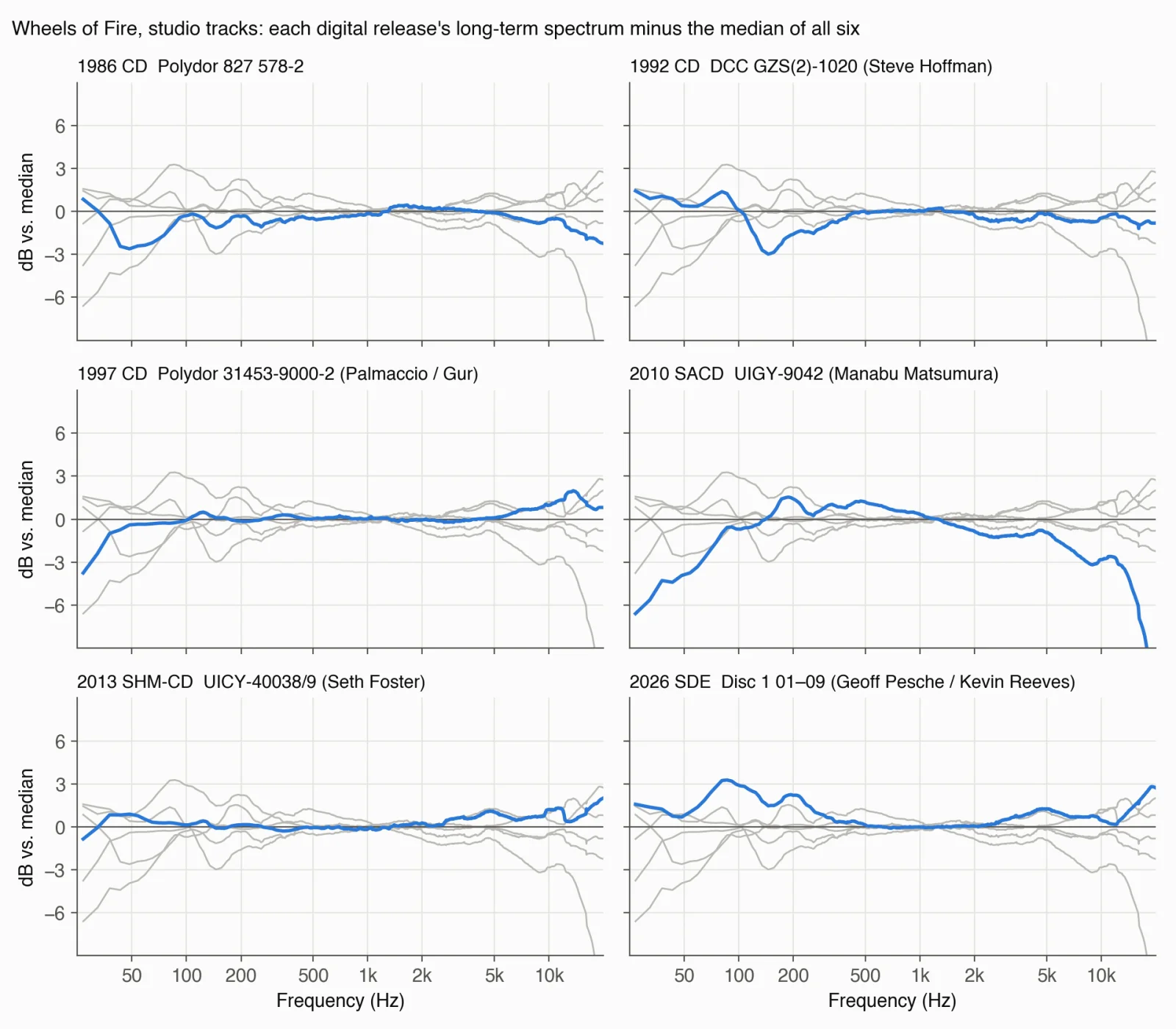
図1: 『Wheels of Fire』スタジオ8曲の長時間スペクトルを、ディジタル版6種で比べた。各版の値から6種の中央値を引き、500 Hz〜2 kHz の平均でそろえてある。青がその版、灰色がほかの5種。 1/3 オクターブで平滑。「Passing the Time」は1997年盤が長い版のため除いた。
Author’s measurements (November 2026)
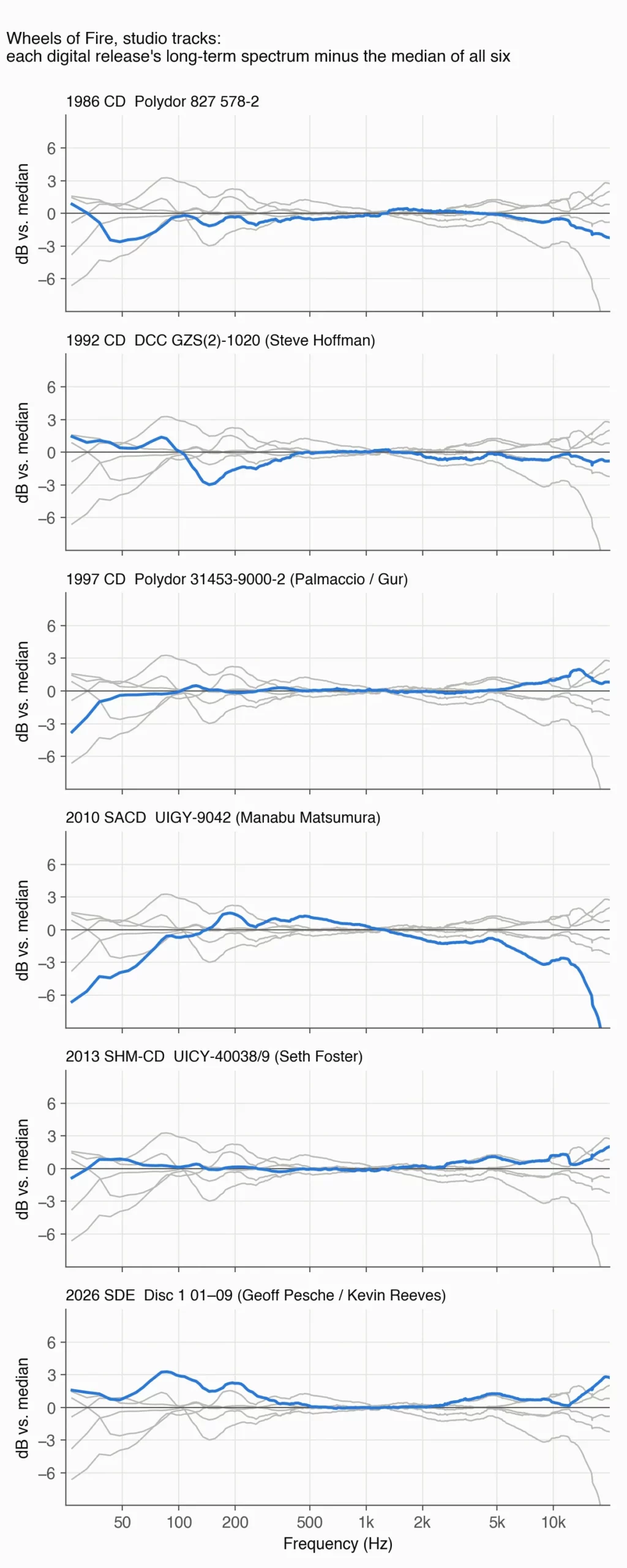
図1: 『Wheels of Fire』スタジオ8曲の長時間スペクトルを、ディジタル版6種で比べた。各版の値から6種の中央値を引き、500 Hz〜2 kHz の平均でそろえてある。青がその版、灰色がほかの5種。 1/3 オクターブで平滑。「Passing the Time」は1997年盤が長い版のため除いた。
Author’s measurements (November 2026)
The LPs: a puzzle that is still open
As far as the digital releases go, the story so far closes neatly. The master carries CSG on six tracks, every digital release except the 2010 SACD inherited it, and in 2026 a version was included whose CSG is explicitly stated to have been reversed in software. That is how it reads.
ここまでの話は、ディジタル版についてはきれいに閉じます。マスターに6曲ぶんの CSG が刻まれていて、2010年の SACD を除くすべてのディジタル版がそれを引き継いだ。 2026年に、ソフトウェアで戻したことを明示した版が収録された。このように読み解けます。
When it comes to measuring the various LPs, including the original pressings, though, it starts to look as if things are not that simple.
ところが、オリジナル盤を含め各種 LP の計測となると、どうやらそう単純な話ではなさそうだ、と気付かされます。
The starting point is a thread Pacholski opened on a forum in 2012. His Atco copy (with “CT” on the label, apparently pressed at Terre Haute for the Columbia Record Club) had no CSG on “White Room.” When I analyzed the sample of the first minute or so that he posted, the phase difference was indeed near 0 degrees. Steve Hoffman wrote that this pressing was cut from copy tapes “prepared by Tom Dowd for CBS,” and that “He must have made the dubs for CBS without the CSG for some reason.”
発端は Pacholski 氏が2012年に掲示板に立てたスレッドです。手元の Atco 盤(レーベルに「CT」の表記、Columbia Record Club 向けに Terre Haute で作られたと見られる盤)の「White Room」に CSG がなかった、というものでした。彼が公開した冒頭1分あまりのサンプルを解析してみると、たしかに位相差は0度付近でした。 Steve Hoffman 氏はこの盤について、Tom Dowd が CBS 向けに作ったダビングから切られたもので、そのダビングにはなぜか CSG がなかった、と書いています。
Up to this point, the story could end with the Record Club pressing as the lone exception. In 2015 Pacholski himself wrote, “Only vinyl I’m aware of without it is the Columbia Record Club pressing.”
ここまでなら、Record Club 向けの盤だけが例外だった、で済みます。 Pacholski 氏自身、2015年には「CSG のない版は、自分の知るかぎり Columbia Record Club 盤だけ」と書いていました。
This time I obtained needle drops made by volunteers and analyzed them: a Monarch-pressed US copy (ST-C-681285-MO / ST-C-681286-MO at the bottom of the label), the 1968 UK pressing (Polydor 583 033), and the 1979 Japanese pressing (RSO MWU 9701/2). All three lacked CSG on all nine studio tracks. How certain each result is varies from disc to disc. The Monarch pressing falls on the no-CSG side even when laid over the 2026 De-CSG version. The Japanese pressing reads as no CSG on all nine tracks in the standalone test. The UK pressing reads as no CSG standalone, but its waveforms match the 2026 disc only weakly when overlaid, so that reading is not corroborated. Each result comes from only one copy, each transferred on a different playback setup, and I have not been able to check the matrix information in the dead wax.
今回、有志による盤起こし音源を入手し、解析してみました。 Monarch プレスの米国盤(レーベル下部に ST-C-681285-MO / ST-C-681286-MO)、1968年の英国盤(Polydor 583 033)、そして1979年の日本盤(RSO MWU 9701/2)。 3枚とも、スタジオ側の9曲すべてで CSG がありませんでした。確からしさには差があります。 Monarch 盤は2026年の De-CSG 版と重ね合わせても CSG なしの側に落ちます。日本盤は単体の判定で9曲ともなし。英国盤は単体の判定ではなしですが、2026年盤との重ね合わせが弱く、裏は取れていません。どれも1枚ずつ、異なる再生環境での盤起こしですし、デッドワックスのマトリクス情報まで確認できていません。
There is also one disc whose matrix I could confirm: a needle drop of a UK two-LP set, kindly provided by onojii (two tracks from side A). The jacket and labels carry the set number 2612-001, a number Discogs lists for a 1971 pressing. Yet the runouts read 583031 A//2 on side A, 583031 B//1 on side B, and 583032 B//2 on the B side of the second record. Checked against the Discogs entries, these do not match the 2612-001 entries; they are the same cutting as the 1968 two-LP set (583 031/2).
マトリクスまで確認できた盤も、1枚あります。 onojii さんに提供していただいた、英国の2枚組の盤起こしです(A面の2曲)。ジャケットとレーベルにはセット番号 2612-001 が印刷されていて、Discogs では1971年の盤として登録されている番号です。ところがランアウトの刻印は、A面が 583031 A//2、B面が 583031 B//1、2枚目の B面が 583032 B//2。 Discogs の登録と照らすと、2612-001 の登録とは合わず、1968年の2枚組(583 031/2)と同じカッティングでした。
“White Room” on this disc has no CSG. The left–right phase difference from 400 to 1600 Hz is +7 to +8 degrees. “Sitting on Top of the World,” also on side A, has none either, but it is one of the tracks that never had CSG, so only “White Room” can settle the matter. Still, the same cutting means the same groove, so this result should hold for every copy with A//2. All five 1968 two-LP entries I checked on Discogs are A//2, and as far as I can find, no stereo copy with A//1 has been reported. It seems safe to conclude that side A of the UK two-LP stereo set was CSG-free from the very first cutting.
この盤の「White Room」に CSG はありませんでした。 400〜1600 Hz の左右の位相差は +7〜+8度です。同じ A面の「Sitting on Top of the World」もなしでしたが、もともと CSG のない曲なので、判定に使えるのは「White Room」だけです。ただ、同じカッティングなら溝の中身は同じですから、この結果は A//2 の盤すべてに当てはまるはずです。 Discogs で確認した1968年の2枚組の登録5件はどれも A//2 で、私が調べた限り、ステレオ盤の A//1 の報告は見つかりません。英国の2枚組のステレオ盤の A面は、最初のカッティングから CSG なしだったと考えてよさそうです。
These are single copies, but the fact that five LPs from 1968 to 1979 all tested as CSG-free cannot be ignored. The 1985 Mobile Fidelity pressing, by contrast, had CSG on the same six tracks as the CDs.
1枚ずつの結果とはいえ、1968年から1979年までの LP 5種がそろって CSG なしと出た、という結果は無視できません。いっぽう1985年の Mobile Fidelity 盤には、CD と同じ6曲に CSG が入っていました。
The master tape carries CSG. Yet it is the LPs closest to the original release that tested as CSG-free. Broadly speaking, I can think of two possibilities.
マスターテープには CSG が刻まれている。それなのに、オリジナル盤の時代に近い LP ほど CSG なしと出た。考えうる可能性は、大きく分けて2つです。
One is that in 1968 a cutting copy was made with the CSG reversed, and that this copy was sent to the US pressing plants and to the UK and Japan as well. Pacholski wrote in 2015, “No pre-CSG tapes, but it’s possible copies were made with the CSG reversed, as was apparently the case for the Columbia Record Club pressing.” Hoffman’s recollection that the Columbia tapes were “clean,” with “no edits,” also fits a copy having been made separately.
ひとつは、1968年の時点で CSG を逆処理したカッティング用のコピーが作られ、米国のプレス工場にも、英国や日本にもそのコピーが配られた、という可能性です。 Pacholski 氏は2015年に「CSG 前のテープはないが、Columbia Record Club 盤がどうやらそうだったように、CSG を戻したコピーが作られた可能性はある」と書いています。 Hoffman 氏の「CBS 向けのダビングは継ぎ目のないきれいなテープだった」という回想も、コピーが別に作られたことと合います。
The other is that a master without CSG existed before the CSG master that survives today. This sits awkwardly with Pacholski’s account that “apparently the whole studio album was mixed using CSG,” but that account is itself an inference from the work tapes.
もうひとつは、いま残っている CSG 入りのマスターより前に、CSG なしのマスターが存在した、という可能性です。 Pacholski 氏の「スタジオの9曲はいったんすべて CSG を通してミックスされた」という説明とは折り合いが悪いのですが、この説明自体が作業用テープからの推定です。
Which it was, I cannot decide from the material at hand. That is because the sound of a needle drop alone cannot distinguish a disc cut from a tape that never had CSG from one cut from a tape with the CSG reversed. Objective analysis cannot settle this, but I myself think it more likely that a tape with the CSG reversed was made at the time and became the cutting master. For one thing, no pre-CSG tape has been found. For another, the other record of the two-LP set, the live one, never had CSG to begin with, so it makes sense to suppose that, once it was decided to issue the album on LP without CSG, the CSG was reversed on the studio record alone to bring the two into line. I confirmed the absence of CSG on the four live tracks by measuring four digital releases and three LPs (the 1985 Mobile Fidelity pressing, a Monarch-pressed US copy, and the 1979 Japanese pressing). “Toad” shows low agreement between left and right in every source, and on the Monarch copy it could not be judged.
どちらなのか、手元の材料では決められません。盤起こしの音だけでは、元から CSG のないテープから切られたのか、CSG を戻したテープから切られたのかを、区別できないからです。客観的な解析では判断できませんが、私自身は、当時 CSG を戻したテープが作られ、それがカッティングマスターになった可能性のほうが高いと考えています。 CSG 前のテープは見つかっていません。そして2枚組のもう一方のライブ側には、もともと CSG がかかっていないので、LP を CSG なしで出すと決めたときに、スタジオ側だけ CSG を戻して揃えた、と考えると筋が通るからです。ライブ側の4曲に CSG がないことは、ディジタル版4種と、LP 3枚(1985年の Mobile Fidelity 盤、Monarch プレスの米国盤、1979年の日本盤)で測って確かめました。「Toad」はどの音源でも左右の信号の一致が低い曲で、Monarch 盤では判定できませんでした。
There is also a second question: from when on were the LPs cut from a source without CSG? A clue may lie in the earliest Atco pressing, that is, discs pressed from lacquers cut at Atlantic’s studio right after the album came out. If those have no CSG, a source without CSG was used from the very first cutting. If they do have it, a switch happened along the way. Wheels of Fire was released by Atco in the US in July 1968 and by Polydor in the UK in August 1968.
もうひとつ、いつから CSG のない音源で切られていたのか、という問いもあります。手がかりになりそうなのは、Atco の最初期のプレス、つまり発売直後に Atlantic のスタジオで切られたラッカーからの盤です。それに CSG がなければ、最初のカッティングから CSG のない音源が使われていたことになります。あれば、途中で切り替わったことになります。『Wheels of Fire』の発売は、米 Atco が1968年7月、英 Polydor が1968年8月。
I also looked into the matrix numbers. Going by the Discogs entries (copied down by the owners of the discs), Atlantic in the spring of 1968 kept the seven stereo LPs that used CSG apart from its other records. Their catalog numbers carry “SC” instead of the “SD” of the other stereo releases, and their matrix numbers begin with CSG-A- rather than ST-A-. Roland Kirk’s The Inflated Tear, for example, is SC 1502, with the matrix numbers CSG-A-681295 and CSG-A-681296. The numbers of the seven titles fall between CSG-A-681243 and CSG-A-681296.
マトリクス番号も調べてみました。 Discogs の登録データ(盤の持ち主が書き写したもの)で見ると、1968年春の Atlantic は、CSG を使ったステレオ LP 7タイトルを、ほかの盤と分けていました。品番はほかのステレオ盤の「SD」でなく「SC」、マトリクス番号の頭も ST-A- でなく CSG-A- です。たとえば Roland Kirk『The Inflated Tear』は SC 1502 で、マトリクスは CSG-A-681295 と CSG-A-681296。 7タイトルの番号は CSG-A-681243 から CSG-A-681296 のあいだにあります。
The matrix numbers of the US Wheels of Fire are ST-C-681285 to 681288 (Atco discs use C rather than A). They sit among the numbers of the SC discs and were presumably assigned around the same time, yet the prefix stayed ST-. The Atco LPs in the same number range (SD 33-240 to 242, among others) are all ST-C- as well. Not a single number beginning CSG- turns up on an Atco LP, so I do not know whether Atco marked its LPs the same way Atlantic did. And Cream’s CSG went onto the tape at the mixing stage, so the matrix numbers cannot tell whether the source used for cutting had CSG or not. Only the discs themselves can answer the question of when.
『Wheels of Fire』の米盤のマトリクスは ST-C-681285〜681288 です(Atco の盤は A でなく C)。番号は SC 盤の番号のあいだにあり、振られたのも同じころのはずですが、頭は ST- のままでした。同じ番号帯の Atco の LP(SD 33-240〜242 など)もすべて ST-C- でした。 Atco の LP には CSG- で始まる番号がひとつも見つからないので、Atco が LP で Atlantic と同じ付け方をしていたのかどうかは分かりません。それに Cream の CSG はミックスの段階でテープに入っているので、カッティングに使った音源に CSG があったかどうかは、マトリクスからは分かりません。いつから、という問いに答えるには、盤そのものを聴くしかありません。
One more thing connects here: the origin of the 2010 SACD. If the copy that went to Japan was one with the CSG reversed, then both the absence of CSG on the 1979 Japanese LP and that LP’s good match with the 2010 SACD can be explained the same way.
もうひとつ、2010年の SACD の出どころもここにつながります。日本に渡ったコピーが CSG を戻したものだったのなら、1979年の日本盤 LP に CSG がないことも、その LP が2010年の SACD とよく合うことも、ひとつの筋で説明がつきます。
Where things stand: three patterns, two questions
Of the two questions raised at the start, one has been answered: where CSG survives in the digital releases. The other, why the LPs have no CSG, remains open. Here is where things stand for the nine studio tracks.
冒頭で触れた2つの問いのうち、「ディジタル版のどこに CSG が残っているか」には答えが出ました。「LP になぜ CSG がないのか」は、まだ分かりません。スタジオの9曲について、ここまでの結果をまとめます。
The releases I measured fall into three patterns.
- No CSG on any track: the five period LPs I measured, the 2010 SACD, and the 2026 De-CSG version.
- CSG absent from only three tracks, “Sitting on Top of the World,” “As You Said,” and “Pressed Rat and Warthog,” and present on the other six: the seven CD, SACD, and download releases other than the 2010 SACD and the De-CSG version, plus the 1985 Mobile Fidelity LP.
- CSG on all nine tracks: Disc 2 of the 2026 box set, the “Stereo reference reels.” The three tracks named above are different mixes from the album versions.
測った版は、3つの型に分かれました。
- 全曲 CSG なし: 測った当時の LP 5種、2010年の SACD、2026年の De-CSG 版。
- 3曲だけ CSG なし: 「Sitting on Top of the World」「As You Said」「Pressed Rat and Warthog」のみ CSG なし、残る6曲に CSG あり: 2010年の SACD と De-CSG 版を除く CD・SACD・配信の7種と、1985年の Mobile Fidelity 盤 LP。
- 全曲 CSG あり: 2026年のボックスセットの Disc 2「Stereo reference reels」。上の3曲はアルバム版とは別のミックスです。
In the second pattern, the three tracks without CSG were the same in every release I measured. So I believe that measuring one track that has CSG on the master, “White Room,” is enough to tell the first pattern from the second. Of the five LPs, I measured all nine tracks on three; the other two I placed in the first pattern on the basis of “White Room” alone. Each is the result from a single copy. “No CSG” here means that CSG cannot be seen in the measurements, not that the music never passed through CSG.
2番目の型で CSG のない曲は、測ったどの版でも同じ3曲でした。そのため、マスターで CSG のある「White Room」1曲を測れば、最初の型か2番目の型かを見分けられると考えています。 LP 5種のうち、9曲を測ったのは3枚で、残る2枚は「White Room」だけで最初の型と判断しました。どれも1枚ずつの結果です。ここでの「CSG なし」は測って CSG が見えないという意味で、一度も CSG を通していないという意味ではありません。
What follows is my own speculation, along with what is still unknown.
- Why only three tracks have no CSG, I do not know.
- The 2010 SACD may be of the same lineage as the tape that was in Japan, but I cannot say so for certain.
- The LPs have no CSG either because a cutting tape with the CSG reversed was made at the time, or because a separate master without CSG existed. The sound of a needle drop cannot distinguish the two. I myself think the former more likely.
- From when on were the LPs cut from a source without CSG? I believe side A of the UK two-LP stereo set was CSG-free from the very first cutting. The earliest US Atco pressings remain unknown. This one question can be answered by listening to the discs.
ここから先は、私の推測と、まだ分かっていないことです。
- なぜ3曲だけ CSG がないのかは、分かりません。
- 2010年の SACD は、日本にあったテープと同じ系統かもしれませんが、断定はできません。
- LP に CSG がないのは、当時 CSG を戻したカッティング用のテープが作られたからか、CSG のないマスターが別にあったからか。盤起こしの音では区別できません。私自身は、前者の可能性のほうが高いと考えています。
- いつから CSG のない音源で切られていたのか。英国の2枚組のステレオ盤の A面は、最初のカッティングから CSG なしだったと考えています。米 Atco の最初期のプレスは、まだ分かりません。この問いだけは、盤を聴けば答えが出ます。
A request: needle drops of period pressings
So I have a request for the readers of this article. If you own a period LP of Wheels of Fire, I would be grateful for a needle drop. US, UK, Japanese, or other countries’ pressings are all welcome. What I most want to know about are the earliest Atco pressings and the Japanese pressings of 1968–69.
そこで、本記事をお読みの皆さんにお願いがあります。『Wheels of Fire』の当時の LP をお持ちの方に、盤起こしのご提供をお願いしたいのです。米国盤、英国盤、日本盤、ほかの国の盤。特に知りたいのは、Atco の最初期のプレスと、1968〜69年の日本盤です。
If you send audio, here is what I would ask:
音声をお送りいただく場合の条件は次のとおりです。
- A lossless format such as FLAC, WAV, or ALAC, at 16 bit/44.1 kHz or higher
- FLAC・WAV・ALAC などの可逆形式で、16 bit/44.1 kHz 以上
- Declicking and level adjustment are fine, but please do not apply any processing that alters the phase relationship between the left and right channels (phase correction, stereo width adjustment, and the like)
- デクリックや音量の調整はかまいませんが、左右の位相に触れる処理(位相補正、ステレオ幅の調整など)はしないでください
- About 60 seconds from near the middle of each track is enough to tell whether CSG is present, so whole tracks are not necessary
- 各曲、中央付近の60秒ほどで判定できますので、曲全体でなくても構いません
- The tracks I would like are “White Room,” “Sitting on Top of the World,” and “Passing the Time” on side A, plus “As You Said” if possible. Since the same side has tracks both with and without CSG, the quirks of the playback system can be subtracted out
- 対象は A 面の「White Room」「Sitting on Top of the World」「Passing the Time」、できれば「As You Said」も。同じ面に CSG のある曲とない曲がそろうので、再生系の癖を差し引けます
- I do not recommend uploading the audio anywhere public. Please contact me to arrange how to send it
- 音声を公開の場にアップロードすることはお勧めしません。送り方は個別にご相談ください
Along with the audio, photos of the label and the dead wax (runout), or the markings etched there, would be a great help. Pressings with the same catalog number sometimes come from different cuttings, and these markings help identify which cutting a disc comes from. Among US Atco pressings there are discs whose number ends in a single letter, as in ST-C-681285-A, with LW and AT etched alongside, and discs whose number ends in a digit and a letter, as in ST-C-681285-1A, with CT. Photos or markings on their own are welcome as well.
音声とあわせて、レーベルとデッドワックス(ランアウト)の写真、またはそこに刻まれた記号も添えていただけると助かります。同じ品番でもカッティングが違うことがあり、どのカッティングからの盤かを見分ける手がかりになります。米 Atco 盤では、ST-C-681285-A のように英字1字で終わり LW と AT が刻まれた盤と、ST-C-681285-1A のように数字と英字で終わり CT が刻まれた盤があります。写真や記号だけのご連絡も歓迎します。
I will publish the results as phase-difference graphs together with a table matching them to the disc markings (the audio you send will not be published), and I will update them in a follow-up article.
ご協力いただいた結果は、位相差のグラフと盤の記号の対応表として公開し(提供いただいた音声は公開しません)、続編で更新していきます。
Appendix: how the measurements were made
Here is what lies behind the words “analyzed” and “compared” in the main text.
本文で「解析した」「照合した」と書いた作業の中身です。
Presence of CSG. I compute the phase difference between the left and right channels in each frequency band. If the difference sits at about −90 degrees across 400–1600 Hz, I read it as CSG present; near 0 degrees, as CSG absent. The 90 degrees of CSG is nearly constant regardless of band, while a left–right time offset rotates in proportion to frequency, so the two can be told apart. Where the consistency across bands is low, I make no call. A detailed explanation of this method, the recordings I used for comparison, and how it looks on a goniometer are in the Bradley’s Barn article.
CSG の有無。左右のチャンネルの位相差を、周波数の帯域ごとに求めます。 400〜1600 Hz のあいだで左右の位相差が約 −90度に張り付いていれば CSG あり、0度付近なら CSG なしと読みました。 CSG の90度は帯域によらずほぼ一定なのに対し、左右の時間差は周波数に比例して回るので、両者は区別できます。帯域ごとの一貫性が低い場合は判定しません。この方法の詳しい説明と、対照に使った音源、ゴニオメータでの見え方は『Bradley’s Barn』の記事に書きました。
Whether two releases share a transfer. I use two numbers to see whether two releases were made from the same single playback of the tape. One is the playback speed ratio. A tape runs at a slightly different speed each time it is played, so a speed ratio of 1.00000 means the two are likely the same single playback, while a deviation of 0.03–0.4% suggests a different playback. The other is the waveform match. I align the starts and the speeds, overlay the two, and take a 0–1 correlation in the band below 2 kHz. With the sources used here, pairs that appear to be the same transfer gave 1.000, pairs that appear to be different transfers of the same tape gave 0.96–0.99, and an LP against a CD gave about 0.5–0.7. Both numbers are rough guides based on the sources used here. These two numbers are what showed that the 2014 download is a patchwork of tracks with different pedigrees.
同じ転写かどうか。 2つの版が同じ1回のテープ再生から作られたかを、2つの数字で見ます。ひとつは再生速度の比。テープは再生するたびに回転がわずかに違うので、速度の比が 1.00000 なら同じ1回の再生の可能性が高く、0.03〜0.4% ずれていれば別の再生と見られます。もうひとつは波形の一致。頭と速度をそろえて重ね、2 kHz 以下の帯域で 0〜1 の相関を取ります。今回の音源では、同じ転写と見られる組で 1.000、別の転写でも同じテープと見られる組で 0.96〜0.99、LP と CD では 0.5〜0.7 程度でした。どちらの数字も、今回の音源での目安です。 2014年の配信が曲ごとに素性の違う寄せ集めだと分かったのは、この2つの数字からです。
The transfer characteristic between two releases (a 2×2 matrix). I examine, band by band, how the left and right channels of one release map onto the left and right of the other: how much of the left goes into the left and how much into the right, and how far the phase rotates. This view is what let me read the De-CSG version as differing from the original by 90 degrees in the low mids plus a component proportional to frequency. It also yields the coherence (degree of agreement) in each band. In theory, this value does not drop if the only difference is a fixed EQ. It drops when the timing offset fluctuates, or when noise or different source material is mixed in. When I wrote that the Japanese LP matches the 2010 SACD well, I meant that its coherence around 640 Hz with that disc was far above its coherence with the 2026 disc. This coherence alone, however, is not enough to determine the lineage of the tape.
2つの版のあいだの伝達特性(2×2 の行列)。片方の版の左右が、もう片方の左右にどう写っているかを帯域ごとに調べます。左が左にどれだけ、右にどれだけ混ざって入るか、位相がどれだけ回るか。 De-CSG 版が元の版に対して「中低域で90度、それに加えて周波数に比例する分」だけ違う、と読めたのはこの見方です。帯域ごとの一致度(コヒーレンス)も同時に出ます。この値は、固定した EQ の違いだけなら理屈の上では下がりません。時間のずれの揺れや、雑音、別の素材が混ざると下がります。日本盤 LP が2010年の SACD とよく合う、と書いたのは、640 Hz 付近のこの一致度が、2026年盤に対する一致度を大きく上回ったことを指しています。ただし、この一致度だけでテープの系統までは決められません。
Left–right time offset. Between each release and the 2026 CSG version, I computed band by band the right-to-right and left-to-left phase differences, fitted a straight line to the difference between them against frequency, and derived the time offset from the slope. I used only bands with coherence of 0.5 or higher, weighted by coherence. Between releases without CSG (the De-CSG version and the 2010 SACD), I fitted from 320 Hz up. Finally, I reset the De-CSG version (the version with left and right realigned) to 0. A positive value means the right channel of that release lags behind the De-CSG version. As a check, I ran a synthetic signal with a 50 µs delay added to the right channel through the same procedure, and it came out as 51 µs. The medians and ranges over eight tracks are: the 2026 CSG version +68 µs (+31 to +93), the 1986 disc +35 (+2 to +67), the 2013 disc +31 (−8 to +52), the 2014 download +31 (−14 to +49), the 1992 DCC +28 (−36 to +43), and the 1997 disc +15 (−49 to +42). For the 2010 SACD, the four tracks I could measure (“White Room,” “Politician,” “Those Were the Days,” and “Born Under a Bad Sign”) give −36 to −54 µs, with a median of about −40 µs. The remaining four tracks did not have enough high-coherence bands for a fit. The per-track values are in Figure 2. For reference, a volunteer’s needle drop of the 1985 MFSL LP gave about +55 µs on “White Room,” the one track measured. LP values, however, include contributions from cutting and playback, so I have not placed them in the same column as the digital releases.
左右の時間差。各版と2026年の CSG 入り版とのあいだで、右どうし、左どうしの位相差を帯域ごとに求め、その差を周波数に対して直線で当てて、傾きから時間差を出しました。使うのは一致度 0.5 以上の帯域で、一致度で重みをつけています。 CSG のない版どうし(De-CSG 版と2010年の SACD)は 320 Hz 以上で当てました。最後に、De-CSG 版(左右を合わせ直した版)を 0 に置き直しています。正の値は、その版の右チャンネルが De-CSG 版より遅れることを表します。確認として、右に 50 µs の遅れを入れた合成音を同じ手順に通すと、51 µs と出ました。 8曲の中央値と幅は、2026年の CSG 入り版 +68 µs(+31〜+93)、1986年盤 +35(+2〜+67)、2013年盤 +31(−8〜+52)、2014年の配信 +31(−14〜+49)、1992年の DCC +28(−36〜+43)、1997年盤 +15(−49〜+42)。 2010年の SACD は、測れた4曲(「White Room」「Politician」「Those Were the Days」「Born Under a Bad Sign」)で −36〜−54 µs、中央値は約 −40 µs です。残りの4曲は、一致度の高い帯域が足りず当てられませんでした。曲ごとの値は図2に置きます。参考までに、有志による 1985 MFSL LP 盤起こしは「White Room」1曲で約 +55 µs でした。ただし LP の値にはカッティングと再生の分が乗るので、ディジタル版と同じ列には並べていません。
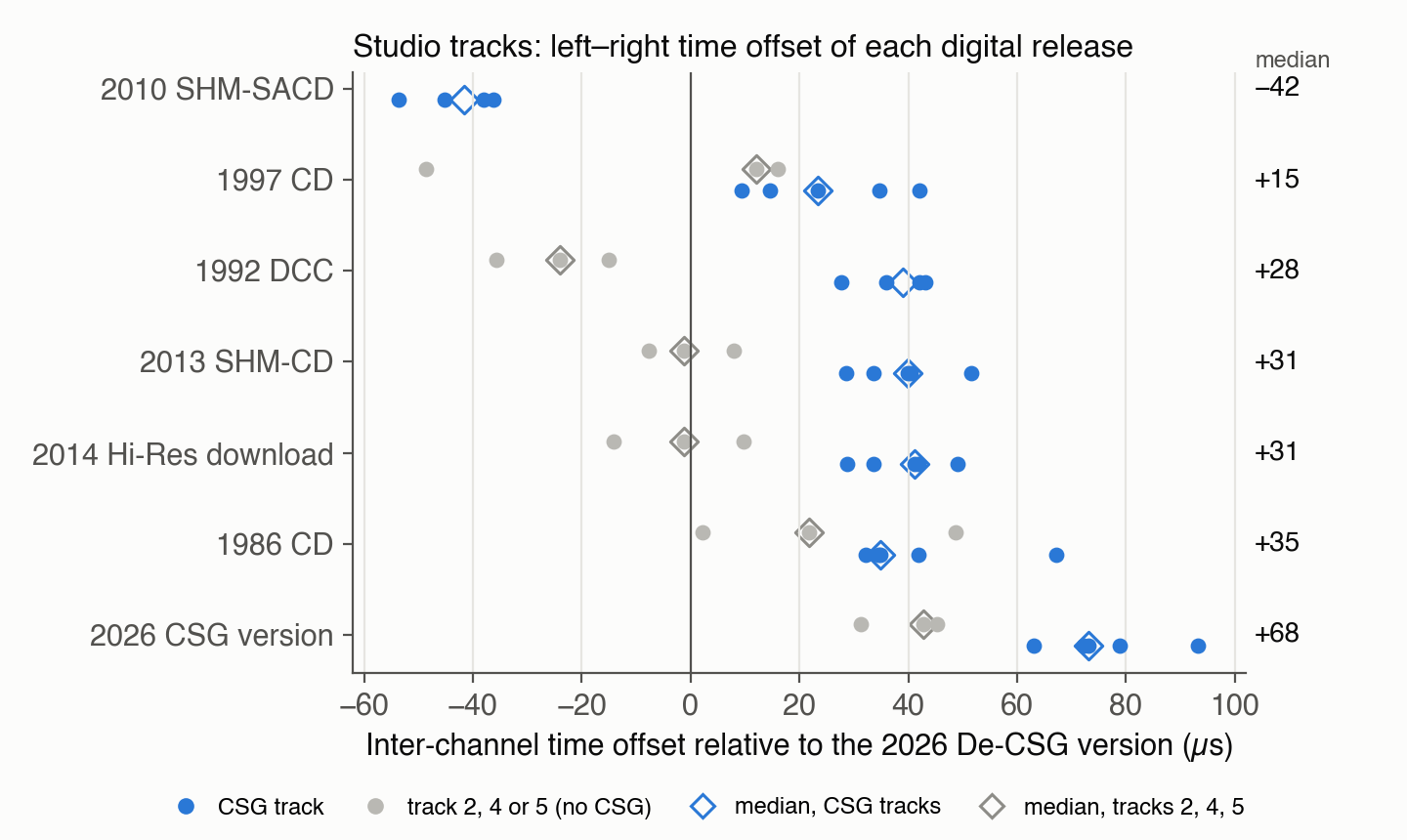
図2: 左右の時間差。 De-CSG 版を 0 とした差(µs)。点は曲(青は CSG のある曲、灰色は CSG のない3曲)、ひし形はそれぞれの群の中央値、右端の数字は8曲の中央値(2010 SHM-SACD は測れた4曲)。正の値は右チャンネルが遅れる向き。
References
- Josh Mound, "The Best Version Of… Cream’s Wheels of Fire and Goodbye", Audiophile Style, 2023-10-11
- Steve Hoffman, post #5 in "SH Spotlight – DCCs Cream "Wheels of Fire" 24kt Gold question/Steve’s "Adventures In Mastering"", Steve Hoffman Music Forums, 2003-06-08
- lukpac, "CREAM "Wheels of Fire" Atco LP – NO CSG", Steve Hoffman Music Forums, 2012-07-16
- lukpac et al., "Cream, Wheels of Fire SHM-SACD", Steve Hoffman Music Forums, 2010–2015
- lukpac et al., "Cream – Wheels of Fire Expanded Editions", Steve Hoffman Music Forums, 2026-04–09
- lukpac, posts #27, #32, #48, #60 in "Cream "Wheels Of Fire" Super Deluxe Edition", QuadraphonicQuad, 2026-06
- "Cream / Wheels of Fire super deluxe edition", superdeluxeedition.com
- Booklet, Wheels of Fire Super Deluxe Edition (Polydor 8819371, 2026): "The Haeco-CSG" (p. 20), "Recording Info & Dates", "Credits" (p. 28)
- Jody Rosen, "The Day the Music Burned", The New York Times Magazine, 2019-06-11
- Discogs releases: 857158 (1986), 2953499 (1987), 1123206 (1992), 2272667 (1997), 3846472 (2010), 7471294 (2013), 8416233 (2014), 37090557 (2026), 5488123 (1979 Japan LP), 12173887 (1968 UK LP), 3815986 (1985 MFSL)
- Discogs releases (matrix numbers): 453433 (Atlantic SC 1502, CSG-A-681295/6), 5051305 (Atco SD 2-700, ST-C-681285-A LW AT), 3624462 (Atco SD 2-700, ST-C-681285-1A CT), 25889626 (Polydor 583 031/2, 583031 A//2, 583031 B//1, 583032 B//2), 1887533 (Polydor 2612-001, 583032 B//3)
- Kohji Matsubayashi, "The 90 Degrees Hidden in Bradley’s Barn: Haeco-CSG on a 1968 LP", microgroove.jp, 2026-10 / 松林 弘治「Bradley’s Barn に隠れた 90度: 1968年の LP に刻まれた Haeco-CSG」