よく知らなかったアーティストの新譜を、なんの気なしにオンラインで試聴しました。最初に耳を捉えたのは、やさしく繊細なナイロン弦ギターと、その周りに広がるオーケストラの響きです。数曲聴いたところで、気がつけば Bandcamp で LP を注文していました。
A new release by an artist I barely knew: I clicked play online, without much thought. What caught my ear first was the gentle, delicate nylon-string guitar, and the orchestra opening out around it. A few tracks in, I found I had already ordered the LP on Bandcamp.
Bandcamp で LP を購入すると、ロスレスのディジタル音源もダウンロードできます。LP が届く前にさっそく聴いてみると、あまりの心地よさに、全曲があっという間に終わってしまいました。どこまでも柔らかく、どこまでも暖かい。なのに、ただ穏やかなだけではありません。音と音のあいだには注意深く張られた糸のようなものがあって、心地よいのに、耳はその行方を追ってしまいます。なんとも不思議な魅力に溢れた楽曲群です。
Buying an LP on Bandcamp also gets you the lossless digital files, so I listened straight away, before the record arrived. It felt so good that the whole album was over before I knew it. Soft all the way through, warm all the way through, and yet not merely placid. Between the notes there is something like carefully strung thread, and comfortable as the music is, my ear keeps chasing where the thread goes. There is a strange charm all through these pieces, one I could not quite pin down.
Choro、Jazz Samba、Bossa Nova といったブラジル音楽の伝統の延長線上にある、それはわかりましたが、この作品の響きは、それだけではないと感じられました。ギターとオーケストラが有機的に絡み合う音は、アンビエントというか、音だけで映像を見せられているというか。そしてどことなく Egberto Gismonti 風味も感じられます。これは一聴したくらいでは真価を理解できないアルバムなのかもしれない、と、何度も何度も聴き込みました。
That much I could tell: the music extends the Brazilian traditions of Choro, Jazz Samba, and Bossa Nova. But the sound of this record did not feel like only that. The way the guitar and the orchestra wind around each other is close to ambient music, or to being shown a film through sound alone. Somewhere in it there is also a flavor of Egberto Gismonti. Suspecting that a single listen would not show me this album’s real worth, I played it again and again.
そもそも、この作品を作ったのはどのようなアーティストなのでしょう。どんな音楽を作ってきて、このアルバムはどう受け止められているのか。初めて聴いた私自身のために、調べたことをまとめておきます。
So who is the artist who made this? What music has he made before, and how has this album been received? For my own benefit, as a first-time listener, I am setting down here what I found.
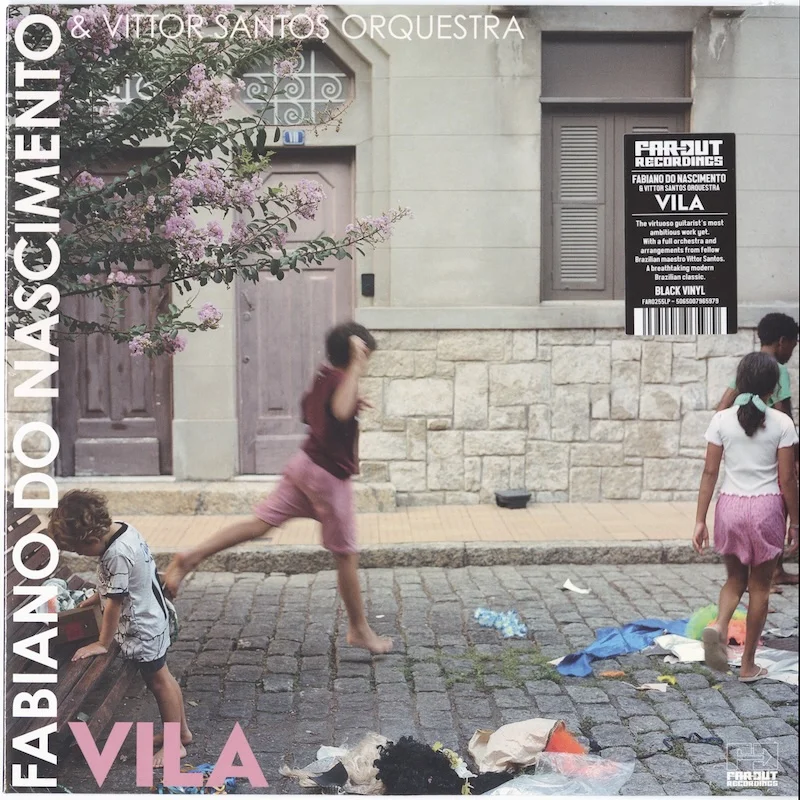
LP 表ジャケット / LP front jacket
A Guitarist Named Fabiano do Nascimento
当該アルバムの主役である ファビアーノ・ド・ナシメント (Fabiano do Nascimento) は1983年、Rio de Janeiro 生まれのギタリスト、作曲家です。祖母と暮らし、7〜8歳のころから音楽家である叔父たちのリハーサルを聴いて育ったそうです。故人となった叔父 Lúcio Nascimento はベーシスト、作曲家で、Fabiano に最初にギターを教えた人物でもあります。Fabiano は6歳からクラシックピアノと音楽理論を学び、10代には Rio の Conservatório de Música Brasileira で研鑽を積みました。一方、Jazz とブラジル音楽については、ほぼ独学だったといいます。
Fabiano do Nascimento, the man at the center of this album, is a guitarist and composer born in Rio de Janeiro in 1983. He lived with his grandmother and grew up, from around the age of seven or eight, listening to the rehearsals of his uncles, who were musicians. His late uncle Lúcio Nascimento, a bassist and composer, was the first person to teach him guitar. Fabiano studied classical piano and music theory from the age of six and trained in his teens at the Conservatório de Música Brasileira in Rio. Jazz and Brazilian music, by his account, he learned mostly on his own.
2001年に家族と Los Angeles へ移住。当初はセッションプレイヤーとして活動し、Arthur Verocai、Mia Doi Todd、Aloe Blacc らと仕事をしてきました。Pablo Calogero、Tiki Pasillas と結成した Triorganico は、2009年に Now-Again Records から『Convivência』を発表。ソロ名義では『Dança dos Tempos』(2015)、『Tempo dos Mestres』(2017)、『Prelúdio』(2020)、『Ykytu』(2021)などを重ね、Sam Gendel、Itiberê Zwarg らとの共作も残しています。現在の拠点は Los Angeles と東京です。
In 2001 he moved with his family to Los Angeles. He worked at first as a session player, for Arthur Verocai, Mia Doi Todd, Aloe Blacc, and others. Triorganico, the group he formed with Pablo Calogero and Tiki Pasillas, released Convivência on Now-Again Records in 2009. Under his own name he has recorded Dança dos Tempos (2015), Tempo dos Mestres (2017), Prelúdio (2020), Ykytu (2021), and more, along with joint albums with Sam Gendel, Itiberê Zwarg, and others. He is now based in Los Angeles and Tokyo.
東京という拠点は、名義上のものではありません。2023年以降は南青山の BAROOM でたびたび公演し、2024年には秩父出身のギタリスト笹久保伸と大磯の Studio SALO でデュオ作『Harmônicos』(Rings)を録音しました。2025年の『Cavejaz』にも日本で録音された演奏と U-Zhaan のタブラが収められ、2026年9月22日には銕仙会能楽研修所で、松丸契をゲストに迎えたソロ公演も予定されています。
Tokyo is not a base in name only. Since 2023 he has appeared repeatedly at BAROOM in Minami-Aoyama, and in 2024 he recorded Harmônicos (Rings), a duo album with the Chichibu-born guitarist Shin Sasakubo, at Studio SALO in Oiso. The 2025 album Cavejaz likewise includes performances recorded in Japan, as well as U-Zhaan on tabla, and a solo concert is scheduled for September 22, 2026, at the Tessenkai Noh theater in Tokyo, with Kei Matsumaru as guest.
6弦、7弦、10弦、ソプラノ、Oktav、バリトンと、さまざまなナイロン弦ギターを使い分けます。多弦ギターへ向かうきっかけのひとつは Egberto Gismonti からの影響でした。速さや音数を前に出すより、小さな音の表情に耳を澄ませる人なのでしょう。2023年の HHV Mag のインタビューでは、自分の演奏についてこう話しています。
He uses a whole family of nylon-string guitars, six-string, seven-string, ten-string, soprano, oktav, and baritone, each for its own purpose. One of the things that led him toward multi-string instruments was the influence of Egberto Gismonti. He is, I suspect, a player who listens for the expression in small sounds rather than leading with speed or the sheer number of notes. In a 2023 interview with HHV Mag, he described his own playing this way.
“The way I play, I tend to play very understatedly, and softly. That’s my vibe.”
「僕の弾き方は、とても控えめで、柔らかい。それが自分のスタイルなんだ」
Fabiano do Nascimento, HHV Mag, 2023別の 15 Questions のインタビューでも、好みの音楽を次のように表現しています。
In another interview, with 15 Questions, he put his tastes like this.
“I personally like music that is subtle, not super loud, harmonically interesting, peaceful, and clear.”
「個人的には、繊細で、大きすぎず、ハーモニーがおもしろくて、穏やかで、澄んだ音楽が好きなんだ」
Fabiano do Nascimento, 15 Questions『Vila』を聴いて感じた柔らかさと、そこに同居する緊張感。この二つは、彼の美意識にそのまま重なるのかもしれません。
The softness I heard in Vila, and the tension that lives inside it: the two may map straight onto his aesthetic.
Vila: A Portrait of a Childhood Place
幼い日の場所を描いたこのアルバムについて、まずは基本情報から見ていきます。
『Vila』は Fabiano do Nascimento & Vittor Santos Orquestra 名義で、Far Out Recordings から2026年2月27日に発売されました。LP と CD は10曲、Digital 版はボーナストラック「Tema Em Harmônicos(No Strings)」を加えた11曲で、曲順が少し変えられています。録音は Los Angeles の Electro Sound Studios と Rio de Janeiro の Fibra Estúdios で行われ、Mike Bozzi がマスタリングを担当しています。
Vila was released on February 27, 2026, by Far Out Recordings, credited to Fabiano do Nascimento & Vittor Santos Orquestra. The LP and CD carry ten tracks; the digital edition adds a bonus track, “Tema Em Harmônicos (No Strings),” for a total of eleven, in a slightly altered running order. The album was recorded at Electro Sound Studios in Los Angeles and Fibra Estúdios in Rio de Janeiro, and mastered by Mike Bozzi.
アルバムの源にあるのは、Fabiano が幼少期の多くを過ごした Bairro Saavedra という場所です。レーベルの紹介によれば、Rio の Catete 地区、通りに面した鋳鉄製の門の向こうにある 30戸の連棟住宅からなる vila で、1928年に建てられたネオコロニアル様式の家々が中庭を囲んでいます。木製の雨戸、タイル張りの床、静かなベンチ。ここでいう vila は、単に「小さな町」という意味ではなく、路地や中庭に沿って小さな家々が並ぶ Rio の都市住居のひとつです。
At the source of the album is a place called Bairro Saavedra, where Fabiano spent much of his childhood. According to the label’s description, it is a vila in Rio’s Catete district, thirty row houses beyond a cast-iron gate that faces the street; the neocolonial houses, built in 1928, surround a courtyard. Wooden shutters, tiled floors, quiet benches. The word vila here does not mean simply a small town. It is one of Rio’s forms of urban housing, small houses set along an alley or a shared courtyard.
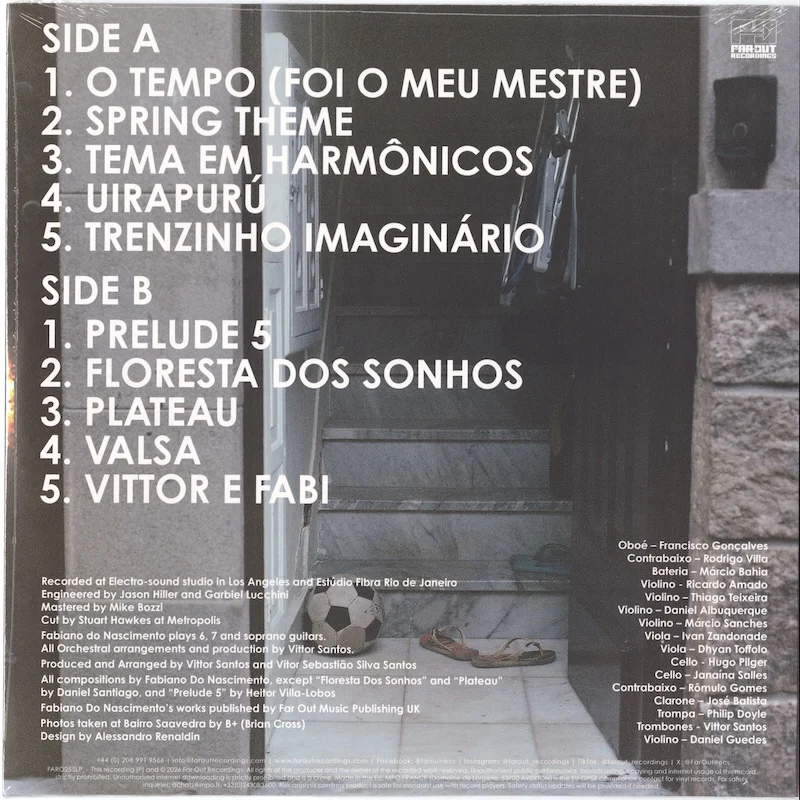
LP 裏ジャケット / LP rear jacket
ただ、この場所について Fabiano 自身が一人称で詳しく語った『Vila』関連のインタビューは、2026年8月20日時点では確認できませんでした。なぜいま Bairro Saavedra を作品にしたのか。そこでの具体的な記憶は何か。なぜタイトルは『Bairro Saavedra』ではなく『Vila』なのか。現在読める背景説明は Far Out Recordings のプレスリリースに遡り、肝心なところはまだ本人の言葉を待つしかありません。
As of August 20, 2026, though, I could not find a Vila-related interview in which Fabiano himself speaks about this place at length, in the first person. Why turn Bairro Saavedra into an album now? What, concretely, does he remember of it? Why is the title Vila and not Bairro Saavedra? The background available to read today traces back to the Far Out Recordings press release, and on the points that matter most, there is nothing to do for now but wait for his own words.
それでも曲名を眺めると、時間、幼年期、夢、親密さといったモチーフが浮かびます。唯一 Fabiano の歌が入る冒頭曲「O Tempo(Foi O Meu Mestre)」は、以前の曲「O Tempo」を録音し直したもの。「Trenzinho Imaginário」は「空想の小さな汽車」、「Floresta Dos Sonhos」は「夢の森」を意味し、終盤には「Valsa」と、二人の名を冠した「Vittor E Fabi」が並びます。
Even so, the track titles bring certain motifs forward: time, childhood, dreams, closeness. The opener, “O Tempo (Foi O Meu Mestre),” the only track on which Fabiano sings, is a new recording of his earlier song “O Tempo.” “Trenzinho Imaginário” means a little imaginary train, “Floresta Dos Sonhos” a forest of dreams, and near the end come “Valsa” and “Vittor E Fabi,” bearing both their names.
全10曲のうち7曲を Fabiano が作曲し、「Floresta Dos Sonhos」と「Plateau」は Daniel Santiago の作曲。残る1曲は Heitor Villa-Lobos の「Prelude 5」を編曲したものです。ブラジルのクラシックギターの伝統が、過去からの引用として目立つのではなく、Fabiano の曲と同じ風景の中で息づいています。
Fabiano composed seven of the ten tracks; “Floresta Dos Sonhos” and “Plateau” are by Daniel Santiago, and the remaining piece is an arrangement of Heitor Villa-Lobos’s “Prelude 5.” Rather than standing out as a quotation from the past, the Brazilian classical guitar tradition lives here in the same scenery as Fabiano’s own tunes.
Fabiano は6弦、7弦、ソプラノギターと歌を担当。Vittor Santos はトロンボーンを吹くほか、オーケストラ編曲、指揮、プロデュースを担いました。オーケストラは弦楽9人に、オーボエ、クラリネット、ホルン、ダブルベース、ドラムス、それに Santos 自身のトロンボーンを加えた16人編成です。この大所帯がギターの背景を塗りつぶすことはありません。その小さな動きを受け取り、膨らませ、ときには静かに手放す。どちらが主役というより、互いが互いの呼吸を作っているように聞こえます。
Fabiano plays six-string, seven-string, and soprano guitars, and sings. Vittor Santos, besides playing trombone, wrote the orchestral arrangements, conducted, and produced. The orchestra runs to sixteen players: nine strings, plus oboe, clarinet, French horn, double basses, drums, and Santos’s own trombone. Big as it is, this company never fills in every inch of the space behind the guitar. It picks up the guitar’s small movements, swells them, and sometimes quietly lets them go. It sounds less like one of them leading than like each shaping the other’s breathing.
二人がこの形式で共演するのは、『Lendas』(2023)に続いて2作目です。前作には Arthur Verocai も参加し、Now-Again Records から発売されました。『Vila』には Verocai のクレジットはなく、レーベルも Far Out Recordings に変わっています。
This is the pair’s second album in this format, following Lendas (2023). Arthur Verocai also took part in that earlier album, which appeared on Now-Again Records. Vila has no Verocai credit, and the label has changed to Far Out Recordings.
そういえば Fabiano は『Lendas』発表時の2023年、先ほどの HHV Mag のインタビューでこう語っていました。
Come to think of it, back in 2023, around the release of Lendas, Fabiano said this in the HHV Mag interview quoted earlier.
“we are already finishing Lendas II”
「もう Lendas II を仕上げているところだ」
Fabiano do Nascimento, HHV Mag, 2023『Lendas』と『Vila』は、どちらも Fabiano のギターと Vittor Santos のオーケストラによる作品です。時系列を考えると、このときの「Lendas II」が『Vila』になったのでは、と想像したくなります。ただし、タイトルだけでなくレーベルも異なるため、別の未発表プロジェクトだった可能性もあります。両者の関係を示す本人やレーベルの記述は、今のところ確認できません。
Lendas and Vila are both albums of Fabiano’s guitar with Vittor Santos’s orchestra. Given the timeline, it is tempting to imagine that the “Lendas II” of that moment became Vila. But the title is different, and so is the label, so it may have been a separate project that never surfaced. So far I have not found any statement by the artist or the labels on how the two relate.
Fabiano do Nascimento — 6, 7 and soprano guitars
Vittor Santos — trombones, orchestral arrangements, production

Violino — Daniel Guedes, Ricardo Amado, Thiago Teixeira, Daniel Albuquerque, Márcio Sanches
Viola — Ivan Zandonade, Dhyan Toffolo
Cello — Hugo Pilger, Janaina Salles
Contrabaixo — Rodrigo Villa, Rômulo Gomes
Oboé — Francisco Gonçalves
Clarone — José Batista
Trompa — Philip Doyle
Bateria — Márcio Bahia

Recorded at Electro-sound studio in Los Angeles and Estúdio Fibra Rio de Janeiro
Engineered by Jason Hiller and Gabriel Lucchini
Mastered by Mike Bozzi
Cut by Stuart Hawkes at Metropolis
Photos taken at Bairro Saavedra by B+ (Brian Cross)
Design by Alessandro Renaldin

FARO255LP / Far Out Recordings 2026
What I Heard
予備知識なしにこのアルバムに向かい、全体を通して最初に気づいたのは、コード進行の妙で聴かせるかつての Samba や Bossa Nova とは、曲の作りが違うことです。多くの曲は限られたコードやフレーズのループ、ときにはワンコードでできていて、リズムと、少しずつ動くハーモニーだけで表情を変えていきます。Fabiano のギターも前面に立つことはほとんどなく、アンサンブルに溶けることを選んでいるようです。
I came to the album with no background knowledge, and the first thing I noticed, across the whole of it, was that the songs are built differently from the older Samba and Bossa Nova that carry the listener on the ingenuity of their chord changes. Many pieces run on a few chords or a looping phrase, sometimes on a single chord, and change expression through rhythm and slowly moving harmony alone. Fabiano’s guitar, likewise, hardly ever steps out front; it seems to choose to dissolve into the ensemble.
「Spring Theme」はゆったりしたワンコードの曲です。タイトルは春なのに、私が思い浮かべたのは晩夏の夜でした。涼しい風、やさしい虫の声。ブラジルの人には、これが春を想起させる響きなのでしょうか。桜や新緑から春を思い描く日本人だから、別の季節を聴き取ってしまうのかもしれません。ストリングスの入り方も、かつて Jobim の歌を包んだ Claus Ogerman のアレンジより、ずっと現代的に聞こえます。
“Spring Theme” is an unhurried one-chord piece. The title says spring, but what I pictured was a late-summer night: a cool breeze, the soft voices of insects. Does this sound suggest spring to a Brazilian ear? Maybe a Japanese listener, who reaches for cherry blossoms and new green leaves when imagining spring, is bound to hear a different season in it. The way the strings come in also sounds far more contemporary than the Claus Ogerman arrangements that once wrapped Jobim’s songs.
「Tema Em Harmônicos」では、メロディが執拗にルート音を避け続けます。オーケストラの和音も同じで、根を下ろさないまま、サンバ風のリズムの上に宙吊りの響きが続く。その中でナイロン弦ギターと対峙するのが、Santos 自身のやわらかなトロンボーンです。
In “Tema Em Harmônicos,” the melody keeps refusing the root note, insistently. The orchestra’s chords do the same. Nothing puts down roots, and a suspended sound hangs over a samba-like rhythm. In the middle of it, facing the nylon-string guitar, is Santos’s own soft trombone.
そして「Uirapurú」。アマゾンの伝説の鳥の名を持つこの曲に、私はノックアウトされました。冒頭のギターは単独演奏は5拍子のような、不思議なタメを持つ拍子に聞こえます。ところが数小節後にドラムが入った途端、ギターは何も変わらないのに、全体は8分の8で走り出す。ギターは 3-3-3-3-4 と刻み、リズム隊は 4-4-4-4、というポリリズムに鳥肌が立ちました。ギターだけを追えばリズムから解放されたアンビエント、リズム隊とストリングスを聴けばヒップホップにも通じるグルーヴ。同じ曲の中に二つの顔があるかのようです。Egberto Gismonti の「Loro」は 3-3-2 というトレシージョのリズムに疾走感あふれるメロディがのる曲でしたが、このあたりにも Gismonti や Hermeto Pascoal の影響を感じさせられます。
And then “Uirapurú.” This track, named after the legendary bird of the Amazon, knocked me out. At the opening, the guitar alone sounds like something close to five beats to the bar, with an odd hold built into the pulse. A few bars later the drums enter, and the moment they do, the whole piece takes off in 8/8, though the guitar has changed nothing. The guitar keeps cutting 3-3-3-3-4 against the rhythm section’s 4-4-4-4, and that polyrhythm gave me goosebumps. Follow the guitar alone and you hear ambient music set loose from meter; follow the rhythm section and the strings and you hear a groove that would not be out of place in hip hop. It is as if the same piece had two faces. Egberto Gismonti’s “Loro” set a racing melody over a 3-3-2 tresillo rhythm, and in passages like this the influence of Gismonti and Hermeto Pascoal comes through.
Villa-Lobos の「Prelude 5」も注目のトラックです。6/4拍子で書かれた原曲を、やや速い5拍子に読み替えて、原曲より少しセンチメンタルな表情を引き出しています。数えてみれば、このアルバムには5拍子の曲が3曲、7拍子の曲が1曲。変拍子は例外ではなく、この作品の語法なのだと思います。
The Villa-Lobos “Prelude 5” is another track worth close attention. The original is written in 6/4; here it is reread in a somewhat faster five, which draws out a slightly more sentimental expression than the original has. Counting through the album, there are three tracks in five and one in seven. Odd meters are not an exception here but part of the album’s grammar.
こうして書き出すと技巧の話ばかりになりますが、聴いている間、仕掛けはほとんど意識に上りません。音楽にそれほど深入りしない人でも、心地よいイージーリスニング、爽やかな BGM として受け止められるのだろうと思います。けれど聴き込むほどに、隅々まで作り込まれていることに気づく。冒頭で触れた「音と音のあいだに張られた糸」は、まさにこの作り込みにあるのでしょう。まだ私が気づいていない作り込みは無尽蔵にありそうです。
Written out like this, it turns into a list of devices. While the music is playing, though, the devices barely reach your awareness. Someone with no deep investment in music could, I imagine, take the album in as pleasant easy listening, as fresh background music. But the closer I listen, the more I find how much craftsmanship has been worked into every corner. That carefully strung thread between the notes I mentioned at the beginning probably comes down to exactly this craftsmanship. And the craftsmanship I have not yet noticed seems close to inexhaustible.
What Others Heard
ひとしきり聴き込んだあとで、世界中(英語圏、ポルトガル語圏、日本語圏)のレビューをさがしてみました。
After a long stretch of listening, I went looking for reviews from around the world (English, Portuguese, Japanese).
『Vila』に寄せられた評価はおおむね高いようです。ただ、評者によって称賛するポイントがさまざまで、興味深いです。
The verdicts on Vila seem largely favorable. What makes them interesting is that each reviewer praises a different thing.
AllMusic の Thom Jurek は本作を次のように表現しています。
Thom Jurek at AllMusic puts the album this way.
“a dreamy, deliriously beautiful collection of originals”
「夢見心地の美しさに酔わされる、オリジナル曲の数々」
Thom Jurek, AllMusic最後の「Vittor E Fabi」を “modern jazz samba offered in luxuriant textures”(豊かな質感をたたえたモダンジャズサンバ)と呼んでいるのも、この作品にある伝統と新しさの同居をよく言い表しているように思います。
He calls the closing track, “Vittor E Fabi,” “modern jazz samba offered in luxuriant textures,” and that phrase too seems to me a good short account of how tradition and newness live together on this record.
PopMatters の Adriane Pontecorvo は 9/10点を付け、17人の演奏を “an ensemble piece in full bloom from start to finish, 17 musicians at their sweetest” と評しました。続く一節はさらに簡潔です。
Adriane Pontecorvo at PopMatters scored it 9 out of 10 and described the seventeen musicians’ playing as “an ensemble piece in full bloom from start to finish, 17 musicians at their sweetest.” The passage that follows is even more compact.
“This music is organic, tender. It is breath after breath of fresh air in sonic form.”
「この音楽はオーガニックで、やさしい。ひと息ごとに新鮮な空気が流れ込んでくる、音のかたちをした呼吸だ」
Adriane Pontecorvo, PopMatters一方、称賛ではないコメントもあります。Ammar Kalia は The Guardian のレビュー「imaginative mood music from a virtuoso」(2026年2月6日)で本作を Global Album of the Month に選び、時代を超えた感覚と現代性の両方を認めながら、劇的で爆発的な可能性が最後まで全面には現れず、穏やかに広がる弦の線の中に留まると書きました。ポルトガルのAltamont によるレビューにも、よく似た観察があります。
Not every comment is praise, though. In his review “imaginative mood music from a virtuoso” (February 6, 2026), Ammar Kalia chose the album as The Guardian’s Global Album of the Month. He credits it with both timelessness and modernity, but writes that its dramatic, explosive potential never fully comes to the front; it stays within the calm, widening lines of the strings. A Portuguese review at Altamont makes a very similar observation.
“O tom é sempre, sempre bonito … ficando sempre aquém de atingir um ponto épico”
Tiago Freire, Altamont常に美しいが、壮大な頂点には届かない、という意味合いです。では、それは物足りなさなのでしょうか。同じ評者は、本作を次のようにも捉えています。
The tone, the reviewer writes, is always, always beautiful, yet always stops short of an epic peak. Is that a shortcoming? The same reviewer also hears the album another way.
“músicas aparentemente simples mas que repetidas audições revelam estar cheias de enigmas musicais, um triunfo de composição, de arranjos e de execução”
Tiago Freire, Altamont一見すると素朴な音楽が、繰り返し聴くうちに音楽的な謎を現す。初聴で覚えた「何度も聴き込まないと真価が理解できないかもしれない」という感触に、いちばん近い評でした。
Music that seems simple at first, he finds, reveals itself over repeated listens to be full of musical enigmas: a triumph of composition, of arrangement, and of performance. Of everything I read, this came closest to the feeling I had on first hearing, that the album’s real worth would not show on a single listen.
リスナーの反応も、好意的ながら一様ではありません。2026年8月の調査時点で、Album of the Year の User Score は78点、Rate Your Music(RYM)は1,000件の評価で平均 3.59/5.00。RYM にはナイロン弦ギターと Samba の影を帯びたクラシカルな主題を称える声や、「Floresta Dos Sonhos」をベストトラックに挙げる声がある一方、過去作のほうを高く評価するリスナーもいました。美しさは認めても、圧倒的とまでは言わない。その温度差も、この静かな作品には似合っています。
Listener reactions, too, are positive without being uniform. As of my survey in August 2026, the User Score on Album of the Year stood at 78, and Rate Your Music showed an average of 3.59 out of 5.00 across 1,000 ratings. On RYM there are voices praising the classical themes shaded by nylon-string guitar and Samba, and voices naming “Floresta Dos Sonhos” the best track, while other listeners rank his earlier records higher. They grant its beauty without calling it overwhelming. That difference in temperature also suits a quiet record like this.
To Places I Don’t Yet Know
私は Rio を訪れたことがありません。Bairro Saavedra が実際にどんなところなのかも、そこに並ぶ家や中庭の光がどんなものなのかも知らない。それなのに『Vila』を聴いていると、自分の記憶のどこかにもあったような懐かしさを覚えます。
I have never been to Rio. I do not know what Bairro Saavedra is actually like, or how the light falls on the row of houses and the courtyard there. And yet, listening to Vila, I feel a nostalgia, as if the place had been somewhere in my own memory all along.
その感覚がどこから来るのか、まだうまく説明できません。Fabiano の繊細なタッチなのか、Vittor のオーケストレーションなのか、あるいは「時間こそが私の師だった」と歌う声なのか。正直分かりませんが、もしかすると、Fabiano の個人的な経験に基づく懐かしさが、普遍性を伴って音にあらわれているのかもしれません。
Where that feeling comes from, I still cannot explain well. Fabiano’s delicate touch? Vittor’s orchestration? The voice singing that time was his master? I honestly do not know. But perhaps a longing grounded in Fabiano’s personal experience is coming through the music with something universal in it.
なんの気なしに始めた試聴が LP の購入につながり、その盤から、知らない音楽家の来歴と、訪れたことのない Rio の小さな住居群へ導かれました。これから何度も針を下ろし、そのたびに音の奥から何が現れるのかを確かめたいと思います。その合間に、Airto Moreira が参加した『Dança dos Tempos』と、Sam Gendel との『The Room』など、他の作品もいろいろ探求してみるつもりです。そこから『Vila』へ戻ったとき、この知らない場所をモチーフにした音楽が、どのように聴こえるのか、今から楽しみです。
A listen begun on a whim led to an LP, and the record led me on to the life of a musician I had not known and to a small cluster of houses in Rio I have never visited. I expect to drop the needle on it many more times, and to find out, each time, what surfaces from deep inside the sound. In between, I mean to explore his other records: Dança dos Tempos, with Airto Moreira on it, The Room with Sam Gendel, and more. When I come back to Vila from those, I look forward to hearing how this music drawn from a place I do not know will sound.
Reviews Worth Reading
最後に、『Vila』についてさらに読みたい方に、印象に残ったレビューを3本紹介しておきます。いずれも、本文では紹介しきれなかった聴きどころを含む文章です。
To close, for anyone who wants to read more about Vila, here are three reviews that left an impression on me. Each of them touches on things to listen for that I could not fit into this piece.
- AllMusic の Thom Jurek 評(英語)。ほぼ全曲をたどりながら、ギターとオーケストラの動きを具体的に描写しています。
- Altamont の Tiago Freire 評(ポルトガル語)。本作を “um discreto triunfo”(控えめな勝利)と呼び、繰り返し聴くことで現れる音楽的な謎を捉えています(Google 翻訳で日本語版を読む)。
- note.com のファラさんの評(日本語)。『Cavejaz』から『Aquáticos』を経て『Vila』へ至る大きな方向転換を指摘し、サンバを差別や抑圧に抗う音楽という社会史から読み解きます。音楽を聴き手へ差し伸べられた「対話」と捉える視点も印象的です。
- Thom Jurek’s review at AllMusic. It walks through nearly every track and describes in concrete terms how the guitar and the orchestra move.
- Tiago Freire’s review at Altamont (Portuguese; read it in English via Google Translate). He calls the album “um discreto triunfo,” an understated triumph, and catches the musical enigmas that appear with repeated listening.
- The review by “ファラ” (Fara?) on note.com (Japanese; read it in English via Google Translate). It points to the sharp change of course that runs from Cavejaz through Aquáticos to Vila, and reads the album through the social history of samba as music that stood up to discrimination and oppression. The idea of music as a dialogue held out to the listener has also stayed with me.