
This article is presented in Japanese and English on the same page.
- 裏ジャケットの1行が言う Haeco-CSG の処理は、溝に刻まれていた。盤起こしした WS 1760 を左右の位相差で解析すると、「Turn Around」では右チャンネルの位相が左より約 90° 遅れていた。対照のふつうのミックスは 0° 付近である。
- 同じ処理は 1993年・2005年・2011年・2021年の4枚の CD にも残っていた。2005〜2021年の3枚は1つの転写から作られたと考えられ、1993年の日本盤はそれとは別の転写である。
- LP 収録の11曲のうち「Little Bird」だけは、LP でも CD でも処理されていない。その理由は溝からも CD からも分からない。
- LP にだけ、CSG とは別に右チャンネルが約 60 µs 遅れるずれがある。CD にも、近いマトリクスの Astral Weeks にもない。テープ側か1968年のカッティング側か、2つの可能性のままである。
- The Haeco-CSG processing named in the single line on the back cover is cut into the grooves. Analyzing my needle drop of WS 1760 for the phase difference between left and right shows that on “Turn Around” the right channel lags the left by about 90°. The ordinary mix used as a control sits near 0°.
- The same processing survives on four CDs, from 1993, 2005, 2011, and 2021. The three discs from 2005–2021 appear to have been made from a single transfer, and the 1993 Japanese CD is a separate transfer.
- Of the 11 songs on the LP, only “Little Bird” is unprocessed, on the LP and on the CDs alike. Neither the grooves nor the CDs explain why.
- The LP alone has a second offset, unrelated to CSG, in which the right channel is delayed by about 60 µs. It is absent from the CDs, and from Astral Weeks, a record with a nearby matrix number. Whether it came from the tape or from the 1968 cutting remains open.
The Beau Brummels の Bradley’s Barn は、前作 Triangle と並び、私の大愛聴盤であり、このバンド後期の大傑作だと思っています。残念ながら、それほど人気があるとは言えず、オリジナル盤の市場価格もまったく高くありませんが、市場価値やみんなの評価などはどうでもよくて(笑)、何度となく聴き返してきた、思い入れのあるアルバムです。2005年に Triangle に関する記事 を書いたこともあります。
Bradley’s Barn by The Beau Brummels, together with its predecessor Triangle, is one of my most-played records, and I consider it one of the band’s late masterpieces. It was never especially popular, sadly, and original copies do not fetch much at all. But I confess that market value and what everyone else thinks are the last things I care about here. It is an album I have come back to countless times, and one I feel strongly about. Back in 2005 I wrote an article on Triangle.

Front cover of Bradley’s Barn (WS 1760)
変更履歴 / Revision History
- 2026年10月8日: 初版公開
- October 8, 2026: Initial publication
The Line on the Back Cover
ただ、このアルバムを聴くたびに、ひとつ気になることがありました。Sal Valentino のヴォーカルは中央に定位しているはずなのに、なぜか不思議な浮遊感というか、広がって聞こえるのです。スピーカに近づいて左や右に顔を向けると、ヴォーカルの位置が左右に動くような感覚になります。これはなんだろう、と以前から思っていました。
Still, every time I listened to this album, one thing nagged at me. Sal Valentino’s vocal should be sitting in the center, yet it had an odd floating quality, as if it were spread out. If I moved close to the speakers and turned my head to the left or right, the vocal seemed to move from side to side. I had wondered for a long time what that was.
その疑問の手がかりが見つかったのは、別の調べものをしているときでした。互換ステレオ盤の連作で 1960年代後半のレコードを調べているうちに、Haeco-CSG という処理があることを知りました。ステレオ盤をモノーラルで再生したときのために、左右の位相関係に手を加えておく処理です。手持ちの LP にそれを使ったものがないか探してみると、愛聴盤 Bradley’s Barn が、まさにその1枚だったのです。
The clue turned up while I was researching something else. While going through late-1960s records for my series on compatible stereo records, I learned of a process called Haeco-CSG. It alters the phase relationship between the left and right channels in advance, for the case where a stereo record is played back in mono. When I looked through my LPs for one that had used it, my beloved Bradley’s Barn turned out to be exactly such a record.
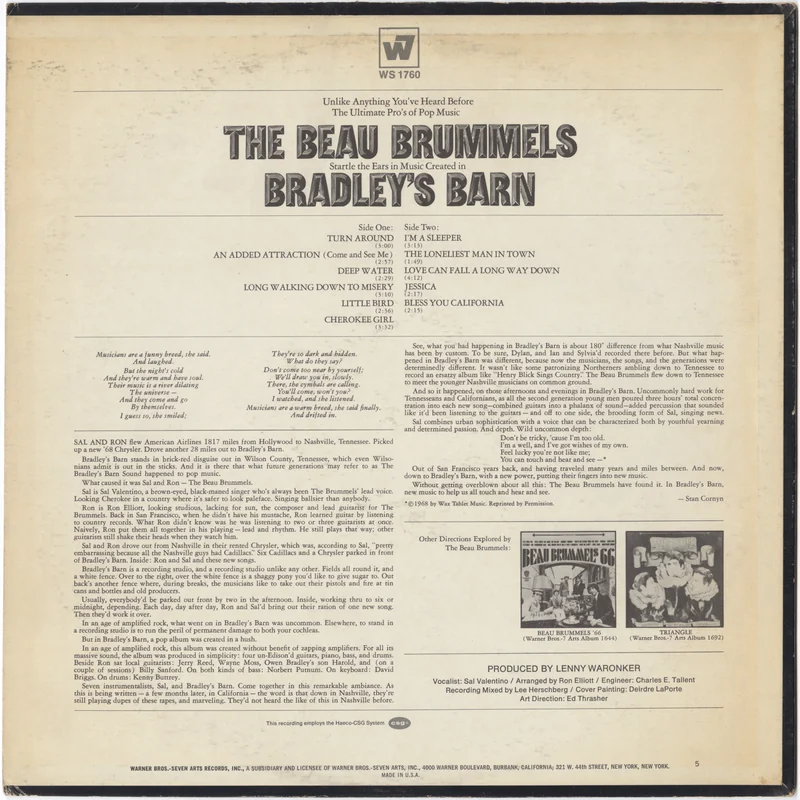
Back cover
裏ジャケットの下のほうに、小さく1行、こう印刷されています。
Near the bottom of the back cover, one small line is printed:

The line at the bottom of the back cover (cropped at full size)
This recording employs the Haeco-CSG System
この録音は Haeco-CSG システムを使用しています
これはなんだろう。何年も聴いてきた盤なのに、この1行を気にとめたことはありませんでした。そこで、調べてみることにしました。
What was this? I had listened to this record for years without ever paying attention to the line. So I decided to look into it.
手元の盤は、Warner Bros.-Seven Arts の WS 1760、1968年の米国盤です。白いラベルに “Promotion Not For Sale” とあるプロモ盤で、ランアウトの刻印は A面が Ƨ 39411 WS1760A -1B o A3、B面が Ƨ 39412 WS1760B -1B o A2 です。Discogs に登録されている同じプロモ盤の刻印と一致します。その登録情報によると、先頭の Ƨ は Columbia の Santa Maria 工場のプレスを示す記号とされています。私が実物で確かめたわけではありませんが、裏ジャケのCSG表記は白プロモ盤だけではなくレギュラーリリース(緑レーベル)でも共通しているとのことです。
My copy is Warner Bros.-Seven Arts WS 1760, the 1968 US pressing. It is a white-label promo marked “Promotion Not For Sale,” and the runout etchings read Ƨ 39411 WS1760A -1B o A3 on side A and Ƨ 39412 WS1760B -1B o A2 on side B. They match the etchings registered on Discogs for the same promo. According to that entry, the leading Ƨ is said to mark a pressing from Columbia’s Santa Maria plant. I have not checked this myself, but the CSG line on the back cover is reportedly not limited to the white-label promo and appears on the regular release (green label) as well.
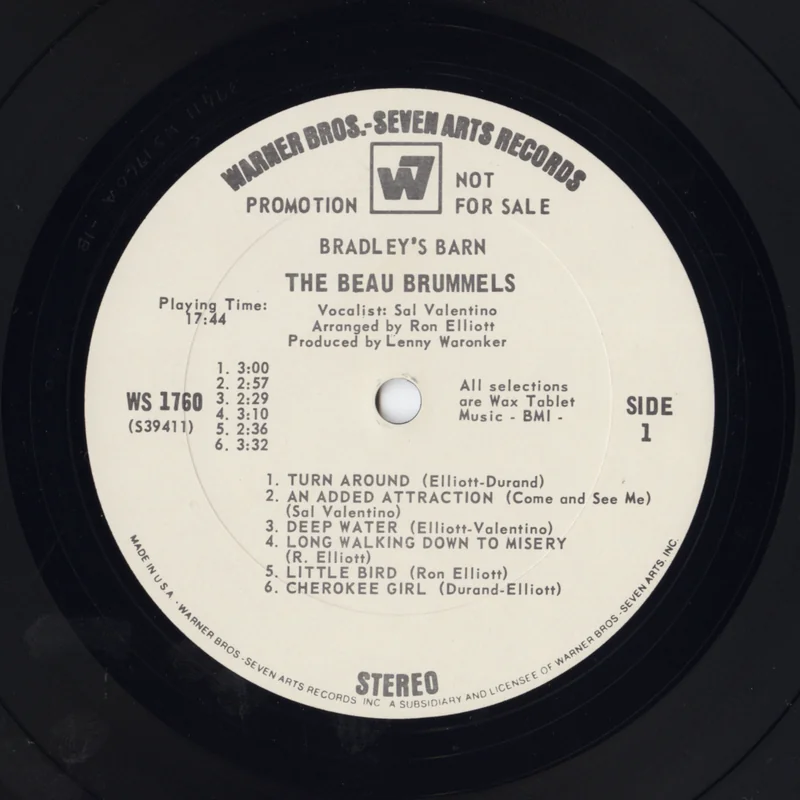
Side A label of my promo copy
ジャケ裏に書かれている通り、この盤の溝に刻まれた音源にはCSG処理が施されているんだろうか。CSG処理とやらの有無は、なんらかの方法で客観的に識別可能なんだろうか。そして、そのCSG処理はカッティングマスターテープに既に施されていたのか、あるいはカッティング時に追加で施されたのか、一体どちらなんだろうか。
Does the sound cut into the grooves of this record really carry CSG processing, as the back cover says? Can the presence or absence of this CSG processing be identified objectively by some method? And was the processing already on the cutting master tape, or was it added at the time of cutting? Which was it?
この記事では、私の所有するプロモ盤から盤起こしした音源、そして4種類の CD の音源を計測して、それを確かめていきます。
In this article I measure the needle drop of the promo copy I own, along with four CDs, to find out.
CSG: Compatible Stereo Generator
で、そもそも CSG とはなにか。Haeco が出した C.S.G. の説明書が、onamrecords.com の A&M Studios の history ページからリンクされた PDF にあるのを見つけたので、さっそく読んでみました。発行元は Holzer Audio Engineering Corporation、所在地は Van Nuys です。全8頁、日付の記載はありません。冒頭にはこうあります。
So what is CSG in the first place? I found the C.S.G. instructions issued by Haeco as a PDF linked from the A&M Studios history page at onamrecords.com, and read it straight away. The publisher is Holzer Audio Engineering Corporation, located in Van Nuys. It runs to 8 pages and carries no date. It opens like this:
The HAECO Compatible Stereo Generator (C.S.G.) is a low noise, low distortion stereo/mono matrixing amplifier. … The principles and methods used (patents pending) are accurate wide band phase shifting.
HAECO 互換ステレオ・ジェネレータ (C.S.G.) は、低雑音・低歪みのステレオ/モノーラル・マトリクス・アンプである。…用いられている原理と方法 (特許出願中) は、正確な広帯域の位相シフトである
Haeco "C.S.G. Instructions", p.1何のための処理かは、説明書の推奨設定に書かれています。
What the processing is for is stated in the recommended settings of the instructions:
Common information played back stereophonically through two speakers has an acoustic buildup of 3 db. Playing back a C.S.G. processed program monophonically through one loud speaker (as on an AM radio) would necessitate a 3 db electrical buildup
左右に共通の情報を2本のスピーカでステレオ再生すると、音響的に 3 dB 持ち上がる。C.S.G. 処理した番組を1本のスピーカでモノーラル再生する (AM ラジオのように) 場合には、電気的に 3 dB 持ち上げる必要がある
Haeco "C.S.G. Instructions", p.62チャンネルのステレオ音源では、中央に定位させた音は、左右に同じ波形で入っています。それをモノーラルに畳むと、中央に置いた音が、左右に振った音に比べて大きくなりすぎます。CSG は、左右の位相関係をずらしておくことで、畳んだときの中央の音量をそろえる機器です。説明書には、左右で異なる本来のステレオ情報には影響しない、とも書かれています。
In a two-channel stereo source, a sound placed in the center is recorded as the same waveform in both channels. When that is folded to mono, the center sound becomes too loud compared with the sounds panned to the left and right. CSG is a device that shifts the phase relationship between the channels in advance so that the center level comes out even when folded. The instructions also state that it does not affect the true stereo information that differs between left and right.
操作は3つしかありません。IN と OUT の切り替え、位相の正逆 (NORMAL と REVERSE)、そして中央の持ち上げ量 (+3、0、−3) です。推奨は +3 で、この位置だと溝を切るのが機械的にいちばん楽になる、とも書かれています。帯域を分けて処理したり、周波数ごとに量を変えたりといった記述は、8頁のどこにもありません。
There are only three controls: IN and OUT, phase NORMAL and REVERSE, and the amount of center buildup (+3, 0, −3). The recommended position is +3, and the instructions add that this position makes the disc easiest to cut mechanically. Nowhere in the 8 pages is there any mention of splitting the signal into bands or varying the amount by frequency.
この +3 という数字から、位相をどれだけずらしているのかが計算で推定できます。左右の間に周波数によらず一定の位相差があるとすると、畳んだときに中央が +3 dB になる角度は 90° です。説明書に角度は書かれていないので推測になりますが、+3・0・−3 の各位置で説明書に示されている数値は、この「一定の位相差」のモデルでほぼ再現できます。
From this figure of +3, the amount of phase shift can be estimated by calculation. If there is a constant phase difference between left and right regardless of frequency, the angle that gives +3 dB in the center when folded is 90°. The instructions do not give an angle, so this is an inference, but the figures the instructions give for the +3, 0, and −3 positions can be reproduced closely by this “constant phase difference” model.
位相をずらす回路が左右どちらのチャンネルに入っているのかは、説明書には書かれていません。書かれているのは、位相の正逆を切り替えるスイッチが左チャンネルにある、ということだけです (“in the left channel only”、p.5)。「右チャンネルを 90°」という記述は、Josh Mound が 2023年に書いた記事にあります。
The instructions do not say which channel the phase-shifting circuit is in. All they say is that the switch for reversing the phase is “in the left channel only” (p.5). The statement that the setting was to “shift the right channel’s phase by 90 degrees” comes from an article Josh Mound wrote in 2023:
Haeco-CSG claimed to solve this by shifting the phase of one channel. The recommended setting was to shift the right channel’s phase by 90 degrees.
Haeco-CSG は、片方のチャンネルの位相をずらすことでこの問題を解決すると謳った。推奨設定は、右チャンネルの位相を90度ずらすことだった
Josh Mound, "Removing Haeco-CSG Processing (Sort Of)", Audiophile Style, 2023Mound は、ステレオで聴いたときの副作用についても書いています。
Mound also writes about the side effect when listening in stereo:
center-panned vocals on a CSG-processed album tend to sound like the singer is standing almost perpendicular to the listener, rather than facing them.
CSG 処理されたアルバムでは、中央に定位したヴォーカルが、歌手が聴き手のほうを向いているのではなく、ほとんど真横を向いて立っているように聞こえがちだ
Josh Mound, ibid.説明書のほうには、ステレオ再生でも中央の定位は広い範囲で保たれる、という趣旨のことが書かれています。私の耳には、冒頭に書いたように、中央の声が浮遊して聞こえていました。
The instructions, for their part, say in effect that the center image is preserved over a wide range even in stereo playback. To my ears, as I wrote at the start, the center voice sounded as if it were floating.
How to Measure It
CSG の説明が正しければ、処理された音源には、はっきりしたパターンが残っているはずです。中央に定位した声は、ふつうのミックスでは左右にほぼ同じ波形で入っているので、左右の位相差は 0° 付近になります。CSG を通した音源なら、少なくとも声の主な成分がある 200〜3200 Hz の帯域で、左右の位相差が 90° 前後に並ぶはずです。
If the description of CSG is correct, a processed source should carry a clear pattern. In an ordinary mix, a center-panned voice is recorded as nearly the same waveform in both channels, so the phase difference between left and right is near 0°. In a source that has passed through CSG, the phase difference should line up around 90°, at least in the 200–3200 Hz band where the main components of the voice lie.
そこで、左右の位相差を周波数ごとに調べる解析 (クロススペクトル解析) を使います。音源を帯域に分けて、帯域ごとに左右の位相差と、その値の一貫性を求めます。あわせて、左右の相関と、右チャンネルをある角度だけ回したときに左右の差がいちばん小さくなる角度も見ます。この記事では、以降これを「位相差の解析」と呼びます。角度の符号は、右の位相が左より遅れているときを正とします。
So I use an analysis that examines the left-right phase difference frequency by frequency (cross-spectral analysis). The source is split into bands, and for each band I obtain the phase difference between left and right and the coherence of that value. I also look at the left-right correlation, and at the angle by which the right channel must be rotated to make the difference between left and right smallest. In the rest of this article I call this “the phase difference analysis.” The sign of the angle is positive when the right channel lags the left.
幸い、この Bradley’s Barn は、楽器の音が左右に寄せてあり、中央にミックスされているのはほとんど Sal Valentino のヴォーカルです。位相差の解析が拾うのは左右に共通して入っている成分なので、中央にあるのがほぼヴォーカルだけなら、見えた位相差はほぼヴォーカルのものとして読めます。あとで耳でも確かめますが、そのときにヴォーカルの残り方や消え方がはっきり聞き分けられるのも、このミックスの利点です。
Fortunately, on this Bradley’s Barn the instruments are panned to the sides, and almost the only thing mixed to the center is Sal Valentino’s vocal. The phase difference analysis picks up the components common to both channels, so if the center holds little besides the vocal, the phase difference it finds can be read as essentially that of the vocal. Later I check by ear as well, and the way the vocal remains or disappears can be clearly told apart there too, which is another advantage of this mix.
この解析で本当に 90° を見つけられるか、を確認する前に、まず CSG とは無関係な音源がどう解析されるかを確かめました。対象としたのは、Bradley’s Barn と同じ年にリリースされた Simon & Garfunkel の Bookends (Columbia、1968年) です。その 2001年リマスター CD (Columbia/Legacy CK 66003) からリッピングした、ヒット曲の Track 10「Mrs. Robinson」を測りました。次に、同じ音源の右チャンネルを人工的に −90° 回して、解析がそれを拾えるかを見ました。
Before confirming whether this analysis can really find 90°, I first checked how a source unrelated to CSG comes out. I chose Simon & Garfunkel’s Bookends (Columbia, 1968), released the same year as Bradley’s Barn. I measured the hit, Track 10 “Mrs. Robinson,” ripped from the 2001 remastered CD (Columbia/Legacy CK 66003). Then I artificially rotated the right channel of the same source by −90° to see whether the analysis would pick that up.
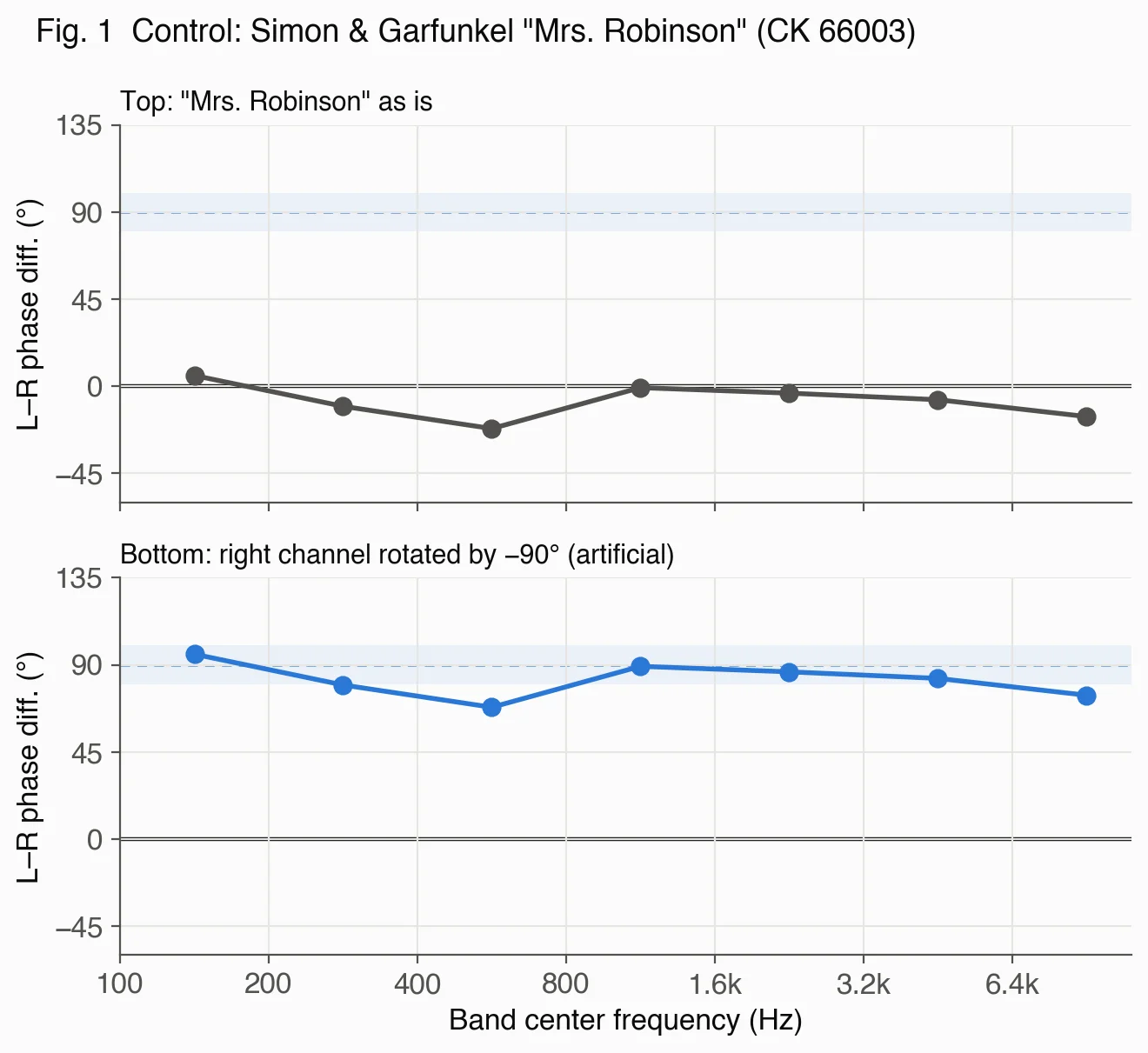
Figure 1: Phase difference per band for “Mrs. Robinson” as is, and with its right channel artificially rotated by −90°
図 1 の上段が、そのままの「Mrs. Robinson」です。200〜3200 Hz で位相差は −22° から −1° の間にあり、左右の相関は +0.32、左右の差が最小になる回転は 0° でした。ふつうのステレオ・ミックスなら、こう見えます。下段は、同じ音源の右チャンネルを人工的に −90° 回したものです。位相差は +68° から +89° に並び、相関は 0.005 まで落ち、左右の差が最小になる回転は +90° になりました。この解析で、90° の移相を拾えています。
The upper panel of Figure 1 is “Mrs. Robinson” as is. Over 200–3200 Hz the phase difference lies between −22° and −1°, the left-right correlation is +0.32, and the rotation that minimizes the left-right difference is 0°. This is what an ordinary stereo mix looks like. The lower panel is the same source with the right channel artificially rotated by −90°. The phase difference lines up between +68° and +89°, the correlation drops to 0.005, and the rotation that minimizes the left-right difference becomes +90°. The analysis picks up the 90° phase shift.
対照は1曲しか用意していません。ただ、帯域によらずほぼ一定の 90° というパターンは、ふつうのミックスでは出ないはずのものです。テープのアジマスのずれでも出ません。アジマスのずれは時間の遅れとして生じ、周波数が高くなるほど位相差が大きくなるからです。
I prepared only one control song. But a pattern of roughly 90° that is nearly constant across bands is something an ordinary mix should not produce. Nor does tape azimuth error produce it. Azimuth error appears as a time delay, and the phase difference grows larger as the frequency rises.
Measuring the Record
CSG なしの音源の解析で手応えをつかんだところで、本命である CSG 処理された音源、つまり私の愛聴盤 Bradley’s Barn の解析に進みます。
With a feel for the analysis gained from the CSG-free source, I move on to the real subject, a CSG-processed source: my beloved Bradley’s Barn.
手元には、冒頭に書いた Warner Bros.-Seven Arts の WS 1760 (白プロモ盤、1B、Santa Maria プレス) のほか、CD が4種あります。4枚組の限定コンピレーション Magic Hollow (Rhino Handmade RHM2 7892、2005)、2枚組の Expanded Edition (Rhino Handmade RHM2 524919、2011)、8枚組 Turn Around: The Complete Recordings 1964-1970 (Now Sounds QCRNOWBX58、2021)、そして 1993年の日本盤 (Warner Bros. Records WPCP-5253) です。
Besides the Warner Bros.-Seven Arts WS 1760 described at the start (white-label promo, 1B, Santa Maria pressing), I have four CDs: the limited four-disc compilation Magic Hollow (Rhino Handmade RHM2 7892, 2005), the two-disc Expanded Edition (Rhino Handmade RHM2 524919, 2011), the eight-disc Turn Around: The Complete Recordings 1964-1970 (Now Sounds QCRNOWBX58, 2021), and the 1993 Japanese CD (Warner Bros. Records WPCP-5253).
まずは LP からです。盤起こしは以下のシステムで行いました。Michell Orbe SE ターンテーブル、SME Series IV のアーム、Hana MH のカートリッジで再生し、Musical Surroundings SuperNova II フォノイコライザ、Benchmark LA4 プリアンプの出力から KORG DS-DAC-10R で 24 bit / 96 kHz で録っています。測ったのは A面1曲目の「Turn Around」と、5曲目の「Little Bird」です。
The LP comes first. I made the needle drop with the following system. The record was played on a Michell Orbe SE turntable with an SME Series IV arm and a Hana MH cartridge, through a Musical Surroundings SuperNova II phono stage and a Benchmark LA4 preamp, and recorded from the preamp output with a KORG DS-DAC-10R at 24 bit / 96 kHz. I measured the first track on side A, “Turn Around,” and the fifth, “Little Bird.”
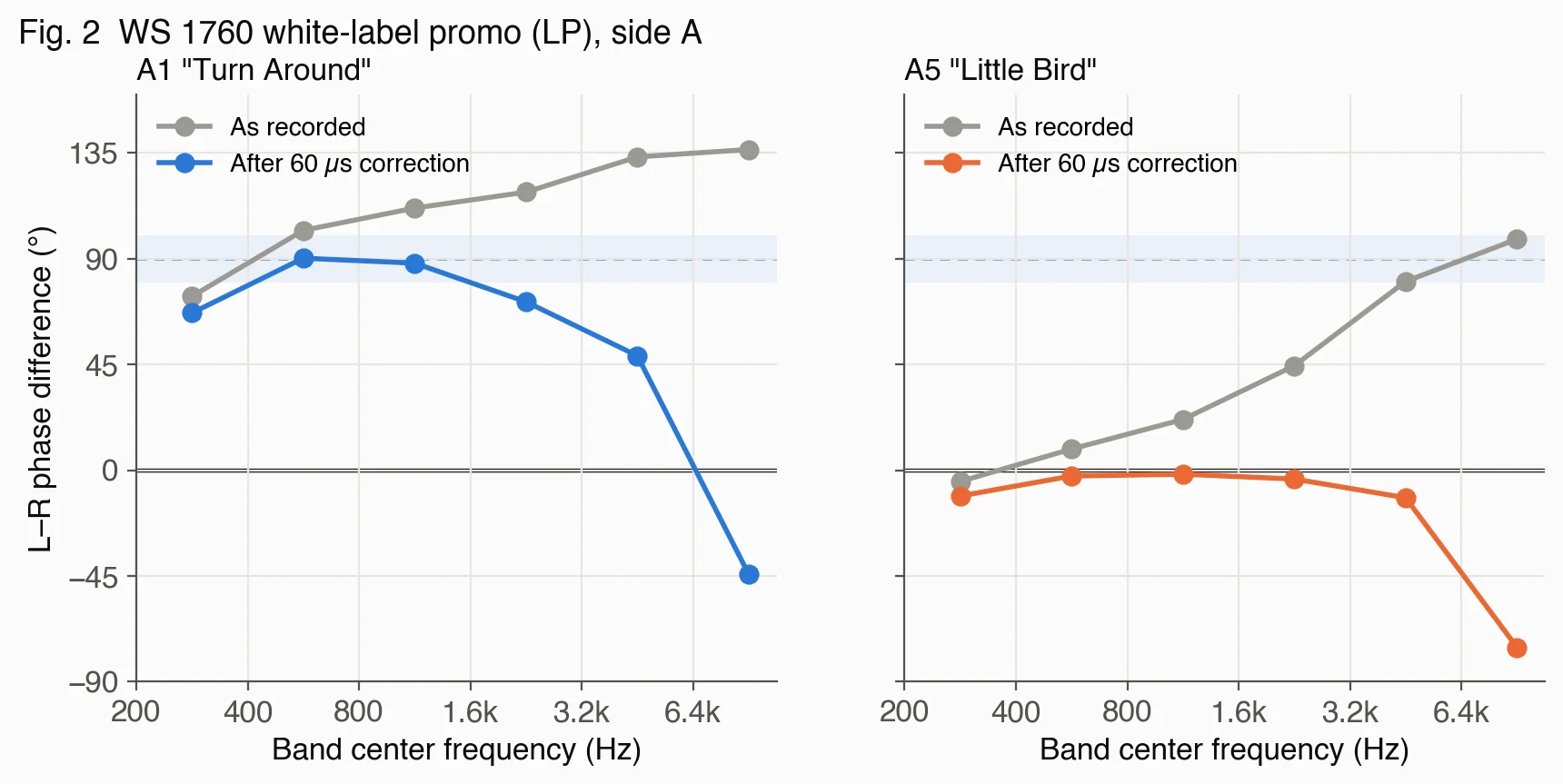
Figure 2: Phase difference per band for A1 “Turn Around” and A5 “Little Bird” on the LP, before and after the 60 µs correction
「Turn Around」の結果が図 2 の左です。補正をしない生の値では、位相差は 400〜3200 Hz で +102° から +118°、左右の差が最小になる回転は +75° でした。90° より少し大きく、高い帯域ほど大きくなる傾向があります。この傾きは、のちほど詳しく説明しますが、CSG とは別の理由で生じたずれによるものです。そのずれを差し引くと、位相差は 400〜3200 Hz の3つの帯域で +90°、+88°、+72° になります。図 1 の下段と同じ型です。
The result for “Turn Around” is on the left of Figure 2. In the raw, uncorrected values, the phase difference over 400–3200 Hz runs from +102° to +118°, and the rotation that minimizes the left-right difference is +75°. That is a little above 90°, and it tends to grow in the higher bands. This slope, as I will explain in detail later, comes from an offset with a cause other than CSG. Once that offset is subtracted, the phase difference in the three bands from 400 to 3200 Hz is +90°, +88°, and +72°. It is the same pattern as the lower panel of Figure 1.
この盤の溝には、CSG の型が刻まれています。ジャケットの表記と、盤起こし音源の解析結果が一致しました。
The CSG pattern is cut into the grooves of this record. What the cover says and what the analysis of the needle drop shows agree.
角度の符号は、右の位相が左より遅れているときを正としていました。つまりこの盤では、右チャンネルの位相が左より約 90° 遅れています。Mound の「右チャンネル」という記述とは矛盾しません。ただし、右の位相を 90° 遅らせても、左の位相を 90° 進めても、左右の関係は同じになります。回路が実際にどちらのチャンネルに入っていたのかまでは、この測定からは分かりません。
I had defined the sign of the angle as positive when the right channel lags the left. So on this record the phase of the right channel lags the left by about 90°. That does not contradict Mound’s “right channel.” But delaying the right channel by 90° and advancing the left by 90° give the same left-right relationship. Which channel the circuit was actually in cannot be determined from this measurement.
ところが「Little Bird」は違いました。図 2 の右です。同じ補正をしたあとの位相差は −2°、−2°、−4°で、相関は +0.43、左右の差が最小になる回転は 0° です。図 1 の上段、つまりふつうのステレオ・ミックスの型です。同じ面の4曲あとの曲には、CSG の型がありません。
“Little Bird,” however, was different. It is on the right of Figure 2. After the same correction, the phase difference is −2°, −2°, and −4°, the correlation is +0.43, and the rotation that minimizes the left-right difference is 0°. This is the pattern of the upper panel of Figure 1, an ordinary stereo mix. Four tracks later on the same side, the CSG pattern is absent.
なぜこの曲だけが外れたのかは、測定からは分かりません。1968年に処理されなかったのか、処理されていないテープが何かの事情で使われたのか、溝からはその区別がつきません。ただ、オリジナルの LP に型がないのですから、この例外は後年の復刻で生じたものではありません。
Why this one song falls outside the pattern cannot be told from the measurement. Whether it was never processed in 1968, or an unprocessed tape was used for some reason, the grooves do not distinguish. But since the original LP has no pattern here, this exception did not arise in a later reissue.
Still There on the CDs
LP では CSG による位相差が確認できました。では、CD リイシュー音源ではどうでしょうか。
The LP confirmed the phase difference produced by CSG. What about the CD reissues?
レコードになるまでのテープには、おおまかに3つの段階があります。
A tape on its way to becoming a record passes through roughly three stages.
マルチトラック・マスター: ステレオ(またはモノーラル)にミックスする前のテープです。この盤では、Rhino のブックレットにあるテープ箱の記入票に「8trk MASTER」とあります。
Multitrack master: the tape before it is mixed down to stereo (or mono). For this album, the tape-box label shown in the Rhino booklet reads “8trk MASTER”.
プロダクション・マスター(ステレオ・マスター): ミックスを終え、曲順や編集まで済ませた2チャンネルの完成品です。以下では「プロダクション・マスター」と呼びます。
Production master (stereo master): the finished two-channel product, mixed, sequenced, and edited. Below I call it the production master.
カッティング・マスター: プロダクション・マスターをもとに、ラッカー(レコードの原盤)作成を念頭に、カッティングしやすさや帯域バランスを調整したテープです。ただし、プロダクション・マスターとは独立したテープとして必ず作られたとは限りません。プロダクション・マスターを再生しながら、旋盤の側で調整することもあります。
Cutting master: a tape made from the production master, with the ease of cutting and the spectral balance adjusted with the lacquer in mind. It was not necessarily made as a separate tape independent of the production master, though. The adjustments could also be made at the lathe while the production master was played.
CSG は左右2チャンネルに対する処理なので、掛けられるとすれば、ミックスより後のどこかです。ミックスのとき、プロダクション・マスターを作るとき、カッティング・マスターを作るとき、そしてカッティングのとき、のいずれかになります。
CSG works on the two stereo channels, so if it was applied, it was applied somewhere after the mix: at the mixing stage, when the production master was made, when the cutting master was made, or at cutting.
まず解析するのは、Rhino Handmade が 2011年3月に出した2枚組 (RHM2 524919) です。ブックレットのクレジットには、ミックスについてこう書かれています。
The first CD I analyze is the two-disc set Rhino Handmade released in March 2011 (RHM2 524919). The credits in the booklet say this about the mixes:
All Recordings Mixed by Lee Herschberg, except Bonus Material Mixed by Andrew Sandoval …
録音はすべて Lee Herschberg がミックス。ただしボーナス素材は Andrew Sandoval がミックス…
Rhino Handmade RHM2 524919 booklet, p.38リマスターは Dan Hersch と Andrew Sandoval (p.39)。テープの出どころや、CSG についての言及は、ブックレットのどこにもありません。
Remastering is credited to Dan Hersch and Andrew Sandoval (p.39). Nowhere in the booklet is there any mention of the tape source or of CSG.
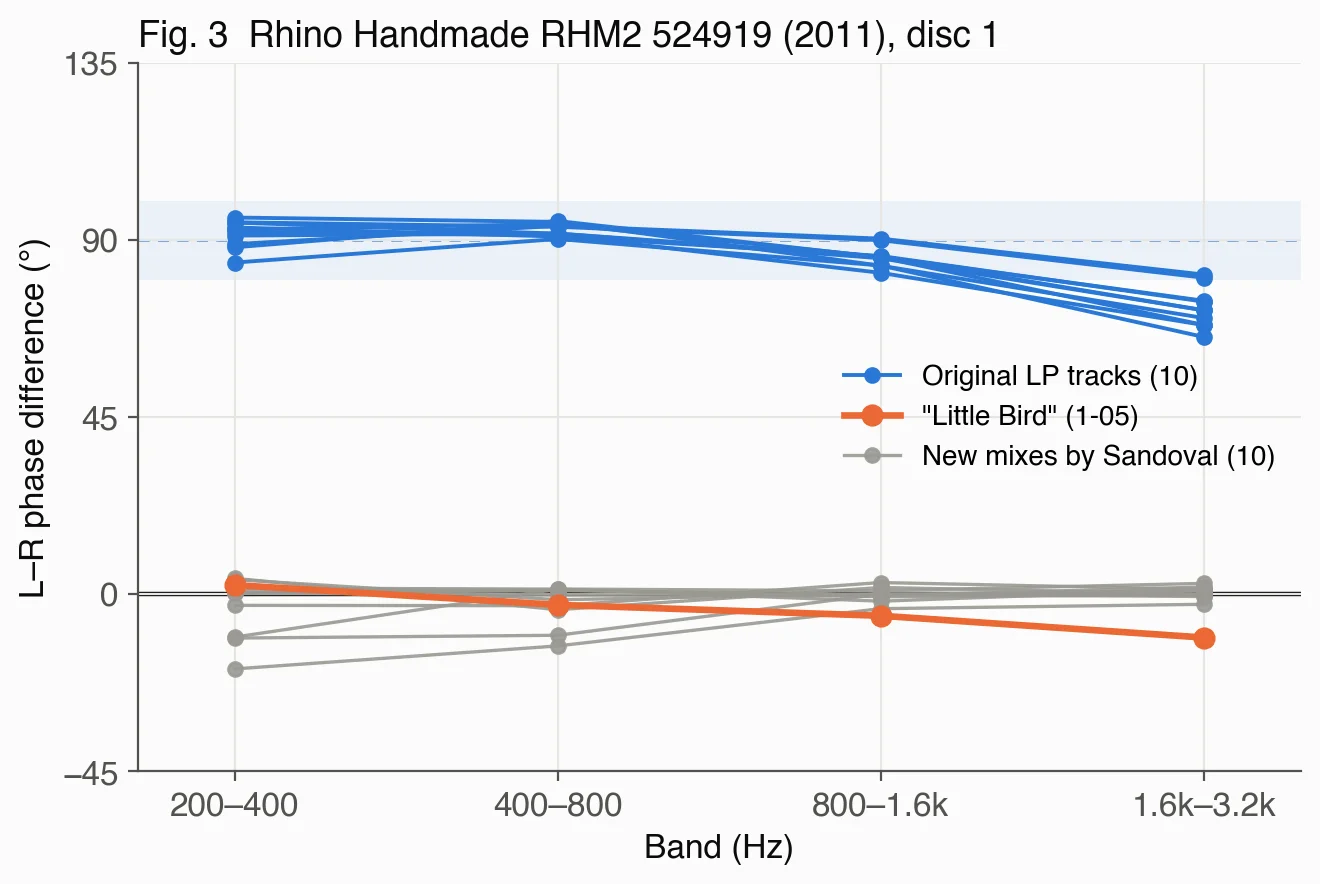
Figure 3: Per-band phase difference of the 11 LP tracks on the Rhino CD and of Sandoval’s new mixes (the CSG tracks line up at 90°)
図 3 が、1枚目の全曲の結果です。オリジナル LP の 11曲のうち、10曲が CSG の型でした。200〜3200 Hz の位相差は +65° から +96°、相関は −0.01 から +0.03、左右の差が最小になる回転は 10曲とも +90° です。例外は1曲だけ、「Little Bird」です。位相差は −11° から +2°、相関は +0.33、回転は 0°。LP で「Little Bird」に CSG 処理の痕跡がなかったのと同じく、この CD でも「Little Bird」は例外です。
Figure 3 shows the results for every track on disc one. Of the 11 tracks from the original LP, 10 have the CSG pattern. The phase difference at 200–3200 Hz runs from +65° to +96°, the correlation from −0.01 to +0.03, and the rotation that minimizes the left-right difference is +90° for all 10. The one exception is “Little Bird”: phase difference −11° to +2°, correlation +0.33, rotation 0°. Just as the LP showed no trace of CSG processing on “Little Bird”, the track is the exception on this CD as well.
「Turn Around」では、200〜3200 Hz の位相差は +68° から +95°、一貫性は 0.64 から 0.79 でした。高い帯域では位相差が小さくなり、3.2〜6.4 kHz で +59°、6.4〜12.8 kHz で +35° でした。右チャンネルを +90° 回すと、左右の差は −3.2 dB で最小になります。
On “Turn Around”, the phase difference at 200–3200 Hz is +68° to +95°, with coherence from 0.64 to 0.79. The phase difference shrinks in the higher bands: +59° at 3.2–6.4 kHz and +35° at 6.4–12.8 kHz. Rotating the right channel by +90° brings the left-right difference to its minimum at −3.2 dB.
この CD には、Sandoval がマルチトラックから新しくミックスした曲も入っています。それらはすべて、ふつうのステレオ・ミックスの型でした。位相差は 0° 付近で、相関は +0.40 から +0.96 です。同じ曲同士で比べると、違いがはっきりします。
The CD also includes tracks that Sandoval newly mixed from the multitracks. All of them have the pattern of an ordinary stereo mix: phase difference near 0°, correlation from +0.40 to +0.96. Comparing the same song in both forms makes the difference plain.
- 1-03 の「Deep Water」は +93° から +74° で、左右の差が最小になる回転では 7.2 dB 下がります。2-01 の同じ曲の alternate version は 0° 付近です
- “Deep Water” (1-03) reads +93° to +74°, and at the rotation that minimizes the left-right difference it drops by 7.2 dB. The alternate version of the same song (2-01) is near 0°
- 1-09 の「Love Can Fall」は +84° から +65° です。2-02 の alternate mix は 0° 付近です
- “Love Can Fall” (1-09) reads +84° to +65°. The alternate mix (2-02) is near 0°
ブックレットの 31頁には、Warner Bros. のテープ箱の写真があります。記入票には「8trk MASTER」とあり、11曲が LP とは違う曲順で並んでいます。8トラックのマルチトラック・マスターなら、ミックス前の素材ですから、CSG を通した音は入っていないはずです。新ミックスがすべて 0° 付近だったこととも、この読みは合います。一方で、CSG の型が出た 10曲は、ミックスを終えたあとの別のテープから取られたと考えるのが自然です。
Page 31 of the booklet has a photo of a Warner Bros. tape box. The label reads “8trk MASTER” and lists the 11 songs in an order different from the LP. If this is the 8-track multitrack master, it is pre-mix material, so it should contain nothing that passed through CSG. That reading also fits the fact that all the new mixes sat near 0°. The 10 tracks that showed the CSG pattern, on the other hand, were most naturally taken from a different tape, one made after the mix.
ここで少し考えてみましょう。CSG 処理は、1968年に Herschberg がミックスしたあとのテープに、すでにかかっていたと考えられます。Rhino が使ったのがプロダクション・マスターなのか、カッティング・マスターやそのコピーなのかは CD からは分かりませんが、どれであっても、Rhino が復刻のときに加えたものでも、1968年に溝を刻むときに初めて加えられたものでもありません。
Let me pause on this for a moment. The CSG processing appears to have been already present on the tape after Herschberg’s 1968 mix. Whether Rhino used the production master, the cutting master, or a copy of either cannot be told from the CD. Whichever it was, though, the processing was neither something Rhino added during the reissue nor something first applied when the grooves were cut in 1968.
同様に、2枚目の CD も解析してみます。英国の Now Sounds が 2021年11月に出した 8枚組 Turn Around: The Complete Recordings 1964-1970 (QCRNOWBX58) です。測ったのは、その Disc 5 です。クレジットでは Alec Palao が編纂・転写・マスタリングを担当し、Warner Music UK からのライセンスとあります。この 11曲を同じ方法で測ると、結果は Rhino 盤とまったく同じでした。10曲が CSG の型で、「Little Bird」だけが 0°。帯域ごとの位相差は 20 kHz までの7帯域で Rhino 盤と 1° 以内です。
I analyzed the second CD the same way. It is the 8-disc set Turn Around: The Complete Recordings 1964-1970 (QCRNOWBX58), released by Now Sounds in the UK in November 2021, and I measured its Disc 5. The credits say Alec Palao compiled, transferred, and mastered it, under license from Warner Music UK. Measuring these 11 tracks by the same method gave results identical to the Rhino disc: 10 tracks with the CSG pattern and only “Little Bird” at 0°. The per-band phase differences are within 1° of the Rhino disc across all seven bands up to 20 kHz.
ここまで一致するなら同じデータではないか、と考えて波形そのものを照合しました。「Turn Around」では、サンプルの 98.1% が完全に一致し、頭をそろえたあとの残差は −69.8 dB、利得の比は 1.00000 でした。違いは曲の頭と尻の無音の長さだけです。2枚の CD は、同じディジタル・データから作られています。
A match that close made me wonder whether they were the same data, so I compared the waveforms themselves. On “Turn Around”, 98.1% of the samples matched exactly, the residual after aligning the starts was −69.8 dB, and the gain ratio was 1.00000. The only difference is the length of the silence at the beginning and end of the track. The two CDs were made from the same digital data.
3枚目の Magic Hollow (2005年) には、Bradley’s Barn の LP 収録曲が3曲入っています。「Turn Around」「Deep Water」「Love Can Fall A Long Way Down」の3曲とも CSG の型で、位相差の数値は Rhino 盤と同じでした。音量と EQ には違いがありますが、左右の位相差は 20 kHz まで Rhino 盤と 1° 以内で一致します。別のテープ再生からの転写なら、位相差までここまでそろうことはないはずです。2005年・2011年・2021年の CD 3枚は、1つの転写から作られていると考えられます。どれが元なのか、Warner の保管庫にある同じファイルなのか、後の盤が先の盤を流用したのかは、音からは判別できません。つまりこの3枚は、CSG と「Little Bird」の例外を確かめる証拠としては、1つと数えるべきものです。
The third CD, Magic Hollow (2005), contains three of the Bradley’s Barn LP tracks: “Turn Around”, “Deep Water”, and “Love Can Fall A Long Way Down”. All three have the CSG pattern, and the phase-difference figures are the same as on the Rhino disc. The level and EQ differ, but the left-right phase difference matches the Rhino disc within 1° all the way to 20 kHz. Had it been a transfer from a separate tape playback, the phase differences would not line up this closely. The three CDs from 2005, 2011, and 2021 appear to have been made from a single transfer. Which one is the source, whether they share the same file in Warner’s vault, or whether later releases reused earlier ones, cannot be told from the audio. As evidence for CSG and the “Little Bird” exception, then, these three discs should count as one.
この3枚とは別の転写から作られた CD が、もう1枚あります。Warner Bros. Records の日本盤、WPCP-5253 (1993年3月25日) です。Discogs に登録されている範囲では、このアルバムの CD として最も早いものです。この CD は、Rhino 盤より約 0.38% 遅く再生されていて、曲が進むにつれて2枚のずれが一定の割合で広がっていきます。同じディジタル・データから作られたのなら、この速度差は出ません。どちらの速度が正しいのかは分かりません。もう1つ、この CD は左右のチャンネルが逆になっていて、Rhino 盤や LP と比べると、音像が左右に反転しています。左右を入れ替えたうえで同じ方法で測ると、「Little Bird」以外の 10曲で、200〜3200 Hz の位相差は +90° 前後でした。左右の差が最小になる回転も 90° 前後です。「Little Bird」には、ここでも CSG の型がありません。結果は Rhino 盤と同じです。CSG と「Little Bird」の例外は、LP の盤起こしに加えて、2005〜2021年の転写とは独立したこの 1993年の CD でも確かめられたことになります。
There is one more CD, made from a transfer separate from those three: the Japanese release on Warner Bros. Records, WPCP-5253 (March 25, 1993). As far as the Discogs listings go, it is the earliest CD of this album. This CD plays about 0.38% slower than the Rhino disc, and the offset between the two widens at a constant rate as a track proceeds. Had they been made from the same digital data, this speed difference would not appear. Which speed is the correct one, I do not know. One more thing: the left and right channels on this CD are reversed, so compared with the Rhino disc and the LP, the stereo image is mirrored left to right. After swapping the channels and measuring by the same method, the 10 tracks other than “Little Bird” show a phase difference of around +90° at 200–3200 Hz. The rotation that minimizes the left-right difference is also around 90°. “Little Bird” once again shows no CSG pattern. The results are the same as on the Rhino disc. CSG and the “Little Bird” exception are thus confirmed not only by my needle drop of the LP but also by this 1993 CD, which is independent of the 2005–2021 transfer.
このアルバムの CD には、ほかに 1995年の米・欧盤 (7599-26887-2)、1998年の日本盤 (WPCR-1959)、2002年の Collectors’ Choice 盤 (CCM-317-2) がありますが、どれも所有していません。それらが WPCP-5253 と同じ転写なのか、2005年以降の CD と同じなのか、また別の系統なのかは、特定できていません。いつか入手できたときに、同じ方法で測ってみようと思います。
Other CDs of this album exist: the 1995 US and European release (7599-26887-2), the 1998 Japanese release (WPCR-1959), and the 2002 Collectors’ Choice release (CCM-317-2). I own none of them. Whether they share the transfer of WPCP-5253, that of the CDs from 2005 onward, or belong to yet another lineage, I have not been able to determine. If I ever get hold of them, I intend to measure them the same way.
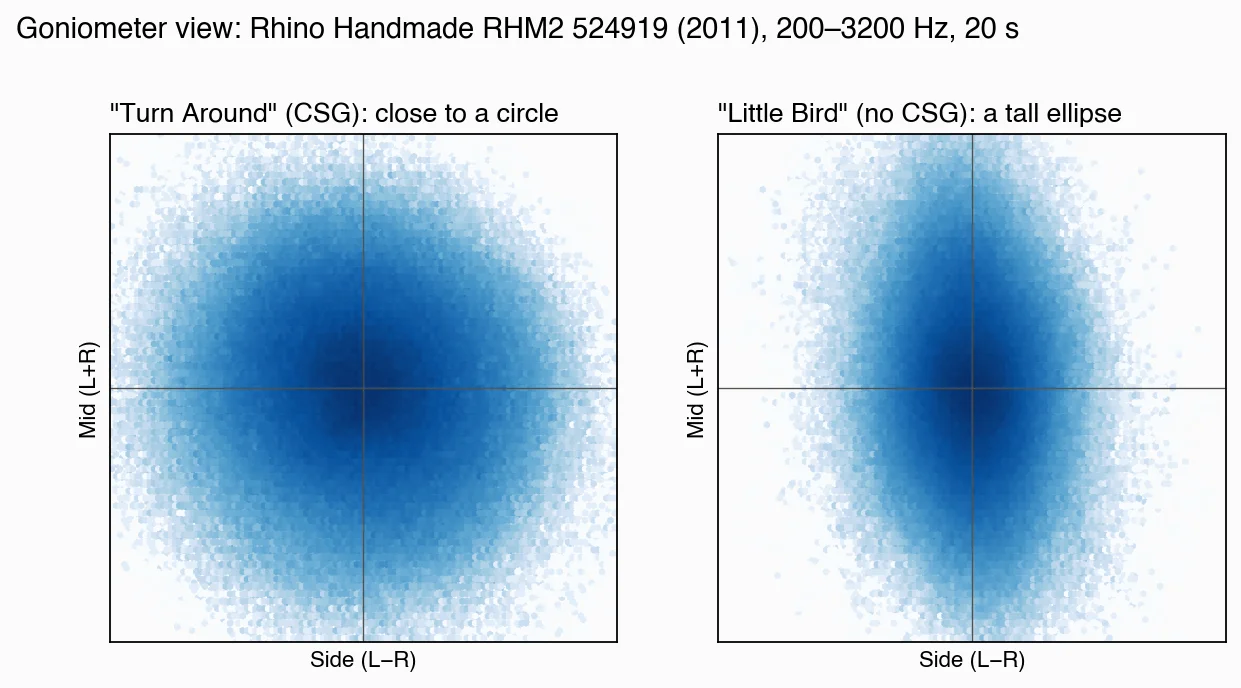
Figure 4: Goniometer display of “Turn Around” (with CSG) and “Little Bird” (without CSG) from the Rhino CD (200–3200 Hz, 20 seconds)
位相差を、折れ線とは別の形でも見ておきます。図 4 は、Rhino 盤の「Turn Around」と「Little Bird」を、ゴニオメータ (リサージュ表示) で描いたものです。縦軸は左右の和 (Mid、L+R)、横軸は左右の差 (Side、L−R) で、200〜3200 Hz の成分の 20秒間を重ねています。左右に同じ波形で入った音は、差がゼロになるので、縦の線として現れます。左右の位相が 90° ずれた音は、和と差が同じ大きさになるので、円に近づきます。CSG の「Turn Around」はほぼ円で、CSG のない「Little Bird」は縦長の楕円です。90° と 0° の違いが、この1枚でも見て取れます。
Let me look at the phase difference in a form other than a line plot. Figure 4 shows “Turn Around” and “Little Bird” from the Rhino disc on a goniometer (Lissajous display). The vertical axis is the sum of left and right (Mid, L+R), the horizontal axis is their difference (Side, L−R), and 20 seconds of the 200–3200 Hz content are overlaid. A sound recorded with the same waveform in both channels has zero difference, so it appears as a vertical line. A sound whose left and right are 90° apart has a sum and a difference of equal magnitude, so it approaches a circle. “Turn Around” with CSG is nearly a circle, while “Little Bird” without CSG is a tall, narrow ellipse. The difference between 90° and 0° can be seen in this single figure as well.
測るだけでなく、実際に聴いてもみました。右チャンネルを +90° 回し戻した「Turn Around」は、ヴォーカルが中央に締まります。元の音源で左から右を引くと、ヴォーカルがはっきり残り、全体に曇った、元気のないモノーラル音源のように聞こえます。回し戻した音源で同じことをすると、ヴォーカルはほぼ消えます。測定結果と耳の印象が一致しました。左右の差が曇って聞こえるのは、高い帯域では位相差が小さく (6.4〜12.8 kHz で +35°)、引き算で高域だけが打ち消されるためと考えられます。
Besides measuring, I also listened. On “Turn Around” with the right channel rotated back by +90°, the vocal tightens into the center. Subtracting right from left on the original leaves the vocal clearly audible, and the whole thing sounds like a dull, lifeless mono recording. Doing the same on the rotated-back version makes the vocal all but disappear. The measurements and what I heard agree. The left-minus-right signal probably sounds dull because the phase difference is smaller in the high bands (+35° at 6.4–12.8 kHz), so the subtraction cancels only the treble.
冒頭の疑問に戻ります。なぜ中央の声が浮遊して聞こえ、首を向けると位置が動くのか。あくまで仮説ですが、こう考えています。私たちが声の位置を聞き分けるとき、両耳に届く音の時間関係を使っています。左右に 90° の位相差があると、中央にあるはずの声の両耳への時間関係があいまいになります。そのため、頭を少し動かしただけで、定位が振れやすくなるのではないか。Mound が書いた「歌手が真横を向いて立っているよう」という印象とも、重なるところがあります。
Back to the question I started with. Why does the centered voice seem to float, and why does its position move when I turn my head? This is only a hypothesis, but here is how I think of it. When we locate a voice, we use the timing relationship between what reaches our two ears. With a 90° phase difference between left and right, that timing relationship for a voice that should sit in the center becomes ambiguous. A small movement of the head may then be enough to make the image wander. This also has something in common with Mound’s impression that the singer sounds like they are “standing almost perpendicular to the listener”.
LP を測った節で見たとおり、LP の位相差は 90° より少し大きく、しかも高い帯域ほど大きくなっていました。CD にはこの傾きがありませんでした。CSG は帯域によらず一定の角度を与えるので、周波数とともに増えるずれは、別の原因によるものです。
As seen in the section on measuring the LP, the LP’s phase difference was somewhat larger than 90°, and it grew with frequency. The CDs had no such slope. CSG applies a constant angle regardless of band, so an offset that increases with frequency has some other cause.
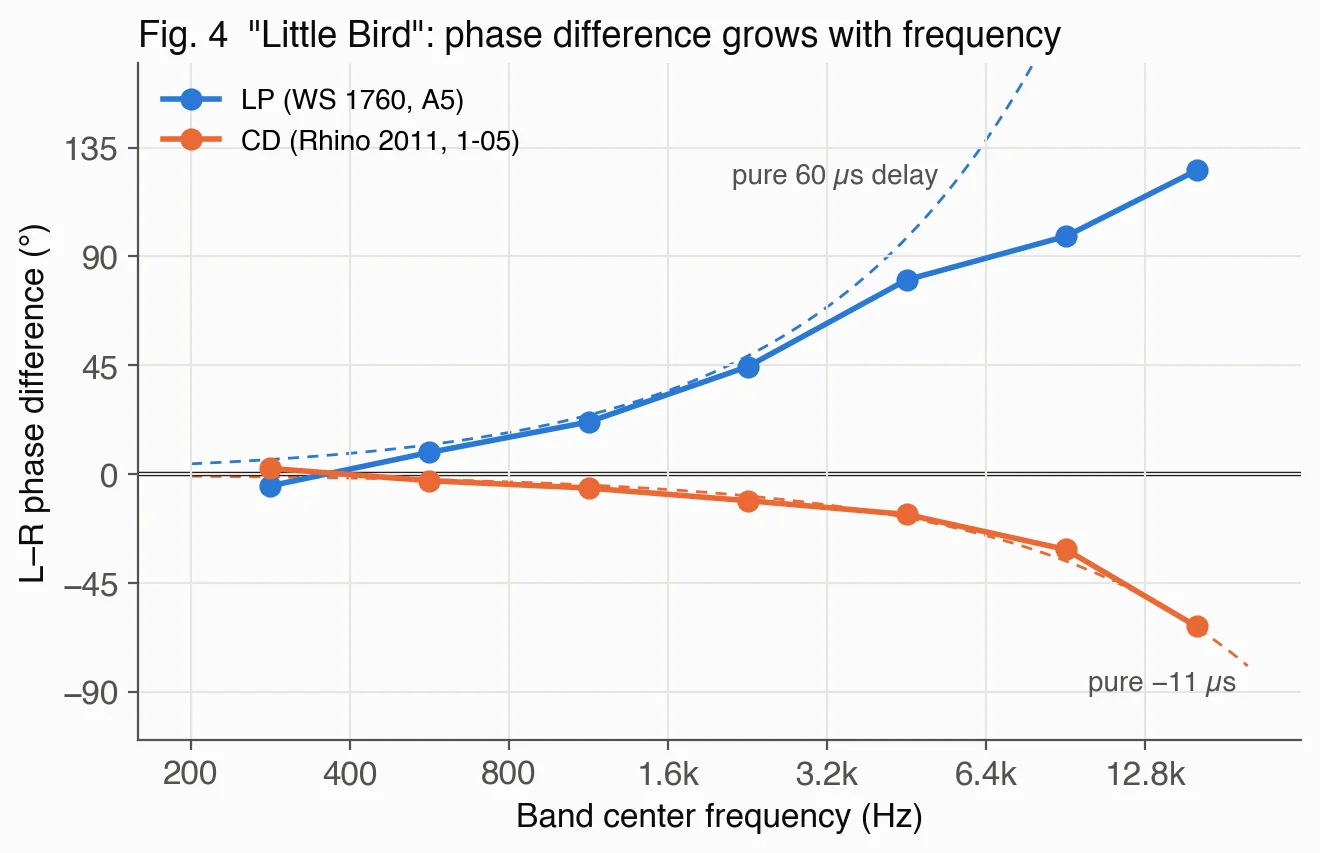
Figure 5: Slope of the phase difference against frequency, LP versus CD (“Little Bird”)
図 5 は「Little Bird」で LP と CD を重ねたものです。CSG の型がない曲なので、傾きだけが見えます。LP の位相差は高い帯域ほど増え、6.4〜12.8 kHz では +98° に達します。右チャンネルが左より一定の時間だけ遅れているなら、位相差は周波数に比例して増えます。この傾きから遅れを求めると、約 60 µs (0.00006秒) になりました。µs はマイクロ秒、100万分の1秒です。「Turn Around」でも、同じ量でした。
Figure 5 overlays the LP and the CD on “Little Bird”. Since the track has no CSG pattern, only the slope is visible. The LP’s phase difference grows in the higher bands and reaches +98° at 6.4–12.8 kHz. If the right channel lags the left by a constant time, the phase difference increases in proportion to frequency. Working back from this slope, the delay comes to about 60 µs (0.00006 seconds). A µs is a microsecond, one millionth of a second. “Turn Around” gave the same amount.
60 µs を補正すると、「Little Bird」の位相差は 6.4 kHz まで ±12° に収まります。「Turn Around」の位相差が +90° 前後にそろったのも、この補正のあとでした。ただし、6 kHz より上では、純粋な遅れの直線から外れます。その理由は分かっていません。
With 60 µs corrected, the phase difference of “Little Bird” stays within ±12° up to 6.4 kHz. It was also after this correction that “Turn Around” settled at around +90°. Above 6 kHz, however, the values depart from the straight line of a pure delay. I do not know why.
CD 側には、この遅れがありません。Rhino 盤にあるのは逆向きの小さなずれです。「Little Bird」では 2.3 kHz で −11°、9 kHz で −31°、16 kHz で −63°、時間にして約 −10 から −13 µs です。LP から CD を引いた差は、0.6〜4.5 kHz で +60 から 70 µs、それより上では 30 から 40 µs に縮みます。「Turn Around」も同じ傾向です。別の転写である 1993年の WPCP-5253 にも、60 µs の遅れはありません。右が約 5 µs 遅れる程度です。Rhino 盤では右が約 10 µs 進んでいましたから、2枚の CD の違いは、別々にテープを再生したときのアジマスの違いとして説明できます。
The CDs do not have this delay. What the Rhino disc has is a small offset in the opposite direction. On “Little Bird” it is −11° at 2.3 kHz, −31° at 9 kHz, and −63° at 16 kHz, which in time is about −10 to −13 µs. The LP minus the CD comes to +60 to 70 µs at 0.6–4.5 kHz and shrinks to 30 to 40 µs above that. “Turn Around” shows the same tendency. The 1993 WPCP-5253, a separate transfer, has no 60 µs delay either, only a right-channel lag of about 5 µs. On the Rhino disc the right channel led by about 10 µs, so the difference between the two CDs can be explained as a difference in azimuth between two separate tape playbacks.
60 µs は、再生側で生じたものではないか。私の再生系がそれだけ左右でずれているのなら、どの盤を測っても同じずれが出るはずです。手元に、5月に同じ環境で盤起こしした TRS-1001 (テスト・レコード) の B 面の音源が残っていました。30 Hz から 15 kHz までのトーンが入っていて、左右の振幅差は 0.0 から 0.5 dB です。左右の振幅がこれだけそろっていることから、トーンは横振動で刻まれているとみてよさそうです。横振動なら、左右の時間差はゼロになるはずです。アームとカートリッジは、5月から変えていません。
Could the 60 µs have arisen on the playback side? If my playback chain were offset that much between channels, every record I measure would show the same offset. I still had a transfer of side B of the TRS-1001 test record, made in May on the same setup. It carries tones from 30 Hz to 15 kHz, and the left-right level difference is 0.0 to 0.5 dB. With the channels this closely matched in level, the tones can safely be taken as laterally cut. For lateral modulation, the time difference between the channels should be zero. The arm and cartridge have not changed since May.
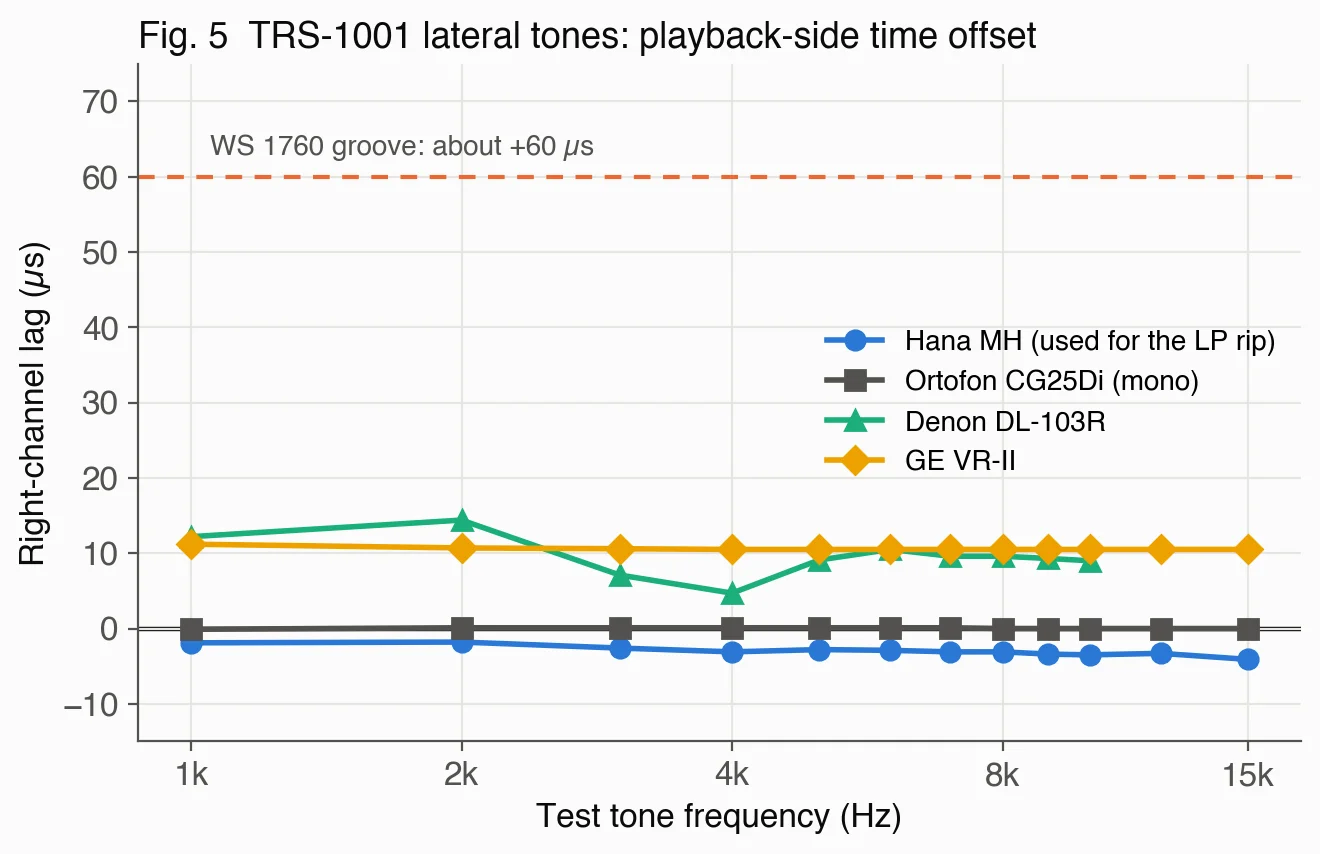
Figure 6: Left-right time offset per tone on TRS-1001 (Hana MH, CG25Di, DL103R, GEVRII)
図 6 がその結果です。Hana MH では、2〜15 kHz の時間ずれは −1.8 から −4.1 µs でした。モノーラル用カートリッジの CG25Di では、15 kHz まで 0.0 µs (±0.2°) です。フォノイコライザ、AD 変換、録音機に、左右差はありません。ほかのカートリッジでは、DL103R が +10 µs 前後、GEVRII が +10.5 µs の一定値でした。カートリッジの癖は、数 µs から 10 µs 程度です。
Figure 6 shows the result. With the Hana MH, the time offset at 2–15 kHz was −1.8 to −4.1 µs. With the CG25Di, a mono cartridge, it is 0.0 µs (±0.2°) all the way to 15 kHz. The phono stage, the A/D converter, and the recorder have no left-right difference. Among the other cartridges, the DL103R sat at around +10 µs and the GEVRII at a constant +10.5 µs. A cartridge’s own bias runs from a few µs to about 10 µs.
TRS-1001 と WS 1760 では、盤も、測った半径も違います。それでも、20倍の差と逆の符号を、再生系の癖で説明することはできません。60 µs の遅れは、WS 1760 の溝そのものに刻まれているとみてよさそうです。プレスの工程で左右の時間差が生じることはないので、この遅れが入ったのは、ラッカーを刻むまでのどこか、ということになります。
TRS-1001 and WS 1760 are different records, measured at different radii. Even so, a twentyfold difference with the opposite sign cannot be explained by the bias of the playback chain. The 60 µs delay can safely be taken as cut into the grooves of WS 1760 itself. Pressing does not introduce a left-right time difference, so the delay entered somewhere along the way to the cutting of the lacquer.
Measuring Another Record from the Same Period: Astral Weeks
では、溝に刻まれているとして、1968年秋の Warner Bros.-Seven Arts のカッティング設備には、いつもこの癖があったのでしょうか。それを確かめるには、同じ時期に同じ系列で刻まれた別の盤を測ればよいはずです。
Supposing it is in the grooves, then, did the Warner Bros.-Seven Arts cutting equipment of autumn 1968 always have this quirk? To check, I should be able to measure another record cut around the same time in the same lineage.
手元に Van Morrison の Astral Weeks がありました。WS 1768、米国のグリーン・ラベル盤です。ランアウトは 39435 WS 1768 4-1-C と 39436 WS 1768 3-1-C。マトリクスの番号は Bradley’s Barn の 39411 から 24番違いで、近い時期に作られた可能性があります。ジャケットに CSG の表記はありません。A面1曲目と4曲目を、同じ環境で盤起こししました。
I had Van Morrison’s Astral Weeks on hand: WS 1768, a US green-label pressing. The runouts read 39435 WS 1768 4-1-C and 39436 WS 1768 3-1-C. The matrix number is 24 away from the 39411 of Bradley’s Barn, so the two may have been made close in time. The jacket carries no CSG notice. I transferred the first and fourth tracks of side A on the same setup.
まず CSG のパターンはありませんでした。400〜3200 Hz の位相差は、1曲目が +8°、+2°、+6°、4曲目が +8°、+5°、+10°。相関は +0.64 と +0.89、左右の差が最小になる回転は 0° です。CSG は片方のチャンネル全体を回すので、処理されていれば中央の声は 90° 前後に出るはずですが、0° から 10° に収まっています。この2枚では、ジャケットの表記の有無と、溝の処理の有無が対応しています。
First, there was no CSG pattern. The phase differences at 400–3200 Hz were +8°, +2°, and +6° for track one and +8°, +5°, and +10° for track four. The correlations are +0.64 and +0.89, and the rotation that minimizes the left-right difference is 0°. CSG rotates one entire channel, so a processed record would put the centered voice at around 90°, but here it stays within 0° to 10°. On these two records, the presence or absence of the notice on the jacket corresponds to the presence or absence of processing in the grooves.
時間のずれのほうは、1曲目で +7 から 9 µs、4曲目で +10 から 20 µs でした。4曲目は高い帯域の一貫性が低く、値がばらついています。再生側の −3 µs を差し引いても、溝には約 +10 µs が残ります。WS 1760 の 60 µs の、およそ6分の1です。
As for the time offset, it was +7 to 9 µs on track one and +10 to 20 µs on track four. Track four has low coherence in the higher bands, and the values scatter. Even after subtracting the −3 µs of the playback side, about +10 µs remains in the grooves. That is roughly one sixth of the 60 µs on WS 1760.
2 枚のラッカーが同じカッティング室で刻まれたかどうかは分かりません。それでも、同じ系列でマトリクスが 24 番しか離れていない盤に出ないのですから、60 µs は Warner Bros.-Seven Arts の設備に常にあった癖ではなく、WS 1760 に固有のものと考えられます。ただし、それがプロダクション・マスターにあったのか、カッティング・マスターにあったのか、その回のカッティングの調整で入ったのかは、この2枚の比較では区別できません。
Whether the two lacquers were cut in the same cutting room, I do not know. Still, since the offset does not appear on a record from the same lineage only 24 matrix numbers away, the 60 µs appears to be particular to WS 1760 rather than a constant quirk of the Warner Bros.-Seven Arts equipment. Whether it was on the production master, on the cutting master, or introduced in the adjustments of that particular cutting session, however, cannot be distinguished by comparing these two records.
What Remains Unknown, and the Next Step
60 µs がどこで入ったのか。現時点の手持ちの盤や資料だけでは判断できませんが、可能性としては2つ考えられそうです。
Where did the 60 µs come in? I cannot decide that from the records and sources I have at hand now, but two possibilities seem conceivable.
1つ目は、テープは正常で、1968年のカッティング側で入った、という可能性です。テープ再生機のアジマス、途中の機器、カッターヘッドのどれかが、右チャンネルを 60 µs 遅らせたことになります。1993年の CD と、2005年以降の CD の元になった2回の転写では、正常なテープを正常な機器で再生したはずなので、どちらの CD にも出ないことになります。
The first is that the tape was fine and the offset entered on the cutting side in 1968. In that case, the azimuth of the tape machine, some device in the chain, or the cutter head delayed the right channel by 60 µs. The two transfers behind the 1993 CD and the CDs from 2005 onward would then have played a correct tape on correctly set-up equipment, so the delay would appear on neither CD.
2つ目は、テープ側が傾いていた、という可能性です。プロダクション・マスターがヘッドの傾いた機械で録られていて、1968年には標準の再生機でそのまま刻まれたとすると、ずれは溝に残ります。この2回の転写がどちらもテープに合わせてアジマスを調整していれば、ずれはどちらの CD にも出ません。この場合、傾いていたのはカッティング・マスターだけ、ということもありえます。
The second is that the tape side was skewed. If the production master had been recorded on a machine with a tilted head, and in 1968 it was cut as it was on a standard playback machine, the offset would remain in the groove. If both of these two transfers adjusted azimuth to match the tape, the offset would appear on neither CD. In this case, it is also possible that only the cutting master was skewed.
CSG の説明書は、テープのアジマスが完全でないと処理の効果が崩れる、と念を押しています。そして、ディスクに転写してしまえばその心配はない、とも書いています。
The Haeco instructions stress that the effect of the processing breaks down unless the tape azimuth is perfect. They also say that once transferred to disc, there is no such worry.
Once a C.S.G. processed tape has been transferred to disc, there is no danger … as a disc has no azimuth
C.S.G. 処理したテープをいったんディスクに転写してしまえば、危険はない。…ディスクにはアジマスがないからだ
Haeco "C.S.G. Instructions", p.4説明書が心配しているのは、処理したテープを再生するときのアジマスです。再生機のアジマスがずれていれば、そのずれは位相差として溝に刻まれ、ディスクにはアジマスがないので、以後は増えも減りもしません。この盤の 60 µs も、そうやって溝に残ったずれの一つかもしれません。どちらの可能性かを決める材料は、私の盤と CD の比較にはありません。1993年の日本盤 CD にもこの遅れがなかったことは、どちらの可能性とも矛盾しません。言えるのは、CD に 60 µs がないのが1回の転写の偶然ではなく、独立した2本目の転写でも同じだった、ということまでです。
What the instructions worry about is the azimuth when playing back a processed tape. If the playback machine’s azimuth is off, that error is cut into the groove as a phase difference, and since a disc has no azimuth, from then on it neither grows nor shrinks. The 60 µs on this record may be one such offset left in the groove. My comparison of the LP and the CDs holds nothing that can decide between the two possibilities. The fact that the 1993 Japanese CD also lacked this delay is consistent with both. All I can say is that the absence of 60 µs on CD is not a coincidence of a single transfer, since an independent second transfer gave the same result.
2つの可能性を分ける材料は、別のプレスにあります。私が X でこの 60 µs のことを投稿したところ、ハルさん (@hull_doronco) が反応をくださいました。WS 1760 の米国盤には、刻印の違う3種類があります。Discogs の登録によれば、Terre Haute 工場の「T」の刻印と 1A、Santa Maria の Ƨ と 1B (私の盤)、そして 1C です。ハルさんは 1C を Pitman 工場とし、3つすべてで同じずれが出るのなら、原因はマスターテープ側ではないか、と指摘してくださいました。3つが別々のラッカーから作られたかどうかは、登録からは確定できませんが、そう考えるのが自然です。
What could separate the two possibilities is another pressing. When I posted about this 60 µs on X, Hull-san (@hull_doronco) responded. The US pressings of WS 1760 come in three variants with different etchings. According to the Discogs entries, they are the “T” stamp of the Terre Haute plant with 1A, the Ƨ of Santa Maria with 1B (my copy), and 1C. Hull-san identified 1C as the Pitman plant, and pointed out that if all three show the same offset, the cause might lie on the master tape side. Whether the three were made from separate lacquers cannot be settled from the entries, but that is the natural reading.
@kohji405mi16 私もこのアルバムは大愛聴盤なので興味深いです。
— ハル (@hull_doronco) October 7, 2026
マト1A/1A(テラホート製)、1B/1B(サンタマリア製)、1C/1C(ピットマン製)の全部で同じなのかどうか(全部同じであればマスターテープ起因?)
Terre Haute 盤と Pitman 盤を将来入手できたら、あるいは、それらの盤起こし音源を提供してくださる方が現れたら、この記事と同じ方法で測ろうと思っています。
If I can obtain a Terre Haute pressing and a Pitman pressing in the future, or if someone offers needle drops of them, I plan to measure them by the same method as in this article.
3枚とも約 60 µs の遅れがあれば、ずれはラッカーを刻む前、テープかコピー側にあったことになります。1B の私の盤だけにあれば、Santa Maria 向けのラッカーを刻んだその回で入ったことになります。3枚がそれぞれ違う値なら、刻むたびに調整が違っていたということで、これもカッティング側です。結果が出たら、この節は書き直すつもりです。
If all three have a delay of about 60 µs, the offset was there before the lacquer was cut, on the tape or copy side. If only my 1B copy has it, it entered in the session that cut the lacquer for Santa Maria. If the three show different values, the adjustment differed with each cut, which again places it on the cutting side. Once the results are in, I intend to rewrite this section.
Closing
裏ジャケットの1行、”This recording employs the Haeco-CSG System” は、何だったのか。
What, then, was that single line on the back cover, “This recording employs the Haeco-CSG System”?
この1枚については、答えが出ました。溝には確かに、CSG の処理が刻まれていました。LP で測った2曲のうち「Turn Around」では、右チャンネルの位相が左より約 90° 遅れていました。説明書の推奨設定から計算した 90° と一致し、Mound の記述とも矛盾しません。同じ処理は、1993年・2005年・2011年・2021年の CD にもそのまま残っていました。CD では、オリジナル LP の 11曲のうち 10曲がこの型です。
For this one record, the answer is in. The CSG processing was indeed cut into the groove. Of the two tracks I measured on the LP, “Turn Around” had the right channel lagging the left by about 90°. That matches the 90° calculated from the recommended setting in the instructions, and it does not contradict Mound’s description. The same processing remained, untouched, on the CDs of 1993, 2005, 2011, and 2021. On the CDs, 10 of the 11 tracks from the original LP show this pattern.
そして、溝には別のものも刻まれていました。CSG とは無関係な、右チャンネルの 60 µs の遅れです。この遅れは、1993年の CD にも、2005年以降の CD にもありませんでした。近いマトリクスの Astral Weeks にも、同じ大きさのものはありませんでした。それがテープ側によるものなのか、カッティング工程によるものなのかは、別の工場でプレスされた盤を測るまで判断がつきません。「Little Bird」だけが処理されていない理由も、溝からも CD からも分かりません。
And something else was cut into the groove: a delay of 60 µs in the right channel, unrelated to CSG. This delay was on neither the 1993 CD nor the CDs from 2005 onward. Nor was anything of the same size on Astral Weeks, with its nearby matrix number. Whether it comes from the tape side or from the cutting process cannot be decided until a copy pressed at another plant is measured. Why “Little Bird” alone is unprocessed is also something neither the groove nor the CDs reveal.
余談ですが、左右の音量のバランスは、音源ごとに違っていました。LP (WS 1760) で測った2曲は、Rhino 盤より右チャンネルが 1.5〜2 dB 大きく、その差は帯域によって変わります。テスト・レコードで見た再生系の左右差 (0.5 dB 以内) では説明できない量です。1993年の日本盤 CD は逆に、Rhino 盤より左チャンネルが大きく、その差は帯域によらず平らで、曲ごとに 2〜6 dB 違います。どれが元のテープのバランスに近いのかは分かりません。これも今後の追加調査としたいところです。
As an aside, the balance of left and right levels differed from source to source. In the two tracks measured on the LP (WS 1760), the right channel is 1.5–2 dB louder than on the Rhino CD, and the difference varies with band. That is more than the left-right difference of the playback chain seen on the test record (within 0.5 dB) can explain. The 1993 Japanese CD goes the other way: its left channel is louder than on the Rhino CD, the difference is flat across bands, and it varies from track to track by 2–6 dB. Which of these is closest to the balance on the original tape, I do not know. This is another thing I would like to take up in a further investigation.
何年も聴いてきて、声が浮遊して聞こえるのはなぜだろう、と思っていました。確かめられたのは位相差のほうだけで、浮遊感との結びつきは、まだ私の仮説です。それでも、90° の位相差がその理由だとすれば、手がかりは裏ジャケットに最初から書いてあったことになります。なぜ 1968年に、レコード会社がこんな処理を必要としたのか。その事情は、互換ステレオ盤シリーズの続きで扱います。現時点で公開済みの第1回はこちらをご覧ください。
For years I had listened and wondered why the voice seemed to float. What I was able to confirm is only the phase difference; its link to the floating sensation is still my hypothesis. Even so, if the 90° phase difference is the reason, the clue had been printed on the back cover from the start. Why, in 1968, did a record company need processing like this? I will take up those circumstances in the continuation of the series on compatible stereo records. The first installment, already published, is here.
References
- Holzer Audio Engineering Corporation, “C.S.G. Instructions” (instruction manual, 8 pages, undated. 14110 Aetna Street, Van Nuys). PDF: https://www.onamrecords.com/sites/default/files/images_new/A%26M%20Studios/HAECO_CSG%20Instructions.pdf (linked from the A&M Studios history page on onamrecords.com, https://www.onamrecords.com/labels/a-m-studios/146494/history)
- Josh Mound, “Removing Haeco-CSG Processing (Sort Of)”, Audiophile Style (Club TBVO), 2023-10-17
- The Beau Brummels, Bradley’s Barn, Warner Bros.-Seven Arts WS 1760 (US, 1968, white-label promo). Discogs release 4207512. The commercial green-label pressing is Discogs release 2568633, and the Terre Haute pressing is Discogs release 15954116
- The Beau Brummels, Bradley’s Barn, Warner Bros. Records WPCP-5253 (CD, Japan, 1993-03-25). Discogs release 5684292
- The Beau Brummels, Magic Hollow, Rhino Handmade RHM2 7892 (4CD, 2005). “Deep Water”, “Love Can Fall A Long Way Down”, and “Turn Around” on Disc 4. Discogs release 1680950
- The Beau Brummels, Bradley’s Barn, Rhino Handmade RHM2 524919 (2CD, 2011-03-21). Booklet p.31 (photograph of the tape box), pp.38–39 (credits). Discogs release 5378477
- The Beau Brummels, Turn Around: The Complete Recordings 1964-1970, Now Sounds QCRNOWBX58 (8CD, UK, 2021-11-12), Disc 5. Discogs release 20976250
- Van Morrison, Astral Weeks, Warner Bros.-Seven Arts WS 1768 (US, green label). Discogs release 3536289
- Simon & Garfunkel, “Mrs. Robinson”, Bookends, Columbia, 1968 (control for the phase-difference analysis). The measurement used a rip of the 2001 Columbia/Legacy CK 66003. Discogs release 2645625
- TRS-1001 (test record), lateral-cut tones 30 Hz–15 kHz on side B (check of the left-right difference of the playback chain)
- Needle drops and analysis: the author (Michell Orbe SE, SME Series IV, Hana MH, Musical Surroundings SuperNova II, Benchmark LA4, KORG DS-DAC-10R, 24 bit / 96 kHz). CG25Di, DL103R, and GEVRII were also used to check the playback chain