This article is presented in Japanese and English on the same page.
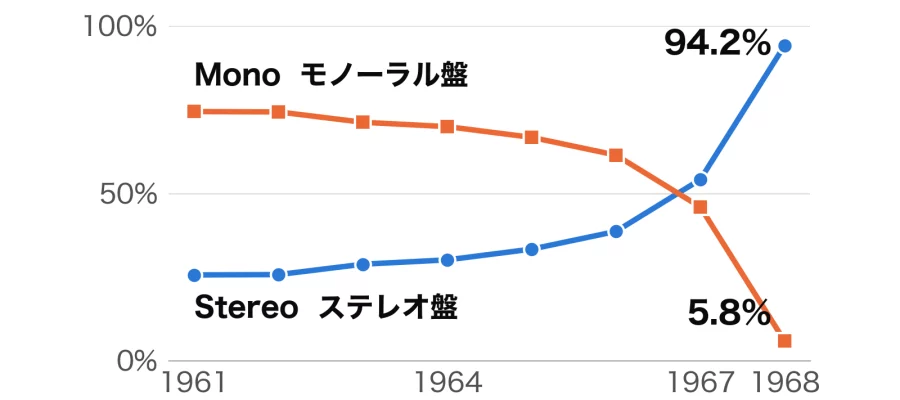
- ラック業者を除く小売の LP 販売で、ステレオ盤の枚数比は 1961年の 25.6% から 1966年の 38.6% まで、伸びはゆるやかなままだった。それが 1967年に 54.1%、1968年に 94.2% へと一気に動いた。
- 二重のプレス・在庫・請求の費用軽減のため、レーベル側はステレオ盤への一本化を望んだが、容易ではなかった。英 Philips や米 Mercury が兼用の盤を試みたが、技術詳細は不明。オールステレオへの切り替えは多くのレーベルに重い負担だった、との意見もあった。
- 売れているレコードプレーヤのうちステレオ機が 61% まできたが、針メーカーは「古いモノーラル機でステレオ盤をかけると傷めるおそれがある」と警告した。売れ筋のモノーラル針のうち、ステレオ盤を安心してかけられるのは約半分という指摘もあった。
- 二重在庫を解消しようと、1967年5月に CBS と RCA はモノーラル盤をステレオ盤と同じ値段に上げた。だが CBS は、モノーラル盤の客が離れたまま、ステレオ盤に移っていないと見た。そこで CBS は同年夏、ステレオ盤は今日のモノーラル機でかけてよいと宣言した。
- 1968年初めから、大手でモノーラル LP の製造停止が始まった。 1月には ABC などが停止をすでに発表し、MGM と WB も続いた。 8月には RCA も旧録音を除いて打ち切った。ただし ABC・MGM・WB は放送局向けのモノーラル盤を残した。
- In LP sales at retail outlets other than rack jobbers, the share of stereo records by units grew only slowly, from 25.6% in 1961 to 38.6% in 1966. Then it jumped to 54.1% in 1967 and 94.2% in 1968.
- To cut the cost of duplicate pressing, stocking, and invoicing, the labels wanted to switch to stereo records only, but that was not easy. Philips in Britain and Mercury in the United States tried records meant for both kinds of phonograph, but the technical details are unknown. There was also a view that the switch to all-stereo was a heavy burden on many labels.
- Stereo phonographs had reached 61% of phonographs sold, but stylus makers warned that playing stereo records on old mono phonographs might damage the records. It was also pointed out that stereo records could safely be played with only about half of the best-selling mono styli.
- To end the double inventory, CBS and RCA raised the price of mono records to that of stereo records in May 1967. But CBS judged that the mono customers had left and had not moved to stereo. So in the summer of that year, CBS declared that stereo records could be played on the mono phonographs of the day.
- From early 1968, the majors began to discontinue mono LPs. In January, ABC and others had already announced that they were stopping, and MGM and WB followed. In August, RCA dropped them too, except for vintage material. ABC, MGM, and WB kept mono records for radio stations, however.
変更履歴 / Revision History
- 2026年10月17日: 初版公開
- October 17, 2026: Initial publication
Half as Many Record Rack Divider Cards
1967年7月1日付で、レコード店のラックに差す仕切りカードの業者 Gopher Products が、取引先に告知を出しました。モノーラル用とステレオ用に2種類あったカードを、兼用の1種類にするという知らせです。理由として挙げられたのは、レコード会社によるモノーラル盤とステレオ盤の値段の変更でした。
Gopher Products, a supplier of the divider cards that record stores place in their racks, sent a notice dated July 1, 1967, to its customers. It said that the two kinds of card, one for mono and one for stereo, would be replaced by a single card for both. The reason given was the change in the prices of mono and stereo records by the record companies.
In view of the price changes by the Record Manufacturers in Mono & Stereo Albums, we are going to change our policy of having TWO kinds of Divider Cards (Mono & Stereo).
(…) The same Card will be used for both Mono and Stereo—a SAVINGS to you since the number of cards used in your racks will be cut by 50%.
レコード各社によるモノーラル・アルバムとステレオ・アルバムの価格変更を受け、当社は仕切りカードをモノーラル用とステレオ用の2種類そろえる方針を改めます。
(…) 同じカードをモノーラルにもステレオにも使います。ラックで使うカードの枚数が半分になりますので、お客様の節約になります。
Billboard, August 19, 1967, Section II (International Music-Record Directory), p. 121(広告)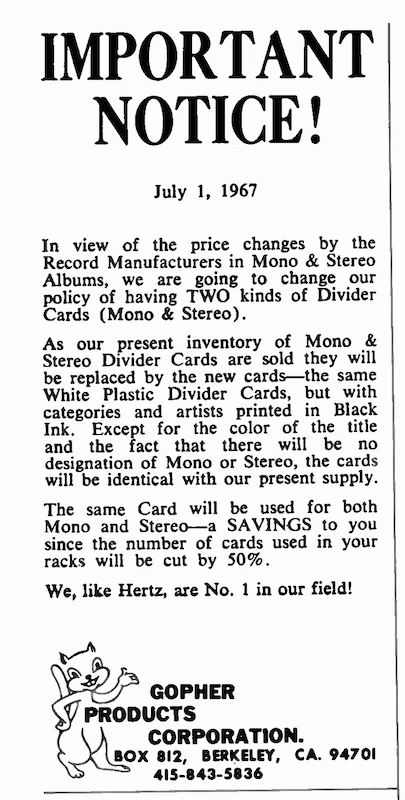
Figure 1: The notice from Gopher Products Corporation in Billboard, August 19, 1967, Section II (International Music-Record Directory), p.121. It is dated July 1, 1967
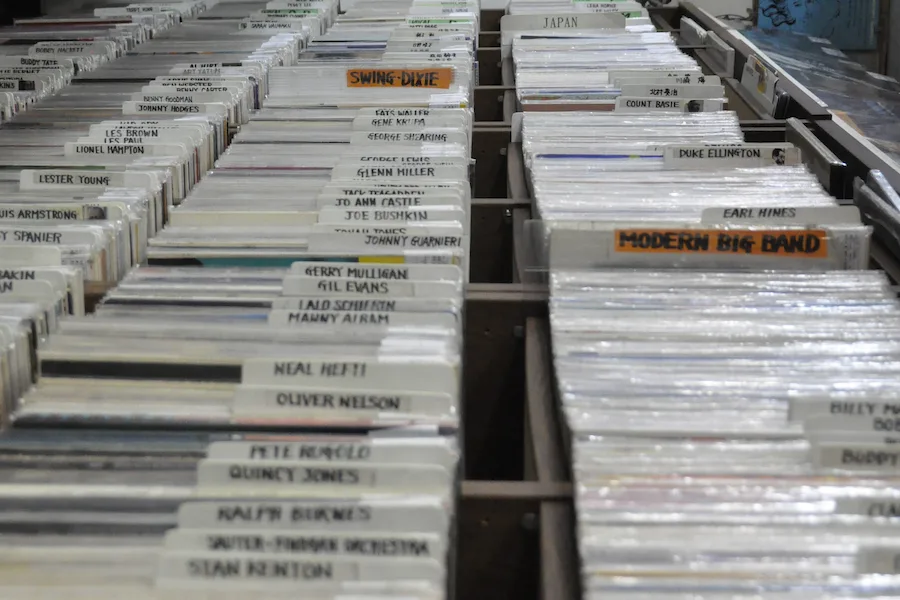
SWING-DIXIE・MODERN BIG BAND) とアーティスト名の手書きの仕切りで、Gopher が扱ったような業者の印刷の既製品とは種類が違う。Figure 2: An example of divider boards in a record store. Handwritten dividers for genres (
SWING-DIXIE, MODERN BIG BAND) and artist names, which I photographed on December 15, 2011, at Kawasaki TOPS, a used record store in Kawasaki, Kanagawa, that no longer exists. They are a different kind from the printed, ready-made dividers from suppliers like Gopher.それまでの Gopher の仕切りカードには Mono と Stereo の表示があり、店はモノーラル用とステレオ用の2組を立てていました。それを1組にするので、枚数が半分になります。告知によれば、新しいカードは今までと同じ白いプラスチックの仕切りカードで、ジャンル名とアーティスト名は黒のインクで印刷されます。タイトルの色と、Mono・Stereo の表示が無くなることのほかは、今のカードと同じだと書かれています。 9月には、余ったステレオ用のカード(12×14インチ、赤い文字に stereo の語が入ったもの)を1枚20セント、送料込みで売り切る案内広告も出しています。 2組のカードが並ぶ売り場とは、どんな姿だったのでしょうか。
Until then, Gopher’s divider cards had carried the words Mono and Stereo, and stores had set up two sets, one for mono and one for stereo. Making them one set halves the number of cards. According to the notice, the new cards are the same white plastic divider cards as before, with the genre and artist names printed in black ink. Apart from the color of the title and the removal of the Mono and Stereo markings, it says, they are the same as the current cards. In September, Gopher also ran a classified ad to sell off the leftover stereo cards (12×14-inch, with the word stereo in red lettering) at 20 cents each, postage included. What did a sales floor with two sets of cards side by side look like?
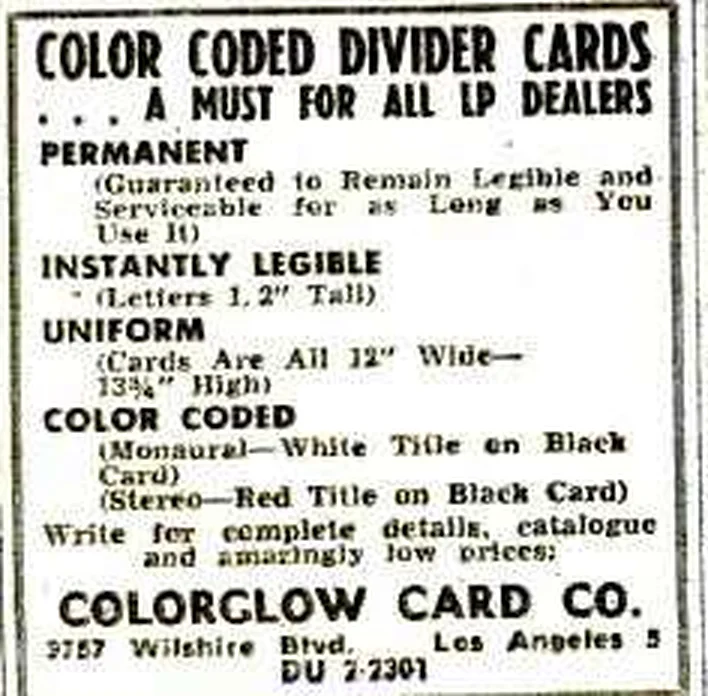
Figure 3: An advertisement for the divider cards of Colorglow Card Co. of Los Angeles, in Billboard, February 8, 1960, p.16. This maker produced two kinds of divider card: red lettering on black for stereo, and white lettering on black for mono. All were 12 inches wide and 13¾ inches high.
モノーラルとステレオの両方の仕切りが写る写真、特に当時の米国のレコード店のものは、残念ながらまだ見つけられていません。ただ、米国ではないのですが、隣国カナダはオンタリオ州ロンドンのレコード店を写した貴重な1枚を見つけることができました。 Facebook のグループ「If You Grew Up In London, Ontario, You Will Remember When…」への投稿にあるものです。写真は転載せず、リンクと筆者の描写にとどめます。
Unfortunately, I have not yet been able to find a photograph showing both mono and stereo dividers, particularly one of an American record store of the period. The one valuable photograph I did find is not of an American store but of one in neighboring Canada, a record store in London, Ontario. It is in a post to the Facebook group “If You Grew Up In London, Ontario, You Will Remember When…”. I will not reproduce the photograph here, and limit myself to the link and my own description.
手前のラックには STEREO 33 1/3 POPULAR VOCALISTS と書かれた仕切りが立っています。そこに Best Of The Beach Boys の Duophonic ステレオ盤(1966年)と、Perry Como の Hello Young Lovers のステレオ盤(1967年)が入っています。中段にも STEREO の仕切りが並び、SACRED、MISCELLANEOUS、SHOWTIME、CLASSICAL といったジャンル名が読めます。その奥には HI-FI 33 1/3 CLASSICAL の仕切りがあり、カナダでしか出なかった Scots Wha’ Ha’e(1963年)が入っています。さらに奥の HI-FI の仕切りには、Louis Armstrong の Hello, Dolly!(1964年)が見えます。撮影は 1967年ごろと筆者は推定しています。
In the rack in the foreground stands a divider reading STEREO 33 1/3 POPULAR VOCALISTS. Behind it are the Duophonic stereo record of Best Of The Beach Boys (1966) and the stereo record of Perry Como’s Hello Young Lovers (1967). The middle row also has a line of STEREO dividers, and genre names such as SACRED, MISCELLANEOUS, SHOWTIME, and CLASSICAL can be read. Behind them is a divider reading HI-FI 33 1/3 CLASSICAL, and behind it sits Scots Wha’ Ha’e (1963), which was released only in Canada. Behind a HI-FI divider further back, Louis Armstrong’s Hello, Dolly! (1964) can be seen. I estimate that the photograph was taken around 1967.
同じジャンル名の仕切りが、ステレオ用と HI-FI 用の2組ある。これが二重在庫の売り場の姿で、Gopher の告知が「半分になる」と書いたカードの、半分になる前の姿と読めます。モノーラル側の仕切りには MONO の語が無く、HI-FI と書かれている点も目を引きます。カナダの店の写真なので、米国のレコード店とは事情が異なるところもあったのかもしれませんが、ともあれ、二重在庫が店でどう見えていたか、その貴重な実例としてリンク先の写真をご覧ください。
Dividers with the same genre names come in two sets, one for stereo and one for HI-FI. This is what a sales floor with double inventory looked like, and it can be taken as showing the cards before the halving that Gopher’s notice announced with the words “cut by 50%.” It is also striking that the mono dividers do not carry the word MONO but read HI-FI. Since this is a Canadian store, some circumstances may have differed from those of American record stores, but in any case, please follow the link and see the photograph as a rare example of how double inventory looked in a store.
前回の記事では、1958年に CBS が互換ステレオ盤の方式を発表したものの、業界で採用されることはなく、大手がモノーラル盤とステレオ盤の二重在庫を選んだところまでを見ました。 Billboard が 1969年に載せた、ステレオ盤とモノーラル盤の販売比率の表によれば、1961年に 25.6% だったステレオ盤の枚数比は、1966年でも 38.6% でした。 LP の6割以上がまだモノーラル盤だったことになります。
In the previous installment, I followed the story up to the point where CBS announced its compatible stereo record system in 1958 but the industry did not adopt it, and the majors chose a double inventory of mono and stereo records. According to a table of the sales ratio of stereo to mono records that Billboard published in 1969, the share of stereo records by units was 25.6% in 1961 and still 38.6% in 1966. That means more than 60% of LPs were still mono records.
この表を 1968年まで読み進めてみます。
I will follow the figures in this table through 1968.
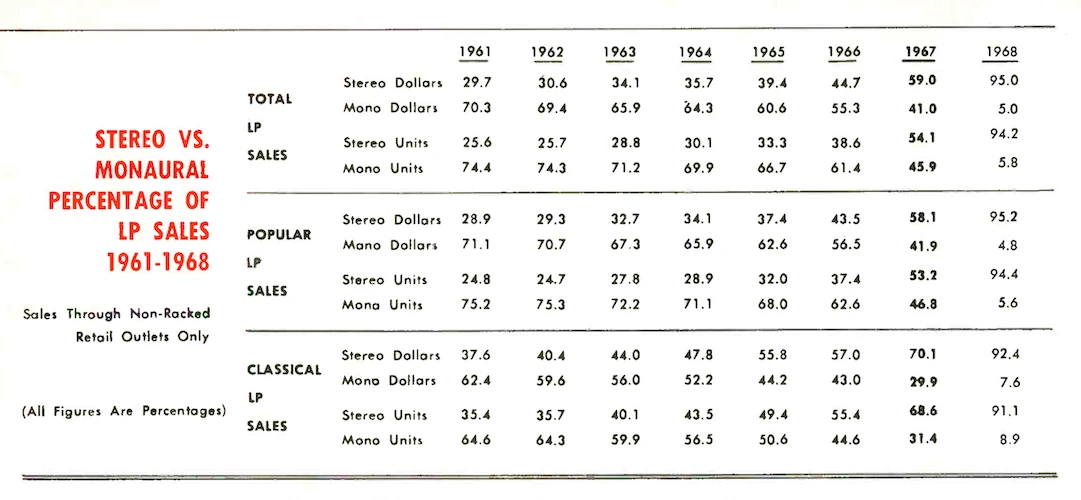
Figure 4: The table “STEREO VS. MONAURAL PERCENTAGE OF LP SALES 1961-1968” on p.13 of the Buyer’s Guide (Billboard 1969-1970 International Music-Record Directory), the supplement to Billboard, August 30, 1969. The ratios are for sales through retail stores excluding rack jobbers (“Sales Through Non-Racked Retail Outlets Only”)
ステレオ盤は 1966年の 38.6% から、1967年に 54.1%、1968年に 94.2% になりました。モノーラル盤でいえば、61.4% が 45.9%、5.8% に減ったことになります。 1961年から 1966年までは年に 5ポイント余りまでしか動いていなかった数字が、1967年に 15.5ポイント、1968年に 40.1ポイント動きました。何がそれを動かしたのでしょうか。
Stereo records went from 38.6% in 1966 to 54.1% in 1967 and 94.2% in 1968. In terms of mono records, 61.4% fell to 45.9% and then to 5.8%. A figure that had moved by no more than a little over 5 points a year from 1961 to 1966 moved 15.5 points in 1967 and 40.1 points in 1968. What moved it?
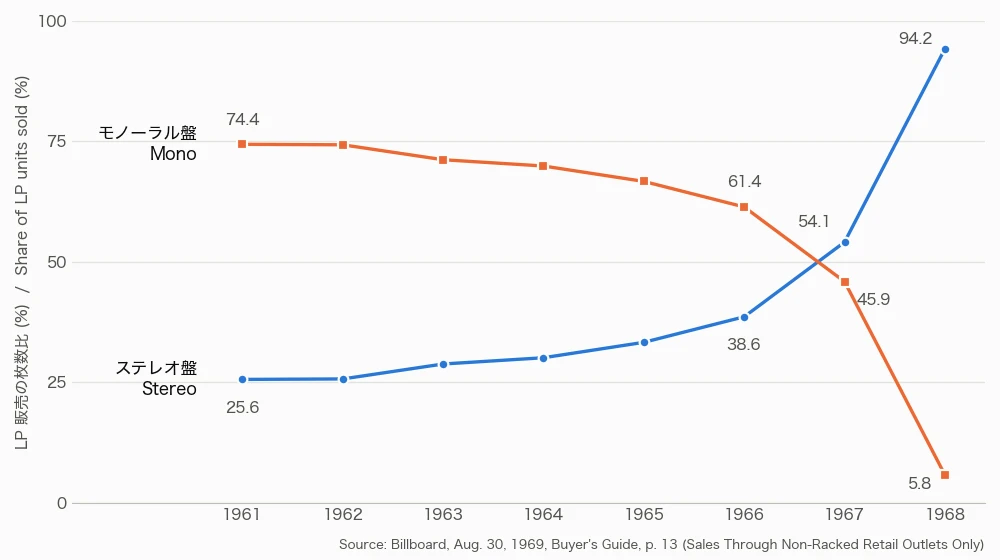
Figure 5: The unit shares for all LPs (Stereo Units and Mono Units) from the table in Figure 4, which I plotted as a line chart. The shares of stereo and mono records changed places in 1967, and in 1968 stereo records reached 94.2%.
前回の記事の結びには、「モノーラル盤とステレオ盤の並走はなぜ終わったのか」という問いを置きました。その答えを、1967年と 1968年の Billboard の誌面から拾っていきます。
At the close of the previous installment, I posed the question of why the parallel run of mono and stereo records ended. I will pick up the answer from the pages of Billboard for 1967 and 1968.
Attempts to Build “Compatibility” into the Record
二重在庫が終わるとすれば、1枚でモノーラル機にもステレオ機にも使える盤が出たからだろう、と考えるのが自然でしょう。実際に 1967年の初めには、そうした盤の記事が続いています。ここでいう「互換」は盤の側の互換、つまりモノーラル盤とステレオ盤を1枚にまとめる試みのことです。
If the double inventory ended, the natural assumption would be that a record appeared that could be played on both mono and stereo phonographs. Indeed, in early 1967 there is a run of articles about such records. “Compatibility” here means compatibility on the side of the record, that is, attempts to merge the mono record and the stereo record into one.
Philips in Britain
まず英国です。 Billboard 1967年2月4日号の Graeme Andrews の記事 “Key Changes Sweep U.K. Mart; Philips Compatible” (p.1) は、英国の大手では初めて Philips (Fontana) が「互換」のステレオ・モノーラル兼用 LP を出すと決めた、と報じました。互換盤は3月に、Fontana の「Jazz Life」シリーズ6枚で出るとされています。その1枚が、Bud Powell の Hot House (Fontana FJL 903) です。ジャケットには、stereo と並んで also playable on mono と印刷されています。
Britain first. Graeme Andrews’s article “Key Changes Sweep U.K. Mart; Philips Compatible” (p.1) in Billboard, February 4, 1967, reported that Philips (Fontana) had decided to release “compatible” stereo-mono albums, the first major British record company to do so. The compatible records were to appear in March as six titles in Fontana’s “Jazz Life” series. One of them is Bud Powell’s Hot House (Fontana FJL 903). On the cover, also playable on mono is printed next to stereo.
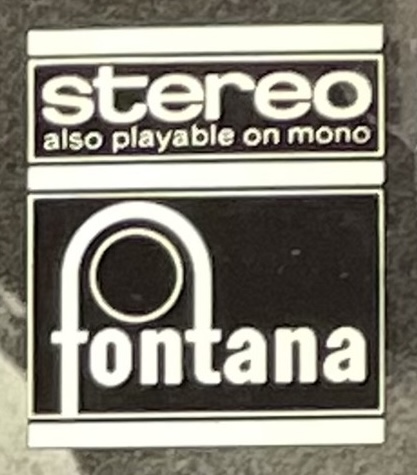
Figure 6: The marking at the top right of the front cover of Bud Powell’s Hot House (Fontana FJL 903, UK, 1966). Image: cropped from the lot photograph of Lay’s Auctioneers (September 29, 2022, Lot 356)
同じ記事は、Philips がドイツなどの国では、モノーラル再生にも使えるステレオ盤をすでに売ってきた、とも書いています。英国の業界の動機として記事が挙げたのは、二重のプレス・在庫・請求にかかる費用をなくしたい、ということでした。同じ記事は、英国のモノーラル機の多くがまだ軽い針圧のピックアップを備えていない、とも書いています。互換盤を技術的にどう作ったのか、あるいはふつうのステレオ盤に表示を添えただけなのかは、記事には書かれていません。
The same article also says that Philips had already been selling stereo records that could also be used for mono playback in countries such as Germany. The motive that the article gave for the British industry was to eliminate the cost of duplicate pressing, stocking, and invoicing. The same article also notes that many mono phonographs in Britain still did not have lightweight pickups. Whether the compatible record was achieved by some technical means, or was simply an ordinary stereo record with a marking added, the article does not say.
Mercury’s Compatible Stereo LP
2週間後の2月18日号の Claude Hall の記事 “Merc. ‘Experiments’ With Compatible LP” (p.1) は、米国の Mercury が Mercury・Smash・Fontana の各レーベルで、互換 LP を静かに試していたと報じました。例として挙がったアルバムの中に、Keith の 98.6/Ain’t Gonna Lie があります。同じ記事は、互換盤は何年も前に米国の大手が試みて、大きな成功を収めなかった、とも書いています。 Mercury の社長 Irving Green の言葉は、方式の説明を含んでいません。
Two weeks later, Claude Hall’s article “Merc. ‘Experiments’ With Compatible LP” (p.1) in the February 18 issue reported that Mercury in the United States had been quietly experimenting with compatible LPs on its Mercury, Smash, and Fontana labels. Among the albums cited as examples is Keith’s 98.6/Ain’t Gonna Lie. The same article also says that the compatible record had been attempted by major U.S. labels years earlier without any great success. The words of Mercury’s president, Irving Green, contain no explanation of the method.
Irving Green, Mercury president, said compatible product for the firm was still in the experimental stage . . . “so far we’re still trying to figure out how to do it.”
But, yes, we’re doing experiments with compatible product. I guess every company is.
Mercury 社長の Irving Green は、同社の互換製品はまだ実験段階だと述べた。「いまのところ、どうやればよいかをまだ模索している」。
「しかし、そう、われわれは互換製品の実験をしている。どの会社もしているはずだ」。
Billboard, February 18, 1967, p. 101967年2月の時点で、社長自身が「まだ実験段階」「やり方を模索中」と言っています。どのような盤なのかは、この記事からは分かりません。 5月6日号の Hank Fox の記事 “Industry Eyes Price Increases Via De Luxe Packages, All-Stereo” (p.4) は、Mercury が廉価レーベルと通常価格のポップ数枚で互換盤を出したことを伝えています。互換盤は Philips を通じて欧州で広く使われてきたもので、Mercury の系列の外でも数社が研究段階にあると知られている、とも書いています。ただし、互換盤の技術方式には触れられていません。
As of February 1967, the president himself was saying that the product was “still in the experimental stage” and that “so far we’re still trying to figure out how to do it.” What kind of record it was cannot be learned from this article. Hank Fox’s article “Industry Eyes Price Increases Via De Luxe Packages, All-Stereo” (p.4) in the May 6 issue reports that Mercury had issued compatible records on its budget labels and on several regular-priced pop albums. It also says that the compatible record had been widely used in Europe through Philips, and was known to be in the research stage at several companies outside the Mercury group. It does not, however, touch on the technical method of the compatible record.
A Reno Dealer’s Stickers
同じ5月6日号には、Reno の販売店主 Chuck Ramsey の話が載っています。 Ramsey は3年前から、自作のステッカーをすべてのステレオ盤に貼っていました。
The same May 6 issue carries the story of Chuck Ramsey, a dealer in Reno. For three years, Ramsey had been putting a sticker of his own making on every stereo record.
Now! Now! Compatible Stereophonic High Fidelity Recording.
I have been using these on stereo records, all stereo records, for the past three years, eliminating the need for double inventory
いまこそ! 互換ステレオ・ハイファイ録音。
このステッカーを、ステレオ盤に、すべてのステレオ盤に、この3年間貼ってきた。二重在庫の必要がなくなる
Billboard, May 6, 1967, p. 10Ramsey は、モノーラル機の持ち主からステレオ LP を返品されたことは一度もない、と語っています。盤に手を加えたわけではないので、Ramsey の「互換」は盤の側の互換とは別の意味です。ふつうのステレオ盤をモノーラル機でかけてよい、と店主が自分の責任で宣言したものと読めます。
Ramsey said he had never had a stereo LP returned by the owner of a mono phonograph. Since he did nothing to the record itself, Ramsey’s “compatible” means something different from compatibility on the side of the record. It can be read as a dealer declaring, on his own responsibility, that an ordinary stereo record may be played on a mono phonograph.
このステッカーの実物は残っているのでしょうか。筆者が探したところ、Discogs に出ていた中古盤の説明文に、それらしいステッカーの記述が見つかりました。盤は Jack Bedient & The Chessmen の Where Did She Go?(Satori 1001、1967年)です。出品者は Reno の RilestonRecords の Riley Harrison さんで、お願いすると写真を送ってくださいました。ステッカーは金色で、文言は「互換ステレオ・ハイファイ録音」です。 Billboard の記事も、Ramsey のステッカーを金色だと書いています。文言は誌面の引用と同じ(Now と New の違いは除く)で、誌面には “Now! Now!” とありますが、実物のステッカーは “Now! New!” でした。
Does an actual sticker survive? When I searched, I found a description of what looked like the sticker in the listing text of a used record on Discogs. The record is Where Did She Go? by Jack Bedient & The Chessmen (Satori 1001, 1967). The seller is Riley Harrison of RilestonRecords in Reno, who kindly sent me photographs when I asked. The sticker is gold, and its wording is “COMPATIBLE STEREOPHONIC-HIGH FIDELITY RECORDING.” The Billboard article also describes Ramsey’s sticker as gold. The wording matches the quotation in the magazine (apart from the difference between Now and New): the magazine has “Now! Now!” but the actual sticker reads “Now! New!”

Figure 7: The gold sticker on the front cover of Where Did She Go? by Jack Bedient & The Chessmen (Satori 1001). The price tag “Our Price $4.49” lies under the gold sticker, so the price tag is presumed to date from the same period. Photo: Riley Harrison, RilestonRecords
Jack Bedient & The Chessmen は Reno を拠点にしたバンドで、この盤は小さな地元のレーベルから出した自主盤です。盤が見つかったのも Reno でした。 Riley さんによれば、Reno のリサイクル店 Savers に、地元の誰かのコレクションとして寄付されていたものだそうです。
Jack Bedient & The Chessmen were a band based in Reno, and this record is a private release on a small local label. The record was also found in Reno. According to Riley, it had been donated to Savers, a thrift store in Reno, as part of a local person’s collection.
ステッカーにも値札にも店名は印刷されていませんが、文言と色、バンドの土地、盤の出どころを合わせると、Billboard の記事でとりあげられたステッカーそのものとみてほぼ間違いないと筆者は考えています。写真を提供してくださった Riley Harrison さん (RilestonRecords) に感謝します。
Neither the sticker nor the price tag has a store name printed on it, but taking together the wording and color, the band’s home town, and where the record came from, I think it is almost certain that this is one of the stickers described in the Billboard article. My thanks to Riley Harrison (RilestonRecords) for providing the photographs.
Mercury 2/ Records in My Collection
互換ステレオ盤に関連して Billboard を調べていた筆者は、2月18日号の Mercury の記事に出会いました。そこで、この時期の Mercury にマトリクスが 2/ で始まる盤があったことを思い出しました。昔、盤の内周にあるその刻印を見て、これはいったいなんだろうと思ったことがあります。記事には Keith の 98.6/Ain’t Gonna Lie が登場します。筆者の持っている 2/ の盤の1枚、SR-61102 が、まさにそれでした。
While going through Billboard in connection with compatible stereo records, I came across the Mercury article in the February 18 issue. That reminded me that Mercury had, in this period, records whose matrix numbers began with 2/. Long ago, looking at that stamping in the runout area of a record, I had wondered what on earth it was. The article mentions Keith’s 98.6/Ain’t Gonna Lie. One of my 2/ records, SR-61102, was exactly that.
レコードの内周(音溝が終わってからレーベルまでの平らな部分、通称「デッドワックス」)には、原盤の番号が刻まれています。マトリクスと呼ばれるこの刻印は、Mercury 系のふつうのステレオ盤では SR 61129-A- M1 のように M を挟む形です。ところが筆者の 2/ の盤では、2 に続けて品番の数字が刻まれ、2 と数字のあいだに手書きの斜め線が入っています。筆者の 2/ の盤はすべてこの形で、M がありません。 Keith の SR-61102 なら 2/61102、Smash の SRS-67088 なら 2/67088 という具合です。手元の盤をすべて調べたわけではありませんが、1966〜67年の Mercury 系の盤で少なくとも6枚あります。
In the runout area of a record (the flat part between the end of the groove and the label, commonly called the “dead wax”), the number of the master is stamped. On ordinary stereo records of the Mercury group, this stamping, called the matrix, takes a form with an M in it, such as SR 61129-A- M1. On my 2/ records, however, the digits of the catalog number follow a 2, with a handwritten slanted line between the 2 and the digits. All of my 2/ records take this form, and there is no M. Keith’s SR-61102 is 2/61102, and Smash’s SRS-67088 is 2/67088. I have not examined every record I own, but there are at least 6 such Mercury-group records from 1966–67.
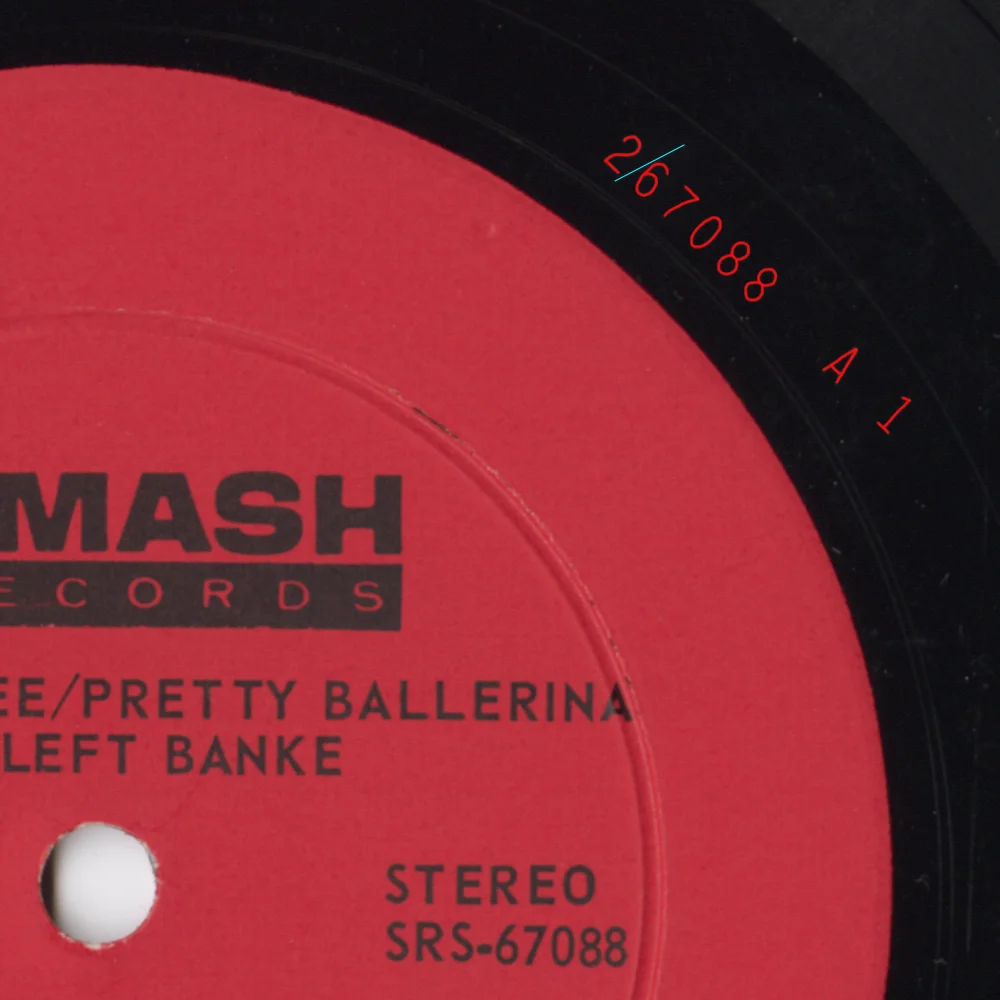
2/67088 A 1。刻印を赤、手書きの斜め線を水色で筆者がトレースしたFigure 8: The runout area and part of the label on side A of my copy of Smash SRS-67088 (The Left Banke). The stamping is
2/67088 A 1. I traced the stamping in red and the handwritten slanted line in light blue
Discogs の登録と筆者の盤を照らし合わせると、同じ 2/ の原盤がモノーラル品番とステレオ品番の両方に使われた例があるとみてよさそうです。 2/61099 は MG 21099(モノーラル品番)と SR 61099(ステレオ品番)の両方に刻まれています。 PHM 200-217 にいたっては、モノーラル品番で、ジャケットもレーベルもモノーラルの表示なのに、盤はステレオです。この盤は筆者の手元にあり、ステレオであることは筆者が確かめました。
Comparing the Discogs entries with my records, it seems safe to say that there are cases where the same 2/ master was used for both a mono catalog number and a stereo catalog number. 2/61099 is stamped on both MG 21099 (the mono number) and SR 61099 (the stereo number). PHM 200-217 goes further: it carries a mono catalog number, and both the cover and the label are marked mono, yet the record is stereo. I have this record, and I confirmed for myself that it is stereo.
ただし、誌面が報じた Mercury の互換盤と、筆者の 2/ の盤が同じものかは確かめられていません。 2/ の刻印が何を意味するのか、Mercury の側の説明も見つかっていません。
Whether the Mercury compatible record that the magazine reported and my 2/ records are the same thing, however, I have not been able to confirm. Nor have I found any explanation from Mercury of what the 2/ stamping means.
そこで筆者は、2/ の盤3枚 (SRS-67088・SR-61102・PHM 200-217) と、2/ でないステレオ盤2枚 (SR 61129・SR-61161)、専用のモノーラル盤1枚 (MG 21104) を、同じ再生系で盤起こしして比べました。解析はBradley’s Barn の記事と同様です。 2/ の盤には、前回の記事で測った CBS 型の溝の処理も、次回で扱う CSG 型の位相処理も見当たりませんでした。 2/ の盤に共通の帯域の処理も無いとみてよさそうです。音量については、2/ の盤のほうが、むしろ専用のモノーラル盤に近い高さで切られていたとみられます。 2/ の盤の測定の詳細は、別の記事で扱う予定です。
So I transferred three 2/ records (SRS-67088, SR-61102, and PHM 200-217), two stereo records without 2/ (SR 61129 and SR-61161), and one dedicated mono record (MG 21104) on the same playback chain and compared them. The analysis follows the one in the Bradley’s Barn article. On the 2/ records I found neither the CBS-type groove processing measured in the previous installment nor the CSG-type phase processing to be covered in the next. It also seems safe to say that the 2/ records share no processing of particular frequency bands. As for level, the 2/ records appear to have been cut at a level closer, if anything, to that of the dedicated mono record. I plan to cover the details of the measurements of the 2/ records in a separate article.
ジャケットも見ました。 SRS-67088 のジャケットの裏には、ステレオ盤をモノーラル機でかけられるという表示はありません。あるのは逆向きの定型文です。
I also looked at the covers. The back cover of SRS-67088 has no marking saying that the stereo record can be played on a mono phonograph. What it has is the boilerplate for the opposite direction, mono records on a stereo phonograph.
Play your Smash Monaural recordings on a Stereo phonograph. The sound quality of any Smash Monaural recording is actually enhanced on a Stereo phonograph.
Smash のモノーラル録音は、ステレオのレコードプレーヤでお聴きください。 Smash のモノーラル録音はどれも、ステレオのレコードプレーヤでは音質がいっそう引き立ちます。
Smash SRS-67088 のジャケット裏(筆者所蔵)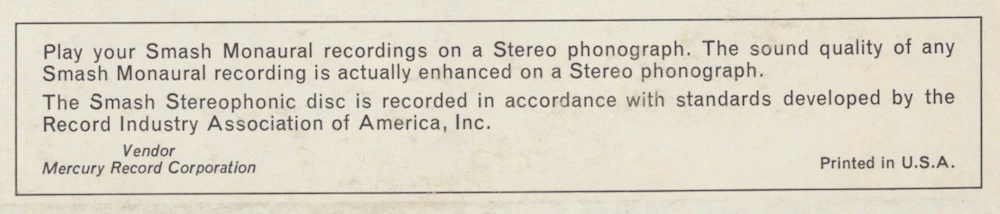
Figure 9: The boilerplate on the back cover of Smash SRS-67088 (The Left Banke). Cropped from my scan
前回の記事で見た 1958年の売り文句、「モノーラル盤をステレオ機で」の向きがそのまま残っています。一方で、同じ盤に最初から入っていた Smash のカンパニースリーブには、Mercury のポータブル機 AG 4100 の広告があります。スピーカーが1個のモノーラルの機械に、ダイヤモンドのステレオ・カートリッジを付け、モノーラル盤もステレオ盤もかけられる、という広告です。掲載された最新の品番は SRS 67087 で、この盤の1つ前です。
The 1958 sales pitch seen in the previous installment, mono records on stereo phonographs, is still there with its direction unchanged. On the other hand, the Smash company sleeve that originally came with the same record carries an advertisement for Mercury’s portable AG 4100. The ad is for a mono machine with a single speaker that is fitted with a diamond stereo cartridge and plays both mono and stereo records. The latest catalog number listed is SRS 67087, the one right before this record.
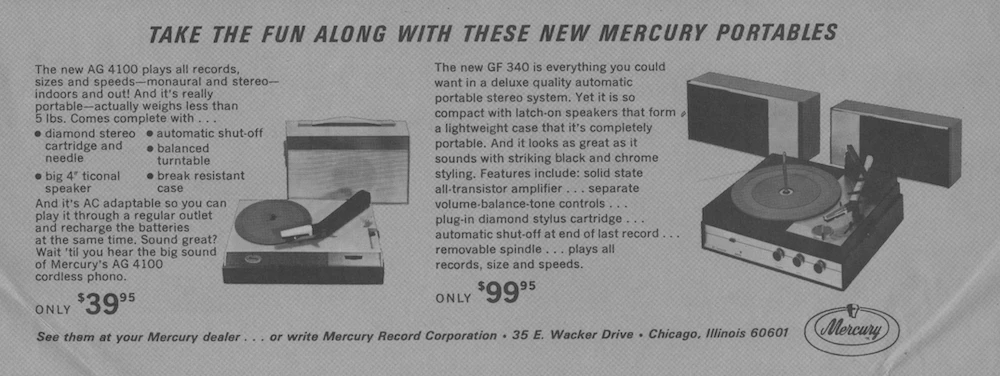
Figure 10: The advertisement for Mercury’s portables on the company sleeve that came with the same record. The AG 4100 is on the left. Cropped from my scan
1枚の LP の中で、ジャケットの裏は 1958年の向きを、スリーブは「ステレオ・カートリッジが付いていればどちらの盤もかかる」という 1967年の向きを向いています。
Within a single LP, the back cover carries the 1958 claim, while the sleeve carries the 1967 claim: with a stereo cartridge fitted, either kind of record will play.
ここまでで分かったことを整理してみましょう。 PHM 200-217 は、モノーラル品番でモノーラルのジャケットに入れて売られた、ステレオの盤です。同じ 2/ の原盤をモノーラル品番とステレオ品番の両方に使った例と合わせて見ると、Mercury の「互換」は、2月4日号が英国の業界の動機に挙げた向きのものだったのではないか、と筆者は考えています。二重のプレス・在庫・請求の費用をなくすために、1つの原盤でモノーラル品番とステレオ品番をまかなう、在庫の側の互換です。ただし、Green が「模索中」と言ったものが何だったのかは、誌面には書かれていません。ステレオ盤を単にモノーラル盤として売ったのか、あるいはなんらかの互換カッティングがされた盤なのか、は不明なままです。
I will sort out what has been learned so far. PHM 200-217 is a stereo record that was sold under a mono catalog number in a mono cover. When I look at this together with the cases where the same 2/ master was used for both a mono and a stereo catalog number, I think Mercury’s “compatible” may have pointed in the direction that the February 4 issue cited as the British industry’s motive: a compatibility on the side of inventory, in which one master serves both the mono and the stereo catalog number, to eliminate the cost of duplicate pressing, stocking, and invoicing. What Green meant when he said “so far we’re still trying to figure out how to do it,” however, the magazine does not say. Whether a stereo record was simply sold as a mono record, or whether the record was given some kind of compatible cutting, remains unknown.
Mono Records Go Up by $1
Mercury に続いて、他社も互換盤への取り組みを続々と表明する、そのように続くと想像しながら誌面を読み進めていきました。ところが、次に動いたのは値札、つまり価格でした。
I read on through the pages expecting the story to continue that way, with other companies following Mercury and announcing their own work on compatible records one after another. What moved next, however, was the price tag, that is, the price.
5月6日号で互換盤が報じられて3週間足らずで、ステレオ盤とモノーラル盤の同価格化、という発表がありました。同価格化という言葉から、ステレオ盤が安くなったと思う方がいるかもしれませんが、むしろモノーラル盤が高くなったのです。
Less than three weeks after the May 6 issue reported on the compatible records, there came an announcement of price equalization between stereo and mono records. The term price equalization may lead some readers to think that stereo records became cheaper. In fact, it was mono records that became more expensive.
1967年5月25日(木)の朝、CBS はモノーラル・アルバムの希望小売価格を1ドル上げると発表しました。対象は Columbia・Epic・Okeh・Date の各レーベルです。 5月25日の記者会見で発表したのは、CBS Records の副社長兼ゼネラル・マネージャー、Clive J. Davis です。同じ年の10月に社長となり、のちに 1974年に Arista Records を設立する人物です。同じ日に RCA も、モノーラル盤をステレオ盤と同じ価格にすると発表しています。発効は RCA が6月1日、CBS が6月5日でした。 Billboard 6月3日号の Mike Gross の記事 “Col. to Raise Mono Price, RCA Too; Cue All-Stereo” (p.1) が報じています。
On the morning of Thursday, May 25, 1967, CBS announced that it would raise the suggested list price of its mono albums by $1. The labels concerned were Columbia, Epic, Okeh, and Date. The announcement at the May 25 press conference was made by Clive J. Davis, vice president and general manager of CBS Records. He became president in October of the same year, and later, in 1974, founded Arista Records. On the same day, RCA also announced that it would bring its mono records to the same price as its stereo records. The new prices took effect on June 1 for RCA and on June 5 for CBS. Mike Gross reported this in the June 3, 1967 issue of Billboard, in the article “Col. to Raise Mono Price, RCA Too; Cue All-Stereo” (p. 1).
Billboard と同時代の業界誌 Cash Box も、同じ週の6月3日号 p.7 で CBS の発表を報じています。見出しは “CBS Lifts Mono LP Price To Stereo Level; End Of Double-Inventory Seen As Factor”、つまり「CBS がモノーラル LP の価格をステレオの水準に引き上げ、二重在庫の解消がねらいとみられる」です。記事は、いずれはステレオだけの LP 業界を実現するための手として、CBS が来週(5日)からモノーラル LP の値段を上げる、という文で始まります。本文も、二重在庫という要因が業界から消えることへの Davis の期待をはっきり伝えています。 Cash Box は同価格化を、見出しの段階で、二重在庫をなくすための手と読んでいました。
Cash Box, a trade paper contemporary with Billboard, also reported the CBS announcement in the same week, in its June 3 issue, p. 7. The headline was “CBS Lifts Mono LP Price To Stereo Level; End Of Double-Inventory Seen As Factor”. The article opens with a sentence saying that CBS would raise the price of its mono LPs from the following week (the 5th) as a step toward eventually realizing an all-stereo LP industry. The body, too, plainly conveys Davis’s hope that double inventory would disappear from the industry as a factor. Cash Box, from its headline on, read the price equalization as a step toward ending double inventory.
同じ Billboard の記事の続き (p.8) で、CBS の Davis は互換盤に触れています。
In the continuation of the same Billboard article (p. 8), CBS’s Davis touches on the compatible record.
a compatible record would necessarily involve a compromise between true stereo and mono
a stereophonic record will now give satisfactory reproduction on most monaural phonographs
互換盤は、本物のステレオとモノーラルのあいだの妥協を必然的に伴う
ステレオ盤は、いまでは大半のモノーラルのレコードプレーヤで満足に再生できる
Billboard, June 3, 1967, p. 8同じ記事は、Philips が海外の大手として互換盤を推している、と Davis の立場と並べて書いています。
The same article sets Davis’s position alongside that of Philips, writing that Philips, as a major overseas manufacturer, had been pushing for a compatible disk.
Davis はさらに、売れているレコードプレーヤの 61% はステレオ機だと述べました。同じ頁に載った2つの表(図 11)を並べると、その意味が見えてきます。 1966年に生産されたレコードプレーヤの 63% はステレオ機でした。ところが、同じ年に売れた LP のうち、ステレオ盤は 38.6% にとどまっています。機械の側はとうにステレオに移っていたのに、盤の側は6割がまだモノーラルだった、ということです。
Davis further stated that 61% of the phonographs being sold were stereo phonographs. Placing the two tables printed on the same page (Figure 11) side by side shows what that meant. Of the phonographs produced in 1966, 63% were stereo. Yet of the LPs sold in the same year, stereo records accounted for only 38.6%. The machines had long since moved to stereo, while six out of ten records were still mono.
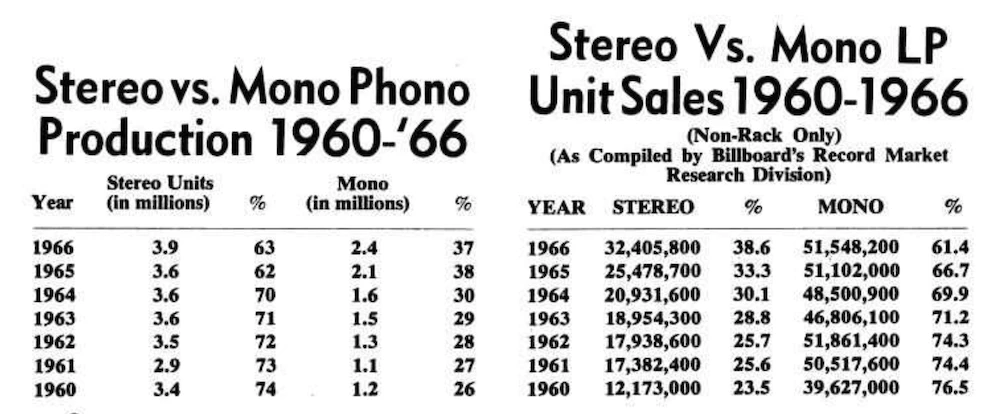
Figure 11: The two tables on p. 8 of the June 3, 1967 issue of Billboard. Left, “Stereo vs. Mono Phono Production 1960-’66”; right, “Stereo Vs. Mono LP Unit Sales 1960-1966”. The right-hand table is “Non-Rack Only” (retail excluding rack jobbers), compiled by Billboard‘s Record Market Research Division. The figures for 1961–66 are the same as those in the table in Figure 4
同じ号には、各社の反応も掲載されています。同じ続きの部分で、Dot の Randy Wood は、モノーラル・アルバムは前から儲からず、量は減り、値引きは増えていた、と述べました。 Capitol の Gortikov の発言は要約で載っていて、ステレオのみの在庫への一歩と位置づけ、モノーラル・ステレオ・テープの3本立てで在庫が膨らむことを挙げています。 Mercury の Steinberg は、業界にはもっと余裕のある利幅が要る、と語っています。
The same issue also carries the reactions of other companies. In the same continuation, Randy Wood of Dot said that mono albums had long been profitless, with decreasing volume and higher discounts. The remarks of Capitol’s Gortikov appear in summary: he described the move as a step toward stereo-only inventory and pointed to the inventory swelling across three lines, mono, stereo, and tape. Steinberg of Mercury said that the industry needed a more comfortable margin.
Hank Fox の記事 “DEALERS & RACKS: Will Hurt at First—Boon in Long Run” (p.8) は、販売店の声も拾っています。販売店の報告では、クラシックではステレオがモノーラルに最大で8対1の差で勝ります。一方、10代が売上の大きな割合を占めるポップでは、モノーラルが並ぶか少し勝ります。 1967年の時点で、枚数比の中身はジャンルでかなり違っていたと考えられます。
Hank Fox’s article “DEALERS & RACKS: Will Hurt at First—Boon in Long Run” (p. 8) also collects the views of dealers. Dealers reported that in classical music, stereo outsold mono by as much as eight to one. In pop, on the other hand, where teenagers accounted for a major share of sales, mono either tied or slightly led. As of 1967, the balance between stereo and mono units appears to have differed considerably by genre.
同価格化は、小売の側に別の要求も生みました。 8月19日号の Fred Kirby の記事 “Korvette’s Rothfeld Asks Mfrs. to Rechannel Mono” (p.1) には、ディスカウント・チェーン E. J. Korvette の商品部門の責任者 David Rothfeld の要求が載っています。業界がモノーラルとステレオを同じ値段にした以上、ステレオ以前の録音にも電気的ステレオ (electronic stereo)、つまり疑似ステレオを選べるべきだ、というものです。
Price equalization also produced another demand on the retail side. Fred Kirby’s article “Korvette’s Rothfeld Asks Mfrs. to Rechannel Mono” (p. 1) in the August 19 issue carries the demand of David Rothfeld, head of the merchandise division at the discount chain E. J. Korvette. Since the industry had gone to one price for mono and stereo, he argued, the consumer should also have the choice of electronic stereo, that is, simulated stereo, for recordings made before the stereo era.
The Shelves and the Wholesalers React
値上げの直後、店の棚で何が起きたかは、Billboard 12月2日号の表で追えます。 1967年の小売店の枚数を4週ごとに並べた表です。
What happened on the store shelves right after the price increase can be followed in a table in the December 2, 1967 issue of Billboard. It lists 1967 retail-store unit sales in four-week periods.
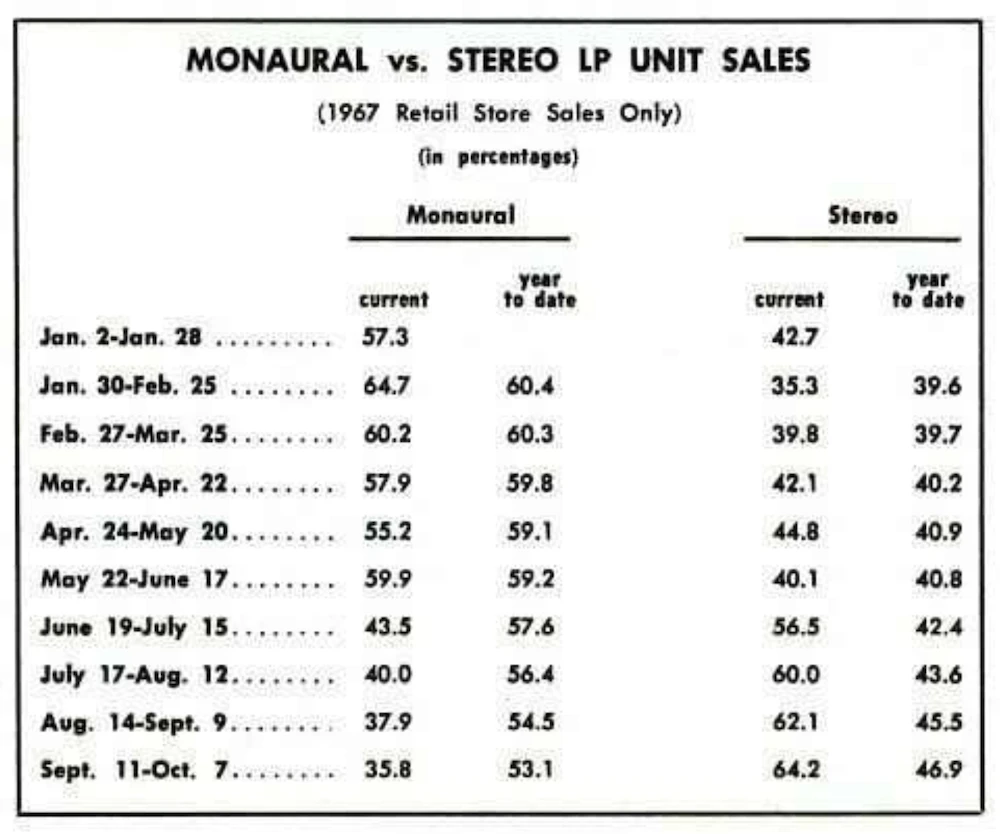
Figure 12: The table “MONAURAL vs. STEREO LP UNIT SALES (1967 Retail Store Sales Only)” on p. 10 of the December 2, 1967 issue of Billboard
同価格化の直前までの期では、モノーラルが 55〜65% を占めていました。 6月19日から7月15日の期で、モノーラル 43.5%、ステレオ 56.5% と逆転します。この表の範囲(1967年)では、ステレオがモノーラルを上回った最初の期です。 9月11日から10月7日の期には、ステレオが 64.2% になりました。この表の母集団は「小売店のみ」で、Buyer’s Guide の比率表(ラック業者を除く小売)とは別の集計です。そのため、ここの 56.5% や 64.2% を、1967年の年間の 54.1% と直接比較できないことには注意が必要です。
In the periods up to just before price equalization, mono held 55–65%. In the period from June 19 to July 15, the figures reversed, with mono at 43.5% and stereo at 56.5%. Within the range of this table (1967), this is the first period in which stereo outsold mono. In the period from September 11 to October 7, stereo reached 64.2%. The population of this table is “Retail Store Sales Only”, a different count from the ratio table in the Buyer’s Guide (retail excluding rack jobbers). The 56.5% and 64.2% here therefore cannot be compared directly with the 54.1% for the full year 1967, and this needs to be kept in mind.
6月24日号の記事 “Korvette Cuts Mono Stock On Classical” (p.3) によれば、Korvette はクラシックのモノーラル盤の品数を減らしていました。 Rothfeld は、「段階的にやめている」と言っても間違いではないとしつつ、Heifetz や Horowitz のような多くのアーティストと一部のオペラは、モノーラルとステレオの両方を置き続けるとも述べています。モノーラルを完全に切るのは、当分先だと見ていました。同じ記事で、レコード店チェーン Sam Goody の総支配人 Sam Stolon は、モノーラルにはまだ1〜2年の寿命があると見て、「世間はモノーラルが値上がりしたことすら知らない」と語っています。
According to the article “Korvette Cuts Mono Stock On Classical” (p. 3) in the June 24 issue, Korvette had been reducing its range of classical mono records. Rothfeld said that “Phasing out” would not be inaccurate, while adding that for many artists such as Heifetz and Horowitz, and for some operas, the store would keep stocking both mono and stereo. He expected that cutting mono completely was still some way off. In the same article, Sam Stolon, general manager of the record-store chain Sam Goody, saw a year or two of life left in mono and said, “The public doesn’t even know the price of mono has gone up.”
12月2日号の6面は、同価格化の直後、多くの販売店がモノーラルを 5% 以下でしか仕入れなかったと書いています。ただ、その後に揺り戻しがありました。 9月9日号で、卸の Galgano は次のように語っています。
Page 6 of the December 2 issue says that right after price equalization, for many dealers, mono made up no more than 5% of their purchases. There was a swing back afterward, though. In the September 9 issue, the wholesaler Galgano spoke as follows.
“At first, when the price changed, dealers quit buying mono,” Galgano said last week. “Now they’re buying mono again, because they’re finding out there’s still a healthy demand for mono. We’re selling about 25 per cent mono right now.”
「値段が変わった当初、販売店はモノーラルの仕入れをやめた」と Galgano は先週語った。「いまはまたモノーラルを仕入れている。モノーラルの需要がまだしっかりあると分かってきたからだ。うちの売上はいま、約 25% がモノーラルだ」。
Billboard, September 9, 1967, p. 71値上げに乗らなかったラック業者(スーパーや量販店などレコード店以外の売り場に、棚ごと品ぞろえを請け負う卸)もありました。 12月2日号の Ray Brack と Earl Paige の記事 “Price Equalization No Help, Say Midwest Rackers as Sales Sag” (p.3) によれば、J. L. Marsh (Heilicher) はモノーラルの価格を据え置き、旧価格の 3.79ドルで売り続けました。 「モノーラルの価格を変えないことで、動きの衝撃をやわらげた」と語り、売上の 10% はまだモノーラルだと述べています。
Some rack jobbers (wholesalers who stock entire racks in outlets other than record stores, such as supermarkets and mass merchandisers) did not go along with the price increase. According to the article “Price Equalization No Help, Say Midwest Rackers as Sales Sag” (p. 3) by Ray Brack and Earl Paige in the December 2 issue, J. L. Marsh (Heilicher) left its mono price unchanged and kept selling at the old price of $3.79. The firm said that “we lessened the impact of the move” by not changing the mono price, and that 10% of its sales were still mono.
レコード会社の側にも、モノーラルの値上げを撤回した例があります。 MGM は同価格化から2か月で、モノーラルの価格を 4.79ドルから 3.79ドルに戻しました。その理由を、8月19日号で Mort Nasatir が説明しています。
There was also a case on the record-company side of a mono price increase being withdrawn. Two months after price equalization, MGM put its mono price back from $4.79 to $3.79. Mort Nasatir explained the reason in the August 19 issue.
Instead of obsoleting mono and increasing stereo sales, he said mono sales died and stereo sales have remained where they were before.
We hope that some day mono will become obsolete, but it will have to die a natural death.
モノーラルを時代遅れにしてステレオの売上を増やすどころか、モノーラルの売上が死んだだけで、ステレオの売上は以前のままだった、と彼は述べた。
いつかモノーラルが時代遅れになることを望んでいるが、それは自然死でなければならない。
Billboard, August 19, 1967, p. 6販売店の対応はもうひとつありました。 7月1日号の1面「Mono Dealt a Body Blow」の続きの8面に、Record Center の話が載っています。この店はモノーラル機の交換用のステレオ・カートリッジの特売をしていました。同時に、古いセットのカートリッジとトーンアームは重すぎて、いずれ盤を傷めてしまう、と店の側が認めています。モノーラル盤を買っていた客にステレオ盤を売るには、最低でもステレオカートリッジへの交換、場合によってはレコードプレーヤ自体まで替えてもらう必要があったのです。
Dealers had one more response. Page 8 of the July 1 issue, continuing the front-page story “Mono Dealt a Body Blow”, carries the case of Record Center. The store was running a sale on stereo cartridges to replace the cartridges on mono phonographs. At the same time, the store admitted that the cartridges and tone arms of older sets were too heavy and would eventually chew up the record. To sell stereo records to customers who had been buying mono, a dealer had to get them at least to replace the cartridge with a stereo one, and in some cases to replace the phonograph itself.
“Compatibility” Changes Direction
モノーラル盤が1ドル上がったあとで、ステレオ盤はちゃんと売れたのでしょうか。 Billboard 7月22日号の3面によれば、CBS はそうは見ていませんでした。小売もラック業者も、値上げでモノーラルの客を失ったまま、その客をステレオに誘導せず、売上を手放している、と見立てていました。それが Davis の次の運動の動機として書かれています。 Davis の声明は、店頭の掲示として、すべてのアルバムへの差し込みとして、そして今後のジャケットの文言として配られました。
After mono records went up by $1, did stereo records sell as expected? According to p. 3 of the July 22 issue of Billboard, CBS did not think so. Its reading was that both retailers and rack jobbers had lost their mono customers through the price increase, were not steering those customers toward stereo, and were giving up those sales. The magazine gives that as the motive for Davis’s next campaign. Davis’s statement was distributed as a store display, as an insert in every album, and as the wording for future jackets.
Columbia stereo records can be played on today’s mono record players with excellent results. They will last as long as mono records played on the same equipment, yet will reveal full stereo sound when played on stereo record players.
Columbia のステレオ盤は、今日のモノーラル再生機ですぐれた結果で再生できます。同じ機器でかけたモノーラル盤と同じだけ長持ちし、ステレオ再生機でかければ完全なステレオの音が現れます。
Billboard, July 22, 1967, p. 3
これが、この記事で扱うもうひとつの「互換」です。盤に手を加える互換ではなく、再生側の互換の宣言、つまり「いまのモノーラル機でステレオ盤をかけてよい」という宣言です。 Reno の Ramsey が自作のステッカーで3年前からやっていたことを、CBS が全アルバムでやった、と見ることもできます。ステレオ盤に「モノーラル機でもかけられる」と表示する例は、英国の Philips が半年ほど先に出していました。 Fontana の「Jazz Life」のジャケットに刷られた also playable on mono(図 6)と同じ向きの宣言です。
This is the other “compatibility” this article deals with. It is a declaration of compatibility on the playback side, with no change to the record: “Columbia stereo records can be played on today’s mono record players.” One could also see it as CBS doing on every album what Ramsey in Reno had been doing with his home-made sticker for three years. An example of marking stereo records as playable on mono phonographs had already appeared some six months earlier, from Philips in Britain. The also playable on mono printed on the Fontana “Jazz Life” jackets (Figure 6) is a declaration pointing in the same direction.
前回の記事で見た 1958年の互換は、「モノーラル盤をステレオ機で」という向きでした。 SRS-67088 のジャケット裏の定型文も、その向きのままです。 1967年の Davis の文言は「ステレオ盤をモノーラル機で」で、向きが逆です。 Davis の7月の記事は Mercury にも「互換」の語にも触れていません。
The 1958 compatibility seen in the previous installment pointed in the direction of playing mono records on stereo phonographs. The boilerplate on the back cover of SRS-67088 still points that way. Davis’s 1967 wording, stereo records on mono phonographs, points the opposite way. The July article on Davis’s statement mentions neither Mercury nor the word “compatible”.
“Yes, But”
この宣言に、針のメーカーが待ったをかけました。 8月5日号に、Ray Brack の記事 “Warn Against Stereo Play On Mono Units” (p.1) が載りました。主要な針メーカーは Columbia の主張、つまりステレオ盤をモノーラルのレコードプレーヤで傷めずにかけられるという主張に同意していない、と伝えています。 Pfanstiehl の Wight は、ステレオ盤の損傷を防ぐ鍵は縦のコンプライアンスだと述べました。 Fidelitone の Reese は、異議の中身を条件付きの「はい」と言い表しました。
The stylus manufacturers raised objections to this declaration. The August 5 issue carried Ray Brack’s article “Warn Against Stereo Play On Mono Units” (p. 1). It reported that the major phonograph needle manufacturers did not agree with Columbia’s assertion that stereo records may be played on mono phonographs without damage. Wight of Pfanstiehl said that vertical compliance was the key to preventing damage to stereo records. Reese of Fidelitone put the substance of the objection as a conditional “Yes”.
The real answer to the question, ‘Will stereo play on mono equipment?’ is ‘Yes, but . . .!’
「ステレオはモノーラルの機器でかかるか」という問いへの本当の答えは「はい、ただし……!」だ
Billboard, August 5, 1967, p. 58Pfanstiehl・Fidelitone・Recoton・Walco の発言を並べると、条件は3つに整理できそうです。カートリッジに縦のコンプライアンスがあること、アームが軽いこと、機器が5〜6年以内のものであること。
Lining up the statements from Pfanstiehl, Fidelitone, Recoton, and Walco, the conditions seem to come down to three: the cartridge must have vertical compliance, the arm must be light, and the equipment must be no more than five or six years old.
針メーカーとは別に、レーベルの側にも異論がありました。 Cash Box 9月23日号 p.7 の記事 “Atlantic’s Sachs: Mono LP Sales Still A ‘Substantial’ Business” に、Atlantic の副社長 Nesuhi Ertegun の見方が載っています。
Apart from the stylus manufacturers, there was also dissent on the label side. The article “Atlantic’s Sachs: Mono LP Sales Still A ‘Substantial’ Business” on p. 7 of the September 23 issue of Cash Box carries the view of Nesuhi Ertegun, vice president of Atlantic.
Sharing Sachs’ comments on the mono LP situation, Nesuhi Ertegun, vp of Atlantic, is also of the belief that “stereo records do not sound good on mono machines.” Thus, he differs with the contention of engineers at Columbia Records who believe that stereo LP’s played on late model mono machines give “excellent results.”
モノーラル LP の状況についての Sachs の意見を共有して、Atlantic 副社長の Nesuhi Ertegun もまた、「ステレオ盤はモノーラル機では良い音がしない」という考えである。したがって彼は、最近の型のモノーラル機でかけたステレオ LP は「すぐれた結果」を与えるとする Columbia Records の技術者たちの主張とは、意見を異にする。
Cash Box, September 23, 1967, p. 7(誌面の綴りは "Neshui"。筆者が修正)Walco の社長 H. A. Bodkin は、8月19日号で 1958年の事情を振り返っています。前回の記事で見た「古い針がステレオ盤を傷める」問題を、針メーカーの側から述べたものです。
H. A. Bodkin, president of Walco, looked back at the situation of 1958 in the August 19 issue. This is the problem of old styli damaging stereo records, seen in the previous installment, stated from the stylus manufacturers’ side.
Cartridges had entirely too much tone arm pressure, ranging from 8 to 14 grams, and stylus tip radiuses of 1 mil. were completely unacceptable for the stereo record grooves.
カートリッジのトーンアームの針圧はまったく大きすぎて 8〜14グラムあり、針先の半径 1ミルはステレオ盤の溝にはまったく受け入れられないものだった。
Billboard, August 19, 1967, p. 65Fidelitone は8月12日号で、もっと具体的な数字を出しています。売れ筋のモノーラル針のうち、ステレオ盤に迷わず勧められるだけのコンプライアンスがあるのは約半分だ、というものです。言い換えれば、残りの半分については、Davis の「すぐれた結果」を針メーカーは保証していません。
In the August 12 issue, Fidelitone gave a more specific figure. Of the best-selling mono needles, only “about 50 per cent” had enough compliance that the company would recommend them for stereo records without reservation. In other words, for the remaining half, the stylus manufacturers did not vouch for Davis’s “excellent results”.
Compatible Styli and Stereo Cartridges
売る側の答えは2つの形をとりました。ひとつは針先をそろえた「互換」針で、Duotone と Fidelitone が出しています。 Duotone の 12月16日号の広告は、使用中の何十万台ものモノーラル機に向けて、巨大な市場が開けると謳っています。もっとも、Duotone の「互換」は針先の半径のことです。縦のコンプライアンスが足りない最も古い型(交換針の売上の 5〜10%)には互換の表示を付けない、と 9月9日号で説明しています。
The sellers’ answer took two forms. One was a “compatible” stylus with its tip made to suit both kinds of record, offered by Duotone and Fidelitone. Duotone’s advertisement in the December 16 issue claimed that it opened a vast market among the hundreds of thousands of mono phonographs in use. Duotone’s “compatible”, though, referred to the tip radius. For the oldest models without sufficient vertical compliance (5–10% of replacement needle sales), it explained in the September 9 issue, it would not apply the compatible label.
もうひとつの答えは、カートリッジごとステレオ用に替えることです。 Sonotone の交換用カートリッジは、針メーカーの警告と同じ8月5日号の頁に載っています。 Pfanstiehl は翌 1968年2月3日号で、カートリッジに疑いがあれば新しいステレオ・カートリッジを売るよう販売店に勧めました。同じ記事で Pfanstiehl は、針先はそれほど重要でなく、軽いトーンアームとカートリッジの十分な縦のコンプライアンスが要点だ、と半年前より踏み込んで言い直しました。縦のコンプライアンスを売りにした「モノーラル機でステレオ盤を安全に」という製品は、1967〜69年の Billboard のテキスト層を検索した範囲では見当たりません。無かったとは言えません。
The other answer was to replace the whole cartridge with a stereo one. Sonotone’s replacement cartridge appears on the same page of the August 5 issue as the stylus manufacturers’ warning. In the February 3, 1968 issue, Pfanstiehl advised dealers to sell the customer a new stereo cartridge if there was any doubt about the cartridge. In the same article, Pfanstiehl went further than it had six months earlier, restating that the tip was not so important and that the essentials were a lightweight tone arm and sufficient vertical compliance in the cartridge. In my search of the text layer of Billboard for 1967–69, I found no product that was sold on the strength of its vertical compliance as making stereo records safe on mono phonographs. That does not mean there was none.
針メーカーが挙げた条件は、すべて再生機の側にあります。 PHM 200-217 のように、モノーラル品番でステレオ盤を売った Mercury の判断がどこに根拠を置いていたのかは、針メーカーの数字から推すことはできません。誌面の Mercury の発言は「模索中」までで、その先は書かれていません。
All the conditions the stylus manufacturers named lie on the playback side. What Mercury based its decision on when it sold stereo records under mono catalog numbers, as with PHM 200-217, cannot be inferred from the stylus manufacturers’ figures. Mercury’s statements in the trade press go only as far as “still trying to figure out how to do it”, and nothing beyond that is written.
Davis の7月の声明は、対象を「今日のモノーラル機」に限っていました。ステレオ盤が出た当初はモノーラル専用機でかけられなかったが、近年はモノーラル機もステレオ機も目立って改良され、その制約はなくなった、というのが声明の挙げた根拠です。盤の傷みについても、ステレオ機でかけたときより針飛びも摩耗も増えない、と書いています。
Davis’s July statement limited its scope to “today’s mono record players”. The grounds it gave were that when stereo records first appeared they could not be played on mono-only phonographs, but that in recent years both mono and stereo phonographs had been markedly improved and that restriction had gone. On wear, it says that neither skipping nor wear increases compared with playing on a stereo phonograph.
この宣言の真意には、2つの見方が考えられると筆者は見立てています。ひとつは、縦方向のコンプライアンスが増したモノーラル・カートリッジや、交換したステレオ・カートリッジであれば技術的に問題ない、と CBS が判断したという見方です。針メーカーの条件と Fidelitone の「約半分」は、この機械の側の違いにかかわるものでした。もうひとつは、盤の傷みはさておき、売るために宣言したという見方です。同じ号で Davis が挙げた動機は、小売がモノーラルの客をステレオに誘わず、売上を手放していることでした。どちらも考えられますが、CBS をはじめ各社の当時の真意は、誌面からは分かりません。
I see two possible readings of what lay behind this declaration. One is that CBS judged there to be no technical problem with a mono cartridge of increased vertical compliance, or with a replacement stereo cartridge. The stylus manufacturers’ conditions and Fidelitone’s “about 50 per cent” concerned this difference on the machine side. The other is that CBS made the declaration in order to sell, record wear aside. The motive Davis gave in the same issue was that retailers were not steering mono customers toward stereo and were giving up sales. Both are possible, but what CBS and the other companies actually intended at the time cannot be known from the trade press.
Becoming Jacket Boilerplate
論争はあっても、文言は各社に広がりました。 1968年12月14日号の86面には、各社の文言を並べた短い記事が載っています。
Despite the dispute, the wording spread across the companies. Page 86 of the December 14, 1968 issue carries a short article lining up the wording used by each company.
Record companies are writing different scripts on their album jackets to inform the consumer about the use of stereo records on monaural phonographs.
レコード各社は、ステレオ盤をモノーラルのレコードプレーヤで使うことについて消費者に知らせるため、それぞれ違う文言をアルバムのジャケットに書いている。
Billboard, December 14, 1968, p. 86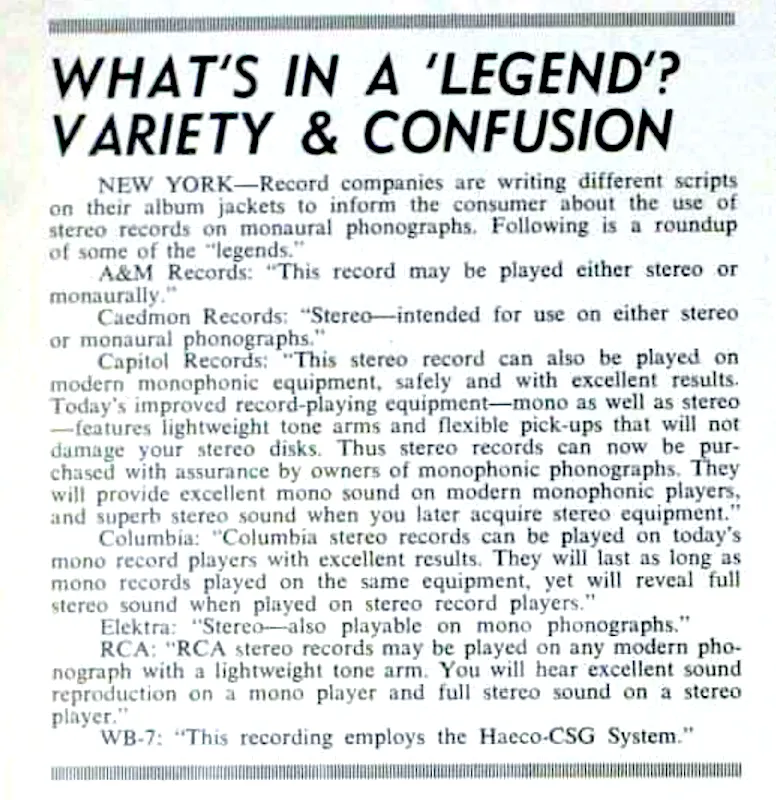
Figure 13: The article “What’s in a ‘Legend’? Variety & Confusion” on p. 86 of the December 14, 1968 issue of Billboard. A list of each label’s wording, printed on jackets, stating that the stereo record can be played on mono equipment without trouble
記事に並ぶのは A&M・Caedmon・Capitol・Columbia・Elektra・RCA の文言です。 1年半前に Davis が差し込みで配った宣言は、1968年の末には各社のジャケットの定型文になっていました。
The article lists the wording of A&M, Caedmon, Capitol, Columbia, Elektra, and RCA. The declaration Davis had distributed as an insert a year and a half earlier had become jacket boilerplate at each company by the end of 1968.
Mono LPs Disappear
モノーラル LP の1ドルの値上げと、「今のモノーラル機でステレオ盤をかけてよい」という宣言。この2つのあとに来たのは、モノーラル LP の製造停止です。 Billboard 1968年1月6日号の “Stereo Rattles Stations—Mfrs. Strangle Monaural” (p.1) で、Hank Fox は各社の状況をまとめています。 ABC とその傘下のレーベル、Capitol のクラシック・レーベル Angel、MGM が配給するクラシックの DGG、そして Monument は、モノーラルの製造停止をすでに発表していました。 CBS・Capitol・WB-Reprise・Liberty・Mercury-Smash-Fontana・MGM/Verve は移行中です。同じ記事の8面によれば、RCA は方針に変更なしとして全製品を両方の形で出し、Decca・Atlantic・United Artists も両方のプレスを続けていました。
The $1 increase on mono LPs, and the declaration that “Columbia stereo records can be played on today’s mono record players.” What came after these two was the discontinuation of mono LPs. In “Stereo Rattles Stations—Mfrs. Strangle Monaural” (p.1) in the January 6, 1968 issue of Billboard, Hank Fox summarized where each company stood. ABC and its subsidiary labels, Capitol’s classical label Angel, the MGM-distributed classical line DGG, and Monument had already announced that they were stopping mono production. CBS, Capitol, WB-Reprise, Liberty, Mercury-Smash-Fontana, and MGM/Verve were in transition. According to the continuation of the same article on p.8, RCA, saying there was no change in policy, was releasing all product in both forms, and Decca, Atlantic, and United Artists were also continuing to press both.
Mercury の Steinberg は同じ8面で、クラシックとジャズはモノーラルでプレスしない、ポップについてはいまは形だけのモノーラル・プレスをしている、と述べています。
On the same p.8, Mercury’s Steinberg said that the company was not pressing classical or jazz in mono, and that for pop it was now doing only token mono pressing.
Mercury の一般向けのモノーラル LP がいつまで出たのかを、筆者は品番で追ってみました。筆者の調べでは、Mercury の一般向けのモノーラル LP は MG-21156 (The Savage Resurrection) が最後です。番号の並びでは、MG-21151 (Jerry Butler Jerry Butler’s Golden Hits Live) と、MG-21152 と 21153 にあたる2枚組 MGP-2-105 にもモノーラル盤があります。 MG-21154・SR-61154 と MG-21155・SR-61155 は欠番です。 MG-21157 (The Ever-Green Blues 7 Do Eleven) のモノーラル盤は、局向けの白レーベルのプロモ盤にしかありません。続く SR-61158 (The Riverboat Soul Band) と SR-61159(Manfred Mann Up The Junction のサウンドトラック)はステレオ盤だけです。一般盤もプロモ盤(61158 は白レーベル、61159 は緑レーベル)も、表ジャケットの右上に MERCURY STEREO SR 61159(61158 は SR 61158)と PLAYABLE ON MODERN MONAURAL EQUIPMENT が刷られています。
I traced by catalog number how long Mercury’s regular mono LPs continued. As far as I can tell, the last regular mono LP on Mercury is MG-21156 (The Savage Resurrection). In the number sequence, MG-21151 (Jerry Butler Jerry Butler’s Golden Hits Live) and the two-record set MGP-2-105, which occupies MG-21152 and 21153, also exist as mono records. MG-21154 and SR-61154, and MG-21155 and SR-61155, are unassigned numbers. The mono version of MG-21157 (The Ever-Green Blues 7 Do Eleven) exists only as a white-label promo for radio stations. The next two, SR-61158 (The Riverboat Soul Band) and SR-61159 (the soundtrack of Manfred Mann Up The Junction), are stereo only. On both the regular copies and the promos (a white label for 61158, a green label for 61159), the top right of the front cover carries MERCURY STEREO SR 61159 (SR 61158 for 61158) and PLAYABLE ON MODERN MONAURAL EQUIPMENT.
時期は 1968年の3〜4月ごろとみられます。 Billboard の新譜評では、1968年1月27日号の Jerry Butler に MG 21151 と SR 61151 の両方の品番が載り、4月13日号の新譜一覧の SR 61158・61159 はステレオの品番だけです。ただし、誌面の品番の載せ方は盤の実態と食い違うところがあります。 3月16日号は 7 Do Eleven にモノーラルの品番 MG 21157 も載せ、3月23日号は The Savage Resurrection にステレオの品番しか載せていません。そのため、境目は盤で判断しました。 MODERN (今日の) という限り方は、Davis の声明の「今日のモノーラル機」と同じです。 1968年12月14日号の各社の文言の記事に並ぶのは A&M・Caedmon・Capitol・Columbia・Elektra・RCA で、Mercury は入っていません。
The timing appears to be around March to April 1968. In the Billboard album reviews, the review of the Jerry Butler album in the January 27, 1968 issue lists both catalog numbers, MG 21151 and SR 61151, while SR 61158 and 61159 in the new-release list of the April 13 issue carry stereo numbers only. The way the magazine listed catalog numbers does not always match the records themselves, however. The March 16 issue also gives the mono number MG 21157 for 7 Do Eleven, and the March 23 issue gives only the stereo number for The Savage Resurrection. So I judged the changeover by the records themselves. The qualifier MODERN is the same limitation as the “today’s mono record players” of Davis’s statement. The article on the companies’ legends in the December 14, 1968 issue lists A&M, Caedmon, Capitol, Columbia, Elektra, and RCA. Mercury is not among them.
1月13日号は、MGM が局向けのプロモーション盤を除いてモノーラルの製造を全廃し、モノーラルの返品をステレオと交換すると報じました。 1月20日号では WB も停止し、ラジオ局向けのプロモーション盤はモノーラルで出し続けるとしています。 7月13日号は、Atlantic がモノーラルの入口と出口の両方を閉じる、と書きました。モノーラルの返品の最終日を7月31日としたものです。
The January 13 issue reported that MGM had dropped all mono production except promotional copies for radio stations, and would exchange mono returns for stereo. The January 20 issue reported that WB too had stopped, while continuing to release radio promotion copies in mono. The July 13 issue wrote that Atlantic was ending both its shipments of mono records and its acceptance of mono returns. It set July 31 as the last day for mono returns.
最後が RCA でした。 8月17日号の Fred Kirby の記事 “RCA Drops Monaural in Pop and Red Seal Lines” (p.3) が、その決定を報じています。
RCA came last. Fred Kirby’s article “RCA Drops Monaural in Pop and Red Seal Lines” (p.3) in the August 17 issue reported the decision.
RCA is discontinuing manufacture of monaural product in its pop and Red Seal album lines except for vintage material, while Epic is deleting monaural-only albums from the catalog. These are the latest steps in the industry’s phasing out of monaural product.
RCA は、ポップと Red Seal のアルバム・ラインで、旧録音を除いてモノーラル製品の製造を打ち切り、Epic はモノーラルだけのアルバムをカタログから外す。これらが、業界のモノーラル製品の段階的な廃止における最新の段階である。
Billboard, August 17, 1968, p. 31968年1月に「方針に変更なし」と言っていた RCA のこの決定は、8月には Epic のカタログ整理と並べて、業界の「最新の段階」と報じられています。 1月に両方を続けるとされた4社のうち、RCA と Atlantic は、この半年で停止の側に移りました。
This decision by RCA, which in January 1968 had said there was “no change in policy,” was reported in August, alongside Epic’s catalog cleanup, as “the latest steps” in the industry’s phasing out of mono. Of the four companies said in January to be continuing both, RCA and Atlantic joined the companies discontinuing mono within that half year.
ただし、記事に出た社の範囲では、ABC・MGM・WB のいずれも局向けのモノーラル盤は残しています。例外は Capitol で、2月1日から局向けもステレオのみにしました。店の棚からモノーラル LP が消えても、放送局にはモノーラル盤が届き続けていたことになります。
Among the companies named in the articles, though, ABC, MGM, and WB all kept their mono records for radio stations. The exception was Capitol, which went stereo only for stations too from February 1. Even as mono LPs vanished from the store shelves, mono records kept arriving at the broadcasting stations.
A Detour: What Became of the Older Recordings
モノーラル盤が消えるとき、ステレオで録られていない古い録音はどうなったのでしょうか。本筋から少し外れて、その扱いを見ておきます。
When mono records disappeared, what became of the older recordings that had not been recorded in stereo? Stepping a little off the main line, I will look at how they were handled.
Duophonic in 1961
電気的にステレオらしくした盤は、1967年に始まったものではありません。 Capitol の Duophonic は 1961年5月に導入されました。
Records made to sound like stereo by electrical means did not begin in 1967. Capitol’s Duophonic was introduced in May 1961.
Capitol Records last week introduced “Duophonic Sound,” its system of electronically enhancing monaural recordings for reproduction on stereo equipment, by reissuing 14 single-channel sets in the new stereo-aimed form. Capitol is careful to point out that “duophonic is not stereophonic” but uses such expressions as “a means of bringing monaural recordings up to stereo standards.”
Capitol Records は先週、モノーラル録音をステレオ機器での再生向けに電気的に増強する方式「Duophonic Sound」を発表し、単一チャンネルの14組をこの新しいステレオ向けの形で再発した。 Capitol は「Duophonic はステレオではない」と注意深く断りつつ、「モノーラル録音をステレオの水準に引き上げる手段」といった表現を使っている。
Billboard Music Week, May 29, 1961, p. 2
1961年の Duophonic は、3.98ドルのモノーラル盤と並べて売る、50セント増しの版でした。 Capitol 自身が「ステレオではない」と断り、モノーラル盤はそのまま残っています。他の大手もそれ以前から旧いモノーラル盤をステレオの買い手向けに出していた、と同じ記事は書いています(社名は載っていません)。冒頭の写真でも、Duophonic の Best Of The Beach Boys は STEREO の仕切りに入っていました。二重在庫の時代の疑似ステレオは、モノーラル盤と並べてステレオの棚にも置く、追加の版でした。
The Duophonic of 1961 was a version sold alongside the $3.98 mono record at 50 cents more. Capitol itself stated that “duophonic is not stereophonic,” and the mono record stayed on sale as it was. The same article says that other majors had been issuing older mono records for stereo buyers before this (it does not name the companies). In the photograph mentioned at the beginning of this article, too, the Duophonic Best Of The Beach Boys sat behind a STEREO divider. Simulated stereo in the era of double inventory was an additional version, placed on the stereo shelf as well, alongside the mono record.
The Companies in 1967
1967年にも、各社の扱いは分かれていました。 Columbia の廉価クラシック・レーベル Odyssey は、1月21日号で「ステレオに rechannel しない」と明言しています。 RCA は4月1日号で、Eddy Arnold のモノーラルのみだった6枚を電気的にステレオ化しました。同価格化のあとに Korvette の Rothfeld が求めた疑似ステレオについては、クラシックの各社は乗りませんでした。 8月26日号の Fred Kirby の記事 “Diskeries Study Rechanneling” (p.40) が各社の答えを載せています。 Angel の Robert Myers は「誰もだませない。 rechannel には何の意味もない」と言い、London は廉価のステレオは本物のステレオだけにすると答えています。 Rothfeld の発言には、rechannel した盤にその旨を明示させる規制がすでにあると読める箇所があります。何の規制を指しているのかは誌面からは分かりません。
In 1967, too, the companies differed in how they handled older recordings. Columbia’s budget classical label Odyssey stated in the January 21 issue that it “will not rechannel for stereo.” RCA, the April 1 issue reported, had electronically reprocessed for stereo six Eddy Arnold albums that had been mono only. As for the simulated stereo that Korvette’s Rothfeld asked for after price equalization, the classical companies did not go along. Fred Kirby’s article “Diskeries Study Rechanneling” (p.40) in the August 26 issue carries the companies’ answers. Robert Myers of Angel said, “You’re not fooling anybody. Rechanneling means nothing,” and London answered that its budget stereo would be true stereo only. There is a passage in Rothfeld’s remarks that can be read as saying that regulations already required rechanneled records to be labeled as such. What regulations he meant cannot be told from the page.
1968: The FTC’s Labeling Rules
翌 1968年1月27日号には、Mildred Hall の記事 “FTC Crackdown on Fake Stereo” (p.4) で FTC (連邦取引委員会) の動きが載りました。
The following year, the January 27, 1968 issue carried Mildred Hall’s article “FTC Crackdown on Fake Stereo” (p.4) on the move by the FTC (Federal Trade Commission).
The Federal Trade Commission (FTC) says too many altered monaural records are being sold to the public as genuine stereo.
連邦取引委員会は、加工されたモノーラル盤があまりに多く、本物のステレオとして一般に売られている、と述べている。
Billboard, January 27, 1968, p. 4FTC は、「Electrically Enhanced for Stereo」のような表示を欺瞞的としました。「Electronically Rechanneled for Stereo Effect」も同じです。そのうえで、推奨の文言を示しています。 1968年の誌面には、各社の注記が並んでいます。 Epic の 1930年代のジャズは「モノーラルと rechannel ステレオ」で出ると書かれました(1月6日号)。 Camden の全面広告は、凡例「(e)」に「electronically reprocessed for stereo」と添えています(7月20日号)。 Folkways の注記は、ステレオにもモノーラルにも使えると断っています(7月27日号)。このうち Folkways の文言は、FTC の推奨に寄せたものではないか、と筆者は考えています。 Columbia の Collectors’ Series は 12月7日号で「rechannel はしない」としています。
The FTC held that a label such as “Electrically Enhanced for Stereo” was deceptive. The same went for “Electronically Rechanneled for Stereo Effect.” It then presented recommended wording. The 1968 issues carry one company notice after another. Epic’s jazz of the 1930s was written up as being issued “in monaural and rechanneled stereo” (January 6 issue). A full-page Camden ad adds “electronically reprocessed for stereo” to its legend “(e)” (July 20 issue). The Folkways notice states that the record is intended for use on either stereo or mono phonographs (July 27 issue). Of these, I think the Folkways wording may have been written to come close to the FTC’s recommendation. Columbia’s Collectors’ Series, in the December 7 issue, said that “No rechanneling will be done.”
モノーラル盤が残っているあいだはモノーラル盤と並べる追加の版だった疑似ステレオの役割が、ここで変わったのではないか、と筆者は考えています。各社がモノーラル盤をやめると、モノーラルでしか録られていない録音の扱いを選ぶことになります。疑似ステレオにするか、RCA の「旧録音を除く」のように例外としてモノーラルで残すかです。疑似ステレオが、その録音の唯一の版になりうるようになりました。 FTC が表示を問題にしたのは、まさにこの時期です。 1961年の Capitol は自ら「ステレオではない」と言い、モノーラル盤も並べて売っていました。 1968年には、その断りが規制の側から求められるようになっています。
I think the role of simulated stereo may have changed at this point. While mono records remained, it had been an additional version placed alongside them. Once the companies dropped mono records, they had to choose how to handle recordings that existed only in mono: make them simulated stereo, or keep them in mono as an exception, like RCA’s “except for vintage material.” Simulated stereo could now become the only version of a recording. It was exactly at this time that the FTC took issue with labeling. In 1961, Capitol said on its own that “duophonic is not stereophonic” and sold the mono record alongside. By 1968, that disclaimer was being demanded from the regulatory side.
From 54.1% to 94.2%
Buyer’s Guide の比率表で、ステレオ盤は 1967年に 54.1%、1968年に 94.2% です。 1967年5月のモノーラル盤の値上げ、同じ年の夏の「ステレオ盤をモノーラル機で」という宣言、そして 1968年の各社のモノーラル LP の製造停止。この3つが、1966年の 38.6% からの2年間に収まっています。
In the Buyer’s Guide percentage table, stereo records are 54.1% in 1967 and 94.2% in 1968. The mono price increase of May 1967, the declaration that summer that stereo records could be played on mono phonographs, and the companies’ discontinuation of mono LPs in 1968. All three fall within the two years after the 38.6% of 1966.
並走を終わらせたものは何だったのか。それは、盤の側の互換、つまり Mercury や英国の Philips が 1967年に試みた兼用の盤、ではなかったと筆者はみています。むしろ、モノーラル盤を1ドル上げた値段と、「今のモノーラル機でステレオ盤をかけてよい」という再生側の宣言だったと考えられます。
What ended the parallel run? In my view, it was not the compatibility on the record’s side, the dual-purpose records that Mercury and Philips in Britain tried in 1967. Rather, I think it was the price, with mono records raised by $1, and the declaration on the playback side that “Columbia stereo records can be played on today’s mono record players.”
値段の側の変化は、業界誌の社説でも年明けに振り返られていました。実際、1969年初めの Cash Box の社説 “The Price Of Doing Business”(1月4日号 p.3)は、モノーラル盤の消滅を実質の値上げと見る声があることを認めたうえで、オールステレオへの切り替えは多くのレーベルにとって重い負担だった、と書いています。 Gopher の仕切りカードは値段の変更を理由に半分になり、Davis の文言は 1968年末に各社のジャケットの定型文になり、RCA は旧録音を除いてモノーラルの製造をやめました。 Mercury の社長が「模索中」と言った盤も、筆者の手元の 2/ の盤で見るかぎり、溝の上ではふつうのステレオ盤に見えました。では、Mercury の互換盤とは何だったのでしょうか。その問いは、Mercury の互換盤に絞った別の記事で考えることにします。
The change on the price side was also looked back on in a trade-paper editorial at the start of the new year. Indeed, the Cash Box editorial “The Price Of Doing Business” (January 4, 1969 issue, p.3) acknowledged that some saw the disappearance of mono records as a price increase in effect, and wrote that the switch to all stereo had been a heavy burden for many labels. Gopher’s divider cards were halved because of the price change, Davis’s wording had become boilerplate on the companies’ jackets by the end of 1968, and RCA stopped making mono except for vintage material. As for the record about which Mercury’s president said the company was “still trying to figure out how to do it,” it looked, as far as I can see from the 2/ records in my collection, like an ordinary stereo record in the groove. What, then, was Mercury’s compatible record? I will take that question up in a separate article devoted to Mercury’s compatible record.
一方で、モノーラル側に残った客がいます。各社は小売店向けのモノーラル LP をやめながら、放送局向けのモノーラル盤は残しました。シングルの客も同じ側にいます。モノーラル機の持ち主にステレオ盤を売る問題は、LP では値段と宣言で片づきましたが、局とシングルでは片づいていません。前回の記事の結びに置いたもうひとつの問い、「『互換盤』はなぜもう一度呼び戻されたのか」は、この連作の次回、そこから考えます。
On the other hand, some customers stayed on the mono side. While the companies dropped mono LPs for retail stores, they kept mono records for radio stations. Singles buyers were on the same side. The problem of selling stereo records to owners of mono phonographs was settled for LPs by the price and the declaration, but it was not settled for stations and singles. The other question left at the close of the previous installment, why the “compatible record” was called back once more, is where the next installment of this series will begin.
References
- Billboard, February 8, 1960, p. 16 (Colorglow Card Co. advertisement)
- Billboard Music Week, May 29, 1961, p. 2 "Cap Introduces New Duophonic Sound System"
- Billboard, January 21, 1967, p. 48 (Odyssey)
- Billboard, February 4, 1967, pp. 1, 10 (By Graeme Andrews; the compatible LP of Philips in Britain; Fontana’s "Jazz Life" series)
- Billboard, February 18, 1967, pp. 1, 10 (By Claude Hall; Mercury’s compatible LP and Irving Green’s remarks)
- Billboard, April 1, 1967, p. 3 (RCA, Eddy Arnold)
- Billboard, May 6, 1967, pp. 4, 10 (the subheading "Compatible Disk" in Hank Fox’s article; Chuck Ramsey of Reno)
- Billboard, June 3, 1967, pp. 1, 8 (By Mike Gross / By Hank Fox; price equalization; Davis’s remarks; the two tables for 1960–66; the companies’ reactions; dealers’ views)
- Billboard, June 24, 1967, p. 3 ("Korvette Cuts Mono Stock On Classical"; Korvette’s Rothfeld and Sam Goody’s Sam Stolon)
- Billboard, July 1, 1967, pp. 1, 8 ("Mono Dealt a Body Blow"; Record Center)
- Billboard, July 22, 1967, p. 3 (Davis’s wording and motive)
- Billboard, August 5, 1967, pp. 1, 58, 59 (By Ray Brack; the stylus makers’ objections; Sonotone, Empire)
- Billboard, August 12, 1967, p. 10 (By Mike Gross; the May 25 press conference and Davis), p. 68 (Fidelitone)
- Billboard, August 19, 1967, pp. 1, 30, 31 (By Fred Kirby; Korvette’s Rothfeld), p. 6 (Mort Nasatir of MGM), p. 65 (H. A. Bodkin of Walco), Section II (International Music-Record Directory) p. 121 (Gopher Products advertisement)
- Billboard, August 26, 1967, p. 40 (By Fred Kirby; the companies’ answers on rechanneling)
- Billboard, September 2, 1967, p. 70 (Classified Mart; Gopher’s sell-off of its stereo cards)
- Billboard, September 9, 1967, pp. 70, 71 (Duotone’s compatible stylus), p. 71 (By Earl Paige; Galgano)
- Billboard, October 14, 1967, p. 3 ("Executive Turntable"; Clive J. Davis named president of CBS Records)
- Billboard, December 2, 1967, p. 3 (By Ray Brack & Earl Paige; J. L. Marsh / Heilicher), p. 6, p. 10 (the four-week table of 1967 retail store sales)
- Billboard, December 16, 1967, p. 62 (Duotone advertisement)
- Billboard, January 6, 1968, pp. 1, 4, 8 (By Hank Fox; the companies’ discontinuation of mono production; Epic; Steinberg’s remarks)
- Billboard, January 13, 1968, p. 3 (MGM)
- Billboard, January 20, 1968, p. 3 (WB)
- Billboard, January 27, 1968, p. 4 (By Mildred Hall; FTC), PDF p. 84 (review of the Jerry Butler album)
- Billboard, February 3, 1968, p. 64 (Pfanstiehl)
- Billboard, March 16, 1968, PDF p. 74 (review of 7 Do Eleven)
- Billboard, March 23, 1968, PDF p. 76 (review of The Savage Resurrection)
- Billboard, April 13, 1968, PDF p. 47 (Mercury new-release list)
- Billboard, July 13, 1968, p. 3 (Atlantic)
- Billboard, July 20, 1968, PDF p. 23 (Camden full-page advertisement)
- Billboard, July 27, 1968, p. 40 (Folkways)
- Billboard, August 17, 1968, p. 3 (By Fred Kirby; RCA)
- Billboard, December 7, 1968, p. 3 (Columbia Collectors’ Series)
- Billboard, December 14, 1968, p. 86 (the article listing the companies’ legends, "What’s in a ‘Legend’? Variety & Confusion")
- Billboard, August 30, 1969, Buyer’s Guide p. 13 "Stereo vs. Monaural Percentage of LP Sales 1961-1968"
- Cash Box, June 3, 1967, p. 7 ("CBS Lifts Mono LP Price To Stereo Level; End Of Double-Inventory Seen As Factor")
- Cash Box, September 23, 1967, p. 7 ("Atlantic’s Sachs: Mono LP Sales Still A ‘Substantial’ Business")
- Cash Box, January 4, 1969, p. 3 (editorial "The Price Of Doing Business")
- Photograph of the sticker on Jack Bedient & The Chessmen Where Did She Go? (Satori 1001) (courtesy of Riley Harrison, RilestonRecords)
- Records from my collection: Mercury SR 61093 (Horst Jankowski So What’s New?) / SR 61099 / SR-61102 (Keith 98.6/Ain’t Gonna Lie) / SR 61111 / SR 61129 (Keith Out Of Crank, control) / SR-61161 (Spanky & Our Gang Like To Get To Know You, control) / MG 21104 (dedicated mono record, control), Smash SRS-67088 (The Left Banke, including the jacket and company sleeve), Philips PHM 200-217
- The marking on the jacket of Fontana FJL 903 (Bud Powell Hot House, "Jazz Life" series) (Figure 6; Lay’s Auctioneers auction photograph, September 29, 2022, Lot 356)
- Discogs entries (the matrix of MG 21099 / SR 61099)
- Discogs entries (Mercury MG 21151 / MGP-2-105 / MG-21156 / MG 21157 / SR 61158 / SR-61159; releases 7393477, 12940710, 3801807, 3431620, 7877222, 8016253)
- Post to the Facebook group "If You Grew Up In London, Ontario, You Will Remember When…"
- Photograph I took (Figure 2): December 15, 2011, at Kawasaki TOPS (川崎TOPS)
- The previous installment (the compatible stereo record of 1958 and double inventory)
- The Bradley’s Barn article (the analysis procedure)