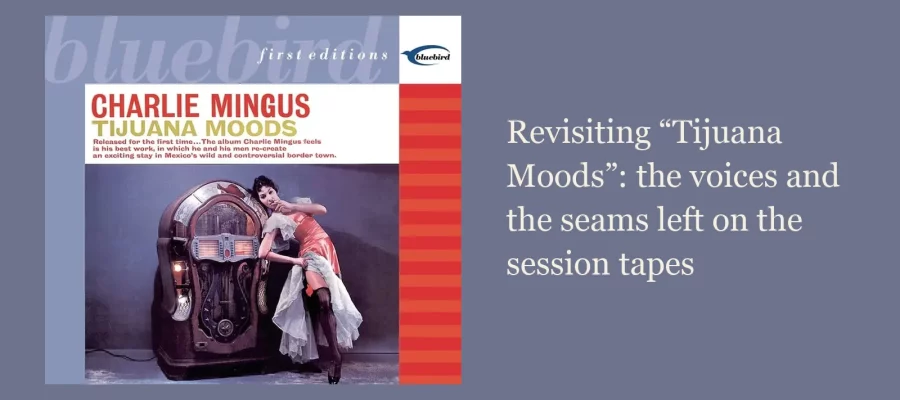
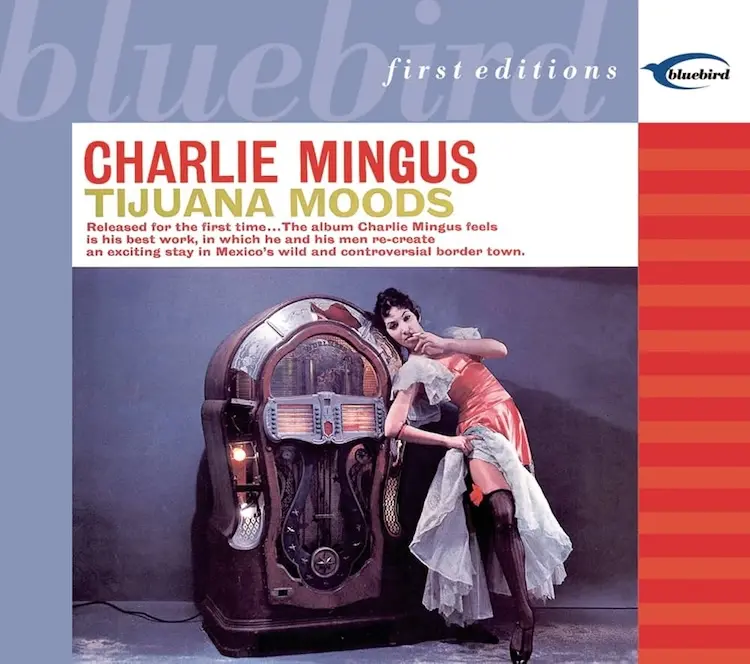
It was in 2006, twenty years ago now, that I wrote about Charles Mingus’s Tijuana Moods (RCA Victor LSP-2533) and its two-CD reissue with bonus tracks (Bluebird 09026-63840-2) on this blog. Back then I wrote of the 2001 Bluebird 2CD reissue that "the more closely I listened to every corner of it, the more mysteries were solved, and at the same time the deeper the new mysteries grew." I have kept listening to this album since, kept reading the literature, and recently I had the chance to go back through that 2CD from end to end once more, this time down to the waveforms and spectrograms. What I learned, what needs correcting, and what new questions came up: I am putting them together here as a sequel, twenty years on.
As a companion piece dealing with the same Mingus tape-editing method, "island-hopping," I am publishing Charles Mingus’s Pre-Bird, and the voices left on the offcuts at the same time. That one is about the 1960 Mercury session; this one is about the 1957 RCA Victor session. Read together, I think they give a stereoscopic view of how Mingus used the recording studio.
Why the session happened at all (the lawsuit over Thad Jones)
In the 2006 article I mentioned, citing a Down Beat report, that Mingus’s Debut label had been about to sue RCA Victor. At the time that was all I could get to; the story is now somewhat more concrete.
According to an article headed "Sad Thad" in the September 5, 1957 issue of Down Beat, p.11, the trumpeter Thad Jones, then under exclusive contract to Debut, took part in an RCA recording under the pseudonym "Bart Valve," and Debut responded by filing a $20,000 damage suit (Jones himself was named among the defendants; RCA answered with a general denial).
The recording at issue was Al Cohn’s The Jazz Workshop (Four Brass, One Tenor) (RCA Victor LPM-1161, 1955). It was recorded on May 9, 14, and 16, 1955 at Webster Hall in New York (matrices F2JB3730-F2JB3741), and the credits list Thad Jones under the name "Bart Valve."
The plaintiff, Debut Records, was the independent label Mingus founded together with Max Roach. According to Gabbard’s biography, the seed money was $500 that Mingus obtained through a claim he filed with the union, plus several hundred dollars raised by his then wife Celia. It was mainly Celia who ran the day-to-day business, and Gabbard writes that it was Celia who almost single-handedly kept Debut going for several years. And in this same year, 1957, Mingus and Roach, carrying mounting debts, wound Debut down.
That biography of Mingus by Krin Gabbard (2016) says this about the Tijuana Moods session:
In 1957 Mingus was still relatively obscure, but he had landed a session with RCA, one of the most important labels in the music world, to settle a lawsuit he had brought after the company recorded Thad Jones when he was on exclusive contract with Debut.
Krin Gabbard, Better Git It in Your Soul: An Interpretive Biography of Charles Mingus, University of California Press, 2016, p.71In other words, the Tijuana Moods session itself came about as the settlement of this lawsuit. The lawsuit that my 2006 article could only touch on in the context of "probably not the reason for the release delay" is treated in Gabbard’s biography as the very circumstance that brought the session into being.
That said, there are points in Gabbard’s account that do not square with the primary sources. In the Down Beat article, the plaintiff is Debut, not Mingus personally. And if we line up the relevant dates, we get the following.
- May 1955 — the recording at issue in the suit (LPM-1161)
- July 18 / August 6, 1957 — the two Tijuana Moods sessions
- September 5, 1957 issue — Down Beat reports the suit; RCA answers with a general denial
Two years and three months from recording to report. Where in that span the suit was filed is stated neither in the Down Beat article nor in Gabbard’s biography. As of the report, the month after the session, RCA was entering a general denial, that is, showing every sign of contesting the case. Gabbard’s reading is that this dispute lay behind Mingus, still little known at the time, getting the chance to record for RCA Victor, the most major of major labels. There is no material that would pin down the path from filing to session.
There are two things I want to add. First, this paragraph of Gabbard’s carries no note. The notes before and after it cite sources for the discography of the record, for Mingus’s own liner notes, and for the Clarence Shaw anecdote, but no source is given for the story connecting the lawsuit to the session itself. Second, Brian Priestley (author of Mingus: A Critical Biography, 1982), who contributed the essay to the 2001 booklet, went through RCA’s enormous internal files and wrote, "Victor’s voluminous files have not yielded confirmation of this." The side that treats the session as the product of a settlement cites no source; the side that doubts it has consulted the company’s internal documents. As a matter of the weight of the evidence, I think this asymmetry is worth keeping in mind.
Why the release was five years late
The sessions were in July and August of 1957. Yet the album did not come out until the summer of 1962. Five years after the recording. What happened in between?
First, for why it was not released at the time, there is a concrete explanation involving the label’s circumstances. According to John S. Wilson’s review “Mingus’ Best—Off Shelf at Last” in the New York Times of July 22, 1962, just after the release, the recording was made not for RCA Victor proper but for its subsidiary Vik label.
made for the Vik label, which Victor killed shortly after this Mingus session
John S. Wilson, "Mingus' Best—Off Shelf at Last", The New York Times, July 22, 1962, p.77Made for Vik, and Vik, the vessel that was to receive it, disappeared. But Wilson’s explanation does not stop there. Other Vik material was issued by Victor proper, yet this record stayed on the shelf for "the past five years." Wilson locates the reason in RCA’s coldness toward jazz, putting it as "if Victor had been at all responsive to the jazz market." That is the view from outside the company.
From inside RCA, meanwhile, a different explanation emerged. Three months before the release, Billboard’s April 28, 1962 issue, p.6, carried a bylined article by George Avakian, A&R manager of RCA Victor’s popular division, "George Avakian Views Growing Jazz Market." This article, a survey of the growing jazz market, sets up a subheading "Mingus Released" and announces plans to release a Mingus record made several years earlier. The reason it gives for the delay is this one sentence:
it was so far ahead of its time that it was deemed unwise to release it commercially until now
George Avakian, "George Avakian Views Growing Jazz Market", Billboard Music Week, April 28, 1962, p.6The original is in the passive voice, and it does not say who made the judgment. Some care is needed here: Avakian himself joined RCA Victor at the end of September 1960 (the Billboard issue of October 3, 1960 reports the appointment). In 1957 he was not at RCA. So this is a passage in which Avakian, who arrived later, explains that RCA Victor at the time had judged it so. Note that this article mentions neither Vik nor the lawsuit.
The contemporary explanations are these two. The insider wrote that "there had been a judgment that it was too far ahead of its time," and the outside critic wrote that "Vik disappeared, and after that an RCA indifferent to jazz let it sit." They contradict each other, and I do not have the material to judge which is closer to the truth. But on one point they agree: neither mentions the lawsuit. The Down Beat article of the previous section likewise reports that the suit existed but does not connect it to the release. What can be said at this point is that how the lawsuit bore on the delay, or did not, cannot be read out of the contemporary record.
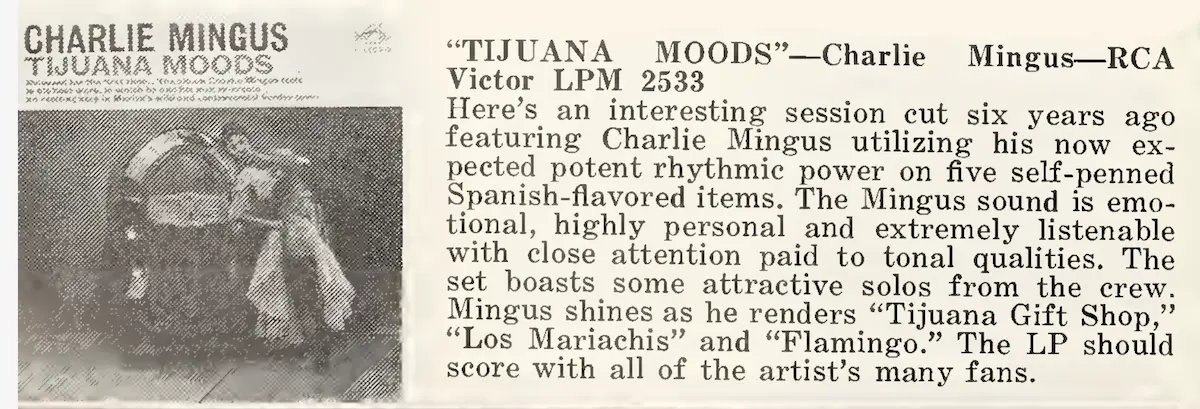
In later years, the person who tried to answer this blank head-on was Brian Priestley, whose name has already come up. In his essay for the 2001 booklet, Priestley, having examined RCA’s internal documents, states the reason for the delay flatly:
not because of any litigation but because the Vik label itself was quickly phased out
Brian Priestley, Tijuana Moods (Bluebird 09026-63840-2, 2001) booklet notes, pp.10-11This supports Wilson’s first reason from the side of the internal documents. It does not, however, resolve the other question Wilson raised (why, when other Vik material was transferred, this record alone took five years).
One piece of background to add: in the fall of 1960, RCA brought in Avakian under a policy of building its pop and jazz album divisions up to a competitive level (the Billboard issue of October 3, 1960, cited above). It is tempting to read the 1962 release as an extension of this change of course, but the personnel article mentions neither Mingus nor Tijuana Moods, and nothing more can be said than that the timing lines up. What is certain is the sequence: the release plan was announced in April 1962, five years after the recording, and the record went on sale in July.
The Tijuana experience
On the album’s source of inspiration, we have Mingus’s own first-hand testimony. According to the recollection he gave John F. Goodman in 1972 (Mingus Speaks, 2013, pp.266-270), Mingus, with Dannie Richmond and no one else, hired a limousine in California and went down to Tijuana. The money came from an insurance payout. Goodman introduces the recollection as Mingus’s famous Tijuana story (or set of stories), and the content is quite explicit.
Gabbard also writes:
The experience inspired Tijuana Moods, recorded for RCA Victor a few weeks later in July 1957
Gabbard, ibid., p.216Gabbard also notes that Richmond was the only member of the band Mingus invited along on the Tijuana trip. The experience of that trip for two was the direct wellspring of that "Tijuana mood." When I listen to the album with this genesis in mind, Dannie Richmond’s drums sound dearer to me than anything else on it.
The reissue lineage
Before arriving at the 2001 2CD set I covered in my 2006 article, Tijuana Moods went through several stages of reissue.
- 1962: RCA Victor LSP-2533, the original LP. The 5 master takes only
- 1986: Bluebird 5635-1-RB (2LP) / 5644-2-RB (CD), New Tijuana Moods. The 5 master takes plus alternate versions. Because of the CD’s playing-time limit, however, "Ysabel’s Table Dance (Alternate Take)" (12:57) was dropped from the CD edition, so the CD has 9 tracks against the 2LP’s 10
- 2000: RCA Victor Gold Series 74321749992 (2CD), Tijuana Moods (The Complete Edition). Produced by BMG France. CD 1 has the master takes, CD 2 all of the alternate takes. No index points are set at the splice locations
- 2001: Bluebird 09026-63840-2 (2CD), Tijuana Moods (First Editions). Supervised by Ben Young. Alongside the master takes and the composite partial alternate takes, it includes previously unissued session fragments (breakdowns and false starts among them). The definitive edition, with the splice locations recorded via the CD index function
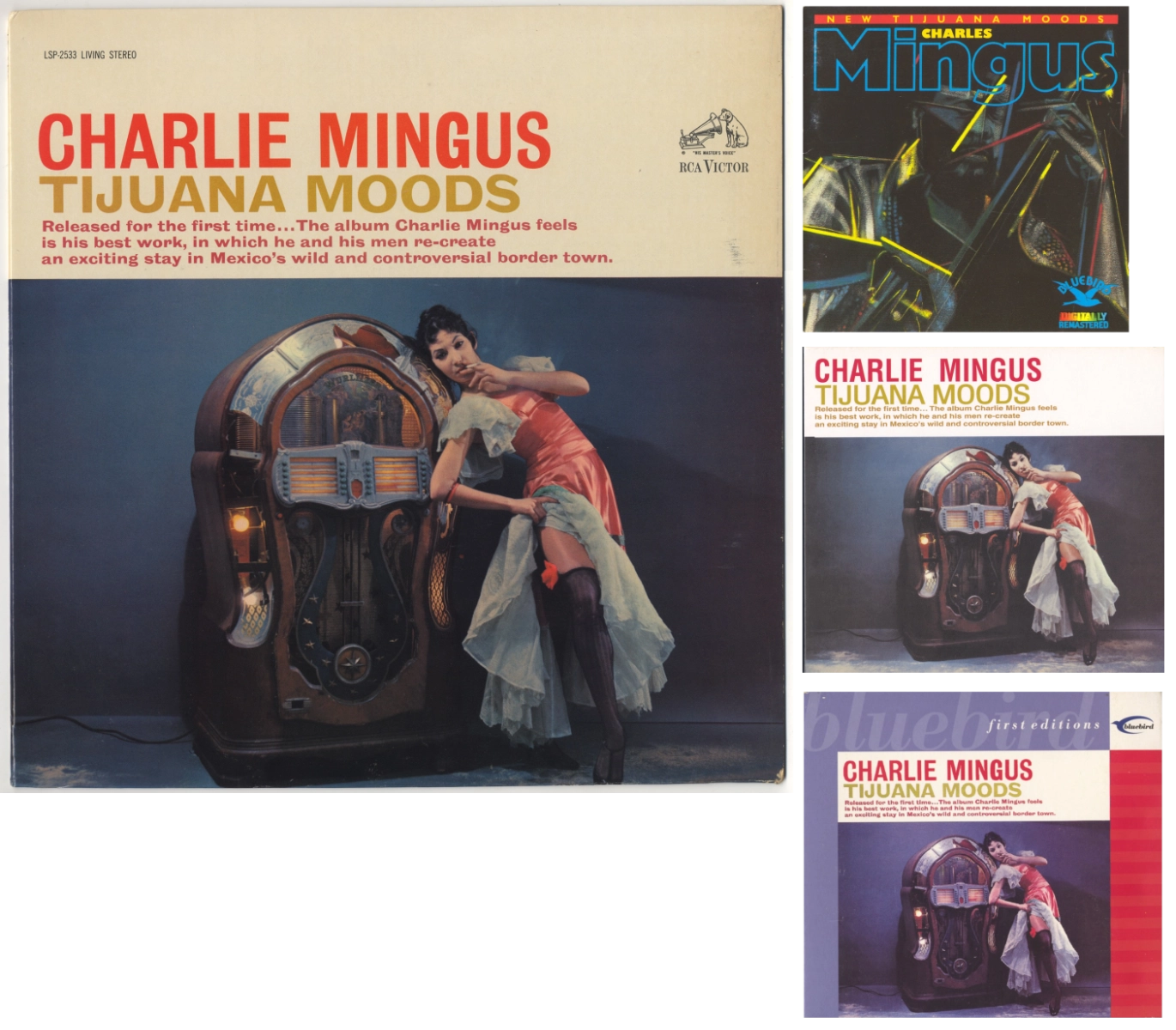
So the sequence runs like this: the incompleteness of the 1986 CD, with its one missing track, called forth the "complete edition" of 2000, which in turn led to the 2001 reissue supervised by Ben Young that went after the full picture of the sessions.
It is easy to overlook, but the 2000 and 2001 editions were made by entirely separate teams. The 2000 edition was produced by Daniel Baugarten of BMG France, with 24-bit remastering by Jean-Pierre Chalbos of La Source Mastering. The 2001 edition was researched and restored at BMG US by Ben Young, with mastering by Michael O. Drexler. Two 2CD sets claiming to be "complete" appeared only a year apart because separate projects had been running on opposite sides of the Atlantic.
Here are the production credits in one table.
| 1957 Recording sessions | |
|---|---|
| Recording producer | Bob Rolontz |
| Recording engineer | Bob Simpson |
| Tape editing supervision | Charles Mingus |
| 1962 First LP release (RCA Victor LSP-2533 / LPM-2533) | |
| LP release supervision | Brad McCuen |
| 1986 New Tijuana Moods (Bluebird) | |
| Remastering production | Ed Michel |
| Engineering / mastering | Ray Hall / Jack Adelman |
| 2000 Tijuana Moods (The Complete Edition) (RCA Victor Gold Series) | |
| Reissue producer | Daniel Baugarten |
| Mastering | Jean-Pierre Chalbos (La Source, Paris) |
| 2001 Tijuana Moods (Bluebird First Editions) | |
| Reissue producer | Ben Young |
| Mastering engineer | Michael O. Drexler |
The 2-track session masters
The liner notes to the 1986 edition say this:
This compact disc, digitally remastered from the original 2-track session master tapes, presents the original TIJUANA MOODS (the album Charles Mingus called "the best record I ever made") side by side with, except for "Ysabel’s Table Dance", full-length, alternate versions of each selection.
New Tijuana Moods (Bluebird 5644-2-RB, 1986) liner notesThe phrase "2-track session master tapes" matters. It means the 1957 recording was made in 2-track (stereo), in other words not a multitrack recording of 3 or more tracks.
In my 2006 article I speculated that the mono LP might have been made by downmixing from a 3-channel master, but if this statement is taken at face value, that speculation does not hold. The option of going back to a multitrack and remixing never existed; every edition starts from the same 2-track mix. If differences in sound can be heard between the editions, they come from processing at the mastering stage.
And there is one more thing. This statement also confirms that Mingus’s island-hopping (splicing) was not editing done on a production master after mixdown, but physical cutting and splicing of the session master itself. The tape the scissors went into was the only tape on which the performances were recorded.
Who assembled the alternate versions
The "alternate versions" on the 1986 edition are not simply other takes from the 1957 sessions that had been lying there intact. Ed Michel’s own text in the liner notes explains frankly how they came to be.
First, the actual condition of the session tapes Michel faced.
The reality of the tapes was something else again. Hardly anything was recorded as a complete take, so arriving at the originally released track involved building up on a base take—or segment of a base take—and adding sections recorded as "patches" or "inserts." And, as noted, there was shortening, elimination of details, some loss of structure and solo in making the original TIJUANA MOODS.
Ed Michel, New Tijuana Moods (Bluebird 5644-2-RB, 1986) liner notes, pp.6-7Hardly anything was played through to the end as a complete take. What the two sessions of July 18 and August 6, 1957 (recording producer Bob Rolontz, recording engineer Bob Simpson) left behind was not finished pieces but a pile of raw material. The 5 tracks released in 1962 are what RCA built up from that material. On how the results turned out, Michel gives this assessment:
First of all, there’s the question of the edits. Most of them are kind of brute-force, and none of them are particularly subtle, which is to say that your ears certainly tell you that there’s an edit there.
Michel, ibid., pp.6-7"Brute-force." He is talking about the 5 tracks released in 1962, which on the 2001 edition are Tracks 1-5 of Disc 1. Michel did not, however, touch this release master; on the 1986 edition it appears in its original form.
Then what are the alternate versions? In the same text, Michel himself writes:
But there was, gratefully, enough first-rate material for an album of alternate approaches to the same tunes, and this time I promised myself that the edits would be a little more on the seamless side.
Michel, ibid., pp.6-7"This time." The alternate versions are not unearthed unissued takes; they are constructions that Michel, together with engineer Ray Hall, assembled from the fragments into full-length form in July 1986. On the 2001 edition, these are Tracks 6-9 of Disc 1 and Track 1 of Disc 2.
To sort this out, the album’s editing has three layers. The fragments the 1957 sessions left behind. The release master that Mingus himself cut and spliced together from them within 1957 (the one whose edits, as Michel put it, your ears can plainly hear). And the alternates Michel newly assembled from the same body of fragments in 1986 (the ones with the edits pushed toward the seamless side). When we listen to the two discs of the 2001 edition, we are moving back and forth among these three layers. If the splices sound different between the master takes and the alternates, what we are hearing is the difference between two editing rooms nearly 30 years apart, 1957 and 1986.
The two-channel stereo image lets you identify who is speaking
This recording was made by assigning individual instrument microphones to left, center, and right on the console and mixing them down to two channels. The placement stays consistent throughout, and it was enough to tell who was talking.
| Left | Center | Slightly right of center | Right |
|---|---|---|---|
| Trumpet (Clarence Shaw) | Bass (Mingus), piano (Bill Triglia), drums (Dannie Richmond) | Booth (Bob Rolontz) | Trombone (Jimmy Knepper), saxophone (Shafi Hadi), voice and handclaps (Ysabel Morel), castanets (Frankie Dunlop) |
The interesting one is the booth. After many rounds of comparative listening, I found that the voice from the booth sits slightly to the right of center, which makes it distinguishable from Mingus’s voice, which sits dead center. The booth is a separate room, so this "slightly right" is not a position in the studio; it is a placement decided at the console. Ysabel Morel is on the right. Both her handclaps and her stifled laugh in a scene I describe later come from the right channel, which backs this up.
Even when the playing stops and the studio gets noisy, you can follow who is speaking by where the voice comes from. Nearly every speaker identification in the conversations quoted in this article rests on this stereo placement.
Note that the liner notes identify the main voice in the booth as Bob Rolontz (the recording producer), but they use the phrase "principal speaker." And indeed, careful listening turns up two spots where a different voice enters from the booth (around 34:48 and around 49:36, both in source-WAV time), which confirms from the audio itself that there were at least two people in the booth. Whether the second voice is recording engineer Bob Simpson, I have no material to verify.
Into the session tapes
The second half of Disc 2 on the 2001 edition (Tracks 4 through 13) holds a group of unissued fragments you could call "session footage": breakdowns (takes that fell apart partway), false starts, and conversations exchanged between takes. Small voices caught by the instrument microphones. I raised the volume, slowed the playback, listened over and over, and attempted transcriptions (see supplementary note 1 at the end of this article on the method and its limits).
Below, I go through them song by song. All the quoted conversations are based on my own listening, and the timestamps are positions in a WAV file made by concatenating Disc 2.
Ysabel’s Table Dance: "she was gassing me"
Disc 2 Track 4 is the session fragments of "Ysabel’s Table Dance" (matrix H4JB 5226). After the collapse of take 2, this exchange survives.
"Man, I thought, I was, excuse me, man, I goofed, she was gassing me, man."
"She’s gassing us, too."
The first speaker is Mingus himself. The leader and bassist admits his own playing mistake and apologizes, and the booth (Rolontz) answers that she is gassing them too. "She" is, of course, Ysabel Morel, who was dancing a table dance in the studio. The booth starts to add "Listen, Ysabel, you should be—" and the tape cuts off; when it resumes, a woman’s stifled laugh comes from the right channel. The bandleader flubbed his part because he was watching the dancer, and he confesses it right in front of her. I think these few seconds carry the warmth of this album better than anything else on it.
At the end of the same Track 4, right after take 8 falls apart, a very different, urgent voice comes in.
"You’ve got some damn limits!"
"Are you out of your mind? This is our last chorus!"
From the flow, these two utterances read like an argument, but however many times I replay them, both are Mingus’s voice. This is not an exchange with someone else; Mingus is protesting alone, presumably toward the booth. Since he says "last chorus," the collapsed take 8 must have reached the final chorus of the piece. The protest, I take it, is that they were stopped when a complete take was within reach. What "limits" refers to, I do not know. Reading it as a constraint on the side that stops the playing, say studio contract hours or remaining tape, seems natural, but there is no material to settle it.
What is certain is what happened right afterward. The matrix of the master take is H4JB 5226-3B/4/5/9. Take 9, recorded immediately after the protest, is in fact part of the master. Whether the protest carried the day, the tape does not tell us.
Dizzy Moods: "I’ll stake my career on it" and "Don’t do that"
Track 5 ("Dizzy Moods," matrix H4JB 5225) has a charming scene that the liner notes also describe. Asked by the booth to confirm the tempo, Mingus vouches for it:
"You sure your tempos match your other thing?" — "I’m pretty sure. I’ll stake my career on it."
And the instant he does, a small female voice comes in.
"Don’t do that."
According to the liner notes, this woman was a guest Mingus had invited to the July 18 session. Her voice sits on the left, and the placement itself confirms she is not Ysabel Morel, who sits on the right. The perfect timing of that "Don’t do that," flying in from a corner of the studio. It is the kind of humor you can only hear on a session tape.
Tijuana Gift Shop: the hard passage, and the missing take numbers
Track 7 is a collection of breakdowns of "Tijuana Gift Shop" (matrix H4JB 5230). Just before take 1, Mingus can be heard telling trombonist Jimmy Knepper the order of entrances while apologizing for his own lapse.
"I’m coming before you, Jimmy." "I’ve been goofing, and I’m waiting on you, sorry."
What the track contains is take 1, take 2, and take 4. There is no take 3. Take 2 and take 4 fall apart at the same spot, in the same way, partway through Clarence Shaw’s trumpet solo, which tells us where the hard passage of this arrangement was. After take 4, Mingus says "Come on, trumpet, solo, rehearsal." and they go into rehearsal, and the tape stops. What appears next is the solo section edited out of the master take, take 6 (Track 8), and take 5 is missing as well. I will come back to the missing take numbers later, looking at the whole picture.
Los Mariachis: the working title "Street Musicians," and the struggle of take 19
Tracks 9 through 11 are "Los Mariachis" (matrix H4JB 5227), the longest stretch of the session footage and the one with the most drama in it.
To begin with, at the opening, the piece does not yet have a name.
"Lack of a better title right now." "Although it’s got Calypso in it, so I don’t know what else to call it."
"You can just call it Street Musicians."
The suggestion comes from Bob Rolontz in the booth (this remark is also reproduced in the liner notes). And in fact, throughout the piece Mingus keeps referring to a structural section as "the Calypso" ("Four before the Calypso" and the like, seven times by my count), so this hesitation over the working title is continuous with the design of the piece itself.
This way of thinking in sections resonates with later scholarship. Jazz scholar Stefano Zenni argues that Mingus used a form he calls the extended chorus, binding several sections of differing character, tempo, and harmony into a single long chorus, and that "Los Mariachis" is organized as something rarer still within that practice: a classical rondo that returns to the main section while piling up episodes. The soloist has to travel that whole itinerary, so the direction of a solo is strongly determined by the form, he points out. This reading matches the section-level instructions left on the tape, such as "Four before the Calypso."
After take 2 falls apart, there is this scene.
"I goofed that one."
"No you didn’t, man. It was very good. You’re supposed to hold your note and do just as you did."
The one apologizing first is Clarence Shaw; the one consoling him is Mingus. Since the reply is "hold your note," the other party is a horn player, and the horn placed on the left is Shaw’s trumpet. On "Ysabel’s Table Dance" it was Mingus himself apologizing with "I goofed." Now the same words come from a sideman, and the leader waves them away. It is an exchange that gives a glimpse of the human relations of this session.
The center of the struggle was take 19. From the booth’s announcement "Take nineteen." at 1:10:21 (source WAV), it is playing, interruption, restart, interruption, over and over. The count-ins add up to four in all, and partway through Mingus even strips down the instrumentation.
"Look, bass and piano. One, two, three, four."
In the interruption of take 21, the precision of Mingus’s instructions shows clearly.
"One, so start one bar before the out chorus," "which means you’re starting the C7 chord of his solo." "You knock off one, and then one end of his solo."
He is specifying the entry point from both sides, by bar count and by chord name. Not "just do it again," but from where, and from which chord. It is a fine example showing that Mingus’s way of running a session was not mere force of will.
And when take 22 gets through a whole section, the room relaxes. Onto Mingus’s pet theory that music does not fade out in church, wordplay piles up.
"No, you don’t fade out in them churches" "You drop out" — "Fall out" — "Pass out"
The one who threw in "Fall out" is a player in the center or on the right, and laughter breaks out right after. This is the same studio that had been drilling down bar by bar only a few dozen seconds earlier.
At the end of Track 11, an interesting voice can be made out. The index table for Track 11 in the liner notes leaves the take number and description of its final row (index 10) blank in print. And yet, just 0.57 seconds after the position of index 10 on the CD, the booth says quietly on the tape: "Twenty-four." A blank in the official documentation gets filled in by a small spoken announcement left on the tape. Take 24 (H4JB 5227-24) fades out about 8 seconds after the count-in, and there Track 11 ends.
A Colloquial Dream: the editing intent is spoken on the spot
There is also the reverse case, where the documentation confirms what is said on the recording. On Track 13 ("A Colloquial Dream," matrix H4JB 5229), just before take 8, the booth’s announcement goes like this.
"Take eight, work part, patch for six."
"Patch for six." The take 8 about to be recorded is material to be spliced onto take 6: an editing intent stated on the spot, in the middle of the recording session. And the matrix of the composite take of this piece included as Disc 2 Track 2 is H4JB 5229-6/8/10. Exactly as the booth said, take 8 was grafted onto take 6 and released. As direct evidence that island-hopping was not a "fix it in the edit later" technique but that the edited final form was already being designed at the moment of recording, audio this explicit is hard to come by.
While I am at it, there is one misprint in the liner notes. The note in the personnel section reading "CD 2, TRACKS 2 AND 10-14: add Lonnie Elder, narration; possibly Dunlop, tambourine, additional voices" cannot stand as printed, because CD 2 has no Track 14 (it has 13 tracks in all). The correct reading is presumably "TRACKS 2 AND 12-13." My grounds are three. (1) On CD 2, "A Colloquial Dream" occupies exactly three tracks, Track 2 / 12 / 13, and the additional personnel this note lists all belong to this piece. (2) The recording dates are separate: Tracks 9 through 11 are from July 18, and Tracks 2 / 12 / 13 are from August 6. Lonnie Elder was a participant on August 6, so he cannot apply to tracks recorded in July. (3) "Additional voices" is a term for voices as musical participation, and this is precisely a piece in which narration and shouts enter as part of the music.
Mingus himself was present at the editing sessions
"Patch for six" was audio evidence that the editing was designed at the recording session. The production side attests to the same thing in writing. It is Ben Young’s essay "A Note on the Contents: Meditation on a Pair of Editing Scissors," on pp.6-7 of the 2001 edition’s booklet. It is a text by a different author, collected in the same booklet as Priestley’s notes (pp.8-12). On the editing of the release master, Young writes:
Mingus was present at all the editing sessions with engineer Bob Simpson, dictating the choice of takes and where to cut them.
Ben Young, "A Note on the Contents: Meditation on a Pair of Editing Scissors", Tijuana Moods (Bluebird 09026-63840-2, 2001) booklet notes, pp.6-7So the splice designed on the studio floor as "patch for six" was executed in 1957 by recording engineer Bob Simpson, with Mingus himself in attendance. Simpson held the scissors, but it was Mingus who decided where to cut them. The line "1957 / tape editing supervision / Charles Mingus" in the production credits table rests on this passage.
Then what was done five years later, in 1962, at the time of release? Young continues:
In 1962, RCA Victor producer Brad McCuen saw to it that Tijuana Moods finally came out. McCuen assembled the pieces for the LP and cleared the final sequence with the composer (Brian Priestley’s notes imply that Mingus’s original sequence might have been different). He discovered that Mingus had made most of the critical edits before the project went into hibernation (see page 11).
Young, ibid., pp.6-7This is a passage to read with attention to the scope of the words. What Young writes is "most of the critical edits," not all of them. And on McCuen’s side there is real work too: he "assembled the pieces for the LP." The 1962 job was not merely confirming a running order, nor, conversely, was the editing done from scratch in 1962. The decisive cutting and splicing had been finished in 1957 under Mingus’s direction, and in 1962 McCuen built that material into an LP as a product and settled the sequence with the composer himself. That is the division of labor the original text conveys.
The term "island-hopping," which I have used in this article (and in the 2006 article, and in the companion piece), also comes from this essay by Young.
Most of the splices on Tijuana Moods are due to a recording process sometimes known (in the industry) as "island-hopping."
Young, ibid., pp.6-7That Young calls this not an editing method but "a recording process" lines up exactly with the "patch for six" scene. The cutting and splicing did not begin after the recording; it was built into the way the recording itself was made.
It may be that the very design of the piece, stacking sections of differing character inside itself, demanded this recording process. Rather than aiming to reach the finished form in a single complete pass, tightening each section on its own and joining them afterward may simply have made better sense for this structure.
The finished takes are spliced in 37 places
The conversations are not the only thing worth studying on the 2001 edition. On the five finished takes of Disc 1, CD index marks are placed at the positions of the splices (the joins in the tape). In my 2006 article I listed the 14 points in "Ysabel’s Table Dance"; this time I computed them for every track mechanically from the cue data.
| Track | Number of splices |
|---|---|
| Dizzy Moods | 9 |
| Ysabel’s Table Dance | 14 |
| Tijuana Gift Shop | 5 |
| Los Mariachis | 6 |
| Flamingo | 3 |
That makes 37 splices across the five finished tracks. The shortest interval is in "Tijuana Gift Shop," from 2:10.97 to 2:11.40 (measured from the start of the track): just 0.43 seconds. A 0.43-second section sits there as a single, independent "island." Twenty years ago I wrote, in astonishment, "I never imagined the fragments had been assembled this minutely!"; put into numbers, the astonishment is sharper still.
Here let me add one caution for anyone who plans to study this 2CD closely. The index marks mean different things on Disc 1 and on the session footage of Disc 2. On the finished versions and the alternate takes, an index marks a splice point, that is, an editing join; on the session footage of Disc 2 (Tracks 4-13), an index marks the start of another take. When the index number advances in the session footage, it is not because "an edit was made" but because "the next take begins." Confuse the two and you will misread the fragments as the scars of a chopped-up edit.
The handling of index 00 is not uniform either. On Disc 1 it is the gap between tracks, but on Disc 2 Track 4 the span from index 00 to 01 runs 73.27 seconds, and that span itself is the BREAKDOWN (H4JB 5226-2). When ripping a CD track by track, many ripping programs attach the span from index 00 to 01, the pregap, to the end of the preceding track; for these bonus tracks on Disc 2 (the session footage), attaching the pregap to the beginning of its own track is the more accurate choice.
What remains on the tape, and what is lost
Now we come to what I most wanted to write about this time. I surveyed the session footage exhaustively at the waveform level, and I will set out what I found, starting from what is certain.
The take numbers skip in 8 places
Collating the cue indexes against the take designations in the liner notes yields one fact that can be read without interpreting a single sound: missing take numbers.
| Track (matrix) | Missing takes |
|---|---|
| Dizzy Moods (5225) | takes 9-13 (5 takes), take 15 |
| Ysabel’s Table Dance (5226) | takes 4-6 (3 takes) |
| Los Mariachis (5227) | take 4, takes 11-14 (4 takes) |
| A Colloquial Dream (5229) | take 7 |
| Tijuana Gift Shop (5230) | take 3, take 5 |
Eight places, 17 takes in all. The booth announcements count off the take numbers scrupulously (the tape even preserves a moment where the announcer starts to say take 7 and corrects himself to take 8), so wherever a number is skipped, the take bearing that number is simply not on this CD.
An unused "composite" survives on the tape, still composited
The next certainty is a fact the liner notes themselves acknowledge. The 2001 track listing carries the designation COMPOSITE in six places. In other words, material assembled by splicing multiple takes together survived on the tape beyond the finished versions. The most notable is the designation at Disc 2 Track 4 index 1:
COMPOSITE INCOMPLETE TAKE H4JB 5226-3A/4 (UNEDITED)
2001 edition track listing, Disc 2 Track 4 index 1A composite of two takes, 3A and 4, and yet marked (UNEDITED), meaning that no further editing was applied for the 2001 CD release. Put another way, the spliced-together state of 3A and 4 was not the work of Ben Young or Michael O. Drexler, the producers of the 2001 2CD; it was already on the tape that way. So when, and how, was this join made? One plausible path runs like this: to assemble the master take (H4JB 5226-3B/4/5/9), the used portions of 3B and 4 were pulled out, and the leftover portions were spliced to each other and wound onto the session reel. In the working practice of 1957-62, removing an unwanted portion also meant cutting, pulling, and splicing. No gap is left in the tape; only the join remains. Or, and this is pure conjecture, perhaps a version joining 3A and 4 was also made at the time, and in the end it was the 3B-and-4 side that was used. The truth is lost to us, but at the very least, 3A and 4 were stored spliced together.
At the joins, there are 18 stretches of digital silence
On top of that, across the whole of the session footage (Disc 2 Track 4 onward), I mechanically detected every span in which all samples are zero. The result: 18 of them. And all 18 sit at track boundaries or index positions, that is, at the joins between one piece of material and the next. Not one appears in the middle of a take’s performance.
A state in which every sample is zero can never arise from a transfer of analog tape, because even a no-signal passage always carries tape hiss. A run of zeros is the result of muting in the digital domain, not the state of the tape itself. So the shortcut "there is silence, therefore the tape was cut there" is not available.
Does that mean these 18 silences tell us nothing? Not so. Measure the "shape of the edge" going into each silence, and the 18 cases divide cleanly into two groups.
The first group (9 cases) enters the silence with a fade. The level falls monotonically over 2 to 3 seconds. In the example at 37:48.158, the level over the preceding 3 seconds runs −30.9 → −34.2 → −42.0 → −47.7 → −56.3 → −77.1 dB. The reverberation of this studio stops at a noise floor of −55 to −65 dB, so a drop to −77 dB does not happen without processing. In other words, the 2001 production team did fade performances out when necessary, even in the session footage. This I can state as settled.
The second group (4 cases) shows not even 1 dB of movement in the level right up to the cut. Playing or talking is proceeding normally, and then, abruptly, silence. The extreme example is at 43:11.690 (the spot where take 3 of "Tijuana Gift Shop" is missing), where the 250 ms just before the silence is actually 8.1 dB louder than the second before it. The durations, too, cluster under one second, at 0.290 / 0.500 / 0.509 / 0.564 seconds, plainly a different operation from the fades that take several seconds to fall.
And of these 4 abrupt cases, 3 coincide with skipped take numbers (the gaps at take 3, take 4, and takes 11-14). Three out of four is a small count, but where the correspondence between the fade group and the missing takes is scattered, the abrupt group lines up neatly with the gaps.
What was erased (my hypothesis)
From here on, I am speculating.
A fade is a musical operation; you apply it because you want a performance to end naturally. Then what is it that was muted with no fade, cut off dead? It was not silenced for any musical reason. If so, what was erased was not performance but, I suspect, noise occurring at the joins. Physically, several candidates offer themselves: the click as the thickness of the splicing tape passes over the playback head; leader tape (it carries no oxide coating and so produces no sound, but a shock noise rides the transition on either side); or dropouts from stretching or creasing near a cut end that had been handled by hand.
On this reading, there would have been two kinds of join. The musical editing joins made to assemble the production master were destined for the finished product, so they were spliced with care and left no trace. The provisional joins, by contrast, made only to wind the leftover scraps together for storage, had no need to be careful, and might well have been separated by leader tape. What was muted in 2001, on this account, was the noise of the latter.
But this is my conjecture, and it cannot be proven objectively. My attempts to detect traces of the splices themselves (residual clicks and the like) in the waveform came up with nothing. The extent of a mute is decided by the engineer, so the position of a silence cannot pin down the position of a cut. The only thing that can be stated with certainty about positions is the missing take numbers. And even if this hypothesis is wrong, the three preceding facts (the missing take numbers, the composite left on the tape, the silences dividing into two groups) do not move.
Splicing too clean to hear
I examined two spots in the spectrogram where the liner notes explicitly say a splice exists: the join between the middle of take 3 and take 7 of "Ysabel’s Table Dance" (around 29:11), and the roughly five-minute COMPOSITE span of 3A/4 mentioned above. In both cases, the join is completely invisible. There is no step in the hiss band, no staircase in the level, no click, and musically the material flows on naturally.
At the very places where a join is known to exist, the join cannot be heard. Which means the RCA engineers of 1957 did their splicing work that cleanly.
In closing: twenty years on
I wrote my 2006 article in the key of "the mystery only deepens." Why was the album shelved for five years? Why does even the definitive CD contain almost no unedited takes? To me back then, Tijuana Moods was a two-layered mystery: the minutely edited finished product, and the invisible session behind it.
Twenty years on, the first layer has an answer, at least as far as the doorway. The album was made for the sideline Vik label, and Vik was folded. It was not the lawsuit. But while other Vik material was released by Victor proper, why this album alone sat unmoved for five years is a question on which the contemporary accounts still disagree with each other. The second layer remains, even now, in the realm of conjecture. Even so, in the form of the missing take numbers, I can at least draw the outline of what is not there.
And what changed most of all is that I came to have the means, and the patience, to listen closely to the scraps of tape. When I set about transcribing the conversations left on the scraps, what I found there was not the sealed-room labor of an enigmatic genius but a flesh-and-blood band and its leader: pressed for time ("You’ve got some damn limits!"), fumbling a passage while gazing at the dancer, stumbling twice at the same hard spot, encouraging colleagues, scolding them, calling out instructions by chord name, laughing together over wordplay. And when the recording was done, Mingus moved to the editing room and, at Bob Simpson’s side, directed the choice of takes and the placement of the cuts. The brilliant splices that remain on the master tape stood on top of this unglamorous accumulation of work.
In the Pre-Bird article, I introduced the conversation just before take 4 that survives in the opening 42 seconds of the 1999 CD. If that was a single scrap of tape, what the 2001 edition of Tijuana Moods contains is a bundle of scraps. In both cases, precisely because the island-hopping method cut up the session masters themselves, the parts that did not become "islands" survived, conversations and all. It gives me a strange feeling to think that, as a byproduct of Mingus’s editing craft, a live account of a 1950s jazz recording session has reached us half a century later.
The album Mingus called the best record he ever made: we can now, at last, hear the substance of that pride as a working process, from performance through to editing. What was astonishment twenty years ago has, this time, turned into respect.
Appendix 1: how the transcriptions were made, and their limits
The transcriptions of conversation in this article were made with the help of whisper (speech recognition), alongside boosted-volume files played back at 0.7 to 0.5 times speed, listened to over and over on headphones. Some passages are very fast and hard to catch, and some are buried under instrument sounds, so I cannot claim that every word is accurate; within the range of what I could hear, I have presented what seems to me, at present, the most plausible reading.
Appendix 2: what 2-track stereo left us
The session was recorded on 2-channel stereo tape: multiple instrument microphones were assigned to two channels at the mixing console and recorded as such. Half a century later, this left two benefits for the transcription work.
First, as touched on in the main text, speakers could be identified by their position in the stereo image. If a voice came from the left, it was a player panned left; if from center-right, it was the booth, and this reasoning actually held up. The three voices that pile up at center (Mingus, pianist Bill Triglia, drummer Dannie Richmond) I separated by vocal quality (Triglia somewhat raspy, Mingus slightly nasal). Incidentally, of the utterances whose speaker could be identified, about 60 percent were Mingus’s. Where the command of the session lay shows up plainly in the utterance counts as well.
Second, simultaneous speech could sometimes be disentangled. There is the spot where Mingus’s voice at center overlaps a left-side player’s "That’s what I’ve been doing."; the spot where the trumpeter Shaw breaks in from the left to explain himself over Mingus’s remark; and the three-way spot where Mingus’s "Keep going." lands on top of a gravelly voice on the right and Shaw on the left. Folded down to mono, these voices would clump together; in the stereo space, they arrive from separate positions.
Because it was recorded on 2 tracks, we can now, nearly 70 years later, reconstruct who said what. The single line "2-track session master tapes," confirmed in the section on the reissue lineage, connects back to this.
Discography
- Tijuana Moods (1962, LP) — RCA Victor LSP-2533 (stereo) / LPM-2533 (mono)
- New Tijuana Moods (1986, 2LP/CD) — Bluebird 5635-1-RB (2LP) / 5644-2-RB (CD)
- Tijuana Moods (The Complete Edition) (2000, 2CD) — RCA Victor Gold Series 74321749992
- Tijuana Moods (2001, 2CD, First Editions) — Bluebird 09026-63840-2
- Research and restoration by Ben Young; mastered by Michael O. Drexler
- Al Cohn The Jazz Workshop (Four Brass, One Tenor) (1955, LP) — RCA Victor LPM-1161
- The recording at issue in the lawsuit. May 9, 14, and 16, 1955, Webster Hall (NYC). Thad Jones participated under the name "Bart Valve"
References
- "Sad Thad", Down Beat, September 5, 1957, p.11.
- "Avakian Move Seen Coup for Victor", Billboard, October 3, 1960, pp.1-2, 16.
- George Avakian, "George Avakian Views Growing Jazz Market", Billboard Music Week, April 28, 1962, p.6.
- "Cash Box Album Reviews", Cash Box, June 23, 1962, p.32.
- John S. Wilson, "Mingus’ Best—Off Shelf at Last", The New York Times, July 22, 1962, p.77.
- John F. Goodman, Mingus Speaks, University of California Press, 2013, pp.266-270.
- Krin Gabbard, Better Git It in Your Soul: An Interpretive Biography of Charles Mingus, University of California Press, 2016, pp.43, 71, 216.
- Stefano Zenni, "Mingus: Understanding His Album, Tijuana Moods", Playback with Lewis Porter!, November 16, 2025 — guest contribution to Lewis Porter’s Substack.
- Tom Lord, The Jazz Discography — Al Cohn entries (C6322.10 / C6326 / C6327).
- jazzdisco.org, Al Cohn discography — session details for RCA Victor LPM-1161.
- New Tijuana Moods (Bluebird 5644-2-RB, 1986) liner notes.
- Ben Young, "A Note on the Contents: Meditation on a Pair of Editing Scissors", Tijuana Moods (Bluebird 09026-63840-2, 2001) booklet pp.6-7.
- Brian Priestley, booklet notes, Tijuana Moods (Bluebird 09026-63840-2, 2001) booklet pp.8-12.
Related articles
- Tijuana Moods / Charlie Mingus — the 2006 article on this blog. The present article is its sequel, twenty years on
- Charles Mingus’s Pre-Bird, and the voices left on the offcuts — the companion article published alongside this one, on the island-hopping of the 1960 Mercury session