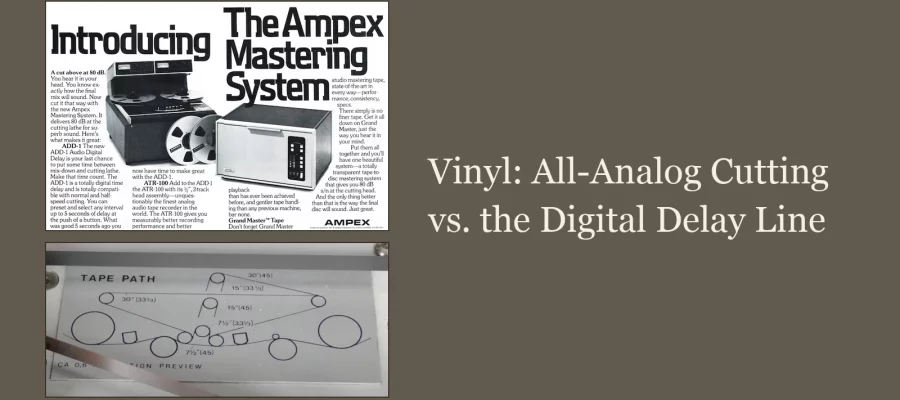
Recently, the following post was making the rounds on X (was: Twitter).
結局山下達郎氏が自らのアナログ音源時代の作品の再発になかなか首を縦に振らなかったのはこういうこと。知っている人は知っているけど今出るレコードはみんなデジタル処理を経ているから、、、
— レコード買取は名古屋ラジオデイズレコードへGo!!! (@Radiodays_Reco) April 14, 2024
ブログを書きました。
👉『現在のレコードのカッティング・音質の課題と展望』https://t.co/bsi3ITdqIJ pic.twitter.com/OjrKGml3eJ
The post above, from Radio Days Records, a record shop in Nagoya, says in substance: this is why Tatsuro Yamashita long refused to allow vinyl reissues of his analog-era work; those in the know are aware that every record released today has passed through digital processing. It links to their own blog post titled “Current issues and prospects for record cutting and sound quality”.
Prompted by that post, I went back and researched the specific timeline, the historical background, and the actual equipment that was used, and put it together here, if only in rough outline.
I should note that before the Radio Days Records post above, a YouTube video published on December 7, 2022, “Digital Delay: The little dirty secret of vinyl mastering (including past AAA records)“, had already attracted attention.
The video opens with the remark that, according to an article in the German magazine Mint, over 99% of the records in production today (including those whose masters are not digital) are “digital”, and goes on to give an objective explanation of analog delay versus digital delay.
Among the comments on this video is one from Francisco Jose Castanedo Jordan, an engineer who actually did cutting work in the 1980s, saying that everything stated in the video is 100% correct. What I find interesting is that Jordan, despite being a former mastering engineer, also writes that he loves digital playback (CDs and so on) when it is set up correctly, and that while he agrees analog (LPs and so on) can sound good, he himself does not actually like analog all that much.
I should also note that, as far as I have been able to determine, similar discussions about preview-head tape machines and cutting with digital delay were taking place on online forums around the world well before the video above, from around 2010 to 2011, among music lovers, record collectors, enthusiasts, amateur and semi-professional mastering engineers, and people who worked in the field at the time (searching on terms like “preview head” and “digital delay” turns up plenty of them).
Updated 2024/04/18:
- Added information from onojii (Sheffield Lab 8 was a direct-to-disc cutting, but with manual variable pitch)
Updated 2024/04/20:
- Added a link to the manual PDF for the Klark-Teknik DN775 digital delay unit, its relationship to the DN773 broadcast delay, AD/DA specifications, and so on
- Added a link to the manual PDF for the Benchmark ADC1 USB
- Following a correction from Shimamori, added a note that this article does not discuss the pros and cons, or relative merits, of using an LP cutting master as a CD master, and added “mainly in popular music” to the preceding passage
- Created and added a signal-path comparison diagram of preview-head cutting vs. digital delay cutting (a rough, not strictly accurate, conceptual version), based on the figures in the Bachman paper
- Added information on the cutting equipment at Masterdisk Studios as of 1987
- Other minor typo fixes and small additions
Updated 2024/04/21:
- Added a mention of a 2004 interview with Willem Makkee, a Dutch cutting engineer committed to analog cutting
- Along with it, added a side column on “Songs For Drella”, which comes up in that interview
- Other minor additions and wording fixes
Updated 2024/04/22:
- Added a photograph capturing the automatic variable pitch control section of a Scully 601 cutting lathe
Updated 2024/09/11:
- Added a mention of one of the earliest examples of automatic variable pitch, released by US Columbia around 1953
0. Summary first
Variable pitch cutting arrived together with the microgroove record and the tape machine, and by the mid-1950s cutting lathes with automatic variable pitch had begun to be used in mastering studios.
Automatic variable pitch requires reading the audio signal off the tape about 0.5 to 1 revolution ahead of the cutter head and feeding it to the cutting lathe’s control unit. Naturally, the preview distance on the tape varies with tape speed (ips) and cutting speed (rpm).
An ordinary tape machine has record, playback, and erase heads, but for disc mastering the manufacturers offered special models fitted with two playback heads.
Even before such models appeared, in-house engineers and specialist firms were converting standard models into preview-head machines.
First shown at the 1979 AES convention, the Ampex ADD-1 was a digital delay unit with 16-bit resolution and a 50 kHz sampling frequency.
It was offered as the mastering rig for a new era, paired with the Ampex ATR-100 series tape machines, for which no preview-head model was available.
The Neumann VMS80 appeared the same year. Its automatic variable pitch control used a preview of 0.5 revolution rather than the 0.6 revolution of the VMS66 and VMS70, which broke compatibility with existing preview-head tape machines.
Some tape machine manufacturers offered conversion kits, but because of the cost, it is possible that some studios chose to cut with a digital delay instead.
LPs cut from digital masters appeared in Japan in 1972 and in the United States in 1978.
As if changing places with the direct-to-disc boom, PCM digital recording spread, mainly in classical music and jazz.
When cutting a lacquer disc from a digital source, the digital delay has no drawbacks, so as PCM recording spread, the digital delay gradually took hold as well.
In 1982 the CD appeared, the first consumer digital playback medium.
At first, masters that had been equalized for analog LP cutting were often used as-is for the CD master.
The 1985 “Brother In Arms” (mastered by Bob Ludwig) is one of the earliest examples of a dedicated CD master prepared separately from the LP master, and is known as a landmark release.
Later, around the time CD sales overtook LP sales, the primary target of mastering became the CD (digital), and the use of digital masters kept increasing.
Opportunities for LP cutting equipment kept shrinking, preview-head tape machines stopped being maintained, and I believe the occasional LP cut came to be done with an ordinary tape machine and a digital delay.
Analog records, which hit an all-time sales low in 2006 and were on the verge of extinction, have since made a comeback.
Reissues of classic albums and famous recordings cut from the original analog master tapes became more common, and a few mastering studios with renowned engineers maintained and restored vintage equipment, making all-analog cutting from preview-head tape machines possible again.
For the great majority of studios, however, recording new material in analog with the LP in mind and doing LP-specific mastering is unrealistic, so I suspect a digital delay is used in most cases. I also suspect that many studios that have long owned preview-head tape machines keep them in storage rather than in working order.
Hence the claim that most of the “new release” and “reissue” LPs still coming out today are cut using a digital delay. And there are more than a few buyers who reject records cut through anything other than an all-analog path.
1. What variable pitch is
Variable pitch cutting is a technique born of the need, when cutting the master source material to a lacquer disc, to keep adjacent grooves from overlapping while wasting as little of the groove spacing between them as possible.

source: Heller, Florian & Borchers, Jan. (2012). DiskPlay: In-track navigation on turntables.
10.1145/2207676.2208317.
Available from: ResearchGate [accessed 17 Apr, 2024]
The basic operating principle is this: before the cutter head actually cuts a groove into the lacquer disc, the amplitude and depth of that groove are determined ahead of time by some means, and the speed at which the cutter head advances (that is, the spacing between adjacent grooves) is adjusted accordingly.
In quiet passages (where the cut amplitude is narrow), the pitch (the spacing of the cut) is narrowed; conversely, in loud passages (where the cut amplitude is wide), the pitch is widened. The purpose is to cut the record efficiently in this way and extend the playing time per side.
In the early days of the LP this variable pitch cutting was done manually, and from the late 1950s it came to be done automatically.
In the era of 78 rpm shellac discs, the pitch was essentially fixed. One reason is that the recordable and reproducible frequency range (the low end in particular) was far more limited than it is today. Another is that cutting in those days was direct-to-disc (dubbed discs aside), so there was no way to detect the recorded sound 1 to 2 seconds ahead of the cut, and therefore no way to realize variable pitch.
Direct-to-disc LPs use a fixed pitch for the same reason.
After this article was published, onojii pointed out the following. Indeed, Sheffield Lab LAB-8 was cut with manual variable pitch during direct-to-disc cutting. Thank you for the information. In the post below (in Japanese), onojii writes that they always enjoy reading this blog, and notes that on Sheffield Lab LAB-8 (Prokofiev’s Romeo and Juliet) the disc was direct-to-disc cut while the pitch was adjusted by hand.
いつも興味深く拝見しております。ありがとうございます。細かいことですが、シェフィールドラボ(LAB8。プロコフィエフのロメジュリ)では、手動でピッチ調整をしながらダイレクトカッティングしていたようです。ご参考になれば幸いです。 pic.twitter.com/EMlk8hGJrC
— onojii (@onojii1020) April 18, 2024
2. A rough history of cutting, seen through automatic variable pitch
Here, let us look over the evolution of cutting technology from around 1948 to 2000, from the perspective of automatic variable pitch.
2.1 The birth of variable-pitch cutting
On June 18, 1948, Columbia announced the Long Playing Microgroove (LP) record (see: Things I Learned On Phono EQ Curves, Pt.11).
At almost the same time, the Ampex 200 tape machine appeared, followed by the Ampex 300, and tape masters spread rapidly through disc mastering operations (see: Things I Learned On Phono EQ Curves, Pt.17, section 17.2).
Then came the principle of an automatic variable-pitch cutting control system using a tape machine equipped with a preview head, described in a patent filed in August 1952 (U.S. Patent 2,738,385) by none other than William S. Bachman, the developer of the GE variable reluctance cartridge, who later moved to Columbia and contributed greatly to the development of the LP (see: Things I Learned On Phono EQ Curves, Pt.12, section 12.2.1).

At Columbia in the US, I have been able to confirm that automatic variable-pitch cutting was gradually introduced starting with releases from around 1953. The two posts below (in Japanese) are my own notes on this: the first points out that the earliest mention of variable pitch I found in The Billboard is in the article “Costly 10-In. Classic LP’s Show Decline” in the July 11, 1953 issue (p.15, 41), and that a Columbia Masterworks company sleeve from around 1953 also mentions it, citing ML4596 as an example; the second shows the label of that ML4596, which proudly carries the words “Variable Pitch”.
例の件の補足
— Kohji Matsubayashi (@kohji405mi16) September 5, 2024
The Billboard 誌で、可変ピッチに関する最初期の言及は、1953年7月11日号の記事「Costly 10-In. Classic LP's Show Decline」(p.15, 41) において
さらに Columbia Masterworks の 1953年頃のカンパニースリーブでも言及されており、そこでは ML4596 が例示されていた https://t.co/06EcblhKKo pic.twitter.com/50Uulfb3YE
↑Columbia Masterworks ML4596 のレーベル (Discogs より拝借)
— Kohji Matsubayashi (@kohji405mi16) September 5, 2024
レーベル上に “Variable Pitch” と誇らしげにあるのが面白い pic.twitter.com/CIKg75cUhN
The automatic variable-pitch control system was first implemented on the Scully 601 cutting lathe, which appeared around 1955, and then on the Neumann AM32b in 1957.
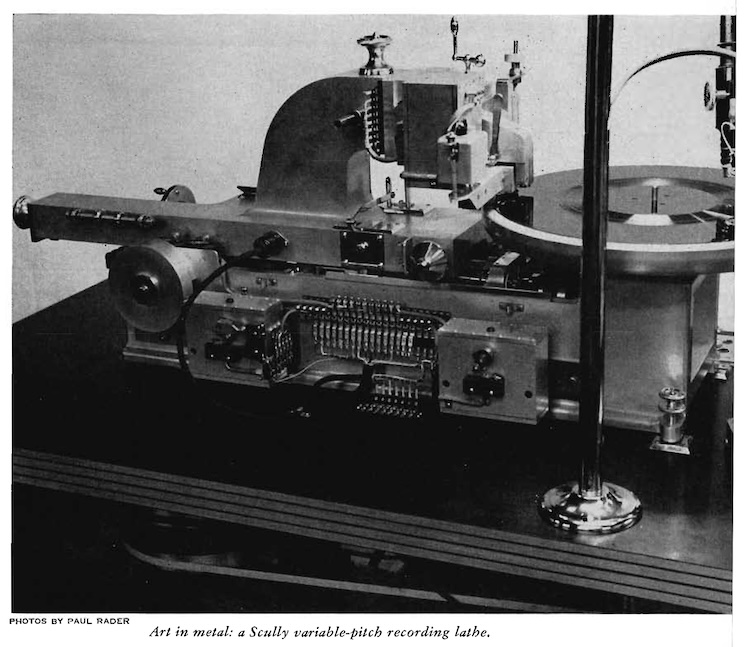
A photo of the automatic variable-pitch control section of the Scully 601, from a 1956 article describing the Scully lathe in detail
As in the principle of the Bachman patent, it consists of an amplifier, rectifier, variable resistor, feed motor, adjuster, and so on
In this way, variable pitch took shape as standard practice in mastering (cutting) from analog master tapes to lacquer discs.
2.2 The birth of purpose-built preview-head tape machines
At major labels that developed their own mastering technology in house, such as Columbia and RCA Victor, variable-pitch cutting was initially done with Scully cutting lathes combined with existing tape machines that in-house researchers and developers had modified themselves.
Later, the major tape machine manufacturers, including Ampex, Studer, MCI, and Telefunken, produced custom models with preview heads, and these were widely used for variable-pitch cutting in mastering studios around the world, together with cutting lathes that supported automatic variable pitch.
As for the modifications made to a standard tape machine, one was removing the record/erase heads and adding a preview reproducing head, but the most troublesome part was making the delay time between the preview head and the main reproducing head adjustable.
The delay time (the spacing between the preview head and the main reproducing head) differs depending on the automatic variable-pitch control system of the cutting lathe being used. It also differs depending on the tape speed (ips) and the rotational speed of the cutting lathe (rpm).
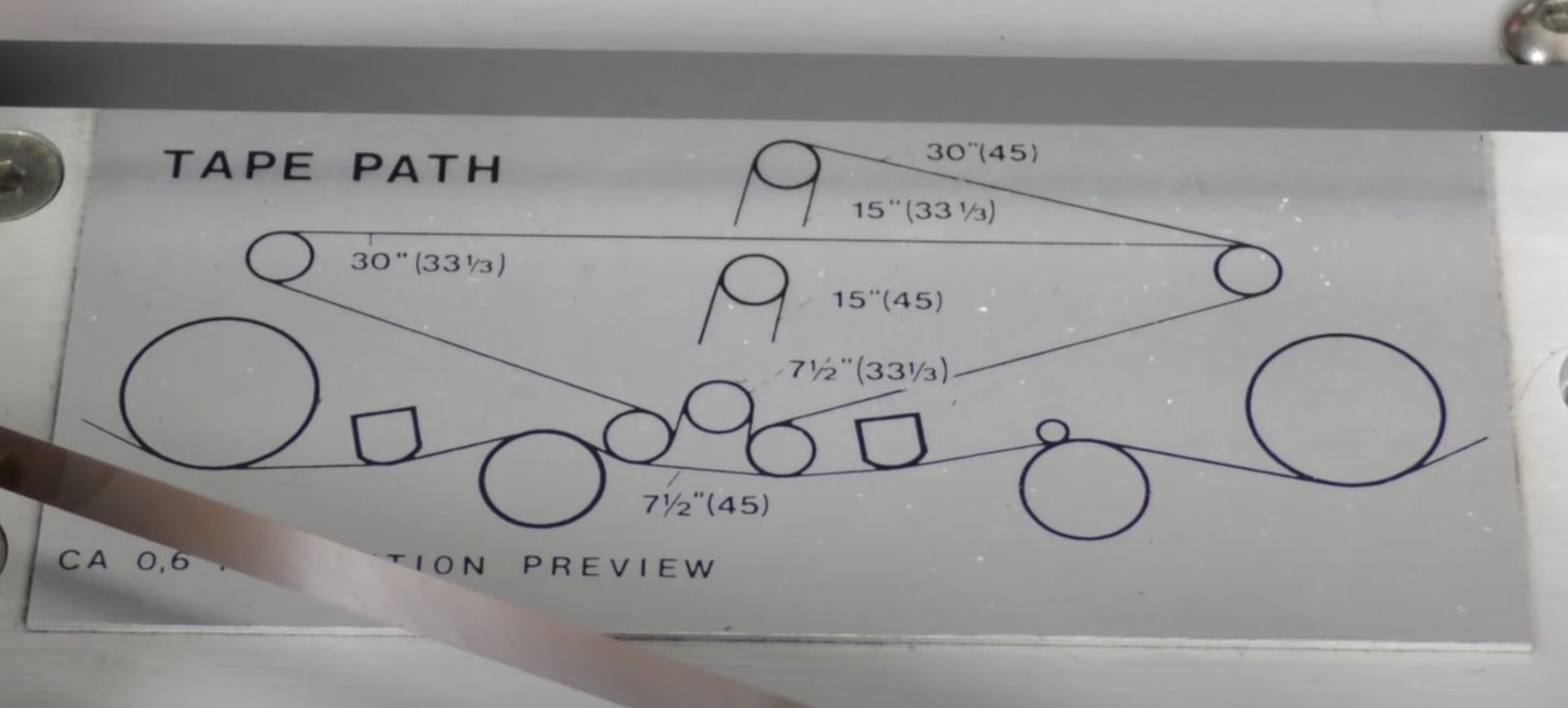
The plate on the deck of the special vinyl-cutting version of the Studer A80, showing the tape paths for adjusting the preview head delay time
Since the plate reads “CA 0.6 REVOLUTION PREVIEW”, this is the 0.6-revolution preview version (for the Neumann VMS66/70)
The tape path is changed according to tape speed (30/15/7½ips) and cutting lathe rotational speed (45/33⅓rpm) to adjust the delay time
On the other hand, there were engineers like C. Robert Fine and George Piros of Fine Sound Studios and later Fine Recordings, who kept to manual variable-pitch cutting (without automatic cutting via a preview head) until much later years.
It was true craftsmanship: while mixing down directly from the 3-track master tape to 2 channels, music director Wilma Cozart Fine followed the score and gave cues to the cutting engineer, who operated the variable pitch by hand. Initially they used a Fairchild 523 cutting lathe.
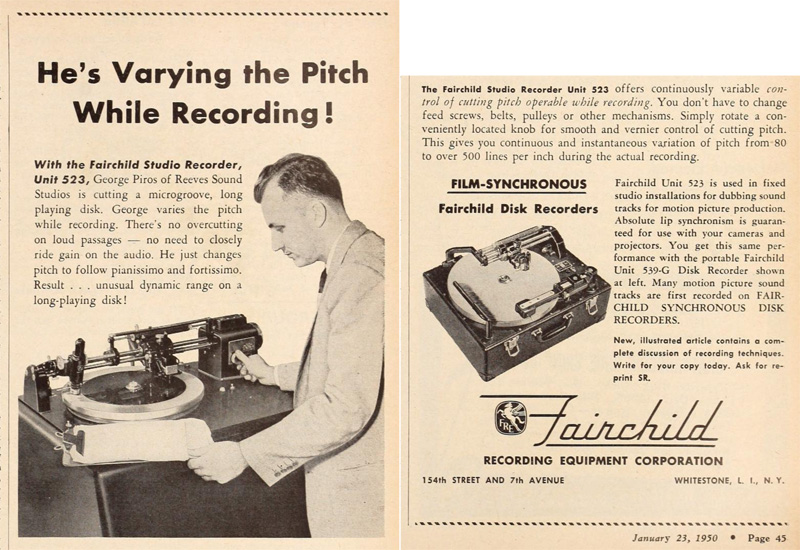
A 1950 Fairchild ad showing George Piros manually operating the variable pitch while cutting on a Fairchild 523
2.3 The arrival of the Ampex ADD-1 and ATR-100
The first change to arrive in this “all-analog” world of variable-pitch cutting was the appearance of a digital cutting delay unit called the Ampex ADD-1.
As far as I have searched through magazines and materials for studio engineers, the oldest article touching on the Ampex ADD-1 is in the “New Products” section of Recording Engineer / Producer, June 1979. So it is natural to assume it appeared around that time.
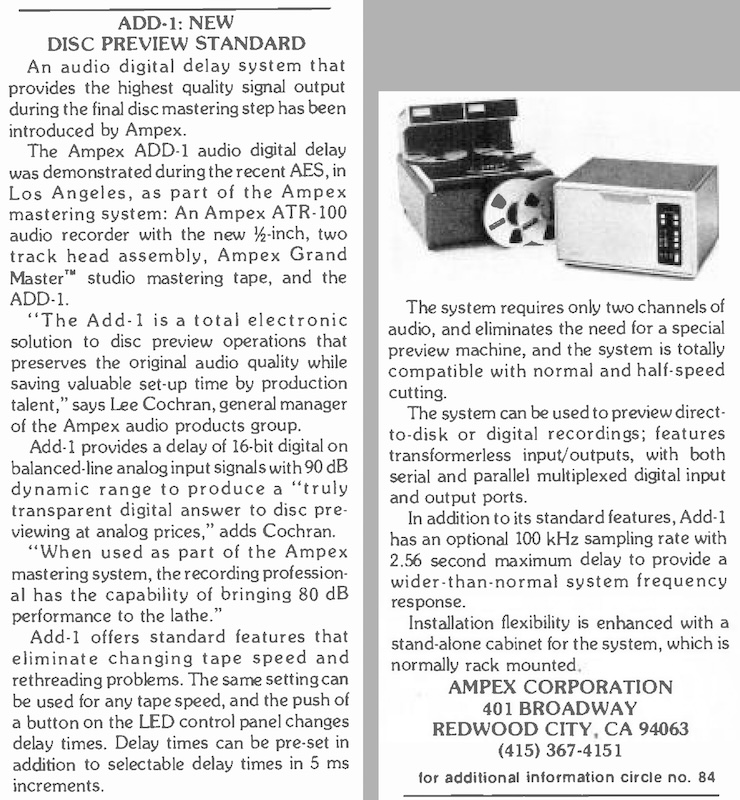
The Ampex ADD-1 as it appeared in the new-products section of a magazine for recording engineers and producers
It says the unit can be used “for direct disc cutting as well as digital recording” and that it also supports half-speed cutting
Before that, there had been the HAECO VP-1000 Advance Head-less Mastering System, presented in the lecture “Advanced Head-less Variable Pitch / Variable Depth Lathe Control System” given by Howard S. Holzer of HAECO at the 1974 AES convention, but it seems fair to say that the ADD-1 was the first to arrive with real impact as a product for the professional market.
The ADD-1 takes an analog input signal, performs A/D conversion, applies a fixed delay in a buffer in the digital domain, and then converts it back to an analog signal via D/A conversion. This was the arrival of the so-called digital delay line (DDL).
Traditionally, the analog signal read by the preview head was used for variable-pitch control, and the analog signal read by the main reproducing head was fed directly into the cutter head.
With this DDL, the analog signal read by the tape machine’s reproducing head is used for variable-pitch control, and at the same time that signal is also sent to the DDL, where it is A/D converted, delayed, and D/A converted before being fed into the cutter head.
In other words, the signal fed to the cutter head is no longer the analog signal from the master tape passed directly through the recording equalizer (RIAA). Instead, the signal from the master tape is A/D converted, delayed, then D/A converted, and only then fed through the recording equalizer (RIAA) to the cutter head.
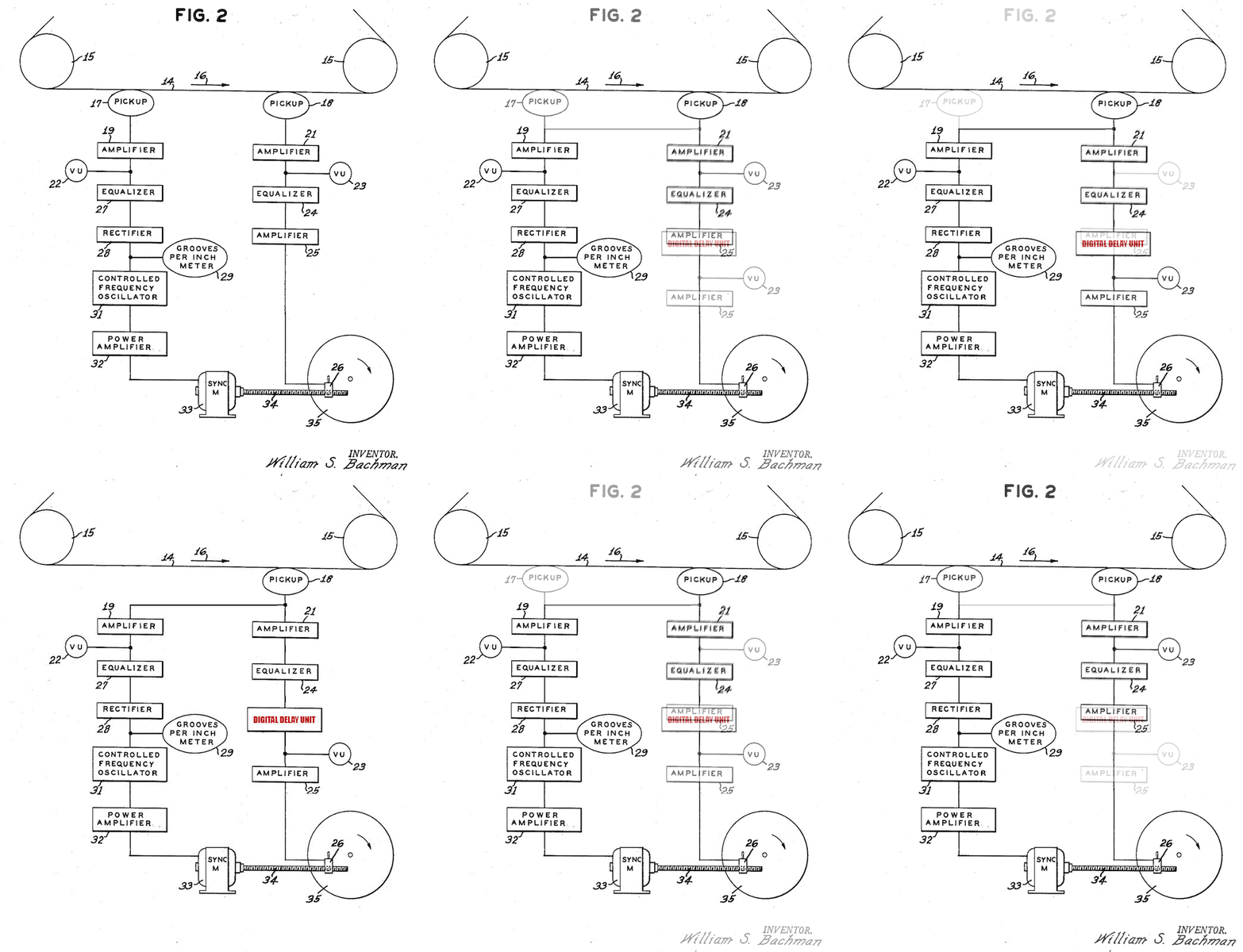
The preview head (17) is gone, the main reproducing head (18) is used for automatic variable-pitch control, and the same signal passes through the digital delay into the cutter head
Note that (19) and (21) are tape preamplifiers, (24) and (27) are NAB equalizers for tape, and (25) is the cutting power amplifier
Ampex also filed a patent on digital delay in 1980, “Digital Delay for High Quality Audio Use” (U.S. Patent 4,348,754A).

Furthermore, the ADD-1’s partner in the system branded the “Ampex Mastering System“, the ATR-100 series tape machine, apparently had no preview-head version available even as a custom order. In other words, as of 1979, Ampex had faded out the preview-head tape machine.
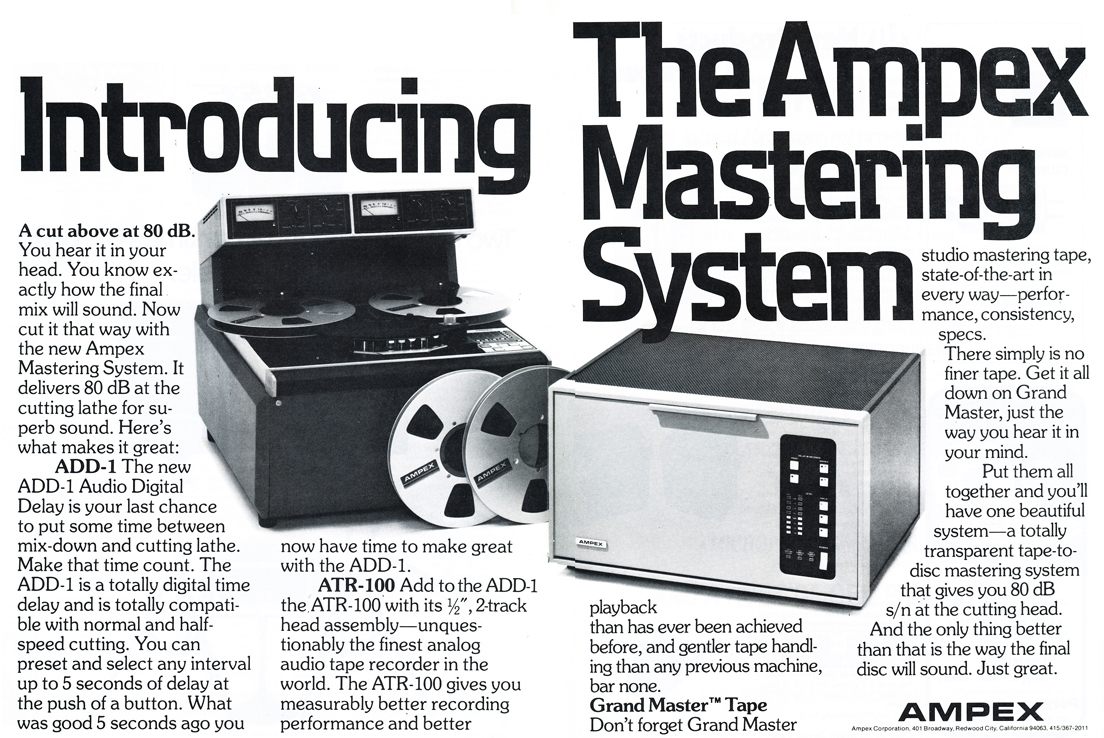
A 1979 ad for the Ampex ATR-100 series tape recorder and the ADD-1 digital delay
The ADD-1 is said to have had 16-bit resolution and a sampling rate of up to 50kHz (100kHz in a custom version) (source: what the noted audio critic Bert Whyte, who attended the AES Los Angeles convention held May 15-18, 1979, wrote about the ADD-1 demonstrated there in his “Behind the Scenes” column in the August 1979 issue of Audio magazine).
It was also, unthinkably from the vantage point of the 21st century’s digital heyday, very expensive: the minimum 1.3-second delay version cost $14,500, and versions allowing longer delays required purchasing additional modules. I wonder what a fully specced unit would have cost. 🙂
Masterfonics Sound Studio in Nashville is said to have been one of the earliest studios to install this Ampex ADD-1. This famous studio, said to have begun operating in 1973, reportedly mastered from an Ampex ATR-102 tape machine using a Neumann SAL-74, the Ampex ADD-1, and a Zumaudio cutting control computer.

That said, it is not as if many mastering studios all switched to DDL cutting at once in 1979. They were already doing automatic variable-pitch cutting from preview-head analog tape machines, and the engineers on the ground at the time presumably saw no sonic benefit, indeed (with the digital technology of the day) nothing but drawbacks.
Still, with a DDL, automatic variable-pitch cutting becomes possible with a standard tape machine, without having to prepare a purpose-built preview-head machine. Instead of pouring large sums into acquiring and maintaining purpose-built preview-head tape machines or modifying existing ones, all you need to buy is the DDL.
This, I believe, was one of the factors behind the gradual adoption of DDLs in later years, driven in part by cost-conscious decisions on the management side.
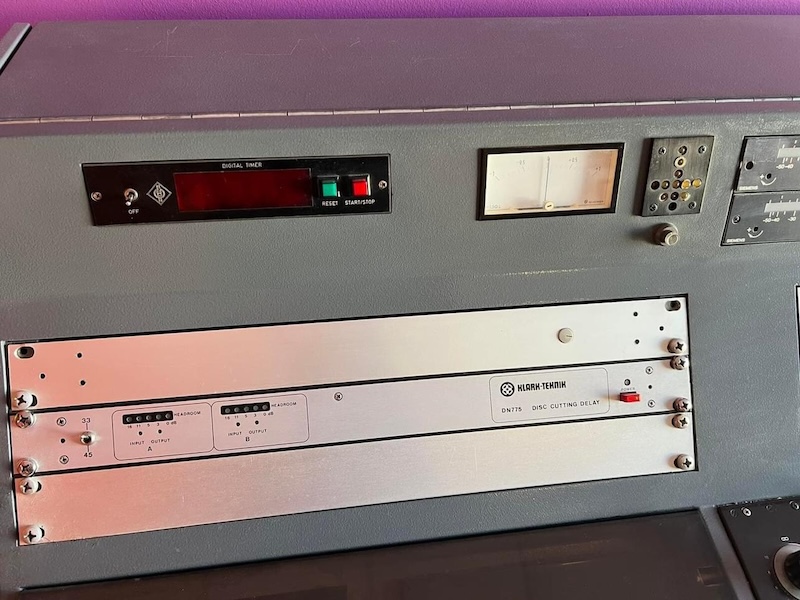
A Klark Teknik DN775 digital delay incorporated into a Neumann VMS70 + SX74 + SAL74B system
A valuable real-world example showing that even a VMS70 was sometimes combined with a DDL
The manual (with schematics) for the Klark Teknik DN775 digital delay shown in the photo above can be viewed here.
The DN775 appears to be a disc-mastering-only version of the DN773 broadcast digital delay; you can see a “33/45” toggle switch, absent on the DN773, added at the left end of the front panel. Also, on both the DN773 and DN775, fine adjustment of the delay time is apparently done by shorting jumpers inside the unit. The resolution is 16 bits and the sampling rate is 50kHz.
2.4 The arrival of the Neumann VMS80 cutting system
Also in 1979, Neumann, which by then had established de facto standard status in recording studios, announced the VMS80, a cutting lathe with what was then state-of-the-art computer control. Naturally, it supported automatic variable pitch.
However, this VMS80 (and its successor, the VMS82) differed from its elder siblings, the VMS66 and VMS70, in one respect concerning automatic variable pitch. The VMS66 and VMS70 required the preview head signal to be “0.6 revolutions ahead of the cutter head”, but the new VMS80 required a signal “0.5 revolutions ahead of the cutter head”.

As a result, studios considering a new VMS80 installation were forced to choose among several options.
- Modify the tape machine currently in use, whose preview head reads 0.6 revolutions ahead, so that it reads 0.5 revolutions ahead.
- Wait for the tape machine manufacturers to offer kits or services for converting to 0.5-revolution preview (manufacturers such as Studer and Telefunken reportedly did offer them).
- Newly install a preview-head tape machine with switchable preview distance, such as 0.5 / 0.6 / 1 revolution, like the MCI JH-110M.
For example, the famous mastering studio Sterling Sound reportedly commissioned Michael Spitz, who founded ATR Services after leaving Ampex, to custom-modify an ATR-104 tape machine, fitting it with a preview head matching the 0.5-revolution preview and thereby making it compatible with the VMS80 (photos of that custom preview-head ATR-104 can be seen here).
Decades after the introduction of the ATR-100, Michael Spitz converted an ATR-104 into a preview head tape machine for George Marino at Sterling Sound, then one of the major mastering facilities in New York City (now in Nashville, TN).
The conversion involved an extension to the machine’s top platform, where an additional reproducing head and a few rollers could be added.
The ATR-104 was used as a base, since 4 channels of audio are needed in a stereophonic preview head tape machine; two for the preview/control signals and two for the audio.
This machine is still in active service, nowadays used by Ryan Smith and Joe Nino-Hernes at Sterling Sound’s Nashville facility.
“The Giants of Tape, Part Two”, J.I. Agnew, PSAudio blog (May 7, 2020)To those options, presumably, one more was added: give up on the preview-head tape machine, install a DDL, and use a standard tape machine.
Finally, while noting that I reserve judgment on its credibility, I should mention that some people claim that “from the late 1970s through the 1990s, cutting with a DDL was very common”, as in the post below.

2.5 The rise of cutting from digital masters
Digital recording had already begun in Japan and the United States in the 1970s. In particular, around the time the direct-to-disc cutting boom of the late 1970s wound down, releases made with PCM digital recording increased, as if taking its place.
The history of digital recording for commercial release is described in detail in Tom Fine’s paper “The Dawn of Commercial Digital Recording“, published in the Spring 2008 issue of the ARSC Journal.
According to Tom’s paper, the first digitally recorded LP released anywhere in the world was Nippon Columbia NCC-8501-N, recorded April 24–26, 1972 and released in October 1972. The recording was made on a DENON DN-023R, with 13-bit resolution at a 47.25kHz sampling rate.
In the United States as well, Soundstream, founded in 1976 by Dr. Thomas Stockham, a professor at the University of Utah, developed a recorder with 16-bit resolution at a 37.5kHz sampling rate; experimental recordings were made in the summer of 1976, and a demonstration was given at the AES convention in the fall of 1976.
Then, using the Soundstream recorder improved to a 50kHz sampling rate, Telarc 5038, recorded April 4–5, 1978, became the first digitally recorded LP released in the United States.
By the time 1980 arrived, the major labels were all installing digital recording equipment, putting it to use mainly for classical music and jazz.
All of this happened before the CD debuted as a consumer digital medium in 1982.
When cutting such digital recordings to the LP, then the primary consumer playback medium, a digital delay is naturally effective for variable pitch cutting.
Unlike cutting from analog tape, a D/A conversion has to happen anyway to feed an analog signal to the cutter head, so using a DDL brings more advantages than drawbacks.
For that reason, I imagine that cutting systems incorporating a DDL gradually increased whenever failed cutting equipment was replaced or new equipment was brought in.
The article “Cutting At Master Room” in the May 1985 issue of Studio Sound, below, carries an interview with Arun Chakraverty of The Master Room in London, and states that in addition to a Dolby A-Type Model 360, a Studer DD16 was used as the digital delay.
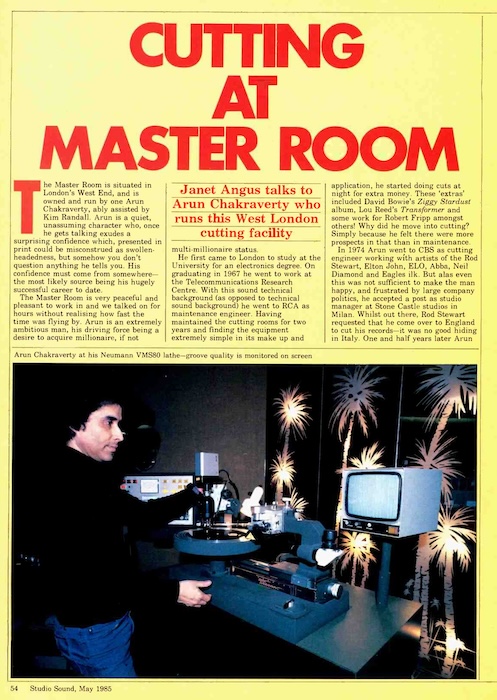
The same article goes on to say that the analog tape machine was a Studer A80, the digital tape machines were SONY PCM1610 / 5850 U-Matic, and cutting was done with a VMS80 + SX74 + PG74B; it also states that “the delay is especially important for digital sources with no preview head” and that “99% of the master is sent to the cutter“.
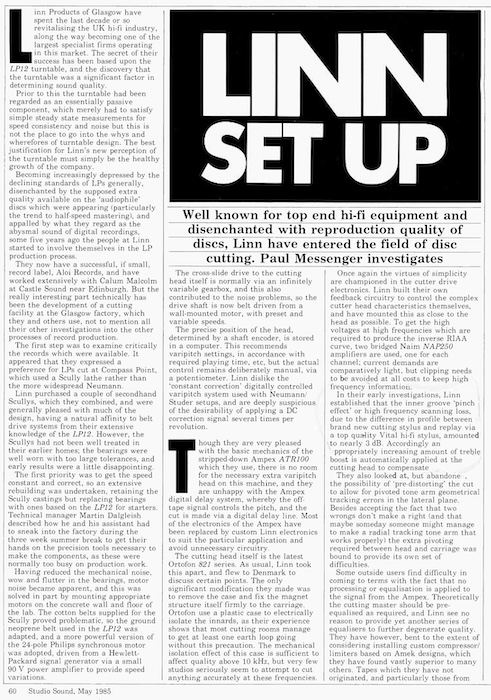
Another article in the same issue, “LINN SET UP”, touches on the famous LINN. The company, which had also started mastering for its own label in 1982 amid the LP’s decline, was dissatisfied with the sound of its Ampex ATR100 (no preview head, and no room to modify one in) and delay system, and used it modified with the company’s own custom circuitry.
2.6 The fade-out of the LP and the rise of the CD
Then, in 1982, the CD (Compact Disc) made its glamorous debut as the consumer medium to replace the LP.
CD sales caught up with LP sales in 1986 in Japan and in 1987 in the United States, and soon overtook them.
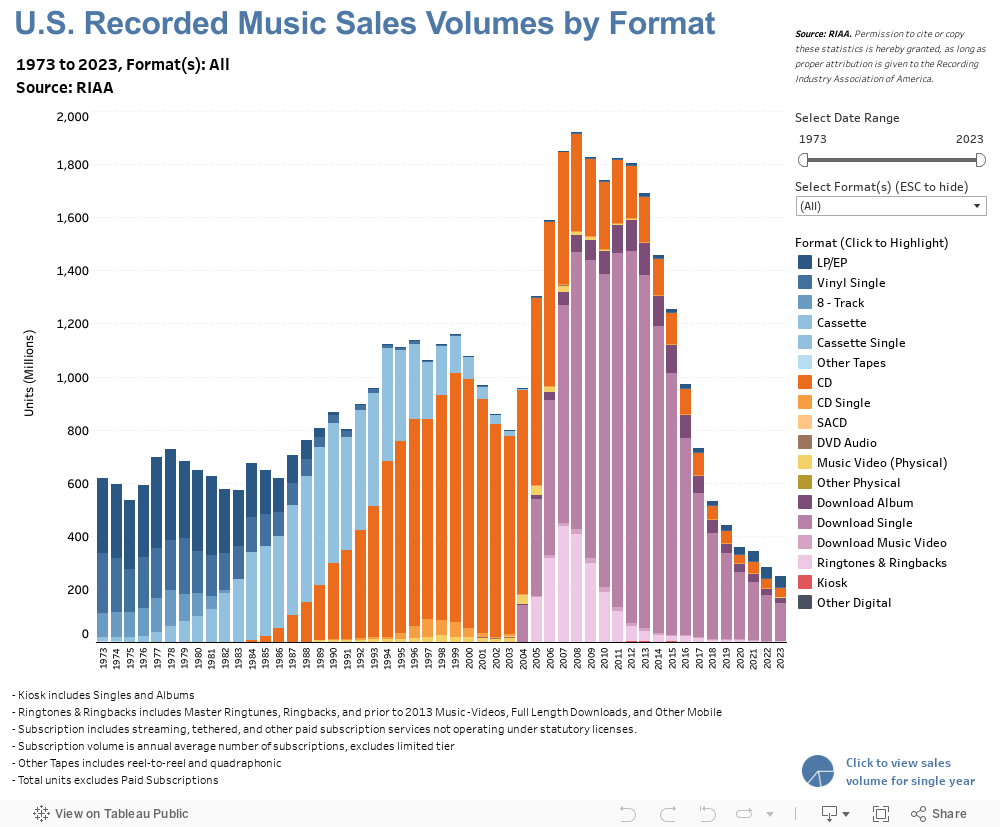
As an aside, what I find noteworthy in this chart is that in the United States, after the LP’s decline, the dominant medium became not the CD but the cassette tape. According to Tom, this was because cassette tape was still the mainstream of car audio in the automobile market of the time, and the CD probably only overtook the cassette in the mid-1990s, when CD players became standard equipment in car audio.
Now, although the CD was in the minority compared with the LP when it debuted in 1982, its mastering was apparently not something specially prepared for the CD (separate from the cutting master for the LP). That is, at first, mainly in popular music, the cutting master equalized for the LP was simply digitized as it was and put on the CD.
(Note: please keep in mind that I am not making any argument here about the rights and wrongs, or the relative merits, of using the LP cutting master directly as the CD master.)
This is discussed in the invaluable long interview that Tom conducted with the great Bob Ludwig for Stereophile (Pt. 1, Pt. 2). I quote it below at some length.
Ludwig led Masterdisk into the digital era, first cutting lacquers from digital sources (Soundstream, 3M Digital, Sony) then as an early US compact disc mastering facility (see Decades of Digital Devices).
In 1984, he mastered the first CD manufactured in the US: Bruce Springsteen’s Born In The USA (footnote 8). Ludwig told me that CDs had a slow but steady climb in the American market after their 1983 introduction. “When CDs were first coming out, I visited Tower Records down by Lincoln Center, and the CD section was just a yard or two wide.”
In those days, the tape used to make the CD master was often an “equalized” copy that had gone through the mastering console from the “flat” master tape and included all the EQ and dynamics changes that mastering engineer made to cut the LP lacquer.
Ludwig said clients often didn’t want to pay for a separate CD master, so there might be audible things like increased brightness in songs toward the inner diameter of an LP, bass centered to optimize LP loudness and trackability and the like. “I would master the best I could for vinyl, while keeping an open mind for the CD. Occasionally I’d do a separate master for the CD,” he said.
One such occasion was Dire Straits’s Brothers in Arms. “When I heard that record, I was just stunned by what (co-producer/mixing engineer) Neil Dorfsman had done,” Ludwig remembered. “Just beautiful. I said, ‘I’m mastering this one for CD’ (footnote 9). So there were two separate masters for that one.”
The choice to go the extra mile paid dividends. Brothers in Arms was the first CD to outsell the vinyl version. Ludwig calls it “a major breakthrough in the CD format as far as CD’s acceptance.”
Bob Ludwig—The Mastering Master Bids Farewell (Part 2) Page 2It is interesting that one of the earliest representative albums “in the United States” to receive “a dedicated CD mastering separate from the LP”, and moreover the landmark album whose CD outsold its LP, was that very “Brothers In Arms”. In any case, it seems that in this period, as the LP faded out, the main focus of mastering work shifted from the LP to the CD.
And the masters used to make LPs increasingly became digital recordings, so the occasions for cutting from the analog signal after D/A conversion through a DDL presumably kept growing.
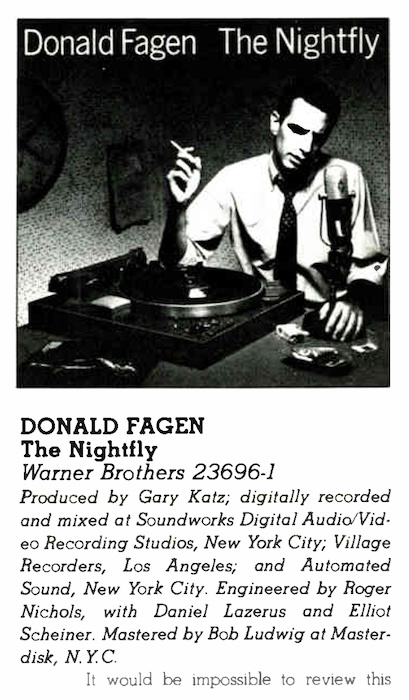
George Petersen’s review of Donald Fagen’s The Nightfly (LP), one of the earliest digital recordings and famous for its sound quality. Noting that it is a digital recording, he writes that “on the first listen he noticed no particular difference just because it was digital” and that “on the second listen he instead felt a transparency of sound and a confidence across the entire frequency range“.
Incidentally, this LP was also cut by Bob Ludwig at Masterdisk.
That said, the following article shows that the Masterdisk studio in question, at least as of 1987, had one preview-head Studer A80 in use, and so continued to maintain a setup that could cut from an analog tape master without going through a DDL.
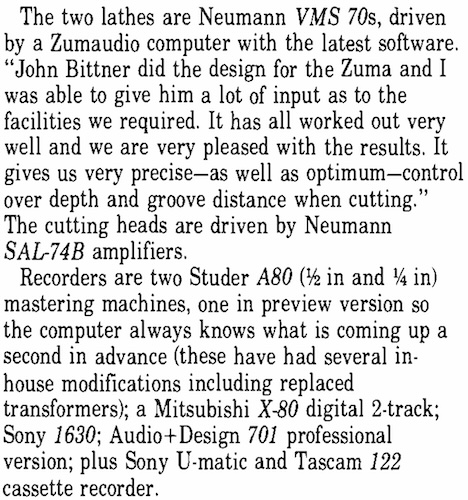
A visit to Masterdisk Studios, published in the September 1987 issue of this magazine for studio engineers.
It lists two VMS70 cutting lathes, automatic variable pitch control by Zumaudio, and SAL-74B cutting amplifiers.
At the same time, it lists two Studer A80 tape machines for analog sources, one of them fitted with a preview head.
For digital sources, a Mitsubishi X-80 / Sony PCM-1630 / Audio+Dexign 701 / SONY U-matic were on hand. Somewhat unexpectedly, a Tescam 122 cassette recorder is also listed.
Moving further ahead in time, even in the early 2000s, when the LP had become an endangered species (or was on the verge of extinction), there were a very few exceptional LPs recorded and cut all-analog.
One of those rare exceptions is D’Angelo‘s uncompromising, indisputable historic masterpiece “Voodoo” (2000), recorded and mixed in analog by Russell “The Dragon” Elevado at the famous Electric Lady Studios, and cut by “The Inhabitant” (Adrian Morgan).

At the same time, LP reissues of past masterpieces from the analog tape era had also begun in some quarters. The renowned Dutch cutting engineer Willem Makkee (1947-2017), known for his strong convictions about cutting, such as working all-analog and using no limiters, was also cutting the Speakers Corner reissues of the early 2000s all-analog, with a Neumann VMS80 + SX-74 and a preview-head tape machine, as he related in a 2004 interview with Michael Fremer.

Another aside. In the interview above, there is a passage about having Warner send the cutting master tapes for LP reissues, and about having them send analog tapes rather than digital ones. This is also a little long, but I quote it below.
In the middle of it, of all things, the celebrated Lou Reed & John Cale album “Songs For Drella” comes up.
MF (Michael Fremer): Now the Warners vinyl reissues are cut here, but I suppose it’s the same process and the same issues, to make sure you get good tapes…
WM (Willem Makkee): Yes! Here’s a copy of one…
MF: Oh! (Lou Reed and John Cale’s) Songs For Drella!
WM: This is all analog tape. We are not using the digital copy they sent us.
MF: And you can tell by listening that they’ve sent analog.
WM: Yes. It sounds huge. It sounds very good, this, actually. Of course not every tape (song) is on the same level.
MF: So on the fly you have to adjust levels as you’re cutting?
WM: Yes. And no limiters. I don’t like that. It ruins the dynamics. It’s loud, but it’s not music!
Who's Cutting Those Lacquers? Part 2, Michael Fremer, AnalogPlanet.com, Apr. 30, 2004The episode related above is very interesting, but wait: no LP of “Songs For Drella” was ever reissued by Speakers Corner, was it?
As far as I know, there are basically only two LP versions: first the original 1990 LP (Sire/Warner Bros. 9 26140-1), and then the 30th anniversary (Record Store Day) LP of 2020 (Sire/Warner Bros. R1 26140).
So I wonder whether there was a plan around 2004 for Songs For Drella, too, to be reissued by Speakers Corner (which in the end never came out).
Incidentally, among the LPs that Makkee cut and that Speakers Corner actually reissued is “Transformer” (RCA Victor / Speakers Corner LSP-4807), released October 18, 2004.
Apart from a very few exceptions like “Voodoo”, however, nearly all new recordings had come to be made digitally.
And since no company could justify spending large sums maintaining all-analog cutting equipment that no longer paid for itself, I believe the few remaining LP releases came to be cut, for the most part, through a DDL, either from digital masters or, in the case of analog masters, from an ordinary tape machine with no preview head.
3. The LP revival, the “all-analog” article of faith, and what I make of it
In the United States, LP sales hit bottom in 2006, and from there the LP gradually, at a truly modest pace at first, began its comeback.
Perhaps the driving force behind it was Record Store Day, which began in 2008.
At the same time, reissues of classic albums (all of which, naturally, have analog original master tapes) aimed at the so-called audiophile market moved forward. One pioneering example is the German label Speakers Corner, which has released LP reissues cut all-analog from the original master tapes ever since its first release in July 1993.
In the process, the spotlight fell more and more on the illustrious mastering engineers who had lived through the analog era, and I believe this is when the practice of cutting all-analog, using restored vintage preview-head tape machines rather than a DDL, made its full-scale return.
And today, many of the mastering studios that handle these audiophile LP reissues proudly advertise their all-analog mastering chains built around preview-head tape machines as a point of differentiation.
For example, the following 2012 video shows the renowned mastering engineer Sean Davies cutting Johanna Martzy’s 1954 original master with a preview-head tape deck (Lyrec TR8) and a Neumann VMS70 (the reissue that was actually released is here).
Now, in the era of the analog revival, legendary performances from 50 to 70 years ago are being reissued, mastered all-analog from the original master tapes on restored vintage equipment. And in the 21st century, thanks to improved technology and accumulated know-how, mastering of overwhelmingly higher quality is possible than in the 1950s through 1970s (setting aside the deterioration of the master tapes themselves).
Pressing quality and technique, mastering know-how, and further gains in technology and quality built on the long accumulated history of analog and digital technology: that is probably why there are quite a few reissue LPs, made to a high standard, that I feel deliver playback at a very high level, easily surpassing the vintage original pressings (again, setting aside the deterioration of the master tapes themselves).
Under these circumstances, it is only natural that the DDL came to be seen plainly as a drawback.
Since the start of the 2020s, moreover, newly recorded albums are increasingly released on LP in addition to streaming, digital download, CD, and cassette. I too buy new releases on LP, mainly through Bandcamp, when musicians I follow in my favorite genres put out something new, partly as a way of supporting them (and on Bandcamp, an LP purchase comes with a FLAC digital download as well, which makes it an even better deal). In the post embedded below, I wrote about one such purchase: Saana Sahel by Colloboh (Leaving Records, 2023), an album by a Nigerian-born, LA-based composer and producer working with modular synths, whose distinctive sound I described as new age, ambient, jazz, soul, and krautrock-like, with a faint bossa flavor.
今晩最後は Saana Sahel / Colloboh (Leaving Records no number, 2023)
— Kohji Matsubayashi (@kohji405mi16) December 11, 2023
ナイジェリア出身でLA在住の作曲家/プロデューサがモジュラーシンセなどで紡ぐ、ニューエイジかつアンビエントかつジャズかつソウルかつクラウトロックぽくどことなくボッサ風味もある独特の音触が心地よい良作。 pic.twitter.com/7VIlAeJxnP
Many of these new releases, or rather, nearly all of them, are no doubt cut using a DDL.
But I personally do not think for a moment that this diminishes the value of LP albums from the 1980s to the present (new releases and reissues alike) cut from digital sources through a DDL.
Of course, if there were two albums made identically from the very same analog master, one cut through a DDL and the other cut from a preview-head tape machine, and I were asked which I would choose, naturally I would want to pick the latter (laughs).
But I do not believe that an album’s value is lowered simply because it was cut with a DDL (leaving aside arguments from a purely audio point of view).
Here is a March 2022 YouTube video from the famous Abbey Road Studios, in which Miles Showell, well known for half-speed cutting, and Geoff Pesche explain disc cutting techniques and the equipment they use.
It is a cutting demonstration video, and I do not think the equipment shown is the only gear Abbey Road Studios has, but in this video the signal goes from an analog master through a DDL, that is, A/D conversion, then delay, then D/A conversion, before being fed to the cutter head.
The DDL setup used in this video consists of a Benchmark ADC1 USB (A/D conversion), some form of digital delay in between that is not shown (whether a dedicated unit or a computer system is unclear), and multiple Benchmark DAC1 units (D/A conversion) serving variable pitch control, cutter head drive, and monitoring, with the whole system clock-synchronized by an Abendrot Everest 701 True Audio Master Clock.
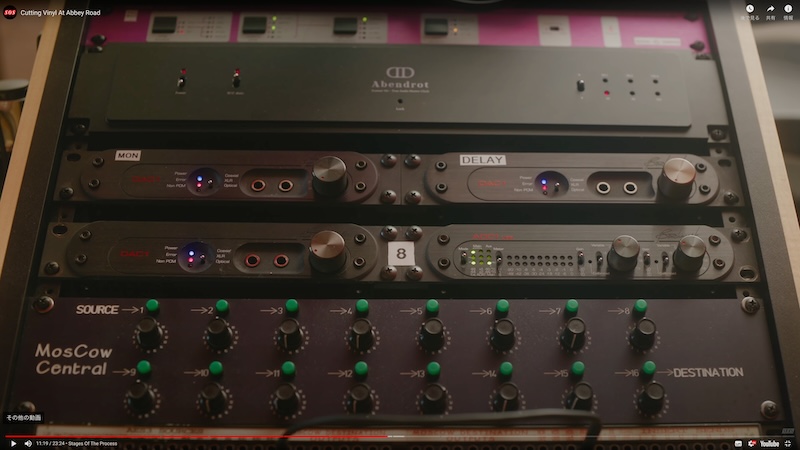
Judging from the LED positions on the ADC1 USB in the video, it appears to be running at 24bit/96kHz with an external clock (the Abendrot Everest 701) (ADC1 USB manual PDF).
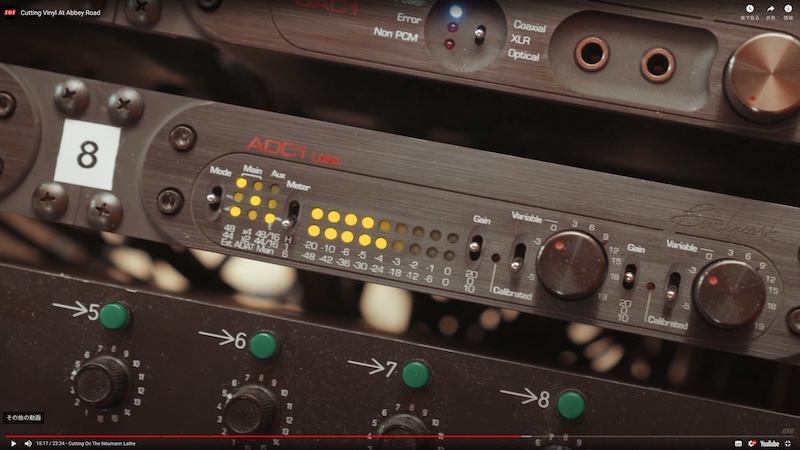
So even one of the masters of all-analog cutting does this kind of DDL cutting when the occasion calls for it. And the video is packed with genuinely fascinating information down to the smallest details; I thoroughly enjoyed it.
Let me note one more interesting piece of related information.
It is an ABX double-blind test, run on ten subjects, comparing analog playback of a tape with playback of the same tape passed through an Ampex 16-bit digital delay.
As expected, or contrary to expectations, that will differ from person to person, but in any case the reported result of this interesting experiment was that there was no significant difference between the two.

The test was conducted by David Carlstrom, who was one of the people at the ABX Company, which developed the ABX method.
Finally, as an analog lover who also loves digital, I find myself hoping that this does not turn into a simplistic, or extreme, faith in analog (and perhaps, in some quarters, a faith in vintage as well).
Though of course, needless to say, I am an analog lover myself (laughs).
It is entirely possible that we will someday hear “that hugely popular, celebrated album was actually cut using a DDL!” And that could, perhaps, move used-market and vintage-trading prices considerably.
I am not a used record dealer, so I have no plans to fret over such things, but if the all-analog vs. DDL debate were to drive up the market price of an album I genuinely love and want to own, I would surely find that a pity. Then again, market prices are set by supply and demand, so there is nothing to be done about it.
The most I can do is this: without being swayed by the opinions and reputations around me, guided by my own musical tastes and values, to research for myself, think for myself, and buy only those records that feel worth the money to me. That is all.
Just as I have always done.