2024/10/30

How Records Were/Are Manufactured (5)

第1回第2回第3回第4回 に続き、戦後のレコード製造工程や原材料の歴史、特に 射出成形スチレン盤 について改めて調べてみた、そんな記録です。

Following on from the first, second, third and fourth parts, this is a record of a renewed look into the history of postwar record manufacturing processes and raw materials, particularly injection molding and styrene records.

5回目となる今回は、1964年の Burt Bacharach = Hal David 両氏へのインタビュー記事に登場する射出成形スチレンシングル盤への不満という面白いエピソードのほか、英国の射出成形ヴァイナル盤研究開発を捉えた興味深い動画の紹介、同じく射出成形ヴァイナル盤製造を1970年代に行っていた日本コロムビアの学術論文、最後に21世紀になって登場した「エコフレンドリーな」射出成形PET盤について、それぞれみていきます。

This time, the fifth part, we’ll be looking at an amusing anecdote about dissatisfaction with injection-molded styrene singles, which appears in a 1964 interview with Burt Bacharach and Hal David; an intriguing video documenting the research and development of injection-molded vinyl records in the UK; an academic paper from Nippon Columbia, which also manufactured injection-molded vinyl records in the 1970s; and finally, the “eco-friendly” injection-molded PET records that have emerged in the 21st century.

レコード業界における射出成形による製造法の役割が、長期的なコスト削減および生産効率向上、という目的から、持続可能なレコード文化存続へ、とシフトするさまを現在進行形でみているんだなぁ、という思いを強くした学びでした。

This study reinforced my belief that we are currently witnessing an ongoing shift in the role of injection molding in the record industry, from long-term cost reduction and improved production efficiency to the preservation of a sustainable record culture.

Continue reading
2024/10/30

How Records Were/Are Manufactured (4)

第1回第2回第3回 に続き、戦後のレコード製造工程や原材料の歴史、特に 射出成形スチレン盤 について改めて調べてみた、そんな記録です。

Following on from the first, second and third parts, this is a record of a renewed look into the history of postwar record manufacturing processes and raw materials, particularly injection molding and styrene records.

4回目となる今回は、1954年当時の射出成形 vs 圧縮成形の様子を解説した記事をかわきりに、1950年代末には結局LP盤のほとんどが圧縮成形プレスで製造されていたこと、逆に射出成形スチレン盤は7インチシングル盤として米国で広く普及したこと、その他1960年代のさまざまなエピソードをみていきます。

This time, the fourth part, begins with an article from 1954 explaining the state of injection molding vs compression molding. We will then go on to look at how by the end of the 1950s, most LPs were produced using compression molding presses, how injection-molded styrene records became widely used in the United States as 7-inch singles, and other various episodes from the 1960s.

21世紀の現在、新しい文脈から射出成形12インチLP盤が再登場していますが、当時の技術レベル(や当時のレーベルの経営的思惑)からは、射出成形LP盤は主流になれなかったのだろう、そんな風に思わされました。

Now in the 21st century, injection-molded 12-inch LPs are making a comeback in a new context, but it seems to me that given the level of technology at the time (and the business intentions of the labels at the time), injection-molded LPs probably could never became mainstream.

Continue reading
2024/10/30

How Records Were/Are Manufactured (3)

第1回 および 第2回 に続き、戦後のレコード製造工程や原材料の歴史、特に 射出成形スチレン盤 について改めて調べてみた、そんな記録です。

Following on from the first and second parts, this is a record of a renewed look into the history of postwar record manufacturing processes and raw materials, particularly injection molding and styrene records.

3回目となる今回は、射出成形技術が初めてレコードに使用された1947年から、米巨大レーベルが射出成形に大きな投資を行うことを表明した1950年、さらに1951年〜1953年の朝鮮戦争によるレコード製造原材料不足の時期を、当時の記事などでたどっていくことにします。

This time, the third part, will look back through articles from that time, tracing the period from 1947, when injection molding technology was first used on records, to 1950, when major AMerican labels announced they would be making major investments in injection molding, and then the period from 1951 to 1953, when the Korean War caused a shortage of raw materials for record manufacturing.

当時はありふれた大量生産品であったレコードという製品を作るにあたり、レーベルやプレス工場といった企業にとって、技術面もさることながら、コストに対する意識生産可能速度や効率 が最も重要であった、という至極当たり前のことを、改めて強く認識することとなりました。

This exploration made me keenly aware of the very obvious fact that when it came to producing records, which were a commonplace mass-produced item at the time, companies like labels and pressing plants were most concerned with cost awareness and manufacturing speed and efficiency, in addition to technical aspects.

Continue reading
2024/10/30

How Records Were/Are Manufactured (2)

前編 に続き、戦後のレコード製造工程や原材料の歴史、特に 射出成形スチレン盤 について改めて調べてみた、そんな記録です。

Following on from the first part, this article is a record of a renewed look into the history of postwar record manufacturing processes and raw materials, particularly injection molding and styrene records.

「射出成形盤はいつ頃から製造されたか」、「米国における圧縮成形 vs 射出成形のバトルはどのようなものだったか」、「圧縮成形のスチレン盤は存在したか」、そして「Mercury の例の廉価盤はなにか」などをみていくわけですが、2回目となる今回は、RCA Victor が1957年と1976年に社内技術紀要に掲載した2つの解説論文をたよりに、レコード製造技術の概要を改めてみていきます。

We’ll be looking at questions such as “WHen did injection-molded records start to be produced?”, “What was the battle like between compression molding and injection molding in the US?”, “Did compression-molded styrene records exist?”, and “What was that budget Mercury records?”. In this second article, we’ll take another look at the outline of manufacturing technology, relying on two explanatory articles published by RCA VIctor in their internal technical bulletins in 1957 and 1976.

RCA Victor は、米国レコード業界を牽引する立場でもあり、長年に渡りレコード製造技術の自社開発を積極的に行っていましたし、またそれらの成果を学術論文や社内技術紀要などに比較的積極的に公開していたため、このような資料が残っていることには感謝しかありません。

RCA Victor had been a leader in the US record industry, and for many years it actively developed its own record manufacturing technology. It also actively published the results of these efforts and researches in academic papers and internal technical journals, so we are very grateful that such materials have survived.

Continue reading
2024/10/11

How Records Were/Are Manufactured (1)

今回は、SNS 上でみかけたあるレコードの特徴をきっかけにして、戦後のレコード製造工程や原材料の歴史を改めて調べてみた、そんな記録の前編です。

This first installment is my attempt to revisit the post-war history of record-manufacturing processes and materials—sparked by an intriguing feature I noticed on a post on social media.

Preface / はじめに

レコードは何から作られているか。レコードのプレスはどのように行われているか。なんとなくでもご存じの方は多いでしょう。

What are records made of, and how exactly are they pressed? Many readers probably already have at least a rough idea.

レコードの主たる原材料として使われてきたものには、シェラック、ベークライト、ポリ塩化ビニル、ポリスチレン、PET などがあります。当然、圧倒的に主流なのはポリ塩化ビニルです。

The principal raw materials that have been used for records include shellac, Bakelite, polyvinyl chloride (PVC), polystyrene and PET. Unsurprisingly, PVC has long been the overwhelmingly dominant choice.

また、レコードの製造(プレス)方法としては、圧縮成形が主流で、射出成形のものもあります。

As for manufacturing methods, compression molding is the mainstream process, although injection-molded records do exist.

Continue reading
2024/09/03

HumminGuru NOVA アドバンス超音波レコードクリーナ

Kickstarter 経由で2021年10月に入手した、お手頃価格の超音波レコードクリーナ HumminGuru、毎日のように愛用してきました。

HumminGuru Ultrasonic Record Cleaner, which I obtained via Kickstarter in Oct. 2021, is a great product at relatively affordable price, and I have been cleaning records almost every day.

Cleaning “Lean In / Gretchen Parlato & Lionel Loueke” with HumminGuru

Cleaning “Lean In / Gretchen Parlato & Lionel Loueke” (Edition Records EDNLP1216, 2023) with HumminGuru

Continue reading
2024/08/08

Things I learned on Phono EQ curves, Pt. 24

EQカーブの歴史、ディスク録音の歴史を(私が独りで勝手に)学ぶ本シリーズ。前回 Pt.23 では、1970年代民生用アンプに内蔵されたフォノイコの RIAA 偏差 に関する興味深い記事、および、米国で伝統的に使われていた LCR 録音イコライザの話などを紹介しました。

In the previous Part 23, I learned an interesting article on RIAA deviation of 1970’s consumer amplifiers, as well as LCR recording/reproducing equalziers that had been the legacy especially in the United States.

今回の Pt.24 では、音声信号が最終的にレコードの溝として記録されるまでに通過するシグナルチェーン、そこで使われる機器の歴史的変遷などについて、改めて復習していきます。

This time on Pt.24, I am going to revisit and learn the signal chain from the audio source to the groove cut into lacquer discs, as well as the history and evolution of these.

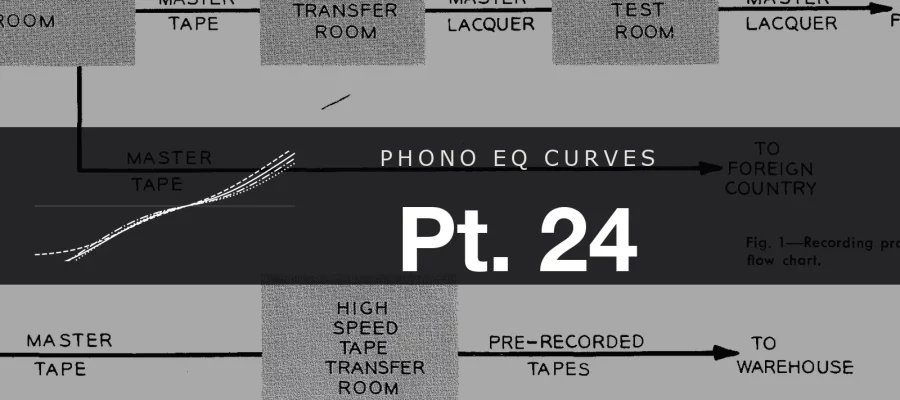
Recording process flow chart

source: RCA Engineer, Vol. 3, No. 2, Oct.-Nov. 1957, pp.8-9
1957年のRCA社内エンジニア向け紀要に掲載された、録音プロセスのフローチャート
“Recording process flow chart” from 1957 technocal bulletin for RCA’s engineers.

Continue reading
2024/07/12

“Gruve-Gard” and “Rim-Drive” (T-Rim)

7インチ、10インチ、12インチ。33⅓rpm、45rpm、(ごく一部78rpmも)。我々が手にするレコードのほとんどは、いわゆる「マイクログルーヴレコード」(または「ファイングルーヴレコード」)と呼ばれるものです。

このレコードには、当然ながら、さまざまな規格が関わっています。録音再生特性 にまつわるあれこれもそうですが、レコードの直径、センターホールの大きさ、レコードの反りの許容範囲、音源がカッティングされる最内周の最小半径、溝の形状、レーベルの大きさ、その他あらゆる側面が標準化されています。

1940年代末にマイクログルーヴレコードが登場してからしばらくはレーベルや工場ごとにバラバラだったこれらの特性ですが、それぞれの国で徐々に標準規格化が進み、そして最終的には国際的に統一されていきました。

45/45 ステレオレコードが登場して数年経った頃、1960年代初頭には、ほぼ全ての国で実質的に同等の規格が採用されることとなりました。

例えば 音溝の断面形状・寸法 などは RIAA Dimensional Standards (Bulletin E4) という標準規格で定義されており、民生用レコードにおいては、溝の夾角が90°±5°、溝底半径が最大 0.00025インチ(0.006mm)、溝幅が最低 0.001インチ(0.025mm)、とされています。

一方、レコード自体の形状については、1948年に Columbia が LP をデビューさせてしばらくの間は、従来の78回転盤と同様に、完全にフラットな面を持つマイクログルーヴレコードが大半でした。

しかし、多くの方がご存知の通り、現在製造され流通している盤のほとんどは、断面が完全にフラットではありません。音楽が記録されたエリアに比べて、レコード最外周の「リードイングルーヴ」部分とレーベル部分が厚くなっています。通称「グルーヴガード」と呼ばれるものです。

また、1949年に RCA Victor が発表した、通称「ドーナツ盤」と呼ばれる7インチ45回転盤は、レーベル部分のみが厚くなっています。これは、元々オートチェンジャーでのスタックを念頭に設計されていたためです。

この レコードの断面形状 についても、RIAA Dimensional Characteristics によって規格化されています。

今回は、この「グルーヴガード」について、歴史的経緯を追ってみることにします。

Continue reading
2024/06/05

Things I learned on Phono EQ curves, Pt. 23

EQカーブの歴史、ディスク録音の歴史を(私が独りで勝手に)学ぶ本シリーズ。前回 Pt.22 では、1950年代以降の 民生用アンプに内蔵されたフォノイコの変遷 について学びました。

On the previous Part 22, I learned the historys — especially the transition of the built-in phono equalizers — in the late-1950s to mid-1960s.

今回の Pt.23 では、1970年代民生用アンプに内蔵されたフォノイコの RIAA 偏差 に関する興味深い記事、および、米国で伝統的に使われていた LCR 録音イコライザ の話などをみていきます。

This time on Pt.23, I am going to learn the interesting article on RIAA deviations of 1970s’ consumer amplifiers, as well as LCR recording equalizers that had been the legacy especially in the United States.

SONY TA-2000F: RIAA Deviation and Pulse Response

source: 季刊ステレオサウンド No.21 ’72 (Vo. 7, No. 2) 特別増刊 プリアンプ・パワーアンプのすべて (1972)

SONY TA-2000F プリアンプ内蔵フォノイコの RIAA 偏差とパルス応答特性
RIAA deviation and pulse response of SONY TA-2000F’s phono preamp

Continue reading
2024/06/03

Things I learned on Phono EQ curves, Pt. 22

EQカーブの歴史、ディスク録音の歴史を(私が独りで勝手に)学ぶ本シリーズ。前回 Pt.21 では、マイクログルーヴLP登場前から存在している周波数テストレコードの歴史を、録音カーブの視点から学びました。

On the previous Part 21, I learned the history and diversity of “Frequency Test Records”, which had been available since 1930s — i.e. before the microgroove record era.

今回の Pt.22 では、1950年代以降の 民生用アンプに内蔵されたフォノイコの変遷 について学んでいきます。

This time on Pt.22, I am going to learn and study the history of consumer amplifiers — especially the transition of the built-in phono equalizers — in the late-1950s to mid-1960s.

Bell 3030 Schematics (Phono EQ)

source: Scribd.
Bell 3030 アンプの PHONO プリアンプ部回路図抜粋
左チャンネルは Eur / RIAA / LP それぞれに専用フォノEQ回路があるのに、右チャンネルは3ポジションともに同一 (RIAA) 回路となっている
From Bell 3030 Amplifier’s schematic: right channel shares the RIAA de-emphasis circuit among the Eur / RIAA / LP position.

Continue reading