2024/10/30

How Records Were/Are Manufactured (3)

第1回 および 第2回 に続き、戦後のレコード製造工程や原材料の歴史、特に 射出成形スチレン盤 について改めて調べてみた、そんな記録です。

Following on from the first and second parts, this is a record of a renewed look into the history of postwar record manufacturing processes and raw materials, particularly injection molding and styrene records.

3回目となる今回は、射出成形技術が初めてレコードに使用された1947年から、米巨大レーベルが射出成形に大きな投資を行うことを表明した1950年、さらに1951年〜1953年の朝鮮戦争によるレコード製造原材料不足の時期を、当時の記事などでたどっていくことにします。

This time, the third part, will look back through articles from that time, tracing the period from 1947, when injection molding technology was first used on records, to 1950, when major AMerican labels announced they would be making major investments in injection molding, and then the period from 1951 to 1953, when the Korean War caused a shortage of raw materials for record manufacturing.

当時はありふれた大量生産品であったレコードという製品を作るにあたり、レーベルやプレス工場といった企業にとって、技術面もさることながら、コストに対する意識生産可能速度や効率 が最も重要であった、という至極当たり前のことを、改めて強く認識することとなりました。

This exploration made me keenly aware of the very obvious fact that when it came to producing records, which were a commonplace mass-produced item at the time, companies like labels and pressing plants were most concerned with cost awareness and manufacturing speed and efficiency, in addition to technical aspects.

Continue reading
2024/10/30

How Records Were/Are Manufactured (2)

前編 に続き、戦後のレコード製造工程や原材料の歴史、特に 射出成形スチレン盤 について改めて調べてみた、そんな記録です。

Following on from the first part, this article is a record of a renewed look into the history of postwar record manufacturing processes and raw materials, particularly injection molding and styrene records.

「射出成形盤はいつ頃から製造されたか」、「米国における圧縮成形 vs 射出成形のバトルはどのようなものだったか」、「圧縮成形のスチレン盤は存在したか」、そして「Mercury の例の廉価盤はなにか」などをみていくわけですが、2回目となる今回は、RCA Victor が1957年と1976年に社内技術紀要に掲載した2つの解説論文をたよりに、レコード製造技術の概要を改めてみていきます。

We’ll be looking at questions such as “WHen did injection-molded records start to be produced?”, “What was the battle like between compression molding and injection molding in the US?”, “Did compression-molded styrene records exist?”, and “What was that budget Mercury records?”. In this second article, we’ll take another look at the outline of manufacturing technology, relying on two explanatory articles published by RCA VIctor in their internal technical bulletins in 1957 and 1976.

RCA Victor は、米国レコード業界を牽引する立場でもあり、長年に渡りレコード製造技術の自社開発を積極的に行っていましたし、またそれらの成果を学術論文や社内技術紀要などに比較的積極的に公開していたため、このような資料が残っていることには感謝しかありません。

RCA Victor had been a leader in the US record industry, and for many years it actively developed its own record manufacturing technology. It also actively published the results of these efforts and researches in academic papers and internal technical journals, so we are very grateful that such materials have survived.

Continue reading
2024/10/11

How Records Were/Are Manufactured (1)

今回は、SNS 上でみかけたあるレコードの特徴をきっかけにして、戦後のレコード製造工程や原材料の歴史を改めて調べてみた、そんな記録の前編です。

This first installment is my attempt to revisit the post-war history of record-manufacturing processes and materials—sparked by an intriguing feature I noticed on a post on social media.

Preface / はじめに

レコードは何から作られているか。レコードのプレスはどのように行われているか。なんとなくでもご存じの方は多いでしょう。

What are records made of, and how exactly are they pressed? Many readers probably already have at least a rough idea.

レコードの主たる原材料として使われてきたものには、シェラック、ベークライト、ポリ塩化ビニル、ポリスチレン、PET などがあります。当然、圧倒的に主流なのはポリ塩化ビニルです。

The principal raw materials that have been used for records include shellac, Bakelite, polyvinyl chloride (PVC), polystyrene and PET. Unsurprisingly, PVC has long been the overwhelmingly dominant choice.

また、レコードの製造(プレス)方法としては、圧縮成形が主流で、射出成形のものもあります。

As for manufacturing methods, compression molding is the mainstream process, although injection-molded records do exist.

Continue reading
2024/09/03

HumminGuru NOVA アドバンス超音波レコードクリーナ

Kickstarter 経由で2021年10月に入手した、お手頃価格の超音波レコードクリーナ HumminGuru、毎日のように愛用してきました。

HumminGuru Ultrasonic Record Cleaner, which I obtained via Kickstarter in Oct. 2021, is a great product at relatively affordable price, and I have been cleaning records almost every day.

Cleaning “Lean In / Gretchen Parlato & Lionel Loueke” with HumminGuru

Cleaning “Lean In / Gretchen Parlato & Lionel Loueke” (Edition Records EDNLP1216, 2023) with HumminGuru

Continue reading
2024/08/08

Things I learned on Phono EQ curves, Pt. 24

EQカーブの歴史、ディスク録音の歴史を(私が独りで勝手に)学ぶ本シリーズ。前回 Pt.23 では、1970年代民生用アンプに内蔵されたフォノイコの RIAA 偏差 に関する興味深い記事、および、米国で伝統的に使われていた LCR 録音イコライザの話などを紹介しました。

In the previous Part 23, I learned an interesting article on RIAA deviation of 1970’s consumer amplifiers, as well as LCR recording/reproducing equalziers that had been the legacy especially in the United States.

今回の Pt.24 では、音声信号が最終的にレコードの溝として記録されるまでに通過するシグナルチェーン、そこで使われる機器の歴史的変遷などについて、改めて復習していきます。

This time on Pt.24, I am going to revisit and learn the signal chain from the audio source to the groove cut into lacquer discs, as well as the history and evolution of these.

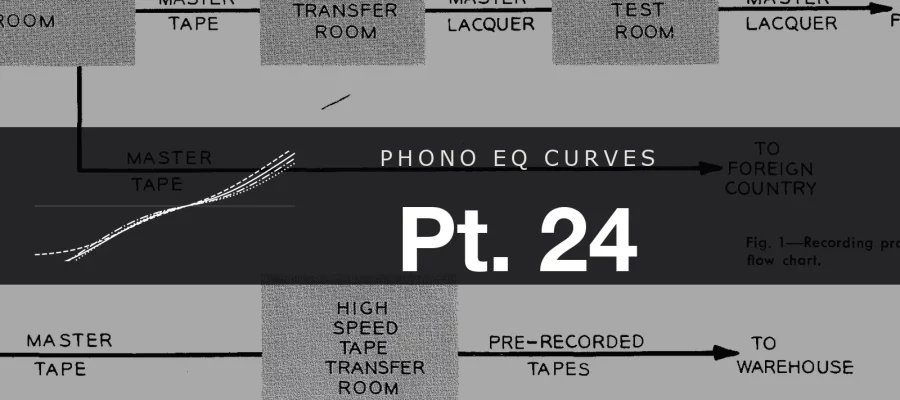
Recording process flow chart

source: RCA Engineer, Vol. 3, No. 2, Oct.-Nov. 1957, pp.8-9
1957年のRCA社内エンジニア向け紀要に掲載された、録音プロセスのフローチャート
“Recording process flow chart” from 1957 technocal bulletin for RCA’s engineers.

Continue reading
2024/06/05

Things I learned on Phono EQ curves, Pt. 23

EQカーブの歴史、ディスク録音の歴史を(私が独りで勝手に)学ぶ本シリーズ。前回 Pt.22 では、1950年代以降の 民生用アンプに内蔵されたフォノイコの変遷 について学びました。

On the previous Part 22, I learned the historys — especially the transition of the built-in phono equalizers — in the late-1950s to mid-1960s.

今回の Pt.23 では、1970年代民生用アンプに内蔵されたフォノイコの RIAA 偏差 に関する興味深い記事、および、米国で伝統的に使われていた LCR 録音イコライザ の話などをみていきます。

This time on Pt.23, I am going to learn the interesting article on RIAA deviations of 1970s’ consumer amplifiers, as well as LCR recording equalizers that had been the legacy especially in the United States.

SONY TA-2000F: RIAA Deviation and Pulse Response

source: 季刊ステレオサウンド No.21 ’72 (Vo. 7, No. 2) 特別増刊 プリアンプ・パワーアンプのすべて (1972)

SONY TA-2000F プリアンプ内蔵フォノイコの RIAA 偏差とパルス応答特性
RIAA deviation and pulse response of SONY TA-2000F’s phono preamp

Continue reading
2024/06/03

Things I learned on Phono EQ curves, Pt. 22

EQカーブの歴史、ディスク録音の歴史を(私が独りで勝手に)学ぶ本シリーズ。前回 Pt.21 では、マイクログルーヴLP登場前から存在している周波数テストレコードの歴史を、録音カーブの視点から学びました。

On the previous Part 21, I learned the history and diversity of “Frequency Test Records”, which had been available since 1930s — i.e. before the microgroove record era.

今回の Pt.22 では、1950年代以降の 民生用アンプに内蔵されたフォノイコの変遷 について学んでいきます。

This time on Pt.22, I am going to learn and study the history of consumer amplifiers — especially the transition of the built-in phono equalizers — in the late-1950s to mid-1960s.

Bell 3030 Schematics (Phono EQ)

source: Scribd.
Bell 3030 アンプの PHONO プリアンプ部回路図抜粋
左チャンネルは Eur / RIAA / LP それぞれに専用フォノEQ回路があるのに、右チャンネルは3ポジションともに同一 (RIAA) 回路となっている
From Bell 3030 Amplifier’s schematic: right channel shares the RIAA de-emphasis circuit among the Eur / RIAA / LP position.

Continue reading
2024/04/18

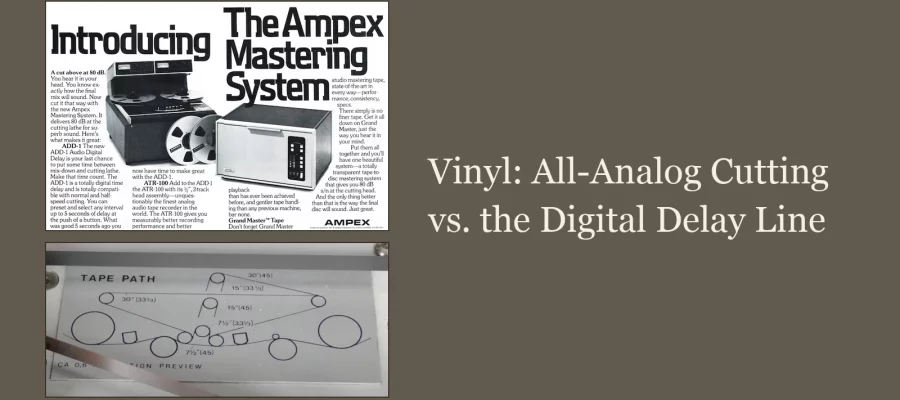
LPのオールアナログカッティングとディジタルディレイ

先日、X (was: Twitter) 上で、以下の投稿が話題になっていました。

今回は、この投稿をきっかけとして、具体的な時期や歴史的経緯、実際に使われた機材などを改めて調べ直し、ざっくり簡単にではありますがまとめてみました。

Continue reading
2024/04/06

Things I learned on Phono EQ curves, Pt. 21

EQカーブの歴史、ディスク録音の歴史を(私が独りで勝手に)学ぶ本シリーズ。前回 Pt.20 では、1954年〜における米国の各レーベルの RIAA 対応状況について各種資料から追いました。また、過去〜現在における EQ カーブ調査の系譜についてまとめました。

On the previous part 20, I looked for trace of how the U.S. labels migrated to RIAA, after the standardization of RIAA Recording and Reproducing Standards in early 1954, by researching various documents and magazines. Also I examined the genealogy of the studies and researches on EQ curves, from past to the present.

多忙等のため少し間があいてしまいましたが、今回の Pt.21 です。もともとは、今回を最終回として、今まで触れられなかった小トピックのほか、ここまでの学びの総括を行い、全体をどのように捉えるのがもっとも論理的整合性が高いと考えられるか、を考察するつもりでした。

After a long absence, here’s the Pt. 21. Initially I was thinking to make this part the summary and conclusion part of the entire series, including some other minor topics, as well as my final consideration of the history of the EQ curves, based on the whole study I have conducted, to find the most logical and consistent.

しかし、その「小トピック」のひとつを書き始めてみると、予想以上に分量が増えてしまったため(笑)、今回は、録音カーブの視点から眺めた「テストレコード」についてのみ扱うことにします。

However, once I started writing one of the “minor topics”, it became longer and longer… so this time I’m going to deal only with a variety of “Test Records”, from the viewpoint of disc recording curves.

ですので、当連載はもう少しだけ続く予定です(笑)

So this series of articles will be continued for a little while longer 🙂

Freq. Response Graph FPR0468H3 of DENON 103-R No. 9076 plotted using JVC TRS-1005

Frequency response graph sheet (Nippon Columbia FPR0468H3) that came with DENON 103-R Serial No. 9076, plotted using JVC TRS-1005 test record.
私が所有する DENON 103-R カートリッジ(シリアル番号9076)に付属してきた、JVC TRS-1005 テストレコードを使った特性グラフシート(日本コロムビア FPR0468H3)

Continue reading
2024/03/30

78rpm pulley for Michell DC GyroDec / Orbe

Introduction

我が家で Michell Orbe SE が稼働し始めて、はや9ヶ月が経過しました。そのパフォーマンスには非常に満足しています。

It’s been already nine months since the installation of Michell Orbe SE at home. I have been totally satisfied with the performance.

一方、20年以上お世話になった弟分である Michell GyroDec を引退させられないのは、Orbe で 78回転盤がかけられないためです。

On the other hand, I cannot retire Orbe’s little brother Michell GyroDec, which has served me well for over 20 years, because Orbe cannot play 78rpm.

GyroDec / GE VRII playing EmArcy 78 rpm

そこで、33⅓ / 45 / 78 回転の3スピード対応のプーリの制作を英国の工房にお願いしてみました。

So I asked a workshop in England to make a custom pulley that can do three speeds: 33⅓, 45 and 78 rpm.

Continue reading